
Selling a Home in Probate: 2026 Executor’s Guide
You may be holding a set of keys, a death certificate, and a pile of mail that keeps getting thicker by the day. The house is empty, but the bills aren't. Utilities still need to be paid. Insurance needs attention. A mortgage may still be due. Family members may already be asking when the home will sell and when money will be distributed.
That's the part of probate that catches people off guard. Selling the house is only one piece of the problem. The harder question is often how the estate keeps functioning while everyone waits.
The First Overwhelming Days After Inheriting a Home
The first week after inheriting a house rarely feels like a real estate problem. It feels personal. You walk through rooms filled with furniture, paperwork, medicine bottles, photo albums, and unfinished plans. Then the practical issues hit. Who secures the property? Who checks the mail? Who pays the taxes and insurance? Who has the legal right to decide anything?

Many families are surprised by how slowly cash becomes available. Neutral guidance notes that probate sales can take 8 months or more in some states, and that delay affects mortgages, taxes, utilities, and other estate expenses that still have to be paid during the wait, as explained in this probate timeline overview for South Carolina families.
That delay creates pressure fast. An executor may want to aim for the highest possible sale price, but the estate may need certainty more than upside. If the house needs work, every month of delay can mean more carrying costs, more maintenance, and more stress.
What families usually need first
Abstract legal theory isn't the primary need. A working plan is.
- Immediate control: Secure the home, forward mail, confirm insurance, and prevent the property from sitting unattended.
- Clear authority: Find out who can sign, who can list, and whether the court must approve a sale.
- A money decision: Decide whether the estate can afford to wait for a slower market sale or needs a faster, simpler exit.
If you're dealing with Texas probate, it helps to spend a few minutes understanding Texas estate administration because the type of administration often determines how much freedom an executor has.
A second issue often appears when siblings or co-heirs are involved. If more than one person has an interest in the property, this guide on selling inherited property with multiple owners can help you spot conflict points early, before they turn into a stalled sale.
Grief makes every decision heavier. Probate adds deadlines, expenses, and paperwork on top of that. The fastest way to lower stress is to separate emotional decisions from legal and financial ones.
Confirm Your Legal Authority to Sell the Property
Before you discuss list price, repairs, or buyers, confirm who has authority to act for the estate. In probate, that question controls almost everything else.
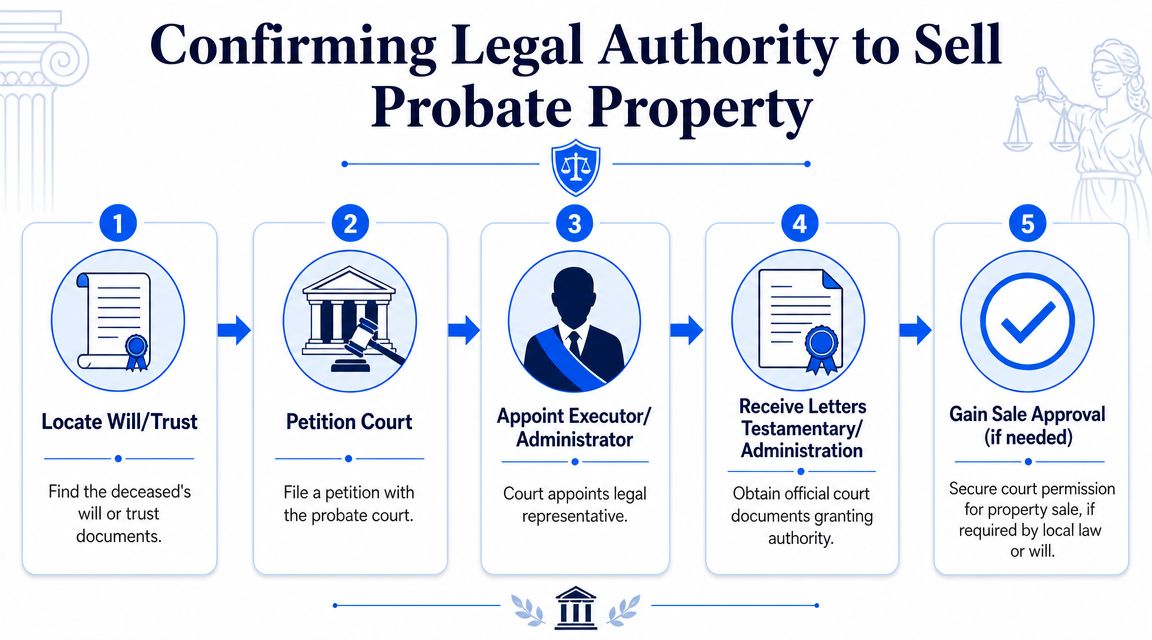
In a probate sale, the executor or court-appointed representative generally has authority to sell the property, and in many states the sale requires court approval before closing. The estate is also responsible for making sure the property is marketed and sold in compliance with probate rules, as outlined in this probate sale legal guide.
Executor, administrator, and why the title matters
If there's a valid will, the court may appoint an executor named in that will. If there isn't a will, the court typically appoints an administrator. Different states use slightly different terms, but the practical point is the same. One person, or sometimes more than one, gets legal authority to act for the estate.
Heirs don't get that authority automatically just because they're family.
That means an adult child can't call an agent, sign a listing agreement, and move forward because everyone “agrees.” Title companies and buyers want proof. Courts want the process followed. If the wrong person signs, the transaction can stop cold.
The documents that matter most
The key papers are usually the court-issued authority documents. People often refer to them as Letters Testamentary or Letters of Administration. Those documents show that the court has officially authorized someone to act for the estate.
Practical rule: Get the probate authority documents in hand before you negotiate seriously with buyers, order major work, or promise a closing date.
That doesn't mean you have to sit still while probate is opened. You can usually gather records, secure the property, clean out obvious trash, and line up professionals. But the person signing contracts must have authority.
Here's the sequence most families should follow:
- Find the estate documents: Locate the will, trust documents if any exist, deed, mortgage statements, tax records, and insurance information.
- Open probate with the court: The court has to appoint the personal representative before a sale can move forward properly.
- Confirm sale power: Some estates allow a more standard path. Others require specific court approval before closing.
- Share authority with professionals: Your agent, title company, and attorney should all work from the same set of probate documents.
- Match the sale process to the authority level: If the court must supervise the sale, don't use a normal transaction timeline.
A short walkthrough can help if this process still feels abstract:
Why this step changes the entire sale
The legal gate in selling a home in probate isn't marketing. It's authority.
If the representative has broad authority, the home may move through a more familiar listing and closing process. If the estate needs court supervision, every major step gets slower because the sale must fit the probate calendar, filing rules, and approval requirements. That's why families who rush into pricing or cleanup before confirming authority often waste time.
The cleanest probate sales start with a simple question: Who can legally sign, and what approvals does that person still need?
How to Price a Probate Property and Handle Repairs
A probate property shouldn't be priced by guesswork, family opinion, or what the nicest house on the block sold for. The estate needs defensible value, not optimism.
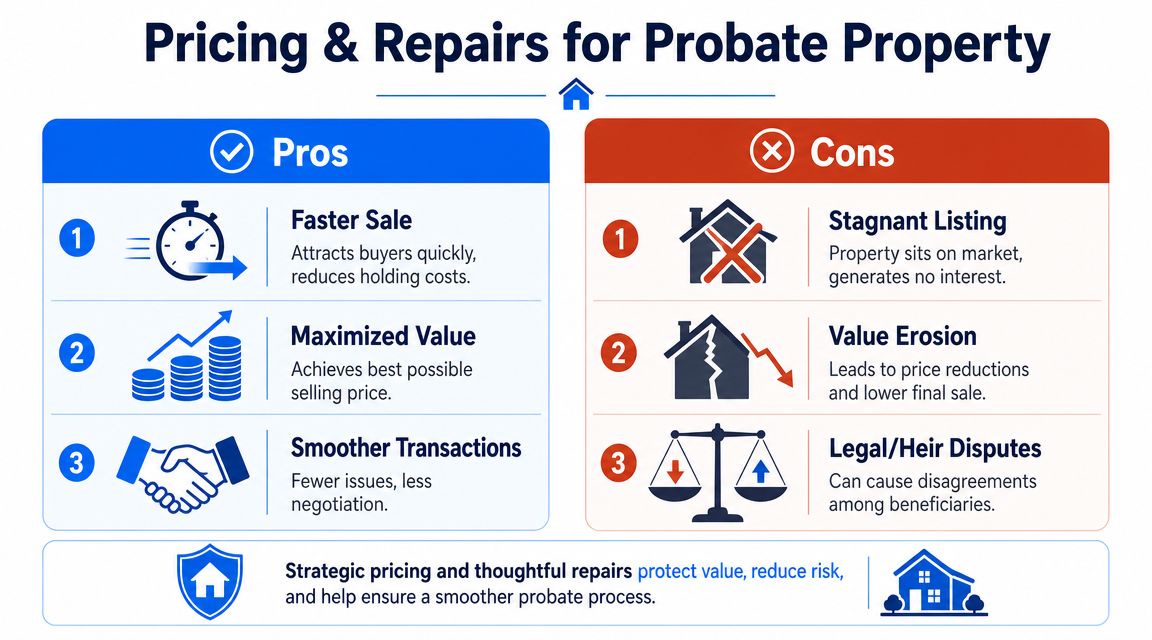
A major technical pitfall in probate sales is valuation. Many court-supervised processes require the home to sell for at least 90% of its appraised value, and an inaccurate appraisal can trigger delays, objections, or a failed sale even when buyer interest is strong, according to this Texas probate real estate guide.
Start with value, not ambition
Executors sometimes feel pressure from heirs to “test the market high.” That can backfire in probate. If the appraisal is off, or if the list price ignores the home's true condition, the estate can lose time without improving the final outcome.
A vacant inherited house is especially vulnerable to bad pricing because it often has deferred maintenance, dated finishes, or title issues that ordinary buyers notice quickly.
Good pricing usually comes from three inputs:
- The required appraisal: This is the legal anchor in many probate situations.
- Actual condition: Roof, systems, flooring, water damage, and layout issues affect real buyer behavior.
- Your chosen sale path: A retail MLS strategy and an as-is direct sale are priced differently for good reason.
When repairs help and when they don't
Repairs feel productive. They can also drain an estate.
The question isn't whether new paint, flooring, or cleanup can improve appearance. It usually can. The key question is whether the improvement adds more net proceeds after delays than it costs in cash, time, management, and risk.
That's where many families make an expensive mistake. They chase a higher future sale price while ignoring carrying costs and probate friction. If the house sits longer, needs repeated access for contractors, or triggers disagreements among heirs, the “value add” can disappear.
If you're considering selective updates, this resource on flooring solutions for home value gives practical context on which improvements tend to matter most to buyers. But probate sellers should still judge every repair by one standard: does it improve the estate's net outcome, not just the headline price?
For houses with heavy deferred maintenance, many executors choose an as-is approach instead of managing contractors through probate. This guide on how to sell a house as-is is useful if the estate wants to avoid repairs altogether.
The best probate pricing strategy is often boring. It's accurate, documented, and realistic about condition. That's what keeps a sale moving.
A simple repair filter for executors
Use this test before approving work:
- Safety and preservation first: Fix issues that protect the property from getting worse, like active leaks or security problems.
- Low-disruption improvements second: Trash removal, deep cleaning, and basic yard work often help more than major remodeling.
- Skip speculative upgrades: If the project depends on “maybe buyers will pay more,” the estate is taking risk with everyone's inheritance.
Probate rewards discipline. It doesn't reward over-improvement.
Compare Your Options for Selling a Probate Home
Once authority and pricing are clear, the core decision begins. How should the estate sell?
Executors often get pulled in opposite directions. One side argues for top dollar. The other wants speed, certainty, and fewer moving parts. Both concerns are legitimate.
A probate sale through the MLS can produce a higher price, but it's usually slower and more expensive. One industry explainer says the probate process typically takes 6 months to more than a year and total probate expenses usually run 3% to 8% of the estate's value. In that comparison, on-market MLS sales produced a median probate sale price of $320,000 and netted estates an average of $49,000 more than the next-best approach, even after commission costs were considered, based on this probate sale comparison.
That sounds compelling until you apply it to the actual house in front of you. If the property is vacant, needs work, or is carrying ongoing costs, a slower path may still be the wrong fit.
Probate sale options compared
| Selling Method | Typical Timeline | Key Costs | Pros | Cons |
|---|---|---|---|---|
| Agent-listed MLS sale | Usually the longest path in probate | Commissions, cleanup, possible repairs, holding costs, probate-related expenses | Broad buyer exposure, strongest chance at a higher sale price | More showings, more prep, more uncertainty, longer wait for cash |
| Auction | Depends heavily on court rules, buyer turnout, and property type | Auction fees, carrying costs before sale, possible lower buyer pool for distressed homes | Defined sale event, can work for unusual properties | Less control, uneven bidder quality, outcome can disappoint |
| Direct cash buyer | Often the simplest operational path once legal authority is clear | Usually fewer prep costs, reduced repair burden, title and probate compliance still matter | Faster, fewer contingencies, as-is option, easier for executors managing an estate remotely | May trade some upside for speed and certainty |
The right method depends on the estate's real problem
If the estate has cash reserves, the house is in strong condition, heirs are cooperative, and the representative can tolerate a longer process, an MLS listing may make sense.
If the estate is dealing with unpaid expenses, out-of-state heirs, deferred maintenance, or beneficiary conflict, certainty becomes more valuable. In those cases, the “best” option isn't the one with the highest possible gross price. It's the one most likely to close cleanly without draining the estate during the wait.
That's why I tell families to focus on three filters:
- How much time can the estate afford?
- How much work can the executor realistically manage?
- What happens financially if the sale takes longer than expected?
When a cash sale fits probate
A direct buyer can be a practical solution when the house needs to be sold as-is, the family wants fewer showings, or the estate can't keep carrying the property. Some companies in this space, including cash home buyers that purchase as-is properties, work with inherited homes and probate situations where convenience matters more than retail presentation.
That doesn't make a cash sale automatically right. It means you should compare it carefully against the hidden costs of waiting.
A probate house doesn't need the “highest offer” on paper. The estate needs the offer that actually solves the legal, financial, and timing problem in front of it.
A smart executor compares net proceeds, timeline, certainty, repair burden, and family stress. Gross price is only one line on that list.
Managing the Offer and Court Approval Process
Once the estate accepts an offer, the transaction becomes less emotional and more procedural. That's good news. Probate closings can feel intimidating, but they usually follow a set pattern.
The operational sequence of a probate sale depends heavily on the type of administration. In Texas, for example, dependent administration can take about 8–18+ months because it requires court oversight, a formal appraisal, and often a court-approved sale where overbids are solicited, as described in this explanation of probate sale workflow in Texas.
What happens after an offer is accepted
The key steps usually look like this:
- The representative accepts an offer that fits the estate's authority and pricing rules.
- The sale documents are prepared for the probate transaction.
- The title company reviews authority and title status to confirm the right parties can convey ownership.
- Court approval is obtained if required under the administration type or local rules.
- Closing documents are signed by the authorized representative and proceeds are delivered to the estate, not directly to heirs.
That last point matters. The money belongs to the estate first.
The part that surprises buyers and sellers
Court-supervised sales can add notice periods, hearings, and overbid procedures. In some processes, the accepted offer is not the final word until the court confirms it. That means the estate, buyer, title company, and attorney all need patience.
Buyers who are used to ordinary retail transactions often get nervous here. Executors should prepare them early. A probate sale may include extra paperwork, longer response times, and court-driven deadlines that nobody can accelerate just by “pushing harder.”
Court approval doesn't mean the sale is going wrong. It means the sale is following the rules that protect the estate.
Title work and closing discipline
Title companies play a quiet but central role in selling a home in probate. They check whether the representative has authority, whether old liens or ownership issues need resolution, and whether the deed will be signed by the correct party.
Executors can make this easier by keeping one organized file with:
- Court documents: Appointment papers and any sale authority orders.
- Property records: Deed, tax information, mortgage statements, insurance, and HOA records if relevant.
- Offer package: Contract, amendments, disclosures, and any probate-specific addenda.
- Communication log: Notes on heir notifications, attorney instructions, and court dates.
What slows closings isn't usually the buyer's interest. It's missing paperwork, unclear authority, or a contract written as if this were a standard sale when it isn't.
Final Steps and Critical Mistakes to Avoid
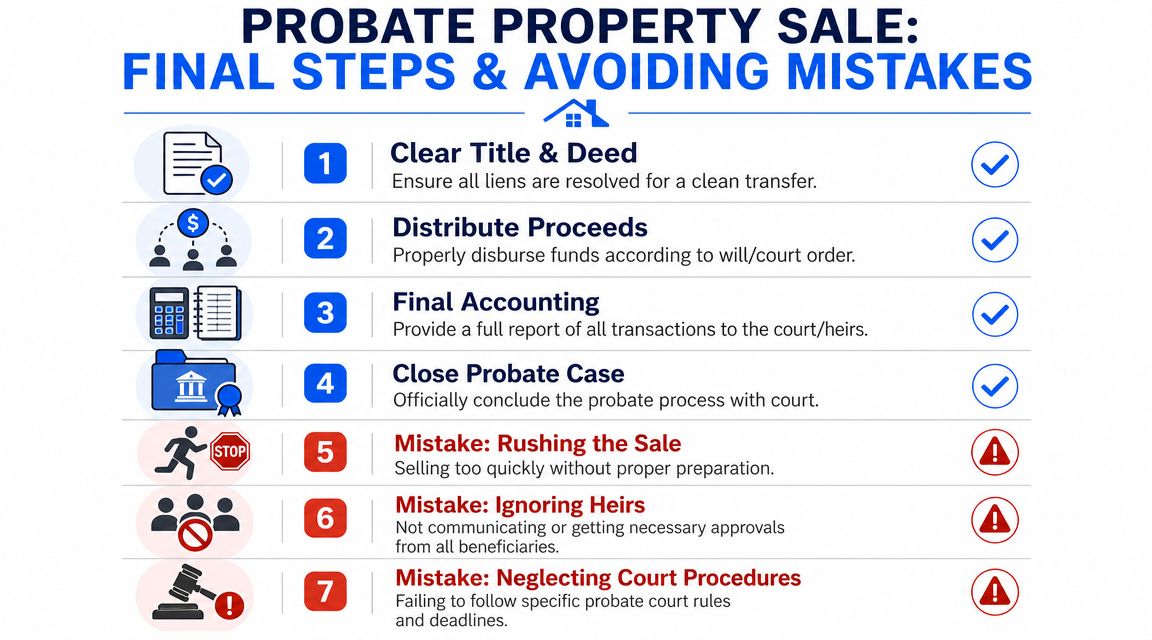
After closing, the work isn't quite over. The sale proceeds typically go into the estate account, where they can be used to pay approved expenses, debts, and distributions in the proper order. Executors should keep clean records because beneficiaries, attorneys, and sometimes the court may need a full accounting.
Families also ask about taxes. A common probate planning issue is the home's basis for tax purposes. The exact tax treatment depends on the estate and state, so this is one area where a CPA or probate attorney should review the file before distributions are made.
The mistakes that create the most stress
Most probate sale problems come from a short list of avoidable errors.
- Acting before authority is clear: If the wrong person signs or negotiates too far ahead of the court process, the sale can stall.
- Confusing list price with net proceeds: A higher offer isn't always better if it requires repairs, repeated delays, and months of carrying costs.
- Ignoring the title file: Old liens, deed issues, and incomplete probate documents slow down closings more than most families expect.
- Failing to communicate with heirs: Silence creates suspicion. Even when one representative has legal authority, updates reduce conflict.
- Over-improving the house: Probate estates rarely benefit from renovation projects that are hard to manage and harder to justify.
- Distributing money too early: Heirs should not receive proceeds before the estate's obligations are handled properly.
- Treating probate like a normal sale: It isn't. The legal process controls the transaction.
A calm way to finish strong
If you're the executor, your job isn't to squeeze every theoretical dollar from the property. Your job is to protect the estate, follow the court process, and make a decision you can defend with paperwork and common sense.
That usually means three things:
- Document every major decision
- Choose the sale path that fits the estate's cash needs
- Close only when title, authority, and court compliance are fully lined up
Selling a home in probate is manageable when you stop treating it like a guessing game and start treating it like a controlled process.
If you need a practical cash-sale option for an inherited or probate property, Cyber Homes buys houses as-is, works through title companies, and can fit a closing timeline around the estate's needs. For executors dealing with repairs, vacant homes, or ongoing carrying costs, that kind of direct sale can be worth comparing against a traditional listing so you can choose the path that fits the estate, not just the property.