
Top 10 Companies That Buy Houses for Cash in Phoenix, AZ

Selling a house in Phoenix gets complicated fast when life doesn't wait. Maybe you inherited a property that needs work, your tenant stopped paying, or you've got a relocation deadline and no appetite for repairs, showings, and financed buyers backing out. In those situations, cash buyers can solve a real problem. They remove a lot of friction, but they don't all solve the same problem equally well.
Phoenix is also not some sleepy corner of the cash-buyer world. It's a market where homeowners can compare national iBuyers, local investors, and franchise operators side by side. One Phoenix roundup of cash buyers even shows how review visibility shapes decisions, listing Offerpad at a Phoenix business address and showing review data across several platforms, including an overall score of 3.9 from 850 reviews, BBB 4.3 from 231 reviews, Trustpilot 4.3 from 208 reviews, Yelp 1.5 from 64 reviews, and Zillow 4.6 from 25 reviews on the same page at Clever's Phoenix cash buyer roundup. That tells you something important. In Phoenix, reputation matters almost as much as speed.
If you're weighing a cash sale, the right question isn't just “who pays cash?” It's “which type of buyer fits my situation?” This guide breaks down the top companies that buy houses for cash in Phoenix, AZ by category, so you can choose based on your actual goal. Speed, flexibility, title issues, rental exit, or a cleaner online process. If you want a few practical ways to improve presentation before you choose your path, this property prep guide for sellers is a useful place to start.
1. Cyber Homes

A Phoenix seller who is staring at a code-violation notice, an inherited property full of belongings, or a tenant problem usually does not need a polished online dashboard. That seller needs a buyer who will look at the situation, explain the options clearly, and close without asking for repairs, cleaning, or retail prep.
That is the lane Cyber Homes appears to serve. Its cash home buying program for as-is sellers is built around direct purchases rather than the standardized, mostly digital process you see from iBuyers.
Where Cyber Homes fits in this list
This company belongs in the local-investor style category, not the tech-platform category. That distinction matters. Local and regional direct buyers are often the better fit when the property has deferred maintenance, the timing is messy, or the seller wants room to discuss title, occupancy, or cleanout issues with a real person.
From a practical standpoint, Cyber Homes is worth considering if your goal is certainty and flexibility. Sellers in probate, divorce, relocation, pre-foreclosure, or rental exit situations often value those two things more than squeezing for top retail price.
What stands out
The useful parts of this model are straightforward:
- As-is purchase approach: Sellers can skip repairs, cleaning, and staging.
- Direct communication: The process appears built for conversation, which helps when the file is not simple.
- Flexible closing timing: Local buyers are often easier to work with if you need a fast close or a little extra time to move out.
- Alternative funding model: The company says it buys with cash or private money, which can reduce the risk that a deal depends on a traditional mortgage approval.
One caution from experience. Ask any direct buyer two questions early: how they fund purchases, and which title company will handle closing. Those answers tell you a lot about whether the offer is real or just a number meant to get control of the deal.
Trade-offs to understand
Cyber Homes is not the obvious choice for every seller. If your house is clean, updated, and easy to finance, an iBuyer or even a traditional listing may produce a stronger net. Direct buyers usually win on speed, convenience, and tolerance for ugly situations. They usually do not win on maximum price.
That trade-off is normal. The right fit depends on the problem you are solving.
For Phoenix homeowners comparing categories, I would place Cyber Homes in the “talk to a human, solve a messy property issue” bucket. That makes it different from Opendoor and Offerpad, which are usually better matched to sellers who want a standardized online process and a more uniform property profile.
2. Opendoor

Opendoor is the cleanest fit for sellers who want a standardized, mostly digital experience. If you'd rather upload photos, review a dashboard, and choose a closing window online than negotiate with a local investor over the phone, this model will feel familiar. It's built for convenience and process control.
The Phoenix market supports this type of model because activity is still healthy enough to keep as-is inventory moving. Redfin describes Phoenix as somewhat competitive, gives it a competitiveness score of 56 out of 100, and reports an average home price of $465K that was up 3.3% month over month in its Phoenix housing market snapshot. In practical terms, that kind of market gives algorithm-driven buyers room to operate efficiently.
When Opendoor makes sense
Opendoor works best when the property is relatively standard and the seller wants predictability. You submit details, upload photos, receive an offer, and pick a timeline that usually falls in a flexible window. The seller dashboard is one of the better parts of the experience because it reduces back-and-forth and keeps paperwork organized.
There's also an optional program called “Cash Now, More Later,” which may appeal to sellers who want immediate liquidity but still like the idea of sharing in future resale upside. That's a niche option, but it shows how Opendoor tries to appeal to homeowners who want more than a simple one-step sale.
If you're comparing direct buyers against a more personal model, it helps to also review how a traditional as-is cash purchase works at Cyber Homes' cash home buying page.
Where sellers get tripped up
The biggest mistake with Opendoor is assuming the initial convenience automatically means the best net result. It doesn't. Service charges can vary, and the final number can shift after the condition review. Sellers with older homes, unusual lots, major repairs, or tenant issues often run into limits faster with iBuyers than with local investors.
- Best fit: Cleaner homes, straightforward title, sellers who like online workflows
- Main advantage: Strong process visibility and flexible timeline options
- Main caution: Final economics can change after condition assessment
- What to ask: Request the full offer breakdown, not just the headline number
Opendoor is strong at systematizing the sale. It's weaker when the property or situation falls outside the system.
3. Offerpad

Offerpad deserves special attention in Phoenix because this is one of the markets where the company has deep visibility. It's a Phoenix-founded iBuyer, and that local familiarity gives it more credibility here than a generic national brand often gets. For sellers who want a date-certain process and like the idea of working with a company that has a visible local footprint, Offerpad is one of the first names to review.
What I like about Offerpad is that the seller proposition is easy to understand. You request an offer, pick a closing date, and sell as-is. Repair costs are commonly handled through credits at closing rather than requiring you to fix items before the sale. Some sellers also value the free local move benefit when selling directly to Offerpad because moving logistics are often the most annoying part of a rushed sale.
Best use case for Offerpad
Offerpad is a strong option for organized sellers who care about timing. If you need to line up a new purchase, coordinate with a lease end, or move on a specific week, the ability to choose a close date is a practical advantage. That's especially true when certainty matters more than wringing out top market exposure.
Another reason Offerpad stays relevant in Phoenix is that local homeowners can compare not just speed claims but also public reputation. As noted earlier, Phoenix buyers and sellers have enough review data on major platforms to see that even well-known brands show mixed feedback depending on the experience. That's normal in this segment. What matters is whether the company's process lines up with your property type.
A date-certain closing is valuable only if the buyer can actually honor it. Ask what happens if the repair adjustment changes late in the process.
Trade-offs
Offerpad is still an iBuyer, which means it works best on homes that fit its box. If your property has unusual condition issues, title complications, inherited ownership questions, or tenant friction, local direct buyers usually have more room to adapt. You'll also want to understand the service fee clearly because “convenient” and “cost-effective” are not always the same thing.
- Good fit: Sellers who want a scheduled closing and a structured process
- Useful perk: Free local move on qualifying direct sales
- Potential downside: Service fees and credits can reduce net proceeds
- Watch for: Properties that don't match standard iBuyer criteria
For a retail-clean Phoenix house with a seller who values convenience, Offerpad remains one of the more credible iBuyer options in the city.
4. HomeVestors
HomeVestors, widely known as We Buy Ugly Houses, sits in a different category from iBuyers. This is a national franchise model with local operators, which means the value of the experience often depends on the individual office handling your deal. For homeowners with a rough property and no desire to make it presentable, that's still a meaningful option.
This style of buyer is part of Phoenix's long-standing as-is ecosystem. Independent Arizona-focused rankings reported that traditional cash-buying investors often target roughly 30% to 70% of fair market value, while iBuyers tend to offer about 70% to 80%, and closing windows can range from as fast as 7 days to as long as 60 depending on the company and model in Houzeo's Arizona cash buyer guide. That spread explains why seller expectations go wrong so often. “Cash buyer” is not one lane.
Why HomeVestors still matters
HomeVestors appeals to sellers who want someone to physically walk the property, assess it in person, and make an off-market offer without worrying about curb appeal. The company also promotes no commissions or agent fees and says local franchisees can handle as-is situations where unwanted personal property is left behind.
That matters more than many sellers think. A clean digital process is nice, but inherited homes, hoarder conditions, and long-deferred maintenance usually need a buyer who's comfortable seeing the mess up close.
If your top priority is unloading a distressed house without repair demands, it also helps to understand the realities of an as-is home sale process.
Where caution is warranted
The franchise structure is both the strength and the risk. You get local presence, but the quality of communication and flexibility can vary by operator. In practice, I tell sellers to treat HomeVestors like a local company wearing a national jersey. Vet the actual office, not just the logo.
- Best fit: Distressed homes, inherited clutter, sellers who want an in-person walk-through
- Advantage: Familiar national brand with local operators
- Trade-off: Experience can vary because offers come from franchise offices
- Seller move: Review the specific purchase contract carefully before signing
HomeVestors Phoenix is a practical option for ugly-house situations. It's less compelling for polished homes that could attract stronger terms elsewhere.
5. Doug Hopkins

Doug Hopkins is one of the better-known local names in the Phoenix metro cash-buying space. That visibility matters because a public-facing operator usually has more incentive to maintain process discipline and communicate clearly. If you want a local buyer with recognizable branding and a straightforward no-obligation setup, this is a sensible company to quote.
Where Doug Hopkins stands out is on problem-solving language. The company openly says it will evaluate homes with high mortgages, liens, and title complexities. That's a useful signal. Many buyers love “easy” properties and disappear when the file gets messy. Sellers in divorce, probate, payoff pressure, or inherited-title situations need someone willing to look at the deal.
Good fit for complicated files
For straightforward cases, the company targets a fast turnaround and markets a simplified, no-fee approach. It also emphasizes that there are no surprise charges and that initial responses often come quickly after contact. That makes it appealing to owners who need speed but still want someone rooted in the local market.
When title issues exist, the best buyer isn't always the highest first offer. It's the buyer who keeps working after title uncovers a problem.
Doug Hopkins is also a decent option for sellers who want local familiarity without moving into the franchise model. You're still dealing with a buyer that has broad public visibility in the Valley, but the positioning feels more local-investor than national-system.
Limits to keep in mind
This isn't a universal fit. The company says it can't buy properties that are currently listed under an active agent agreement, and speed still depends on what turns up during title and property review. If the seller hears “about a week,” that should be understood as a best-case straightforward scenario, not a blanket promise for every house.
- Strong use case: Liens, high mortgage balances, and title friction
- Appeal: Local name recognition and simple intake process
- Potential issue: Not every property closes on the fastest timeline
- Important question: Ask whether there are any title conditions that could delay closing
For owners who want a visible Phoenix-area operator with experience in difficult payoff scenarios, Doug Hopkins belongs on the short list.
6. Highest Cash Offer

Highest Cash Offer is interesting because it widens the property funnel. A lot of cash buyers talk broadly but tend to prefer site-built homes in predictable neighborhoods. This company explicitly buys manufactured and mobile homes as-is alongside traditional houses, which can make it more relevant for sellers who don't fit the standard profile.
That kind of flexibility matters in Phoenix because cash sales are already a significant part of the market. One Phoenix-focused market summary reported that 27% of homes in Phoenix were bought with cash in 2024, and the same guide noted that many cash-home-buyer offers range from 30% to 70% of fair market value, while some iBuyer-style offers can get closer to 70% to 80% in Houzeo's Phoenix cash buyer overview. When cash is this common, sellers should choose based on fit, not just on whether the company says “we buy houses.”
Where this company can help
Highest Cash Offer uses a low-friction model. The process centers on a consultation followed by a cash offer, and the company presents itself as a direct buyer that can handle as-is situations without showings or repair requests. For sellers with older mobile or manufactured homes, that alone can put it ahead of some larger brands.
This can also be relevant for inherited properties where ownership is split and the asset type narrows your buyer pool. If you're dealing with that kind of estate complication, this guide to selling inherited property with multiple owners is worth reviewing before you sign anything.
What to verify in writing
The website is less specific than some competitors about fees and target timelines. That doesn't automatically mean a bad experience. It does mean the seller needs to ask sharper questions before moving forward.
- Best fit: Manufactured or mobile homes, plus standard as-is houses
- What's good: Simple intake and broad property acceptance
- What's missing: Clear published fee policy and prominent closing timeline details
- Seller move: Ask for a written net sheet and a target close date
Highest Cash Offer Phoenix is worth a look if your property type makes mainstream iBuyers a bad match.
7. HBSB Holdings
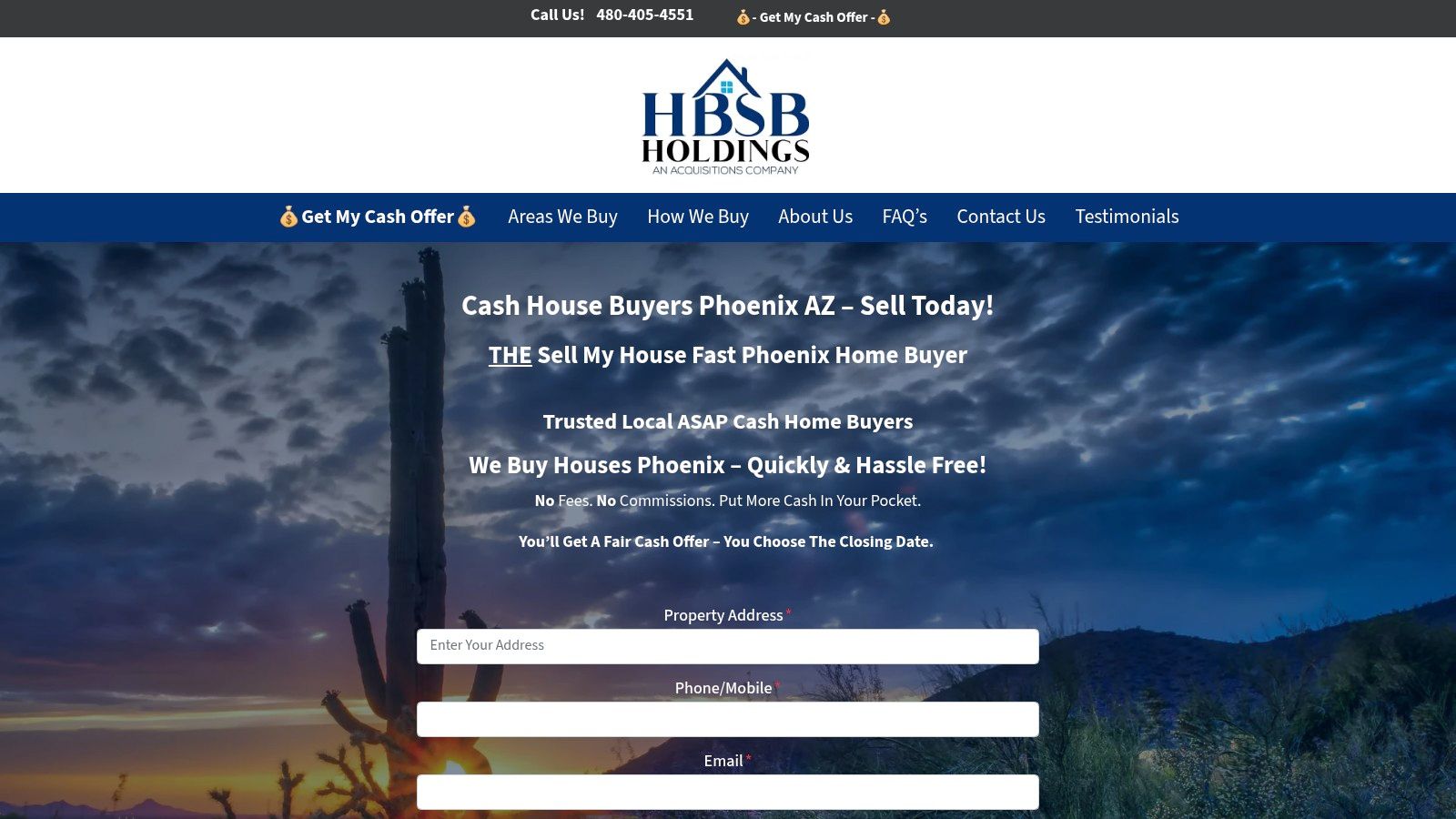
HBSB Holdings is a local Phoenix operator that markets the straightforward terms many sellers want to hear. No fees, no commissions, as-is purchases, and closings through a local title company. For owners who prefer a local direct buyer over a national brand, that pitch has real appeal.
What I like here is the emphasis on occupancy flexibility. Many sellers don't just need a fast sale. They need a buyer who can work around move-out timing, leftover belongings, or a delayed handoff. Local operators often handle that better than system-heavy companies.
Why local operators win some deals
HBSB Holdings references quick closings when needed and frames itself as a hands-on Phoenix buyer. That can matter when you need a simple path from offer to title without a lot of layered process. If you're selling a tired rental, dealing with deferred maintenance, or trying to avoid public listing exposure, this is the type of company that often feels easier to work with.
The local-title-company angle is also useful. A reputable title company can surface payoff issues, vesting questions, and lien problems early, which helps prevent ugly surprises right before closing.
What sellers should watch
The trade-off is familiar. A direct buyer offering speed and convenience usually won't match what an exposed MLS listing could produce on a strong retail-ready home. Sellers should also ask for a written net sheet even when a company says “no fees,” because credits, adjustments, and repair deductions still affect the bottom line.
The cleanest way to compare cash buyers is to ask each one for the exact amount you'll receive at closing, not just the purchase price.
- Best for: Local sellers who want speed and occupancy flexibility
- Advantage: Arizona-based team and direct local closing setup
- Trade-off: Convenience can mean a lower final price than a broad-market sale
- Smart question: Ask how possession timing works if you need extra days after closing
For a seller who wants a local buyer with a simple as-is model, HBSB Holdings is a reasonable company to include in the mix.
Phoenix Cash Home Buyers: 7-Company Comparison
| Provider | Process & Complexity 🔄 | Resources Required ⚡ | Expected Outcomes ⭐📊 | Ideal Use Cases 💡 | Key Advantages ⚡ |
|---|---|---|---|---|---|
| Cyber Homes | Very low complexity, quick online/phone intake, buys as‑is, few contingencies | Own cash/private lenders; moderate local team; limited tech | High certainty and speed; offers often below max MLS price | Sellers needing immediate sale, foreclosure, relocation, probate, landlords | Fast offers (hours), no commissions, up to $2,000 moving advance, personal service |
| Opendoor | Moderate, data-driven online workflow; post‑inspection adjustments possible | Large tech platform and capital reserves; nationwide operations | Standardized, predictable process; variable service charge; net may change after inspection | Sellers wanting online convenience and flexible 14–60 day closes | Seller dashboard, flexible timelines, “Cash Now, More Later” option |
| Offerpad | Moderate, firm cash offers, date‑certain closings; repairs via credits | Well‑capitalized iBuyer model; moving logistics for local moves | Date‑certain closings; net proceeds may be lower than MLS after fees | Sellers needing precise close date and moving assistance | Free local move (up to 50 miles), transparent FAQs, streamlined timeline |
| HomeVestors (We Buy Ugly Houses) | Low–medium, local in‑person evaluations; franchise variability; typically weeks to close | National franchise network with local operators and on‑the‑ground staff | Convenient as‑is sales; offer quality and timing vary by franchisee | Sellers with distressed/ugly homes or who prefer local, in‑person review | National brand, no commissions, ability to leave unwanted items |
| Doug Hopkins (Phoenix/metro AZ) | Low, local investor process, quick initial response, targets ~1 week | Local capital and title/payoff expertise; Phoenix‑focused team | Fast initial offers; closings depend on title/condition; handles complex payoffs | Phoenix sellers with liens, high mortgages, or urgent timelines | Local visibility, rapid responses (<24h initial), handles title complexities |
| Highest Cash Offer (Phoenix) | Very low, phone consultation then cash offer; streamlined intake | Nationwide buyer resources with Phoenix‑dedicated operations | Cash offers for site‑built and manufactured homes; timeline not explicit online | Owners of manufactured/mobile homes or sellers wanting low‑friction process | Broad property coverage, simple phone‑based consult |
| HBSB Holdings (Phoenix) | Low, local buyer with promise of fast closings (as little as one week) | Arizona‑based team and local title relationships | Fast local closings; possible lower price in exchange for speed; “no fees” phrasing needs net sheet | Sellers who need rapid local close and flexible occupancy | Local title closings, flexible occupancy, advertised one‑week closes |
How to Choose the Right Phoenix Cash Buyer for You
The best cash buyer in Phoenix depends on the problem you're solving. If you have a clean, fairly standard house and you value a polished online workflow, an iBuyer like Opendoor or Offerpad may fit better than a local investor. If you've got title issues, deferred maintenance, inherited ownership questions, or a tenant situation, local direct buyers often make more sense because they can adapt faster.
That distinction matters in Phoenix because the local cash ecosystem is broad, not uniform. Some firms are built for speed on standard homes. Others are built for ugly houses, estate situations, or landlords who need to exit without repairs. If you treat all cash buyers as interchangeable, you'll compare the wrong things and likely choose poorly.
I'd narrow your decision around three questions. First, how fast do you really need to close? Some buyers can move quickly, but the practical closing timeline still depends on title, occupancy, and property condition. Second, how much hand-holding do you want? Some sellers prefer an app and dashboard. Others want a person who will answer the phone and walk them through title and move-out details. Third, how complicated is the property? The more unusual the house or ownership file, the more valuable flexibility becomes.
Before you sign anything, get offers from at least two or three companies and compare net sheets line by line. Don't focus only on the headline purchase price. Look at repair credits, service charges, closing cost treatment, and whether the buyer is funding directly. Ask what could cause the offer to change. Ask which title company will handle the file. Ask what happens if you need to stay in the house a little longer after closing.
It also helps to know the baseline value of what you're selling. This fair market value guide is useful if you want a simple framework before comparing direct offers. Once you know your rough market value, it gets much easier to judge whether a lower offer is a fair trade for speed and convenience, or just a weak deal.
A good Phoenix cash buyer doesn't just promise speed. The company solves the specific friction in your sale. Choose the buyer that matches your timeline, property condition, and tolerance for complexity. That's how you get a fast sale without creating a second problem.
If you want a personal, flexible alternative to big-box iBuyers, Cyber Homes is worth a close look. The company buys houses as-is, can typically make firm offers within hours, doesn't charge commissions, and can even advance up to $2,000 for moving expenses before closing. For Phoenix sellers dealing with foreclosure pressure, probate, divorce, relocation, or a problem rental, that kind of certainty can make the decision much easier.