
As Is Home Buyers: A 2026 Guide to Selling Fast

If you're staring at a house that needs work and a deadline that won't move, you're not stuck. You're dealing with a sale that doesn't fit the polished, staged, open-house version of real estate people love to talk about.
Maybe the roof is old. Maybe the house came to you through probate. Maybe tenants left a mess, a divorce changed the plan, a job transfer sped everything up, or you're behind and need a clean exit before the situation gets worse. In real life, sellers don't always have the money, time, or energy to repaint walls, replace flooring, and wait around for a financed buyer to make up their mind.
That's where as is home buyers come in. Not as a magic fix. As a practical path.
Facing a Complicated Home Sale? You Have Options
A lot of homeowners land here after trying to solve the problem the “normal” way. They call an agent, hear a list of repairs, get told to declutter, stage, clean, store half the furniture, and prepare for weeks of uncertainty. That advice works for some properties. It doesn't work when the house is damaged, inherited, half-packed, or tied to a deadline.
If your home is crowded with belongings while you're trying to decide what stays and what goes, temporary storage can buy you breathing room. This Gentle Giant Removals storage advice is useful if you're sorting a fast move, an estate cleanout, or a sale where you need the house accessible without making permanent decisions overnight.
The three real paths sellers usually face
Most stressed sellers have three options, not two.
- List with an agent: Better if your house shows well, your timeline is flexible, and you want maximum exposure.
- Sell to a large iBuyer: Sometimes workable for cleaner, more standardized homes in select markets.
- Sell to an independent cash buyer: Often the most realistic fit when the property has issues, the timeline is tight, or the situation is messy.
That third option gets overlooked. It shouldn't.
When a house has damage, deferred maintenance, title complications, or urgency attached to it, simplicity matters more than polish.
An independent cash buyer isn't trying to turn your house into a showroom before the sale. They're buying the problem and taking the project off your plate. That can be the right move when the alternative is spending money you don't have to chase an outcome you can't wait for.
When this option makes the most sense
You should seriously consider as is home buyers if you relate to any of these:
- Repair fatigue: The house needs more work than you're willing or able to manage.
- Life-event pressure: Probate, divorce, relocation, landlord burnout, or financial stress is driving the sale.
- Property damage: Fire, water, storm, or neglect has made a standard listing difficult. If that's your situation, this guide on how to sell a fire-damaged house is worth reading.
- Need for certainty: You care more about getting to closing cleanly than squeezing every possible dollar from the process.
You don't need a perfect house. You need a clear plan.
What Are As Is Home Buyers and How Do They Work
You call because the house has problems and you need a real solution, not a list of prep work. An as is home buyer buys the property in its current condition and takes responsibility for what happens after closing.
As is home buyers are usually independent investors or local buying companies, not traditional retail buyers using a mortgage. That distinction matters. A mortgage buyer often needs the home to meet lender standards. An independent cash buyer is judging the deal based on condition, repair cost, title risk, and resale or rental potential. That makes them a true third option, separate from both an MLS listing and a large iBuyer.

What “as is” actually means
“As is” does not mean the buyer accepts the property blindly. It means you are not agreeing to make repairs before closing.
A legitimate buyer still needs to inspect the house, confirm the numbers, and decide whether the project makes sense. Independent guidance on as-is sales explains that buyers often use general and specialist inspections to check for structural, roof, sewer, electrical, and moisture issues because visible problems rarely tell the whole story, as noted in this practical guide to as-is home sales.
So if a buyer asks to walk the property, look in the crawlspace, or review the title work, that is normal. You should expect it.
How the business model works
Independent as-is buyers make money by solving problems that the open market handles poorly. They buy houses with deferred maintenance, difficult occupants, estate complications, liens, code issues, or sellers who do not have the time or cash to get a property market-ready.
Here is the trade. The buyer takes on the repair bill, holding costs, cleanup, paperwork, and resale risk. You accept a lower price than you might get from a fully exposed retail listing with time for updates and negotiations.
That lower price is not automatically a bad deal. It can be the right deal if speed, certainty, and simplicity matter more than stretching for top dollar.
What these buyers are usually solving for
- Condition problems: aging systems, water damage, foundation concerns, code violations, hoarding, or years of deferred maintenance
- Timeline pressure: probate, divorce, relocation, foreclosure risk, inherited property issues, or landlord burnout
- Execution risk: situations where a failed financing contingency or months of showings would create more damage than value
A real cash buyer prices the house based on its current condition and the risk they are taking over, not on the polished version of the property you do not have time or money to create.
Why independent buyers get overlooked
A lot of sellers hear only two paths. List with an agent or request an instant offer from a big iBuyer. That framing misses the option that often fits distressed or complicated properties best.
Independent buyers work in a narrower, more local way. They can be more flexible on condition, occupancy, closing date, and title issues. They can also vary widely in quality. Some are professional and reliable. Some are not.
That is why you should not lump every cash buyer into one bucket. Treat the independent as-is buyer as a separate category. Then vet them carefully. The right one gives you a safe, straightforward sale without repairs, listings, or financing uncertainty.
The 4 Step Process to Selling Your House for Cash
If you are staring at a house with deferred maintenance, a tight deadline, or a messy title situation, you do not need a complicated sales process. You need a buyer who can explain each step clearly, answer direct questions, and close without adding new problems.
A safe cash sale is usually straightforward. It should also be easy to verify.

Step 1 starts with a clear property review
You contact the buyer and share the situation. Give the address, condition, occupancy, timeline, and any issue that could affect value or closing. Water damage. Probate. Tenants. Code notices. Liens. Roof leaks. Foundation movement. Say it early.
Direct sellers get better results because the buyer can price the deal correctly from the start. Sellers who hide problems usually end up with a revised offer, a delayed closing, or a deal that falls apart.
A family-owned buyer like Cyber Homes buys houses as-is for cash or private money, can present a firm offer within hours, closes through reputable title companies on the seller's timeline, and may advance up to $2,000 for moving expenses before closing. Those are the practical details you should ask any independent cash buyer to spell out before you go further.
Step 2 is the walkthrough and buyer verification
A real buyer needs to assess the property. That may start with photos or a virtual tour, then move to an in-person visit. The point is simple. They need enough information to make a credible offer.
This step protects you too.
A serious independent buyer will ask focused questions, notice condition issues, and explain what they can and cannot take on. A weak buyer often does the opposite. They talk big, avoid specifics, and throw out a number before they understand the property.
What a reliable buyer checks during the walkthrough
- Major systems: roof, plumbing, electrical, HVAC, foundation, windows
- Occupancy status: owner occupied, vacant, tenant occupied, or partially cleared
- Work required: light cleanup, full rehab, or something in between
- Title and access: ownership, probate, liens, gate codes, utilities, and scheduling
Good rule: if a buyer gives you a strong offer without enough questions, proof of funds, or a real look at the house, slow down and verify them.
If you are preparing to move out quickly, even basic cleanup planning helps. A solid professional move-in cleaning guide can help you decide what is worth doing and what you can skip in an as-is sale.
Step 3 is the written offer and term review
After the walkthrough, you should get a written offer with clear terms. Price matters, but so do the details that make the sale safe and workable. Look at the closing date, any inspection or title contingencies, who pays standard closing costs, whether occupancy after closing is allowed, and how earnest money is handled.
Do not compare buyers on price alone. Compare certainty.
That matters even more with independent cash buyers, because quality varies. One buyer may be able to close in days through a title company with verified funds. Another may have no real capital and hope to assign your contract to someone else later. Those are completely different risks.
Later in the process, many sellers like to see how the timeline works in practice:
Step 4 is closing on the timeline that fits your situation
A good cash buyer works around real-life constraints. You may need extra time to move. You may be waiting on probate documents. You may need to coordinate with tenants or family members. The closing date should reflect that.
Some sellers want speed. Others want flexibility. The best independent buyers can often handle both, as long as the title work supports it.
Before closing, gather these basics
- Mortgage information: payoff details if you still have a loan
- Property documents: tax statements, HOA documents, leases if they apply
- Identity and ownership paperwork: especially for inherited or jointly owned homes
- Access details: gate codes, alarm information, tenant coordination, utility status
If a buyer can explain the steps, show proof of funds, use a reputable title company, and give you a written offer without pressure, you are probably dealing with the right kind of cash buyer.
Weighing the Pros and Cons of a Cash Sale
Frankly, a cash sale is not how you chase the absolute highest possible retail price. It's how you solve a problem efficiently.
That distinction matters because too many sellers waste time comparing a fast as-is offer to a fantasy number they were never realistically going to net after repairs, cleaning, carrying costs, and months of uncertainty.
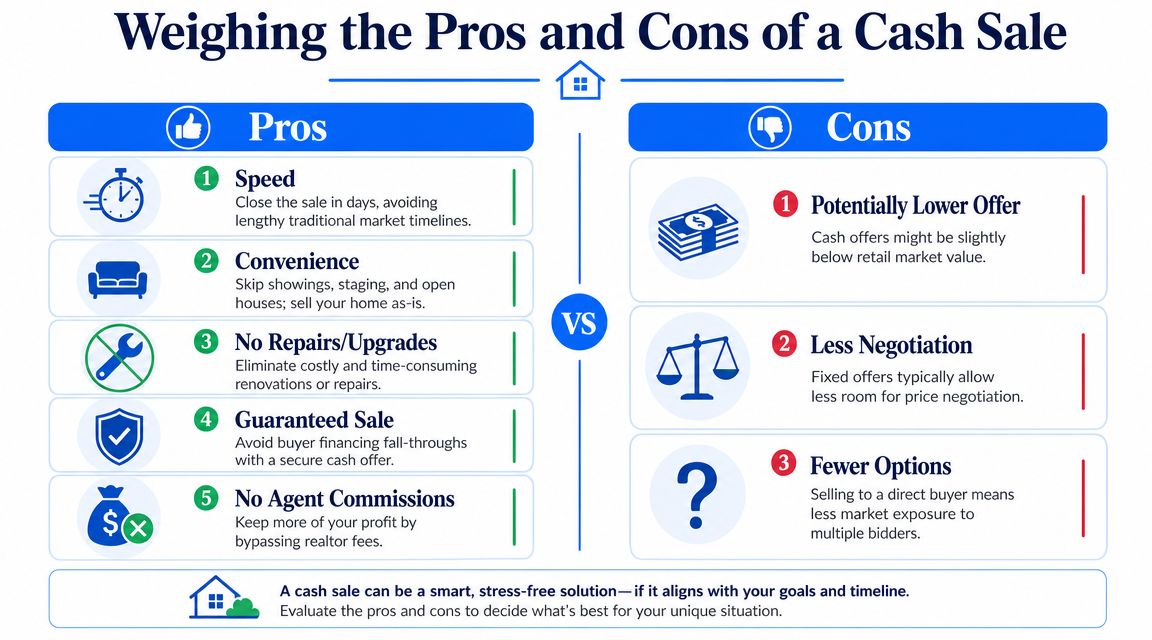
Why sellers choose cash anyway
The biggest advantages are practical, not theoretical.
- Speed: You can avoid the prep-listing-showing loop that drags out a sale.
- Convenience: No staging, repeated walkthroughs, Sunday open houses, or repair contractors in your driveway.
- Condition flexibility: You can sell the house with old finishes, deferred maintenance, or damage.
- Certainty: You avoid lender-driven surprises that often derail conventional deals.
- Simplicity: There are fewer moving parts for you to manage.
For a seller dealing with grief, relocation, debt pressure, or a difficult property, those benefits are not small. They're the whole point.
The downside you should accept upfront
The main drawback is simple. The offer will usually be lower than the price a polished, exposed, fully marketed property might command.
That's not a scam by itself. That's the math of the service. The buyer is taking on repair costs, holding costs, resale risk, and the burden of execution. You're paying for speed and convenience with some of the upside.
A smart seller asks one question: “What do I keep, and how certain is it?”
Convenience has value. So does certainty. If you need both, stop judging the offer against a perfect-world listing and start judging it against your real alternatives.
A practical way to think about the tradeoff
A traditional listing often comes with pre-sale work. If you're preparing a home for occupancy, this professional move-in cleaning guide gives a good sense of the kind of labor sellers and buyers often end up coordinating around a standard move. In an as-is cash sale, much of that burden can move off your to-do list.
Use this framework:
| Decision lens | Cash sale view |
|---|---|
| Need to move fast | Strong fit |
| House needs serious work | Strong fit |
| Can't manage showings | Strong fit |
| Want top-dollar retail outcome | Usually weaker fit |
| Okay with more uncertainty for a higher possible price | Traditional listing may fit better |
If your goal is relief, not optimization, cash often wins.
Comparing Your Options MLS Agent iBuyer and As Is Buyer
Most homeowners hear the same two choices over and over. List with an agent or use an iBuyer. That's incomplete.
The more useful comparison is MLS agent vs iBuyer vs independent as-is buyer. Each serves a different seller. Trouble starts when people pick the wrong tool for the job.
Home Selling Methods Compared
| Factor | As-Is Buyer (Cyber Homes) | iBuyer | MLS Agent |
|---|---|---|---|
| Best for | Distressed homes, inherited property, urgent timelines, complex situations | More standardized homes in supported markets | Homes that can show well and sellers who can wait |
| Repairs needed before sale | Usually not required | Often expects a cleaner, more predictable property | Commonly recommended before listing |
| Process style | Direct and relationship-based | System-driven and standardized | Public listing with showings and negotiation |
| Flexibility | Often higher on condition, occupancy, and closing timing | Usually narrower | Depends on market and buyer response |
| Exposure to multiple buyers | No | No | Yes |
| Price ceiling | Lower than ideal retail in many cases | Usually below open-market upside | Highest potential upside if everything goes right |
| Certainty of closing | Higher when funds and title process are real | Can be solid, but model constraints matter | Depends heavily on buyer financing and appraisal |
| Good fit for unusual properties | Yes | Often limited | Sometimes, but prep and marketing may be difficult |
The financing issue most sellers underestimate
A lot of deals don't fall apart because the buyer changed their mind. They fall apart because the financing got messy.
According to NAR data cited by NAHB, 74% of home buyers financed their purchase, which means a large share of traditional sales still depend on underwriting, appraisals, and lender timelines. That same source also notes the median purchased home price was $318,185, compared with $271,445 for first-time buyers, and the CFPB says first-time buyers account for approximately half of the home purchase mortgage market. Those facts help explain why many entry-level and financed buyers are more constrained by price and loan requirements than direct cash buyers, as summarized in these housing market statistics from NAHB.
That doesn't mean cash is always better. It means cash removes a major category of risk.
Where the independent buyer stands apart
An iBuyer and an independent buyer are not the same thing.
iBuyers tend to work best when the house is easy to model. Independent buyers are often more useful when the property is rough, the title is complicated, tenants are involved, or the seller needs a real conversation instead of an automated pricing funnel.
If you're still considering a direct sale without going fully public on the market, this guide on how to sell a home privately helps frame what to compare before you decide.
One more point matters. If urgency is being driven by money pressure, not just timing, check local counseling or stabilization options before you sign anything. Fast cash is helpful. It shouldn't be your only idea if a temporary support program could give you room to choose differently.
How to Vet Cash Buyers and Avoid Scams
Sellers get hurt. Not by the idea of a cash sale, but by picking the wrong buyer.
A reputable independent buyer should be easy to verify. If they aren't, walk away. You do not need to reward vagueness with trust.
Green flags that actually matter
Start with the offer itself. Legitimate as-is buyers use recent comparable sales and adjust for condition, expected repair costs, and holding expenses to reach a number. If they can't explain their pricing logic, that's a problem, which aligns with this home pricing guidance on comparable sales and condition adjustments.
Look for these signs:
- Written offer terms: You should see the price and the core deal terms in writing.
- Proof of funds or clear funding process: A serious buyer can explain how they'll close.
- Third-party title company: Closing through an established title company protects everyone.
- Professional communication: Clear answers beat fast talk.
- Walkthrough discipline: Real buyers inspect. Fake buyers bluff.
If a buyer says, “We don't need to see much,” hear that as a warning, not a convenience.
Red flags you shouldn't excuse
Some behaviors should end the conversation immediately.
- Upfront fees: You should not pay a buyer to buy your house.
- Pressure to sign instantly: Urgency can be real. Manufactured urgency is manipulation.
- Constant price changes: A buyer who keeps retrading without a solid reason is telling you who they are.
- No title company named: That's basic transaction infrastructure. It shouldn't be mysterious.
- No explanation of the number: Offers need a rationale.
Questions to ask before you sign
Ask these directly:
- How did you calculate this offer?
- Will you close through a title company?
- Can you show proof of funds or explain your funding source?
- What could cause your price to change?
- Who signs the purchase agreement and who appears at closing?
If you want an example of what a direct-buying model looks like before comparing local options, review how companies that buy homes for cash describe their process and terms. Then compare that standard against the buyer in front of you.
The safest mindset is simple. Trust documents, process, and consistency. Don't trust speed alone.
Your Final Checklist and Frequently Asked Questions
When you're selling a house under stress, a short checklist helps more than another sales pitch. Keep it simple and move the file forward.
Your pre-sale checklist
- Gather ownership documents: Deed information, probate paperwork if inherited, trust documents if applicable.
- Pull mortgage details: Lender name, account information, and any payoff questions.
- Collect property paperwork: Tax statements, HOA documents, insurance claim details if there's damage.
- List occupancy facts: Vacant, owner-occupied, or tenant-occupied, plus lease terms if relevant.
- Write down known issues: Roof leaks, plumbing problems, foundation movement, code notices, or unpermitted work.
- Set your real timeline: Decide whether speed, flexibility, or maximum price matters most.
Common questions sellers ask
Do I need a lawyer to sell my house for cash
Not always. Many cash sales close smoothly through a reputable title company. But if the property is inherited, tied to divorce, held in a trust, or has title complications, legal advice can be smart.
What happens if I have tenants
You can still sell. The buyer will want to know lease terms, rent status, deposit details, and whether tenants are current or cooperative. Be direct about occupancy from day one.
Can I sell an inherited house as-is
Yes. Inherited properties are one of the clearest use cases for as-is home buyers, especially when heirs don't want to repair, clean out, or manage a full listing process. The key is making sure the authority to sell is documented properly.
Do I need to clean the house out first
Usually not completely. Most direct buyers expect some level of leftover items or deferred cleanup. Still, ask what they want removed so there are no surprises before closing.
How is a moving advance paid out
If a buyer offers a moving advance, ask for the terms in writing. Clarify whether the money is advanced before closing, how it's documented, and whether it comes through the title process or directly from the buyer.
The best cash sale is not the one with the flashiest promise. It's the one that closes exactly the way it was explained.
A good as-is sale should leave you with fewer problems, not new ones. If the buyer is transparent, the process is documented, and the timeline works for your life, you're probably looking at the right kind of deal.
If you need a direct sale and want to compare a straightforward cash option, Cyber Homes is one route to evaluate. Look at the process, confirm the title and funding details, and decide whether the speed and simplicity fit your situation better than listing.