Probate Process in Texas: Stages, Timelines and Selling
Your father died in March. The house in Garland sits empty, the utilities are still in his name, and three siblings have three different plans: keep it, rent it, sell it. One of them has already called an agent. Nobody has filed anything at the courthouse yet, and everyone has heard a different story about how long the probate process in Texas takes.
The reassuring part is that Texas doesn't run probate the way many picture it. Independent administration, the dominant pathway, is built to keep a judge out of routine decisions, so an inherited house can often be listed, negotiated, and sold while the estate is still open. What stalls a sale is paperwork: authority nobody has documented, an heir list nobody can prove, an original will nobody can find, or a title company asking for one more order.
This walkthrough follows the probate process in Texas in the order a family meets it. Which path fits comes first. Then the steps, the people, and the dates that move the calendar. Then the two questions that decide whether the house can close at all: who is allowed to sign, and whether the small estate shortcut can transfer the deed.

Which Texas Probate Path Fits Your Estate
Start with the will, because the will usually decides how much a court stays involved. A testator can authorize independent administration inside the will itself. When the will is silent, all of the distributees can generally agree to independent administration and designate a qualified executor, unless the court finds that arrangement wouldn't serve the estate's best interests. That consent route also exists for intestate estates, where no valid will controls, which surprises families who assume dying without a will guarantees a judge takes over. Both forms sit side by side in the Texas Estates Code Chapter 401.
In a formal administration, the court validates the will, appoints an executor or administrator, and oversees the collection of property, payment of debts and taxes, and distribution of what remains. Independent administration trims the ongoing supervision. Dependent administration keeps it. The Texas State Law Library describes dependent administration as the more formal method and notes that independent administration typically involves less court oversight and can be faster and less expensive.
Two of the four routes below are shortcuts and two are full administrations. The shortcuts are narrow, and each one fails for a different reason.
The four routes through a Texas probate
| Path | Best for | Court involvement | Main limit |
|---|---|---|---|
| Muniment of title | Real estate with no unpaid debts beyond real-estate liens | One court order, no executor appointed | Application must be filed within four years of death |
| Small estate affidavit | Estates under $75,000 with no real property beyond a qualifying homestead | Court-approved affidavit | Cannot transfer other real property such as rentals or land |
| Independent administration | Most estates where the will or all heirs allow it | Minimal after the inventory filing | Heirs can demand an accounting after 15 months |
| Dependent administration | Contested estates or estates where heirs don't agree | Ongoing court supervision | Slower and more formal than independent administration |
Run three questions today, before you call anyone.
- Is there a will, and does it authorize independent administration? If yes, you likely start on the light-supervision path. If the will is silent, the answer depends on whether every distributee will sign an agreement.
- Do all heirs agree? Unanimous consent is what converts a silent will or an intestate estate into an independent administration. One holdout changes the plan, not just the mood at the kitchen table.
- Does the house need a formal title transfer before it can be sold? A deed still in the deceased person's name has to move, through an executor's authority or a muniment order, before any title company will insure the sale.
Comparing the small estate route against formal administration is where most families get lost. The Law Office of Bryan Fagan probate guide sets the two side by side for Texas cases, including which one moves real property.
How the Texas Probate Process Unfolds Step by Step
Here's the sequence in one view, then the version with the snags that happen in Texas counties.
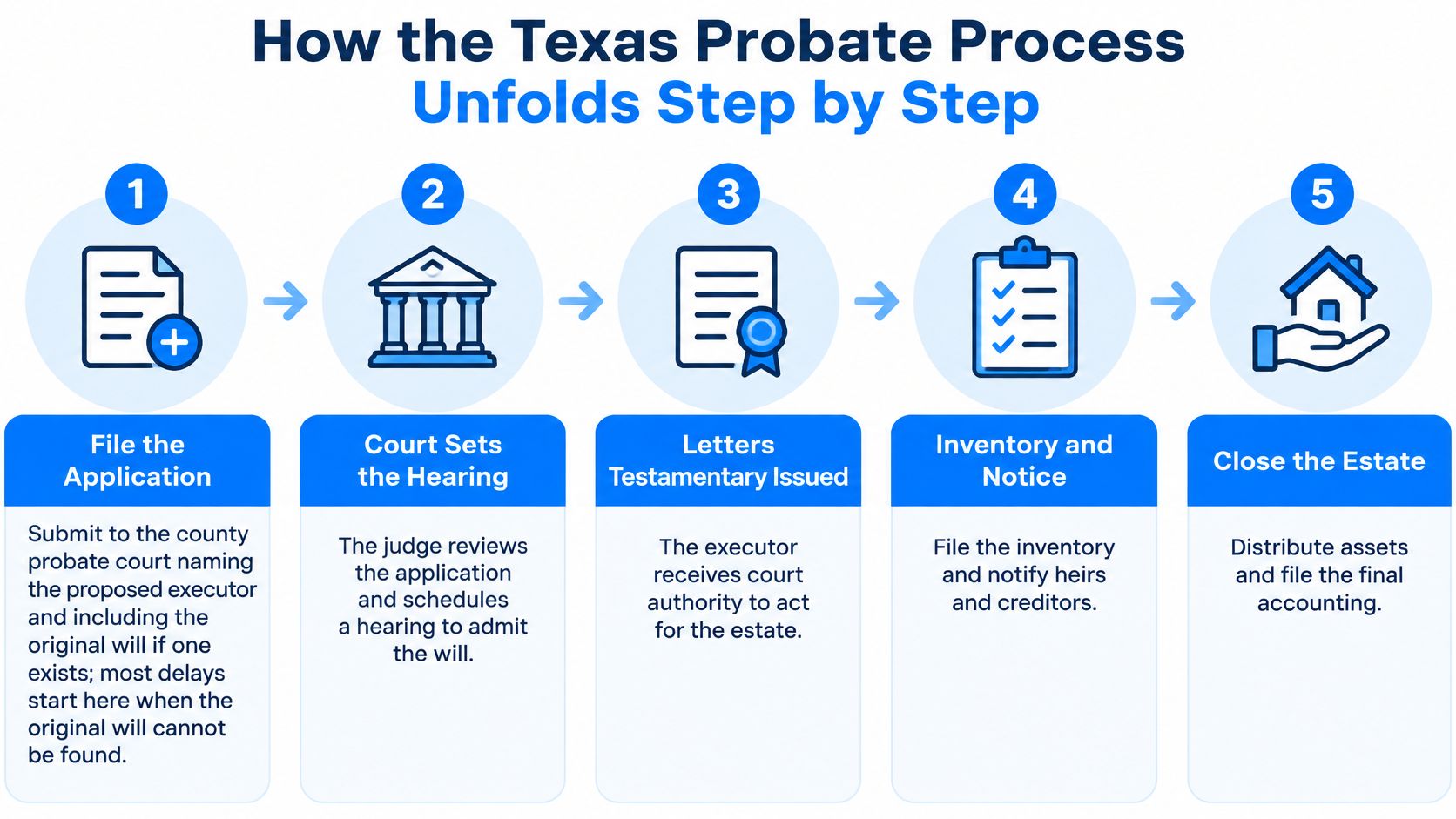
File the application in the county probate court. The application names the proposed executor and attaches the original will if there is one. The original matters. A copy triggers a hearing about why the original is missing, and that hearing can push everything back by weeks. Common snag: the will is in a safe deposit box nobody can access, or in a drawer at a sibling's house in another state.
The court sets a hearing and admits the will. After the hearing, the judge signs an order and the clerk issues letters testamentary when there's a will, or letters of administration when there isn't. Those letters are the estate's proof of authority, so order several certified copies. Common snag: an heir objects, or an address for a required notice can't be confirmed.
The executor qualifies and takes control. Qualifying means formally accepting the role, sometimes with an oath and a bond. Then the practical work begins: change the locks, keep the insurance in force, keep utilities on, collect rent, and photograph the condition of the house. An uninsured vacant house is a problem the heirs inherit twice.
Creditors get notice and file claims. Valid claims get paid. Invalid ones get rejected in writing. Common snag: an unpaid property tax bill or a home equity lien, which has to be resolved before any buyer's lender or title company will proceed.
The executor files the inventory, appraisement and list of claims. This is the hinge of the whole process in an independent estate. Where the court allows it, an affidavit in lieu of the inventory serves the same purpose.
Debts and taxes get paid, and property gets sold. Once the estate is past that inventory stage, an independent executor can market and sell the house without returning to court for permission on each step.
The remainder is distributed and the file closes. Beneficiaries sign receipts, and the executor keeps the records that support every decision.
The reason step five changes the pace is statutory. Under Texas Estates Code Chapter 402, once the court has entered the order appointing the independent executor and the required inventory-related filing has been submitted and approved, no further action of any nature may be taken in probate court except where the Estates Code specifically and explicitly requires court action. The executor still identifies and safeguards assets, handles valid creditor claims, complies with tax obligations, and distributes property correctly. What disappears is the routine permission slip.
What a closed file looks like: a signed order, the recorded deed or muniment order, receipts for every bill paid, written releases from creditors, and a distribution receipt signed by each heir.
If you want the same steps described from the filing side, how probate works in Texas explains what the court reviews at each hearing.
Who Does What in a Texas Probate
No one can sell the estate's house until someone holds legal authority to do it. That single rule explains most of the frustration heirs feel in the first month. Three siblings cannot sign a listing agreement together because the deed isn't in their names yet. Think of the executor as a property manager hired by all the heirs, with powers set by the court and limited by the will.
| Role | What they do | Question to ask |
|---|---|---|
| Executor or independent administrator | Manages assets, pays valid debts, files the inventory and distributes the estate | How will you document the house sale and your fees? |
| Heirs and beneficiaries | Agree to the administration path, receive distributions, can demand an accounting | Do we all agree on the path and the sale price? |
| Creditors | Submit claims against the estate within the claim period | Is this claim valid, and is it secured by a lien on the house? |
| Probate court | Validates the will, appoints the executor, supervises dependent administration | Does this step need a court order? |
| Probate attorney | Prepares filings, advises on the path and tracks deadlines | Which path fits this estate, and what will it cost? |
| Title company | Checks the chain of title and sets document requirements before insuring a sale | Which probate documents do you need before closing? |
The last row is the one families underestimate. A probate judge doesn't clear title; a title company decides what it will insure, and it will ask for documents on its own list. That's why the order of operations matters: authority first, then a contract, then the title company's review.
When several people inherit the same house, the practical questions multiply. Selling inherited property with multiple owners covers how co-heirs divide proceeds and who has to sign what.
Deadlines and Accounting Rules to Plan Around
Texas probate timelines vary enormously, but the calendar isn't random. The Texas Judicial Branch reported that approximately 57,000 probate cases were filed in the referenced fiscal year and that about two-thirds were independent administrations, as noted in this State Bar of Texas guide to handling an estate. That route isn't an edge case. It's the normal one, so its dates are the dates most families have to meet.
| Deadline | Rule | Why it matters for a house sale |
|---|---|---|
| Inventory, appraisement and list of claims | Within 90 days after qualification, unless the court extends it | Claims and asset values must be settled before the sale is documented |
| Muniment of title application | Within four years of death | A late filing removes this shortcut |
| Accounting demand | An interested person may demand one 15 months after letters are issued | Sale records must be kept for review |
| Response to accounting demand | The executor has 60 days to comply | Non-compliance can lead to enforcement in probate court |
| Heirship determination | Required before appointing an independent administrator in an intestate estate | Can add a court proceeding before title is clear |
The muniment route deserves its own note because it's the fastest way to move a house when the estate qualifies. Texas's muniment-of-title procedure can transfer real property without appointing an executor at all, when the court finds the estate has no unpaid debts other than debts secured by real-estate liens, or that administration is otherwise unnecessary. The applicant generally has to establish the death, jurisdiction and venue, timely filing within four years, proper citation, and the absence of debts requiring administration, as set out in Texas Estates Code Chapter 257. Once the order is entered, a certified copy of the probate order and the will should be filed in the county real-property records to establish the beneficiary's chain of title before closing.
Plan around dates, not months. No statute sets a total duration for an estate. Creditor claims, tax filings, and whether the heirs agree determine the length, so build the calendar from the milestones above and treat any quoted overall timeline as an estimate.
Small Estate Shortcuts and Why Houses Often Need More
The $75,000 figure is the most misread number in Texas probate. The common belief is that an estate under that threshold skips probate entirely and the family can sell the house. That belief is wrong in a specific, expensive way. Eligibility for a small estate affidavit generally requires no will, total non-exempt assets of no more than $75,000, sufficient assets to pay debts, unanimous heir agreement, and no real property other than a qualifying homestead passing to a surviving spouse or minor children, per the Tarrant County probate court small estate affidavit form.
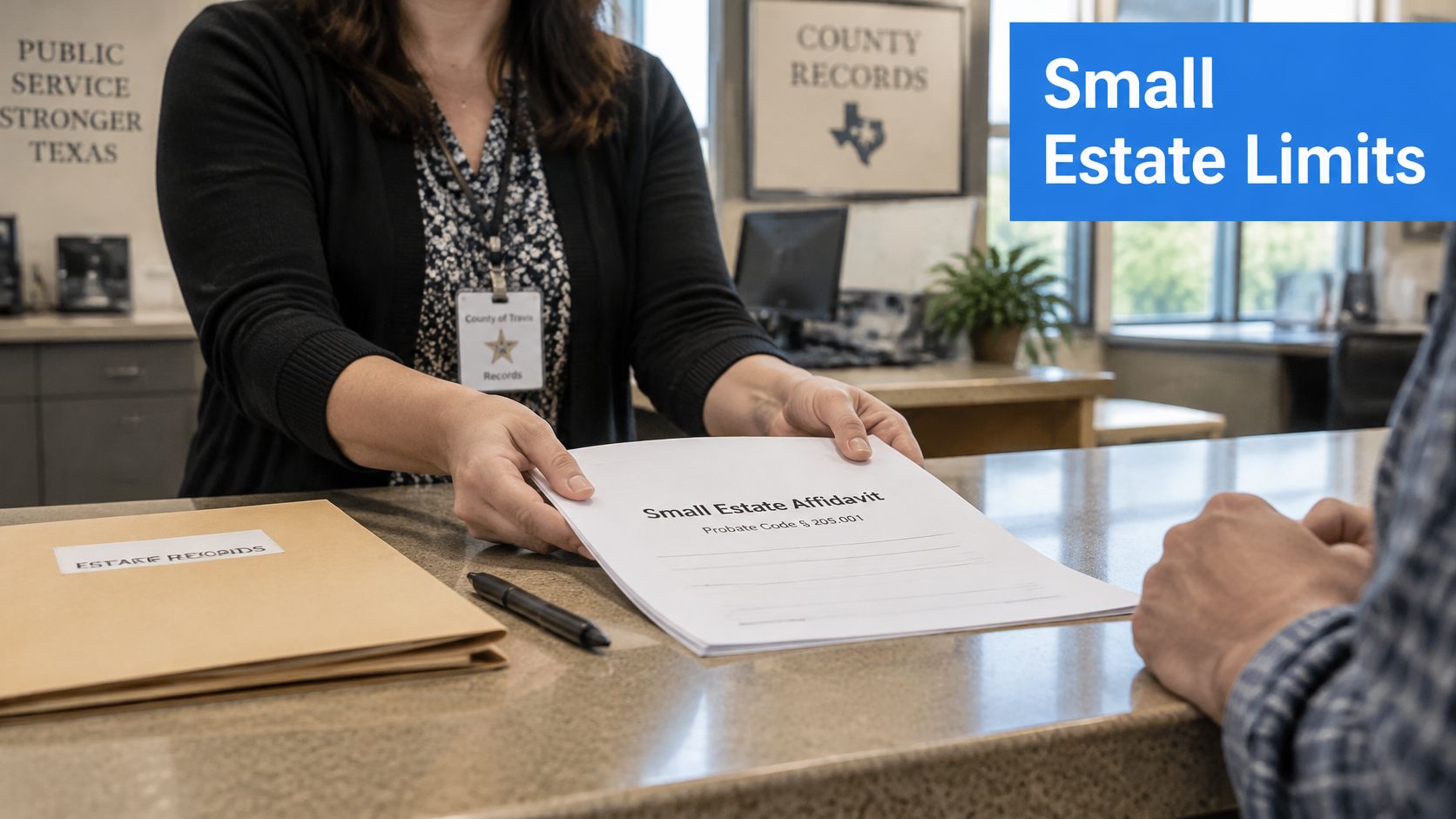
A duplex under $75,000 shows the gap
Say three siblings inherit a rented duplex in Dallas. The combined estate, including bank accounts, comes in under $75,000. The affidavit can help them collect the bank funds. It cannot transfer the duplex. A court-approved affidavit may be recorded to transfer a qualifying homestead, but it cannot generally transfer other real property, and a rental duplex is other real property. The title company will still want probate, heirship documentation, or some form of court authority before it insures a sale.
That's the information gap that costs a family a month. An heir signs a purchase contract believing the paperwork is a formality, then discovers the buyer's title company won't close without an order that was never filed.
Run the sequence in order before signing anything.
- Does a will exist? If yes, the affidavit is off the table.
- What kind of property is it? A qualifying homestead for a surviving spouse or minor children is different from a rental, a vacant house, land, or a second home.
- Are there debts? The estate has to be able to pay them.
- Do all heirs agree? Unanimity is required, not a majority.
- What does the county require for recording? Recording rules and forms vary by county, so confirm locally.
For families in Montgomery County, this explanation of small estate affidavits in The Woodlands covers the local filing expectations. And if the house itself is the problem, because it needs repairs nobody can supervise from another state, selling a house as-is for cash in Texas explains what buyers inspect.
Collecting money and transferring title are two different steps. An affidavit can solve the first and leave the second untouched.
Selling the Inherited House During Probate
Authority over an estate works like a signature card at a bank: the account exists either way, but only the person whose name is on file can move the money. The title company plays the bank's role in a sale. Until it sees court-issued proof of who may sign, the house cannot change hands, and a purchase contract signed too early usually gets renegotiated from a weaker position.
Who is allowed to sign for the estate
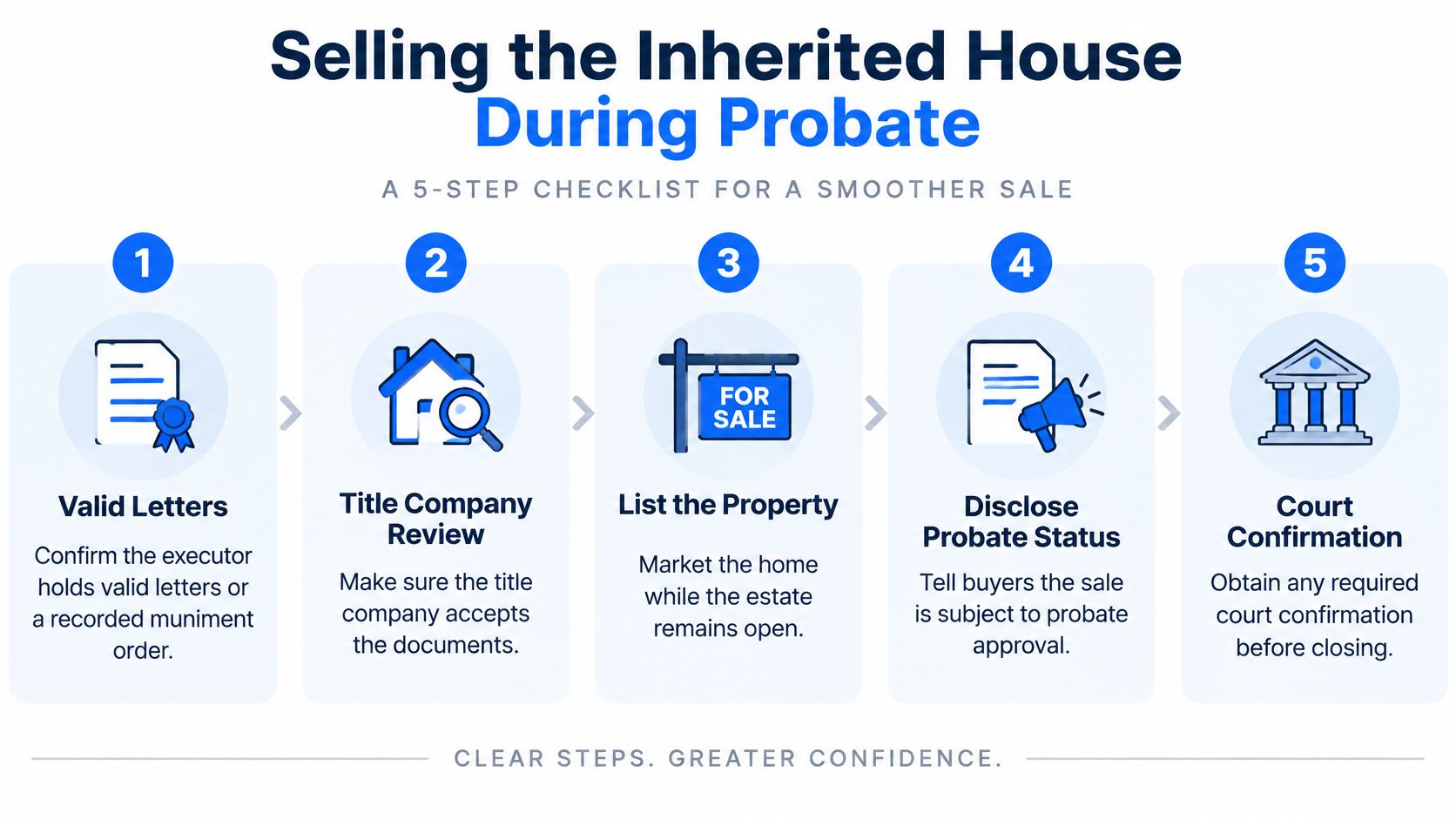
Once the court issues letters, the executor named in the will can act for the estate. Most Texas estates run as independent administrations, which is why an inherited house here can often be listed and sold without going back to a judge for permission at each step. An independent executor signs the listing agreement and the deed under authority the letters already grant. A dependent administration needs court approval for the sale itself, and a muniment-of-title estate has no executor at all, so the recorded order does the signing work. Heirs acting on their own behalf cannot sign a listing agreement no matter how clearly the will reads.
A buyer's agent will rarely catch this. A title company always does, usually late, after a contract is already signed.
The documents a title company asks for
Expect a request list similar to this, and gather it early.
- Certified letters testamentary or letters of administration, current and legible.
- The will, or the order that names the executor, so the chain of authority is documented.
- A recorded muniment of title order, when the estate used that route instead of appointing an executor.
- Lien payoff statements for any mortgage, home equity loan, or judgment attached to the property.
- Property tax receipts for the current year, because unpaid taxes follow the house rather than the person.
Notice what is not on that list: a small estate affidavit. The shortcut can release bank balances and wages, but it generally cannot transfer a house, so an estate that relied on it still needs probate or another court order before a title company will insure the sale.
For an intestate estate, missing proof of heirs is the classic bottleneck. The court typically requires an heirship determination before an independent administrator may be appointed, which can add a separate proceeding before the property can be conveyed reliably.
Recordkeeping carries its own risk. After the statutory period, an interested person may demand an accounting, and an executor who fails to comply within the required window can face enforcement in probate court. For a property sale, that means preserving the purchase contract, closing statement, valuation support, lien payoff records, expenses paid by the estate, and the distribution calculations, so the transaction holds up if a beneficiary questions it later.
Here's the working checklist for the executor, in order.
- Confirm the executor's authority in writing and order certified copies.
- Order a valuation you can defend, not just a free online estimate.
- Collect lien statements for every mortgage and judgment against the house.
- Verify property taxes and insurance are current and the policy is still active.
- Record the probate order in the county real-property records if the estate used muniment of title.
- Keep every receipt, from the lock change to the final utility bill.
For the property-level version of those requirements, selling a probate home in Texas groups them by what the title company asks for first.
Some heirs want a fixed closing date more than a top-of-market price, particularly when the roof needs replacing and nobody lives nearby to manage contractors. Cyber Homes buys houses for cash in Dallas, Fort Worth, Houston, Austin, San Antonio, and El Paso. Selling has three steps: tell us about the property, get a fair cash offer, and pick your closing date. The offer is no-obligation, and any preliminary figure can change after property review, inspection, title review, or verification of information. A title company still needs the executor's authority documented before it will insure the sale, so the probate paperwork comes first on either route.
If you're managing an inherited Texas house and the probate calendar is setting your timeline, Cyber Homes can take the property off your hands as-is, with no repairs, no showings, and no commissions. We buy houses for cash in Dallas, Fort Worth, Houston, Austin, San Antonio, and El Paso, and the sale closes through a reputable title company on the date you choose. Visit Cyber Homes to tell us about the property and get a fair cash offer with no obligation.

Edited by
James Vasquez
Real Estate Investor & Land Specialist with 10+ years experience in residential flipping, vacant land investing, land wholesaling, and subdivision deals.
Disclaimer: The information provided is for educational purposes and does not constitute financial or legal advice. Always consult with licensed professionals before making investment decisions.