Top 10 Companies That Buy Houses for Cash in Georgia

You're managing an inherited house in Atlanta that needs repairs, a relocation date is approaching, or a foreclosure deadline is becoming difficult to ignore. A traditional listing may produce a higher gross price, but it can also bring inspections, financing delays, appraisal risk, showings, and uncertainty about when the sale will close.
A non-contingent cash offer generally means the buyer doesn't need a mortgage approval, appraisal approval, or sale of another property to complete the purchase. That can remove major failure points, but “cash” doesn't automatically mean every contingency disappears. A buyer may still request an inspection, title review, document review, or another contractual exit right.
This guide compares seven Georgia cash-buying companies, with attention to the practical issues sellers care about most: speed, certainty, property condition, fees, geographic coverage, closing mechanics, and the amount you'll retain. Georgia remains a significant cash-sale market. 31.6% of U.S. home sales were all-cash in 2025, and Atlanta's metro area recorded a 29.0% cash-share rate in the first half of 2025, according to Realtor.com's cash-sale research. The central trade-off is simple: a fast, non-contingent sale can reduce stress and execution risk, but it may not maximize the price you'd receive from a well-managed MLS listing.

Get a cash offer for your home
1. CyberHomes
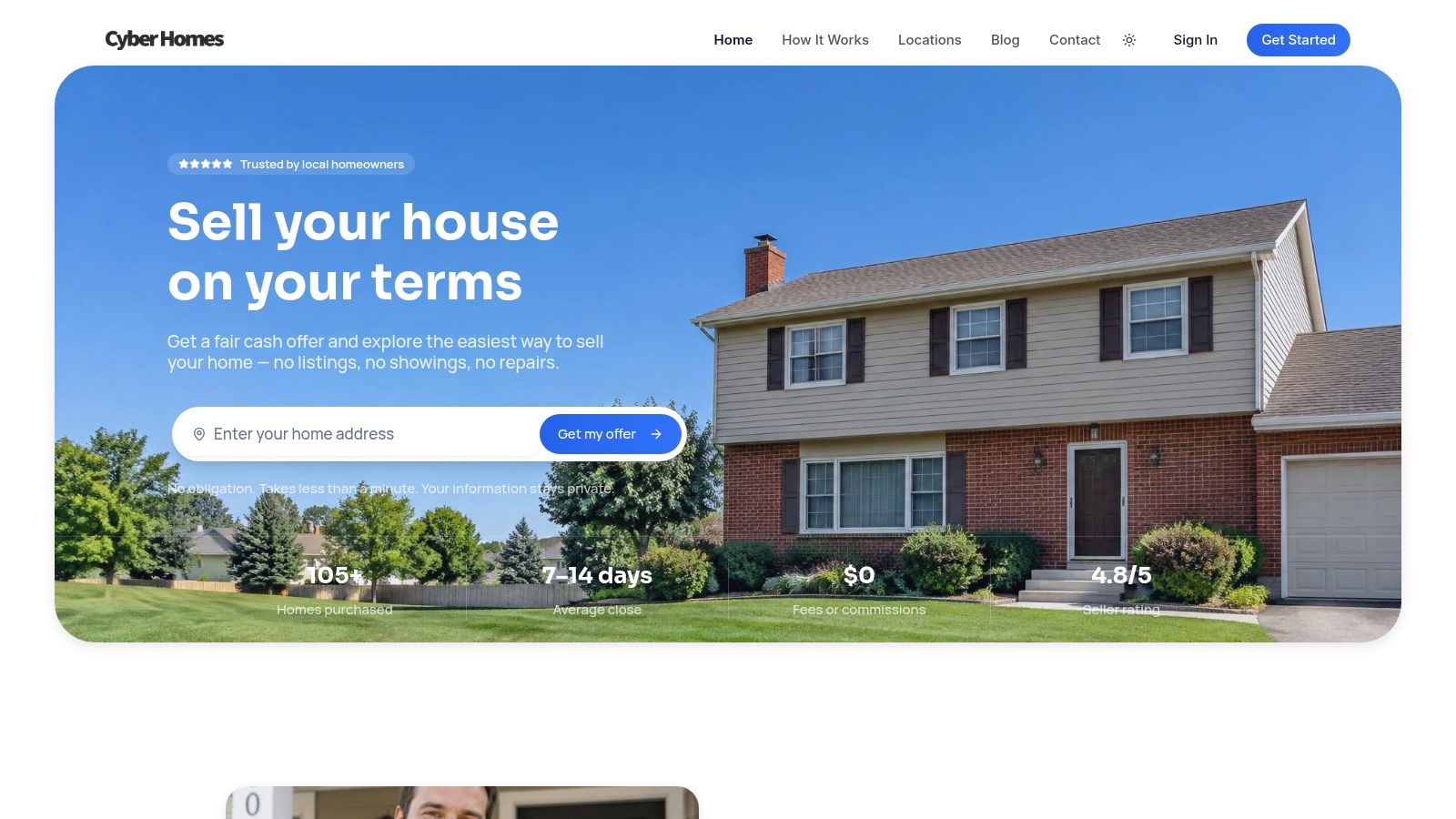
CyberHomes is a strong fit for Georgia sellers who value speed, certainty, and an as-is transaction over pursuing the highest possible retail price. The company describes itself as a family-owned direct cash buyer, and its Atlanta operation offers homeowners an alternative to listing publicly or working with a large iBuyer.
The process is designed to be direct. CyberHomes says sellers can receive a no-obligation cash offer usually within 24 hours, choose a closing date, sell without repairs or showings, and complete the transaction through a reputable title company. The company also says it covers standard closing costs and doesn't charge seller commissions. Those details matter because the headline offer is only one part of the comparison. A seller should ask for the estimated net proceeds, including any title charges, liens, taxes, concessions, or other deductions.
Practical rule: Treat “cash” as a financing description, not a guarantee that the contract has no contingencies. Read every termination right before signing.
CyberHomes positions its offers around local evaluation rather than a purely algorithmic estimate. Sellers work with one point of contact, which can be useful in probate, divorce, foreclosure, relocation, tenant, or inherited-property situations where the facts change during the transaction. The company also says it may advance up to $2,000 for moving expenses before closing, subject to its current terms, which can help a seller manage an urgent move.
Where CyberHomes fits best
CyberHomes is worth considering when the home needs work, showings would be disruptive, or a conventional buyer's financing creates too much uncertainty. Its Atlanta-focused comparison of companies that buy houses for cash also emphasizes as-is purchases, no required repairs, no seller commissions, title-company closings, and seller-selected timing.
The limitation is equally important. CyberHomes prioritizes execution over top-market pricing, so a seller may net less than with a successful MLS sale. Coverage is concentrated in selected major markets, including Atlanta, so confirm that the property is currently eligible before relying on a proposed timeline.
Pros
- Fast response: The company says offers usually arrive within 24 hours.
- As-is process: Sellers can avoid repairs, showings, and agent commissions.
- Flexible closing: You can request a preferred closing date rather than accepting a fixed schedule.
- Personal communication: One point of contact can simplify complicated sales.
- Moving support: An advance of up to $2,000 may be available under current terms.
Cons
- Price trade-off: The offer may be below the net proceeds from a strong MLS sale.
- Limited coverage: Availability varies by Georgia location.
- Terms require verification: Confirm contingencies, fees, proof of funds, and closing procedures in writing.
Visit CyberHomes to check current Georgia coverage and request an offer.
2. Opendoor
Opendoor is designed for sellers who want a technology-led cash process with fewer public showings and a structured online dashboard. In Georgia, its strongest relevance is generally around metro Atlanta and other areas where the company is actively acquiring qualifying homes.
The online intake is convenient. A seller can submit property information, review guided next steps, and compare available sale paths. Opendoor offers a direct Cash Offer route as well as a “Cash Now, More Later” option, which gives sellers a choice between immediate certainty and a potential later-market process. Those options aren't interchangeable, so the seller should compare the timing, service charge, repair treatment, and cancellation terms for each one.
The contingency question
A direct cash offer can remove the mortgage and appraisal contingencies associated with a financed retail buyer. Opendoor may still evaluate the property, request repair credits, or apply deductions after its inspection process. A seller should distinguish between a firm purchase price and an initial estimate that remains subject to property review.
The Cash Now, More Later program lists a 5% service charge, according to the Opendoor review and program overview. The charge is only one part of the net calculation. Repair deductions, standard seller closing costs, and any other transaction charges can reduce what reaches the seller at closing.
Opendoor coordinates closing dates with licensed Georgia attorneys, which can make the process easier for owners who prefer not to manage every administrative step themselves. Flexible timing is useful for relocation or purchase coordination, but flexibility doesn't eliminate the need to confirm possession terms. Ask whether you must vacate before recording, whether a post-closing occupancy arrangement is available, and which party controls the final walkthrough.
Best for: Sellers with a qualifying home who want a mostly digital process and are comfortable trading some net proceeds for convenience.
Watch closely: The service charge, repair credits, inspection rights, and the exact language defining when the offer becomes binding.
Visit Opendoor to review current Georgia eligibility and selling options.
3. Offerpad
Offerpad gives Atlanta-area sellers several paths instead of forcing every property into a single cash-sale model. The choices can include a direct cash offer, marketplace exposure, or an Offerpad-supported listing. That flexibility helps when a seller wants a fast fallback but isn't certain that a direct investor sale is the best financial result.
The process starts online and is presented as a simplified experience from offer request through closing. Sellers can generally select a closing window of 8 to 60 days, based on the plan notes for its Georgia operation. A seller moving for work may want the longer end of that range, while someone dealing with a deadline may prefer the earliest available date.
Net proceeds matter more than the offer headline
Offerpad publishes a 5% service fee, plus standard seller closing costs, according to its Georgia program information. The fee can make the comparison easier because the charge is identified upfront, but it also means the offer price shouldn't be compared directly with an agent's suggested list price. The correct comparison is estimated net proceeds after the fee, repairs, concessions, title charges, and any other deductions.
Offerpad may also request repair credits after its inspection. That doesn't necessarily make the model unsuitable, but it weakens the assumption that a cash sale is automatically final on the day the first offer appears. Ask for the inspection scope, the repair-credit process, and the circumstances in which the company can terminate or revise the agreement.
A useful feature for some sellers is the possibility of moving out a few days after closing, if the specific agreement allows it. Possession language must be written clearly. A verbal promise about extra time isn't enough when a moving truck, tenant notice, or replacement-home schedule depends on it.
Best for: Owners who want a national operator, a published fee structure, and more than one selling route.
Trade-off: The direct-cash path may be easier than an MLS listing, but the service fee and post-inspection credits can materially change the final net.
Visit Offerpad to check current Georgia service areas and terms.
4. HomeVestors, We Buy Ugly Houses
HomeVestors operates through a network of local franchisees using the We Buy Ugly Houses brand. That structure gives the company broad recognition and local coverage, while also making the individual franchise operator an important part of the seller's experience.
A local franchise buyer may be comfortable evaluating a property that needs substantial work, has an inherited-property complication, or would be difficult to show. The as-is model means the seller doesn't need to complete renovations before receiving an offer. Quick evaluations and fast closings can appeal to owners who need a clear exit rather than a long marketing campaign.
The franchise model changes the comparison
The brand name doesn't tell you everything about the actual buyer. Each local operator may have different experience, funding capacity, preferred property types, and tolerance for title or occupancy problems. Before accepting an offer, ask who will be named as the buyer, whether the buyer intends to close directly, and whether the contract permits assignment to another entity.
A recognizable brand can simplify discovery, but the purchase agreement still controls your risk.
Offers from investor buyers usually reflect repair expenses, holding costs, resale risk, and the buyer's required margin. That means the amount may fall below what a seller could net after a conventional listing, even when the property is attractive to retail buyers. The right question isn't whether the offer matches an online estimate. It's whether the speed and certainty justify the difference after all selling costs.
Sellers should request proof of funds, identify the title company or Georgia attorney handling the closing, and confirm that the earnest-money and closing provisions are written into the contract. Review the local operator's recent reputation rather than relying only on national branding.
Best for: Sellers with properties needing repairs who want a known investor brand and a local evaluation.
Cons: Operator quality, communication, offer terms, and closing speed can vary by franchise territory.
For a broader explanation of the as-is model, see as-is home buyers.
Visit We Buy Ugly Houses to locate the relevant Georgia operator.
Get a cash offer for your home
5. WeBuyHouses.com
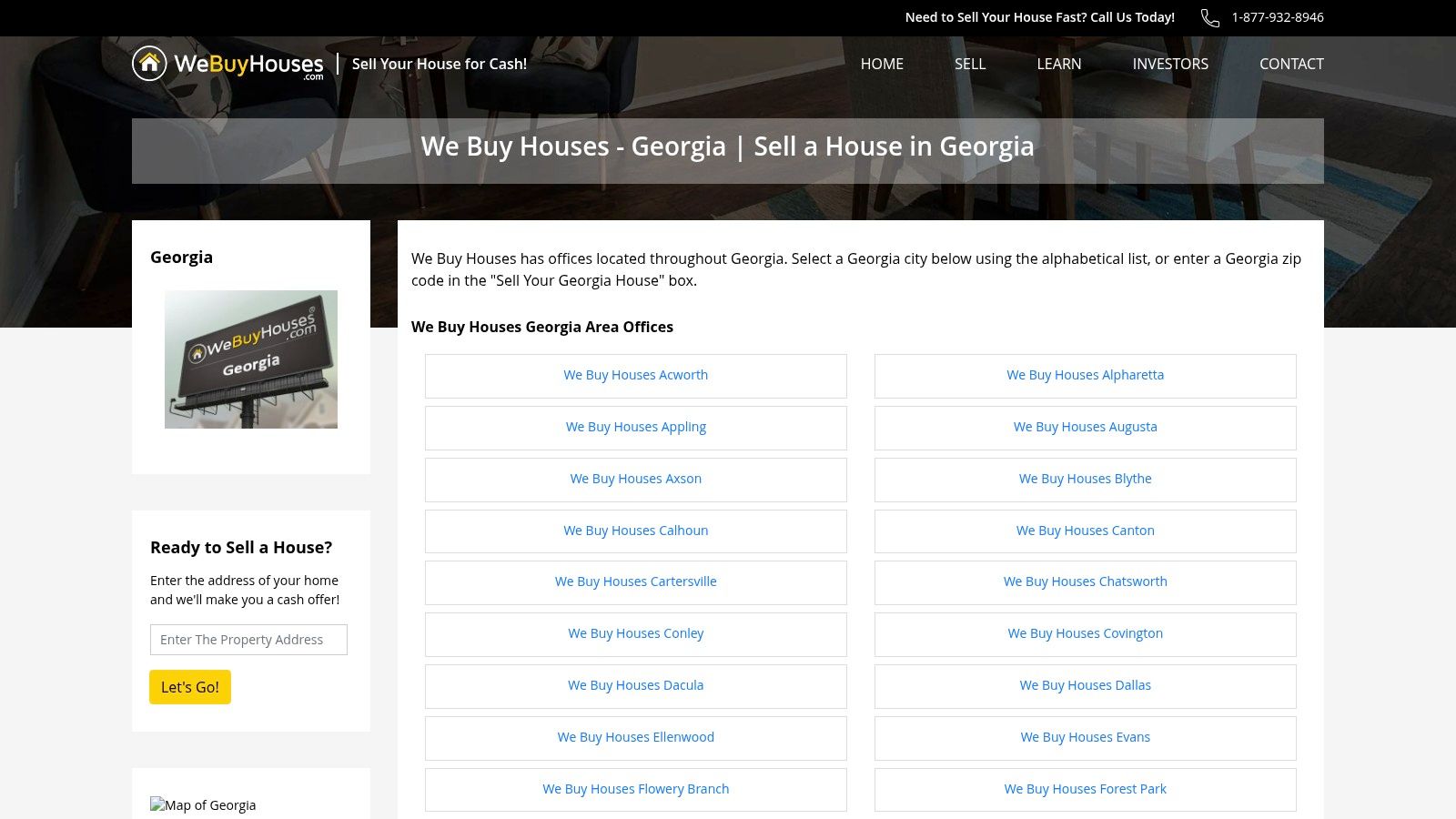
WeBuyHouses.com connects sellers with independently owned local investors operating under a national brand. The intake process is simple: submit the property address, provide basic information, and wait for a local investor to make contact.
That broad network can help sellers outside the largest Georgia markets. The company promotes as-is purchases and a direct-to-buyer process, which can be useful when the property has deferred maintenance, difficult tenants, or a short relocation window. The buyer, rather than a traditional buyer's agent, handles the acquisition conversation, so the process may involve fewer parties.
Coverage doesn't guarantee uniform execution
The main advantage is reach. A seller can start with one brand and potentially connect with a local buyer without contacting several investors separately. The drawback is that each office operates independently. Response times, offer structure, closing capacity, and communication standards may differ between locations.
Ask the local representative whether the company will buy directly or assign the contract. If assignment is possible, clarify whether the original buyer remains responsible for closing and whether the seller can object to a substitute buyer. Also request a proof-of-funds document tied to the entity that will provide the purchase money.
A fast response isn't the same as a non-contingent contract. Review inspection provisions, title objections, financing language, appraisal language, and any clause allowing the buyer to cancel. If a seller needs a recorded deed by a specific date, the agreement should state the closing date and possession terms precisely.
Best for: Sellers who want a statewide starting point and a direct connection to a local investor.
Trade-off: The national intake is consistent, but the local experience isn't necessarily standardized.
Visit WeBuyHouses.com to submit a Georgia property address.
6. Express Homebuyers
Express Homebuyers is a national direct buyer with more than 20 years in business, according to the company information provided for this comparison. Its appeal is process simplicity. Sellers who don't want to coordinate repairs, photography, open houses, buyer showings, and lender requirements may prefer a direct acquisition conversation.
The company purchases homes as-is and presents a paperwork-light route intended to reduce friction. That can work well for a vacant property, a rental with deferred maintenance, or an inherited home where the owner lives outside Georgia. It can also help when family members need a predictable process, although all owners and estate representatives still need to be identified correctly before contract signing.
Certainty still depends on the contract
A cash buyer can avoid the lender approval risk attached to a financed purchaser, but the buyer may retain inspection, title, or internal approval rights. Sellers should ask for the complete purchase agreement rather than relying on a summary of the offer. The document should identify the buyer, price, closing date, deposit, title process, possession, and every condition that allows termination.
Express Homebuyers' direct model may produce an offer below a property's full retail potential because the buyer accounts for repairs, carrying costs, and resale uncertainty. Compare the offer with a realistic MLS estimate, not just an optimistic list price. Include agent compensation, seller concessions, preparation costs, delay risk, and the time value of a faster closing in that comparison.
Availability and timeline can vary by Georgia location. Confirm that the company is actively buying in the property's county and ask who will conduct the evaluation. A local contact who can explain the offer calculation is more useful than a generic promise of speed.
Best for: Sellers who want a seasoned, direct, as-is process with fewer administrative steps.
Cons: The price may reflect the buyer's repair and holding risk, and local availability can affect timing.
Visit Express Homebuyers to begin a Georgia inquiry.

Get a cash offer for your home
7. Veyla Capital Group
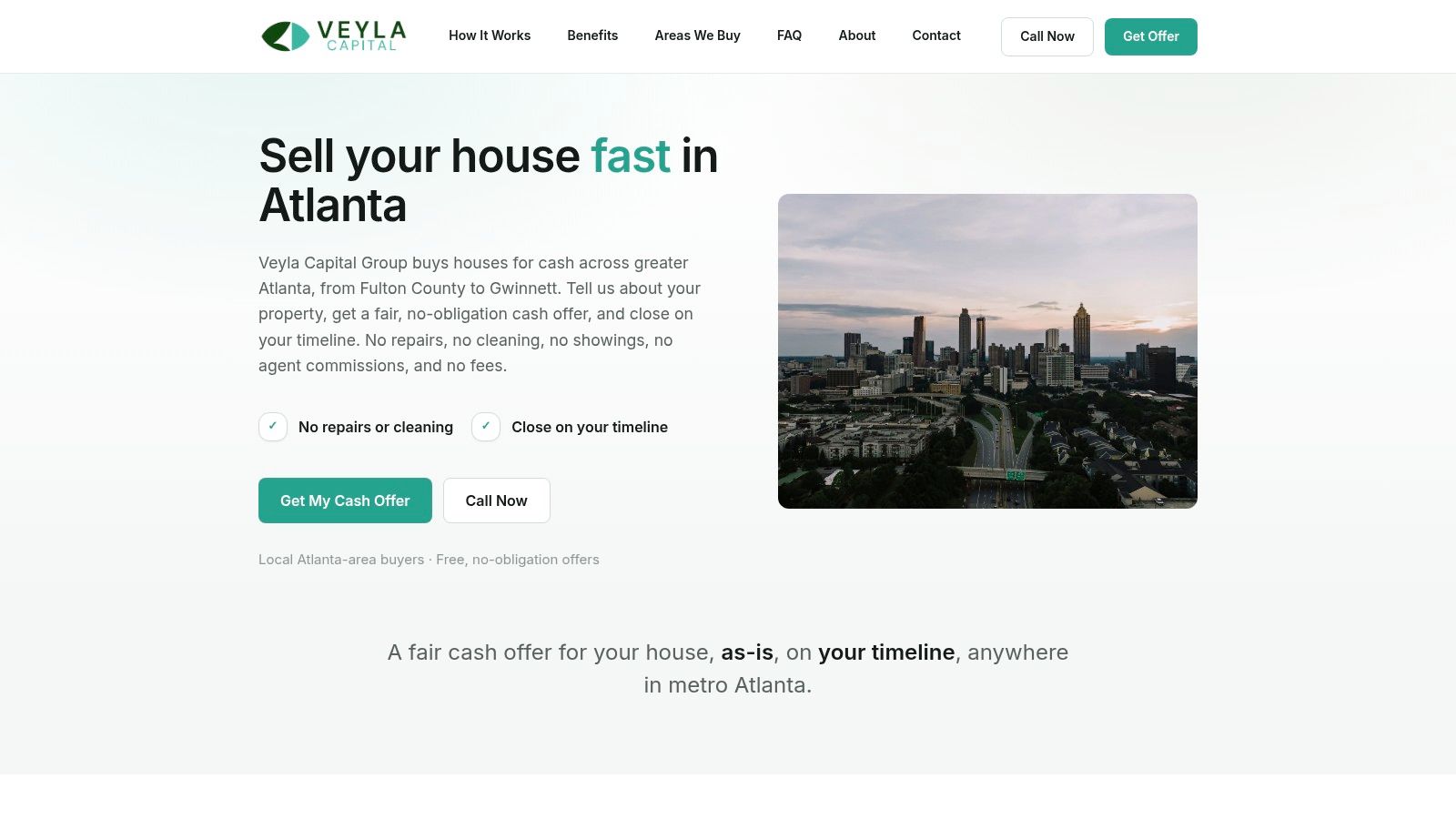
Veyla Capital Group is an Atlanta-based investment company focused on properties across the metro area. Its local footprint can be an advantage for sellers who want a decision-maker familiar with Fulton, DeKalb, Cobb, Gwinnett, and nearby counties rather than a remote intake team.
The company presents itself as the actual buyer rather than a wholesaler passing the contract to another investor. That distinction deserves verification in every transaction, but it gives sellers a useful question to ask early: “Will your company be the entity on the deed and the source of funds at closing?” A clear answer can reduce uncertainty about assignment, resale, and last-minute buyer substitutions.
Proof of funds is part of the offer
Veyla emphasizes quick walkthroughs or photo evaluations, as-is purchases, and proof-of-funds clarity. Those are practical features for sellers comparing several Atlanta buyers. A local buyer may also be able to explain how neighborhood condition, title status, occupancy, and repair scope affect the proposed price.
The regional focus is the main limitation. Veyla may be a sensible option for metro Atlanta but less relevant to a seller in Savannah, Augusta, Columbus, or a rural county outside its acquisition area. Smaller local teams can also have narrower acquisition criteria or less flexibility for unusual properties.
Before signing, ask for a written offer and proof of funds, confirm whether the offer is contingent on inspection or partner approval, and identify the closing attorney or title company. Do not assume that “no service fee” means there are no deductions. Request a net sheet showing taxes, title charges, liens, recording costs, and any agreed credits.
Best for: Atlanta-area sellers who want local communication, direct-buyer clarity, and a relatively simple as-is evaluation.
Trade-off: Coverage is regional, and the team's acquisition capacity may be narrower than a national operator.
Visit Veyla Capital Group to check current metro Atlanta coverage.
Georgia Cash Home Buyers, 7-Company Comparison
| Company | 🔄 Implementation complexity | ⚡ Resource requirements | ⭐📊 Expected outcomes / Impact | 💡 Ideal use cases | ⚡ Key advantages |
|---|---|---|---|---|---|
| Cyber Homes | Low, quick inquiry, single point of contact | No agent commissions; covers standard closing costs; advances up to $2,000 for moving | ⭐ High certainty and speed; typically offers within 24h, closings in 7–14 days; 4.8/5 seller rating | Time-sensitive needs: foreclosure, probate, divorce, relocation, costly repairs, problem tenants | Local, family‑owned service; as‑is purchases; personal service and fast closings |
| Opendoor | Low, mostly digital dashboard and guided steps | Service charge varies (e.g., ~5% option); repair credits may apply | ⭐ Data‑informed offers; convenient digital process; net proceeds may be lower after fees/repairs | Sellers who want fewer showings and a streamlined online experience | Instant online offers; flexible selling options (Cash or Cash Now, More Later) |
| Offerpad | Low, 100% online with clear timelines | Published service fee (~5%) + standard seller closing costs; post‑inspection credits possible | ⭐📊 Fast offers and flexible closing windows (8–60 days); net reduced by fees/repairs | Sellers wanting predictable fees and multiple sale pathways | Multiple sale paths (cash, marketplace, listing); transparent fee timeline |
| HomeVestors (We Buy Ugly Houses) | Moderate, local franchise evaluations; variable operator processes | No required seller repairs; offer levels vary by franchise to cover repairs/holding | ⭐ Recognized national brand; typically quick closings but offers below retail | Owners needing as‑is sale with brand recognition and local operators | Broad franchise network; local market knowledge; quick as‑is purchases |
| WeBuyHouses.com | Low–Moderate, online intake connecting to local investors | No buyer agent fees; offer terms and pricing set by independent local investors | ⭐📊 Broad statewide reach; quick direct‑to‑buyer responses; variable nets by market | Distressed or time‑sensitive sellers statewide who want direct offers | Unified intake with local investor connections; wide geographic coverage |
| Express Homebuyers | Low, paperwork‑light, streamlined process | As‑is purchases; offers reflect repair/holding costs and may be below retail | ⭐ Seasoned operator (20+ years); consistent speed and certainty | Sellers prioritizing speed and low paperwork over top price | Long track record; fast, simple process designed to avoid financing delays |
| Veyla Capital Group | Low, local walkthrough/photo evaluations; direct buyer | No separate service‑fee line item; smaller team may limit price flexibility | ⭐ Local decision‑makers; transparent proof‑of‑funds; competitive for metro Atlanta | Metro Atlanta sellers wanting a local, transparent buyer (no wholesalers) | Direct buyer model, proof‑of‑funds clarity, local market focus and education |
Turn a Cash Offer Into a Certain Closing
The best cash buyer isn't automatically the one with the fastest verbal response or the highest headline number. Compare the written net proceeds, the buyer's contractual exit rights, the closing provider, and the evidence that the buyer can fund the purchase.
Start by requesting the complete offer and purchase agreement. Identify every contingency, inspection right, title objection period, approval condition, assignment provision, and termination right. A non-contingent offer should explain what the buyer can still review and whether the buyer can cancel after that review.
Confirm proof of funds before treating the offer as reliable. The document should correspond to the buyer named in the agreement or clearly explain the relationship between the funding entity and the purchaser. Ask which Georgia title company or attorney will handle escrow and closing, and contact that provider independently using verified contact information. Don't wire money or release sensitive information based only on a buyer's email instructions.
Your net-proceeds comparison should include the purchase price, service fees, repair credits, title charges, taxes, liens, concessions, and any other seller-paid costs. Neutral industry coverage describes investor-style offers as often falling around 50% to 70% of market value, while iBuyer-style offers may reach 70% to 80% or more, with service fees still applying. The practical lesson is that offer size alone doesn't answer the question. Compare what remains after costs with a realistic MLS alternative, including preparation, commissions, concessions, carrying costs, and the possibility of a longer closing.
What the closing timeline should show
A typical direct-sale process moves through several identifiable stages:
- Inquiry and evaluation: You provide the address, property details, and access for a walkthrough or photo review.
- Written offer: The buyer states price, closing date, conditions, possession terms, and expenses.
- Contract signing: All owners, estate representatives, or authorized parties sign the purchase agreement.
- Title work: The closing provider searches ownership, liens, taxes, judgments, and other title issues.
- Escrow and final review: The parties satisfy agreed conditions, verify payoff information, and prepare closing documents.
- Final walkthrough and recording: The buyer confirms the property's agreed condition, funds are delivered, the deed records, and possession transfers according to the contract.
CyberHomes is an option for sellers who want an as-is, non-contingent cash process, personal communication, a stated 7 to 14-day closing range, and possible moving-expense assistance. Its Atlanta materials describe offers usually within 24 hours, seller-selected closing dates, standard closing-cost coverage, and title-company closings. Confirm current Georgia coverage, the exact offer terms, and any assistance conditions directly at CyberHomes.
A foreclosure, probate, divorce, tenant, or title problem may require advice from a Georgia real estate attorney before you sign. The fee for a professional contract review can be small compared with the cost of an unclear contingency, an unexpected lien, or a missed closing deadline.
CyberHomes provides direct as-is cash offers, seller-chosen closing dates, and a process designed to remove repairs, showings, and financing uncertainty, with possible moving-expense assistance under its current terms. If you're comparing Georgia cash buyers and want to test speed and net proceeds against your alternatives, visit Cyber Homes to check coverage and request a no-obligation offer.

Edited by
James Vasquez
Real Estate Investor & Land Specialist with 10+ years experience in residential flipping, vacant land investing, land wholesaling, and subdivision deals.
Disclaimer: The information provided is for educational purposes and does not constitute financial or legal advice. Always consult with licensed professionals before making investment decisions.