Pre Foreclosure vs Foreclosure: Key Differences Explained
The notice's legal stage, not the word “foreclosure,” determines the homeowner's deadline and which options may remain. Pre-foreclosure generally means the homeowner is delinquent and no sale has occurred. Foreclosure is the enforcement process that can lead to an auction or lender repossession.
A scheduled sale changes the practical choices. Before the sale, the homeowner may still have time to address the default or sell, subject to the lender's requirements. Once a sale is scheduled, that date sets the immediate deadline. The notice in hand is more useful than a broad label.
Foreclosure activity includes properties at different stages, from early default notices to scheduled auctions and repossessions. During the third quarter of 2025, 222,318 U.S. properties were in the foreclosure process, including pre-foreclosures. The cited report concerns vacancy and zombie foreclosures, so it does not support that process-wide count. What matters to an individual homeowner is whether the notice shows a sale date: that date can determine how much time remains and who may still be able to buy the home.

Pre-Foreclosure and Foreclosure Side by Side
The Pre Foreclosure vs Foreclosure question gets settled by the notice in your hand, not by the headline you read. One label describes a delinquency period with no sale on the calendar. The other describes enforcement machinery that ends with a trustee's or sheriff's sale and, if no bidder clears the debt, a lender-owned property.
| Factor | Pre-foreclosure | Foreclosure |
|---|---|---|
| Legal status | Default or delinquency, no sale yet | Enforcement underway, with a sale scheduled or the lender in possession |
| Who holds the property | Homeowner, with the lender's claim growing | Homeowner until the sale, then lender or buyer |
| Homeowner control | Can reinstate, modify, refinance or sell with lender approval | Few options; the process sets the sale date |
| Typical notice | Missed-payment letters, demand or notice to accelerate | Notice of trustee sale, auction notice or lis pendens |
| Typical duration | Starts after several missed payments, and federal rules generally wait until 120 days delinquent | Two to three months from acceleration to sale in some states, longer in others |
| Buyer access | Lender-approved pre-foreclosure sale, usually with a full payoff | Auction bidding or purchase of a lender-owned home |
Nationally, the volume is smaller than the crisis years but still substantial. In 2025, foreclosure filings, which include default notices, scheduled auctions and bank repossessions, were reported on 367,460 U.S. properties, 14% more than in 2024 yet 87% below the 2010 peak of nearly 2.9 million properties, according to ATTOM's year-end 2025 foreclosure market report. Those filings worked out to 0.26% of all U.S. housing units. Lenders initiated foreclosure on 289,441 properties in 2025, up 14% from 2024 and still 86% below the 2009 peak of 2,139,005 starts.
The two counts are not interchangeable, and that's the point. A foreclosure start is an initiation event. A filing total rolls in default notices, scheduled auctions and completed repossessions, so it always looks bigger and scarier than any single homeowner's situation. The same report shows how much room the middle of that range holds: properties that were foreclosed in the fourth quarter of 2025 had spent an average of 592 days in the foreclosure process.
Take the table to the phone call. Each row is a question for the servicer: what stage is this file at, is a sale scheduled, what is the reinstatement amount, and has a workout package been received. Those four answers tell you more than the word printed at the top of the letter.
When Each Stage Begins and How Long It Lasts
The word foreclosure can describe several different stages, but the notice in hand sets the practical deadline. A missed-payment letter, a formal default notice, and a scheduled sale do not leave the homeowner with the same time or choices. Read the notice for the action required and its due date.
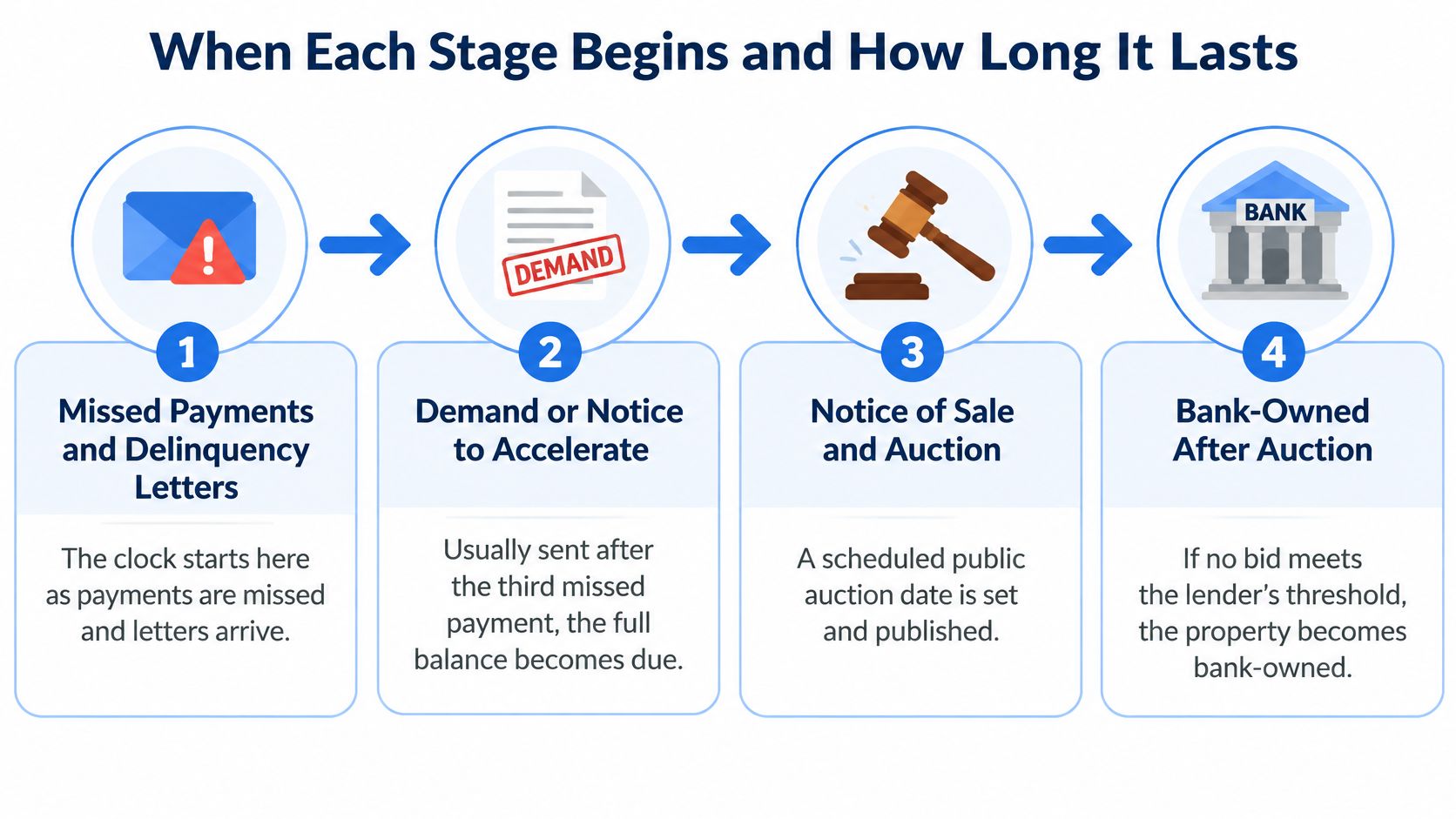
The Notices Arrive in a Fixed Order
Delinquency comes first. Missed-payment letters and collection calls begin the process, but they are not a final legal action. HUD's guidance on avoiding foreclosure describes the early stage as roughly the first three to four months of missed payments. Responding to those notices promptly gives you more time to discuss possible arrangements with the servicer.
After the third missed payment, the lender generally sends a demand or notice-to-accelerate letter and allows about 30 days to cure the default or arrange another solution, according to HUD. If the default remains unresolved, the file may go to foreclosure attorneys. Acceleration changes what is owed: the lender can demand the full balance rather than only the overdue installments.
A formal default notice moves the file into the legal process. The Consumer Financial Protection Bureau's foreclosure timeline distinguishes the initial pre-foreclosure phase from later enforcement, which can include a scheduled auction or completed repossession. Federal rules generally prevent a servicer from starting foreclosure until the borrower is at least 120 days delinquent. After that point, state procedures and court requirements determine how quickly the case can advance.
A scheduled auction puts a firm date on the file. A trustee's or sheriff's sale is the legal event that can transfer the property. Before that date, a homeowner may still be able to resolve the default or complete a sale, but the available time depends on the notice and applicable procedure.
Write this on the folder: A pre-foreclosure filing means the homeowner still owns the house. A completed foreclosure means ownership has transferred through the legal process. The notices between those stages set the deadlines that matter.
Federal Rules Set the Earliest Start Date
The federal 120-day floor gives borrowers time to seek loss mitigation before foreclosure begins. Depending on the loan and circumstances, that period can be used to pursue a modification, repayment arrangement, refinance, voluntary sale, or pre-foreclosure sale package. The right option depends on both the homeowner's finances and the stage shown on the servicer's notice.
That federal threshold is a useful reference when checking how far behind on a mortgage you can be before foreclosure, but it does not tell you the date of a particular sale. FHA loans have an additional rule: for monetary default, HUD generally prohibits foreclosure until at least three consecutive monthly payments are unpaid and requires the servicer to consider loss-mitigation options before starting, with exceptions such as abandonment.
Judicial and Nonjudicial States Run Different Clocks
In a judicial foreclosure, the lender files a court case, and a lis pendens is entered in the public record. The borrower generally has a stated period to respond to the complaint, and a judge must approve the sale. In a nonjudicial process, the security instrument is often a deed of trust. The trustee named in that document can advertise and conduct the sale without a courtroom. Knowing how a deed of trust works helps clarify the trustee's role and the process described in the documents.
The time from an acceleration notice to a sale varies with the state's process. In some states, that interval can be relatively short; where court proceedings are required, it can take considerably longer. The timing on your notice, not a general estimate, is the deadline to work from.
A Deadline Table to Work From
Use these timings as a general guide, then compare them with the dates and requirements in your own notices. State procedure affects which steps apply and how quickly they move.
| Milestone | Typical timing | Rule or source |
|---|---|---|
| Missed payments before demand | First three to four missed months | HUD standard sequence |
| Demand or notice to accelerate | Generally after the third missed payment, with about 30 days to cure | HUD guidance |
| Earliest federal foreclosure start | At least 120 days delinquent | CFPB servicing rule |
| FHA foreclosure for monetary default | Not before three consecutive unpaid monthly payments | HUD FHA rules |
| Acceleration to foreclosure sale | Varies by state; shorter in some states and longer where courts are involved | State procedure |
| Servicer loan review before sale | At least 30 days before a scheduled sale | Fannie Mae requirement |
| Restart after failed FHA pre-foreclosure sale | Foreclosure initiated within 60 days of termination | HUD guidance |
The Four Dates to Write Down
For a homeowner weighing a sale, the label pre-foreclosure is less useful than four file details: the acceleration date, scheduled sale date, reinstatement amount, and whether the servicer has accepted a loss-mitigation or pre-foreclosure-sale package. Together, they show which paths may still be available and how much time remains.
Gather every notice and make one record of the date received, cure deadline, sale date, and servicer contact. If dates conflict, ask the servicer to clarify them promptly. Do not assume that a sale date can be extended after it passes.
Homeowner Options Before and After the Sale
The date and stage printed on a notice determine which options remain open. A homeowner weighing a sale should match each choice to the deadline, then confirm with the servicer whether the sale date is still scheduled.
While the Sale Is Still Ahead of You
- Reinstatement. Pay the overdue payments, fees, and costs in one amount to bring the loan current and stop the sale. It offers a direct way to keep the home, but requires the most cash at once.
- Repayment plan. Spread the arrears across future payments while continuing the existing loan. This can preserve ownership if your income can support the higher payments.
- Loan modification. Ask the lender to change the loan terms to make payments more manageable. The lender must approve the change, and you will need to provide the requested paperwork.
- Refinance. A new loan may pay off the existing debt if your equity and income qualify. As arrears grow, refinancing can become harder to arrange before a sale deadline.
- Pre-foreclosure sale, often called a short sale. Sell for less than the loan payoff with the lender's approval. HUD's pre-foreclosure sale guidance describes this as a lender-approved disposition. The lender must approve the sale price and payoff before closing.
- Deed-in-lieu of foreclosure. With the lender's consent, transfer the property to the lender instead of proceeding through foreclosure. Approval is required, and the lender may consider the property and other circumstances.
For an FHA pre-foreclosure sale, if the sale fails or participation ends, HUD requires foreclosure to be initiated no later than 60 days after termination. That deadline makes it important to track the program status and scheduled sale date closely. A short sale that remains unresolved may leave little time to pursue another option.
After the Sale
Once the auction takes place, the opportunity to sell the home before foreclosure is generally over. The next question is whether the former owner can remain in the property or has a right to redeem it. Redemption rules and timelines differ by state, so check the law that applies where the home is located. An overview of foreclosure timelines and redemption periods discusses these concepts, but its details concern British Columbia and do not establish U.S. state rules.
Before a lender-approved sale can close, the payoff amount must be verified and the servicer must agree in writing to the price. Without both, a signed purchase contract does not resolve the lender's approval requirements. If a traditional listing is unlikely to close before the date on the notice, compare other sale routes and their timing. Cyber Homes buys homes from sellers facing foreclosure, inherited property, divorce, relocation, costly repairs, problem tenants, tax arrears, or downsizing, including sales involving a distressed property. A buyer's interest does not itself pause a scheduled foreclosure sale, so confirm the deadline and any required lender approval before relying on a sale to resolve the debt.
How Each Stage Changes Price and Buyer Pool
Most owners assume the price is what waiting costs. It usually isn't. Title problems, payoff errors and timing cost more than the discount ever does, and they get harder to fix with every stage the file advances.
A lender's approval letter and a verified payoff are the two documents that decide whether a pre-auction sale can close at all.

The pattern that holds at every stage: the buyer pool narrows as the process advances, and each narrowing costs more than the price cut that comes with it.
Pre-foreclosure. A lender-approved sale can close before the auction, provided three things line up: the lender accepts the price, the payoff and reinstatement figures are verified in writing, and liens or title defects get cleared. Liens surface at this stage. A second mortgage or a tax lien turns a simple payoff into a negotiation, and negotiations have a way of running past a scheduled sale date.
Auction. Bidders typically need cash, often can't inspect, and discount for condition they can't verify. The lender sets a minimum bid at or near the debt. The property either sells to a professional buyer or reverts to the lender as real-estate-owned inventory.
Real-estate-owned. After repossession the lender lists the home as REO, which usually means a conventional sale with a single seller and clearer title. That's why REO prices look firm and the process looks slow. The lender has already absorbed the uncertainty and priced it back in.
What Actually Moves the Net
A price cut is visible. The other costs aren't. A closing that crosses the sale date, a payoff quoted from an old statement, or a lien nobody found until the title search will wipe out more than a modest discount.
Online estimates aren't appraisals, and any preliminary figure can move after property review, inspection, title review or verification of information. Compare offers on three numbers instead of one: net proceeds, closing date and certainty of closing. Cyber Homes covers the closing costs, which belongs in the net column rather than the headline price column.
Questions Sellers Ask During Pre-Foreclosure
The same five questions come up once the first notice lands, and each answer depends on the stage printed on that notice.
Can I still list the home during pre-foreclosure? Yes. You own it until the sale, so a listing is possible. A sale that brings in less than the loan balance generally needs lender approval, which is what makes it a short sale, and that approval runs on the lender's clock rather than yours.
Does a missed payment hurt my credit? Late payments get reported to the credit bureaus, and a completed foreclosure can sit on a credit report for years. Pre-foreclosure itself isn't a credit-report entry, but the payments behind it are.
Does a sale clear the mortgage? It does when the closing pays the verified payoff in full. The lender's lien releases at closing and title passes clean. A sale that falls short needs the lender's written agreement to accept less.
Can the lender come after the remaining balance? That depends on your state's law and the loan's terms. Ask the servicer in writing and get a local attorney's read before you accept any figure.
Which notices affect the title? Ask a title company to run a search and confirm what's recorded before you list. A lis pendens or a tax lien changes what a buyer can close on.
Every one of those answers shifts when the stage shifts, so check the notice first and ask the question second. A file at the demand-letter stage has options that a file with a scheduled sale date no longer does.
Which Stage Fits Your Situation and Next Steps
The notice in your file matters more than the label you use for your situation. Find the stage it names, identify the next deadline, and choose an option that can be completed before that date.
| Situation | Stage | First move | Deadline to act |
|---|---|---|---|
| Two missed payments, no default notice yet | Delinquency, before pre-foreclosure | Ask the servicer about loss-mitigation options | Before the next payment is due |
| Demand or notice to accelerate received | Pre-foreclosure | Request reinstatement and payoff figures in writing | About 30 days from the letter |
| Notice of trustee or sheriff sale with a date | Auction stage | Confirm the sale date and compare reinstatement with a pre-auction sale | Before the scheduled sale |
| Sale already held, redemption period open | Post-sale | Check state redemption rules and possession status | Within the state redemption window |
| Lender owns the property after auction | Real-estate-owned | Contact the lender or a buyer to arrange a standard sale | Set by the lender's listing plan |
The Two Decisions Behind Every Row
Start by asking the servicer for its workout options and a written payoff or reinstatement figure. The payoff is the amount required to satisfy the loan; reinstatement is the amount needed to bring overdue payments and related charges current. Use the written figures when comparing choices, rather than relying on a phone estimate or website estimate.
Then decide whether you can restore the loan or need to sell. Reinstatement or a repayment plan may fit when the shortfall is temporary and income can bring the loan current. A sale may fit when keeping the home is no longer realistic. If a sale date is near and no workout is pending, compare whether a listing or cash sale can close before it. Compare the expected proceeds and timing with the lender's figures, not just the proposed sale price.
A cash buyer is one possible route when a listing cannot meet the deadline. Before signing, learn how to spot we buy houses scams, including pressure to accept an offer without time to review it.
The date that governs all five steps is the earliest one printed on a notice in your file. Work backward from that date, because each option must be completed in time to affect the scheduled sale or other deadline.
The Checklist for This Week
- Gather every notice and write down the acceleration date, sale date, and any redemption deadline.
- Request written reinstatement and payoff figures from the servicer.
- Ask whether a loss-mitigation or pre-foreclosure sale package is pending on the file.
- If the figures do not add up, book a free session with a HUD-approved housing counselor.
- Compare reinstatement, a traditional listing, and a cash sale against the deadline you can meet.
If you consider a cash sale, put the timing in writing and compare it with the sale date on your notice. Cyber Homes lets sellers choose the closing date, which can be months out. Its average time from a property being sold to closing is 7 to 14 days. Submitting information does not obligate you to sell, and it does not obligate Cyber Homes to buy the property.
A sale date does not automatically end every option, but the stage and deadline determine what remains possible. Cyber Homes buys houses for cash in any condition, as-is, with no repairs or showings, and covers closing costs. The seller chooses the closing date. Request a no-obligation cash offer from Cyber Homes and compare it with reinstatement and a listing on a timeline you can meet.

Edited by
James Vasquez
Real Estate Investor & Land Specialist with 10+ years experience in residential flipping, vacant land investing, land wholesaling, and subdivision deals.
Disclaimer: The information provided is for educational purposes and does not constitute financial or legal advice. Always consult with licensed professionals before making investment decisions.