
How to Sell a House As-Is for Cash in Texas (2026)

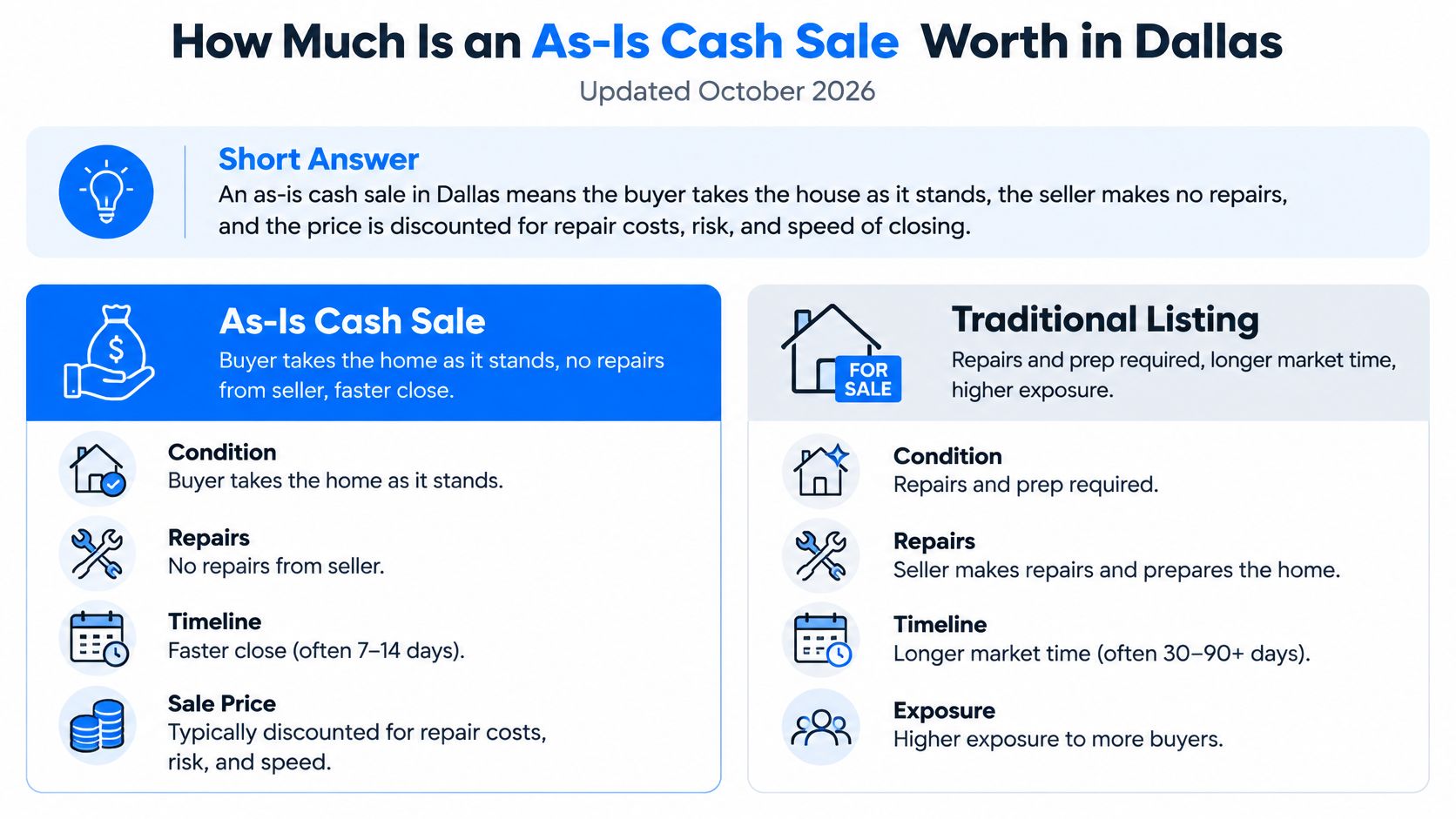
Selling a house as-is for cash in Dallas, Texas means the buyer accepts its current condition and you don't make repairs. Offers can fall well below retail after repair costs and the buyer's margin, while a straightforward transaction can target a 7 to 30 day closing if title is clear.
Updated October 2026. To understand how to sell a house as-is for cash in Texas in 2026, compare what you'll keep and how reliably you'll close, not just the offer printed at the top of the contract.

How Much Is an As-Is Cash Sale Worth in Dallas
A Dallas home's as-is cash value depends on its condition, location, and the costs a buyer expects to take on. The amount you keep also depends on your mortgage payoff and any closing expenses you agree to pay.
Dallas County is not one uniform pricing market. Compare recent sales near the property, such as in Oak Cliff, Lake Highlands, Preston Hollow, Lakewood, or Bishop Arts. Focus on homes with similar size, condition, and location.
Compare the sale paths
The table compares selling directly to a cash buyer, listing the home unrepaired, and renovating before listing. A cash-sale timeline is a planning target, not a guarantee. The commission range below is a budgeting example, not a required rate.
| Path | Price position | Seller fees | Time | Repairs | Certainty |
|---|---|---|---|---|---|
| Cash buyer as-is | Usually below an estimated after-repair value; a 70% formula can illustrate one possible approach | No agent commission for a direct sale without representation; confirm any other charges | A possible target is 7 to 30 days if title is clear | Seller makes no repairs under the agreement | Depends on verified funds, contract contingencies, and title |
| Agent listing as-is | Market value adjusted for condition and possible buyer credits | Negotiated commission; 5% to 6% is a budgeting example, plus agreed concessions | Marketing period plus the buyer's loan closing | Buyer may request repairs or credits | Inspection, financing, and appraisal can affect closing |
| Fix and list | Potentially higher sale price after renovation | Negotiated commission, contractor bills, and holding costs | Renovation schedule plus marketing and closing | Seller funds and manages the work | Inspection and appraisal can lead to further negotiations |
Put the market figures in their proper month
Movoto's Dallas market trends reported a $414,000 median home price, down 2.6% year over year, and an average of 65 days on market as of November 6, 2026. That snapshot suggests a balanced-to-mildly buyer-favorable market, rather than one where sellers can assume they set the terms.
A citywide median is not an appraisal or an estimate of a particular home's after-repair value. A well-maintained house and one with structural problems can draw very different offers, even on the same street.
A traditional listing puts the home in front of more buyers, while adding showings, inspection negotiations, appraisal, and lender approval. A direct cash purchase removes the lender's underwriting process, though the buyer may still have inspection or termination rights under the contract.
Decision rule: Compare what you would net from each path, then weigh that amount against the likelihood and timing of closing. A lower offer may suit your priorities if its certainty justifies the difference.
How Do Cash Buyers Price a Dallas House
Investor buyers generally work backward from after-repair value, subtracting renovation costs, acquisition and resale expenses, carrying costs, risk, and their intended profit.
After-repair value, or ARV, means the estimated resale price after the planned work is finished. It's not the home's current as-is value, its tax assessment, or the amount you owe.
Work through the repair calculation
The 70% rule is a screening formula, not a Texas rule or a guaranteed offer:
Illustrative offer = 70% of after-repair value minus estimated repairs.
For a hypothetical Dallas house, use $414,000 as an assumed ARV, not as a property-specific valuation. The formula leaves $289,800 before repairs, with the remaining allowance intended to cover costs, risk, and profit.
| Hypothetical condition | Assumed repair budget | Formula result | Rounded illustrative offer |
|---|---|---|---|
| Light cosmetic work | $15,000 | $274,800 | About $275,000 |
| Moderate repairs | $45,000 | $244,800 | About $245,000 |
| Heavy rehabilitation | $90,000 | $199,800 | About $200,000 |
These are worked examples, not observed Dallas offer ranges. A buyer might exceed the formula for a straightforward project in a desirable location or offer less when the scope is uncertain.
Percentage bands are particularly easy to misuse. An offer expressed as a percentage of current as-is value cannot be compared directly with one expressed as a percentage of finished ARV. Ask each buyer to identify the comparable sales, repair scope, and valuation basis behind the offer.
For light repairs, cosmetic bids help establish a relatively narrow scope. Moderate projects need estimates for systems, roofing, or other major components; heavy structural, fire, or water damage calls for a more cautious reconstruction budget.
Compare the money left over
The following net sheet uses hypothetical expenses throughout. It assumes the same mortgage payoff on both paths and a negotiated example commission of 5.5%, not a standard or mandatory fee.
Dallas net sheet on a hypothetical $414,000 example
| Line | Cash as-is moderate repairs | Fix and list near median |
|---|---|---|
| Starting price | $245,000 illustrative offer | $414,000 assumed sale price |
| Agent commission | $0 for this direct-sale example | $22,770 at an assumed 5.5% |
| Repairs or buyer credits | $0 paid by seller | $45,000 repairs plus $5,000 concessions |
| Holding costs before close | $0 additional in this simplified model | $6,000 assumed for about two months |
| Example mortgage payoff | $160,000 | $160,000 |
| Assumed title charges and prorated taxes | $5,000 | $5,000 |
| Rough seller cash | $80,000 | $170,230 |
The retail route produces substantially more cash in this scenario. But you'd need to fund the renovation, manage contractors, carry the property, and achieve the assumed sale price.
The U.S. Census Bureau's Texas housing profile provides statewide context, not an address-level valuation. Your decision needs neighborhood comparables and actual quotes for repairs, insurance, taxes, title charges, and payoff.
Include mortgage interest, property taxes, insurance, utilities, lawn care, and any buyer concessions in the comparison. With FHA or VA financing, property-condition requirements can also create repair demands that an as-is label doesn't remove.
How Do You Vet a Cash Buyer Before You Sign
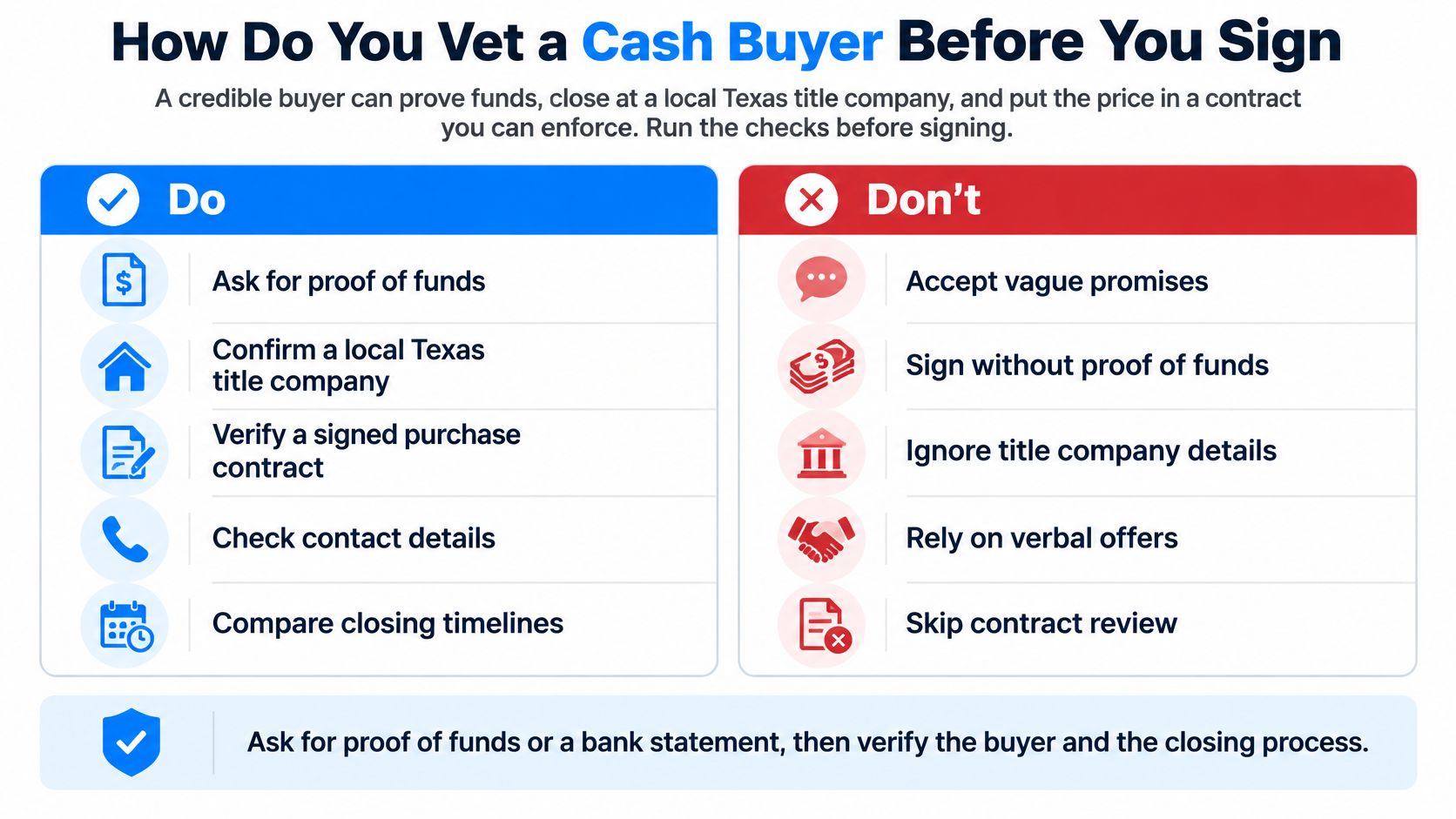
A credible cash buyer can demonstrate access to funds, accept an independent Texas title-company closing, and put the agreed price and obligations in a written contract.
Treat an attractive verbal offer as an invitation to investigate, not as money you can count on. A buyer with broad cancellation rights may offer less certainty than a slightly lower bidder with verified funds and tighter terms.
Run the checks before committing
- Verify funds. Request current proof of funds matching the purchasing entity, or identify the private lender supplying the money. Check that the amount supports the purchase.
- Use independent escrow. Require earnest money to be deposited with the title company under the contract, not sent to the buyer personally.
- Choose the closing company. Use a Texas title company you select or jointly accept, and verify its contact information independently.
- Reject upfront charges. Don't pay an application, processing, or offer-release fee merely to receive an offer.
- Check completed transactions. Look for recent reviews describing actual closings, then compare the buyer's legal name with the name on the contract.
- Read assignment provisions. A wholesaler may intend to transfer the purchase contract rather than buy the property personally. Have the arrangement and its consequences explained before signing.
The Texas Real Estate Commission's Seller's Disclosure Notice belongs in a documented transaction, alongside the buyer's acknowledgment of the property's condition. Your practical title benchmark is a clean, insurable title commitment, with ownership interests and liens addressed before closing.
Recognize a weak offer early
Be cautious when a buyer pressures you to omit defects, promises an immediate closing before opening title, or cuts the price after the walkthrough without identifying newly discovered work. An undisclosed assignment plan also deserves scrutiny because you need to know who must perform.
Use this guide to we-buy-houses scam warning signs to evaluate pressure tactics and payment requests. Compare written contracts using the same net sheet, including cancellation rights and responsibility for closing charges.
A no-obligation offer is useful only if you're free to decline it without paying a penalty.
How Does a Texas Cash Sale Move from Offer to Close
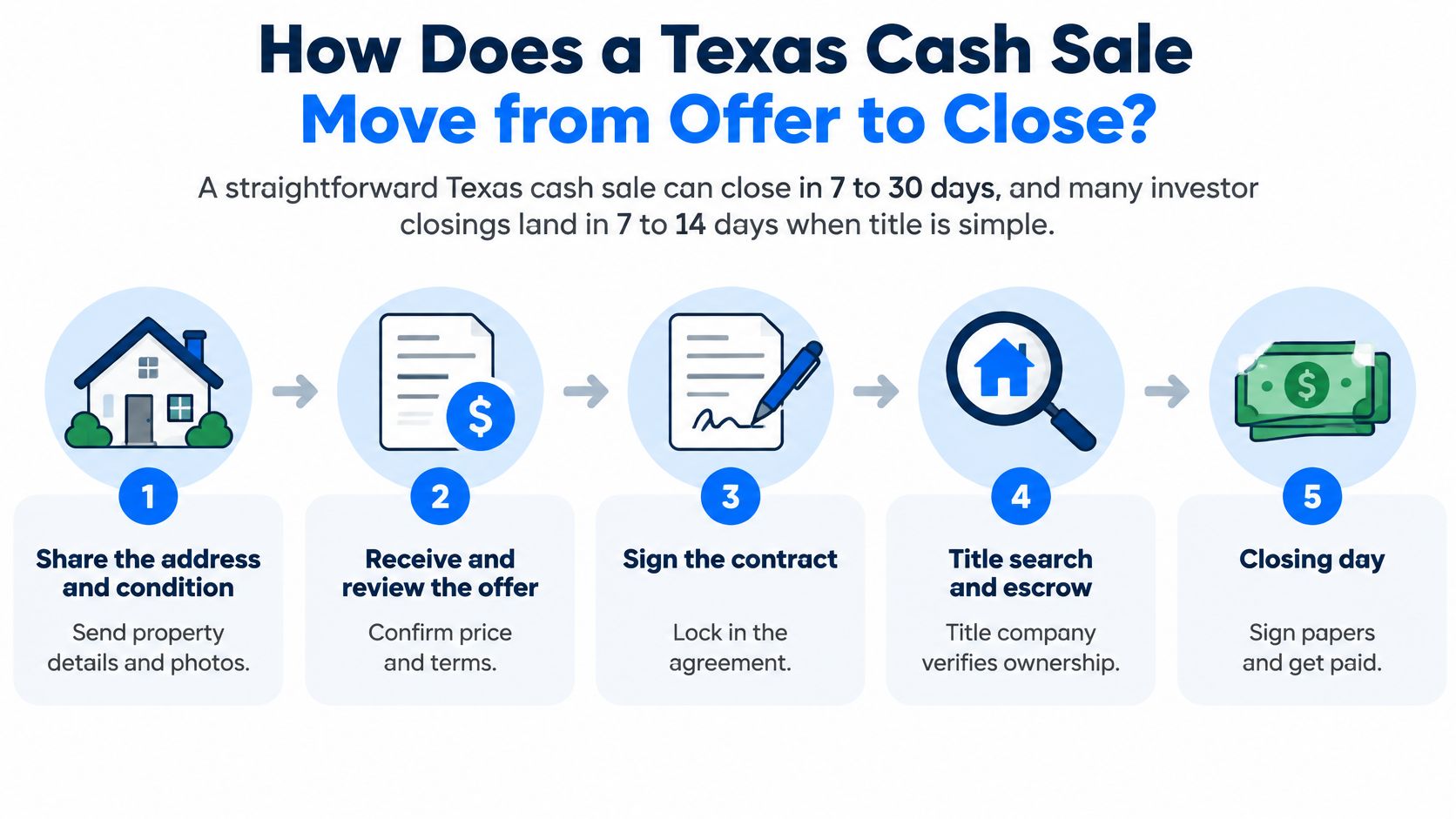
In a Texas cash sale, the price is only one part of the result. The title review, agreed closing date, sale expenses, and timing of payment all affect how much you receive and when you can use it.
Cyber Homes says its average time from sale to closing is 7 to 14 days. Your own schedule depends on the contract and whether title, payoff, or occupancy issues need attention.
Follow the documents, not just the calendar
Submit the address and property details. Describe the home's condition, occupancy, and your preferred move-out date. Cyber Homes reviews the property and local sales, then usually presents a no-obligation cash offer within 24 hours.
Allow the walkthrough. Cyber Homes uses one quick walkthrough instead of open houses. Make damaged areas accessible and point out anything that photos might not show.
Review and sign the purchase contract. Check the buyer's legal name, price, as-is terms, earnest money, inspection rights, closing and possession dates, and who pays title expenses. Any later price change should appear in a signed amendment.
Open title and request the payoff. The title company examines ownership and recorded claims. The lender provides the payoff amount for the planned closing date. Missing signatures or disputed liens can delay the sale.
Complete the condition paperwork. Provide applicable disclosures and supporting records, then get the buyer's written acknowledgment. A walkthrough does not replace written disclosures.
Review the settlement statement. Check that the sale price, payoff, prorated taxes, credits, and charges match the agreement. Before relying on payment instructions, call the title company using a phone number you obtained independently.
Sign and confirm funding. Ask the title company when documents will be recorded and proceeds disbursed. Transfer possession on the agreed terms, not before, unless a written agreement sets out the arrangement.
Keep the schedule realistic
An offer deadline and a closing deadline serve different purposes. A price may arrive quickly, while probate authority, a payoff dispute, or move-out arrangements take longer to resolve.
Cyber Homes' cash home-buying process lets you review a no-obligation offer and choose your closing date. Keep decisions tied to the signed agreement.
- Resolve ownership early. Missing heirs or required signatures can prevent the sale from closing.
- Set occupancy terms in writing. A tenant's departure or a delayed move-out needs an agreed plan.
- Confirm who is buying. If the contract may be assigned, make sure you know who is responsible for completing the purchase.
What Must You Disclose and What Gets Paid at Closing
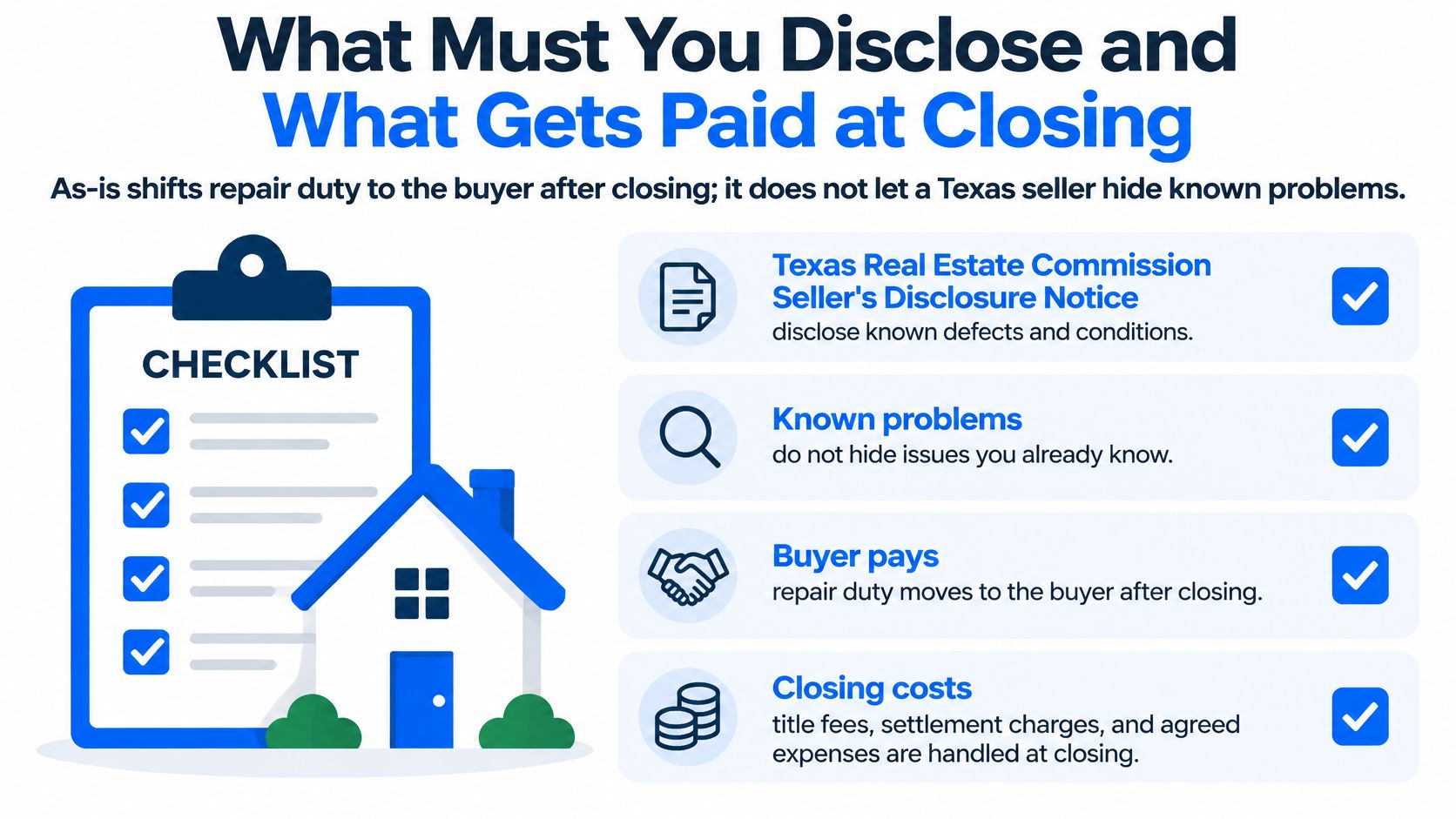
As-is shifts responsibility for repairs to the buyer after closing; it doesn't let a Texas seller hide known problems or avoid the transaction's applicable disclosure requirements.
Use the Texas Real Estate Commission Seller's Disclosure Notice when applicable to a previously occupied single-family residence. Have the title company or a Texas attorney confirm the correct form, current version, and any exemption for your particular transaction.
The Texas Property Code disclosure provision reinforces the importance of documenting property condition rather than treating an as-is agreement as permission to conceal defects. Omitting known material facts or making misleading statements can expose a seller to a claim even when the buyer accepts the property's condition.
Gather the records before accepting a deadline
- Ownership documents. Deed, survey, probate papers, divorce orders, and any documents explaining who may sign.
- Debt and tax records. Mortgage statement, payoff authorization, property-tax bills, and notices concerning liens.
- Occupancy agreements. Leases, amendments, deposits, and written possession arrangements.
- Condition history. Inspection reports, repair invoices, permits, warranties, and insurance claims.
- Government notices. Open code cases, unsafe-building notices, nuisance citations, and any vacant-property correspondence.
For Dallas properties, review expansive-clay soil and foundation movement, drainage and flooding, hail-damaged roofs, freeze-burst pipes, older plumbing and electrical systems, and aging heating or air-conditioning equipment. These are due-diligence categories, not a diagnosis that every local house has those problems.
Ask the relevant municipal department about the specific address's open permits, code-enforcement cases, occupancy restrictions, and vacant-property obligations. Don't assume a change of ownership eliminates an outstanding notice.
Understand payoff and tax treatment
At closing, the title company applies the buyer's funds to the agreed lender payoff, lien releases, and settlement expenses before sending you the balance. If the proceeds won't cover everything, you'll need to bring funds or obtain written approval for an authorized short payoff.
Confirm whether an attorney is required for your particular closing and who will prepare or review legal documents with the local title company. Complicated ownership, disputed debt, or uncertain disclosure obligations justify independent Texas legal advice.
Also ask the title company to confirm Texas's transfer-tax treatment, recording charges, and other settlement fees rather than assuming that every item called a tax is a transfer tax. Obtain an itemized estimate before committing.
For federal income taxes, ask a tax professional whether you qualify for the home-sale gain exclusion and what limit applies to your filing status. Inherited basis, rental depreciation, and the length and nature of your ownership can change the outcome; sale proceeds and taxable gain aren't the same amount.
When Do Probate Foreclosure or Damage Change the Deal
Cash buyers can purchase complicated properties, but signing authority, possession, repair uncertainty, and legal deadlines determine whether the transaction can finish.
A buyer's willingness to accept damage doesn't resolve an ownership dispute. Likewise, an owner's willingness to sell doesn't stop a scheduled foreclosure.
Ownership and occupancy complications
Inherited property and probate. Establish whether an estate representative, heirs, or another authorized party can convey the property, and have the title company identify the required documents. The Law Office of Bryan Fagan, PLLC's explanation of Texas affidavit of heirship requirements can help you prepare questions, but the title company must determine whether that approach is acceptable for the transaction.
Use the probate home sale guide to organize the practical selling decisions. Don't promise a closing date until the required authority and signatures are established.
Divorce and tenants. A divorce order, deed, and required signatures need to align before closing. For rented property, provide the lease and deposit records, and have counsel confirm the tenant's continuing rights rather than promising vacant possession.
Liens and back taxes. Give every notice to the title company, including disputed claims. Have it determine payoff requirements and lien priority instead of assuming the mortgage is the only debt that matters.
Damage and municipal restrictions
Fire, water, foundation, hail, and hoarding-related conditions need a specific repair or cleanout scope. Photos, insurance records, and access for inspection help the buyer assess the work, but they don't establish a retail price.
Code violations deserve their own review. Ask the city whether corrective work, permits, inspections, or occupancy approval will be required after the sale, and make sure the contract doesn't promise something you can't deliver.
Foreclosure deadlines require independent confirmation
For a residential deed-of-trust default, the Texas foreclosure deadlines calendar describes a general sequence of at least 20 days to cure, followed by at least 21 days' sale notice, with auctions generally on the first Tuesday between 10 a.m. and 4 p.m. That creates a potential minimum sequence of roughly 41 days, not a fresh guaranteed window after you contact a buyer.
Texas recorded 3,080 foreclosure starts in October 2025, second among states, according to ATTOM's October foreclosure report. That statewide count doesn't establish your deadline; your lender's notices and applicable legal requirements do.
- Get both figures. Request reinstatement and full payoff immediately.
- Share the auction information. Give the actual notice and sale date to the buyer and title company.
- Check sufficiency. Confirm that proceeds cover debt, taxes, liens, and closing expenses.
- Obtain written authorization. A short payoff needs lender approval, not the buyer's assurance.
- Verify completion. Confirm recording and disbursement before the deadline, and authenticate wire instructions by calling a known title-company number.
An accepted purchase offer is not confirmation that a foreclosure has been stopped.
Should You Request a Cash Offer Now
Request a cash offer when avoiding repairs, coordinating a difficult situation, or meeting a hard deadline matters more than obtaining the highest possible retail price.
A maintained home in Lakewood or Preston Hollow may be a better listing candidate if you can manage showings and carry the property through marketing and closing. The discount needs to buy you something valuable, not merely replace a process you could comfortably handle.
Match the route to your constraints
- Repairs you won't fund. A direct purchase can avoid contractor deposits and project management.
- A firm deadline. Compare the proposed closing with the actual legal or moving deadline.
- A complicated transition. An estate, divorce, or tenant situation may make agreed possession and dependable funding especially important.
We buy in Dallas, Fort Worth, Houston, Austin, San Antonio, and El Paso. Our process is to collect property details, provide a fair cash offer, and let you pick the closing date, with no obligation to sell and $0 in seller fees or commissions.
Frequently asked questions
How much do you lose selling as-is?
There's no universal loss percentage. Compare the cash discount with the repair spending, selling expenses, carrying costs, and uncertainty you'd otherwise accept.
Does disclosure still apply?
Selling as-is doesn't authorize hiding known defects. Confirm the disclosure form and any transaction-specific exemption with a Texas professional.
Can I sell with a mortgage?
Yes, an outstanding mortgage doesn't automatically prevent a sale. The closing must provide for an acceptable payoff or another lender-approved resolution.
How fast can clean title close?
Clean title removes a major source of delay, but funding, signed documents, and possession still need coordination. Use the contract's closing date, not an advertising promise, for your plans.
What if the buyer assigns the contract?
Review whether assignment is permitted and what obligations remain with the original buyer. Get legal advice if the purchaser's identity or responsibility becomes unclear.
Does Texas charge a transfer tax?
Confirm state transfer-tax treatment with the closing title company or a Texas attorney. Ask for recording fees, prorated property taxes, and other settlement charges to be identified separately.
Cyber Homes offers an as-is sale without seller repairs, fees, or commissions, with a closing date you choose. Visit Cyber Homes to request a no-obligation offer, then compare its written terms and estimated net proceeds with your listing alternative before deciding.

Edited by
James Vasquez
Real Estate Investor & Land Specialist with 10+ years experience in residential flipping, vacant land investing, land wholesaling, and subdivision deals.
Disclaimer: The information provided is for educational purposes and does not constitute financial or legal advice. Always consult with licensed professionals before making investment decisions.