
5 Best Ways of Selling Your Home by Owner in Boise, ID

A small share of U.S. home sales close with no agent at all. For most owners that path stays uncommon, because the work does not disappear when the listing commission does.
Boise sellers who close on their own still get paid, and they can keep more of the price, only if they cover pricing, marketing, disclosure, negotiation and settlement themselves. Each of those jobs costs time, cash or both. A repair credit, a buyer-agent fee or a title charge can erase a commission you never paid.
I look at one figure before signing: the amount left after every by-owner cost and every settlement line. That net, not the commission avoided, is the sale. Read the closing statement line by line before you accept it.

Five Ways to Sell by Owner in Boise and Who Each Fits
Five routes exist, and they differ less in whether you pay a commission than in how much of the agent's job you take on yourself. Pick the one that matches your time, your tolerance for paperwork and how fast you need the money.
Start with the price question, because it shapes everything else. The 2025 Profile of Home Buyers and Sellers put the median by-owner sale at $360,000 against $425,000 for agent-assisted homes, a $65,000 gap, or approximately 15.3% below the agent-assisted median, with agent-assisted sales accounting for 91% of transactions. Part of that spread comes from sellers who sold to a tenant or a neighbor, or from homes that needed work. Not all of it does. That gap is the reason you should compare routes on net proceeds rather than on the commission you avoid.
Use the table as a filter, then read the verdict for the route that sounds like you.
| Route | Typical cost to you | Time to sell or close | Effort | Best for |
|---|---|---|---|---|
| Full DIY FSBO | Photos, advertising, title and escrow fees | About 20 days to sell, the Boise median Redfin reports for the three months ending October 2026 | High: pricing, marketing, showings and contracts | Confident sellers with time and comparable-sales skill |
| Flat-fee MLS listing | Flat listing fee plus photos and closing costs | Similar to full FSBO once listed | Medium: you still handle showings and offers | Sellers who want MLS exposure without a percentage commission |
| By-owner sale with attorney or title company closing | Attorney or title fee added to other costs | Set by your buyer's financing and the title company's calendar | Medium: marketing and negotiation stay with you | Sellers who want a professional check on closing paperwork |
| Sell to someone you know | Attorney or title fees only | Often the fastest if the buyer is ready | Low to medium: a written contract is still required | Tenants, neighbors and family buyers with financing in place |
| Local cash buyer, as-is | Usually no commission, with an offer typically below full-market value | Set by the closing date you choose | Low: no showings or repairs | Sellers who need speed or certainty, or want to skip repairs |
1. Full DIY FSBO. You set the price, write the listing, take the calls, run the showings and negotiate the contract. The outlay is the smallest of the five: photography, a sign, a lockbox, and title and escrow charges at closing. The workload is the largest, and it arrives in bursts. This fits a seller who has been through a sale before, has weekday availability, and can read a settlement statement without flinching. If your plan is to price from an online estimate and hope, this isn't your route.
2. Flat-fee MLS listing. A local broker puts your home on the Intermountain MLS for a fixed fee while you keep the showings, the offers and the negotiation. It buys the one thing you can't buy on your own: syndication to the portals and to buyer agents who search the MLS first. The common failure is treating the listing as the marketing plan. Photos, the property description and clear showing instructions still decide whether the phone rings.
3. By-owner sale with an attorney or title company handling closing. You run the marketing and negotiate the price, and a professional reviews the purchase contract, the earnest money and the deed. This is the version I'd push a first-time seller toward, because it keeps the commission in your pocket while removing the technical mistakes that generate renegotiation later. You pay a fee. It's the cheapest insurance in the transaction.
4. Selling to someone you know. A tenant who wants to stay, the neighbor who has admired the house for years, a relative. Say a Boise landlord decides to sell a rental and offers it to the tenant at a number both sides accept. No listing, no showings, no buyer-agent question, and often the quickest close of the five. Put every term in writing anyway: price, fixtures, closing date, who pays which fee. A handshake over a six-figure asset is how friendships get tested.
5. Local cash buyer, as-is. No showings, no repairs, no financing contingency. The offer usually lands below full market value, and you're trading price for speed and certainty. The as-is cash sale process in Boise explains how those numbers are built. At Cyber Homes the process runs in three steps: tell us about the property, get a fair cash offer, and pick your closing date. We review the property against local sales and present a no-obligation offer, usually within 24 hours, and a guaranteed cash close removes the financing risk entirely.
Pricing at Recent Boise Sales, Not List Prices
Price from three to five homes that closed near yours in the last few months. Not from a portal estimate, not from your neighbor's asking price, and not from what you need the money for. That's the whole discipline, and it's where most by-owner sales are won or lost.

Boise's citywide numbers tell you what a normal month feels like. Redfin's Boise housing market report shows a median sale price of approximately $545,000 for the three months ending October 2026, about two offers per home on average, roughly 20 days to sell, and a 1.8% increase in the median price year over year. Those are averages across every neighborhood and price band in the city, not a valuation of your house.
Build a comparable set you can defend
- Pull three to five closed sales in the same school area or subdivision, matching age, gross living area, bed and bath count, condition and lot type.
- Adjust for what differs, including renovation quality, garage capacity, lot size, finished basement space and accessory units.
- Date every number. A sale from fourteen months ago is history in a market that clears in about three weeks.
An above-market listing doesn't just sit. It goes stale in buyer search results, and the reduction that follows reads as weakness to anyone who can see the listing's history. Boise's short marketing window makes that turn happen faster than most owners expect.
Set three numbers before you publish
Write down a target price, a minimum net you'll accept after payoff, fees and concessions, and a review trigger, such as no serious showing activity after 10 to 14 days. Having the trigger decided in advance is what separates a disciplined seller from one cutting the price in a panic.
If you'd rather watch than read, the walkthrough below covers the same pricing decision from the seller's side.
Your Real Net After Costs and Buyer-Agent Pay
Net equals your sale price minus the mortgage payoff and every seller cost. The commission you skip is one input in that equation.
On an illustrative $545,000 sale, using the citywide median as the starting price, the rates below are assumptions. Swap them for your own quotes before you treat the result as your net.
| Line item | Illustrative amount | Where to verify |
|---|---|---|
| Commission avoided at an assumed 5% total | $27,250 | Compare with agent commission quotes |
| Seller concessions at an assumed 1% | $5,450 | Negotiated in the contract |
| Buyer-agent pay at an assumed 2.5% | $13,625 | Written agreement with the buyer or their agent |
| Recording fees and any transfer costs | County schedule, filled in before signing | Ada County Recorder |
Offering 2.5% to a buyer's agent puts $13,625 back against the $27,250 counted as saved. Add the $5,450 concession and roughly two thirds of that gross figure is already gone. What remains is real money, just smaller than the headline rate.
Since August 17, 2024, offers of buyer-agent compensation may not be displayed on a Multiple Listing Service under the practice changes described in the NAR settlement FAQ. Compensation stays negotiable and can be structured as a flat amount, a percentage, an hourly rate or another objectively ascertainable amount. Decide in advance whether your asking price assumes no buyer-agent payment, a specified payment, or room for a concession, and put any agreement in writing rather than relying on an MLS field that no longer carries it.
Before you sign, set the closing statement next to this worksheet. Sale price, payoff, concession, buyer-agent pay, and recording or transfer charges should match the lines you already priced. A charge that is not on the worksheet is either a new cost or a number you have not decided yet. I would hold the signature until those lines reconcile to the net you can accept.
The test: if the net from a cash offer beats your by-owner net, the commission you avoided cost you money. Run both numbers before you list, not after.
Vet Buyers Safely Before Accepting Showings
Screen every buyer on funds before you schedule a showing or negotiate a price. A buyer who can't produce proof of funds or a lender's letter isn't a buyer yet, and an hour of your Saturday isn't the place to find out.
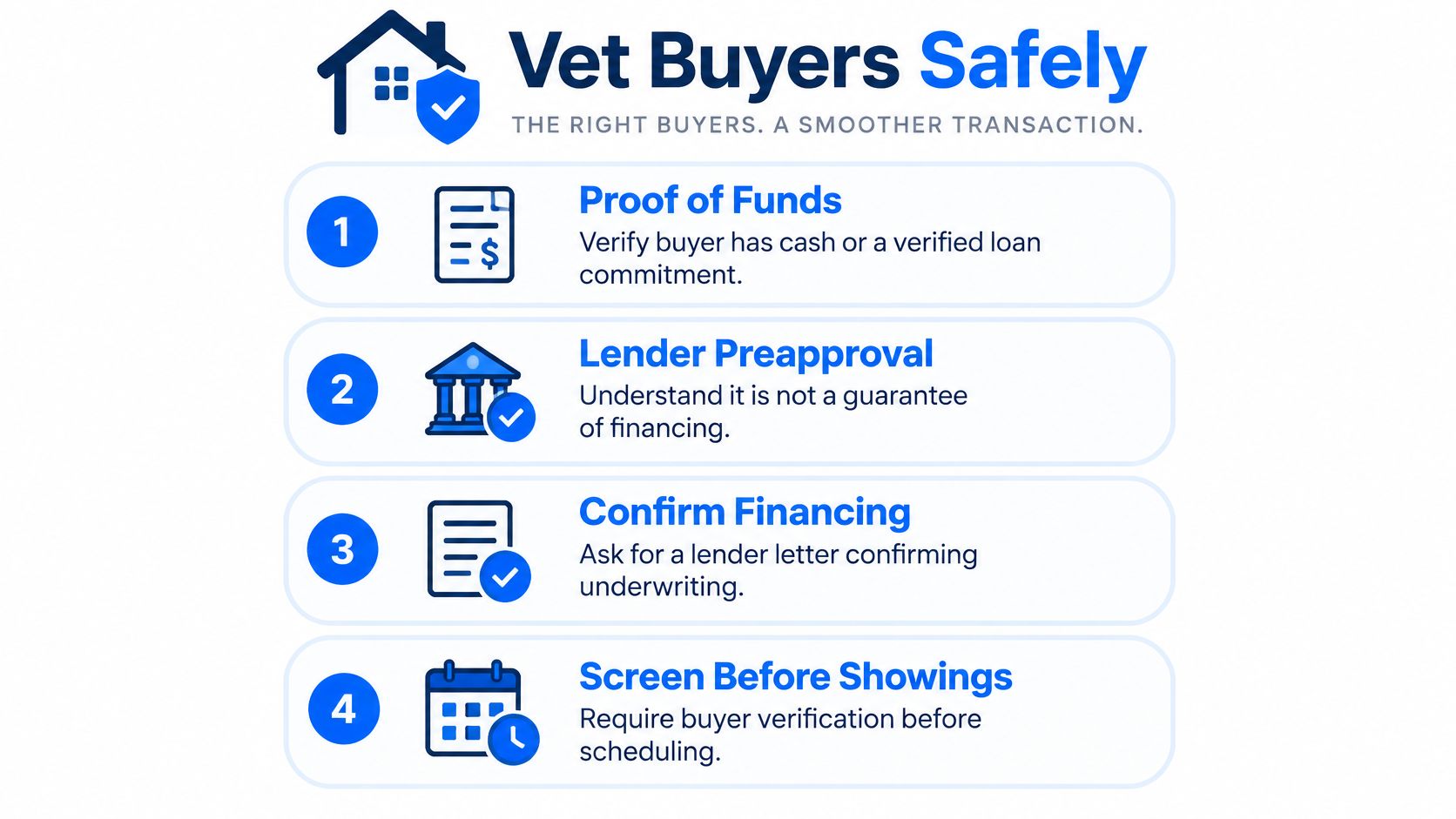
Proof of funds and preapproval are different documents. Proof of funds shows cash on deposit. A preapproval says a lender looked at the file, and it is not guaranteed financing. Ask which lender, when the appraisal gets ordered and when the financing contingency expires, then hold the buyer to those dates in writing.
Earnest money belongs with the title or escrow company, never with you. Holding a buyer's deposit in your own account creates a dispute you don't want if the deal falls apart over an inspection item.
Show safely. Meet visitors at the door rather than letting them arrive to an open house, keep valuables and prescription medication out of sight, and never show an empty home alone. Tell a neighbor when a showing is scheduled.
Verify every wire by phone. Call the closing agent on a number you already have, not the one printed in an email that arrived that morning. Wire fraud doesn't announce itself with a typo in the subject line.
The touring rule creates one easy checkpoint. Under the NAR settlement FAQs, the written-agreement requirement attaches when an MLS participant is working with a buyer and that buyer is touring a home. It doesn't apply to someone who calls to ask about the roof. So when a buyer's agent requests a showing, ask them to confirm the written agreement and how any requested compensation would be paid. If you're ever unsure whether an "offer" is legitimate, this guide to house-buying scams covers the patterns. Requesting a cash offer through Cyber Homes takes less than a minute and your information stays private, which makes it a low-risk way to get a second number.
Idaho Paperwork, Title and Closing Rules
A thin disclosure file gives a Boise buyer a reason to reopen price after inspection. That cut comes out of what you keep at closing.
Build the property file before you market. Pull together completed condition disclosures, permits and invoices, utility and tax figures, any survey or boundary material you already have, HOA documents, leases, and a written list of known defects. Incomplete or inconsistent seller disclosures are what turn a clean sale into a renegotiation or a post-closing dispute. A documented package lets buyers price that risk while they are still deciding, not at the inspection table.
Licensed participants must disclose whom they represent, so confirm the current agency rules with the Idaho Real Estate Commission before you list. If the buyer has no agent, say that clearly and in writing. You do not want a later claim that you were advising both sides.
The purchase contract is the other half of your net. Possession date, prorations, inspection rights, financing deadlines, and default remedies become seller-side charges once the title company prepares the closing papers. I would have an Idaho real estate attorney read that contract before you sign. Most Idaho sales close through a title or escrow company.
Confirm the local items with the offices that set them:
- Seller disclosure form: ask the Idaho Real Estate Commission whether a state form applies to your transaction.
- Lead-based paint: federal rules cover homes built before 1978 and require a signed disclosure plus the EPA pamphlet.
- Fees and taxes: confirm title insurance custom, transfer tax, and recording charges with the title company and the Ada County Recorder. Boise sits mainly in Ada County, with edges reaching into Canyon County.
- Point-of-sale: ask the City of Boise whether an inspection or certificate applies before you list.
Buyers price uncertainty into their offers, and they price it high. Straighten the file and the contract terms first so fewer of those costs land on your side of the closing.
Reading Your Settlement Statement Line by Line
For most loan-financed sales, the closing statement is the Closing Disclosure, which replaced the HUD-1 for most transactions, and how the HUD-1 settlement statement works is a useful comparison if you've sold before. Cash deals often use an ALTA settlement statement instead. Either way, two halves face each other: the buyer's side lists what the buyer pays, and the seller's side lists your sale price, commission and mortgage payoff. Credits such as earnest money, prorations and concessions reduce what's due on both sides.
| Statement side | Line item | What it shows | Who typically pays or receives |
|---|---|---|---|
| Seller | Sale price | Contract price | Seller receives; basis for every other line |
| Seller | Real estate commission | Per listing or buyer-agent agreement | Seller pays |
| Seller | Mortgage payoff | Per payoff letter | Seller pays from proceeds |
| Seller | Owner's title insurance | Title company quote | Confirm in purchase contract |
| Seller | Recording and transfer costs | Ada County Recorder and title company | Confirm in purchase contract |
| Buyer | Lender origination and fees | Loan estimate and Closing Disclosure | Buyer pays |
| Buyer | Prepaid interest, taxes and insurance | Escrow setup and prorations | Buyer pays per contract |
| Credit | Earnest money deposit | Held by title or escrow | Credited toward buyer's cash due |
| Credit | Seller concession | Agreed in contract | Credited to buyer |
| Credit | Property tax proration | Days owned in the tax year | Split by closing date |
Read it in this order:
- Check the sale price against the signed contract, digit for digit.
- Check the commission and the payoff against the buyer-agent agreement or listing agreement and the lender's payoff letter.
- Confirm every proration and credit date, including the tax year split and any HOA dues.
- Verify wire instructions by phone with the closing agent before any funds move.
- Ask about every unfamiliar fee in writing. "What is this for?" is a complete sentence, and a title company will answer it.
Timing is the part sellers get wrong. Under federal disclosure rules, the buyer's Closing Disclosure has to reach them at least three business days before closing, which means your own review window is short and shared. Ask for your draft early, question anything you don't recognize the same day, and don't accept "we'll correct it after signing" from anyone.
Step-by-Step Checklist From Pricing to Closing
Work the sale in this order and don't skip a step to save a week. Each one exists because skipping it costs more than doing it.
- Pull three to five closed comparables and set your target price, minimum net and review trigger.
- Build the disclosure file, and confirm lead-paint obligations and any City of Boise point-of-sale requirement.
- Compare your estimated by-owner net against the net after the commission you'd otherwise pay.
- Decide your buyer-agent position, and put any agreement in writing outside the MLS.
- Qualify buyers on proof of funds or preapproval, and confirm the loan type.
- Hold earnest money with a title or escrow company.
- Set inspection, appraisal and financing dates, and track each contingency removal in writing.
- Verify every wire by phone using a number you already had.
- Review the settlement statement line by line against the contract and the payoff letter.
- Review the Closing Disclosure at least three business days out, and raise questions in writing.
Before you commit to the by-owner path, get a no-obligation cash offer from Cyber Homes and set it beside your projected net. If the offer is close, the certainty is usually worth more than the difference.
Frequently Asked Questions About Selling by Owner in Boise
These are the questions Boise sellers ask most, and each answer points to the step that confirms it.
Is selling without an agent allowed in Idaho?
Yes. You can market and sell your own home, and you still have to meet the state's disclosure, agency and contract requirements. Have an Idaho attorney or title company review the paperwork.
Do I have to pay a buyer's agent?
No. Buyer-agent compensation is negotiable, and since August 17, 2024 it can't be displayed on the MLS. Decide your position before you price and put any agreement in writing.
How long does a by-owner sale take in Boise?
Redfin reported a median of about 20 days to sell for the three months ending October 2026, and closing runs longer than the sale itself once inspection, appraisal and financing dates are scheduled.
Who pays title insurance and transfer costs here?
Custom varies by contract in Ada County. Confirm the split with your title company and the Ada County Recorder before you sign, and read those lines on the settlement statement carefully.
Do FHA or VA buyers complicate a by-owner sale?
They can. Those loans carry appraisal and required-repair conditions that can delay or cancel a deal, so ask about the loan type before you accept an offer.
Should I hire a lawyer for an Idaho by-owner sale?
Consider it, especially when the buyer is unrepresented. A contract review costs far less than a dispute over contingencies, prorations or possession.
How common are by-owner sales?
NAR's 2025 Profile put them at 5% of U.S. home sales, the lowest share recorded in that series, and many of those sellers already knew their buyer.
Selling on your own in Boise can absolutely work, and you should still know what the other side of the table pays. Cyber Homes reviews your property and local sales, then comes back with a no-obligation cash offer, usually within 24 hours, with no showings, no repairs and no commission taken out of the number. Put that offer beside your by-owner net and let the arithmetic decide. Start at Cyber Homes.

Edited by
James Vasquez
Real Estate Investor & Land Specialist with 10+ years experience in residential flipping, vacant land investing, land wholesaling, and subdivision deals.
Disclaimer: The information provided is for educational purposes and does not constitute financial or legal advice. Always consult with licensed professionals before making investment decisions.