Top 10 Companies That Buy Houses for Cash in Ohio

Your roof needs work, the house still contains a tenant's belongings, and your relocation date is already fixed. Or perhaps you're handling probate, facing foreclosure pressure, or trying to move an inherited property without paying for repairs first. In each situation, an Ohio cash buyer can trade some top-dollar potential for a faster, simpler, more certain sale.
This roundup compares Ohio coverage, as-is convenience, offer timing, closing flexibility, communication, costs, and seller protections. Use it as a starting point, not a reason to accept the first offer. A traditional investor buys directly, an iBuyer uses a technology-led process, an auction creates buyer competition, FSBO gives you control but more work, and a short sale involves lender approval when the sale proceeds won't cover the mortgage.
Process flow: Property details → Multiple cash offers → Net-proceeds comparison → Buyer and title verification → Written contract review → Chosen closing date → Verified closing
For broader real-estate investing context, see this guide to investment companies for real estate. Gather your property details, contact several suitable buyers, compare the money you'll receive, confirm who's purchasing the home, and let a reputable title company or qualified attorney manage the closing.

Get a cash offer for your home
1. Cyber Homes
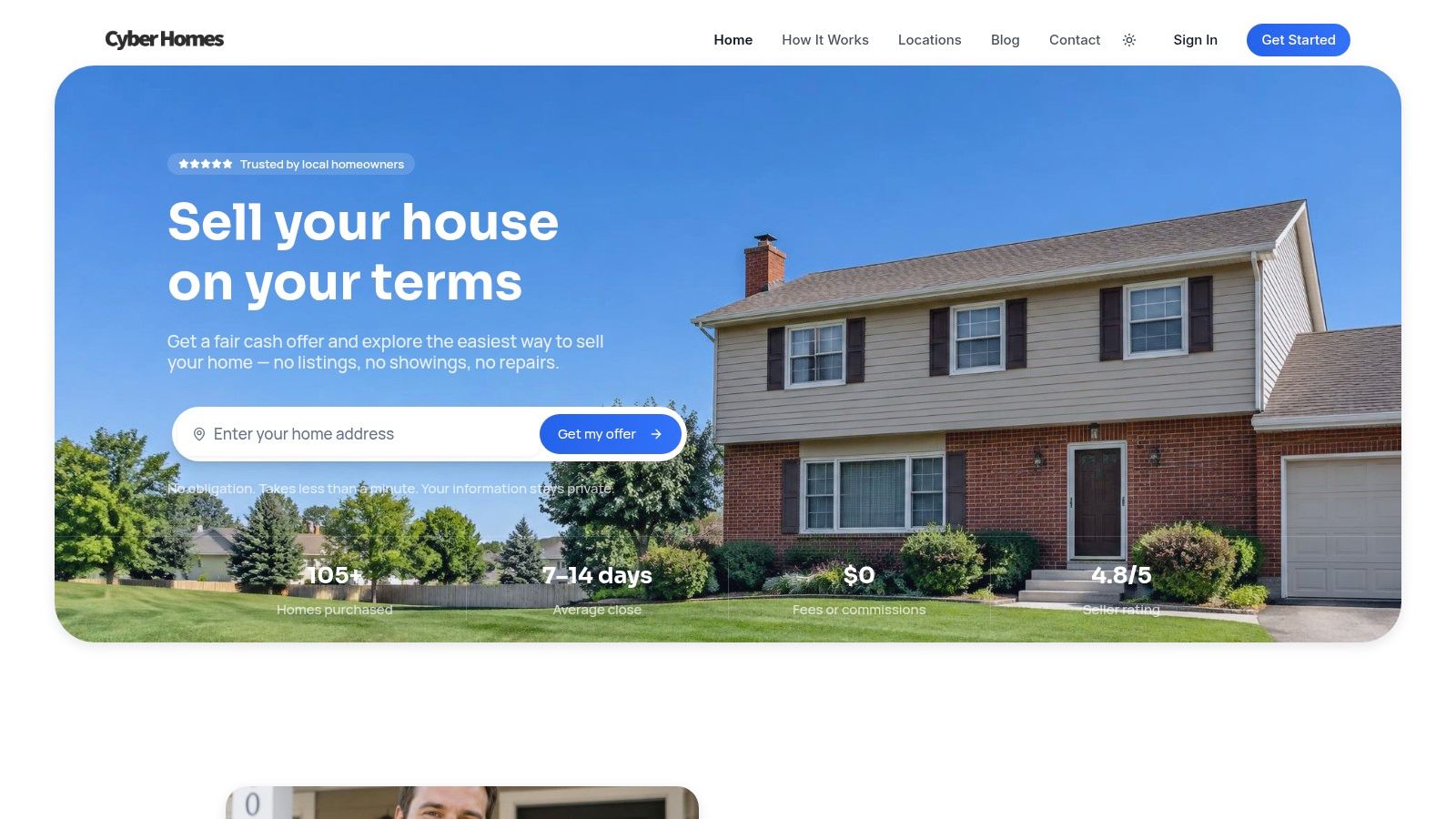
Cyber Homes fits Ohio sellers who need an as-is sale, direct communication, and a predictable closing more than the highest possible MLS price. The company says it buys homes for cash across the United States, accepts properties as-is, and closes through title companies on the seller's schedule, according to its cash home-buying process.
For Ohio and Columbus properties, Cyber Homes says it can provide a no-obligation cash offer usually within 24 hours after reviewing the home and relevant local sales. Sellers choose the closing date, while the company says it handles paperwork and standard closing costs, as described on its Columbus home-selling page. This setup can suit an owner facing a relocation date, inherited-property cleanup, tenant issues, or repair bills that make listing preparation impractical.
Why sellers choose Cyber Homes
The process removes several common listing tasks. Sellers can avoid repairs and showings, receive a written offer after a walkthrough or property evaluation, and close through a title company on an agreed schedule, according to Cyber Homes' Cleveland selling guidance.
Cyber Homes also describes a transition option: an advance of up to $2,000 for moving expenses before closing, subject to its terms. That may help cover movers or storage when relocation costs arrive before sale proceeds.
Practical rule: Treat “no fees” as a prompt for contract review. Ask the title company to list every seller deduction in writing, including taxes, liens, prorations, and property-specific charges.
A direct buyer may be useful for probate, divorce, foreclosure pressure, relocation, costly repairs, problem tenants, or an inherited home. The trade-off is potential net proceeds. Compare the offer with at least two alternatives, including a traditional listing, another cash buyer, or an auction if the property and deadline allow. A fast offer is easier to judge when you compare the actual amount received, closing date, cancellation terms, and who pays outstanding costs.
Pros
- Fast, scheduled process: The company says offers usually arrive within 24 hours, and sellers select the closing date.
- As-is convenience: Sellers can avoid repairs and showings, with agent commissions excluded from the stated model.
- Personal contact: A consistent representative may be easier to work with than a fully automated process.
- Moving support: The company describes advances of up to $2,000 for moving expenses before closing.
Cons
- Potentially lower proceeds: Speed and certainty may come at the cost of a stronger retail-market result.
- Coverage must be confirmed: Service depends on the Ohio property's location and current buying area.
- Terms require review: Confirm deductions, title requirements, inspection rights, and whether the buyer can assign the contract.
Visit Cyber Homes to confirm current Ohio availability and request an offer.
2. HomeVestors, We Buy Ugly Houses
A dated Columbus rental, an inherited Cleveland property, or a vacant Dayton house may be difficult to prepare for a standard listing. HomeVestors connects these sellers with locally owned franchisees operating under the We Buy Ugly Houses brand across Ohio markets, including Cincinnati, Columbus, Cleveland, and Dayton.
The brand provides reach, but the franchise structure creates a practical verification step. Communication, valuation, contract language, and closing coordination can differ between offices. Identify the legal entity buying the property, the person authorized to sign, and whether that entity intends to close or assign the contract.
HomeVestors reports that its network has purchased more than 150,000 homes nationally, as stated on its Ohio seller page. That background may be useful for clean-outs, major repairs, and property complications. It does not establish that a specific offer will produce the highest net proceeds.
How to evaluate the offer
A local franchisee may inspect the house in person and provide an offer based on its condition. The company describes an as-is process, possible clean-out assistance, and flexible closing timing. One office may be ready to close in roughly three weeks, while another may require a longer schedule.
Review the agreement before treating the offer as firm. Confirm repair deductions, inspection rights, cancellation terms, assignment provisions, title requirements, and which closing costs each party pays. Compare the final amount you would receive with a traditional listing, another cash buyer, or an auction if your deadline allows.
Request the franchise office's proof of funds, purchase agreement, and title-company details before relying on the proposed closing date.
Pros
- Ohio reach: Franchise offices serve major markets and additional communities.
- Distressed-property fit: Significant repairs, clean-outs, and dated interiors may not prevent an offer.
- In-person assessment: A property visit can produce a more customized valuation than an initial online estimate.
Cons
- Office-to-office variation: Franchisees are independently owned and operated.
- Lower net proceeds may result: The offer reflects repair, holding, resale, and transaction risks.
- Terms require scrutiny: Inspection and assignment clauses can affect certainty after signing.
Contact the local office serving the property through the HomeVestors Ohio seller page and request the complete offer terms in writing.
3. We Buy Houses
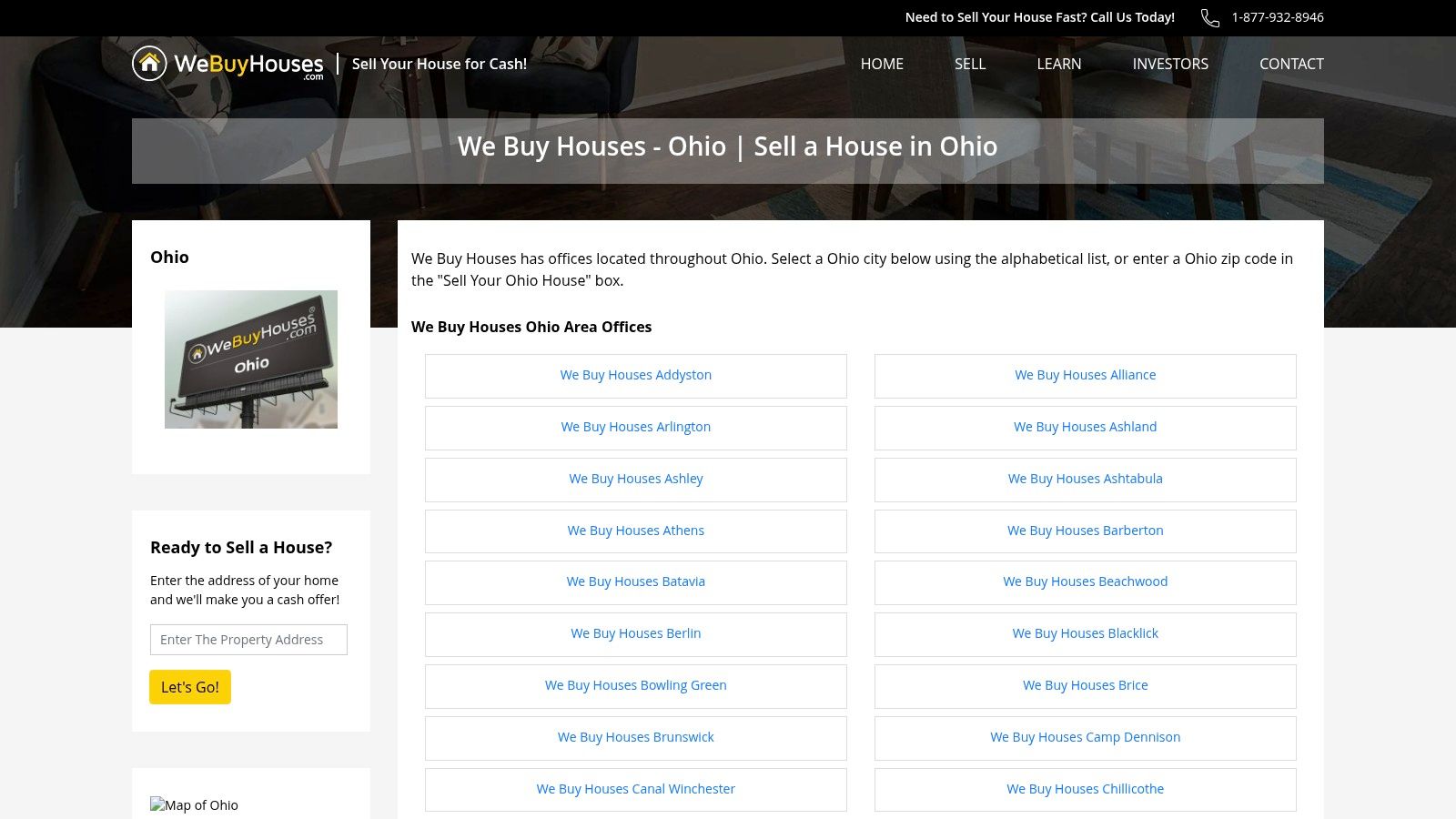
A seller facing a difficult property, an inherited home, or a tight closing deadline may value We Buy Houses for its local investor access. The brand is a network, not one Ohio-wide corporate buyer. Its state portal connects sellers with investors serving different Ohio cities.
The process starts with basic property details. A local investor may arrange a property visit and present an as-is cash offer. That can reduce preparation work compared with listing through an agent, especially when the home needs repairs or cleanup. Speed and convenience still come with a trade-off: the offer reflects the buyer's repair, holding, resale, and transaction risks.
Check the contracting party and net proceeds
Before signing, identify the company that will buy the property. Verify its legal name, role in the transaction, proof of funds, title company, and expected closing date. Read the agreement for inspection rights, cancellation terms, assignment provisions, title requirements, liens, taxes, and closing-cost responsibilities.
An assigned buyer may close personally or transfer the contract to another investor. Ask who will provide the funds and what happens if that party does not perform. Compare the amount you would receive at closing with another cash offer, an auction result, or a traditional listing estimate if your deadline permits.
The local-office structure may provide access in communities that a single buyer does not cover, but service and offer terms can vary by investor. Request every term in writing rather than comparing headline prices.
Pros
- Broad Ohio access: Local offices serve many cities and surrounding communities.
- As-is flexibility: Homes needing repairs, cleanouts, or updates may still receive offers.
- Simple starting point: Sellers can submit basic property information without preparing a full listing.
- No listing commission: A direct sale avoids a traditional agent commission, though other transaction costs may still apply.
Cons
- No uniform buyer experience: The network does not make every offer or closing process identical.
- Variable offer quality: Local investors set their own prices, timelines, and contract terms.
- Assignment risk: Sellers must know whether the contracting party intends to close.
Visit the We Buy Houses Ohio network and request the assigned buyer's written offer, contract, and closing details.
4. Opendoor
A seller relocating from Columbus may value a predictable online process more than an investor's in-person negotiation. Opendoor targets homes that fit its iBuyer criteria and lets owners begin with an online-first, managed cash-sale process. The workflow includes an online estimate, an offer review, service-fee details, repair adjustments, and a closing window selected by the seller.
The convenience has a clear trade-off. A digital estimate is only an opening point, and the final amount depends on the company's condition review and any credits or adjustments. Compare the amount reaching your closing statement, not just the initial offer.
A practical fit for eligible Ohio sellers
Opendoor's Columbus page addresses Ohio-specific details, including conveyance-fee guidance for Franklin County. Flexible scheduling may suit an owner coordinating a move, estate cleanout, or new-home purchase who cannot close immediately.
Eligibility and geography narrow the choice. Availability may be city-specific, with Columbus and selected Ohio metros more relevant than a statewide assumption. Service fees and repair deductions can also reduce net proceeds, so place Opendoor beside a direct investor's written offer and an estimated MLS net. An auction may create a different price and timing profile, while FSBO or a traditional listing may preserve more upside but require more seller work. A short sale involves lender approval and belongs in a separate decision path when the mortgage balance exceeds likely sale proceeds.
Review these Opendoor reviews for another perspective, then verify every term in the offer documents.
Before accepting, confirm:
- The service fee and each repair or adjustment credit.
- The expected net proceeds after all stated deductions.
- The closing date, cancellation terms, and conditions that could change the offer.
- Whether the property qualifies in its Ohio location.
Opendoor reduces showings, staging, and appointment coordination, but it does not remove the need to compare net proceeds. Online management helps with speed and scheduling; a local buyer may offer different terms for a property needing substantial repairs.
Check Opendoor's Columbus selling option and compare its final net sheet with direct cash offers.

5. Upward Home Solutions
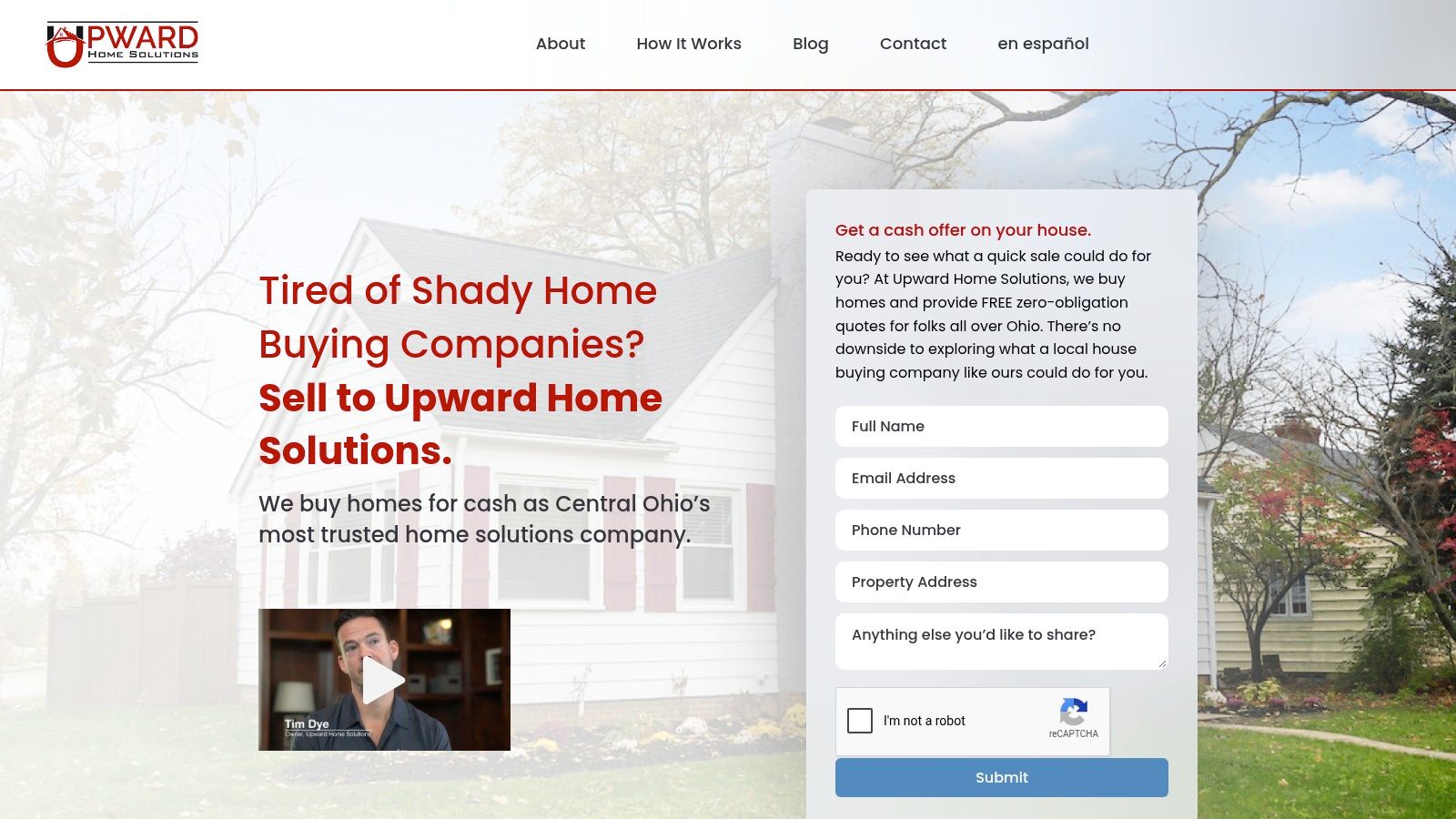
A seller handling an inherited Columbus property, unwanted contents, or a short move-out window may value certainty and less preparation over maximum market exposure. Upward Home Solutions focuses on Columbus and Central Ohio, offering local conversations, in-person walkthroughs, and as-is purchases.
The process is direct: provide property details, schedule a walkthrough, and review the written cash offer. Sellers can leave unwanted furniture or debris behind, which may simplify an estate, rental, or vacant-house sale. That convenience still has a cost trade-off. Compare the proposed net proceeds with a direct offer from another investor and an estimated net from an MLS listing.
Local fit and contract checks
Upward's Central Ohio focus may help when property condition and neighborhood context require an in-person discussion. Face-to-face contact can also make an estate sale or vacant-property handoff easier to coordinate. Its service area may not include every Ohio address, so confirm eligibility before investing time in the process.
The company highlights flexible closing dates. Testimonials on its site reference 10 to 13-day closings, but a testimonial is not a contractual promise. Ask for the exact closing date, title company, earnest-money terms, inspection rights, and circumstances that could change or cancel the offer.
Check public reviews and the BBB listing as part of your due diligence. The company is listed but not BBB-accredited, a distinction sellers who use accreditation as a screening factor should record.
Use this quick comparison before signing:
- Speed and convenience: An as-is sale can avoid repairs, staging, showings, and junk removal.
- Coverage: Central Ohio sellers may receive a more relevant local review, while owners elsewhere may need another buyer.
- Net proceeds: A convenient offer may be lower than an MLS sale's potential net, so compare written figures after deductions.
- Alternatives: An auction changes the pricing and timing risk. FSBO or a traditional listing may preserve more upside but require greater seller effort. A short sale requires lender approval when the mortgage balance exceeds likely proceeds.
Visit Upward Home Solutions to confirm the current service area and request the terms in writing.
6. The Cincy House Buyer
A Cincinnati seller facing vacancy, inherited contents, or major repairs may prefer a regional buyer over a statewide marketplace. The Cincy House Buyer focuses on the Cincinnati metro, including Hamilton, Butler, Warren, and Clermont counties, so its fit depends first on the property's location.
That coverage can add useful neighborhood context. A local investor may better distinguish a rental, inherited home, and renovation project, then arrange a walkthrough and discuss an as-is purchase. Sellers can also discuss a move-out date that matches their next housing arrangement.
Questions to answer before signing
Clarify whether The Cincy House Buyer will purchase the property itself or assign the contract to another buyer. Review the purchase agreement for the named buyer, assignment rights, inspection period, financing or proof-of-funds language, and conditions that could delay or cancel closing.
Ask the title company to confirm ownership, liens, probate issues, and the closing schedule. Also establish who pays standard closing costs and whether any deductions reduce the stated offer. A direct conversation is preferable if the website is difficult to access, since search results do not replace written terms.
For broader Cincinnati comparison context, read this Cincinnati cash-buyer review.
Where it may fit
- Local coverage: A defined Cincinnati-area focus may suit sellers who want regional communication.
- As-is process: Direct negotiations can reduce showings, repairs, staging, and preparation.
- Flexible timing: Move-out terms can be discussed around the seller's deadline.
- Price trade-off: The offer reflects renovation risk, resale plans, and the value of speed. Compare the expected net proceeds with an agent's pricing opinion, an auction, or a private sale.
- Seller checks: Request proof of funds, confirm the buyer named in the contract, and document the closing and cost terms.
Owners outside the service area need another buyer. Sellers with mortgage balances above likely proceeds may instead need lender approval through a short sale.
Contact The Cincy House Buyer to confirm whether the property falls within its Cincinnati-area territory and request a written offer.
Get a cash offer for your home
7. Cleveland House Buyers
Cleveland House Buyers serves Cleveland and nearby Northeast Ohio communities. Its regional focus may suit an owner dealing with an older home, inherited contents, vacancy, or substantial deferred maintenance. Cleveland's housing stock can also involve title questions tied to estates, multiple heirs, or long-unresolved liens, so the seller should confirm those issues before relying on a quick closing.
The company describes an offer process that may return an estimate within about 24 hours, purchases properties in their current condition, and allows discussion of the closing date. That is a process claim, not a guaranteed completion time. Property access, title work, probate documents, liens, inspection rights, and contract terms can still affect the schedule.
For a broader Cleveland comparison, see this review of Cleveland cash buyers.
Where this option may fit
A Cleveland-area seller may value one point of contact who understands local neighborhoods and the condition differences between a lightly dated house and a major renovation project. Avoiding showings, staging, repairs, and a conventional listing can reduce work when the priority is a defined sale timeline.
The cost is potential net proceeds. Compare the written offer with an agent's market opinion, a private sale, or an auction before choosing speed. An auction may create competing bids, while a direct buyer may offer greater timing control. A short sale may be necessary if the mortgage balance exceeds the likely sale proceeds.
Check before signing
- Confirm that the contract names the buyer who will close, rather than an undisclosed assignee.
- Request proof of funds and identify any inspection or cancellation rights.
- Verify the closing date, title responsibilities, standard costs, and deductions from the stated price.
- For an inherited Cleveland property, confirm that every required owner or estate representative can sign.
Trade-offs
- Regional coverage: The company focuses on Cleveland and surrounding Northeast Ohio, not the entire state.
- Lower preparation burden: Major repairs and a traditional listing may not be required.
- Flexible timing: The closing date can be discussed around relocation or estate needs.
- Price for convenience: Speed and certainty can reduce the amount received.
Visit Cleveland House Buyers to confirm coverage for the property's ZIP code and request written terms.
8. Local Ohio Cash Buyers
Local Ohio cash buyers are often the first group homeowners encounter through referrals, neighborhood signs, search results, or investor outreach. They can be effective when the property is distressed and the seller needs a buyer who understands the local area, but the category is too broad to treat as one standardized company.
The benefit is direct access. A local investor may visit quickly, buy as-is, handle clean-out coordination, and structure a closing around probate, relocation, or tenant issues. The risk is inconsistent professionalism. Some investors close personally, while others put the property under contract and look for another buyer.
How to screen the local option
Start with the legal identity and proof of funds. Ohio seller guidance recommends asking whether the buyer is the actual end buyer or a wholesaler, how much earnest money is posted, and how many contingencies permit cancellation, as explained in this cash-buyer question guide.
Use the same written comparison for every offer. Ask for the purchase price, deductions, title responsibilities, inspection period, closing date, and assignment language. If the buyer resists proof of funds, pressures you to sign immediately, or won't explain who will close, the speed advantage isn't worth the contract risk.
Pros
- Local knowledge: A nearby investor may understand the property's neighborhood and condition.
- Flexible structure: Some buyers can work around occupancy, clean-out, or estate timelines.
- As-is potential: Distressed homes may receive attention that retail buyers won't provide.
Cons
- No uniform standards: Reputation and process vary widely.
- Wholesaling risk: The person making the offer may not be the end buyer.
- Offer comparison is harder: You must create your own due-diligence process.
Request offers from multiple local buyers, then have a title company or Ohio real-estate attorney review the contract before you sign.
9. Ohio Cash-Buyer Marketplaces
A cash-buyer marketplace isn't a single buyer. It's a way to expose the property to multiple investors or buying channels, which can be valuable when the main weakness of a direct cash sale is the absence of competition.
Ohio's transaction environment helps explain why comparison matters. One statewide roundup reported that 31.5% of Ohio home purchases were made with cash in 2024, placing Ohio among the top ten states for all-cash home sales, according to Houzeo's Ohio cash-sale overview. That same source reported double-digit year-over-year increases in all-cash sales in ten Ohio counties, including Morrow County and Hardin County. Cash demand isn't confined to one major city.
When a marketplace helps
A marketplace can be useful when you want speed but don't want to rely on one take-it-or-leave-it offer. You can compare buyers by price, closing date, proof of funds, contingencies, and assignment rights. The marketplace may also help surface alternatives when a property doesn't fit a single iBuyer's criteria.
The limitation is that more inquiries create more diligence work. Ask who is submitting each offer, whether the platform verifies funds, and who handles title and closing. A higher headline offer with a long inspection period or weak earnest money may be less attractive than a slightly lower offer with clear execution terms.
Best fit
- Competition: Useful when you want several buyers to evaluate the same property.
- Distressed conditions: Multiple investor profiles may improve the chance of a workable offer.
- Decision flexibility: You can compare a direct sale with an MLS or other route.
Watch closely
- Buyer identity: Confirm the contracting party and end-buyer status.
- Deductions: Compare the amount you'll receive, not only the stated price.
- Timeline: Verify that the platform's advertised speed appears in the contract.
A marketplace is most useful as a comparison tool. It shouldn't replace proof-of-funds verification or attorney review.
Get a cash offer for your home
10. Traditional Sale Alternatives
Sometimes the best company that buys houses for cash is no company at all. If the house is marketable, you have time, and maximizing net proceeds matters more than a fast, certain closing, an MLS listing may produce a better result after commissions, repairs, carrying costs, and concessions.
Ohio sellers also have other routes. FSBO can reduce dependence on an agent but requires you to manage pricing, marketing, buyer screening, negotiations, disclosures, and paperwork. An auction can create urgency and attract cash buyers, but the process and final price depend on the auction structure and buyer participation. A short sale is different from an ordinary cash sale because the lender must approve the transaction when the proceeds won't satisfy the mortgage balance.
Choose the route by problem, not label
An iBuyer suits a qualifying home when you want a predictable digital experience. A local investor suits an as-is property with repairs, vacancy, probate, or tenant complications. A marketplace suits a seller who wants several bids. An agent, FSBO, or auction deserves consideration when the property can attract retail buyers and the timeline allows for marketing.
Investor demand remains meaningful even in a smaller Ohio transaction pool. An Ohio housing needs assessment found that about 179,000 homes were purchased in Ohio in 2024, a 24% decline from 2019, and the fewest since 2014, as summarized in this Ohio investor-market overview. The same source reported a 14.7% investor buyer share in one measured Ohio category. Those figures don't predict your offer, but they show why investors remain active while sellers should still compare alternatives.
The right comparison is cash now versus net proceeds, time, risk, and control. A higher list price isn't automatically better if repairs, carrying costs, delays, or a failed buyer consume the difference.
Use an agent's comparative market analysis, an auction consultation, or a written cash offer as reference points. Don't select a route solely because its marketing promises speed.
Ohio Cash Home Buyers: 7-Company Comparison
| Company | Implementation complexity 🔄 | Resource requirements 📊 | Expected outcomes ⭐ | Speed/Turnaround ⚡ | Ideal use cases 💡 |
|---|---|---|---|---|---|
| Cyber Homes | Low, online form + single local buyer contact | Low, buys as‑is; covers standard closing costs; up to $2k move advance | High seller satisfaction; predictable cash offer but typically below retail | Very fast, offers ~24 hrs; typical close 7–14 days | Owners needing certainty/speed: foreclosure, relocation, probate, major repairs |
| HomeVestors (We Buy Ugly Houses) | Moderate, in‑person visit; franchise variability | Moderate, buys as‑is and handles clean‑outs; local office coordination | Proven experience (150k+ homes); offers typically below market | Fast, can close in ~3 weeks (office‑dependent) | Inherited homes, major repairs, time‑constrained moves |
| We Buy Houses (licensed network) | Low–Moderate, simple intake then local investor visit | Low, as‑is purchases; licensed local investors handle closings | Quick local cash offers; quality and terms vary by office/network | Fast, flexible closings; turnaround depends on local investor | Quick outreach to local buyers; distressed or special‑situation homes |
| Opendoor | Low, mostly online, data‑driven workflow | Medium, service fees and possible repair credits reduce net proceeds | Predictable, managed sale; transparent fees; often below strong open‑market price | Moderate, typical closing window 21–60+ days (seller choice) | Mainstream homes where predictability and convenience matter |
| Upward Home Solutions | Low, 3‑step process with in‑person walk‑throughs | Low, buys as‑is; local hands‑on team; limited geographic range | Local reputation; fast, straightforward cash offers; price trade‑off for speed | Very fast, testimonials cite ~10–13 day closes | Sellers preferring local, face‑to‑face service in Central Ohio |
| The Cincy House Buyer | Low, local walk‑throughs and direct purchases | Low, as‑is purchases; local title closing; fewer third‑party steps | High certainty to close with direct investor; offers below retail | Fast, local process optimized for Cincinnati metro | Cincinnati‑area sellers in Hamilton/Butler/Warren/Clermont counties |
| Cleveland House Buyers | Low, simple local process with quick contact | Low, buys as‑is across many Cleveland ZIPs | Transparent, quick as‑is sales; price concessions typical for speed | Very fast, offers often within ~24 hours; flexible closes | Cleveland/Northeast Ohio sellers needing a fast local buyer |
Choose the Offer That Fits Your Deadline and Net Proceeds
The strongest offer isn't always the one with the highest stated price. A buyer who offers more but can cancel during a broad inspection period may provide less certainty than a buyer whose price, funds, closing date, and responsibilities are clearly documented. Compare the net proceeds and execution risk together.
Before signing, work through this seller checklist:
- Confirm identity and coverage: Verify the buyer's legal name, Ohio service area, and whether it is the end buyer or a wholesaler.
- Request the complete price: Get the written purchase price and every deduction, credit, fee, tax adjustment, and lien responsibility.
- Ask about closing costs: Confirm who pays the title company, standard closing costs, recording charges, and any property-specific expenses.
- Review earnest money: Ask how much is deposited, when it is deposited, and what happens if the buyer cancels.
- Read inspection terms: Identify the inspection period, repair-credit rights, contingencies, and cancellation language.
- Check assignment rights: Confirm whether the buyer can assign the contract and whether you can reject a substitute buyer.
- Select the closing date: Put the date, possession terms, and any post-closing occupancy agreement in writing.
- Use independent professionals: Close through a reputable title company or have a qualified Ohio real-estate attorney review the agreement.
A cash buyer makes particular sense when the house needs substantial repairs, you're relocating urgently, probate or divorce creates a deadline, foreclosure pressure is increasing, or a tenant situation makes showings difficult. The as-is structure can save preparation time and reduce the uncertainty tied to retail financing.
An MLS listing deserves consideration when the property is in good condition, you can wait, and maximizing proceeds is the priority. FSBO may work for an experienced seller who can manage the transaction. An auction can suit a property where buyer competition matters more than a predictable price. A short sale may be necessary when the lender must approve a sale that won't cover the mortgage.
Ohio's cash market also varies by submarket. The Cleveland Fed reported that investors in seven hotspot tracts used cash for 60% of single-family home purchases in 2024, while the share was down 19 percentage points from 2018, according to its Ohio and Pennsylvania investor-owned-home report. The National Association of Realtors separately reported Youngstown at 55.1% cash buyers in March 2024. That concentration means local competition can differ substantially from one Ohio property to another.
Start with basic property information, including the address, occupancy, condition, mortgage, liens, and desired timing. Contact several suitable buyers, compare net proceeds and certainty, verify proof of funds and title arrangements, and choose the offer whose terms are clear, workable, and aligned with your deadline.
Cyber Homes offers Ohio sellers a no-obligation cash offer, an as-is sale without repairs or showings, flexible closing dates, and standard closing-cost handling through a reputable title company. If speed and a clear process matter more than preparing for top-dollar marketing, visit Cyber Homes to request an offer and compare its terms with other Ohio options.

Edited by
James Vasquez
Real Estate Investor & Land Specialist with 10+ years experience in residential flipping, vacant land investing, land wholesaling, and subdivision deals.
Disclaimer: The information provided is for educational purposes and does not constitute financial or legal advice. Always consult with licensed professionals before making investment decisions.