Probate Home for Sale: Timelines, Authority and Options

Most heirs hear the same advice the week after the funeral. List the house, or grab the first cash offer, and the closing will follow. That advice treats a probate home for sale like a normal listing. It isn't.
A funded buyer can still wait for months. The court has to name a signer, the title company has to insure the deed, and many counties still require a hearing on the price. The buyer's money is rarely what sets the date. Authority is.

Can You Sell an Inherited Home During Probate?
Yes. Heirs who assume the estate must close before the house can sell give up months they did not need to lose. A probate home for sale can go under contract, and often all the way to closing, while the estate is still open. The catch is the signature. Only a person the court has formally authorized can sign the deed, and an accepted offer from a fully funded buyer does not change that.
Inheritance is common enough that this gate catches heirs off guard every year. Figures reported by Cotality indicate that approximately 340,000 U.S. properties transferred through inheritance during the 12 months ending in August 2025, equivalent to 7% of all property transfers, and many of those homes sell mid-probate.
Some houses skip the gate entirely. A living trust, a transfer-on-death deed, or joint ownership with survivorship can pass a home to the heir without a court file, and that heir can sign at once. A house inside probate has no such shortcut.
Cash on the table does not replace letters from the court.
A deed in probate works like a car registration after the owner dies. The buyer can stand ready with payment, yet the registration office will not change the name until its paperwork says who may sign. Until letters issue, the strongest offer in the county is still just an offer.
The property itself keeps needing attention while authority gets sorted. A guide to house clearance while awaiting probate from Clear It Services spells out what you can remove early and what should stay until the signer is confirmed.
Before you accept any offer, pin down four things: a realistic timeline, the name of who can sign, every approval sitting between contract and closing, and your route when speed and top price pull apart.
How Long a Probate Home Sale Takes, Phase by Phase
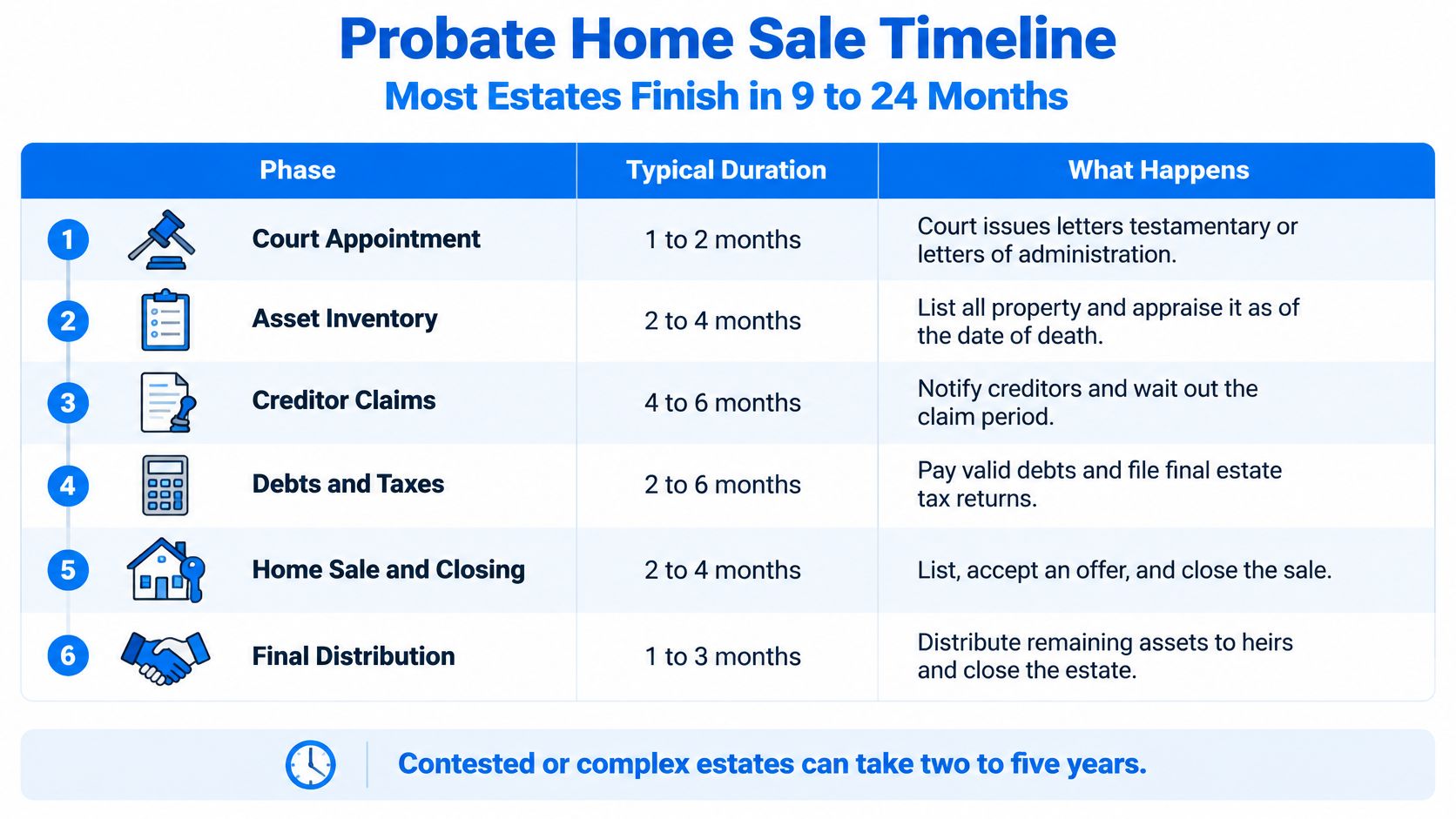
A typical probate estate commonly runs 9 to 24 months, while contested or unusually complex estates may take two to five years, based on estimates in this probate timeline guide. One legal estimate in that same guide places appointment of the representative at roughly 30 to 90 days, then about seven months to a year or more for collecting assets and determining debts.
| Phase | Typical duration | What drives it |
|---|---|---|
| Appoint executor or administrator | 30-90 days | Court issues letters; no sale authority before this |
| Collect assets and determine debts | About 7 months to 1 year or more | Appraisal, mortgage payoff, property taxes, creditor claims |
| Obtain court sale approval where required | Next hearing on the county calendar | Heir objections, missing documents, court backlog |
| Close and distribute proceeds | After title clears | Title insurance, lien payoffs, estate expenses |
| Typical total, standard estate | 9-24 months | Simplified procedures and a complete file move faster |
| Contested or complex estate | 2-5 years | Will contest, heir disputes, multiple properties |
Appointment is the start gun. Until the court issues letters, nobody has sale authority, so marketing before that date mostly creates false hope. Asset collection is the long middle. The house adds an appraisal, title cleanup, mortgage and property-tax payoffs, and creditor claims. Court approval, where your state requires it, waits on the hearing calendar, and an objection or a missing document pushes that date out. Closing comes only after title will insure. Distribution of what's left comes after liens and estate expenses.
What the house itself adds
A bank account can be listed on a form. A house cannot. Someone has to prove what it was worth, clear how it is titled, and keep the lender and the tax collector current. North Carolina readers can compare local pacing with the Law Office of Bryan Fagan's timeline. The shape is similar everywhere. The calendar is not.
What speeds the file and what stalls it
Simplified state procedures, a complete document set, and heirs who already agree will shorten the file. Court backlogs, missing papers, fights among heirs, or a will contest will stretch it into years. An offer can look alive while it is still contingent versus pending on approval and title, so don't treat "under contract" as "closed."
Practical rule: Plan for a year, not a month. The sale cannot start until the court has named the person who holds the pen.
The milestone that matters isn't a buyer. It's proof that the signer has legal authority and that the sale matches your state and county process. Think of a relay. The later runners can't leave until the first runner has a name.
Who Can Legally Sign a Probate Home Sale
Family status does not create a signature. The court does.
How the two appointed roles get their power
An executor is the person named in the will. Authority arrives only when the court issues letters testamentary. An administrator is appointed when there is no valid will, through letters of administration. Neither job is automatic because you are the oldest child or the one paying the utilities. Until those letters exist, a contract signed by an heir is a piece of paper a title company will reject.
The IRS inheritance FAQ covers gifts and inheritances. It does not appoint a seller, and it does not make title insurable. Generic national checklists hide that gap and leave heirs expecting one timetable for fifty different court systems.
Who else shows up at the closing table
| Role | How authority arises | What it allows |
|---|---|---|
| Executor | Named in the will; court issues letters testamentary | Sell if the will or court order authorizes it |
| Administrator | Appointed by the court when there is no valid will; letters of administration | Sell under court supervision, often with added approval |
| Successor trustee | Named in a living trust | Sell trust property per the trust, outside probate if the house is titled to the trust |
| Joint owner with survivorship | Ownership passes on death under the deed | Sell after the deed transfer is recorded, under local recording rules |
| Heir or beneficiary | Inherits a share of proceeds, not title | Cannot sign a sale alone; needs the representative |
Beneficiaries inherit a right to proceeds. They don't inherit the right to convey title. The representative holds the keys. The heir holds a claim on what the house eventually brings. When several people share that claim, selling inherited property with multiple owners turns on written consent, not on who lives closest to the house.
California shows how hard that gate can be. Under the California Probate Code provisions on real property sales, absent an applicable exception, a real-property sale must be reported to and confirmed by the court before title passes, and a private sale generally requires an appraisal dated within one year before the confirmation hearing. An authorized personal representative may sell without that confirmation when the statutory conditions are met. Other states run their own versions of this gate. Some require confirmation only when the will, a devisee, or an heir demands it, and the notice period and hearing mechanics differ from state to state. Confirm the exact rules with the probate court or counsel before you quote anyone a closing date.
Buyers can agree on price while the estate still lacks marketable authority. Ask five questions before anyone signs. Has a representative been formally appointed? Does the will or court order authorize a sale? Must beneficiaries consent? Is court confirmation required? Will a title company insure the deal before probate ends? A missing yes on any one of these is a closing delay measured in weeks, not days.
An offer that ignores a required hearing is not a closing date. It is a hope.
Foreclosure, a vacant house, storm damage, or unpaid taxes make those questions urgent. They don't erase them. Speed and top price pull against each other here, and pushing a buyer before the signer exists buys you neither. Spend fifteen minutes learning how letters get issued in your county before you promise a date.
Approval Gates and Checklist Before Accepting an Offer
An accepted offer, probate approval, and cleared title are three different events. The first one is not closable until the other two are done. Skip a gate and you will renegotiate, or lose the buyer, after weeks of work.
Run the gates in order
- Confirm the appointment and the sale power. Pull the order that names the representative and the will or court order that allows a sale. The title company should review both before you countersign. If the letters are still "coming," you don't have a signer yet, and a pretty offer can't create one.
- Decide whether confirmation is required. Some states make the representative report the sale and wait for a hearing unless an exception applies. Others require confirmation only if the will or an heir demands it. Cause and effect are simple. A strong price still misses the buyer's calendar when a hearing is mandatory or the appraisal is too old for that hearing.
- Check notices and consents. Creditor claim windows and heir notices can still be open. Write down each heir's consent, objection, or silence. One objecting heir can turn a private sale into a contested hearing, even when everyone else is ready to sign.
- Get an insurance answer in writing. Ask the title company whether it will insure this transfer before probate ends. If the answer is no, you don't have a closing. You have a future file. Old deeds deserve a hard look, and a primer on how to spot signs of property title fraud helps you catch a forged lien before it wrecks the hearing.
- Write the contract around the court, not around optimism. Spell out a court-approval contingency, title clearance, termination rights if authority fails, and how estate expenses get paid. A buyer who will not tie dates to those items is asking you to promise something the judge controls.
Each missed gate has the same result. The offer can look excellent and still be unable to close on the buyer's schedule because authority is missing, an heir objects, the appraisal is stale, or a hearing has not been set.
Build the file before you call buyers
Gather this set before the first showing or walkthrough:
- Letters of authority: The certified letters testamentary or letters of administration, not a draft.
- Death certificate and vesting deed: The title company will ask for both on day one.
- Mortgage statement and property-tax bills: Payoffs and delinquencies change the net, and they change urgency.
- Date-of-death appraisal, will, and any sale order: These are what the court and the heirs will measure the price against.
- Heir list with consent status: Name, share, and whether consent is signed, refused, or still open.
Then call the probate attorney and the closing title company, not a buyer first. Ask every buyer for a written timeline tied to each approval. If price matters more than speed, get at least one listing quote so you can see the retail gap in dollars. Rules differ by state and county. Legal calls belong to probate counsel and the title company, not to the person making the offer.
Listing, Cash Offer or Expedited Cash Sale Compared
Speed and top price pull against each other. Pretending they don't is how estates pick a route and then resent it. Compare the three paths on the same facts.
| Route | Speed to close | Price | Fees and costs | Repairs and showings |
|---|---|---|---|---|
| Listing with an agent (MLS) | Several months of marketing, then court and title timelines | Highest potential price | Agent commission plus closing costs | Usually repairs and showings |
| Local investor cash sale | Often weeks once authority and title are ready | Below retail after repair and risk discount | No agent commission; closing costs differ by contract | As-is, limited showings |
| Expedited cash sale | Closes on the estate's documented timeline | Firm offer; discount for speed and as-is risk | No commissions on many offers; read the contract | As-is; walkthrough or evaluation only |
Read the trade-off before you pick
A traditional listing can reach the highest price because the house meets the full buyer pool. You pay for that with months of marketing, an agent commission, repair negotiations, and showings of a house that may still hold someone else's furniture. Court time stacks on top of market time. If heirs can float the mortgage, taxes, insurance, and utilities, listing is the rational choice. If they can't, the "highest price" is theoretical.
A local investor cash sale trades dollars for certainty. The discount covers repairs, holding risk, and a thin resale margin. You skip the commission and most showings, and you sell as-is. You still don't skip letters or title. A cash buyer who promises to close "this Friday" without reading the appointment order is guessing. The cash home buying process only becomes real once authority and insurable title are in the file.
An expedited cash route is the same bargain, tightened. A walkthrough or evaluation leads to a firm offer, then a closing at a reputable title company on the date the estate can document. Cyber Homes, a family-owned cash buyer, is one example of that route. It makes firm cash or private-money offers within hours, buys as-is with no commissions, closes through title companies on the seller's timeline, can advance up to $2,000 for moving costs before closing, and works markets including Dallas, Atlanta, Miami, and Denver. That model is built for urgency and certainty. It is not built to win a top-dollar bidding war, and you should not hire it if the estate can wait for retail.
Match the route to the estate
Use the listing when the will is clear, the heirs agree, the house is habitable, and carrying costs are covered. Use a cash sale when the house is vacant, damaged, behind on taxes, or headed toward foreclosure, and the estate needs a number it can defend. Whichever buyer you pick, make them put the closing date in writing next to each court approval. If they won't, they are selling you a date they don't control.
How to Sell a Probate Home Step by Step
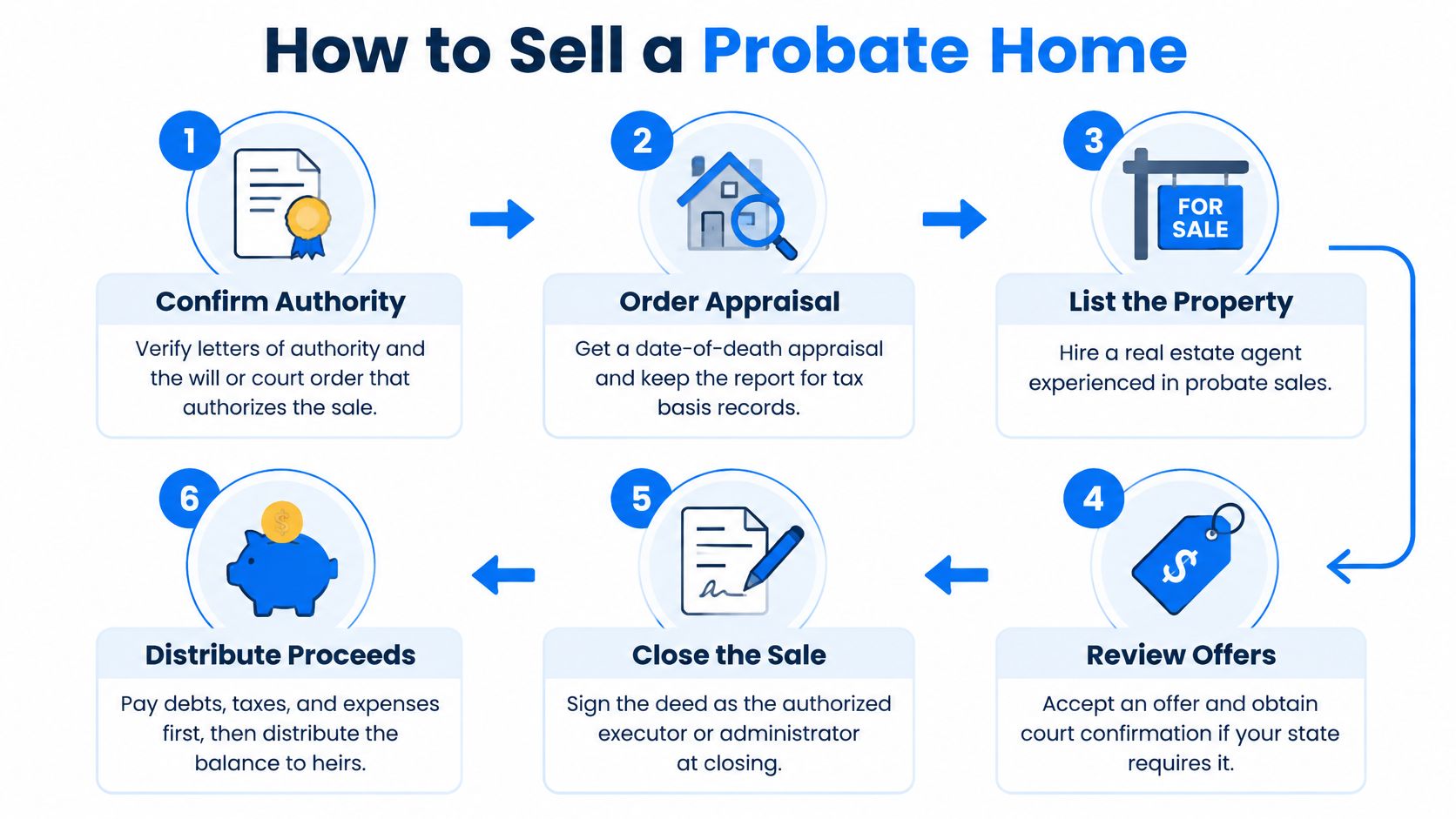
Work the file in order. Skipping ahead is how appraisals go stale and vacant houses go uninsured.
Confirm authority and lock the basis
- Confirm the letters and the sale power. Match the name on the letters to the person who will sign, and read whether the will or the court order authorizes a sale. The common slip is marketing on a family agreement while the letters are still pending. A buyer can't cure that.
- Order a date-of-death appraisal and keep the report. Under IRS Publication 551, the beneficiary's generally applicable tax basis is the property's fair market value on the decedent's date of death. An alternate valuation date applies only when the estate files an estate-tax return and elects it. Say the date-of-death value is $400,000 and the house later sells for $415,000 after qualifying selling costs. The potentially taxable gain is measured from the adjusted basis, not from what the decedent paid in 1998. A sale below that basis because of deferred maintenance can produce a loss, and the tax result still depends on whether the property was held for investment, personal use, or estate administration. The slip is letting an investor's number replace the appraisal. A current market value also lets the representative compare a cash offer with repair-adjusted value and show beneficiaries the duty was considered. Coordinate the appraisal, the closing statement, and the tax file with the estate attorney and a tax professional.
Clear liens, protect the house, and close
- List every lien before you talk price. Mortgage payoff, property taxes, HOA dues, and creditor claims all come out of the check. Heirs who argue over a gross price are arguing over money that isn't theirs yet. Ask each creditor for a written payoff, and date it.
- Keep the house insurable and standing. Leave insurance active, keep utilities on where the policy requires it, and secure or clear the contents. A vacant, uninsured house is the slip that turns a routine estate into a personal loss for the representative. If a pipe fails, document the claim immediately and tell the attorney the same day.
- Pick listing or cash using the actual constraint. If carrying costs are covered and heirs want retail, list it. If the estate needs certainty, take a documented as-is offer. Either way, write down why you chose it. That note is what you show a beneficiary who later says you sold too low.
- File for court approval when your state requires it. Confirm the appraisal still falls inside the window that hearing will accept. Walking in with an outdated report is the usual reason a confirmation gets continued. Ask the clerk for the next realistic hearing date before you promise heirs a month.
- Sign a contract that names the gates. Court approval, title clearance, termination rights, and estate expenses belong in the document, not in a side email. If the buyer needs a loan, their financing is their problem. Your problem is authority. Don't let their deadline delete your contingency.
- Close at the title company, then distribute. Pay liens and expenses first. Distribute what remains only after the court accounting, or as the will directs. Paying an heir early, because they are loud, is the slip that comes back in the final account. Hold the net in the estate account until the attorney says the accounting allows the checks.
The representative holds the house for the beneficiaries. A low price with no appraisal behind it is a personal risk, not a kindness.
Do these eight things in order and the closing date becomes something you can explain. Skip them and you will spend the year explaining delays you could have seen on day one.
If the estate needs a firm number more than a retail experiment, Cyber Homes buys probate and inherited houses as-is, with no commissions, and closes through a title company on the timeline your letters and court approvals actually allow. You get an offer within hours of a walkthrough, and you keep the decision with your attorney and your heirs. Start with a no-obligation review at Cyber Homes.

Edited by
James Vasquez
Real Estate Investor & Land Specialist with 10+ years experience in residential flipping, vacant land investing, land wholesaling, and subdivision deals.
Disclaimer: The information provided is for educational purposes and does not constitute financial or legal advice. Always consult with licensed professionals before making investment decisions.