
How Far Behind on Mortgage Before Foreclosure in 2026

Federal rules generally keep a servicer from starting foreclosure until a borrower is at least 120 days behind, roughly four missed monthly payments. State law then sets how long the process takes after that.
Most explanations stop at that federal floor and treat it like a sale date. It isn't. The same missed payments can mean a notice-based sale in a few months in one state and a court case that runs well past a year in another. Process type, the letters you get, and the week you call all change the calendar.
Picture the file as a relay. The first unpaid due date hands the baton to the servicer. Each later notice is another handoff. You can still step in, but the amount to catch up grows and the paperwork gets heavier. The walk-through below is the one a housing counselor would put on the kitchen table: what "behind" counts, what each letter means, why 120 days is only the starting line, how states diverge, and which option still fits the stage you're in.

How Many Missed Payments Before Foreclosure Can Start
120 days is generally the earliest point a mortgage servicer can make the first foreclosure notice or filing on a covered loan. That is about four missed monthly payments. The Consumer Financial Protection Bureau explains that the federal floor has limited exceptions, including when the borrower abandons the property or when a due-on-sale clause is triggered.
Behind means an installment due date has passed without payment. The count starts with the first unpaid installment. A grace period may delay a late fee, but it does not make an unpaid installment current.
Where you are on the count
| Days Behind | What Typically Happens | What the Borrower Should Do |
|---|---|---|
| 30 days | The servicer may begin outreach, and a late payment may be reported to credit bureaus | Call the servicer and ask about options to address the missed payment |
| 90 days | The loan may be reviewed for possible foreclosure referral, but a review is not the same as starting foreclosure | Request a written reinstatement amount and ask which state process applies |
| Three full missed installments | For many FHA-insured loans, HUD guidance generally keeps foreclosure unavailable until three full installments are due and unpaid | Confirm whether the loan is FHA-insured and ask the servicer which HUD rules apply |
| 120 days | The federal floor for a first foreclosure notice or filing generally arrives, around four missed payments | Check that any loss-mitigation application is complete and ask what protections apply |
The three-installment FHA threshold is another way to mark the 90-day point, not a separate later stage. The HUD servicing guidance describes the FHA rule. A servicer can review or prepare a file before day 120, but for a covered loan it generally cannot take the first step to start foreclosure before that point. The exceptions named above can change that floor.
Why payment one is the milestone that matters
Reaching day 120 does not set a sale date. It opens the door to the next legal steps. State law, court proceedings or a nonjudicial process, required notices, and your response to the servicer all affect how much time follows. The same number of missed payments can therefore lead to different deadlines in different states.
A complete loss-mitigation application may prevent the servicer from starting foreclosure while it reviews the application, if it arrives early enough. It may also provide protections while you keep an approved modification. Contacting the servicer after the first missed payment gives you more time to learn what documents are needed.
Practical rule: Call the servicer during the week of your first missed due date. Ask for the amount needed to bring the loan current, which fees may be added, and what forms are required for a complete application.
Arrears grow with each unpaid month. Late charges and, once attorneys are involved, legal costs can add to the amount required to reinstate the loan. The options may narrow as the file moves from outreach to referral, so ask for the current status and next deadline in writing.
Notice Periods and Cure Periods Explained
Four papers decide how much time you really have. People mix them up because they all arrive in official envelopes.

Think of them as a fire alarm that gets louder. The alarm doesn't put the fire out. The cure window does, if you use it.
The four papers
Notice of default. This is the formal warning that the loan is in default. It should say what you owe and what it takes to fix the default. Read the date on the letter, not just the day it landed in the mailbox.
Cure or reinstatement period. This is the window to pay past-due amounts, fees, and costs and stop the process. It is the chance to put the fire out. Ask for the figure in writing so you're not guessing at inspections, late fees, or attorney charges.
Notice of sale. This announces the auction or trustee sale date. Once this date is on a calendar, a normal listing has less room, and a workout has to be far enough along that the servicer will postpone.
Redemption period. In some states, after the sale, you can still buy the home back by paying what the law requires. Not every state has one. Where it exists, it is a last door, not a plan.
Court case or trustee track
Judicial foreclosure means the servicer files a lawsuit. Dates follow a judge's calendar, so a crowded docket can add many months. You usually remain the owner while the case is open, and you still have to answer papers. Ignoring a summons is how a slow state becomes a faster one.
Nonjudicial foreclosure skips the lawsuit. A trustee or sheriff follows a statute: publish, wait, sell. The steps are shorter because nobody is waiting on a motion calendar. The notices are the whole process, so missing one is costly.
Bankruptcy is a pause, not a wipeout
A bankruptcy filing triggers an automatic stay that can stop a sale while the case is active. It does not erase the mortgage. A lender can ask the court to lift the stay. Chapter choices, exemptions, and whether you can catch up inside a plan all need a bankruptcy lawyer. The credit impact is serious, so treat the filing as a planned tool, not a last-night fax.
The cure window is the idea to keep. Every later notice is a louder alarm. The payment that reinstates is what stops the process.
Why 120 Days Is a Starting Point, Not a Sale Date
A foreclosure sale can happen much later than the first day a lender may begin proceedings. Federal rules generally prevent a first notice or filing until a borrower is more than 120 days delinquent. That is a starting line, not a sale date. State procedures and the borrower's actions shape what happens after it.
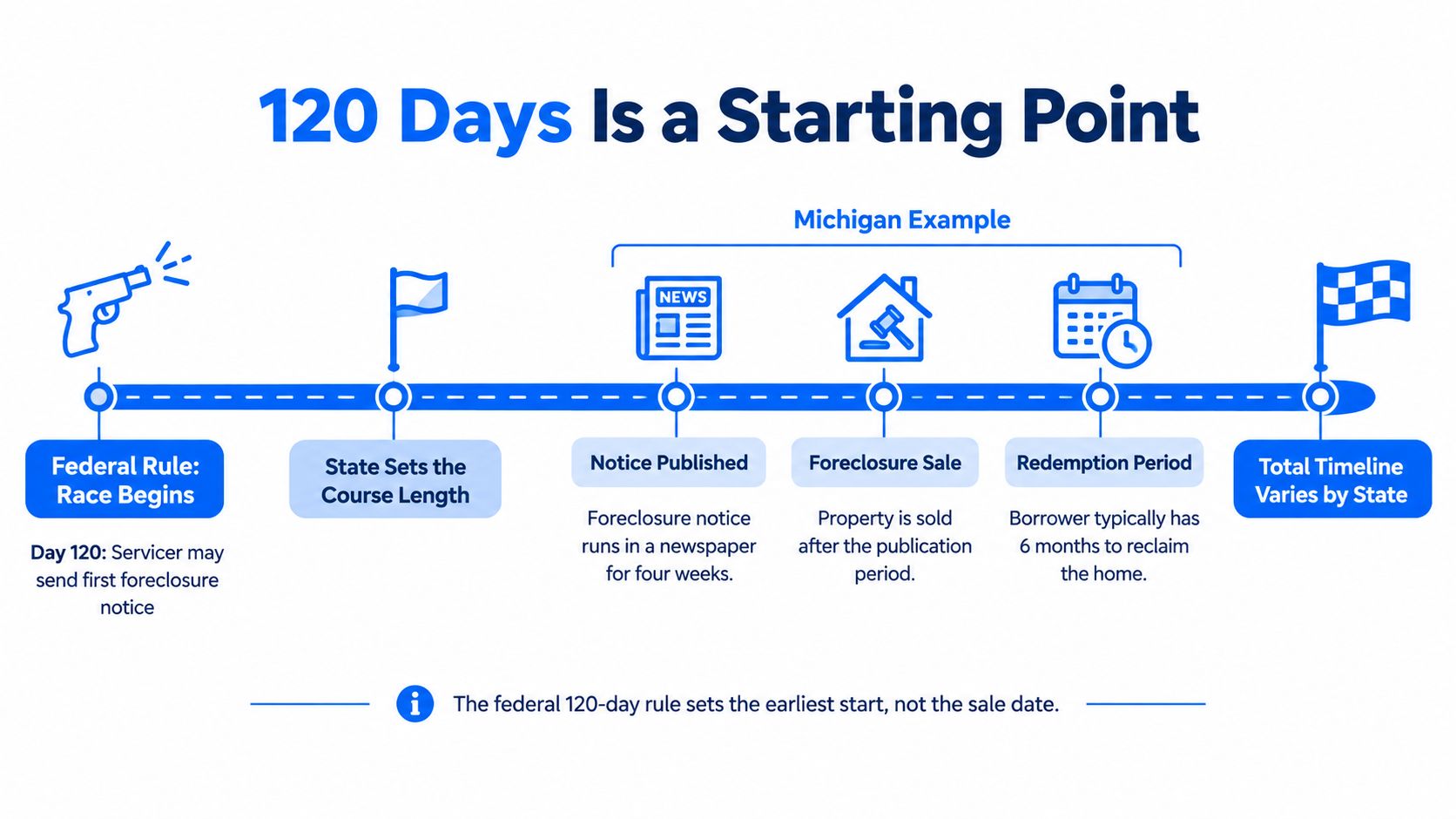
Once proceedings begin, the number of missed payments and the time remaining before a sale are separate measures. ATTOM's mid-year 2025 report found that homes foreclosed in the second quarter of 2025 had spent an average of 614 days in the process nationally. State averages ranged from 125 days in Wyoming to 162 days in Minnesota, with Texas at 135, New Hampshire at 149, and Montana at 154. In the first half of 2025, lenders started proceedings on 140,006 U.S. properties, up 7% from the same period in 2024 and 41% from the first half of 2020. These figures describe completed cases or new filings, not a guaranteed deadline for an individual home.
A Michigan-style course
Michigan illustrates why the process can continue after the first filing. The state's foreclosure-by-advertisement process includes required notices before a sheriff's sale. In qualifying cases, the homeowner may then have a statutory redemption period after the sale. The applicable period depends on the circumstances, so do not treat a broad range as your personal deadline. Check the notices and current state requirements with a Michigan housing counselor or attorney.
Missed payments are only one part of the amount needed to reinstate a loan. Late fees and foreclosure-related costs may also be added. Ask the servicer for a current reinstatement quote, which lists the amount required to bring the loan current. Waiting can increase that amount and narrow the options available. A repayment plan that worked earlier may no longer fit once costs have accrued.
An investor's offer does not automatically pause a sale. Confirm upcoming deadlines with the servicer and local counsel, request a current payoff, and identify any other liens on the property. A national average can help explain the process, but only the notices, state rules, and your case details can clarify your next deadline.
State Foreclosure Timelines Compared
The national average foreclosure timeline was 614 days in the second quarter of 2025, compared with 125 days in Wyoming. That gap shows why a statewide average is only a reference point. The process type, required notices, and actions you take can change the timeline for your home.
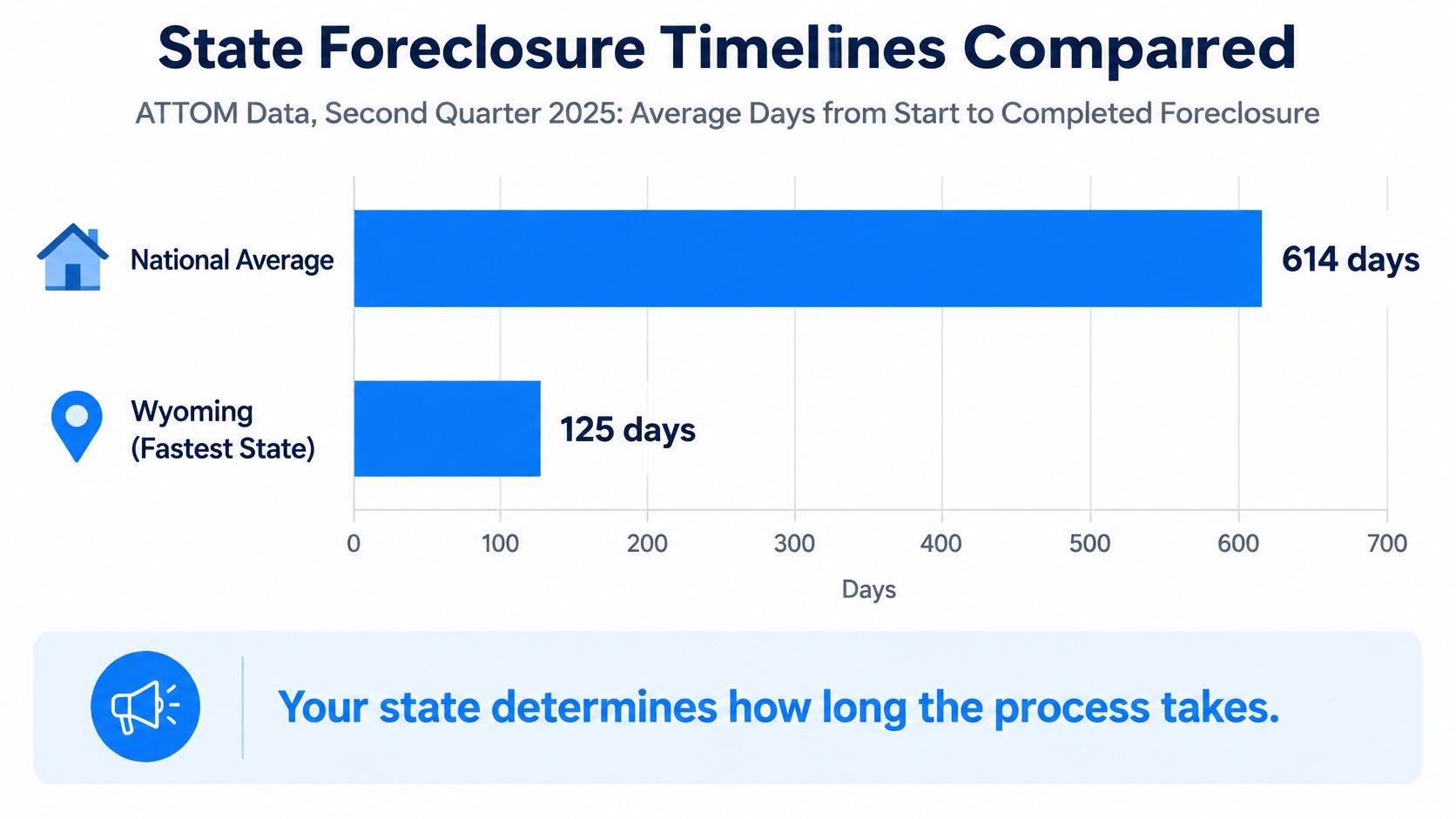
The figures below are second-quarter 2025 averages. They describe completed foreclosure timelines, not the time remaining after you miss a payment. Averages also do not show every notice or deadline that applies to an individual loan.
Average days and what they mean
| State | Process Type | Average Days to Foreclosure | What It Means for Borrowers |
|---|---|---|---|
| National average (all states) | Mixed | 614 | Average completed timeline across states |
| Wyoming | Not specified here | 125 | State average reported for the period |
| Texas | Nonjudicial | 135 | Review the notices and sale date in your case |
| New Hampshire | Not specified here | 149 | State average reported for the period |
| Montana | Not specified here | 154 | Confirm which notices are required and whether each has been sent |
| Minnesota | Not specified here | 162 | Confirm the required notices and the cure deadline stated in them |
| Michigan | Nonjudicial, sheriff's sale | Not stated in this comparison | Check the pre-foreclosure notice, sale notice, and any redemption deadline that applies |
| New York | Judicial | Not stated in this comparison | Check the court papers, response deadlines, and any scheduled hearings |
| Florida | Judicial | Not stated in this comparison | Check the complaint, court deadlines, and any hearing or sale date |
Same delinquency, two calendars
Suppose you and a friend are both about four payments behind, one in Texas and one in New York. The same number of missed payments does not produce the same sequence of steps. Texas uses a nonjudicial process, while New York foreclosure proceeds through a court case. Your own notices and dates show where you are on that path.
In a judicial process, court filings and scheduled hearings form part of the timeline. Read each paper promptly, note any response deadline, and ask a local housing counselor or attorney what you need to do. Ignoring a summons can put you at risk of losing the chance to respond.
Michigan's course has its own stages, including a sheriff's sale and, in qualifying cases, a post-sale redemption period. Check the notice for the sale date and ask whether a redemption period applies to your property. A possible redemption period is not a reason to wait; the deadline and requirements need to be confirmed for your case.
How to read your row
Name the process first. A judicial foreclosure goes through a lawsuit. A nonjudicial foreclosure follows the state's statutory notice process and sale steps.
Use the average as context. It describes completed cases, not a promise or countdown for your loan.
Then check your paperwork. Look for the notices your state requires, the date each was sent or served, any deadline to cure or respond, and the scheduled sale date. If a deadline is unclear, contact your servicer and local counsel to confirm it.
If a retail sale may not close before the scheduled date, compare offers carefully. A list of companies that buy houses for cash can help you identify options, but check the payoff amount, liens, and closing timing before deciding.
A short video can also help you follow the order of the foreclosure steps.
Options That Still Work at Each Stage
The right option depends on why payments stopped, what you can afford now, and how much time remains before the sale. A temporary layoff with a return-to-work date may fit forbearance. A lasting income drop may call for a loan modification or sale. Money you can realistically raise, such as a tax refund, family loan, or bonus, may cover reinstatement. If you are checking the home's condition, liens, and payoff, learn what buyers and title companies mean by a distressed property.
Side-by-side cutoff points
| Option | Works Best When | Stage Where It Still Helps | Main Risk |
|---|---|---|---|
| Reinstatement | You can pay all past-due amounts and fees at once | Any stage until the cure period ends | The lump sum can be large |
| Repayment plan | The shortfall is modest and income has recovered | Early, 30 to 90 days behind | Higher monthly payments for a set period |
| Forbearance | Hardship is temporary and has a clear end date | Early to middle, before a notice of sale | Missed amounts still come due at the end |
| Loan modification | Changed terms can make the payment affordable | Before referral or while a complete application is pending | Documentation takes time and applications can be denied |
| Listing for sale | Equity covers the payoff and there is time for a normal sale | Before the notice of sale | The sale must close before the deadline |
| Cash sale to an investor | The timeline is urgent or the home needs repairs | Late stage, after notices are issued | The offer must be verified; it does not automatically stop foreclosure |
| Bankruptcy | A temporary pause is needed and other options have failed | Any stage | Serious credit impact; a lawyer is required |
What the trade-offs feel like
Reinstatement can bring the loan current if you have the full amount and the cure period is still open. Check whether next month's payment will also be manageable before borrowing for the lump sum. Catching up once does not solve a lasting income gap.
A repayment plan spreads a modest shortfall across future payments. It works only if the added amount fits your current budget. If your income has just returned, compare the new monthly total with your actual take-home pay.
Forbearance reduces or pauses payments for a set time, but the missed amounts remain due. Before signing, ask how repayment works: the balance might be due at once, added to the end of the loan, or included in a modification.
A loan modification may change the terms enough to make payments affordable. The application needs to be complete, and approval is not guaranteed. Send every requested page, then keep proof of when you submitted it.
A regular home listing may preserve more equity when there is time for showings, repairs, and a buyer's financing. The key deadline is the closing, not the listing date. If a sale has been scheduled, do not assume a pending offer will delay it; get any agreement to wait in writing.
A cash sale may suit a short timeline or a home that needs repairs. Before accepting, compare the written offer with the mortgage payoff and all liens, and confirm the closing date comes before the foreclosure sale. A cash offer by itself does not stop the process.
Bankruptcy may temporarily pause a foreclosure case when other options have failed. It has serious credit consequences and requires advice from a lawyer, so discuss whether it fits your circumstances before filing.
Confirm Your Deadline and Act This Week
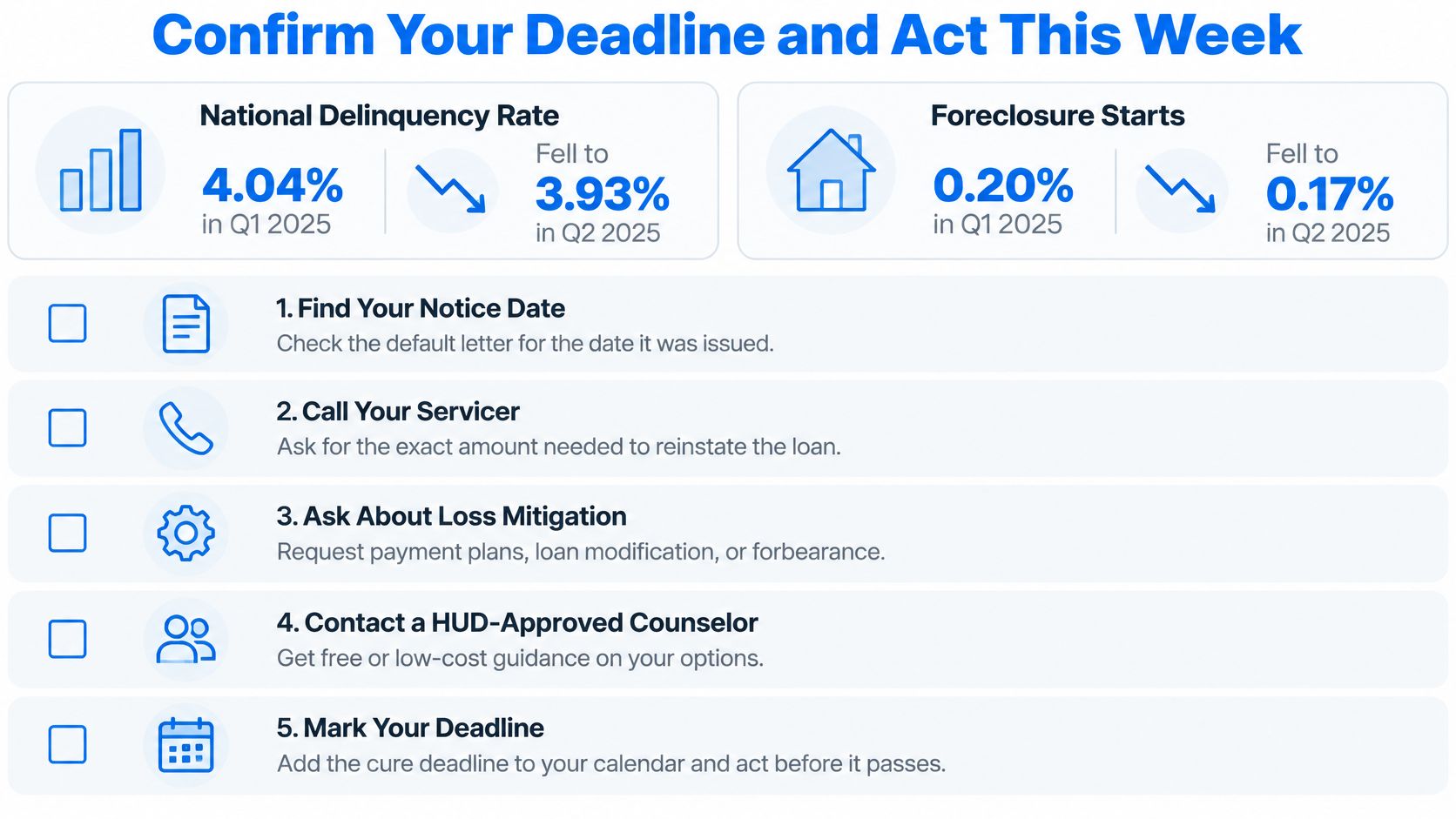
In the first quarter of 2025, the national mortgage delinquency rate increased slightly, according to the Mortgage Bankers Association. That national figure cannot tell you when your home could be sold. The 120-day point is a starting line, not an auction date. State process, required notices, cure periods, and the date you act all shape the remaining time.
This week's checklist
- Request a written reinstatement figure and payoff. Ask for each amount's “good through” date. The figures work like a dated snapshot, and fees may change afterward.
- Confirm your state's process and next sale step. Find out whether foreclosure is judicial or nonjudicial and what notice comes next.
- Submit a complete loss-mitigation application. Keep the fax receipt, portal screenshot, or certified-mail stub as proof of when it was sent.
- Calendar every notice date and cure deadline. Mark the sale date and last day to reinstate somewhere you will see them daily.
- Compare time with your options. Estimate arrears, then weigh a normal listing or workout against the days remaining. Flag bankruptcy or title problems for professional advice.
- Check any cash offer independently. Choose your own title company, and consult an attorney if a sale date is set. A cash closing helps only if it funds before that date. Review the cash home buying process as one option, then compare its timing and terms with the written payoff.
- Call a HUD-approved housing counselor. A counselor can help you sort through notices, deadlines, and next steps. Counseling costs little or nothing.
The process is like a series of gates: passing one date does not tell you when the next opens or closes. Use the notice in hand to confirm the deadline with your servicer, a housing counselor, or an attorney.
If selling is the right exit and time is short, get the payoff and offer in writing. Before signing, confirm with a title company and your advisor that closing can happen before the sale.
If a sale date is already on the calendar, Cyber Homes can evaluate the house and make a firm cash offer for comparison. Check the offer against the payoff and legal timeline; confirm every figure with the servicer and title company before signing.

Edited by
James Vasquez
Real Estate Investor & Land Specialist with 10+ years experience in residential flipping, vacant land investing, land wholesaling, and subdivision deals.
Disclaimer: The information provided is for educational purposes and does not constitute financial or legal advice. Always consult with licensed professionals before making investment decisions.