How to Sell a House As-Is for Cash in Chicago, IL (2026)

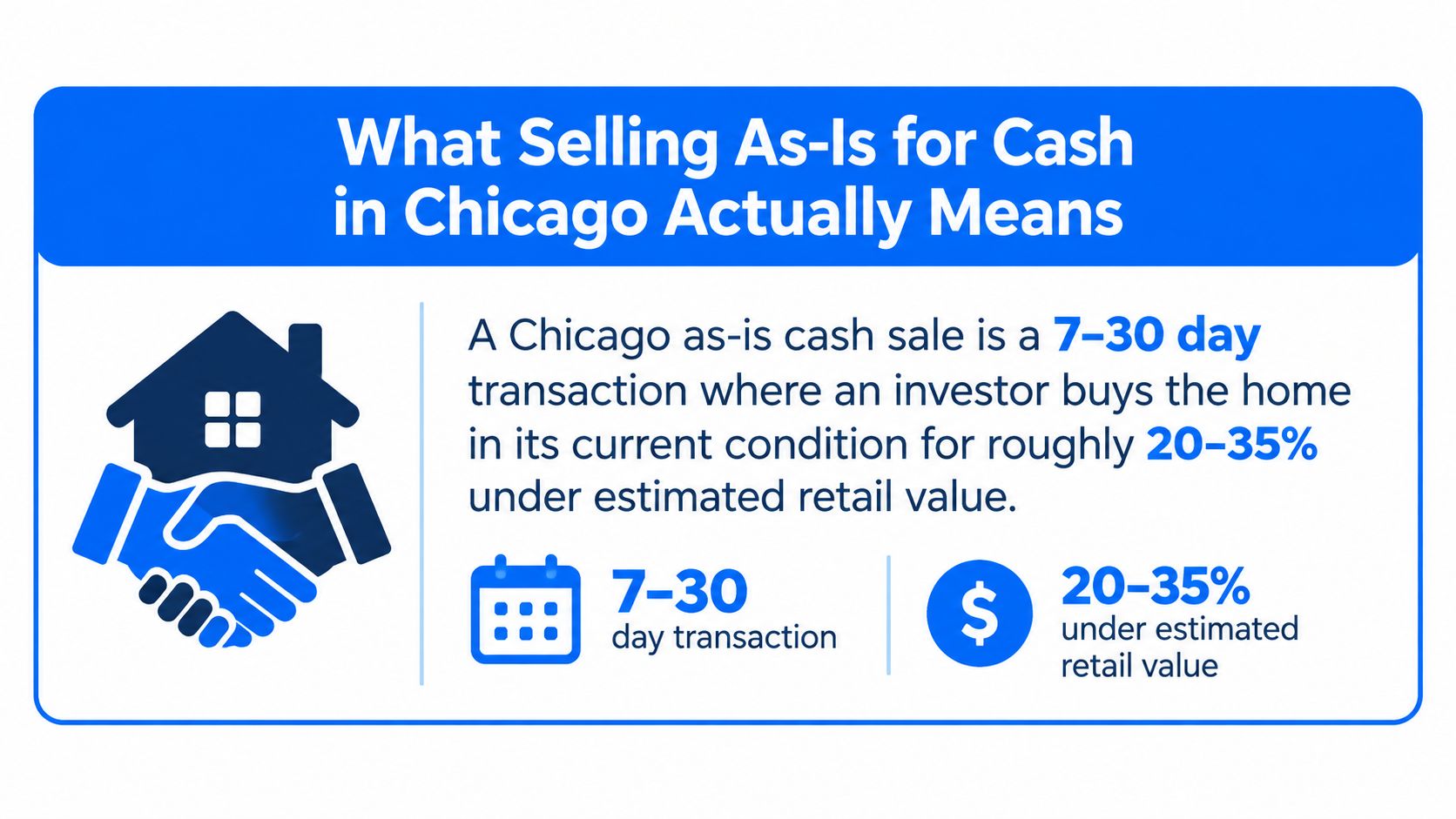
Most Chicago homeowners who sell as-is for cash should expect an offer that's roughly 20% to 35% below estimated retail value, with a closing in 7 to 30 days, and they still need to complete Illinois's Residential Real Property Disclosure Report. If you need speed, skip repairs, and want a date-certain close in Chicago, that trade-off can make sense, but you should treat it as a net-proceeds decision, not a headline-price decision.
Key Takeaways
- Cash works when certainty matters most. It's a fit for foreclosure pressure, probate, divorce, vacancy, major repairs, or inherited homes.
- “As-is” doesn't cancel disclosure. Illinois still expects known defects to be disclosed on the Residential Real Property Disclosure Report.
- Compare net, not list price. A lower cash offer can beat a higher retail price after commissions, repairs, taxes, and delays.
- Vet every buyer. Ask for proof of funds, insist on a local title company, and avoid any buyer who changes the price after inspection.
- Chicago's housing stock is older. Roughly 40% of the city's housing was built before 1940, and Chicago permitted only 3,916 housing units in 2025, so condition risk is baked into the market (city that works analysis).

Get a cash offer for your home
What Selling As-Is for Cash in Chicago Means
Selling as-is for cash in Chicago means you trade retail price for speed, certainty, and fewer moving parts. A cash buyer closes in 7 to 30 days, takes the property in its current condition, and you still complete Illinois disclosure paperwork before closing. That is the right move when repairs, showings, lender delays, or a forced timeline matter more than squeezing out every last dollar.
Chicago's market explains why this option exists. In the three months ending September 2026, homes sold for a median of about $410,000, took roughly 52 days on market, and averaged about three offers (Redfin Chicago housing market). Use that as a benchmark, not a promise for your home. Once you add prep work and closing delays, a traditional sale can stretch well beyond the number on the listing page.
Practical rule: if your house needs work and you want a clean exit date, a cash sale is a timing decision first and a pricing decision second.
Cash sale versus MLS sale
A direct cash sale cuts out the parts that slow deals down. You skip staging, repeated showings, lender underwriting, appraisal problems, and financing contingencies. An as-is MLS listing still leaves you exposed to buyer credits, repair demands, and financing fixes after inspection, so “as-is” on the MLS is not the same as a clean cash closing.
That distinction matters in neighborhoods like Austin, Englewood, Rogers Park, Lincoln Park, and Berwyn-area edge markets, where property condition can vary block by block. If your house has older systems, deferred maintenance, or vacancy issues, the choice is between top-dollar uncertainty and a lower, known result.
A simple way to judge the offer is to work backward from your likely resale value. Cash buyers often start with the home's after-repair value, subtract repairs, holding costs, and their margin, then land near a discounted offer. That is why the headline number is only part of the story.
Bottom line: sell house as-is for cash in Chicago, IL when you care more about the closing date than the highest possible list price.
Cash Buyer vs Agent Listing As-Is vs Fix and List
The right path depends on whether you want the most money, the cleanest process, or the fastest exit. In Chicago, I judge these choices by net proceeds, not the number on the flyer. Commissions, concessions, repairs, and the risk of a late-stage collapse all change the result.
| Chicago As-Is Sale Paths Compared | Typical Net vs Open Market | Fees | Time to Close | Repairs Required | Certainty |
|---|---|---|---|---|---|
| Cash buyer | Lower headline price, often stronger certainty on net | Usually no commission, title and closing costs vary by contract | 7 to 30 days | Usually none by seller | High |
| Agent listing as-is | Can net more if buyers compete, but inspection credits can cut into proceeds | Commission, closing costs, possible concessions | About 52 days on market in the city, plus time to close | Seller often still funds known fixes or credits | Medium |
| Fix and list | Highest gross potential if the work pays off | Repairs, permits, carrying costs, commission, closing costs | Usually the slowest | Seller funds prep and repairs | Medium to low |
A traditional listing makes sense when the home is in good shape and you can wait for the market to do its job. It gets weaker fast when the property needs roof work, plumbing updates, electrical work, or a kitchen overhaul. Buyers then ask for credits, lenders get cautious, and the deal can shrink after inspection.
For a broader menu of selling paths, a practical consumer guide is find home selling guidance, but Chicago sellers still need to test any advice against local title, tax, and disclosure rules.
If you are comparing companies, this Chicago-specific directory of cash home buyers in Chicago helps separate real operators from vague marketing.
How Cash Buyers Actually Calculate Their Offer
A cash offer starts with after-repair value, then gets reduced for repairs, carrying costs, and the buyer's profit margin. The simplest version is the industry's familiar 70% rule, which means a buyer targets about 70% of ARV minus repair costs. That's not law, and it's not a fixed formula, but it's how many investors keep themselves safe when they're taking title as-is.
A Chicago example that actually makes sense
Say a Lincoln Park bungalow would sell for $475,000 after roof, electrical, and kitchen work, and the buyer estimates $40,000 in repairs. A rough target using the 70% rule is $292,500, because 70% of $475,000 is $332,500, and subtracting $40,000 gets you there. If the property needs more work, the offer falls. If it needs less, the offer rises.
That math also explains the condition bands sellers usually see:
- Light repairs, mostly cosmetic and deferred maintenance, usually land around 80% to 90% of ARV.
- Moderate repairs, like one major system or a roof and HVAC issue, often fall around 65% to 80% of ARV.
- Heavy repairs, such as foundation trouble, fire damage, or major water damage, can drop into the 50% to 65% of ARV range.
The buyer also prices in carrying costs, which means taxes, insurance, utilities, and financing costs while they own it and rehab it. They need margin too, because if they overpay, they're stuck with the risk.
Practical rule: if you can estimate ARV and repair cost yourself, you can judge a cash offer in five minutes instead of trusting a buyer's story.
A written offer should spell out the purchase price, earnest money, inspection period, closing date, and who pays closing costs. If the number shifts hard after a walkthrough, or the buyer says they're “just assigning the contract,” that's a red flag, not normal negotiation.

The 7 to 30 Day Cash Sale Timeline
A real cash sale moves fast only when the paperwork is ready. The cleanest Chicago deals start with a few vetted buyers, move through a title search, and close once ownership, liens, and payoff numbers are confirmed. That's why serious sellers should gather documents before they accept the first offer.
What happens first
Start by asking two or three buyers for written offers and proof of funds. Then let the buyer walk the property, either in person or by drive-by, so they can confirm condition and write a real contract.
Once you sign, the title company steps in to verify ownership, liens, municipal issues, and payoff figures. A clean file can move quickly, but probate, foreclosure, and delinquent taxes tend to slow the back end because title has to verify authority and money needed to clear title.
How to keep the deal from slipping
While the buyer is checking title, you should be pulling together the deed, mortgage statement, tax bill, utility balances, leases, permit records, and any probate or divorce authority. The more complete the file, the less chance the closing slips because someone is still hunting for documents.
Best practice: ask where closing will happen before you sign. If the buyer won't use a real Chicago or Cook County title company, walk away.
If you want a buyer-facing overview of the process, this guide to the cash home buying process is a useful reference point for how reputable transactions usually move.
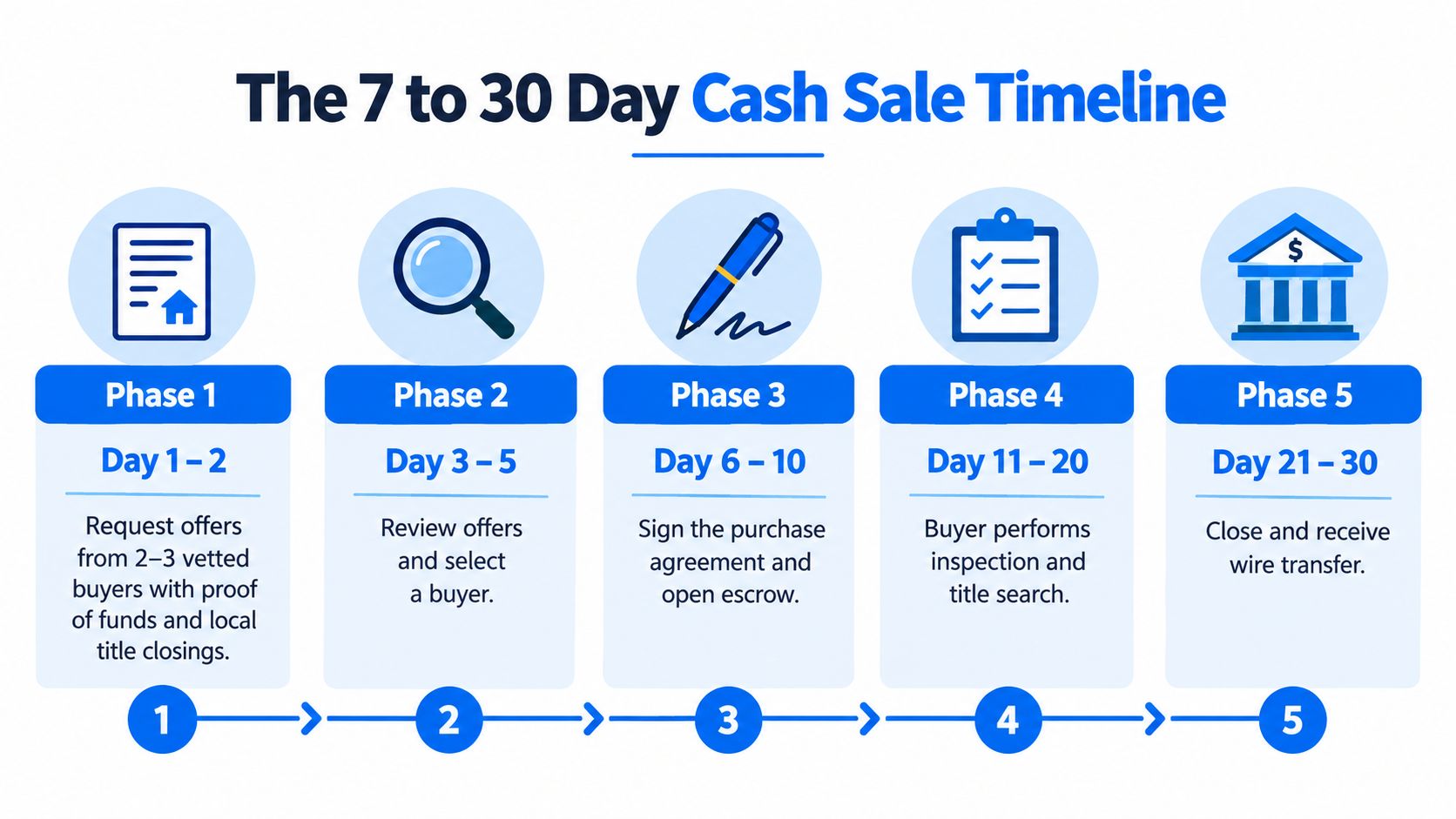
The timeline below is the realistic version:
- Day 1 to 2, collect offers.
- Day 3 to 5, compare terms and select a buyer.
- Day 6 to 10, sign the purchase agreement and open title.
- Day 11 to 20, complete inspection and title work.
- Day 21 to 30, close and receive funds.
A traditional Chicago listing can take far longer because the house has to sit on market, then survive buyer financing, then survive closing. If time is the problem, cash is usually the cleaner exit.
Get a cash offer for your home
Illinois Disclosures and Chicago Vacant Property Rules
“As-is” in Illinois changes repair expectations, not disclosure duties. Illinois sellers still have to complete the Residential Real Property Disclosure Report and disclose known material defects, including structural issues, roof leaks, basement water, plumbing, electrical, HVAC, flooding, environmental hazards, and code problems. Illinois law also allows an as-is contract, but that doesn't erase the duty to tell the truth about what you know.
The timing matters. If the buyer gets the disclosure after contract signing, they can generally have five business days to terminate and recover deposits. If the disclosure doesn't get delivered before conveyance, the buyer can also get a termination right, which is one more reason to get the paperwork done early.
Chicago adds another layer if the property is vacant. The city treats certain single-family and smaller residential buildings as vacant when nobody legally lives there and no former occupant plans to return within six months, and owners must register within 30 days (City of Chicago vacant buildings rules). The city also requires vacant buildings to be insured and can inspect, fine, board up, or even pursue demolition if violations remain open.
Cook County tax pressure also matters because delinquent taxes shrink your net. If you're selling as-is, don't guess on taxes or municipal issues, get a title and lien search, then confirm what has to be paid off at closing. Sellers in places like South Shore, Logan Square, Pilsen, and Lakeview often run into the same problem, older properties with a messy paper trail.
Hidden Costs and Your Real Net Sheet in Chicago
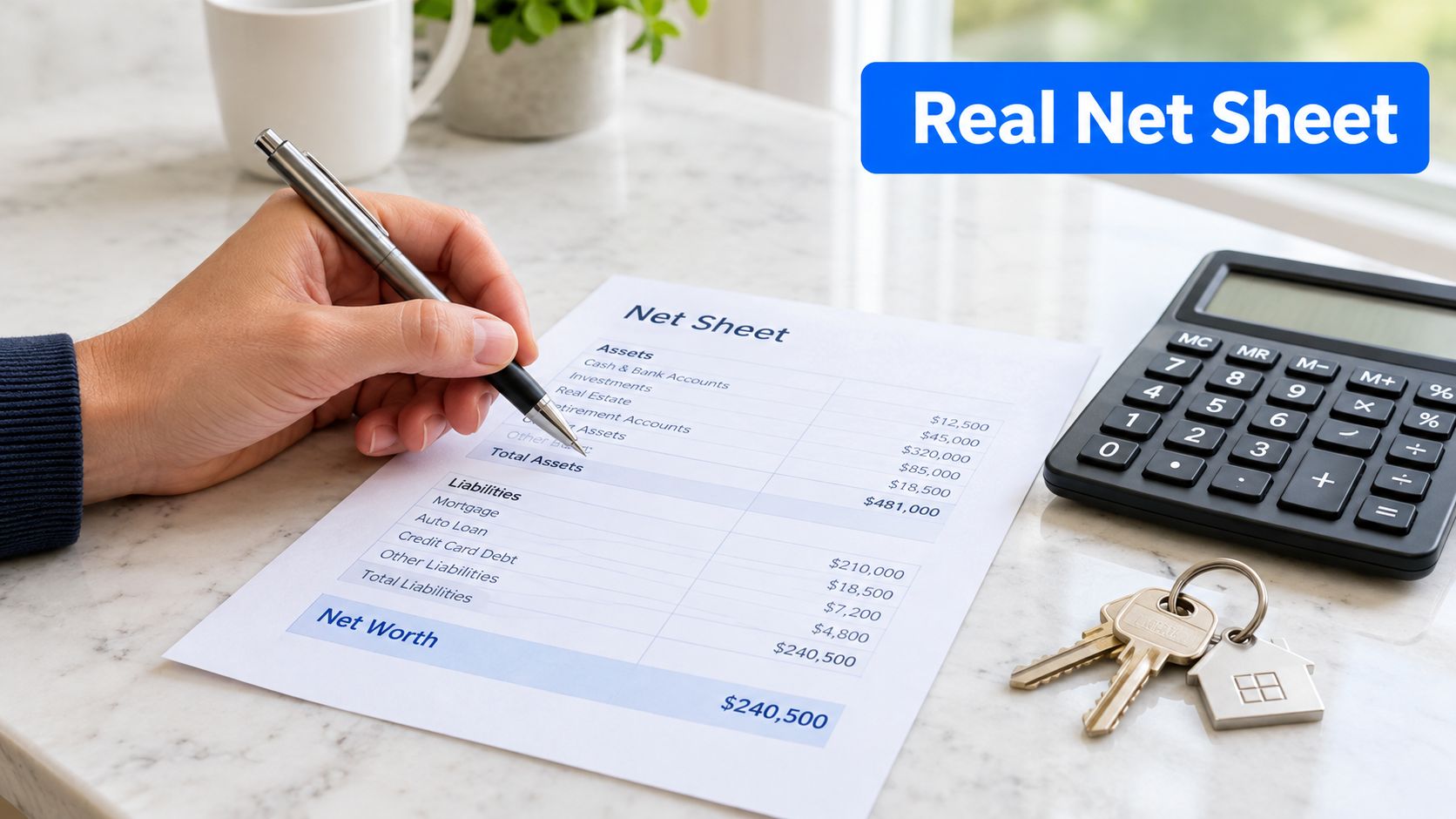
The only number that matters is what hits your account at closing. Chicago sellers should build a net sheet before they accept any offer, because the offer price is only one line on the page. The rest is mortgage payoff, accrued interest, property taxes, title fees, transfer taxes, and any credits or concessions.
A traditional listing can look stronger on paper and still cost you more in the end. If the home sits for months, the mortgage keeps running, taxes keep accruing, insurance and utilities stay on, and the deal can still fall apart after inspection or financing. A cash sale cuts that exposure down fast.
A simple worked net sheet
Use Chicago's median sale price as a benchmark, then compare a lower cash offer with a higher traditional offer after costs and delays. A hypothetical $300,000 cash offer on a home with $180,000 left on the mortgage, $4,500 in delinquent taxes, and $3,500 in title and transfer costs nets about $112,000 before any other negotiated items. A $375,000 traditional sale can net more, but only if the home appraises, financing clears, and the buyer does not reopen the deal after inspection.
That is why sellers should judge offers by net proceeds, not sticker price. A lower cash number can still be the better deal if it removes months of carrying costs and closing risk.
What belongs on the net sheet
- Mortgage payoff. Whatever is still owed, plus interest through closing.
- Taxes and prorations. Any unpaid or prorated Cook County balances.
- Closing charges. Title, recording, and transfer-related items.
- Concessions. Credits for repairs or buyer-requested costs.
- Commissions. This is the MLS cost center you skip in a direct cash deal.
- Holding costs. Mortgage payment, insurance, utilities, and vacancy drag while you wait.
Compare a cash offer to the most realistic net you would keep on the same closing date. That is the number that tells you whether the deal makes sense.
Get a cash offer for your home
Special Chicago Situations and How They Change the Deal
Special situations usually decide the right sale method faster than price does. If you're handling an inherited house, a pre-foreclosure, a divorce, or a tenant-occupied rental, the first question is not “what's the top offer?” It's “what document or deadline has to be cleared before title can transfer?”
Inherited or probate property
Heirs need authority, not just interest. The title company will want a certified will, court order, or other probate authority, plus a clean answer on missing heirs and creditor claims.
Pre-foreclosure
Illinois foreclosure is judicial, so there's a court case, redemption period, sale, and confirmation process. If you're behind on payments, get a current reinstatement or payoff quote before you sign anything, because a buyer can't close fast enough if the lender deadline has already boxed you in.
Divorce, tenants, liens, and damage
A divorce sale usually needs both spouses to sign unless the settlement language and deed already line up. Tenant-occupied properties need lease review and notice compliance, because the buyer doesn't want a closing surprise.
If you have liens, back taxes, or code violations, title has to get payoff letters and municipal clearance. If the place had fire, water, or hoarder damage, the deal usually lands in the heavy-repair band because the buyer is taking on cleanup, risk, and delay.
Best buyer test: proof of funds, local title closing, traceable earnest money, no upfront fees, and no pressure to sign an assignable contract without disclosure.
Watch the warning signs. If a buyer lowers the price after inspection, refuses to name the title company, or asks you to wire money first, stop the deal. If you want a Chicago-focused inherited-property walkthrough, this guide on selling an inherited property in Chicago is worth reviewing before you sign anything.
What to gather before you sell
- Deed and mortgage statement
- Most recent tax bill
- Utility balances
- Leases and tenant notices
- Permit and violation records
- Prior inspection reports
- Probate or divorce authority documents
- A written list of known defects for the disclosure report
For tax basics, primary residences may qualify for the $250,000 single or $500,000 married capital gains exclusion, but you should confirm your situation with a CPA. Also, Illinois CBS-1 instructions show that an attorney field can be marked N/A if the seller isn't represented, but that doesn't mean you should skip legal review when the title or family situation is messy (Illinois CBS-1 instructions).
If you need a straightforward cash sale in Chicago, Cyber Homes handles as-is transactions through a title company and can give you a clear path to closing without repairs or commissions. If you want to compare a direct cash offer against your other options, visit Cyber Homes and ask for a no-obligation review of your house's condition, title situation, and timeline.
FAQs
How much do you lose selling a house as-is for cash in Chicago?
Usually, you give up some upside in exchange for speed and certainty. The question is how much you keep after repairs, holding costs, commissions, concessions, and delay, because a lower cash offer can still win on net.
Do I still need to disclose problems if I sell as-is?
Yes. Illinois still requires the Residential Real Property Disclosure Report, and an as-is contract doesn't excuse you from disclosing known material defects. If you learn something new before closing, you should update it.
Can I sell a house with a mortgage still owed?
Yes, as long as the sale price covers the payoff and closing costs, or your lender agrees to a short sale. The title company usually handles payoff at closing, so you need a current payoff statement before you sign.
What if my Chicago house has code violations or unpaid taxes?
You can still sell, but those items have to be addressed in the closing file. The title company and municipal search will show what must be paid or resolved before the deed can transfer cleanly.
How fast can a cash buyer close in Chicago?
A clean deal can close in the 7 to 30 day range when documents are ready and title is clear. Probate, foreclosure, tenants, liens, or missing paperwork can push it toward the longer end.
Should I accept the first cash offer I get?
No. Get at least two or three offers, ask for proof of funds, and make the buyer put everything in writing. The first offer is only useful if it survives title review and still makes sense on your net sheet.
Is an attorney required to sell a house in Illinois?
Not universally for every form or every closing file, but that doesn't mean you should skip one. Illinois CBS-1 instructions show attorney representation is optional for that field, yet Chicago title work, probate, divorce, or foreclosure issues often justify legal review.
What's the safest way to compare cash buyers in Chicago?
Use a local title company, require earnest money, and avoid upfront fees. Compare the purchase price, closing date, who pays closing costs, and whether the buyer is trying to assign the contract without telling you.

Edited by
James Vasquez
Real Estate Investor & Land Specialist with 10+ years experience in residential flipping, vacant land investing, land wholesaling, and subdivision deals.
Disclaimer: The information provided is for educational purposes and does not constitute financial or legal advice. Always consult with licensed professionals before making investment decisions.