How to Sell a House As-Is for Cash in Indianapolis, in (2026)

Selling an Indianapolis house as-is for cash typically means accepting 70%–85% of after-repair value, closing in 7–30 days, and trading top dollar for certainty, relief from holding costs, and no repair work. The right offer depends on condition, title, liens, timeline, and what you'd keep after every deduction.
If you're dealing with a vacant rental in Marion County, an inherited house near Fountain Square, or an older property in Warren Township with roof, plumbing, or foundation problems, the headline offer can be misleading. A lower cash price may still produce more money in your pocket than a higher listing price after repairs, commissions, taxes, insurance, utilities, buyer concessions, and months of uncertainty.

Get a cash offer for your home
Key Takeaways
- Cash offers prioritize certainty and speed, not necessarily the highest sale price.
- Indianapolis' housing benchmarks vary by source and measurement. The Indiana Business Research Center reported a $310,000 median existing-home price in March 2026, while Realtor.com reported a $250,000 median listing price through August 2026. Compare your property with nearby homes in similar condition, not with a single citywide number. (Indiana Business Research Center, Realtor.com Indianapolis market data)
- “As-is” doesn't cancel Indiana disclosure duties. Sellers still need Indiana's Seller's Residential Real Estate Sales Disclosure Form and must disclose known material defects.
- The 70% rule is a pricing shortcut, not a law. Buyers adjust it for repair risk, holding costs, title problems, financing conditions, and resale uncertainty.
- Get at least two written offers, compare net proceeds, and verify proof of funds before signing.
- Use an independent Indiana title company to handle title, payoffs, taxes, liens, deed recording, and disbursement.
- A cash sale can be sensible for probate, foreclosure risk, divorce, tenant damage, code violations, or a severely distressed property, but only after you confirm the transaction can close.
The 2026 Indianapolis Market and the As-Is Cash Trade-Off
Indianapolis is still more affordable than many large U.S. markets, but prices are climbing. The Indiana Business Research Center reported a $310,000 median existing-home price in the Indianapolis metropolitan area in March 2026, up from $226,500 in March 2021, and Realtor.com reported a $250,000 median listing price and 54 median days on market through August 2026.
That mix means buyers have time to compare homes, and condition matters. A clean, well-priced home in Meridian-Kessler draws a different response than a vacant property in Near Eastside, Broad Ripple, Fountain Square, or Warren Township.
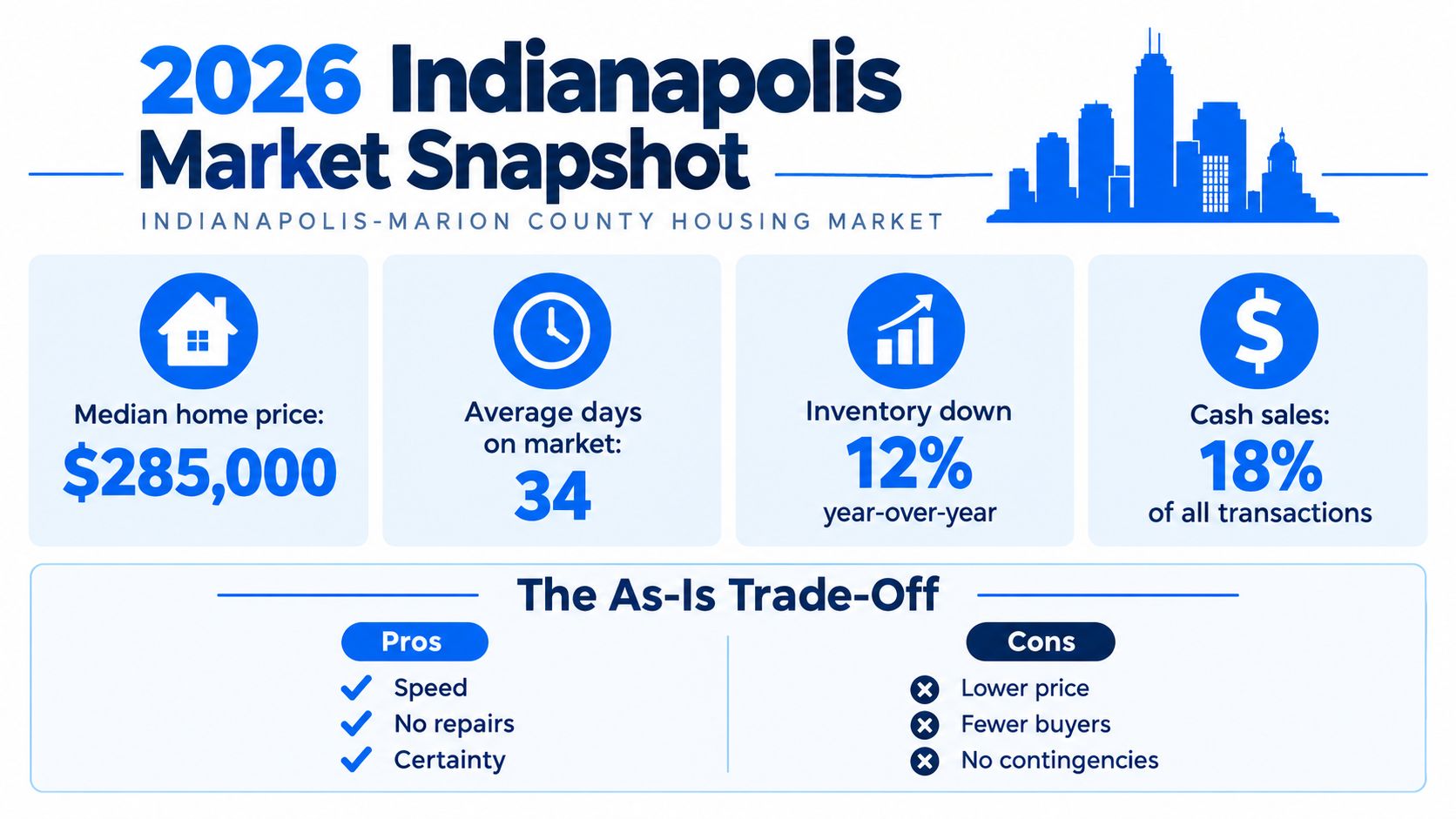
Four numbers belong in your decision
Net proceeds come first. Compare the cash offer after mortgage payoff, liens, taxes, title charges, moving costs, and any credits against the likely proceeds from a listing. An MLS asking price is not your check.
Certainty has real value. A financed buyer can run into appraisal gaps, inspection demands, lender conditions, or a failed loan. A cash buyer removes financing risk only if the buyer has verified funds and a contract that closes.
Timeline matters when you are paying carrying costs or facing a foreclosure, tax, probate, or relocation deadline. Waiting for a higher number can drain cash through mortgage payments, insurance, utilities, maintenance, and missed deadlines.
Stress gets overlooked. Cleaning, showings, contractor coordination, inspection responses, and repeated renegotiation can cost more time and energy than sellers expect.
For a seller weighing an as-is cash offer in Indianapolis, the right question is simple: what will you keep, when will you get it, and what risk stays on your side of the table?
How Cash Buyers in Indianapolis Actually Calculate Their Offer
Cash buyers usually start with the after-repair value, or ARV, then subtract repairs, holding costs, closing expenses, resale risk, and a target margin. The commonly discussed 70% rule uses roughly 70% of ARV minus estimated repairs, but a responsible buyer treats it as a starting framework rather than an automatic formula.
For example, suppose a Marion County house could be worth $310,000 after repairs. A simplified 70% calculation produces $217,000 before repair costs and other deductions. If the property needs a new roof, electrical work, cleanup, and substantial plumbing repairs, the final offer may fall well below that figure. The seller should ask for the assumptions behind the offer, not just the number.
Condition changes the offer more than the label “as-is”
| Condition | Likely repairs | Estimated offer range | ARV anchor |
|---|---|---|---|
| Light cosmetic work | Paint, flooring, cleanup, minor fixtures | 70%–85% of ARV | Around $310,000 |
| Moderate deferred maintenance | Roof or HVAC work, plumbing, electrical, water intrusion, substantial cleanup | 60%–75% of ARV | Around $310,000 |
| Heavy structural or foundation work | Foundation movement, major fire or water damage, severe mold, extensive systems replacement | 45%–65% of ARV | Around $310,000 |
These are planning ranges, not guaranteed Indianapolis pricing. A buyer may offer more for a desirable lot, a strong location, or a house with manageable repairs. The same buyer may offer less when title records are unclear, the home is occupied, the property has municipal orders, or the resale market is uncertain.
Indianapolis properties also carry region-specific inspection concerns. Older housing stock can hide outdated wiring, aging furnaces, failing sewer lines, and frozen or burst pipes. Foundation movement, basement moisture, hail-damaged roofs, poor drainage, and air-conditioning failure can quickly turn a light renovation into a major project.
Ask the buyer for a written breakdown showing ARV, repair assumptions, holding costs, closing costs, and buyer margin. If the buyer refuses to explain the math, get another offer.
Cash Offer Versus Agent Listing Versus Fix-and-List on Net Proceeds
A direct cash sale usually delivers the fastest, most predictable closing, but an agent listing may expose the property to more buyers. Fixing the house before listing can increase the sale price, yet the additional price doesn't automatically become additional profit.
| Path | Typical fees | Repair burden | Time to close | Certainty |
|---|---|---|---|---|
| Direct cash offer | Title and settlement charges, agreed credits, payoff deductions | Usually none required by seller | 7–30 days | High if funds and title are verified |
| MLS listing sold as-is | Customary agent commissions may be 5%–6%, plus buyer concessions and carrying costs | Seller may avoid repairs, but buyers can still negotiate after inspection | Often longer and less predictable | Moderate |
| Fix-and-list | Agent commissions, renovation costs, carrying costs, staging, possible concessions | Seller funds and manages repairs | Longest option because repairs precede marketing | Lower than it appears |
A conventional listing also carries financing risk. Buyers using FHA or VA loans may face property-condition or appraisal issues when a house has safety problems, structural defects, missing systems, or major deferred maintenance. Conventional lenders can impose their own conditions. A buyer who looked committed can still ask for repairs, fail to satisfy underwriting, or walk away under the contract.

A workable Indianapolis decision rule
Choose a cash buyer when your priority is speed, no repairs, and a defined closing date, particularly with foreclosure pressure, probate complications, severe damage, or a vacant property.
Choose an MLS as-is listing when the house is habitable, you can tolerate inspections and negotiations, and you want broader buyer exposure without funding a major renovation.
Choose fix-and-list only when you have the cash, time, and management capacity to complete the work, carry the house, and accept the risk that the finished property may not sell at the optimistic price.
The right question isn't “How much does the cash buyer offer?” It's “Which path leaves me with the strongest realistic net result and the fewest risks?”
Get a cash offer for your home
Step-by-Step Cash Sale Timeline From Offer to Wire in Indianapolis
A normal Indianapolis cash sale can move from initial offer to closing in 7–30 days, but the timeline depends on title defects, probate authority, liens, payoff speed, and the buyer's contract terms.
Seven checkpoints protect the seller
-
Initial inquiry: Provide the address, occupancy status, condition, mortgage information, and your preferred closing date. Be direct about roof leaks, water damage, tenants, code notices, and known liens.
-
Walkthrough or evaluation: A buyer inspects the property in Meridian-Kessler, Fountain Square, or Warren Township and estimates repairs. You can allow access without agreeing to a price.
-
Written offer and proof of funds: Require the purchase price, closing date, inspection rights, earnest-money terms, closing-cost allocation, and proof that the buyer can fund the transaction.
-
Contract execution: Read cancellation rights and assignment language. A buyer who plans to assign the contract to another investor should disclose that arrangement.
-
Title search and commitment: The title company checks ownership, mortgages, judgments, taxes, easements, probate authority, and unreleased interests. Title work often becomes the schedule driver.
-
Due diligence and final walkthrough: The buyer confirms property access and condition under the contract. An as-is clause doesn't prevent the buyer from using negotiated inspection or access rights.
-
Closing and verified funding: Sign the deed and settlement documents at the title company. Don't surrender possession or keys until the title company confirms that funds have been received and disbursed according to the settlement statement.
For a concise overview of the process, review the Cyber Homes cash home buying process. If the property needs a move-out clean before photos or a walkthrough, a specialized service such as San Antonio realtor cleaning can illustrate the type of targeted cleanup sellers often arrange, even though the property is in Indianapolis.
Vetting Cash Buyers, Title Companies, and Indiana Closing Mechanics
A credible cash buyer should provide proof of funds, a named Indiana title company, clear earnest-money terms, and a written closing date before you sign. The buyer shouldn't charge you an upfront fee merely to make an offer.
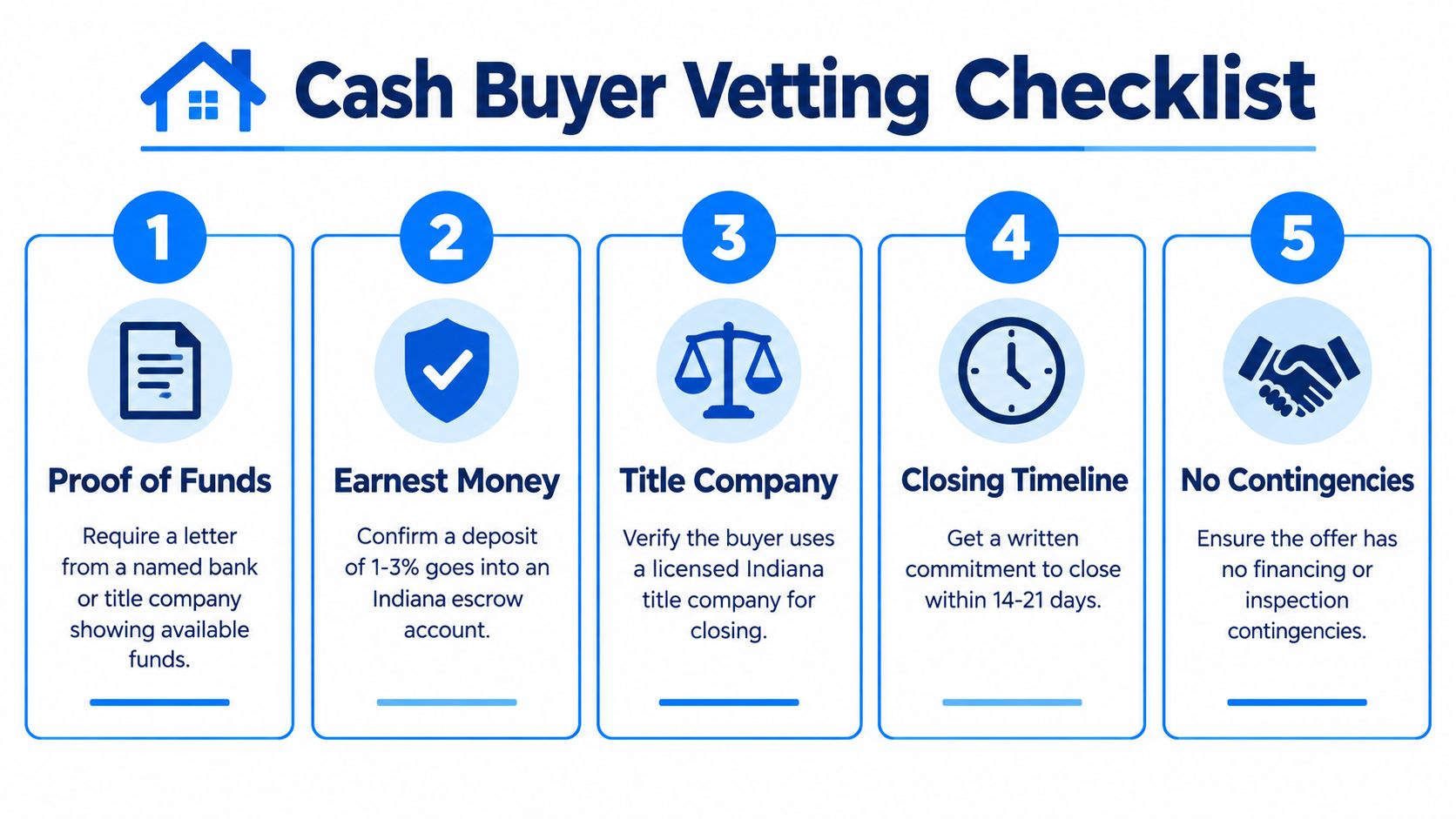
Questions to ask before accepting
- Proof of funds: Is the letter tied to a bank, private lender, or title company, and does it support the offered purchase price?
- Closing company: Will an independent Indiana title company handle the search, deed, payoffs, settlement statement, recording, and disbursement?
- Earnest money: When is the deposit due, where is it held, and what happens if the buyer cancels?
- Contract assignment: Can the buyer assign the contract? If so, is the assignment disclosed and are you still protected if the end buyer doesn't perform?
- Price reductions: Can the buyer lower the price after inspection for conditions already disclosed? A repeated “re-trade” after contract signing is a warning sign.
- Reviews and identity: Does the buyer have a verifiable business identity, local transaction history, and reviews that describe completed closings rather than only lead-generation promises?
Indiana doesn't require an attorney to conduct a residential closing. Closings commonly run through a title or escrow company, although an attorney remains useful for probate, divorce, seller financing, unusual powers of attorney, foreclosure, or disputed ownership. Indiana also has no state real-estate transfer tax on the deed, but recording and filing requirements still apply. (Indiana state sale guidance)
The title company uses the settlement statement to subtract the mortgage payoff, junior liens, delinquent taxes, agreed credits, and settlement charges from the sale price. You receive the remaining balance. Request the payoff figures in writing and compare them with the final settlement statement before signing.
For additional buyer-screening questions, see this Indianapolis cash home buyer comparison, then independently verify the buyer and title company.
Get a cash offer for your home
Why As-Is Sales in Indianapolis Still Require Disclosure and Code Compliance
An as-is home sale doesn't permit silence about known material defects. Indiana sellers generally complete the Seller's Residential Real Estate Sales Disclosure Form under IC 32-21-5 before accepting an offer, including owners who never lived in the property. (Indiana Seller's Residential Real Estate Sales Disclosure Form)
The form addresses known conditions involving the roof, foundation, structure, water, electrical, plumbing, environmental concerns, systems, and code-related problems. If the condition changes before settlement, update the buyer. “I never lived there” may explain why your knowledge is limited, but it doesn't automatically eliminate the obligation to report what you know from records, tenants, contractors, inspection reports, or prior notices.
As-is has a narrower meaning than sellers expect
An as-is clause usually means the buyer accepts the property's current repair condition and the seller isn't promising to renovate it. It does not protect a seller who conceals a known latent defect, makes a false statement, or leaves out a material problem that should be disclosed.
Document uncertainty carefully. Write that the roof age is unknown if you don't have records, attach prior repair invoices, identify basement moisture observations, and disclose unpermitted work or tenant damage when known. A buyer who discovers concealed defects may pursue a legal remedy even after signing an as-is addendum.
Indianapolis code enforcement adds another layer for vacant and severely distressed houses. The Department of Business and Neighborhood Services can issue repair, boarding, or demolition orders under Indiana's Unsafe Building Law and Indianapolis Municipal Code Chapter 537. A repair order can allow six months for compliance, and civil penalties can reach $5,000 for noncompliance. A property remaining vacant and in disrepair after 90 days can face additional penalties of up to $5,000 per year. (City of Indianapolis Unsafe Building Program)
Before accepting an offer, ask the city about outstanding orders, nuisance liens, vacant-building status, and open violations. A cash buyer may accept the property as-is, but the title company still needs to know what must be paid, released, or addressed at closing.
Selling by Situation in Indianapolis
Different problems require different closing controls. The offer is only useful if the seller has authority to sign, the title can be cleared, and the deadline can be met.
Inherited and probate properties
An heir may not have authority to sell immediately. Gather the will, probate case information, letters of authority, death certificate, deeds, mortgage statements, and contact details for every interested party. If the estate has multiple heirs, all required signatures or court approvals must be confirmed before the contract is finalized.
An inherited house often contains deferred maintenance, old furniture, unpaid utilities, or tenant issues. Selling as-is can reduce management work, but don't skip the title search. For a more detailed inheritance-specific checklist, review this guide to selling an inherited property in Indianapolis.
Behind on payments or facing foreclosure
Indiana uses a judicial foreclosure process, so a lender generally must file in court and obtain a foreclosure judgment before a sheriff's sale. Indiana has no post-sale redemption period, meaning the owner cannot regain the property after the sheriff's sale by later paying the debt. (Indiana foreclosure timing guidance)
Ask the lender for a written payoff statement and confirm the court calendar with an Indiana attorney or the court. A cash sale before the sheriff's sale works only if the buyer can close in time, title is clear enough to transfer, and the lender and lienholders accept the payoff. Never assume a verbal extension protects the property.
Divorce or disputed ownership
Divorce sales require the deed, divorce decree, court orders, and written agreement about who can sign and how proceeds are divided. If one spouse owns the property but both spouses have claims, tell the title company before accepting an offer.
A clean contract cannot solve an unresolved ownership dispute. Let the closing company identify signature requirements before you commit to a closing date.
Tenant-occupied rentals
Tell the buyer whether the tenant has a written lease, whether rent is current, whether a security deposit exists, and whether the tenant has received any notice. Gather the lease, payment ledger, deposit records, inspection photos, and notices about repairs or habitability.
Don't promise vacant possession unless you can legally deliver it. A buyer may purchase the property subject to the tenancy, but that term must be explicit in the contract.
Liens, back taxes, and code violations
Mortgage balances are only one part of the payoff equation. Judgment liens, unpaid utilities, tax delinquencies, HOA claims, municipal charges, and nuisance liens can reduce proceeds or delay closing.
Order title work early. If the title company finds an old mortgage that was paid but never released, a judgment against a former owner, or a probate gap, resolving it may take longer than the physical sale.
Fire, water, hoarder, and severely damaged homes
Start with safety and access. Disclose fire damage, smoke damage, water intrusion, mold observations, structural instability, vermin, hazardous materials, and the presence of extensive personal property. Don't remove materials that may be relevant to an insurance claim without checking with the insurer.
A buyer may price cleanup as well as construction. Ask whether the offer includes contents, appliances, vehicles, or debris, and get that agreement in writing.
Your Indianapolis net sheet
Use this formula before comparing offers:
Cash offer price
minus mortgage payoff
minus junior liens and judgments
minus prorated Marion County taxes
minus title and settlement charges
minus agreed credits or moving advances
equals estimated seller proceeds.
A direct buyer may cover standard closing costs, but don't assume that every cost is covered. Require an itemized net sheet from every buyer and compare it with an agent's estimated net sheet.
Tax treatment is separate from closing math. The federal home-sale exclusion can be $250,000 for a single filer or $500,000 for a married couple, subject to eligibility requirements. Consult a tax professional about basis, ownership, occupancy, inherited-property valuation, depreciation from rentals, and any gain.
Documents to gather before marketing the property
- Ownership records: Deed, photo identification, trust documents, probate papers, death certificate, divorce orders, or power-of-attorney documents.
- Debt records: Mortgage statements, home-equity balances, lender contact information, tax bills, and judgment notices.
- Condition records: Indiana Seller's Residential Real Estate Sales Disclosure Form, inspection reports, repair invoices, roof or HVAC records, insurance claims, and contractor estimates.
- Property records: Utility history, HOA or covenant documents, leases, tenant ledgers, security-deposit records, surveys, permits, and code notices.
- Closing details: Preferred closing date, moving plan, possession terms, bank information for verified disbursement, and contact details for every person who must sign.
The practical answer to how to sell a house as-is for cash in Indianapolis, IN in 2026 is to compare certainty against realistic net proceeds. A fast offer below the neighborhood's retail value can be rational when it avoids repairs, carrying costs, failed financing, code escalation, or a foreclosure deadline.
Frequently asked questions
Can I sell my house as-is for cash in Indianapolis?
Yes. You can sell an Indianapolis property in its current condition to a cash buyer, investor, or another buyer willing to accept the repair burden. You still need to disclose known material defects, resolve title issues, and complete the closing properly.
How much do you lose selling as-is?
There isn't one fixed loss because the result depends on ARV, repairs, holding costs, liens, commissions, taxes, and timing. A lower cash price can produce a better net result when it eliminates major renovation costs, buyer concessions, financing delays, and months of ownership expenses.
Can I sell a house without repairs in Indianapolis?
Yes, but “without repairs” means you aren't agreeing to renovate the property, not that the buyer must accept hidden defects. State the condition accurately, provide the Indiana disclosure form, and put any repair refusal or credit agreement in the contract.
What happens if I have a mortgage or liens?
The title company requests payoff statements and deducts approved mortgage and lien amounts from the sale proceeds. If the total debt exceeds the offer, you may need lender approval for a short sale or bring funds to closing.
Does Indiana require an attorney at closing?
Indiana doesn't require an attorney to conduct a standard residential closing. A title or escrow company commonly handles the transaction, but an Indiana attorney is advisable for probate, foreclosure, divorce, disputed ownership, unusual powers of attorney, or complex liens.
Are there transfer taxes on an Indiana house sale?
Indiana has no state real-estate transfer tax on the deed according to the cited state guidance. Recording requirements and filing fees can still apply, so confirm the current charges with the Indiana title company handling your closing.
How do I know whether a cash buyer is legitimate?
Require proof of funds, a written contract, earnest-money instructions, a named title company, a specific closing date, and clear assignment and cancellation terms. Walk away from upfront-fee demands, unexplained inspection price cuts, pressure to skip title work, or requests to wire money outside verified closing instructions.
Cyber Homes offers Indianapolis homeowners a no-obligation cash offer for properties in their current condition, without requiring repairs, showings, or commissions, with closing coordinated through a reputable title company on the seller's preferred timeline. If you're comparing a cash sale with listing, repair, probate, tenant, or foreclosure options, visit Cyber Homes to submit the property details and evaluate the offer against your net sheet.

Edited by
James Vasquez
Real Estate Investor & Land Specialist with 10+ years experience in residential flipping, vacant land investing, land wholesaling, and subdivision deals.
Disclaimer: The information provided is for educational purposes and does not constitute financial or legal advice. Always consult with licensed professionals before making investment decisions.