Selling an Inherited Property in Chicago, IL (2026)

Chicago's March 2026 median home price was approximately $411,000, up 5.4% year over year, but you cannot sell an inherited home just because your name appears in a will. The first step is confirming who has legal authority to sign the deed, typically through Letters of Office or a valid Transfer on Death Instrument.
A family may be grieving while also dealing with a vacant house, unpaid bills, belongings, and relatives who disagree about what happens next. Selling an inherited property in Chicago, IL can be practical, but the transaction must satisfy two separate requirements: someone must have authority to act for the estate, and the title company must be able to insure the buyer's ownership.
The right answer depends on how the property passed, whether probate is required, the home's condition, and the estate's carrying costs. This guide explains the decision points without assuming that every family should list traditionally or accept a cash offer.
Updated for 2026

Get a cash offer for your home
Confirming Legal Authority to Sell the Home
Before clearing out the home or contacting an agent, identify who can legally bind the estate. A person named in a will may eventually inherit the property, but that designation alone usually doesn't authorize the person to sign a listing agreement, purchase contract, or deed.
Illinois separates the question of who benefits from the estate from the question of who may act for it. A probate court generally appoints a personal representative and issues Letters of Office. The representative may be an executor when there is a will or an administrator when there isn't one. The governing documents, probate proceeding, and property type determine the representative's powers and whether court involvement is needed.
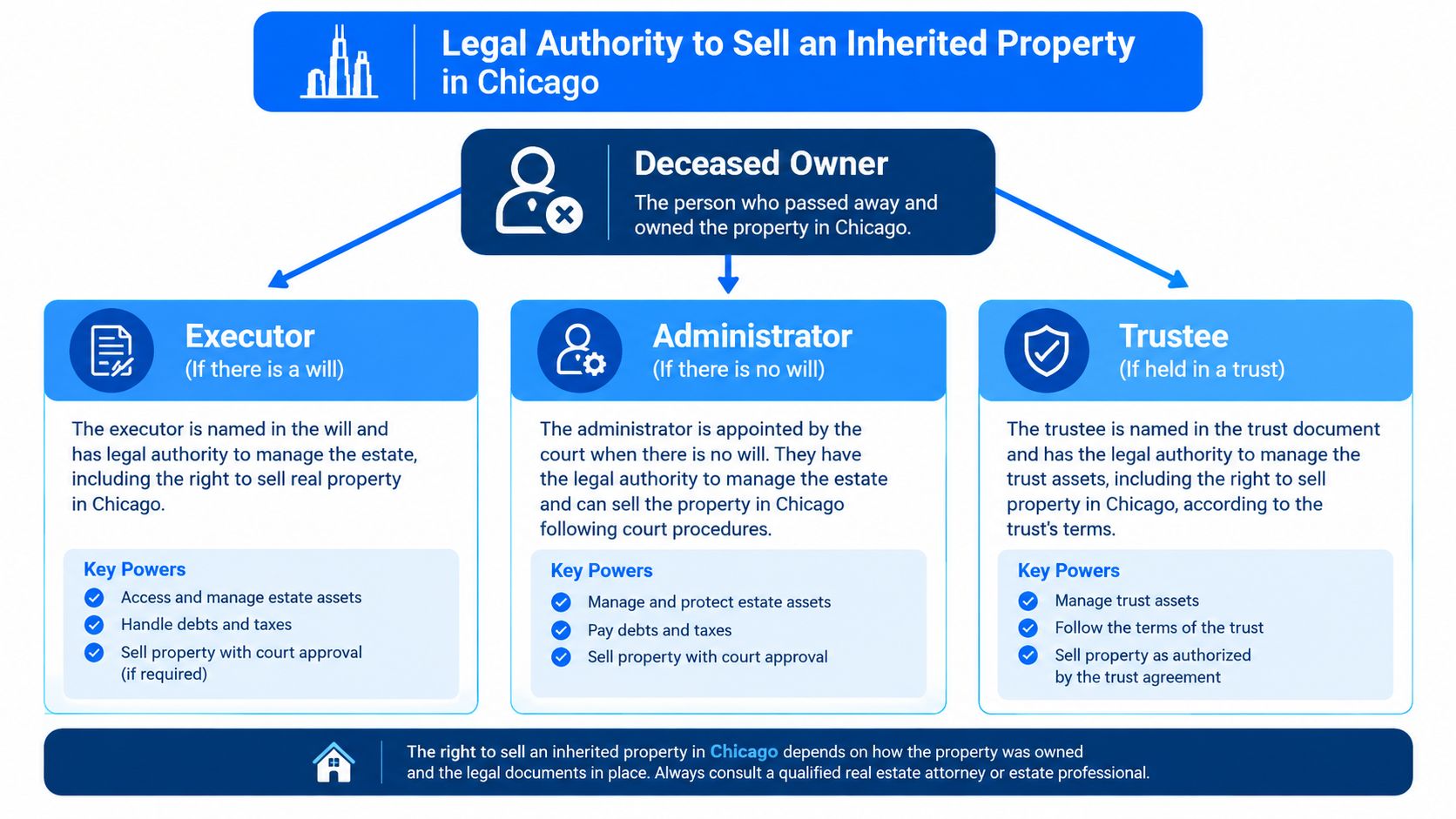
The main authority pathways
- Will and executor: The executor named in the will normally needs formal appointment and Letters of Office before acting for the estate. The executor must also protect the interests of beneficiaries and avoid self-dealing.
- No will and administrator: Illinois intestacy rules determine the heirs, while the court appoints an administrator to manage estate property and debts.
- Living trust and trustee: If the home is titled in a trust, the successor trustee may have authority under the trust instrument without ordinary probate administration. The title company will still review the trust and trustee documents.
- Joint ownership: Property held with survivorship rights may pass to the surviving owner outside probate. The deed must be examined to confirm the ownership form.
- Transfer on Death Instrument: A valid Illinois TODI can transfer residential real estate directly to named beneficiaries. Cook County guidance says the instrument must include required deed information, be signed by the owner, witnessed by two independent witnesses, notarized, and recorded before death. Afterward, beneficiaries generally document acceptance through an acceptance deed and notice-of-death affidavit process. The Cook County TODI guidance explains these formalities.
Practical rule: Don't let a buyer, agent, or family member treat a signed will as a substitute for authority to convey title.
A title company can reject a contract or delay closing if the wrong person signs. For general background on probate transactions, see this overview of selling a home in probate, but Chicago heirs should rely on their own Illinois probate attorney and title company for the controlling answer.
Cook County identifies several possible transfer routes, including probate, miscellaneous probate, title insurance in lieu of probate, heirship affidavits, and heirship deeds. The applicable route depends on the deed, estate facts, and underwriting requirements, so an apparent heir shouldn't sign a deed before the title company confirms the path.
Navigating the 2026 Chicago Real Estate Market
Legal authority comes first, but market conditions help determine whether repairing, listing, or selling as-is makes financial sense. Chicago entered 2026 with rising prices and unusually limited supply. In March, the median price inside the city was approximately $411,000, up 5.4% from the previous year. The broader Chicago metropolitan median was $375,000, up about 4.2%, while metro inventory fell 5.7% to 17,326 homes and Chicago inventory declined 14.2% (March 2026 Chicago market data).
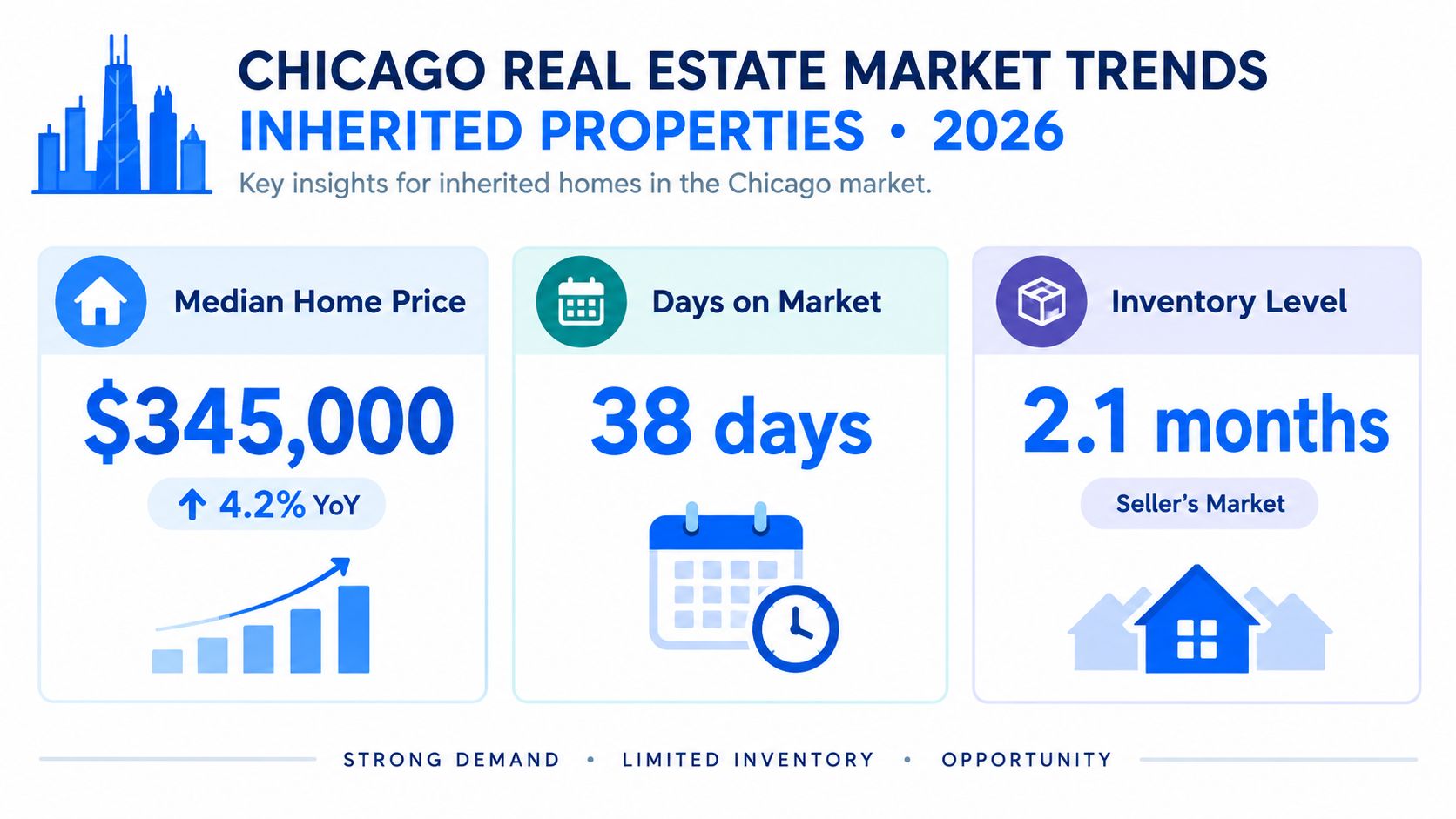
The May figures show why a citywide median is useful as a benchmark, not as an appraisal. Chicago recorded 2,283 home sales, a 1.5% decrease from May 2025, while the city median rose to $420,000, up 7.7% from $390,000. City inventory fell 30.0%, from 4,766 homes to 3,337. In the nine-county metropolitan area, the median reached $399,990, up 5.5%, while inventory declined 14.6% to 12,408 homes (Illinois Realtors' May 2026 report).
How heirs should interpret those figures
A sound home in a desirable Chicago neighborhood may benefit from buyer competition. A property with water intrusion, deferred maintenance, code concerns, tenant complications, or unresolved title issues won't automatically command the city median.
Use the market data as a starting point, then adjust for:
- Neighborhood and property type: A condominium, bungalow, two-flat, and single-family home attract different buyers and valuation methods.
- Condition: Buyers and lenders account for repairs, uncertainty, and occupancy.
- Legal readiness: Strong demand doesn't eliminate the need for insurable title.
- Delay: Waiting for minor improvements may be sensible, but waiting while insurance, utilities, taxes, maintenance, and mortgage obligations continue can reduce the estate's net result.
New listings increased 2.2% year over year in March, but that increase didn't offset the shortage. The practical conclusion is balanced: Chicago heirs may have meaningful equity, yet the benefit of moving quickly depends on whether the property is legally and physically ready to sell.
Essential Documents for a Clear Title Transfer
A buyer's offer and a title company's willingness to insure the deed are different milestones. Start assembling the file before marketing begins, because missing authority documents often cause more delay than the buyer's financing.
Build the estate file
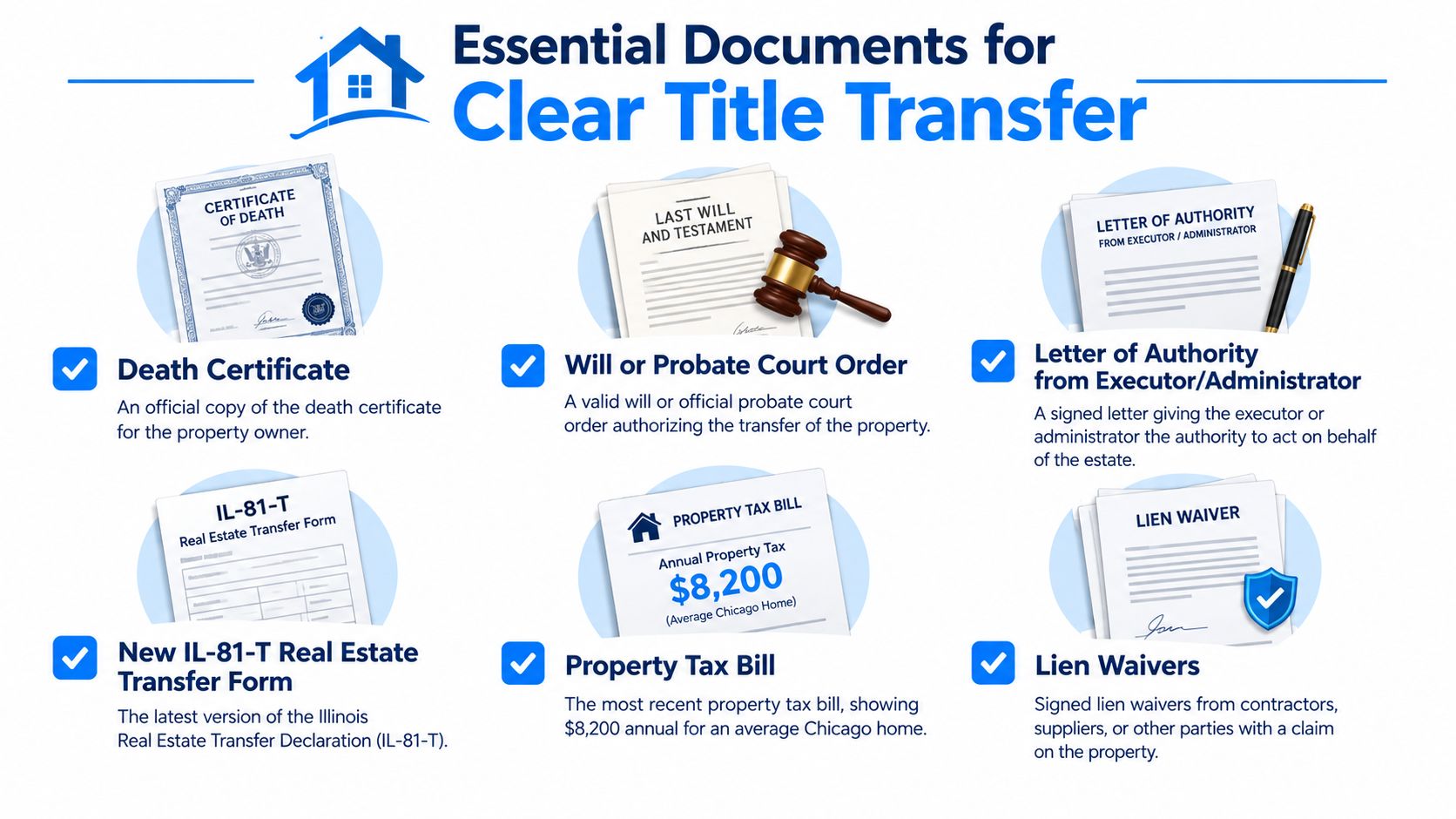
Collect the following:
- Official death certificate: The title company may need a certified copy or another acceptable official record.
- Will, trust, or estate documents: Include the original will if available, trust agreement, amendments, and beneficiary records.
- Court appointment documents: For a probate house sale, provide Letters of Office, the court order opening the estate, and any order affecting the property.
- Recorded deed and tax records: Confirm how the deceased held title and obtain current Cook County property-tax information.
- Mortgage payoff statement: Ask the lender for a current payoff and identify any home-equity loan or reverse mortgage.
- HOA or condominium records: Gather account statements, assessments, rules, contact details, and required resale documents when applicable.
- Insurance records: Tell the insurer about the death and vacancy or occupancy change. Don't assume the existing policy remains adequate.
- Repair and improvement records: Preserve invoices, permits, warranties, and contractor information.
- Lien and title information: Look for judgments, unpaid taxes, municipal charges, old mortgages, mechanics' liens, and other encumbrances.
- Government-issued identification: The representative, trustee, or surviving owner will need acceptable identification for closing.
Clear title problems before accepting a deadline
Ask the title company to search early, not just after an offer arrives. An old mortgage that was paid but never released, unpaid Cook County taxes, a condominium balance, or a municipal violation can prevent a clean closing.
The estate representative should also secure the property, maintain appropriate insurance, prevent freezing or water damage, and address urgent municipal or code matters. Personal belongings can complicate possession and disclosure, so agree on a documented plan for photographs, valuables, firearms, records, and sentimental items.
The title company will identify the exact package it needs. Treat its checklist as a closing condition, not as optional paperwork.
Get a cash offer for your home
Choosing the Right Selling Strategy for the Estate
There isn't one correct way to sell an inherited house in Chicago. The best method depends on the home's condition, the family's capacity, the estate's obligations, and the net proceeds after repairs and carrying costs.
| Selling Strategy | Timeline to Close | Repair & Cleaning Requirements | Best Suited For |
|---|---|---|---|
| Traditional agent listing | Depends on preparation, buyer activity, contract terms, and title readiness | Usually more preparation, cleaning, repairs, photography, and showings | A sound home where maximizing market exposure matters |
| As-is MLS listing | Depends on buyer demand, negotiations, and title readiness | Limited repairs, but honest condition review and safe access remain important | A home needing work where the family still wants broad exposure |
| Direct cash buyer | Negotiated around title readiness and the parties' chosen closing date | Usually no pre-sale repairs or conventional showing schedule | Major repairs, inherited clutter, vacancy, or a need for a simpler transaction |
Traditional listing
An agent can help establish a market-based asking price, coordinate inspections, manage showings, and expose the property to retail buyers. This path may produce a stronger gross price when the home is well maintained, but the estate must manage preparation, negotiation, buyer contingencies, and the possibility that title work delays closing.
As-is listing
“As-is” means the seller isn't promising to renovate the property. It doesn't mean the seller can ignore known facts, conceal defects, or bypass title requirements. Illinois disclosure duties vary with the seller's knowledge, the property, and the transaction, so the estate should complete the required disclosure paperwork with professional guidance.
Cleaning still matters even when repairs don't. For a vacant home, a documented move-out and cleaning plan can reduce disputes about condition and possession. Families may find move-out cleaning guidance from Sweet Home Cleaning Service useful when deciding what to remove before listing.
Direct cash sale
A cash buyer may be useful when the house needs substantial work, contains years of belongings, or is creating urgent carrying costs. The convenience has a price, because a buyer taking repair and execution risk may offer less than a fully repaired retail property could bring.
Compare written offers rather than focusing only on the headline number. Verify proof of funds, confirm who pays which closing charges, ask whether the buyer can assign the contract, and make sure the title company understands the probate or trust structure. A comparison of companies that buy houses for cash in Chicago can help frame questions, but it shouldn't replace independent review.
Understanding Taxes and True Net Proceeds
The contract price isn't the estate's final result. Start with the gross price, then subtract the mortgage payoff, liens, property taxes, transfer taxes, commissions or buyer-related charges, repairs, insurance, utilities, maintenance, and other estate obligations.
For federal income-tax purposes, Internal Revenue Code §1014 generally resets the basis of inherited property to its fair market value on the decedent's date of death. A later sale is usually measured against that date-of-death basis, with eligible improvements and selling costs considered. Inherited property is generally treated as long-term property regardless of how soon it's sold. The Illinois basis explanation and calculator provides background, but the estate's tax preparer should determine the actual reporting.
A simple basis example
Suppose a Chicago home was worth $400,000 at death and later sells for $415,000 after $15,000 of deductible selling costs. The approximate federal capital gain is zero before other basis adjustments, because the net selling amount is approximately equal to the date-of-death basis.
That isn't a guarantee that the transaction creates no tax. Improvements, depreciation recapture for a rental, estate-level income, other basis adjustments, Illinois income-tax treatment, and the estate's broader facts can change the result. Preserve a qualified appraisal or defensible comparative-market analysis dated as of death, repair invoices, and the final closing statement.
Illinois and Cook County considerations
Illinois generally follows federal adjusted gross income for individual income-tax purposes, so the federal basis result typically carries into the Illinois return. Illinois inheritance or estate tax questions are separate from the later sale, and the Illinois Attorney General handles those questions rather than the Department of Revenue. Illinois-source income rules also apply to gains or losses from Illinois real estate, as explained by the Illinois Department of Revenue.
Illinois imposes a state real-estate transfer tax under 35 ILCS 200/31-10, with local taxes potentially added. Model the net proceeds before deciding whether a renovation is worthwhile. A higher expected sale price may not justify months of insurance, utilities, winter maintenance, repairs, vacancy exposure, and tax obligations.
Get a cash offer for your home
Managing Disagreements Among Multiple Heirs
Multiple heirs inherited property together can disagree about almost everything: whether to sell, what price to accept, who removes furniture, whether to fund repairs, and whether one sibling may stay in the home. The executor or administrator should not treat silence as consent or make informal promises that conflict with the estate documents.
Create a written decision process early:
- Identify authority and ownership: Determine whether the representative controls the sale for the estate or whether beneficiaries already hold direct interests.
- Set communication rules: Use one email thread or shared document for offers, repair proposals, expenses, and deadlines.
- Obtain objective information: Use a valuation, repair estimates, mortgage payoff, lien search, and carrying-cost ledger.
- Record approvals: Document who approved the listing price, repairs, personal-property plan, and offer terms.
- Separate emotion from accounting: Track who paid taxes, insurance, mortgage installments, utilities, or necessary repairs.
A family member who wants to keep the house may need to propose a realistic buyout, not merely object to a sale.
A trustee or personal representative must protect the estate and avoid favoritism. If one beneficiary wants the property, the transaction should be evaluated at a commercially reasonable value, with the attorney documenting the process.
Mediation can resolve disputes over price, timing, belongings, or occupancy without turning every disagreement into litigation. If a co-owner refuses to cooperate, an Illinois partition action may be available, although court involvement adds cost, delay, and stress. The legal rights depend on how title is held and whether the property qualifies for protections under Illinois heirs-property law.
For families dealing with co-ownership questions, this guide to selling inherited property with multiple owners offers a practical starting point. It isn't a substitute for advice about the specific deed, will, trust, or probate file.
Answers to Common Inherited Property Questions
Can I sell an inherited house before probate is complete?
Sometimes the property can be marketed, and an authorized representative may be able to contract or sell while the estate remains open. Closing depends on the estate structure, Letters of Office, any required court approval, and the title company's willingness to insure the deed. Probate doesn't automatically have to be fully finished, but an unauthorized heir can't solve the problem by signing first.
Do all heirs have to agree to sell?
It depends on who owns the property and who has authority. An executor or administrator may have power to sell estate property while administering the estate, whereas multiple direct co-owners may need to sign or agree to a lawful resolution. An attorney can determine whether a buyout, mediation, partition, or court order is appropriate.
Can an executor sell an inherited house?
An executor with valid Letters of Office may be able to sell when the transaction is authorized and appropriate for estate administration. The executor must follow the will, Illinois law, fiduciary duties, and title requirements. A probate attorney and title company should confirm the signing authority before an offer is accepted.
Can I sell an inherited house as-is?
Yes, an authorized seller may pursue an as-is listing or direct sale. “As-is” removes an obligation to renovate, not the obligation to address authority, title, liens, known disclosure issues, or safe access.
What happens if the inherited home has a mortgage?
The debt remains secured by the property. Keep communicating with the lender, obtain a payoff statement, and prevent default while the sale is arranged. The mortgage is normally paid from closing proceeds, but a home worth less than its debt may require lender approval for a short sale.
Do I have to pay taxes when I sell inherited property?
Potentially. The date-of-death basis can reduce appreciation-based capital gain, but Illinois income-tax treatment, estate or inheritance-tax issues, depreciation, selling costs, improvements, and other facts matter. A CPA or tax attorney should review a significant transaction.
What documents are needed to sell an inherited house?
Expect to provide the death certificate, will or trust, court appointment documents, deed, tax records, mortgage payoff, lien information, insurance records, identification, and any HOA or condominium documents. The title company will provide the definitive checklist.
Can an out-of-state heir sell a property remotely?
Often, yes. Remote coordination may involve an Illinois probate attorney, electronic document delivery, approved notarization, and a title company that can arrange signing. The out-of-state heir still needs the same authority and title clearance as a local seller.
How long does it take to sell a probate property?
There is no responsible universal timeline. A clear estate with cooperative beneficiaries and ready title may move efficiently, while missing documents, creditor issues, disputes, liens, or court requirements can extend the process. Don't promise a buyer a closing date until counsel and the title company confirm the estate's readiness.
Should I use an agent or accept a cash offer?
Use an agent when the property is market-ready and broad exposure supports the estate's goals. Consider an as-is listing when repairs are limited but you still want MLS exposure. A cash offer may fit a property with major repairs, clutter, vacancy, or urgent carrying costs, but compare the net result and verify funds before signing.
For a useful contrast, families handling property in another jurisdiction can review how Texas handles inherited property, but Texas procedures shouldn't be applied to a Chicago estate without Illinois advice.
Remember that this article is general information, not legal or tax advice. Before accepting an offer, confirm estate authority, title requirements, disclosure duties, liens, mortgages, and tax treatment with qualified Chicago probate, real-estate, title, and tax professionals.
Cyber Homes offers a direct cash-sale option for inherited Chicago properties, including homes that need repairs or clearing out, without requiring a traditional listing or pre-sale renovation. If that approach fits the estate's priorities, request a no-obligation evaluation and discuss a closing date through Cyber Homes.

Edited by
James Vasquez
Real Estate Investor & Land Specialist with 10+ years experience in residential flipping, vacant land investing, land wholesaling, and subdivision deals.
Disclaimer: The information provided is for educational purposes and does not constitute financial or legal advice. Always consult with licensed professionals before making investment decisions.