How to Sell a House As-Is for Cash in Cleveland, OH (2026)
If you need to sell house as-is for cash in Cleveland, OH, expect a firm offer below full retail, but usually above a fire-sale number when the property is marketable and title is clean. In this market, many closings can happen in 7 to 30 days, depending on title, liens, and whether the buyer is cash or just marketing that way.
Key Takeaways
- Speed is the main advantage. Cash sales skip repairs, open houses, and financing contingencies.
- Price is the trade-off. Cash offers usually discount for repairs, holding costs, and resale risk.
- Ohio disclosure still applies. Selling as-is doesn't erase the duty to disclose known defects.
- Vetting matters. Proof of funds, earnest money, and a local title company should be essential.
- Net proceeds beat headline price. Always compare the offer to the net from listing.
Cleveland's older housing stock and uneven neighborhood values make as-is sales relevant in places like West Park, Glenville, Broadway–Slavic Village, Tremont, and Ohio City. A house that needs work in one area can attract a very different buyer pool than a similar house a few miles away. The right question isn't “What's the highest offer?” It's “What will I net, and how certain is the closing?”

Get a cash offer for your home
What Selling As-Is for Cash in Cleveland Actually Means
Selling as-is for cash in Cleveland means a buyer agrees to purchase your house in its current condition, without repairs, staging, or a traditional financing contingency. In practice, that usually means a discounted offer relative to market value, but a much faster close, often through a local title company in 7 to 30 days.
The transaction in plain English
You're trading some top-end price for certainty. A cash buyer looks at the condition, the neighborhood, the title situation, and the resale risk, then makes an offer that reflects all of that. If the house needs work, the offer will usually come in below what you'd see from a move-in-ready listing.
Practical rule: the worse the condition and the messier the title, the more the buyer will price in risk.
That trade-off matters in Cleveland because inventory has been relatively tight, but condition still drives the buyer pool. The 2025 Cleveland market review reported a median sale price of $241,100, about 2,104 monthly home sales, about 4,560 homes in monthly inventory, 2.2 months of supply, and 28.8 days on market WHIO market review. Those figures show a market that isn't frozen, but a distressed home still won't behave like a clean, financed sale.
| Factor | What it means for you |
|---|---|
| Price | Usually lower than a retail listing because the buyer is taking on repairs and resale risk |
| Speed | Faster than a traditional listing, often much faster if title is clean |
| Repairs | Usually none before closing |
| Disclosures | Still required in Ohio |
| Buyer vetting | Critical, because not every “cash” buyer is actually ready to close |
A cash sale works best when the owner values certainty, has limited repair capacity, or needs to solve a title, tenant, probate, or foreclosure problem. It works worst when the house is clean, financeable, and the seller has time to prep it for the open market.
How Cash Buyers Calculate Their Offer in Cleveland
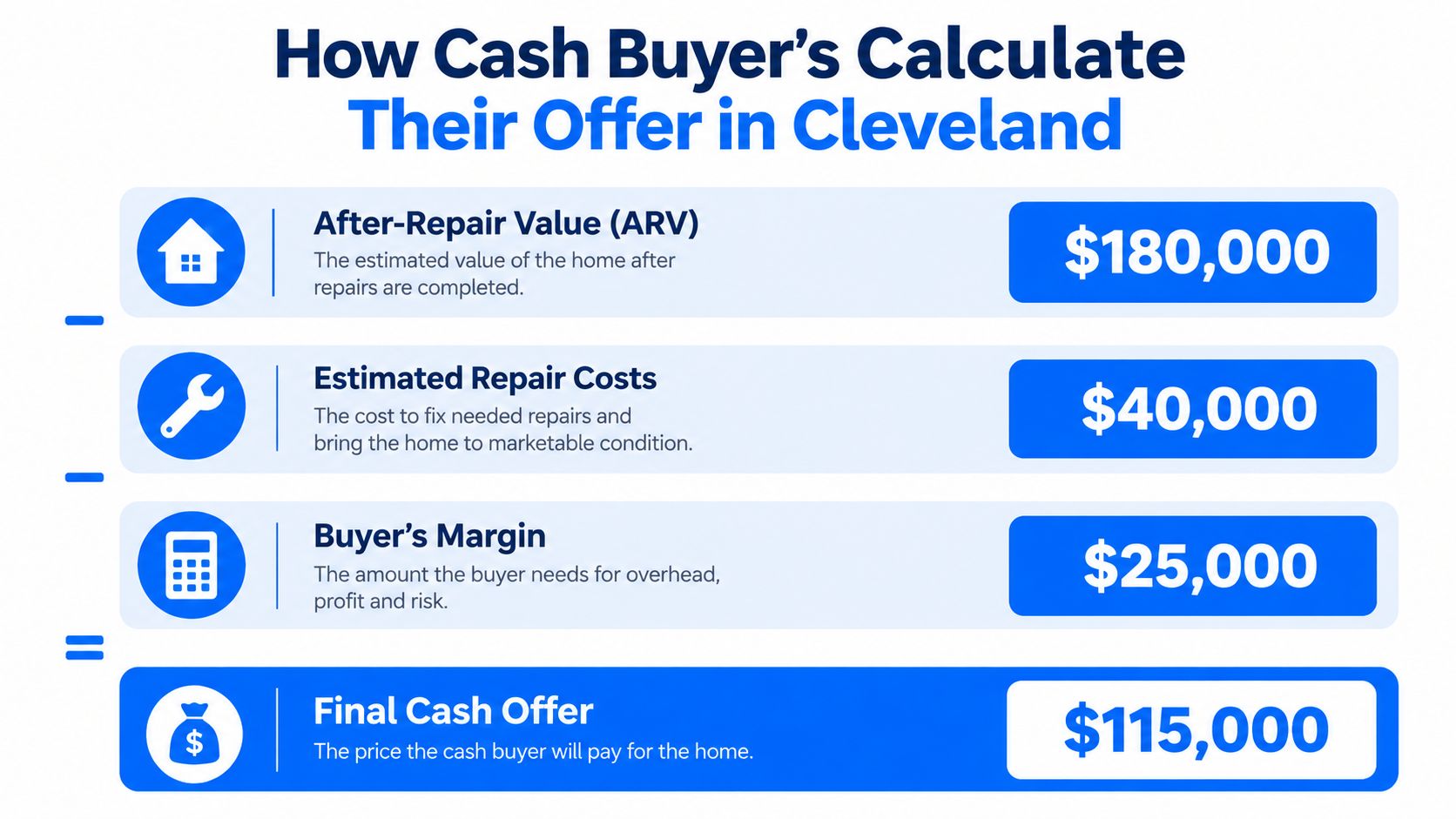
Cash buyers calculate their offer from after-repair value, repair costs, and their margin, then they subtract time and risk. The familiar 70% rule is a rough investor shortcut, not a law, and it usually means a buyer wants to stay around 70% of the home's after-repair value before accounting for renovations and carrying costs.
The basic formula
The formula is simple on paper. A buyer estimates the home's ARV, subtracts expected repairs, then leaves room for resale profit, holding costs, financing, insurance, utilities, and surprise issues. That's why two houses with the same square footage can produce very different offers in West Park, Glenville, or Broadway–Slavic Village.
For example, if a Cleveland property has a $150,000 ARV and needs $30,000 in repairs, a rough 70% calculation starts at $105,000 before the buyer's margin and other costs. Once the buyer protects for profit and risk, that can pull the offer closer to the $75,000 to $80,000 range depending on the scope of work and resale confidence. That's not a guarantee, it's the kind of math investors use when they're buying to resell.
| Condition | Example ARV | Typical Repair Deduction | Illustrative Offer Range |
|---|---|---|---|
| Light repairs | $150,000 | Modest cosmetic and minor system work | Higher end of the cash range |
| Moderate repairs | $150,000 | Several visible repair items and some deferred maintenance | Middle cash range |
| Heavy repairs | $150,000 | Major system, structural, or habitability issues | Lower cash range |
Real offers also shift with neighborhood demand, occupancy, and title risk. A vacant home with clean title can price very differently from an inherited property with multiple heirs or a house tied up in municipal liens. The formula helps you read the offer, but it doesn't replace a local valuation.
If a buyer won't explain how they reached the number, assume the number is doing too much work on its own.
Cash Buyer vs Agent Listing As-Is vs Fix and List
The best path comes down to net proceeds, time, and certainty, not just the asking price. A cash sale is usually the fastest route. An agent listing can bring more exposure. A fix-and-list can produce the strongest gross price, but only if you've got money, time, and a house that can survive inspections and financing.
| Factor | Cash Buyer | Agent Listing As-Is | Fix and List |
|---|---|---|---|
| Net proceeds | Lower headline price, but fewer surprise deductions | Can be decent, but credits and concessions add up | Highest potential, if repairs go well |
| Fees and commissions | Usually no commission | Agent commission applies | Agent commission applies |
| Time to close | Often 7 to 30 days | Often longer because of showings and buyer financing | Usually the longest |
| Repairs | Usually none before closing | Usually none upfront, but buyers may demand credits | Seller funds repairs first |
| Financing risk | Low if the buyer is real cash | Real risk from appraisal, underwriting, and inspection | Still present if buyer uses financing |
| Certainty of execution | High when title and funds are clean | Moderate, deals can fall apart late | Moderate to high after repairs are complete |
A Cleveland owner with an inherited bungalow in Glenville may prefer certainty over waiting for a retail buyer. A vacant colonial in West Park might bring stronger interest on the MLS, but only if it shows well and passes lender scrutiny. A hoarder house in Tremont can look simple on a price sheet and still be expensive to market traditionally.
A net sheet beats a list price
Take a property near Cleveland's median market context and compare the math. If you list at $130,000, you still have to account for commission, holding costs, repair credits, and the possibility that a buyer backs out after inspection or appraisal. A $110,000 cash offer can produce a cleaner result if the listing path burns cash for months and keeps asking for concessions.
The hidden mistake is treating the sticker price as the outcome. The outcome is what lands in your account after every deduction is cleared.
Step-by-Step Timeline of a Cleveland Cash Sale
A Cleveland cash sale moves on paperwork, title, and authority to sell. If the deed is clean and the seller can sign without delay, the process is usually quick. Probate, foreclosure pressure, liens, and unpaid city matters slow things down because the title company has to clear the record before closing.
What happens first
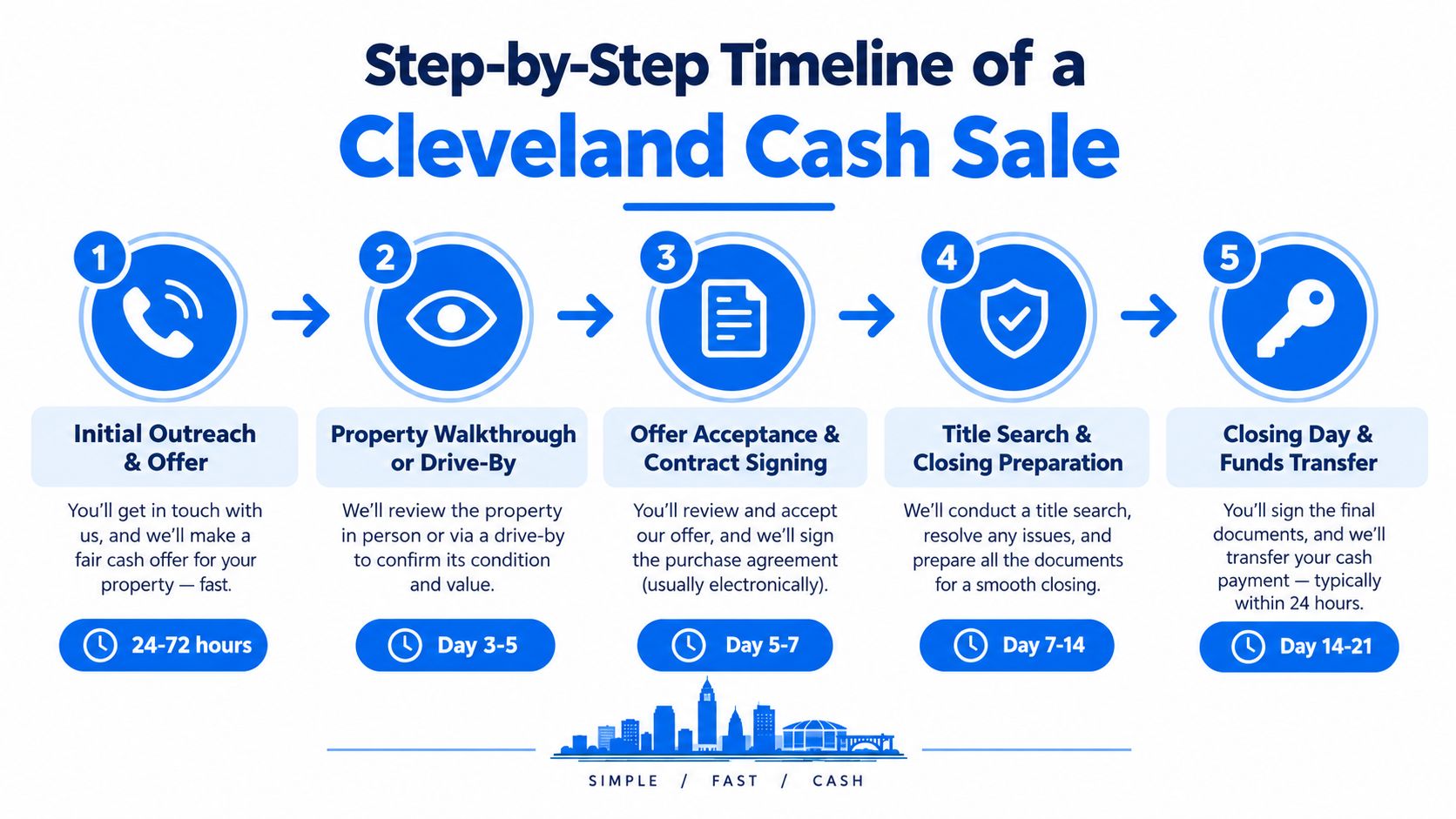
The first call usually leads to an offer within a few days, then a walkthrough or drive-by soon after. If the seller accepts, the buyer signs a contract, deposits earnest money, and sends the file to title. A clean file can move fast. A messy one slows at the title desk, not at the kitchen table.
Cuyahoga County foreclosure timing can change the pace, because an owner may still have redemption rights before sheriff's sale confirmation Cuyahoga County magistrates FAQ. Municipal liens, back taxes, and citation issues can also hold up a title search, especially when Cleveland has already pushed unpaid matters into lien status Cleveland housing fines report.
| Stage | Typical timing |
|---|---|
| Initial outreach and offer | 24 to 72 hours |
| Walkthrough or drive-by | Day 3 to 7 |
| Contract and earnest money | Day 5 to 10 |
| Title search and municipal lien check | Day 7 to 21 |
| Closing | Day 14 to 30 |
Local investors often move faster than regional buyers because they already know the title companies and inspectors they use. Larger online buyers can be more standardized, but standardization does not always mean speed when the property has probate, lien, or condition issues. Before you start, gather the deed, mortgage statements, tax bills, lien notices, and any probate or estate papers so the deal does not stall later.
A seller who wants to verify what gets handed off at closing can use a checklist for final remodel sign-off as a practical reference for itemizing what stays, what goes, and what the buyer should expect. The details are different, but the discipline is the same.
For a clearer look at how a title-driven cash deal is organized, review the cash home buying process.
Get a cash offer for your home
Hidden Costs of Listing As-Is in Cleveland
Listing as-is still creates carrying costs, and those costs can shrink the number that looks best on paper. Mortgage interest, utilities, insurance, and property taxes keep running while the house sits. Add commissions and concessions, and a retail listing can lose ground fast.
What usually gets forgotten
The biggest surprise for many Cleveland sellers is that “as-is” does not mean “no spending.” You may still pay to keep the heat on, keep the place insured, mow the lawn, or cover winter utility bills while you wait for an offer. If the property is vacant, city maintenance or compliance issues can add another layer of friction.
A distressed roof is a classic example. See Four Seasons Roofing roof inspection advice to understand why buyers and appraisers care so much about water intrusion, aging shingles, and visible wear, especially in Northeast Ohio's weather swings. A house with an obvious roof problem often draws repair requests before closing, even when it starts as an as-is listing.
Why financing can collapse late
FHA, VA, and conventional buyers all bring appraisal and condition risk. Once an inspector or appraiser flags a problem, the buyer may ask for a repair, demand a credit, or walk away. That hurts most when the seller has already spent weeks preparing for a closing that never happens.
Practical rule: if the buyer needs financing, expect a second negotiation after the offer is accepted.
The net proceeds often tell the true story. A $130,000 list price can shrink once you subtract commission, holding costs, and repair credits, while a $110,000 cash offer may close cleaner and sooner. The lower headline number is not always the worse deal if the other path keeps bleeding carrying costs and still may not close.
A seller trying to understand what gets handed off at closing can also use a checklist for final remodel sign-off as a practical reference for itemizing what stays, what goes, and what the buyer should expect. The details are different, but the discipline is the same.
For a clearer look at how a title-driven cash deal is organized, review the cash home buying process.
How to Vet a Cash Buyer in Cleveland
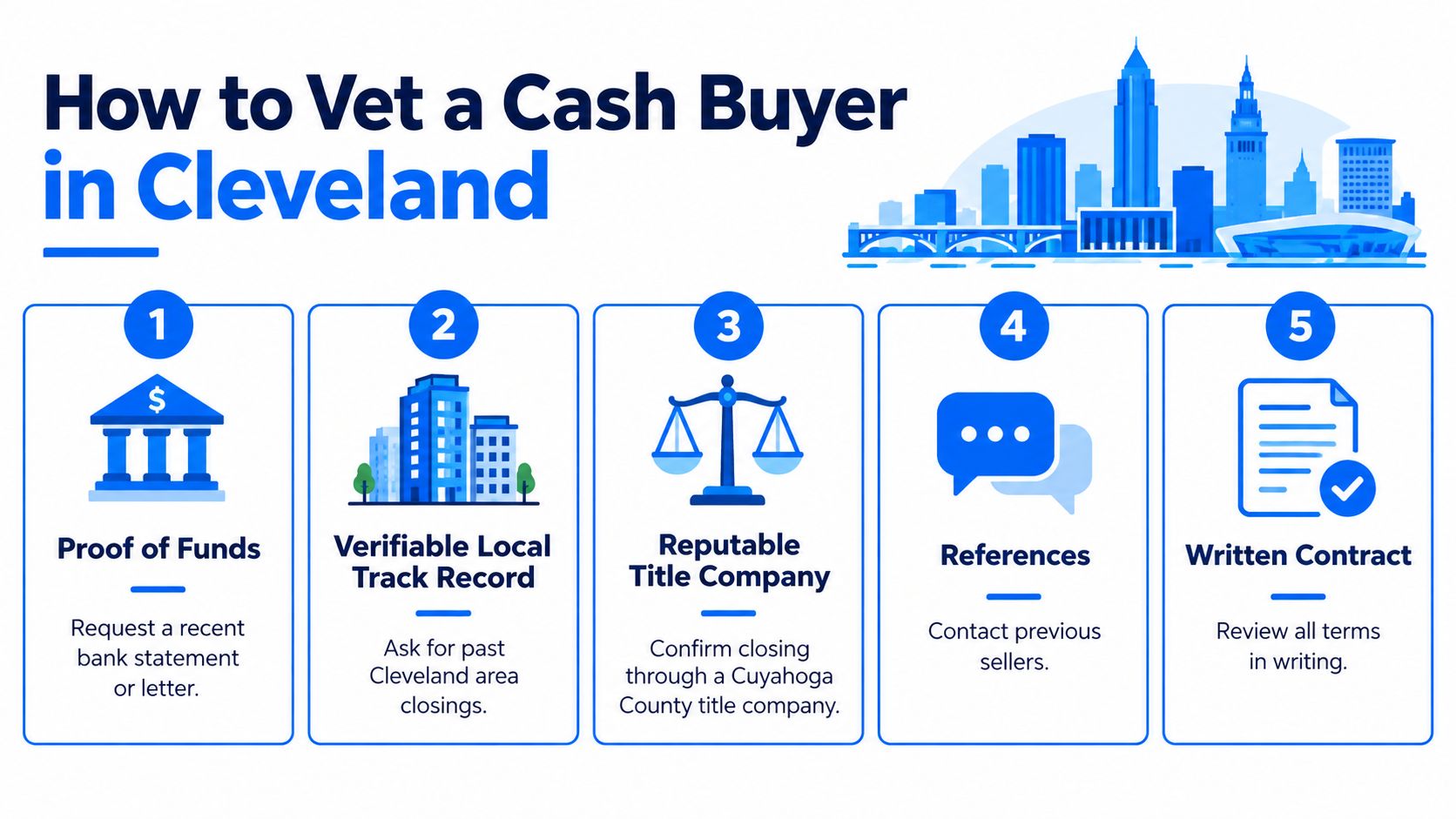
A real cash buyer should be easy to verify, and a fake one usually rushes you. Ask for proof of funds, a local title company, earnest money, and written terms before you sign anything. If the buyer won't provide those basics, keep moving.
What to verify
A legitimate buyer should be willing to close through a reputable Cuyahoga County title company, not some vague in-house process with no neutral third party. Earnest money should be deposited quickly, and you should never pay upfront fees just to get an offer. If they pressure you to sign within 24 hours or keep changing the number after a walkthrough, that's a problem.
Assignment clauses deserve special attention. A buyer who plans to wholesale the contract should disclose that clearly, because you need to know whether you're selling to the end buyer or to a middleman who may flip the paper. That matters even more when the property has probate issues, liens, or title defects.
Red flag: if the buyer won't show proof of funds, won't name the title company, or keeps creating urgency, the offer isn't doing you any favors.
Ohio doesn't generally require an attorney at a routine residential closing, but a lawyer can be useful on inherited, foreclosed, or title-clouded deals. If you're comparing companies, review their purchase agreement before you accept, then compare a few offers side by side. A clean offer today is better than a better-sounding offer that changes tomorrow.
For a wider comparison of buyer types, the top cash home buyers in Cleveland overview can help you narrow the field.
Get a cash offer for your home
Selling With a Mortgage, Liens, or Special Circumstances
A mortgage does not block a cash sale. The loan gets paid off at closing from the sale proceeds, and any HELOC or second lien should be requested early so title work does not stall while someone is waiting on payoff numbers. The seller keeps what is left after payoffs, taxes, and closing costs.

Cases that need extra paperwork
Inherited and probate properties require authority before they require marketing. If several heirs are involved, the title company needs to know who can sign and whether every required owner agrees to the deal. In many Cleveland estate sales, the paperwork comes first because a buyer cannot close around missing authority.
Pre-foreclosure is different. County guidance says the owner keeps title until sheriff's sale confirmation, and redemption can still be available before that point under Ohio procedure. A cash closing before confirmation can be used to satisfy the debt, while waiting too long can push the sale into a more difficult legal path.
Tenant-occupied rentals, divorce, fire damage, water damage, hoarder homes, and code-violation properties all follow the same rule. The buyer can be ready, but the seller still has to deliver authority, title, and usable paperwork. If the city has issued fines or liens, identify them early because they can cut into net proceeds or block clear title.
If the home came from an estate or family transfer, the inherited property guide for Cleveland is a useful place to start.
Gather these before you call buyers
- Deed and ownership records: confirm who can legally sign.
- Mortgage and HELOC statements: get payoff figures early.
- Tax bills and lien notices: verify what must be cleared.
- Probate or estate documents: prove authority when heirs are involved.
- Tenant leases or notices: clarify possession and occupancy.
- Municipal code notices: identify fines, citations, or compliance issues.
Disclosure Rules, Documentation, and Your Next Steps
Ohio still requires the Residential Property Disclosure Form under Ohio Revised Code §5302.30, even when you sell as-is. The form covers the seller's actual knowledge of material conditions such as the roof, foundation, walls, floors, water supply, sewer system, and hazards like lead-based paint, asbestos, and radon Ohio disclosure form. An as-is clause changes the buyer's expectations. It does not erase the duty to disclose known defects.
That distinction matters because omissions can later be framed as misrepresentation or concealment. Keep invoices, inspection reports, insurance claims, and city notices if they document what happened on the property. If you know about unrepaired structural, water, environmental, or code problems, put them on the form and let the title company or attorney help keep the contract language aligned.
Tax basics and seller paperwork
A home sale can also trigger tax questions. The federal home-sale exclusion is generally $250,000 for single filers and $500,000 for married couples, but tax treatment depends on your facts, so consult a tax pro before you sign. That's especially true if the house was inherited, rented, or used partly for business.
Ohio sellers of one-to-four-unit homes generally use the state disclosure form, and many closings are handled by title agencies rather than attorneys. Cleveland sellers should still confirm the current closing practice, any transfer-tax questions, and the exact title process with a local title company or Ohio real-estate attorney. If there's a foreclosure, probate issue, or municipal lien, don't guess.
What to do next
- Pull your documents together. Deed, loan payoff, tax bills, and any notices should be in one place.
- Order payoff statements. Mortgage and HELOC balances change the net sheet.
- Check title and liens. Know what the closing has to clear.
- Complete the disclosure form. Don't leave out known issues.
- Compare at least two offers. Net proceeds matter more than the headline number.
If you want to sell house as-is for cash in Cleveland, OH, the smartest move is to start with the numbers and the paperwork, not the pitch. Compare the offer to your real net, verify who can close, and make sure the title path is clean before you commit.
Cyber Homes helps Cleveland owners compare a no-repair cash sale against the real net from listing, with closings handled through title companies on a seller's timeline. If you want a straightforward offer for a house that needs work, is inherited, or just needs to sell fast, visit Cyber Homes and start with the property details you already have.

Edited by
James Vasquez
Real Estate Investor & Land Specialist with 10+ years experience in residential flipping, vacant land investing, land wholesaling, and subdivision deals.
Disclaimer: The information provided is for educational purposes and does not constitute financial or legal advice. Always consult with licensed professionals before making investment decisions.