
Do I Have to Sell My House in a Divorce? What to Know

No, you don't automatically have to sell your house in a divorce. A judge or negotiated settlement can award the home to one spouse, delay a sale until a future milestone, or order the property sold, and the outcome turns on ownership history, single-income affordability, and the final court order.
Yet if the law doesn't automatically force a sale, why do so many people who fight tooth and nail to keep the family home end up financially trapped two years later? Most divorcing homeowners treat the house as a yes-or-no legal question, when the main bottleneck is cash flow and loan qualification.
A divorce decree, a property deed, and a mortgage contract are three separate legal instruments that answer to different authorities. Keeping a house on one paycheck without a clean buyout calculation and a lender-approved exit from the old loan often creates far more danger than selling from the start.

The Short Answer to Do I Have to Sell the House
You don't have to sell your house solely because you're getting divorced, and "often sold" does not mean "always sold." Courts and settlement agreements generally choose from three routes: one spouse retains the home through a buyout and refinance, both spouses co-own temporarily until a set exit date, or the property is sold and the net equity is divided.
The reason this decision feels forced has less to do with family court judges and more to do with basic household math. Two incomes that comfortably carried one mortgage, one tax bill, and one insurance policy now have to fund two separate homes.
The operative rule: A marital home survives a divorce only when one spouse can qualify for the mortgage alone and absorb the full carrying cost without draining cash reserves.
What Courts Actually Weigh Before Ordering a Sale
Under the Uniform Marriage and Divorce Act (UMDA), first published in 1970 to bring greater consistency to U.S. divorce law and detailed in the Oxford Academic chapter on marital property division, courts equitably apportion marital property rather than defaulting to a forced liquidation. Judges weigh each spouse's contributions, the length of the marriage, each party's economic circumstances, and whether awarding the family home or temporary occupancy to the parent with primary custody of the children makes practical sense.
Still, legal eligibility and financial reality don't always align. Several concrete factors tilt the court's final order one way or the other:
- Ownership history and separate claims: Homes acquired during marriage are typically treated as marital property regardless of whose name sits on the deed, though premarital down payments or inherited interests can alter how equity gets credited.
- State property law: Community property jurisdictions and equitable distribution states handle title presumptions, homestead protections, and division ratios differently.
- Children's housing stability: Keeping kids in their school district carries weight with a judge, but custody alone won't rescue a mortgage payment neither parent can sustain.
- Emotional readiness versus financial clarity: Attachment to a family home frequently pushes people into lopsided settlements. Sorting through the grief of separation with outside support, such as trauma counselling in Kelowna from Interactive Counselling if you're in British Columbia or a qualified therapist in your own area, helps you separate emotional loyalty from a binding financial contract.
When neither spouse can refinance, maintain the payments, or cooperate on upkeep, a sale becomes the most likely outcome. Always verify with a local family-law attorney how your specific court allocates equity, liens, taxes, and selling costs.
Sell, Buy Out or Co-Own Compared
Before choosing a path, put every option side by side against the money required upfront, the monthly burden after the divorce closes, and the exact mechanism that ends your financial tie to your ex.
| Route | What happens | Upfront money | Monthly cost after divorce | How it ends | Main risk |
|---|---|---|---|---|---|
| Sell and divide equity | Home listed or sold as-is; proceeds pay the mortgage and costs first | Seller-side closing costs, typically several percent of the price | Two separate households, no shared mortgage | Closing, then equity split per order | Price and timeline uncertainty; both may need to move |
| One spouse buys out the other | Retaining spouse pays the other's share of net equity and refinances or assumes the loan | Cash or loan for the buyout share | Retaining spouse carries the whole payment | Refinance or lender-approved assumption that releases the departing spouse | Retaining spouse cannot qualify; departing spouse stays on the loan |
| Temporary co-ownership | Both stay on title and mortgage until a set event | Shared upkeep and insurance | Split or assigned payments under a written agreement | Defined date, refinance, or forced sale clause | Missed payments hit both credit reports; deadlock if one wants out |
| Court-ordered sale | Judge orders the home sold and net proceeds held or divided | Court and attorney costs | Existing mortgage payments until closing | Sale and court-directed distribution | Delay and cost; outcome leaves both parties' control |
How to Score Your Own Row
It's easy to fixate on the second column and ignore the last three. A table can show you the structural trade-offs, but it can't tell you whether your budget survives month six after the judgment is signed.
Start by separating gross equity from net proceeds. What matters in any settlement isn't the Zestimate or the neighborhood list price; it's what remains after paying off the primary mortgage, clearing secondary liens or unpaid property taxes, deducting reasonable selling costs, and applying credits for separate-property contributions or post-separation mortgage payments.
Next, pull three concrete items before negotiating a single term:
- Your current mortgage payoff statement: Request an official payoff quote from your loan servicer rather than reading the principal balance off a monthly statement, because payoff quotes capture daily interest and escrow adjustments.
- A written lender pre-qualification: If either spouse wants to buy out the other, get a loan officer to underwrite that spouse's standalone income, debt-to-income ratio, and credit profile. Verbal optimism doesn't close a refinance.
- A realistic maintenance reserve: Roofs, HVAC systems, and plumbing don't pause for a divorce decree. Price out annual property taxes, homeowners insurance, HOA dues, and routine repairs on a single income before scoring the buyout or co-ownership rows as viable.
If two options tie on paper, favor the one that removes shared credit exposure fastest. Clean breaks cost less in attorney fees and credit damage than messy arrangements that unravel a year later.
How Title, the Decree and the Mortgage Differ
Homeowners constantly treat a divorce judgment as a magic wand that rewrites real estate ownership and debt in one stroke. It doesn't. Three separate documents govern your house during and after divorce, and buyers, title companies, and banks don't read them the same way.
Here is how those three instruments divide authority and why the loan contract sits at the center of your financial risk.
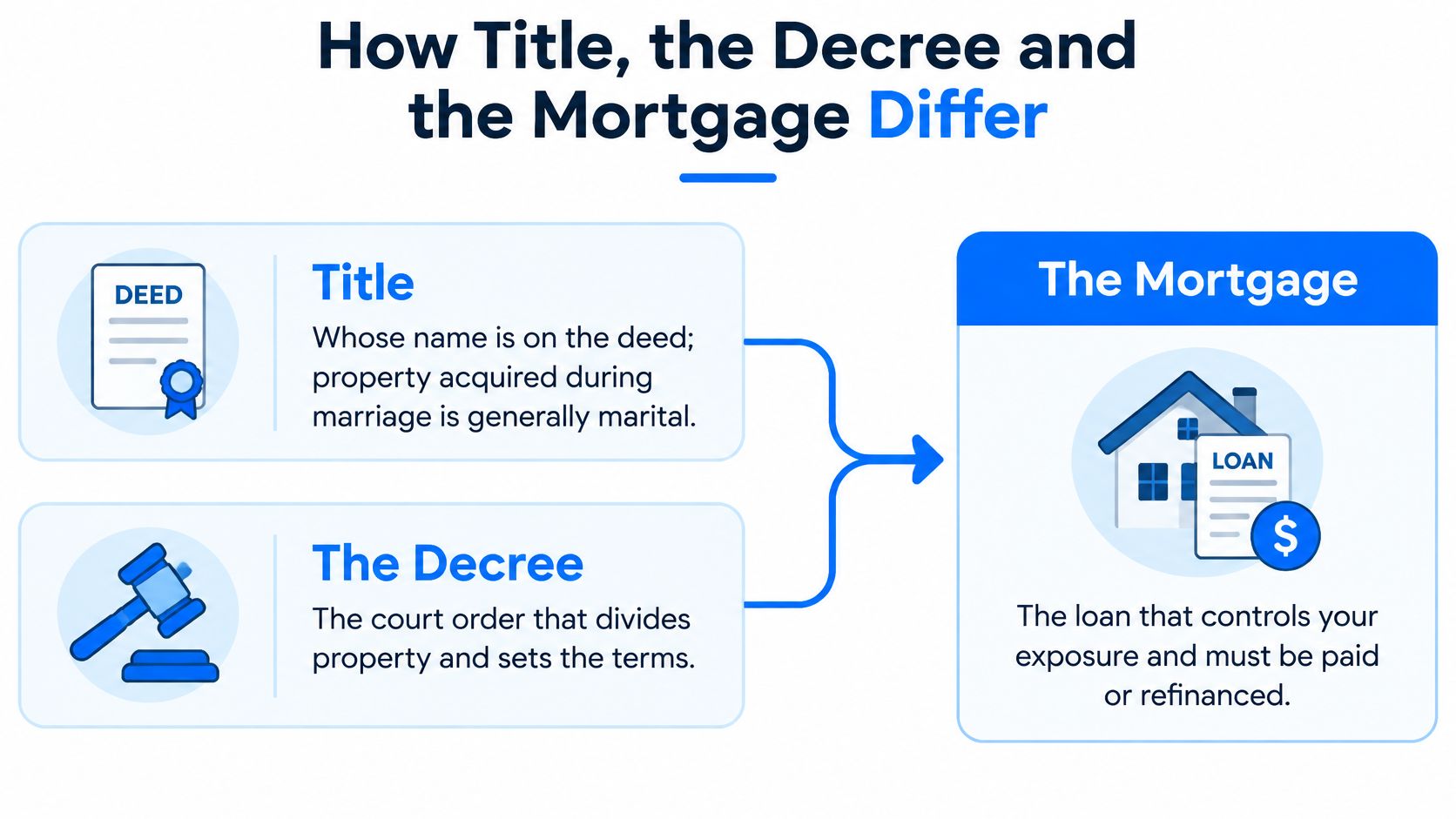
First is title, recorded on the deed. Title tells the county recorder who legally owns the property. Yet as Utah Courts property division guidance illustrates, property acquired during a marriage is generally marital property even when only one spouse's name appears on the deed, meaning a judge can divide the equity regardless of sole title.
Second is the divorce decree or settlement agreement. This is a binding court order between you and your spouse. It decides who gets the house, sets buyout formulas, and gives a judge authority to order a sale when continued joint ownership is impractical or the parties can't agree. In contested divorces, courts routinely order a home sold and hold the net proceeds in escrow pending final distribution.
Third is the mortgage, a private contract between the borrowers and the lender. Because the mortgage lender isn't a party to your divorce case, a family court judge can't erase your name from the promissory note. Signing a quitclaim deed gives up your ownership rights to the property without removing a penny of your mortgage liability.
Clauses Your Settlement Must Put in Writing
Buyers and mortgage servicers look at the deed and the loan, not your divorce file. To keep a cooperative settlement from turning into a post-decree courtroom battle, make sure your written agreement locks down seven operational terms:
- Valuation date and appraisal method: Name a single date for valuing the home and agree on one neutral, state-licensed appraiser (or a clear tie-breaker procedure) so neither side drags out the case with competing valuations.
- Refinance deadline: Pick a specific calendar deadline, not vague language like "within a reasonable time," for the retaining spouse to remove the departing spouse from the loan.
- Listing authority and price reductions: If a sale is ordered or triggered as a fallback, spell out who picks the listing agent, how the initial asking price is set, and the automatic price-drop schedule if the house sits without offers.
- Maintenance, insurance, and tax obligations: State in black and white who pays the mortgage, property taxes, homeowners insurance, utilities, and repairs over a set dollar threshold while the home remains jointly held.
- Allocation of proceeds or shortfalls: Define exact percentages for dividing net sale proceeds and who covers any cash shortfall if the house sells for less than the payoff and closing costs.
Leaving even one of those terms vague invites an expensive return to court when one party stalls.
Buyout Mechanics and How Much the Departing Spouse Gets
A fair buyout isn't a guess or a coin flip over half the home's market value. It's a structured calculation designed to pay the departing spouse roughly what they would have pocketed if the house had sold on the open market.
Running the Net Equity Formula
Start with the agreed current fair-market value from a neutral appraisal. Subtract the exact mortgage payoff and any secondary liens, such as a HELOC, solar loan, or tax lien. Next, subtract reasonable hypothetical selling costs, and adjust for verified separate-property contributions, documented marital improvements, unpaid taxes, and credits for post-separation mortgage payments.
Say a divorcing couple owns a home appraised at $400,000 with a $250,000 mortgage payoff. On paper, that looks like $150,000 in gross equity. Factor in an illustrative 6% selling-cost load of $24,000 for brokerage fees and closing expenses, and the true net equity drops to $126,000.
In a 50/50 division, the departing spouse's buyout share is $63,000, not half the gross equity. Skipping the selling-cost deduction forces the retaining spouse to eat the entire cost of eventually selling the house alone.
Funding the Buyout and Protecting the Departing Spouse
The retaining spouse can pay that $63,000 share in three ways: handing over liquid cash, pulling funds out through a cash-out refinance, or trading an equivalent share of another marital asset such as a brokerage account or retirement fund (accounting for taxes on pre-tax accounts).
Never sign a quitclaim deed before the closing table. Handing over title without simultaneous proof of payoff or lender-approved loan release leaves you with all the debt and none of the collateral.
To protect yourself as the departing spouse, build two hard safeguards directly into the settlement:
- A binding refinance deadline with an automatic fallback sale clause. Give the retaining spouse a concrete window to close a new loan in their sole name. If they miss the date, the agreement should automatically require listing the house for sale without needing a fresh motion before a judge.
- Written lender confirmation releasing liability. Require either a closing statement proving the joint mortgage was paid off through a refinance or a formal written release of liability issued by the servicer under an approved loan assumption.
If the retaining spouse refuses to cooperate, fails to qualify for the refinance, or stops paying the mortgage, act immediately rather than hoping they catch up. Request the servicer's written assumption criteria right away; if qualification fails, document every missed deadline or default and file to enforce the fallback sale clause. When a stalled buyout threatens foreclosure or piles up legal bills, comparing a traditional listing against vetted direct cash buyers, such as these top cash home buyers in Boise or comparable buyers in your own city, gives you a fast, verifiable benchmark for closing the chapter cleanly.
The Mortgage Trap That Outlasts the Divorce
Keeping the family home doesn't remove anyone from a joint mortgage, and mailing a certified copy of your divorce decree to the bank doesn't end your legal obligation to pay. That single misunderstanding ruins more post-divorce credit scores than almost any other mistake in family law.
According to Consumer Financial Protection Bureau guidance on divorce and debt, even when a divorce decree assigns a joint debt to one spouse, creditors can still pursue anyone whose name remains on the loan. Both co-borrowers stay jointly responsible for timely payments until a legally effective loan change occurs, and altering the deed alone does not satisfy the lender.
If your ex keeps the house and misses a payment six months later, the late mark hits both credit reports, and the lender can foreclose against both borrowers. Worse, carrying that old mortgage on your credit report counts against your debt-to-income ratio, blocking you from qualifying for a new mortgage of your own.
Why Keeping the House Can Be Riskier Than Selling
Homeowners often view a buyout as the safe, conservative option and a sale as the drastic one. The data flips that assumption upside down.
A CFPB research report on post-divorce mortgage problems notes that releasing a departing spouse generally requires the remaining borrower to qualify for a lender-approved assumption or another formal lender-approved process. The same report cites historical Bureau of Labor Statistics research showing that divorce or widowhood was associated with more than twice the chance of mortgage delinquency and more than three times the chance of receiving a foreclosure notice or losing the home.
Only three lender-recognized exits sever your mortgage liability:
- A full refinance into the retaining spouse's sole name, paying off the original note at closing.
- A lender-approved mortgage assumption paired with a written release of liability (most common on government-backed FHA, VA, and USDA loans, and far rarer on conventional mortgages).
- A property sale whose closing proceeds pay the mortgage balance down to zero.
Three Steps to Take Before Signing Off on a Buyout
Before you agree to let your spouse retain a house carrying your name on the note, complete three verification steps that prevent a surprise trap later:
- Verify the exact payoff and lien stack: Obtain the official payoff figure from the primary lender plus statements for any second mortgage, home equity line, or municipal lien so no hidden balance derails closing.
- Request written lender release rules: Ask the mortgage servicer in writing whether the loan permits an assumption, what documentation and credit thresholds apply, and how long underwriting takes.
- Test the retaining spouse's standalone credit and income: Insist on a formal loan officer review of pay stubs, tax returns, credit scores, and post-divorce support orders before signing away any negotiating advantage.
If the retaining spouse can't pass that underwriting check today, betting your credit score that they'll magically qualify two years from now is a gamble you shouldn't take.
Whether You Can Actually Afford to Keep It
Strip away the memories in the kitchen and the kids' height marks on the doorframe, and keeping a house comes down to liquidity. Can one paycheck pay the bank, the tax collector, the insurer, and the plumber without emptying your savings account?
Research presented by the American Economic Association reports that divorce produces a rapid decrease in household net worth and income, an immediate decline in homeownership likelihood, and a persistent reduction in homeownership rates lasting decades. That reality punches a hole in the common belief that one spouse can absorb the existing payment and figure out the rest later.
Use this liquidity checklist to test whether keeping the home holds up under real post-divorce numbers.

The Five-Step Single-Income Stress Test
Don't rely on gut instinct or your old two-income budget. Run your actual numbers through five strict filters before committing to keep the property:
- Build the all-in monthly housing cost. Add principal, interest, property taxes, homeowners insurance, private mortgage insurance, HOA dues, and a realistic monthly reserve for maintenance and utilities.
- Measure it against guaranteed solo income. Compare that total against the take-home pay of the single spouse keeping the home. Don't pad the math with speculative alimony; spousal maintenance is strictly limited in many states, so check local rules early, such as how to understand Texas spousal support rules from the Law Office of Bryan Fagan, PLLC, before counting support payments as reliable housing income.
- Subtract the cost of the buyout. If you're borrowing to buy out your ex, plug in the higher monthly payment at today's interest rates rather than the lower rate on your old marital loan.
- Re-run the math under an income hit. Test whether the budget still breathes if your income dips temporarily, your property taxes jump, or the water heater fails the same month your car needs brakes.
- Confirm refinance approval with a lender. Hand the whole package to a mortgage loan officer and ask whether your standalone income and credit qualify under current underwriting rules.
A house with hefty paper equity can still be completely unworkable if neither spouse qualifies for a new loan or if deferred repairs threaten to drain every dollar of post-divorce cash. Sometimes the smartest financial move is letting go of an oversized marital house and mapping out a cleaner transition to sell one house and buy another that matches your new budget.
If you do consider temporary co-ownership to wait out a school year, treat it like a business partnership. Put written safeguards in place covering exclusive occupancy, utility bills, repair approval limits, insurance claims, remedies for missed payments, and clear authority to list and sell immediately if the arrangement breaks down.
For a closer walk-through of how divorcing homeowners weigh these buyout and affordability trade-offs in practice, watch this overview.
Here is the blunt decision hierarchy that protects your net worth: sell if neither spouse qualifies independently, buy out only with approved financing in hand, and co-own only with a hard exit date and an enforceable sale trigger.
Taxes and Hidden Costs That Change the Split
Two assets with the exact same dollar value on a divorce spreadsheet rarely leave you with the same spendable cash. A house carries embedded tax rules and transaction costs that can turn an equal division into a lopsided loss for the spouse who keeps the keys.
Why Adjusted Basis Matters More Than You Think
According to IRS guidance for divorced or separated individuals, transferring a home between spouses or former spouses incident to divorce generally results in no recognized gain or loss for federal income-tax purposes, and transfers under a divorce decree generally aren't subject to gift tax. That sounds painless on closing day, until you look at what travels with the deed.
The spouse who receives the house takes the transferor's adjusted basis rather than a stepped-up fair-market-value basis. In plain English, you inherit the original purchase price plus documented capital improvements, which means you also inherit the entire built-in capital gain when you eventually sell.
When a home is sold later, federal law allows an eligible individual to exclude up to $250,000 in capital gains from the sale of a main home, compared with up to $500,000 on a qualifying joint return. Eligibility hinges on ownership tests, residency use tests, filing status, and statutory rules, so keeping a highly appreciated home and selling it alone after divorce can shrink your tax shield in half and expose a steep capital-gains bill.
A dollar of heavily appreciated home equity isn't worth the same as a dollar in a savings account once you factor in future selling costs and inherited capital-gains exposure.
Numbers Your Settlement Must Document in Writing
Never divide gross equity and walk away. A technically sound property settlement documents every figure that shapes your true after-tax value:
- Original purchase price and documented improvements: Gather closing disclosures and receipts for permanent upgrades (like a roof replacement or kitchen remodel, not routine painting) that raise your adjusted tax basis.
- Prior depreciation claimed: If either spouse claimed home-office deductions or rented out part of the property, depreciation recapture can trigger taxes even when the main-home exclusion applies.
- Current fair-market value and exact mortgage balance: Lock both numbers to the agreed valuation date.
- Tax-position and exclusion allocation: Specify who claims the exclusion if a sale is delayed, who pays property taxes and insurance during that waiting period, and whether the spouse keeping the house receives an offsetting asset discount for embedded tax liability.
Remember that federal tax treatment never overrides state law. County recording charges, state real estate transfer taxes, local homestead exemptions, and state marital-property statutes all chip away at net proceeds, so have a CPA and local family-law attorney check the split before signing.
How Common Divorce Home Sales Are and How Fast a Sale Can Close
Selling a home during divorce can feel isolating, yet it's one of the most common real estate transitions in the country. Looking at national housing patterns puts the choice in clear perspective.
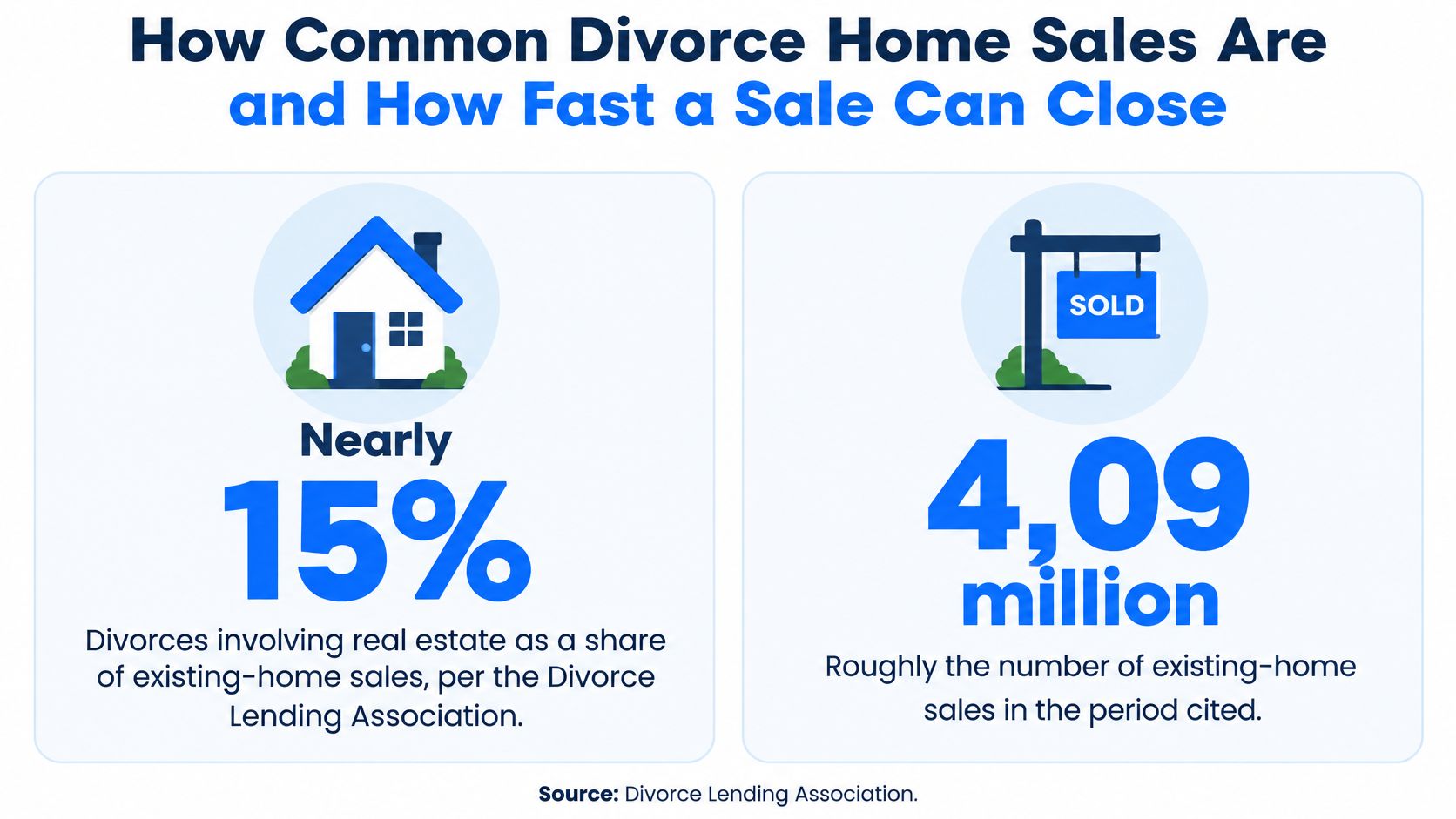
The Divorce Lending Association estimated that divorces involving real estate represented nearly 15% of the roughly 4.09 million existing-home sales in the United States in 2023. Meanwhile, a 2023 U.S. housing analysis published by LaClair DeLuca reported that 53.4% of people divorced in 2022 owned their homes while 46.6% were renters.
Relationship transitions directly drive listing decisions as well. Zillow's 2024 sellers housing trends report found that 37% of home sellers said marriage, divorce, or separation influenced their decision to move and sell, with the median seller reporting a sale price of $300,000.
Comparing a Traditional Listing Against a Direct Cash Sale
Once you decide to sell, your real decision isn't just who buys the house, but which selling method protects your timeline and net proceeds. Both routes solve different problems:
- Traditional MLS listing: Going through a real estate agent can attract a higher headline offer when the home is updated, both spouses cooperate on pricing, and neither party faces an urgent court deadline. The trade-off is friction. You have to agree on an agent, keep the home show-ready, negotiate inspection repairs, pay brokerage commissions and closing costs, and absorb the risk of a buyer's mortgage falling through weeks before closing.
- Direct as-is cash sale: Trading a slice of top-line retail price for speed and certainty often wins when repairs are piling up, communication is strained, or a judge sets a strict closing date. At Cyber Homes, we work with homeowners navigating divorce, costly repairs, or tight legal timelines by purchasing houses in any condition for cash, with no listings, no showings, and no repairs required. We charge $0 in fees or commissions, cover standard closing costs, present a no-obligation cash offer usually within 24 hours, and average 7 to 14 days from sale to closing.
Don't guess which path puts more money in your pocket after carrying costs, repair credits, and delays. Compare projected net proceeds side by side, check strategies to sell a house fast for market value if your home is move-in ready, and have your attorney and tax advisor review the closing numbers before signing a purchase contract.
Confirm the Order Before You Act
Never list a house, transfer a deed, or accept a cash offer during an active divorce without verifying what your court orders allow. Many states trigger automatic temporary restraining orders the moment a divorce petition is filed, restricting either spouse from selling or encumbering marital property without written consent or judicial approval.
Follow this confirmation sequence before making a binding move on the property.
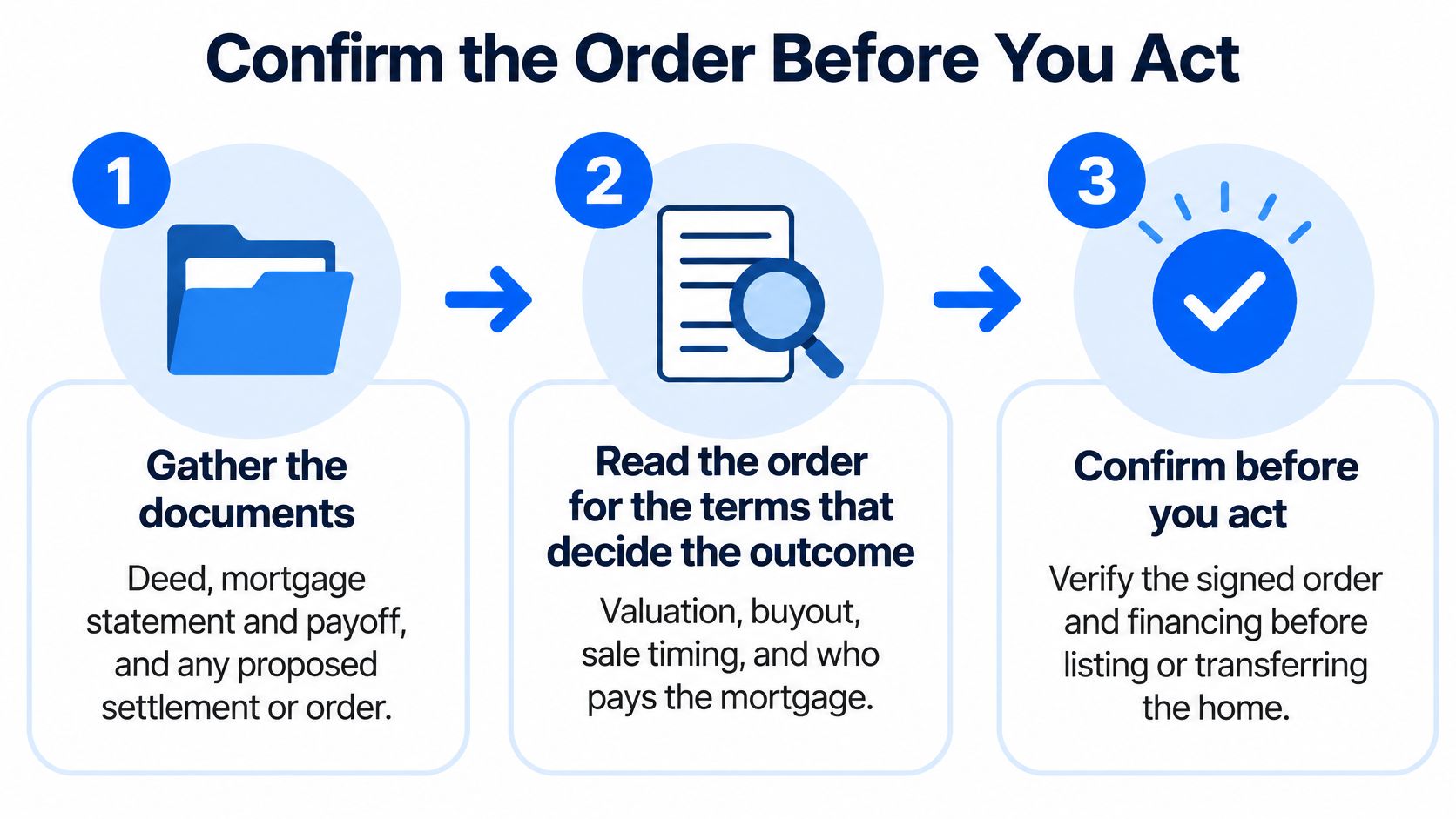
- Audit the controlling terms of the proposed or signed order. Read every clause covering valuation date, buyout timing, listing authority, price-drop rules, and who pays the mortgage during any holding period. Make sure both spouses' signatures and title authority align with what the title company will demand at closing.
- Get jurisdiction-specific legal and tax sign-off. Ask a local family-law attorney whether your court can compel a sale and how state homestead or transfer rules apply, and have an accountant review adjusted basis and main-home exclusion timing on your exact numbers. If you're disputing a court-ordered sale, note that appealing a decree doesn't automatically pause a closing; in Texas, for example, stopping enforcement requires meeting strict Texas Rule 24 supersedeas requirements detailed by The Law Office of Bryan Fagan, PLLC, and other states enforce similar bond rules.
- Commit to the route your financing supports. Match your decision to an approved refinance, a funded buyout, or a clean sale, not wishful thinking about future income.
- Benchmark a cash sale if you face a hard deadline. If the court order requires a prompt closing or neither spouse can carry the house, request a written cash offer to compare against an agent's net sheet. Submitting property details through Cyber Homes creates zero obligation to sell and doesn't obligate us to buy; you get a no-obligation cash offer to evaluate on your own schedule through three simple steps: tell us about the property, review your fair cash offer, and pick your closing date.
State statutes, county procedures, and mortgage contracts vary widely across the country, so your family-law attorney's advice on your signed order always outranks any general guide.
If a divorce settlement or tight court timeline leaves you needing a clean, predictable exit from a shared house without repair bills, open houses, or agent commissions, Cyber Homes buys properties as-is for cash and lets you choose a closing date that fits your legal schedule. Requesting a fair, no-obligation cash offer takes less than a minute and gives both spouses a concrete number to compare against a traditional listing. Visit Cyber Homes today to review your options on your own timeline.

Edited by
James Vasquez
Real Estate Investor & Land Specialist with 10+ years experience in residential flipping, vacant land investing, land wholesaling, and subdivision deals.
Disclaimer: The information provided is for educational purposes and does not constitute financial or legal advice. Always consult with licensed professionals before making investment decisions.