Sell House and Buy Another

You've sold your house, but the new one won't close for weeks. The buyer wants possession immediately, your children are sleeping in a relative's guest room, and every day in temporary housing adds cost and disruption. Or perhaps you've found the replacement home first and are wondering whether you can safely carry both properties until the old one sells.
To sell your house and buy another successfully, stop treating the move as one real estate transaction. It's two transactions connected by a cash-flow problem. You're choosing between the certainty of having somewhere to live, the cost of carrying two homes, and the negotiating power you bring to the purchase. The right sequence depends on your equity, financing, local demand, and tolerance for disruption, not on a universal rule that says you must always sell first or buy first.

Get a cash offer for your home
Why Selling and Buying at the Same Time Feels So Hard
Last Friday, a family closed on its old house. The children spent the weekend at their grandmother's, the furniture went into storage, and the parents tried to keep everyone calm with takeout and borrowed air mattresses. Their new home was under contract, but it wouldn't close for several weeks because the seller refused a rent-back.
Nothing had gone catastrophically wrong. The family had merely optimized the sale without securing enough housing certainty on the other side. They got their money, but they lost control of the transition.

Three risks control the decision
Buying first protects you from being without a home, but it can leave you carrying two mortgages, utilities, maintenance obligations, and property expenses while the original house sits on the market. The danger isn't just the monthly payment. The danger is not knowing how long you'll have to make it.
Selling first gives you cash and a cleaner offer when you make the next purchase. You won't need to persuade a seller to accept a home-sale contingency, and you'll know what equity is available. The price is temporary housing, storage, and possibly two moves if the next closing doesn't line up.
The third risk is less visible until a transaction starts to weaken: the appraisal gap. A buyer may agree to a price that the appraiser doesn't support. If the buyer can't cover the difference, financing can fail, renegotiation can spread through the chain, and a carefully coordinated move can collapse near closing.
Advisor's rule: Don't ask which sequence sounds easiest. Ask which risk you can fund and which risk would cause the most damage.
The U.S. resale market still depends heavily on ordinary existing-home transactions. The National Association of REALTORS® buyer and seller profile reports that 85% of buyers purchased previously owned homes, while recent sellers typically sold at 100% of asking price and closed within about three weeks. The same profile reports that 91% of sellers used an agent, compared with 5% who sold FSBO. That agent-driven structure makes coordination between pricing, listing preparation, financing, and closing dates especially important for move-up buyers.
The rest of the decision is straightforward once you put those pressures on paper. Choose the path that buys the kind of certainty your household needs, then build financing and contract terms around it.
Sell First, Buy First, or Do Both at Once
There are three workable paths. None is risk-free, and each favors a different combination of market conditions and personal finances.
| Path | Housing Risk | Financial Risk | Best Market | Best For |
|---|---|---|---|---|
| Sell first | Temporary housing may be necessary | Lowest exposure to overlapping payments | Cooling or balanced market with active buyers | Owners who need sale proceeds or dislike debt risk |
| Buy first | Lowest risk of being without a home | Two mortgages and delayed sale proceeds | Hot seller market with scarce replacement homes | Owners with strong reserves and reliable financing |
| Simultaneous close | Small timing error can disrupt both transactions | Closing costs, financing, and appraisal risks overlap | Any market with strong coordination | Owners using bridge liquidity, cash, or extended escrows |
Sell first
I generally favor selling first when the local market is balanced or cooling and the current home is likely to attract solid buyer demand. You gain a defined budget, remove the old mortgage from the picture, and can make a cleaner offer on the next home. Sellers often take a buyer with available funds and no sale contingency more seriously.
The drawback is housing between closings. Solve that before listing, not after accepting an offer. A short-term rental, family housing, storage, an extended closing, or a negotiated rent-back can protect you from making a rushed purchase.
Buy first
Buying first makes sense when the replacement home is unusually difficult to find and missing it would create a bigger problem than carrying the old property. It also suits owners who can qualify for the new loan without relying on immediate sale proceeds and who have enough reserves to withstand a delayed sale.
That's a calculated risk, not a lifestyle preference. Set a maximum carrying period and a price floor for the old home before you submit an offer. If you can't tolerate the possibility of reducing the price later, you probably shouldn't buy first.
Close simultaneously
A same-day or tightly coordinated close can produce an elegant transition, but it leaves little room for error. A lender delay, unresolved inspection issue, title problem, or appraisal dispute on one side can affect the other side.
For buyers who need a clean offer, review the cash home buying process as one possible way to separate the two closings. You can also delegate research, scheduling, and transaction administration to a real estate assistant, then use this real estate VA ROI overview to evaluate whether that support would reduce coordination pressure.
My verdict is blunt: pick the path that matches your risk tolerance, not the path your cousin used. The right answer changes with your cash reserves, equity, local inventory, and the urgency of the move.
Your Move-Up Timeline From Decision to Closing
A move-up transaction needs a calendar before it needs a listing date. Use a 12-to-20-week planning window as a working framework, then add buffer for financing, inspections, moving, and the unexpected delay that always appears somewhere.
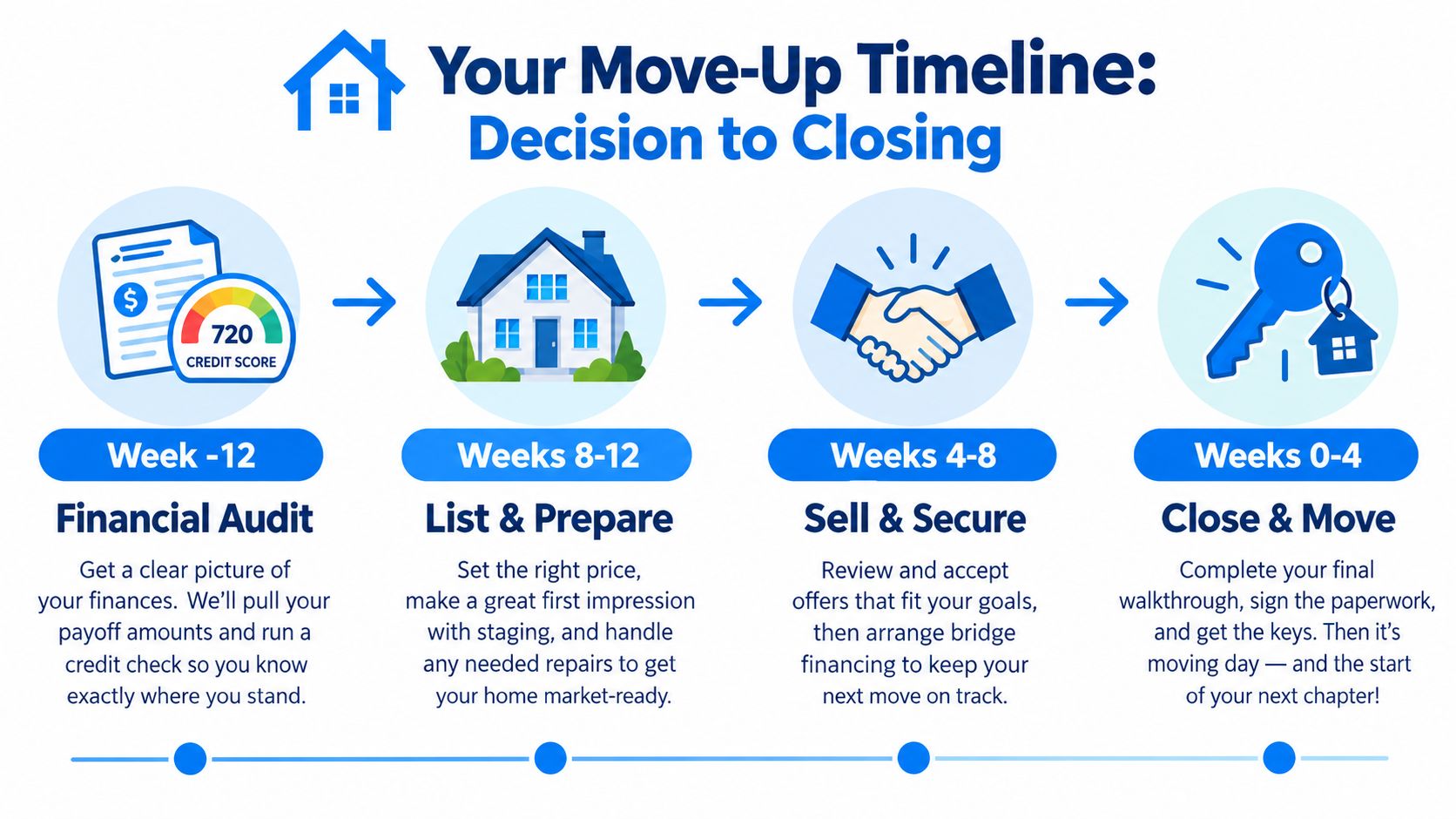
Month minus three
Start with the financial audit. Pull the current mortgage payoff, estimate selling costs, check your credit, and ask a lender to model the new payment with and without the old mortgage. Confirm how much cash you'd have available for the down payment, closing costs, moving, temporary housing, and repairs.
Write down the outcome you need. “We want a bigger house” is not enough. Decide whether you need the sale proceeds, whether you can carry both homes, and how much housing disruption your household can accept.
Month minus two
Interview agents who regularly manage both sides of a move-up transaction. Ask how they'd price the current home, how they'd coordinate the purchase, and what they'd do if the first offer falls apart.
Review comparable sales, active competition, and buyer demand. Then make the uncomfortable decision: list now, wait, or pursue the replacement home first. A good agent won't promise that the home will sell instantly. They'll explain what could slow it down and how the contract should protect you.
Month minus one
Prepare the old property without spending blindly. Prioritize repairs that affect safety, financing, water intrusion, major systems, and buyer confidence. Clean, declutter, stage, and schedule professional photography. A pre-listing inspection or appraisal review can expose issues before a buyer uses them to renegotiate.
If you're considering a rent-back, extended closing, bridge loan, or cash sale, settle the terms now. Don't wait until you have an accepted offer and no bargaining power.
Weeks one through six
Launch the listing, manage showings, evaluate offers, and confirm the buyer's financing strength. If you're also shopping, keep your purchase criteria narrow. The next home must fit your budget and your closing strategy, not just your wish list.
Once under contract, track every deadline in one shared calendar. Inspection, appraisal, loan approval, title work, insurance, and closing documents all matter. If a termite issue appears, review practical guidance on handling termite findings before closing before agreeing to a repair or credit.
The final stretch
Confirm utilities, school transfers, insurance, address changes, mailbox redirection, storage pickup, movers, and HOA document transfers. Ask the title company exactly when proceeds will be available and verify how the purchase down payment will move.
One family I advised took 16 weeks from its first agent meeting to receiving the keys. The next time, they'd begin lender review earlier, reserve temporary housing before listing, and negotiate the closing window before accepting an offer. That's the lesson. A timeline isn't paperwork. It's your defense against being forced into expensive decisions.
Get a cash offer for your home
Financing Options That Bridge the Gap Between Two Homes
The financing tool should match three facts: how much equity you have, how quickly you need to move, and how much uncertainty you can carry. Don't choose a product because it sounds flexible. Choose it because you understand the repayment trigger and the worst-case outcome.
| Option | Typical Cost | Funding Speed | Best For | Main Risk |
|---|---|---|---|---|
| Sale contingency | Contract terms vary | Depends on sale of current home | Buyers who can't safely carry two homes | Sellers may reject the offer |
| Bridge loan | Short-term interest and lender fees | Sometimes days to two weeks | Owners with substantial equity and urgent timing | Temporary double housing costs |
| Post-close rent-back | Negotiated rent and deposit terms | Available only if buyer agrees | Sellers needing time after closing | Buyer may need immediate possession |
| HELOC | Variable interest and lender fees | Depends on lender approval | Owners with usable equity and planning time | Rate changes and reduced borrowing room |
| Clean cash offer | Provider's pricing terms | Can be rapid | Sellers prioritizing certainty and timing | Net proceeds may be lower than retail |
Sale contingency
A home-sale contingency makes the purchase dependent on selling your current property within an agreed period. It can let you cancel without losing earnest money if the sale doesn't happen, but it also asks the next seller to wait for a transaction they don't control.
That weakens your offer in a competitive market. Industry sources cited by mortgage and brokerage publications estimate that roughly 4% to 7% of contingent offers fall through, while August 2025 cancellation data and contingency guidance show why sellers treat contingent transactions cautiously. Use this option when protection matters more than offer strength, and keep the contingency period short enough to remain credible.
Bridge loan
A bridge loan taps equity in the existing home to help fund the next purchase. The CNBC Select explanation of bridge financing describes repayment commonly within one year, although some lenders extend terms to three years, and notes that one structure can cover up to 80% of the combined value of both homes.
The process is simple in concept. Estimate equity, apply, secure approval, close on the replacement home, then repay the bridge loan from the sale proceeds. The hard part is carrying the cost if the old property takes longer to sell. Bridge financing works best when the equity cushion is strong and the sale plan is realistic.
Rent-back and HELOC
A post-close rent-back lets you sell the current home while remaining there temporarily under an agreement with the buyer. It can eliminate a rushed move, but the buyer may need possession, and the agreement must address rent, deposit, insurance, maintenance, and a firm move-out date.
A HELOC offers another way to access equity, usually with a variable rate. It can be more adaptable than a bridge loan, but lender approval takes time and the available credit can change with underwriting or valuation. Treat both tools as temporary solutions, not permission to stretch your budget.
Clean cash offer
A clean cash offer removes the home-sale contingency and reduces financing dependencies. It can improve your position when buying first, but it doesn't remove the need to understand your total cash exposure. A clean offer is only safe when the funds, closing schedule, and fallback plan are already in place.
How a Cash Buyer Like Cyber Homes Changes the Math
A cash buyer changes the transaction from a market-timing exercise into a certainty decision. Instead of preparing for showings, waiting for buyer financing, and negotiating repairs, you request an offer, review the terms, and choose whether the speed and convenience justify the net price.
The supplied Cyber Homes process allows an owner to request a no-obligation offer, sell the property as-is, avoid commissions, and select a preferred closing date. It also describes closing in about 7 to 14 days and an advance of up to $2,000 for moving expenses. Those details matter most when the sale must fund a purchase or when temporary housing would create serious disruption.
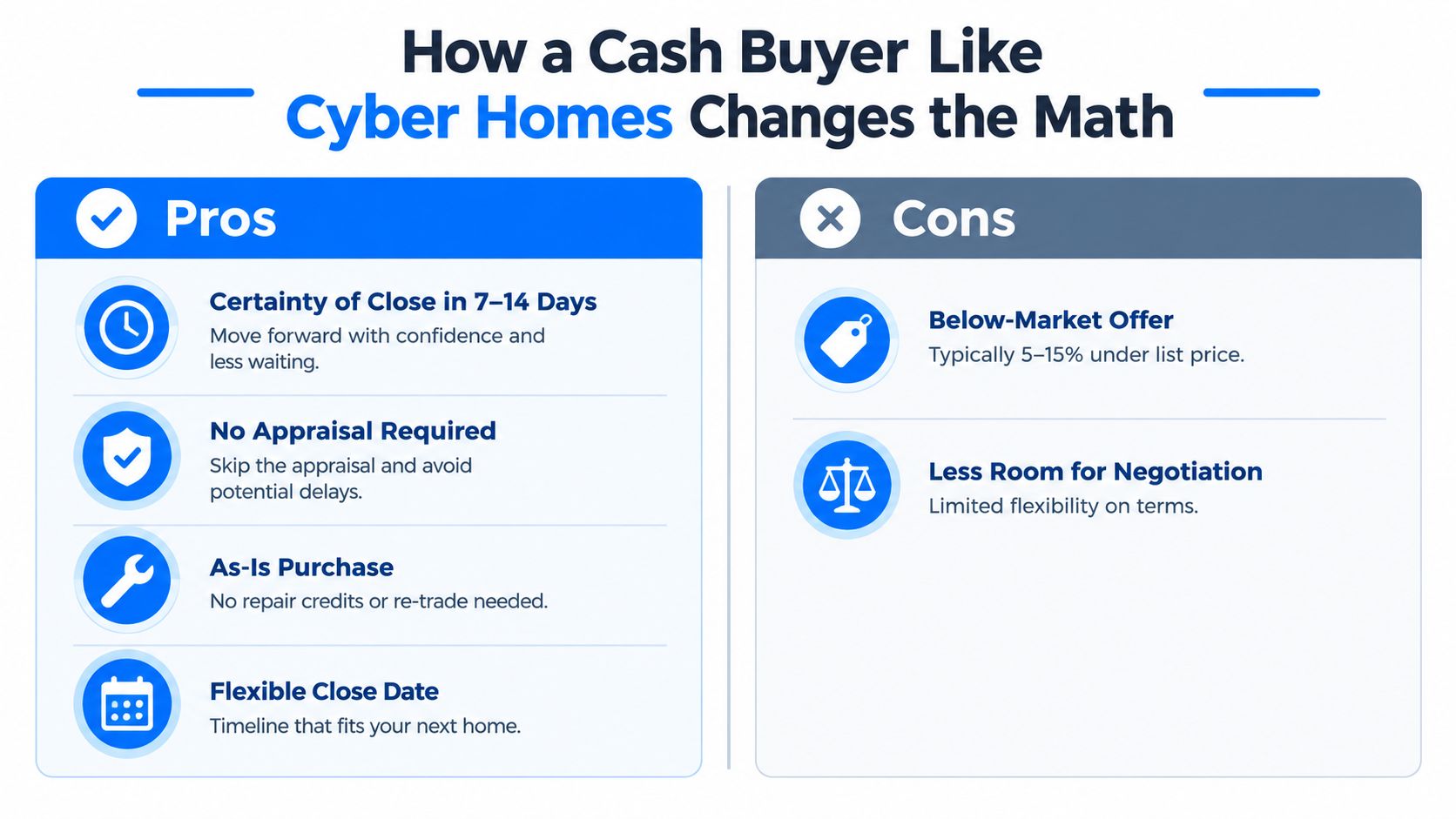
What you receive in exchange for price
A cash sale can provide several forms of certainty:
- No appraisal dependency: The sale isn't structured around a buyer's mortgage appraisal.
- As-is terms: You may avoid repairs, repair credits, repeated showings, and late-stage re-trading.
- Date control: A flexible closing date can help align the sale with the purchase.
- Fewer moving parts: You're dealing with one buyer and a defined process rather than a chain of dependent deadlines.
The trade-off is the offer itself. A cash buyer must account for holding costs, resale risk, repairs, and the capital tied up in the property. Don't compare the offer only with an optimistic listing price. Compare the expected net proceeds after commissions, preparation, repairs, concessions, carrying costs, storage, temporary housing, and the financial cost of a delayed purchase.
The correct comparison is not retail price versus cash price. It's certainty-adjusted proceeds versus the value of waiting.
A cash route is sensible when the house needs work, the move has a hard deadline, the chain is already unstable, or securing the next home matters more than maximizing the last dollar. It's less compelling when you have time, the property is easy to prepare, and local buyers are likely to compete for it.
For a closer look at the mechanics, review the cash home buying process before requesting an offer. Ask for the net amount, closing costs, inspection rights, timeline, and any conditions in writing. Speed is valuable only when the agreement is clear.
Get a cash offer for your home
Negotiation and Inspection Tactics for Move-Up Buyers
A contingent offer can win, but it has to compensate the seller for uncertainty. Your job isn't to make the offer look complicated. Your job is to make the seller believe the transaction has a clear path to closing.
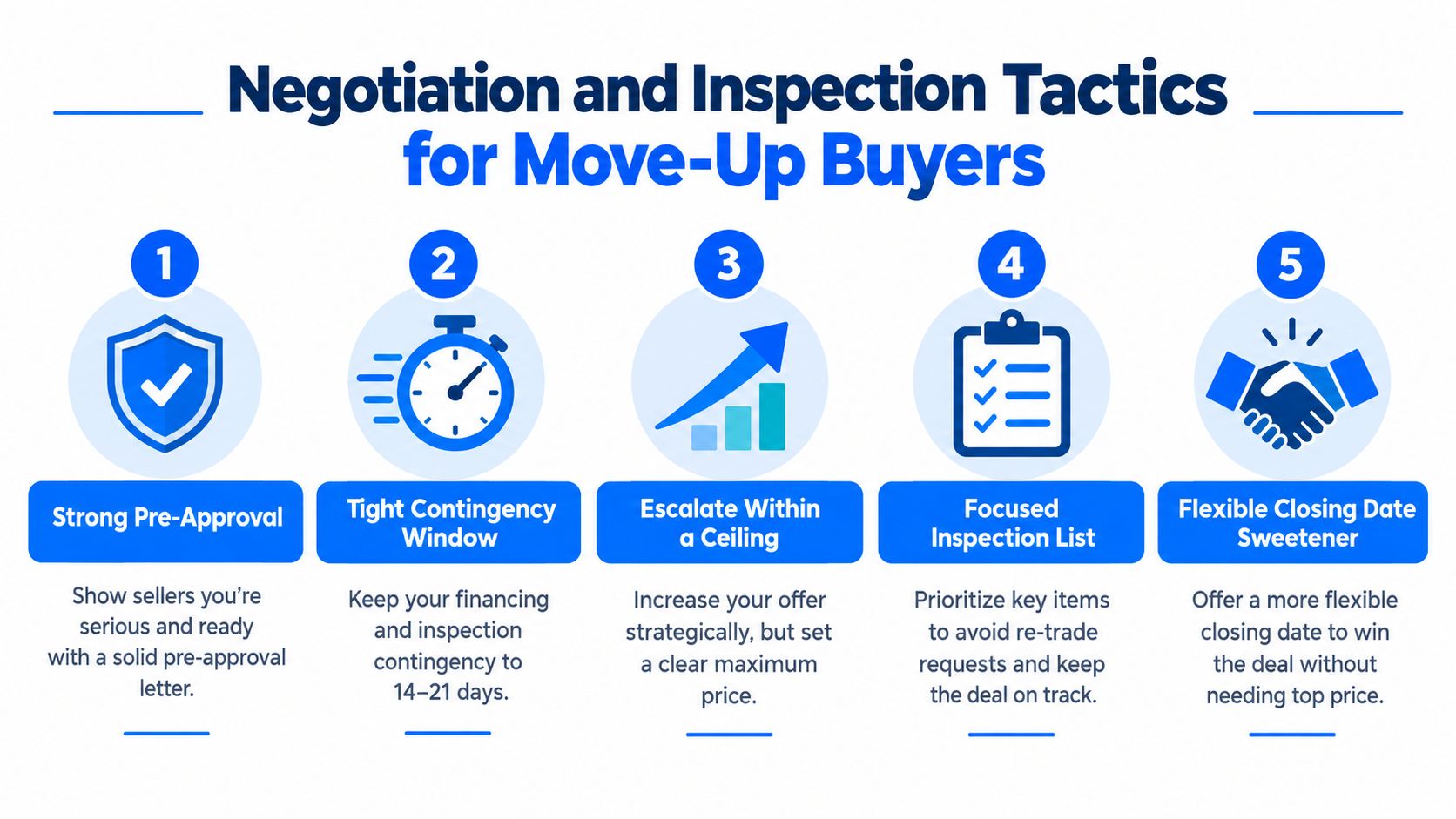
Make the offer credible
Lead with a strong pre-approval supported by current income, asset, and debt documentation. Tell the listing agent exactly where your existing home stands, whether it's listed, under contract, or still being prepared. Vague answers make sellers assume the worst.
Keep the contingency period as short as your transaction can support. Add a kick-out clause if appropriate, allowing the seller to continue marketing the property and giving you a defined period to remove the contingency or step aside if a stronger offer appears.
If price escalation is necessary, set a firm ceiling before emotions take over. An offer that wins the house but creates an unaffordable payment isn't a successful move-up transaction.
Keep inspection negotiations focused
On the purchase side, separate safety, structural, water, roof, electrical, and major-system concerns from cosmetic preferences. Request credits where permitted and practical rather than demanding that the seller control the contractor, schedule, and quality of every repair.
On the sale side, order a pre-listing inspection when the property's condition is uncertain. Disclose known issues clearly, define which repairs you'll handle, and avoid promising a perfect house. Transparency protects the timeline because buyers are less likely to discover a surprise and reopen the entire negotiation.
Coordinate the dates
Closing-date flexibility can be more valuable than a small price increase. A seller may accept a strong, well-documented offer if your timing helps them move, while your buyer may accept a rent-back if you provide a clear end date and appropriate protections.
Use the same principle throughout the chain: solve problems before they become demands. Confirm insurance, title, lender conditions, inspection access, and moving dates early. If the old home must be sold as-is, learn about selling a house as-is and decide which defects you'll disclose, repair, or price into the transaction.
Common Pitfalls and How to Avoid Them
Most failed move-up plans don't fail because the owners misunderstood the dream. They fail because nobody defined the limits. Use these controls before you list or write an offer.
Carrying two mortgages without a stop point
The mistake is approving the new payment and ignoring the overlap. Set a hard monthly carrying-cost ceiling and a maximum period you can tolerate before listing the old home aggressively, reducing the price, or pursuing a different sale strategy.
Include taxes, insurance, utilities, maintenance, loan fees, storage, and temporary housing. If the plan only works when the old house sells quickly at your preferred price, the plan isn't finished.
Accepting an appraisal gap casually
A buyer can offer more than an appraiser supports, especially when comparable sales lag behind current asking prices. Decide in advance how much cash you can bring to cover a gap and whether you'll renegotiate, challenge the valuation, or walk away under the contract terms.
On your own purchase, ask the lender and agent to review comparable sales before you make an aggressive offer. On your sale, price from evidence rather than from the amount you need for the next house.
Letting inspection findings derail the chain
Don't wait for the inspection to discover whether the roof leaks, the electrical panel raises questions, or the drainage needs attention. A pre-listing review gives you time to repair, disclose, or price the issue without a buyer controlling the clock.
On the purchase, agree on your repair priorities before the inspection report arrives. Safety and structural defects deserve attention. Cosmetic preferences usually don't justify reopening a carefully coordinated transaction.
Treating moving day as an afterthought
Book the mover, storage, cleaners, utility transfers, and backup housing before the listing goes live. Confirm the exact possession time for both homes, not just the closing date. A closing later in the day can create a very different move than a morning possession.
Keep essential documents, medication, chargers, children's necessities, and a change of clothes outside the moving truck. Small preparations prevent a closing delay from becoming a household emergency.
Ignoring tax and title questions
The tax treatment of a sale can depend on ownership, occupancy, gain, filing status, and the property's history. Ask a qualified tax professional to review the transaction well before closing, especially if the home was rented, inherited, transferred during divorce, or used partly for business.
Also verify payoff figures, liens, HOA balances, title requirements, and the timing of sale proceeds. Your next purchase depends on usable funds, not the headline sale price.
The best move-up plan has a defined sequence, a funding source, a housing fallback, and a decision point for every major risk. If your current plan has none of those, pause before signing.
If you need to sell before buying, Cyber Homes offers a cash-sale option with an as-is process, flexible closing dates, and a way to avoid the uncertainty of a traditional buyer chain. Request an offer through Cyber Homes and compare the net proceeds and timeline with a conventional listing before choosing your move.

Edited by
James Vasquez
Real Estate Investor & Land Specialist with 10+ years experience in residential flipping, vacant land investing, land wholesaling, and subdivision deals.
Disclaimer: The information provided is for educational purposes and does not constitute financial or legal advice. Always consult with licensed professionals before making investment decisions.