
Selling House with Tenants: Your Options and Legal Limits

Most landlords assume an active lease ruins a property's marketability and forces them to wait until move-out day before listing. In reality, an organized, rent-paying tenancy can serve as a genuine selling point for income-focused buyers rather than a roadblock, as Flo London's landlord selling guide highlights when separating occupied transactions from vacant ones. What derails deals isn't the lease itself. It's treating selling a house with tenants as if the house were empty.
When you sell an occupied rental, two things decide whether you reach the closing table on schedule. First, you have to pick your selling route based on the constraint you can't easily change: your deadline, your renter's willingness to move, or your target net proceeds. Second, you need to treat tenant cooperation as a transaction-risk variable rather than a polite formality. Every appraisal, inspection, and buyer walkthrough runs through the person holding the keys. Get the order of operations right, and you protect both your closing date and your legal footing.

What a Tenant Changes When You Sell
You can sell a rental property while someone lives in it, and an active renter doesn't legally block you from transferring ownership. Say an out-of-state owner decides to exit a single-family rental midway through a yearly lease. The title can still change hands next month, yet the sale works differently than a vacant home transaction in three concrete ways.
- Possession stays with the renter: You can't promise an empty house on closing day because the tenant keeps the legal right to occupy the property until the lease expires or ends through a lawful process.
- Income transfers at closing: Monthly rent keeps flowing under the existing agreement, and the new owner steps into the right to collect it once ownership transfers.
- Landlord obligations follow the property: Security deposits, repair responsibilities, statutory notice rules, and tenant privacy duties don't vanish when the deed records.
Before calling an agent or investor, separate two terms that show up in every purchase agreement. Vacant possession means the buyer receives an empty home with no active tenancy on closing day. An occupied sale means the buyer takes ownership subject to the existing lease and becomes the new landlord automatically.
Think of an occupied sale like selling a car with a passenger who already paid for a cross-country ride. Ownership of the vehicle changes hands immediately, yet the passenger's paid ticket still runs until the agreed stop.
This situation is far more common than many first-time sellers realize. According to the U.S. Census Bureau's Q2 2024 Housing Vacancies and Homeownership report, renter-occupied units made up 30.8% of the nation's housing inventory in the second quarter of 2024, compared with 58.8% that were owner-occupied. The same report recorded a 6.6% rental vacancy rate alongside a 0.9% homeowner vacancy rate. Nearly one-third of U.S. housing stock is rental property, and the vast majority of those units have someone living inside at any given moment.
Three Questions That Set Your Strategy
If you're still weighing whether to hold the rental or exit altogether, comparing long-term returns against a sale in our guide to whether you should sell a home or rent it out helps clarify your financial baseline. Once you decide to sell, answer three questions in strict order.
- How much time remains on the lease? Answer this first. Remaining lease duration locks in your earliest realistic vacancy date and determines whether an owner-occupant buyer can even qualify to purchase the home.
- Is the tenant willing to leave early? A renter who already plans to relocate for work opens options that don't exist when a family wants to finish the school year.
- What does local law allow? City ordinances and state statutes dictate notice windows, renewal rights, and whether selling the property is valid grounds to end a tenancy.
Skip straight to pricing before answering those three questions, and you risk signing a purchase contract you can't legally perform.
Four Ways to Sell a House With Tenants
Landlord exits happen at scale whenever financing costs, taxes, or management fatigue pile up. In a 2025 Aldermore landlord survey covered by Property Industry Eye, 31% of surveyed landlords were considering selling their rental properties, while 29% had sold some properties during the preceding 12 months. When you decide it's your turn to exit, you have four practical routes on the table.
| Path | What happens to the tenant | Typical timing | Price outcome | Main risk |
|---|---|---|---|---|
| Cash sale to an investor, tenant stays | Tenant stays; buyer inherits the lease | Days to a few weeks; seller picks closing date | Usually below retail; no repairs or showings | Buyer discount and lease terms must be disclosed accurately |
| Negotiated early move-out | Tenant leaves by written, voluntary agreement | Several weeks to a few months | Closer to market value once vacant; cash incentive cost | Tenant may refuse or the agreement may be challenged as pressure |
| Occupied listing on the open market | Tenant stays; every showing needs notice and access | Often several months | Market price possible, but smaller buyer pool | Access friction and failed showings delay the deadline |
| Wait for lease end, then list vacant | Tenant leaves at expiry or after lawful notice | Set by remaining lease term, plus listing time | Highest potential if vacant and in good condition | Tenant may renew; holding costs and vacancy losses continue |
When Each Path Wins and When It Breaks Down
A cash sale to an investor with the tenant in place wins when closing certainty and speed matter most. The buyer steps straight into the lease, skips cosmetic repairs, and doesn't need weekend open houses. It falls short if your top priority is squeezing out retail value on a pristine home, since investor offers price in lease obligations and needed updates. If the property also needs deferred maintenance, reviewing how to sell a house as-is shows how condition affects direct offers.
With a negotiated early move-out, both sides trade flexibility for mutual benefit. Say your renter just accepted a job across town or wants a larger place; offering moving assistance in a written, voluntary release can clear the house so you can market to retail buyers. This route breaks down fast if the tenant has no interest in leaving, or if any offer of cash looks like coercion under local tenant-protection rules.
Listing as an occupied property on the open market appeals to landlords who want broad exposure without losing monthly rent during the listing period. It works best when the rent sits close to local market rates and the tenant keeps the home tidy for scheduled visits. Where it fails is logistics: fewer buyers qualify for or want an active lease, and repeated showing requests often trigger access pushback that drags out closing.
Waiting for the lease to end before listing vacant opens the door to the widest buyer pool, including owner-occupants using standard residential mortgages. You can repaint, stage empty rooms, and show the house on short notice. The catch is carrying cost and unpredictability. Mortgage payments, insurance, utilities after move-out, and turnover repairs keep hitting your bank account, and local renewal rules can prevent an automatic move-out even when the initial term expires.
Running the Numbers on Waiting Versus Selling Now
Price tags alone mislead landlords because they ignore time and carrying costs. Consider a hypothetical scenario where a landlord collects $1,650 per month in rent and has nine months left on a 12-month lease.
Waiting out those nine months lets you collect that monthly rent before you list. Against that income, you continue paying your mortgage, property taxes, landlord insurance, and any unexpected HVAC or plumbing repairs that pop up during the hold. Once the tenant leaves, you face a vacant stretch with zero rent while paying utilities, cleaning, painting, listing fees, and closing costs across the sales cycle.
Compare that full net figure against taking a direct cash offer today. Even if the investor offer lands below a projected vacant retail price, eliminating nine months of ownership risk, turnover repairs, and vacancy loss often narrows the true gap dramatically.
Decision rule: Pick your selling path by identifying the one constraint you can't bend. If your closing date is fixed, choose the investor route. If your renter is cooperative and ready to move, negotiate a voluntary release. If top retail price is non-negotiable and you have months of financial cushion, wait for lawful vacancy.
What the Lease Keeps and What You Cannot Promise
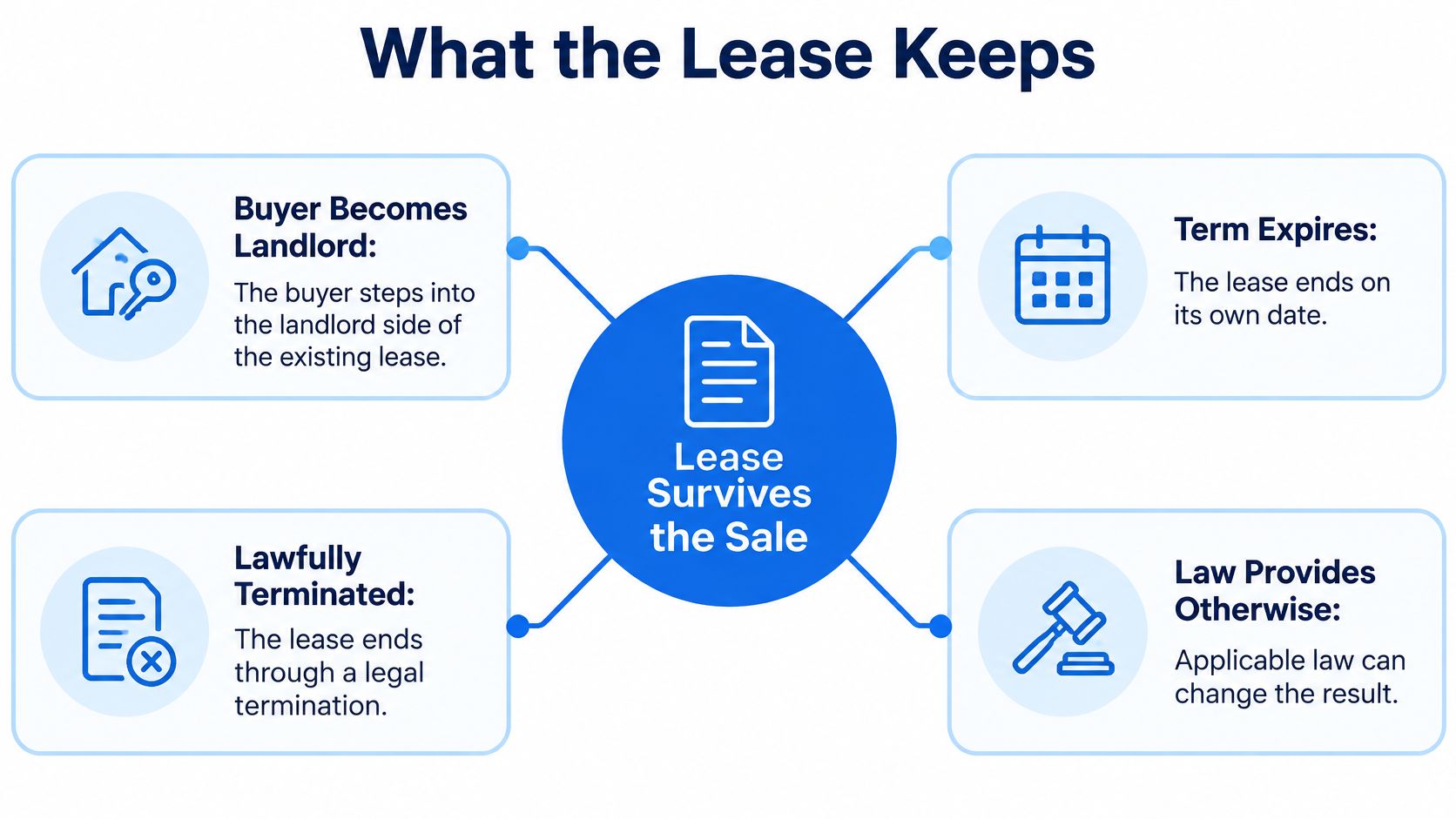
A residential lease isn't an informal understanding you can cancel because you found a buyer. It's a binding private contract governing occupancy, rent, deposits, and upkeep for its stated term. As Home Selling Assistance's guide to selling a tenant-occupied house explains, landlord-tenant rules are governed primarily at the state and local level, and a valid lease commonly survives a sale unless it expires, ends through lawful termination, or applicable law states otherwise.
In practice, ownership transfers through a lease-assignment provision built into the purchase contract. On closing day, the buyer inherits your landlord rights along with your legal duties. According to Nolo's legal encyclopedia on selling property with existing tenants, marketing an occupied home as vacant or promising a buyer they can move in before the tenancy lawfully ends exposes you to breach-of-lease claims, misrepresentation disputes, and derailed closings.
Lease Clauses to Pull Before You Price the Home
Never rely on memory or an unsigned draft sitting in an email folder. Pull the fully executed agreement and extract seven exact items before speaking to any buyer:
- Start and end dates: Confirm whether the fixed term is still running or has rolled over into a periodic arrangement.
- Renewal and auto-renewal terms: Check whether the tenant holds an option to extend or if silence automatically triggers another term.
- Early-termination clauses: Look for any sale-termination language, then verify whether local law allows you to enforce it.
- Rent amount and due date: Match the written rate against what you collect each month, including grace periods or late fees.
- Notice requirements: Identify how much advance written notice you must give for non-renewal, rent changes, or property entry.
- Side addenda: Pull pet agreements, garage or parking assignments, utility splits, and lawn-care promises that bind the next owner.
- Entry and showing rules: Note any limits on showing hours, lockboxes, or advance notice periods written directly into the lease.
If you can't state the lease end date, renewal language, and exact deposit balance without checking your phone, you aren't ready to set an asking price or commit to a closing date.
Handling Security Deposits and Month-to-Month Tenancies
Security deposits trip up more tenanted closings than almost any other line item. Suppose a tenant pays $1,650 in monthly rent and gave you a $1,650 security deposit at move-in. That deposit belongs to the tenant, not your sale proceeds. At closing, you either transfer the funds directly to the buyer's escrow account or apply a $1,650 credit to the buyer on the settlement statement, and the number on the closing sheet must match your written deposit ledger down to the penny.
Month-to-month tenancies catch sellers off guard too. Many owners assume a periodic lease means they can hand the renter a quick note and empty the house next week. In reality, ending a month-to-month tenancy still requires statute-compliant written notice, and required notice windows vary widely across states and cities, ranging from short weekly notices to multi-month periods.
Worse, rent-control and just-cause eviction ordinances in many municipalities restrict you from ending even an expired lease just because you want to sell. Always confirm local rules through your state statute, city housing authority, or a local landlord-tenant attorney before drafting any notice or telling a buyer when the house will be empty.
Lawful Actions Versus High-Risk Mistakes
Frustration during a sale pushes some landlords toward shortcuts that carry heavy legal penalties. Keep a bright line between standard procedures and illegal self-help:
| Action category | Examples | Legal and transaction effect |
|---|---|---|
| Lawful moves | Serving statute-compliant written notice; signing a voluntary, attorney-reviewed cash-for-keys release | Preserves enforceable timelines and protects closing |
| Risky or illegal moves | Changing locks; shutting off utilities; making repeated pressure calls; listing an occupied home as vacant | Triggers tenant lawsuits, statutory penalties, and buyer contract cancellations |
Finally, lock the occupancy terms directly into your purchase contract. The agreement must explicitly state whether the buyer is taking the home subject to the existing tenancy or receiving lawful vacant possession at closing. Ambiguous wording invites a last-minute standoff at the title office.
Managing Access and Tenant Cooperation
A signed contract means nothing if the appraiser cannot get through the front door. Tenant cooperation is the transaction-risk variable most sellers underestimate: a tenant who stops answering texts stalls your inspection contingency, and a stalled contingency pushes your closing date. Once a listing goes live or an offer arrives, buyers, appraisers, home inspectors, photographers, and contractors all need entry, but none of them can walk through on demand. As The Tenants' Voice guidance on landlords selling a property explains for UK rentals, tenants keep quiet enjoyment of the home while it is being marketed. U.S. tenants hold comparable entry and privacy rights, though the specifics come from the lease itself and from state and local law, which differ city by city.
Every unannounced knock or back-to-back showing erodes goodwill. Treat access as a structured workflow from day one, because the tenant who feels respected in week one is the tenant who says yes to the inspector in week four.
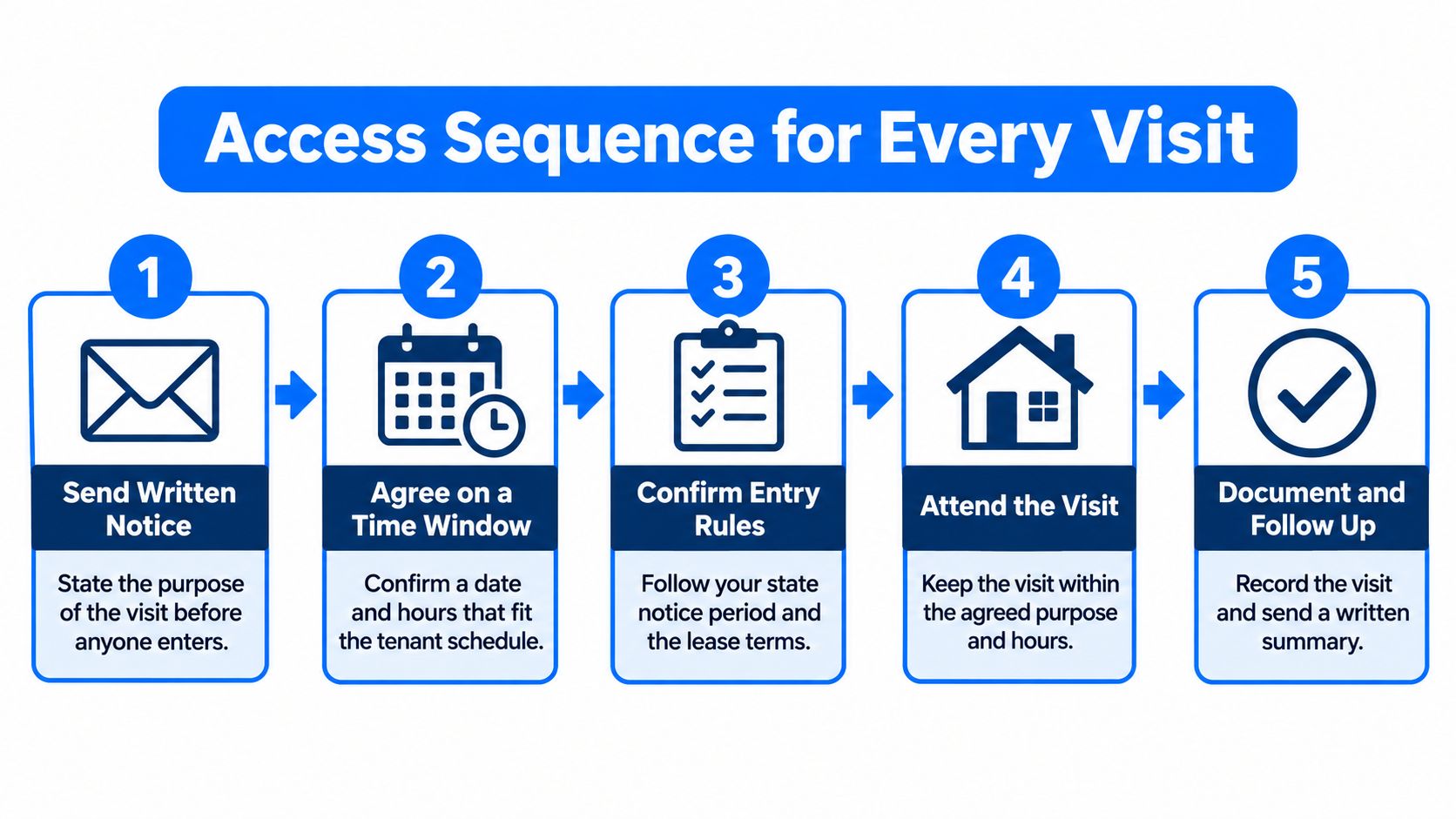
The Five-Step Access Sequence
- Send written notice first. Email or deliver written notice stating the exact purpose of the visit, the requested date, and a clear time window before anyone drives to the property.
- Confirm the agreed window in writing. Wait for the tenant's written confirmation of the date and hours so nobody gets surprised on visit day.
- Verify entry rules and consolidate walkthroughs. Check your lease and state notice statute, and limit serious buyers to one combined walkthrough instead of multiple casual visits.
- Attend and log every visit. Stay within the agreed purpose and hours, note who entered, and record the date alongside any repair or privacy concern the tenant raises.
- Follow up in writing through closing. Send a quick written recap after visits, and wrap up the transaction with a documented closing-day handoff covering keys, legal notices, repair responsibilities, and deposit records.
That log in step four matters more than it looks. If a tenant later claims constant intrusion or a buyer disputes access delays, your dated record is the only neutral account of what happened. If you want the view from the renter's side of the door, our guide to renting a house that is for sale explains the privacy concerns that drive pushback.
Handling the Four Hardest Tenant Scenarios
What if the tenant refuses repeated showings? Don't escalate or force entry with a spare key. Propose a single fixed window that works around their job or family schedule, log any refusal in writing, and pivot to a buyer willing to close after one consolidated walkthrough rather than endless open houses.
Who should schedule appointments? Assign exactly one point of contact, typically you or your property manager. When listing agents, buyers' agents, inspectors, and appraisers all text the tenant separately, wires cross and cooperation evaporates overnight.
Can you offer a rent credit or moving help? You can often offer a modest rent credit for showing inconvenience or moving assistance, provided the terms are in writing, free of coercive pressure, and reviewed by local legal counsel. Some local ordinances treat poorly worded financial offers as unlawful harassment to force a move-out.
What if the sale collapses after the tenant cooperated or moved? Never leave relocation costs to a handshake. Before a tenant packs a box or breaks their routine for a buyer, put in writing who pays moving expenses if the buyer's financing falls through or the contract terminates.
A lower-friction sale with one planned walkthrough often delivers far greater closing certainty than a slightly higher asking price that depends on twenty disruptive showings.
Pre-Listing Document Checklist
Before you call an investor or sign a listing agreement, build a single physical and digital file containing every original tenancy document. Put a dated index on page one, then cross-check every dollar figure and date against the signed lease so there are zero contradictions during due diligence.
| Document | Why the buyer or title company asks | Who usually holds it |
|---|---|---|
| Signed lease and all amendments | Sets term, rent, renewal and obligations | Seller or property manager |
| 12-month rent ledger | Shows payment history and any arrears | Seller or property manager |
| Security deposit records | Fixes the amount to transfer or credit at closing | Seller |
| Move-in condition report and photos | Sets the baseline for later repair disputes | Seller |
| Safety certificates (gas, electrical, smoke and carbon monoxide alarms) | Confirms legal compliance and supports disclosure | Seller or licensed contractor |
| Lead-based paint disclosure for homes built before 1978 | Required under federal U.S. disclosure rules for pre-1978 homes, occupied or vacant | Seller |
| Repair and maintenance log with open requests | Shows condition and any unfinished landlord duties | Seller or property manager |
| Notices served and tenant correspondence | Proves valid notices and written communication | Seller |
| Side agreements, pet or parking addenda | Reveals obligations hidden outside the main lease | Seller |
Three Closing Details That Prevent Delays
First, attach the executed lease and all addenda directly to the purchase agreement. Pairing the full paperwork with explicit contract language stating whether the property transfers occupied or vacant eliminates buyer confusion during underwriting.
Second, don't overlook federal lead-based paint disclosures on homes built before 1978. That requirement applies across the United States regardless of whether a renter lives inside the house or the rooms sit completely empty.
Third, never invent numbers when records go missing. If a previous property manager lost your original security deposit receipt or an early rent ledger, reconstruct the exact transfer using bank statements and disclose any remaining gap in writing. Buyers and title officers can work around a documented gap; they walk away from guessed numbers that fail verification.
If your plan involves waiting for vacancy or coordinating turnover right after move-out, pairing your document prep with realistic pre sale cleaning timing and touch ups from Top Cleaners keeps move-out day from pushing back photography and listing launch.
Sellers who assemble every row in this table before accepting an offer answer lender, buyer, and title questions on the spot. That preparation trims days off the review period and shuts down the surprise renegotiations that kill tenanted deals.
Choose Your Path and Confirm the Order
Skipping steps costs landlords money and legal ground. Even experienced owners get burned when they market a house first and check the lease second. Run your sale in this exact sequence so each decision locks cleanly into the next:
- Read the executed lease cover to cover. Write down the expiration date, renewal terms, entry notice rules, and exact security deposit balance.
- Confirm local legal boundaries. Check your state statute, city housing authority, or a local landlord-tenant attorney before promising any move-out timeline or drafting a notice.
- Assemble your full document pack. Pull the lease, rent ledger, deposit proof, repair log, safety records, and required disclosures into one dated file.
- Select your path using your hardest constraint. Commit to an investor cash sale, a voluntary early move-out, an occupied listing, or waiting for lease expiration based on whether time, tenant cooperation, or retail price matters most.
- Send the first written letter to your tenant. Share your plan calmly, name the single person who will handle scheduling, propose realistic dates, and stick strictly to written entry notices.
How a Direct Cash Sale Works in Practice
If your lease still has months left or you'd rather avoid repeated showings, repair lists, and financing contingencies, selling directly to a cash home buyer is a straightforward option. At Cyber Homes, selling follows three steps: tell us about the property, get a fair cash offer, and pick your closing date.
You work with one point of contact from the first question to the closing table, and the evaluation takes one quick walkthrough instead of open houses. You can choose a closing date that aligns with your lease or financial calendar, even months out. Submitting information through our service doesn't obligate you to sell or obligate Cyber Homes to purchase the property.
Keep expectations grounded on pricing. Property values and potential offer amounts depend on further review, including property condition, title, occupancy, market conditions, and other relevant factors. Because a direct cash buyer takes on the existing lease, tenant relationship, and any deferred repairs, the offer reflects those realities transparently rather than pretending the house is vacant and newly remodeled.
Next move: Commit to one selling path this week and send your tenant that first clear, written letter. Every inspection window, closing date, and legal handoff depends on starting that conversation cleanly.
If you want to skip repairs, avoid repeated showings, and sell a tenant-occupied house on your own schedule, Cyber Homes buys occupied rentals as-is for cash with no fees or obligations. Reach out to Cyber Homes to share your property details, review a fair cash offer that fits your tenancy, and choose the closing date that works best for you.

Edited by
James Vasquez
Real Estate Investor & Land Specialist with 10+ years experience in residential flipping, vacant land investing, land wholesaling, and subdivision deals.
Disclaimer: The information provided is for educational purposes and does not constitute financial or legal advice. Always consult with licensed professionals before making investment decisions.