
Sell My House Fast for Market Value: A Practical Guide

Homes that sold for 10% below their list price spent five times as long on the market as homes selling at list price, according to Zillow's full-year analysis. Waiting longer didn't necessarily protect the seller's price. For a homeowner asking, “How can I sell my house fast for market value?”, that's the central lesson: start with a defensible valuation, then compare what each selling route leaves in your pocket.
A fast sale usually carries a discount when a buyer takes over repairs, resale risk, and uncertainty. That discount is worth paying only when the savings and dependable timing justify it. The right comparison isn't a cash offer against an optimistic asking price. It's cash proceeds against realistic listing proceeds, with the costs of both written down.

Pricing at Market Value Before the Clock Starts
Final sale price compared with list price by time on market
Zillow's full-year analysis summarized these outcomes for listed homes:
| Time on market | Typical sale price vs. list price | What it signals |
|---|---|---|
| Sold almost immediately | About 1% below original list price | Consistent with pricing that attracted buyers promptly |
| About two months | About 5% below original list price | A wider gap between the initial ask and accepted price |
| Average of 11 months | About 12% below original list price | A stale listing with a substantial discount |
| Sold 10% below list | Five times as long on market as homes selling at list | The deepest discount paired with the longest exposure |
The pattern is an association, not proof that every slow sale began overpriced. Condition, location, and seller circumstances still shape outcomes. The warning stands anyway: an ambitious asking price and market value are two different numbers.
Buyers can see listing history and every price reduction. When a property stays available while comparable homes sell, buyers question its condition or assume another cut is coming. Price is also only the headline. A higher offer accepted after extra months of mortgage payments, taxes, insurance, and utilities can leave less cash than a slightly lower offer that closes sooner, so judge every route by the net it produces.
Build a condition-matched valuation
Start with recent nearby closed sales, matched to your property's type, size, age, lot, and condition. Ask an agent or appraiser for the underlying comparable-sales sheet rather than a suggested asking price alone. Examine the photographs and descriptions: did the supposed comparison have renovated bathrooms, extra usable space, or a better location?
Then adjust explicitly, separating observable differences from preferences. A roof that needs replacement deserves different treatment from a kitchen whose finishes are merely unfashionable.
Say your home has a dated kitchen and an aging roof, while the comparable down the street is fully updated. Don't adopt its closing price unchanged. Get a roofing quote, assess the kitchen's actual condition, and ask which adjustments nearby buyers accepted in completed transactions.
Repair cost and value adjustment aren't automatically identical. A buyer may discount disruptive work beyond the contractor's invoice, while a cosmetic upgrade can add less value than it costs. Keep the assumptions visible instead of subtracting an arbitrary renovation allowance.
For the final layer, check the local trend with the Federal Housing Finance Agency's House Price Index, which tracks price changes for the same properties through a weighted repeat-sales method. FHFA cautions that an area index is not an appraisal of an individual home; condition, improvements, and local circumstances still matter.
Price the property you're selling
Request distinct estimates for the property as it stands and, if relevant, after specified repairs. An online estimate that ignores interior damage or occupancy complications isn't a dependable cash-sale benchmark.
Pricing rule: Set your asking price from evidence a buyer can verify, not from the amount you hope to receive.
If you're considering selling your home privately, apply the same discipline. Skipping the public listing doesn't remove the need to establish value.
Before launching, agree with your adviser on what triggers a pricing review: qualified showings without offers, repeated condition objections, or competing homes closing while yours sits unsold. Respond to evidence promptly rather than drip-feeding small reductions that never reach the figure buyers already consider reasonable.
Choosing the Route That Keeps the Most Net Cash
Sale routes compared on timing, price and certainty
| Route | Typical time to close | Price you can expect | Main cost | Certainty |
|---|---|---|---|---|
| Listing through MLS with an agent | Marketing period followed by escrow | Opportunity to compete for retail value if condition supports it | Agreed commission, preparation, repairs, concessions, carrying costs | Depends on buyer qualifications and contract contingencies |
| Direct cash buyer | Contract-specific, subject to diligence and title readiness | An offer reflecting condition, costs, and the buyer's required return | Discount for convenience and risk; verify all deductions | Stronger when funds are verified and cancellation rights are limited |
| iBuyer instant offer | Confirm after evaluation and review of terms | Evaluate the final offer after deductions | Service fees and repair adjustments specified in the offer | Initial offer may remain subject to inspection |
| Auction | Auction schedule plus the contractual closing period | Determined by bidding and any reserve | Auction, marketing, and closing charges | A scheduled auction doesn't guarantee an acceptable sale |
For a conventional benchmark, Zillow's housing data reported a median of 16 days before contract in April 2025, followed by an additional 30 to 45 days for escrow and closing. That's not a deadline promise for your home. Preparation, unsuccessful negotiations, inspection findings, and financing problems can add time.
The route with the highest gross price won't necessarily produce the highest net. Equally, a cash buyer's convenience doesn't automatically justify the discount.
Build comparable seller net sheets
Use this calculation for each written offer or listing scenario:
Sale proceeds before debt payoff = sale price − selling expenses − repair spending − buyer credits − carrying costs.
Then subtract loan payoffs, liens, and other obligations to estimate the cash available to you. Keep moving expenses visible as a separate budget item so you don't confuse sale proceeds with money you can freely spend.
A useful comparison sheet looks like this:
| Line item | Conventional listing | As-is cash offer |
|---|---|---|
| Expected sale price | Supported by condition-adjusted closed sales | Written offer after evaluation |
| Commission or service charge | Your actual agreement | Charges stated in the contract |
| Repairs | Written scope and contractor quotes | Any seller work expressly required |
| Buyer concessions | Realistic allowance for negotiations | Credits already included or still negotiable |
| Carrying costs | Through a realistic completion date | Through the contracted closing date |
| Other seller closing costs | Title-company estimate | Title-company estimate |
| Net before debt payoff | Calculate after all deductions | Calculate on the same basis |
For a dated home, the listing scenario may require upfront repair spending and continued ownership expenses. An as-is buyer may offer less but leave those expenses with the buyer. Either route can win, depending on the size of the price gap and which costs are avoided.
Don't assume concessions will be negligible. Redfin reported that sellers provided concessions in 44.4% of U.S. home-sale transactions during the first quarter of 2025. That finding supports including a concession allowance, not assigning every seller the same credit.
Rank routes against your actual deadline
If your house shows well and you can tolerate an uncertain completion date, an MLS listing deserves serious consideration. Competition may produce enough additional proceeds to outweigh the expenses.
If major work, vacancy, or a fixed relocation date makes continued ownership expensive, evaluate a direct offer against a conservative listing outcome. Our cash home-buying process includes reviewing the property and local sales before presenting a no-obligation offer.
Don't pay for speed you don't need. Don't reject useful certainty because the headline price is lower.
Compare an achievable listing outcome with an executable cash contract. Neither a best-case listing estimate nor an unreviewed instant offer belongs at the top of your ranking.
Which Preparation Steps Pay Off Before a Fast Sale
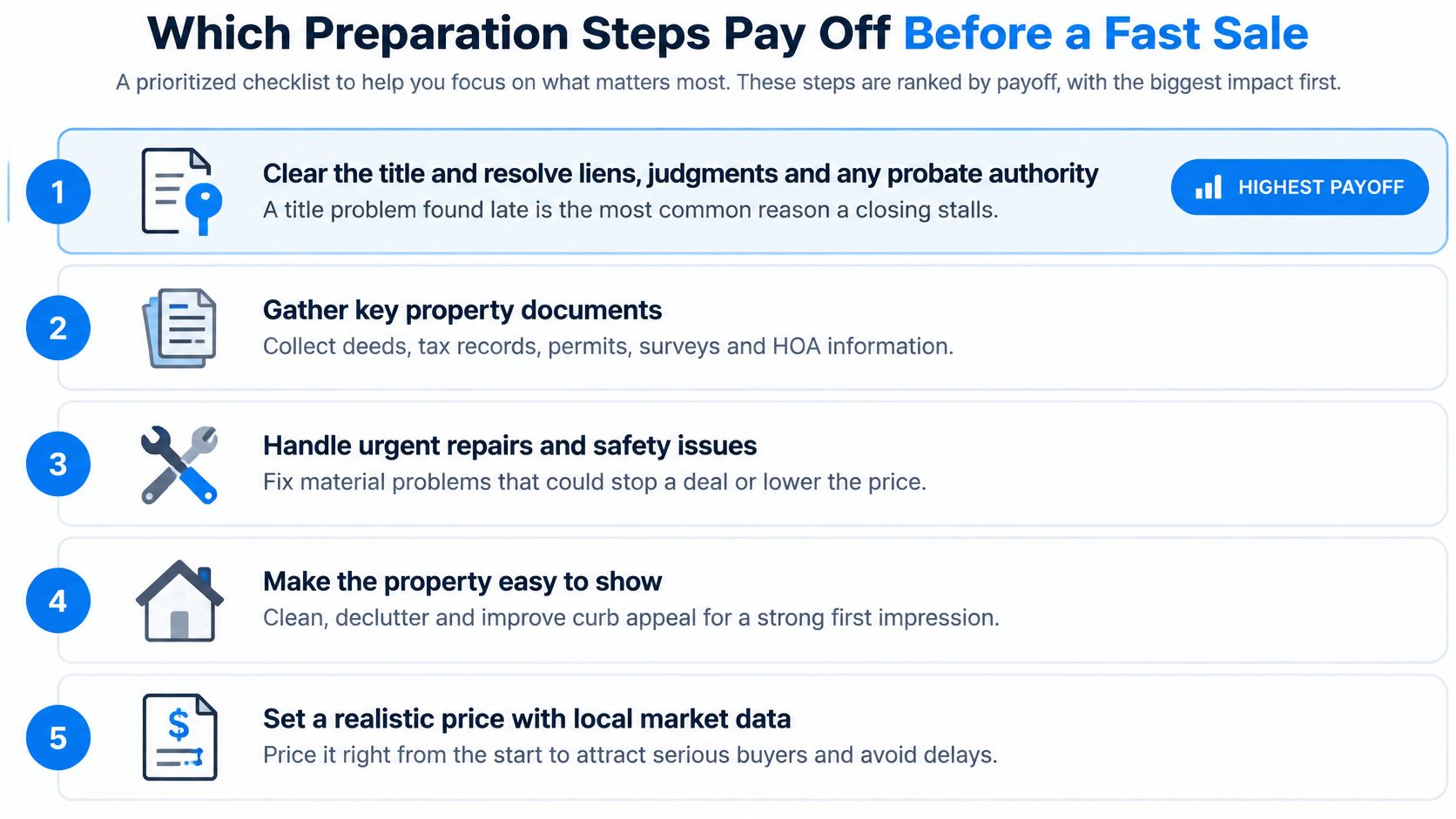
Title problems kill fast sales more often than ugly kitchens do. Start with anything that could prevent ownership from transferring, and treat cosmetic work as the last layer of preparation. In a hypothetical inherited-property sale, a buyer might be ready to close only for the title review to reveal that the person signing hasn't established estate authority. The buyer may terminate rather than wait for the issue to be resolved.
Preparation steps ranked by payoff for a fast sale
| Preparation step | Typical payoff | Cost or effort | Worth it for a fast sale? |
|---|---|---|---|
| Clear title and resolve liens | Protects the ability to transfer ownership | Document collection, payoff work, possible legal fees | Yes, start early |
| Disclose tenants, code issues and unpermitted work | Reduces surprises and renegotiation | Paperwork and professional guidance where needed | Yes |
| Provide access for a focused inspection | Helps establish condition before final negotiations | Scheduling and safe access | Yes |
| Deep clean and declutter | Improves photographs and presentation | Cleaning, disposal, and storage effort | Yes, with a controlled scope |
| Minor repairs buyers would use to negotiate | Removes obvious objections | Written quotes for targeted work | Yes, when inexpensive and straightforward |
| Full kitchen or bath renovation | Rarely recovers its cost inside a compressed sale timeline | Substantial spending and project management | Usually not for an urgent sale |
For inherited homes, have the title company or estate attorney confirm who can sign and what approvals are needed. For occupied rentals, assemble the lease, deposit records, payment history, and relevant notices. Don't promise vacant possession until you know you can deliver it lawfully.
Remove uncertainty before adding finishes
Provide written information about known defects, insurance claims, code notices, and unpermitted work. Arrange access to the attic, crawlspace, electrical panel, mechanical equipment, and other relevant areas without disturbing unsafe materials.
Treat condition, occupancy, and documentation as separate workstreams. A clean interior does not make a property transaction-ready.
As-is describes the repair arrangement, not permission to skip diligence or required disclosures. Use the applicable local forms and obtain legal advice when authority or possession is uncertain.
Keep cosmetic work tightly scoped
Fix a loose latch or dripping faucet when the repair is straightforward. A renovation project makes sense only when the expected sale proceeds justify the cost and delay.
For exterior presentation, compare the scope and scheduling of exterior cleaning options from Cultivate House Detailing before commissioning separate visits. Choose only work that addresses visible problems and is appropriate for the surfaces.
If you'll list publicly, book professional photographs after cleaning and arrange the rooms that will appear in them. Launch with complete information rather than replacing weak photographs after buyers have already dismissed the property.
Redfin's Market Tracker reinforces the distinction between asking price and achieved price. Judge every preparation cost by its effect on your realistic net, because money spent on finishes buyers won't pay for comes straight out of your proceeds.
Keep a concise property summary with supporting title documents, disclosures, repair quotes, and access instructions ready for review.
Negotiating Concessions and Counteroffers
Your negotiating strength comes from credible alternatives, documented condition, and your ability to meet the buyer's proposed schedule. An asking price alone doesn't establish strength. Before responding, translate every requested change into its effect on your net proceeds.
Control the whole concession package
Budget before negotiating. Use the repair quotes and selling-cost estimates in your net sheet to establish a concession allowance. A request that fits within that allowance may be acceptable even when it feels disappointing.
Choose the form of concession deliberately. A price reduction changes the purchase price. A closing-cost credit helps with eligible buyer expenses, subject to the transaction's financing limits. Seller-completed work creates scheduling and workmanship obligations. Don't promise a credit without confirming that the lender and closing agent can accommodate it.
Counter with supported amounts. If a buyer requests a roof allowance, compare the request with the written roofing scope. Separate necessary work from optional upgrades instead of splitting the difference automatically.
Set a response deadline and a private floor. Put the offer's expiration in writing, allowing enough time for review. Keep your minimum acceptable proceeds private, and evaluate competing terms against that figure.
Resolve the package in writing. Specify which repairs or credits are included and whether any inspection rights remain. If the revised offer meets your requirements, don't keep bargaining solely to recover an emotional loss against your original asking price.
Negotiation safeguard: Track the combined effect of the lower price, credits, seller-paid expenses, and delayed closing. A small concession in each category can become a substantial total reduction.
Protect the date as well as the price
A counteroffer with a better price may still leave you exposed if the buyer adds financing, sale-of-home, or broad inspection contingencies. Understand contingent versus pending status before treating an accepted offer as a completed sale.
Ask the closing agent to confirm that the amended terms work together. Check the possession date, document deadlines, and responsibility for any work. If timing is the reason you're selling quickly, don't exchange a workable closing date for a nominal price improvement.
Confirm the Offer Before You Sign
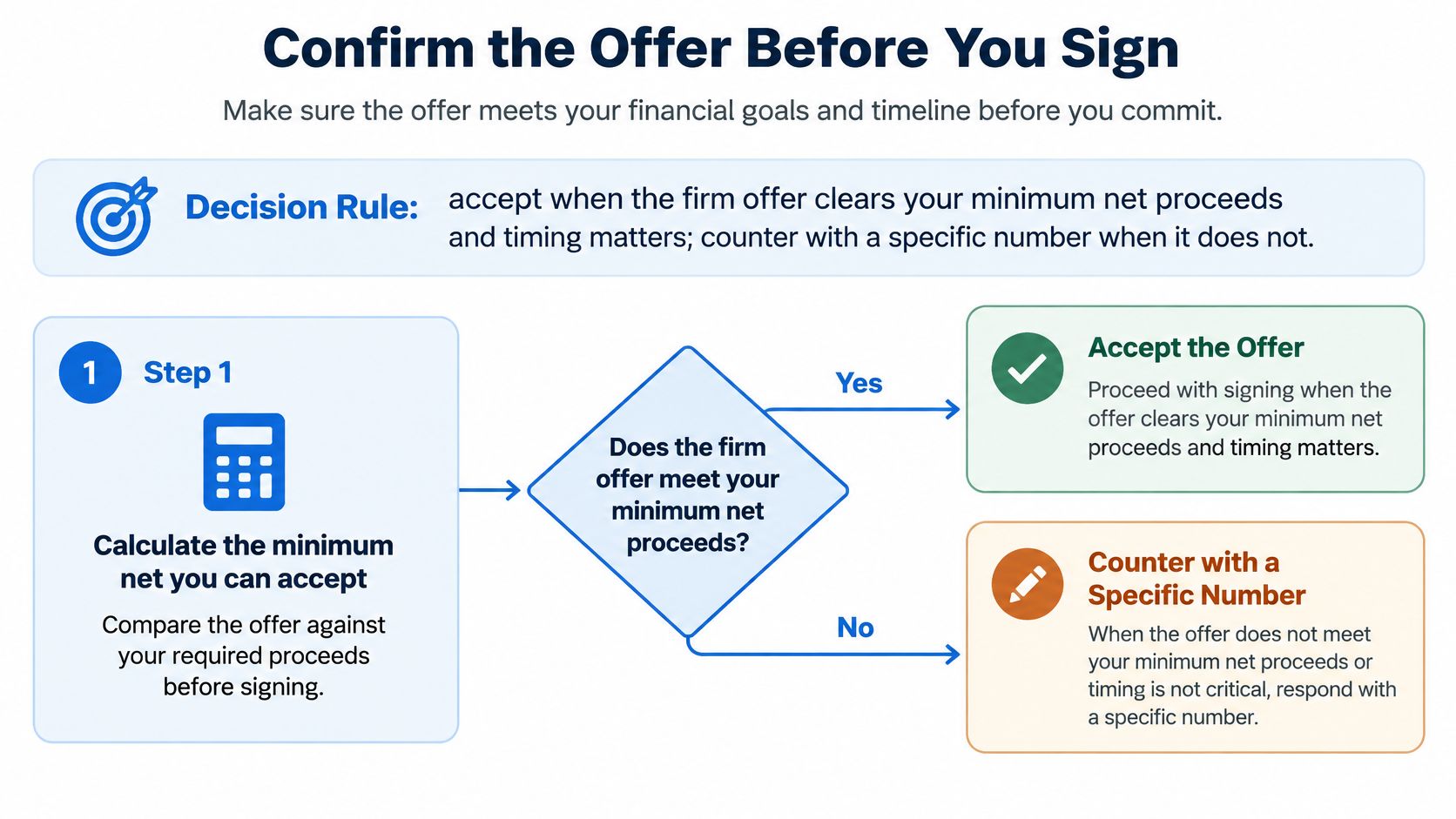
Accept when a firm offer clears your minimum net proceeds and timing matters; counter with a supported amount when it doesn't. A satisfactory price still needs an executable contract.
Calculate your cash requirement. Deduct loan payoff, seller closing expenses, outstanding obligations, and moving costs. Use current payoff information rather than the principal balance shown on an old statement.
Price the delay. Total the ownership expenses you'll continue paying while waiting. Include mortgage payments, insurance, utilities, taxes, maintenance, and any overlapping housing expense, while keeping financing cash flow distinct from equity.
Run independent checks. Review recent closed sales, active competing inventory, and title and condition findings. Compare remodeled properties with yours only after appropriate adjustments.
Test the alternative. Obtain a listing net estimate that includes achievable pricing and likely expenses. Reject assumptions that require every stage to go perfectly.
Verify execution. Review proof of funds, earnest money, closing date, inspection rights, assignment provisions, cancellation rights, and every deduction. Have the title company or your attorney explain unfamiliar terms.
Confirm authority and obligations. Make sure the contract's sellers, ownership records, required approvals, and possession terms align.
The FHFA's housing datasets and valuation guidance distinguish area appreciation measures from an individual property's value and caution that appraisals can reflect past prices. Neither an index nor an appraisal replaces current comparable sales and transaction-specific checks.
We offer a guaranteed cash close, and the average time from the property being sold to closing with Cyber Homes is 7–14 days. Requesting an offer creates no obligation to sell. Have our terms, timeline, and any deductions confirmed in writing, and rely on your closing date once it appears in the contract.
Cyber Homes buys houses as-is for cash, without seller repairs, showings, or commissions. Visit Cyber Homes to request a no-obligation offer, then compare it with a realistic listing net sheet before choosing the price and timeline that work for you.

Edited by
James Vasquez
Real Estate Investor & Land Specialist with 10+ years experience in residential flipping, vacant land investing, land wholesaling, and subdivision deals.
Disclaimer: The information provided is for educational purposes and does not constitute financial or legal advice. Always consult with licensed professionals before making investment decisions.