
5 Best Ways of Selling Your Home by Owner in Cincinnati, OH
The median Cincinnati home sold for $294,243 in July 2025, up 7.0% from the year before and about 34% below the national average, according to the NAR 2025 Profile of Home Buyers and Sellers. That combination sets the stakes: an affordable market keeps buyers moving, which rewards a sharp by-owner listing and punishes a hopeful one. The five routes below are compared on what they leave in your account after costs and after any payment to a buyer's agent, not on the commission headline. Last updated November 2026.

Which of the Five Ways Fits Your Cincinnati Sale
Five routes cover a Cincinnati sale without a listing agent: a full do-it-yourself sale, a flat-fee MLS listing, marketing the house yourself while an Ohio attorney or title company handles closing, a sale to a tenant or relative you already know, or an as-is cash offer. Fit depends on the work you will do, how fast you need the money, and what is left after by-owner costs and any payment you still make to a buyer's agent.
Five ways to sell a Cincinnati home without a listing agent
| Way to sell | Typical costs | Time to close | Effort | Best for |
|---|---|---|---|---|
| Full DIY FSBO | Photos, signage, lockbox, title or escrow fees | Market timeline once the home is priced to sell | High, with showings, screening and paperwork | Confident sellers with their own buyer network |
| Flat-fee MLS listing | Flat fee set by the broker, so get quotes | Market-driven, since the fee doesn't shorten the timeline | Medium | Sellers who want MLS exposure without full agent service |
| Owner sale with attorney or title company closing | Attorney or title fees, quoted locally | Same market timeline once you have a buyer | Medium | Sellers comfortable marketing who want closing handled |
| Sale to someone you know | Usually no listing costs, price negotiated | Set by your contract and the buyer's financing | Low to medium | Owners with a tenant, neighbor or family buyer |
| Cash as-is sale | No commission, price typically below retail | Set by the buyer, confirm in writing | Low | Owners who need speed or want to skip repairs |
Full DIY looks cheapest because there is no listing commission. You still buy the photography, the sign and the lockbox, and you take every showing, screening call and document. If the buyer has an agent, that payment is a separate local quote. Skip the headline savings and subtract those costs from the price you expect to clear.
A flat-fee MLS listing buys exposure, not labor. You pay a broker a set fee to publish the listing where buyers search, then you keep the showings and the negotiating. Ask two or three flat-fee brokers what the fee includes, whether photos cost extra, who answers inquiries, and whether any buyer-agent payment is your responsibility.
The test that matters: write down your expected net under each route before you choose one. A route that saves a commission and costs you weeks of showings plus a price cut isn't a saving at all.
Splitting the job at the closing table suits many Cincinnati owners. You market the house and set the price. An attorney or title company reviews the contract, orders title work, prepares the deed and runs the closing. Quote those fees locally before you treat this as cheaper than full representation.
Selling to someone you know drops most marketing and all of the showings. It does not drop the price question. Agree a number from closed sales and put the terms in writing so the title company can treat the file like any other sale. Many owner sales start with a buyer the seller already knew, which is a different job from finding a stranger.
A cash as-is sale trades price for certainty and speed. Cyber Homes buys houses in Cincinnati, Columbus, Cleveland and Toledo, reviews the property and local sales, then presents a no-obligation cash offer, usually within 24 hours, with the average time from the property being sold to closing running 7 to 14 days. The guide to selling a Cincinnati house as-is for cash covers how that walkthrough and paperwork differ from a retail listing.
National results show why the net matters more than the commission line. The National Association of REALTORS® reported that FSBO transactions were 5% of recent home sales, the lowest share its survey has recorded, while 91% of sellers used an agent. The median FSBO sale was $360,000 against $425,000 for agent-assisted sales, a $65,000 gap, and 60% of FSBO sellers already knew their buyer. That gap does not mean every owner loses money. It means an owner sale has to be run as a complete sales operation, with buyer-agent pay and closing costs counted before you call the commission a win. I'd hire the agent when you need broad exposure, a reprice the market will notice, or help negotiating with a buyer who brings their own representation.
Price From Closed Sales and Follow the Checklist
Price from three to five closed sales of homes like yours in your neighborhood, never from asking prices, then run the launch and the follow-up in order. Asking prices record what other sellers hope for. Closed sales record what buyers paid.
The sequence below is the one I'd work through on a Hamilton County sale, because each step feeds the next one and skipping any of them shows up later in the negotiation.
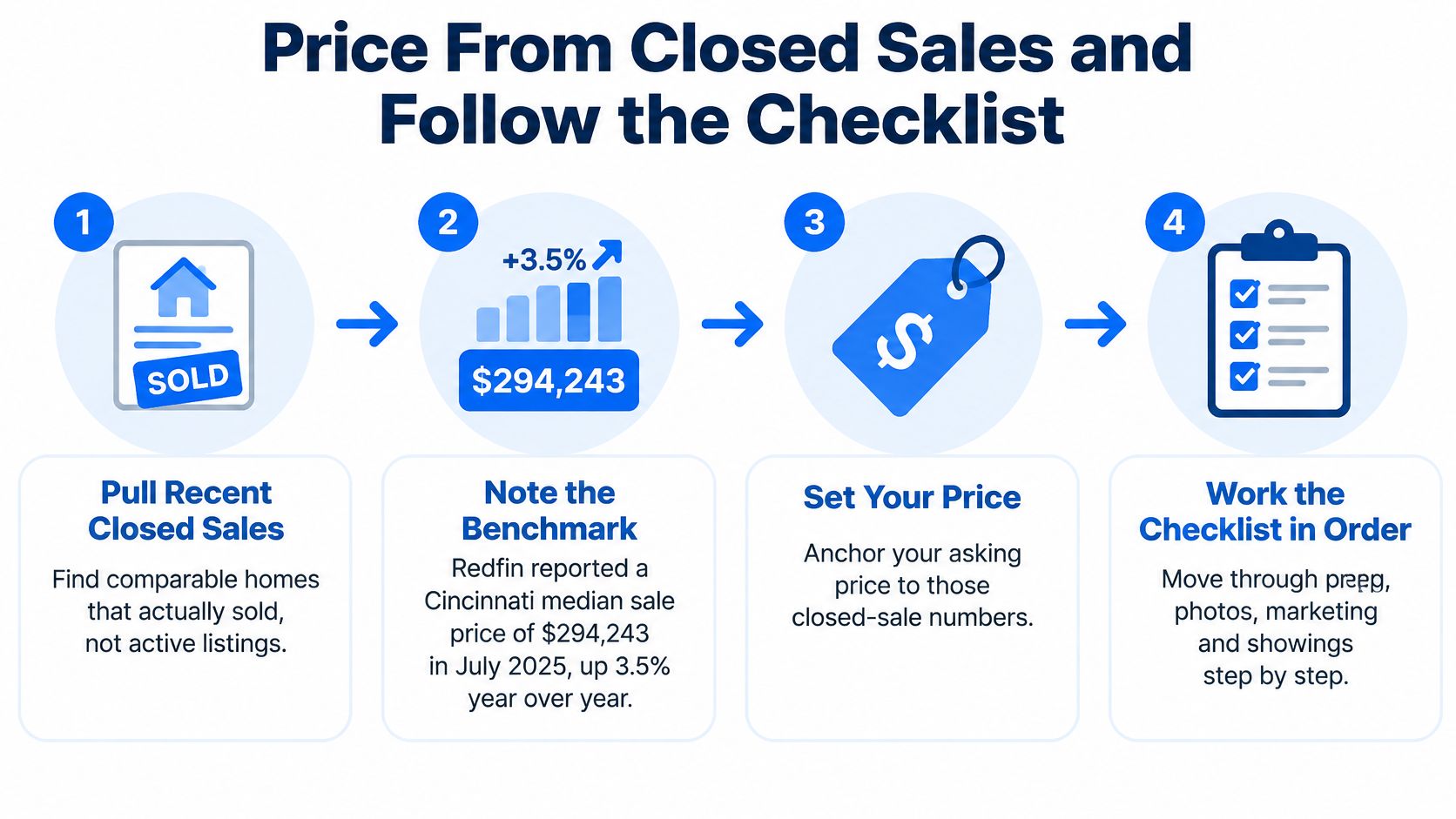
Current benchmarks show a median listing price near $297,000 against a median sold price near $283,000, roughly 44 median days on market and an average sale-to-list ratio around 99%, per Realtor.com's Cincinnati market data. That spread between asking and sold is the whole warning: an overpriced listing loses the buyers who would have paid before the seller notices anything is wrong. Trackers publish slightly different numbers month to month, so pull the current figures for your ZIP code before you commit to a price.
The seven steps from pricing to closing
- Pull three to five closed sales. Match neighborhood, property type, living area, condition, lot and sale date, and record the closing date, final price and any visible concessions. Active listings only tell you what sellers want.
- Adjust for what your house has and lacks. Renovations, deferred maintenance, parking, school-area differences and nearby nuisances move value here, and a comparable stops being comparable once two or three of those differ.
- Set a number you can defend. An overpriced listing burns its first weeks of exposure with the buyers most likely to pay full price, and a bargain listing hands equity to a stranger.
- Launch within two weeks. Professional photos, a measured floor plan, a room-by-room description, showing instructions and a screening process all need to exist before the first inquiry arrives. A thin launch is the most common by-owner mistake.
- Review the traffic every week. Track views, inquiries, showing volume and competing price cuts. Weak qualified activity calls for one decisive reduction, not three small ones that chase the market down.
- Write the net-proceeds sheet before you accept anything. Every cost that lands in your bank account gets its own line, including whatever you decide about the buyer's agent.
- Hand the contract to a professional. An Ohio attorney or title company coordinates the contract, payoff statements, the deed, prorations and recording. That review costs less than a mistake found at the closing table.
For the presentation side of the launch, this walkthrough covers the basics of showing a home while strangers are walking through it.
Your Real Net and Buyer-Agent Pay After the 2024 Rule Change
A by-owner sale pays off only when the commission you avoid is bigger than what you spend to sell, and you aren't required to pay a buyer's agent anything. Both halves of that sentence decide your number, so settle both before the sign goes in the yard.
Run the arithmetic on a $283,000 sale, the benchmark median sold price, against an assumed 5% commission you avoid: $14,150. That's the figure the ads quote. Now subtract professional photos and a measured floor plan, a flat-fee MLS listing if you use one, attorney or title closing costs, transfer and recording fees, title insurance where your contract requires it, prep repairs, and any amount you agree to contribute toward the buyer's agent. Net advantage is commission avoided minus those costs, and when the result is thin, a flat-fee listing or a cash offer can leave you more money and far less of your year.
Worked net-proceeds example for a Cincinnati by-owner sale
| Item | Example amount | How to get the real number |
|---|---|---|
| Sale price (benchmark median sold) | $283,000 | Cincinnati benchmark, replace with your own comparables |
| Commission avoided at an assumed 5% | $14,150 | Illustrative rate only, use your actual agent quote |
| Professional photos and measured floor plan | Quote needed | Ask two local photographers for a package price |
| Flat-fee MLS listing | Quote needed | Ask brokers who offer flat-fee listings in Hamilton County |
| Attorney or title company closing | Quote needed | Ask a Hamilton County closing provider |
| Transfer, conveyance and recording fees | Quote needed | Confirm with the Hamilton County Auditor and Recorder |
| Title insurance | Quote needed | Confirm the customary payer with the title company |
| Buyer-agent compensation or concession | $0 to a negotiated amount | Write it into the purchase contract |
| Estimated net advantage | Commission avoided minus all costs | Calculate once every quote is in |
The bottom row decides whether selling alone was worth the work, and it's the row most sellers never fill in. Your payoff matters just as much as your costs, because what reaches your account is the price minus costs and minus the loan balance. If you're unsure how much of the property you own, how loan-to-value ratio works explains the measure your lender uses before it releases the lien.
What changed on August 17, 2024
Since that date, an MLS participant working with a buyer must have a written buyer agreement in place before the buyer tours a home, including live virtual tours, according to the NAR explanation of written buyer agreements. The agreement has to state the agent's compensation as a specific amount, rate or objectively ascertainable method, say plainly that commissions are fully negotiable, and prevent the agent from collecting more than the buyer agreed to.
The practice changes also bar communicating an offer of buyer-agent compensation through the MLS, as the NAR broker-to-broker guidance sets out, while leaving you free to negotiate compensation outside the MLS. If you pay a buyer's broker through a listing broker, you must receive conspicuous written disclosure and approve the amount or rate first.
Practical rule: decide in writing whether your offer to a buyer's agent is $0, a flat fee or a percentage, then confirm that the agent's signed agreement with the buyer actually allows them to accept it.
Your three choices are declining to pay, negotiating a flat amount off-MLS, or writing a buyer concession into the purchase contract that the buyer may apply toward their agent's fee. Ask for the signed buyer agreement and the permitted amount before the first showing, not after the inspection response.
Local Paperwork, Disclosures and Closing Rules
A Cincinnati by-owner sale needs the Ohio residential property disclosure form, the federal lead-based paint disclosure if the house was built before 1978, and a closing agent who handles title, prorations and recording. Get those three right and most of the legal exposure is handled.
Start with the state form. Ohio requires a seller's disclosure of known material defects, and you complete it yourself, so walk the house room by room with the form in hand rather than filling it from memory. For a home built before 1978, federal law requires you to disclose known lead-based paint hazards and give the buyer the EPA pamphlet, and you keep the signed acknowledgment. Ask an Ohio attorney whether any exemption applies to your situation, particularly with an estate sale or a transfer between relatives.
Required paperwork and closing items for a Cincinnati by-owner sale
| Requirement | Who usually handles or pays | Confirm with |
|---|---|---|
| Ohio residential property disclosure form | Seller completes it | An Ohio attorney, to confirm any exemption |
| Lead-based paint disclosure for homes built before 1978 | Seller discloses and hands over the EPA pamphlet | The title company, on the form and the timing |
| Closing agent | Attorney or title company, both common | A local attorney or title company, on local custom |
| Owner's title insurance | Negotiated, so confirm the customary payer | The title company |
| Conveyance fee and deed recording | Negotiated, so confirm local custom | The Hamilton County Auditor and Recorder |
| Point-of-sale inspection or certificate | Owner arranges, if the property needs one | The City of Cincinnati or Hamilton County, for your address |
Closing practice here isn't uniform, so don't assume. Some Hamilton County transactions close through a title company with an attorney reviewing documents, others through an attorney's office with a title agency issuing the policy. Ask each provider who customarily pays owner's title insurance, the conveyance fee and recording, get the answer in writing with the quote, and compare two or three before you pick.
One item gets skipped constantly: the city certificate. Cincinnati and Hamilton County have code, zoning and occupancy requirements that can attach to a property transfer, especially where permits were pulled, violations were logged or a rental license is on record. Check your specific address with the city before you list, because a certificate you need late in the process can delay a closing that was otherwise ready. Any agent you deal with, whether they represent you or the buyer, can be checked through the Ohio Division of Real Estate and Professional Licensing license lookup.
Vet Buyers and Protect Your Earnest Money
The expensive miss in a by-owner sale is accepting an offer, including one from a buyer you already know, before the money is verified. A relative, a neighbor, or a tenant still needs the same screen as a stranger. Do that before you negotiate a single term. Then compare what you keep after your selling costs and any buyer-agent payment you agreed to pay, not the headline price.
A preapproval letter from a lender and proof of funds are different documents, and you want the right one. A financed buyer needs a lender's preapproval that names the loan type and the amount. A cash buyer needs a statement from a bank or brokerage showing funds available now. Neither document means the loan will fund or the cash will still be there at closing. An unverified buyer is how a signed contract turns into weeks you cannot get back, while the proceeds stay on paper.

Work from a written intake sheet on every offer with the following checks:
- Verify the funds. Name the lender, the loan program and the down payment, and call the loan officer to confirm the file exists.
- Identify every decision-maker and lienholder. A spouse, an heir or a trust trustee who isn't on the contract can stall a closing for weeks.
- List each contingency. Inspection, appraisal, financing, sale of another home, or a home-to-sell clause changes your risk and your timeline.
- Set hard deadlines. Earnest money deposit, inspection period, title commitment, loan approval and closing date all need dates, not intentions.
Run the net on that same sheet. Subtract your by-owner costs and any amount you will pay the buyer's agent. Two offers at the same contract price can leave different proceeds once those items and the contingencies are in. I would rather take the lower price with verified funds, a short contingency list, and a clear cancellation right than a higher number that falls apart after inspection.
Earnest money belongs with the title or escrow company named in the contract, never in your own account. Have an Ohio real estate attorney or an experienced title company review the purchase agreement and coordinate payoffs, deed preparation, prorations and possession. Keep copies of every disclosure, repair invoice, permit and inspection response in one folder.
Call before you wire: confirm wiring instructions by phone with the title company using a number you already have, never a number from an email. Wire fraud on real estate closings succeeds because the email looks exactly right.
Government-backed loans add their own rules. An FHA or VA appraisal can come in under the contract price or flag repairs the lender requires before closing, from peeling paint to a missing handrail. Set your repair ceiling and price reduction limit before responding to the inspection, so a repair list does not erase the net you thought you had. If someone approaches you with an unsolicited offer that requires an upfront fee or a signature on a document you haven't read, our breakdown of how we-buy-houses scam pitches work shows the pattern. Accept only when the net proceeds, timeline, and cancellation rights all hold up, and never hand over possession before closing without written legal advice.
Common Questions About Selling by Owner in Cincinnati
Is it legal to sell my Cincinnati home without a listing agent?
Yes. An owner can market and sell a property directly, though the contract, the disclosures and the closing still have to be done properly, so confirm the specifics with an Ohio attorney.
Do I need a real estate license to sell my own house?
Not for your own property. A license is required to sell property for someone else, and the Ohio Division of Real Estate and Professional Licensing lookup tells you whether anyone you deal with is licensed.
Can I sell by owner if I still have a mortgage?
Yes, provided the payoff is handled at the closing. Request a written payoff statement early and check for liens, judgments or a second mortgage that would have to be cleared.
Should I hire an attorney or use a title company?
Both are routine in Hamilton County. Compare fees, responsiveness and who runs the closing table, and get the scope of work in writing before you commit.
How long will a by-owner sale take?
It depends on your buyer's financing, the contingencies in the contract and how quickly the title work clears. Use market days-on-market as a planning figure for finding a buyer, then add the closing period.
Is the county's assessed value a good price guide?
No. Assessed value serves property taxation, not negotiation. Use recent closed sales of similar homes, adjusted for condition and features.
If I cancel my listing, do I still owe my agent?
That depends entirely on the termination and commission language in your listing agreement. Read the cancellation clause before you sign anything with a new buyer.
Decide How to Respond to a Notice of Default
A notice of default is a written notice from your lender or loan servicer stating that your mortgage payments are past due and the loan is in default. It usually arrives before any court action, and it doesn't by itself end your ownership, which means the weeks right after it arrives are the most valuable ones you'll get.
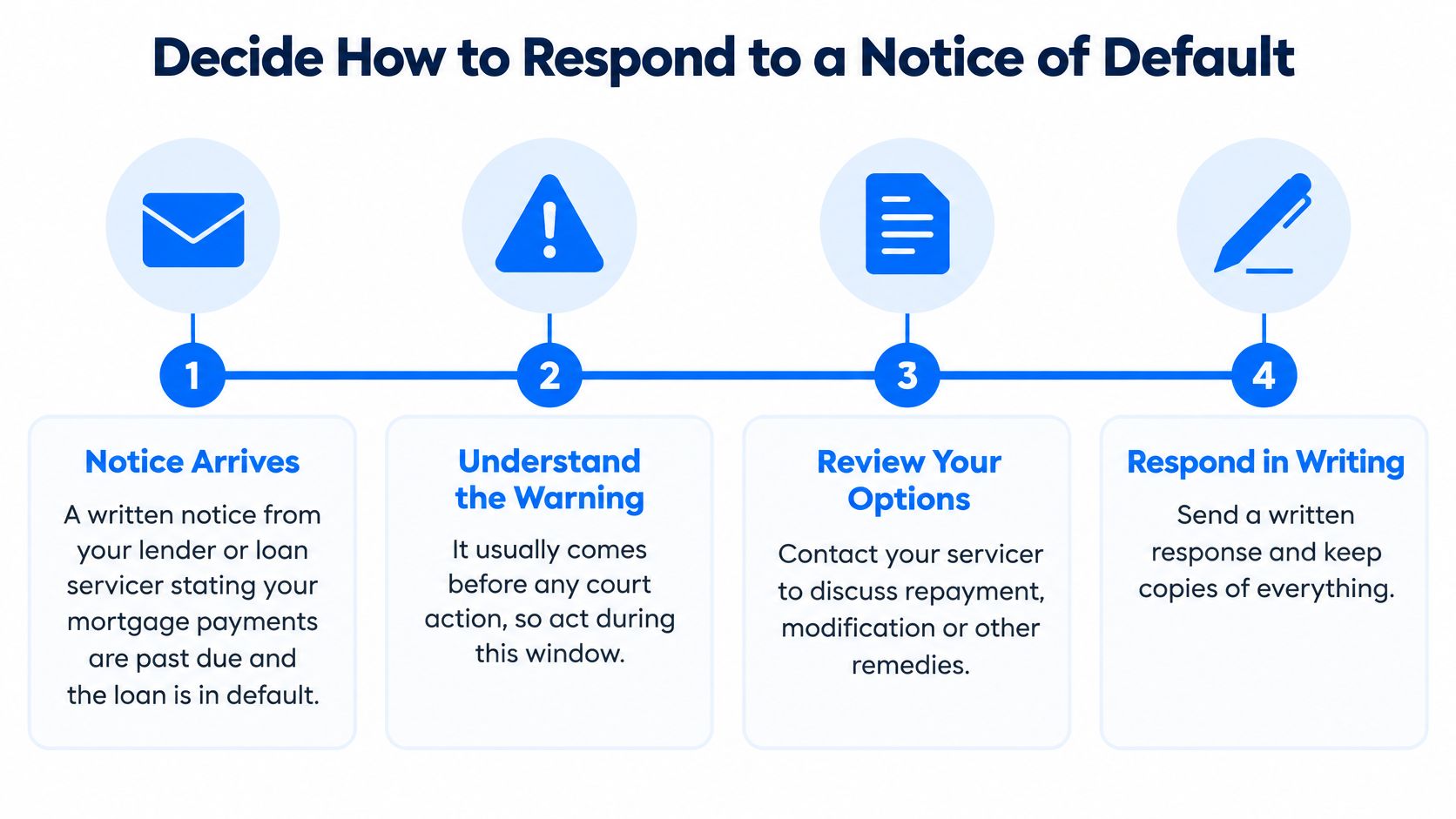
For a Cincinnati property, mortgage foreclosure is generally filed as a lawsuit in the Hamilton County Court of Common Pleas. Confirm the sequence with your servicer and an Ohio attorney, because the stages that follow the notice tend to run this way:
- The notice arrives. Read it for the cure amount and any deadline the servicer states, and keep the envelope.
- The lender files a foreclosure complaint. This is the court step, and it starts a case with a number you can track.
- You respond by the court's deadline. A response filed on time preserves defenses and negotiating room; a missed deadline gives both away.
- The court enters judgment. After judgment, the case moves toward a scheduled sale unless you resolve it.
- A sheriff's sale is scheduled. This is the point where a private sale has to be well underway or finished.
- The sale is confirmed and title transfers. After confirmation, the property is gone and the options narrow sharply.
Timing shifts with the loan, the court's calendar and whether a loss mitigation application is under review, so don't plan around a fixed number of days. Call the servicer and ask specifically about loss mitigation, a repayment plan or a loan modification, and put the request in writing. A HUD-approved housing counselor costs little or nothing and can review your budget with you, and an Ohio attorney or legal aid office can tell you what a response should say.
Then decide with the calendar in front of you. A by-owner sale runs on showings, inspections and a buyer's loan approval, so it needs weeks from the day you start, and starting early is the only version of this that works. A short sale or a deed in lieu of foreclosure both require the lender's approval and both take time to negotiate. Our walkthrough of how far behind on a mortgage you can be before foreclosure explains where the notice sits in that timeline.
With enough time, compare your by-owner net against a cash offer and choose on the numbers. With very little time, get legal advice before you sign anything, then look at a sale that doesn't depend on a buyer's loan. Requesting a cash offer from Cyber Homes creates no obligation for you to sell, which makes it a reasonable second number to hold next to your by-owner estimate.
If you want a second number to compare against your by-owner net, Cyber Homes buys houses in Cincinnati as-is, with no listings, no showings and no repairs needed from you, and we cover the closing costs. Tell us about the property and we'll review it with local sales, then present a no-obligation cash offer, usually within 24 hours, on a closing date you choose. Visit Cyber Homes to see what your house would bring as a cash sale before you decide how to sell it yourself.

Edited by
James Vasquez
Real Estate Investor & Land Specialist with 10+ years experience in residential flipping, vacant land investing, land wholesaling, and subdivision deals.
Disclaimer: The information provided is for educational purposes and does not constitute financial or legal advice. Always consult with licensed professionals before making investment decisions.