
How to Sell a House As-Is for Cash in Cincinnati, OH (2026)

You may be standing in a Cincinnati home you didn't expect to manage, with mail on the counter, a full garage, and a cash offer already in your inbox. That offer can look like relief. It can also arrive before you know who can legally sign, what the title shows, or what you'd keep after a mortgage, taxes, and liens are paid. Slowing down for those checks doesn't mean rejecting a cash sale. It means making the decision with numbers and documents instead of pressure.

Selling an Inherited Cincinnati Home As-Is
Updated for 2026. This guide is general information, not legal or tax advice. For learning how to sell a house as-is for cash in Cincinnati, OH (2026), start with a direct answer. Selling an inherited property in Cincinnati, Ohio is possible, but your first task is confirming who has legal authority to sell and whether probate or other title work is needed before closing.
Consider a common sequence. An adult child is named in a parent's will, lives out of state, and receives a cash offer for an inherited house in Cincinnati, Ohio. The house needs a roof, the basement has belongings from decades of living there, and a sibling wants to keep a few items before anything is signed. The buyer says repairs don't matter. That part may be true. It doesn't answer whether the child is yet the court-appointed executor, whether the sibling also owns an interest, or whether an old mortgage or tax balance will change the net proceeds.
What as-is changes and what it doesn't
As-is describes the negotiated condition of the property. You're agreeing that the buyer takes the home largely in its current state, without you completing the repair list first. It doesn't erase ownership questions, mortgage payoffs, liens, or duties to be truthful about known defects. It also doesn't authorize any family member to sign because they're helping.
That distinction protects everyone. An executor selling a house has a duty to the estate, not just to one buyer conversation. A trustee follows the trust. Multiple heirs who now own together need a shared, documented path. If you treat as-is as a shortcut past those roles, a title company may stop the closing later, when a delay costs more time and goodwill.
Practical rule: Don't judge an offer until you can name the signer, the debts against the property, and the estimated amount the estate or heirs would receive at closing.
Securing the home while you sort out authority
You don't need to renovate before you understand the estate. You do need to protect the property so its value and insurability don't slip while paperwork moves.
- Secure access: Change or control keys when appropriate, check locks, and remove valuables and sensitive documents first.
- Maintain insurance: Confirm coverage continues after the owner's death and tell the insurer if the home is vacant, because vacancy can change terms.
- Keep basic services stable: Manage utilities, lawn care, and mail so pipes, code issues, or missed tax notices don't create new problems.
- Photograph and inventory: Take dated photos of rooms and note personal property before relatives remove items, which helps prevent later disputes.
- Gather records in one file: Collect the deed, will or trust, death certificate, mortgage and tax records, HOA information if any, insurance papers, repair history, leases, permits, and notes on known defects.
Probate administration includes taking possession of and conserving the decedent's real and personal property, which is why an executor or administrator may need to handle the home before it can be sold, according to Cuyahoga County Probate Court estate guidance. Conserving doesn't mean remodeling. It means reasonable care while authority, debts, and beneficiaries are sorted out.
Some Cincinnati homes pass outside ordinary probate through a trust, survivorship ownership, or a transfer-on-death designation. Even then, you shouldn't assume no paperwork remains. A beneficiary may still need recorded confirmation documents before a title company can insure a sale. That topic matters enough that you'll want the deed and any estate filing reviewed together, rather than guessing from family memory.
By the end of this first stage, aim for a concise ownership-and-condition packet. It should show who owned the home, how it passed, who may act now, what is owed, what condition it's in, and what personal property still needs decisions. That packet makes valuations more honest and cash offers easier to compare.
Confirming Who Can Sell the Property
Start by reading the deed, not the offer. The deed tells you how the deceased owner held title, and that often determines your next step.
Common ways a Cincinnati home passes
- Will with an executor: The person named in a will isn't automatically the person with unrestricted power to convey real estate. Authority generally depends on probate court appointment, the estate documents, and title requirements for the specific sale.
- No will: If there's no will, an administrator may be appointed instead. Don't sign a listing or purchase contract until that appointment and its limits are clear.
- Living trust: If the home was transferred into a trust, the trustee typically acts under the trust terms. The title company will want trust documents or a certification that supports the trustee's authority.
- Joint ownership or survivorship: A surviving owner may already hold the interest, but recording and death documentation may still be needed to show clean title.
- Transfer-on-death designation: Ohio law permits certain owners to designate beneficiaries for real estate in a recorded affidavit, and title to the designated interest vests in the named beneficiary after death under Ohio's transfer-on-death designation statute.
- Multiple heirs directly: When several people inherit together, each person's interest can affect signing. A buyer or title company will typically require all required owners, or an authorized fiduciary, to execute the conveyance.
A helpful resource for the broader sequence is guidance on selling a home in probate, which you can read alongside advice from an Ohio estate attorney. Use it for orientation, not as a substitute for reviewing your court appointment.
Can you sell before probate is completely finished? Sometimes a probate house sale can move forward before the estate is fully closed, but timing depends on the estate structure, local law, court orders, and the fiduciary's role. Don't accept a blanket claim in either direction. Ask who must approve the sale, what documents must be recorded, and whether proceeds must stay in the estate until distribution.
Before anyone signs, build a short authority checklist. Confirm the deed, probate appointment if applicable, trust language, survivorship wording, and any transfer-on-death filing. Have the title company confirm the exact seller name for the contract and deed. That one check prevents a common delay where a well-meaning heir signs in a personal name when the estate or trust should be the seller.
Estimating Cincinnati Home Value and Cash Value
An inherited home rarely has one clean value. A tidy, financeable house and the same house with a failed furnace, roof wear, and rooms full of belongings will draw different buyers, even on the same street.
Use several layers instead of one headline number. Recent physically comparable sales give you the strongest starting point. A comparative market analysis from a qualified local professional can adjust for condition and layout. Online estimators are screening tools, not proof. An appraisal may be worth obtaining for estate, tax, or family-dispute purposes. Direct investor offers then show what a buyer will pay after accounting for risk and repairs.
For neighborhood context beyond the property itself, Cincinnati city relocation data from ReloMaps can help out-of-state heirs understand the area they're pricing into. Pair that context with property-specific evidence, since relocation interest doesn't fix a roof or clear a title issue.
Building a repair-adjusted value
Start with an as-repaired value based on comparable Cincinnati sales. Then subtract a conservative repair budget, holding and financing costs, resale risk, title or permit contingencies, and the buyer's required margin. That's the logic behind many cash offers, whether the buyer shows the math or not.
Ask for that math in plain terms. Which items drive the deduction, roof, structure, HVAC, electrical, plumbing, environmental concerns, code issues, or cosmetics? Which costs are contractor estimates and which are allowances? A buyer who can explain the assumptions gives you something to test. A buyer who only repeats a deadline does not.
Don't compare a cash offer with an aspirational list price. Compare it with the money you'd likely keep after the other route finishes.
Cincinnati market tracking has shown 47.6% of sales closing below list price, a warning against treating a hoped-for listing figure as guaranteed proceeds, in Zillow's Cincinnati housing market data. Get at least two independent valuations or broker opinions, collect contractor estimates for major systems, and request an itemized net sheet. Then stress-test the result for a repair overrun and a slower closing. If the cash offer still makes sense after that test, it's a stronger decision than one based on speed alone.
Choosing an Agent Listing or Cash Offer
Four routes can sound similar in a phone call, but they place risk in different places. The right choice depends on condition, timeline, privacy, and how much work the estate can realistically manage.
The visual below summarizes the four routes before you compare written numbers.
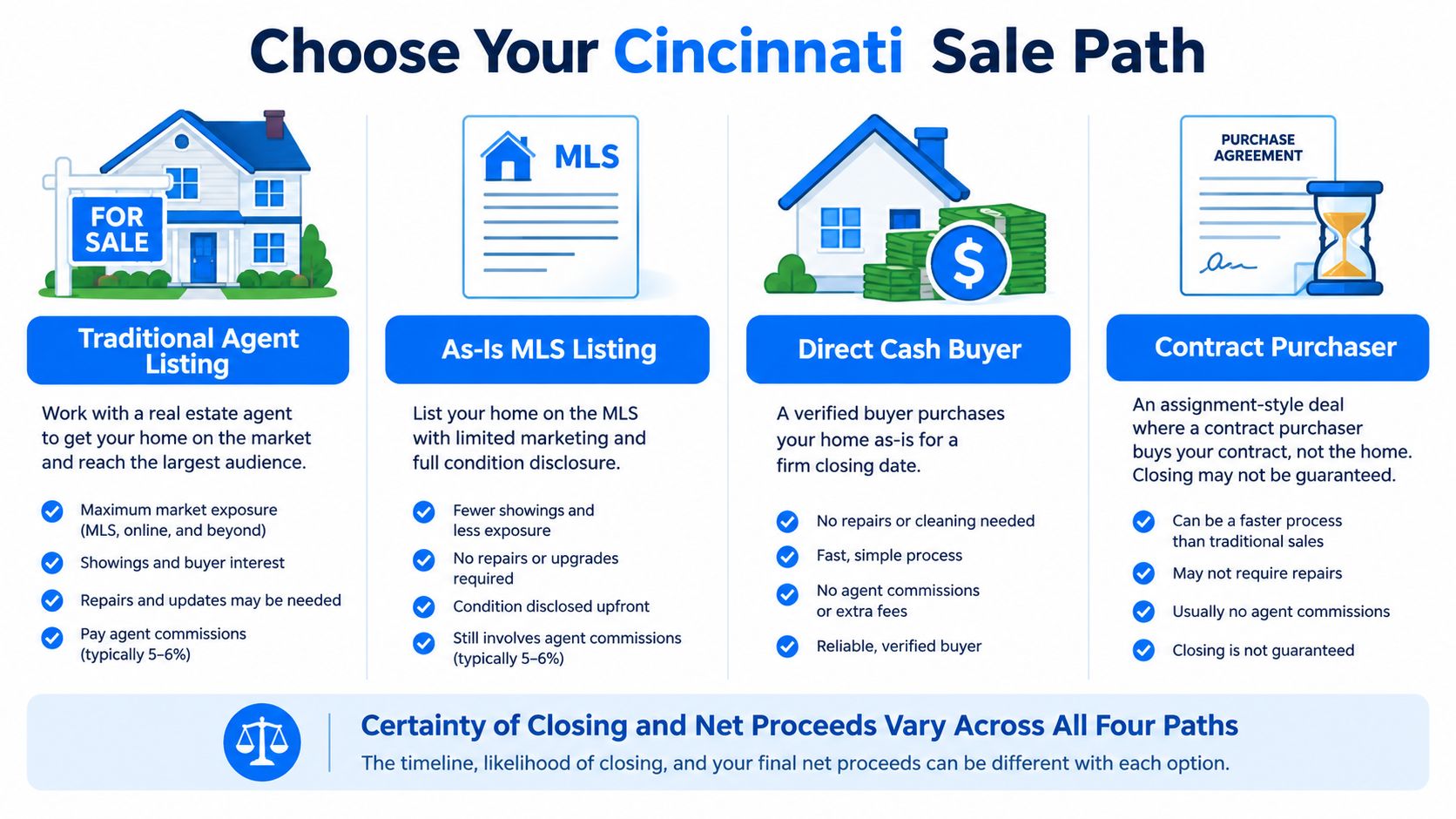
| Sale route | Best fit | Seller gives up or accepts | Evidence to request |
|---|---|---|---|
| Traditional agent listing | Habitable, financeable home when price matters most | Repairs, showings, commissions, and market time | Comparative analysis and estimated net sheet |
| As-is MLS listing | Home needs work but family wants broad exposure | Condition disclosed, possible concessions and inspection talks | Pricing plan for current condition |
| Direct cash buyer | Major repairs, clutter, deadline, or simple closing | Often lower headline price for convenience and certainty | Proof of funds, named title company, written terms |
| Contract purchaser | Seller accepts assignment risk knowingly | Buyer may assign contract rather than close personally | Assignment language and required wholesaler disclosure |
Cincinnati data helps you avoid extremes. Zillow reported an average home value of $295,167 as of December 31, 2025, a median sale price of $279,192, homes going pending in approximately 18 days, and 55.2% of sales closing below asking price, in Zillow's Cincinnati area home value report. That's an active market, not an instant one. A clean home may attract a conventional buyer fairly quickly, while a damaged or deadline-driven property may gain more from certainty than exposure.
Think in terms of a certainty premium. That's the amount you may give up for faster, more predictable execution. Calculate likely listing proceeds after commissions, repairs, cleaning, staging, concessions, carrying costs, and the risk of a failed financing or inspection. Then compare that net with the cash net. The gap, not the list price, is what you're paying for certainty.
If you compare companies, review resources such as cash buyer type companies in Ohio as a starting list, then verify each buyer directly. Cyber Homes is one company that buys houses for cash in current condition without seller commissions, and it should be evaluated with the same proof-of-funds and contract checks as any other buyer.
The short video below offers additional context on weighing speed against proceeds before you sign.
Handling Titles Liens Heirs and Ohio Disclosures
Most inherited-home delays aren't dramatic. They're paperwork problems discovered late. A missing will, an heir who can't be located, an old mortgage that was paid but never released properly, unpaid property taxes, a judgment lien, an HOA balance, or belongings no one has agreed how to handle can all pause a closing.
Clearing the title path
Ask a title company to run ownership, lien, judgment, tax, probate, and municipal-record searches early. Order a mortgage payoff statement rather than relying on a monthly balance. If the home has a mortgage, that loan is typically paid from proceeds at closing if there's enough equity, and the payoff figure determines what remains for the estate or heirs.
Transfer-on-death property needs special care. Ohio requires the transfer to be documented through an affidavit of confirmation filed with the county auditor and county recorder, accompanied by a certified copy of the death certificate, as described in Greene County transfer-on-death recording guidance. For a Hamilton County property, confirm the local filing steps with the title company, but expect that designation affidavit, death certificate, confirmation affidavit, and prior deed may all be reviewed.
When multiple heirs disagree about price, repairs, personal property, or timing, put decisions in writing. Use one shared document for offers received, expenses paid, and items removed. If communication breaks down, talk with an estate attorney or mediator before anyone signs competing documents. Written agreement is slower at first and usually faster at closing.
Ohio disclosure and wholesaler checks for 2026
Don't generalize disclosure rules. Ohio law preserves a seller's obligation to disclose known material physical-condition facts, and an Ohio licensee must disclose material facts known that a reasonably diligent buyer wouldn't discover, under Ohio Revised Code section 4735.67 on disclosure duties. An as-is clause generally concerns condition. It doesn't authorize concealing known material defects. If an agent is involved, ask which prescribed forms apply to your estate sale and keep signed copies.
Also ask a direct question. Is the company buying the home, or assigning the contract? Ohio's wholesaling law took effect March 2, 2026, and requires a wholesaler, before a binding residential contract, to provide a separate conspicuous disclosure in bold type of at least 12-point font, explain possible assignment for profit, and advise seeking legal or real-estate advice, according to Marshall Dennehey's summary of Ohio's wholesaling law. The seller must sign that disclosure before the contract becomes binding. Assignment isn't automatically fraudulent, but undisclosed assignment can affect timing, bargaining power, and who brings funds to closing.
Finally, verify proof of funds, confirm earnest money is held by an identified escrow or title company, and confirm wire instructions by telephone using a number you independently verify. Don't pay an upfront processing, inspection, or release fee without legal review.
Reviewing Taxes and Closing Costs
Taxes and costs are where a headline offer becomes real money. Before closing, the settlement statement may deduct mortgage payoff, property tax prorations or delinquencies, lien payoffs, title and escrow charges, recording costs, and any agreed credits. Ask for an estimated net sheet early so the estate isn't surprised at the table.
Inherited property taxes and basis
For federal tax purposes, inherited property generally starts with the property's fair market value at the decedent's date of death, which becomes the beneficiary's basis, and the IRS also recognizes an alternate valuation date when the estate files Form 706 and elects that method, as explained in IRS guidance on gifts and inheritances. People often call this a step-up in basis, although the value could also step down if the market fell.
Here's a simple hypothetical, not a prediction. Suppose the date-of-death value is documented at a certain amount and that becomes the heir's basis. If the home later sells for more than the adjusted basis, the difference may be taxable as a capital gain. If it sells soon after death for close to that documented value, the gain may be smaller because the basis started near the sale price. Selling expenses, improvements, depreciation, and other facts can change the result.
Keep the date-of-death valuation, appraisal if you obtain one, improvement records, and final closing statement together. Your tax professional will ask for them.
A reportable sale is generally reported on Schedule D and/or Form 8949. Estate or inheritance tax questions depend on the estate and applicable law, so don't assume there's no filing duty because the house sold as-is. A CPA or tax professional should review the sale when value is significant, basis is unclear, multiple heirs will report shares, or an estate return is involved.
Speed can also have a financial context beyond one family. ATTOM reported 1,237 Ohio properties with a foreclosure filing in June 2025, in ATTOM's Ohio real estate and foreclosure data. Those are statewide figures, not a Cincinnati count. They show why some estates can't ignore mortgage arrears, tax deadlines, or carrying costs while debating repairs.
Make a Documented Cincinnati Cash-Sale Decision
Picture an executor choosing between an as-is MLS listing and a direct cash purchase for a vacant Cincinnati home. The listing estimate looks higher. After roof work, cleanout, commissions, utilities, insurance, taxes, and a possible price reduction, the expected net narrows. The cash offer is lower, but the buyer names a title company, provides proof of funds, accepts the disclosed condition, and gives a closing date the estate can plan around. Neither answer is automatic. The documented net and the estate's risk tolerance decide.
Use current timing data as a reality check, not a promise. Realtor.com tracking reported median days on market reached 44 days in September 2026, up 12.8% year over year and still below a 61-day national median, in Realtor.com's September 2026 Cincinnati market report. A habitable home owned by a patient seller may justify testing the market. A severely damaged, tenant-occupied, or deadline-constrained inherited property may not.
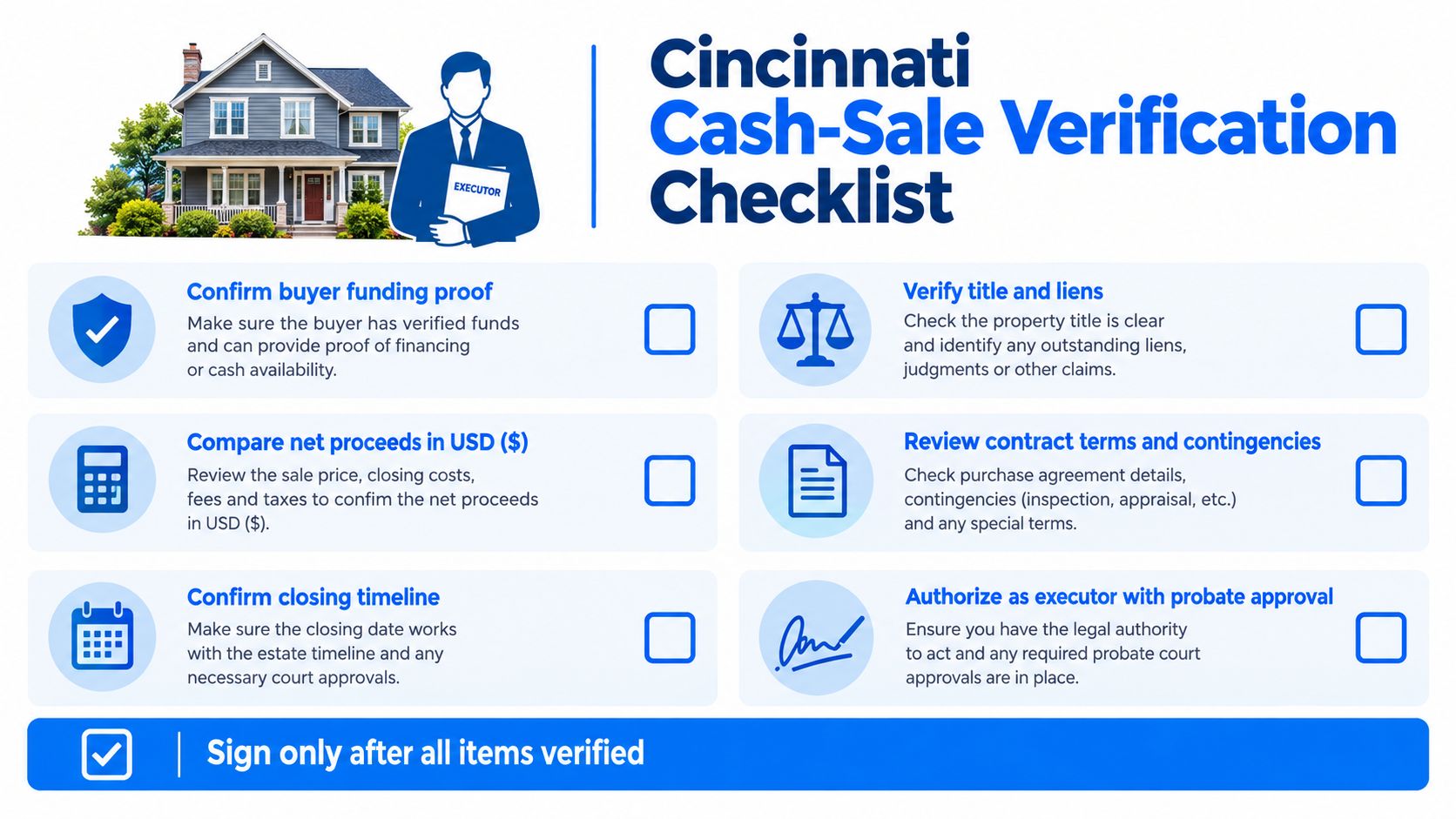
The checklist below can help an executor or out-of-state heir verify the essentials before signing.
Final verification before you sign
- Authority confirmed: Deed, court appointment or trust authority, death certificate, and correct seller name are documented.
- Title reviewed: Mortgage payoff, taxes, liens, judgments, HOA balances, and transfer-on-death or probate filings are identified.
- Buyer identified: Legal buyer name, proof of funds, earnest money holder, and whether the buyer will close or assign are in writing.
- Contract understood: Purchase price, fees, prorations, inspection rights, closing date, extension rights, cancellation rights, and default remedy are clear to a nonlawyer.
- Net compared: Cash net is compared with likely listing net after repairs, commissions, concessions, and carrying costs.
- Disclosures handled: Known material defects and any required Ohio wholesaler or agent disclosures are completed truthfully.
- Distribution planned: Proceeds will be handled and distributed according to the estate plan, trust, or probate requirements, with records preserved.
For a plain-language overview of the closing sequence, review the cash buying process and then ask the title company what differs for an estate seller. Out-of-state heirs can often review documents remotely and coordinate signing through the title company, but identity, notarization, and original-document requirements should be confirmed early. Keep all heirs on written updates so no one learns of a price change secondhand.
Your three nonnegotiables are simple. Verify estate authority. Resolve title and lien requirements. Obtain qualified tax guidance for your facts. If you can do those three things, a decision to sell your inherited house as-is, list it, or accept a cash offer on an inherited house becomes a documented choice rather than a rushed reaction.
If you're weighing a cash sale for an inherited Cincinnati home and want a written, no-obligation option to compare against listing, Cyber Homes can review the property in its current condition, explain its cash offer and closing timeline, and coordinate through a reputable title company. Bring your authority, title, and net proceeds questions to that conversation, compare the numbers in writing, and choose only if the terms fit the estate.
Edited by
James Vasquez
Real Estate Investor & Land Specialist with 10+ years experience in residential flipping, vacant land investing, land wholesaling, and subdivision deals.
Disclaimer: The information provided is for educational purposes and does not constitute financial or legal advice. Always consult with licensed professionals before making investment decisions.