
5 Best Ways of Selling Your Home by Owner in Memphis, TN

Only 5% of recent U.S. home sales were by owner, according to NAR's 2025 seller report, which makes the question bigger than avoiding commission. The five best ways of selling your home by owner in Memphis, TN are full DIY, flat-fee MLS, a privately marketed sale with professional closing help, a sale to someone you know, and an as-is cash sale. Choose based on what you'll keep, how much work you can handle, and when you need the money.
Last updated October 2026.

Which of the Five By-Owner Routes Fits Your Deadline and Condition
The cheapest route isn't necessarily the best one. A market-ready Memphis house with a flexible seller needs a different strategy from a tenant-occupied property with deferred maintenance and a firm moving date.
These routes also overlap. You can use a flat-fee MLS broker for exposure and retain an attorney for contract advice, or sell to your tenant while a title company coordinates closing.
Five by-owner routes compared on cost, time, effort and fit
| Route | Cost | Time to close | Effort | Best for |
|---|---|---|---|---|
| Full DIY sale | Potentially lowest marketing outlay; budget for photos, signs and professional closing help | Buyer search, then financing and contract deadlines | Highest, you handle pricing, marketing, showings and negotiation | Owners with buyer leads or a strong local network |
| Flat-fee MLS listing | Fixed broker fee plus selected extras and closing costs | Public marketing period followed by the buyer's closing schedule | Medium to high, you still manage inquiries and offers | Good-condition homes needing broad exposure |
| By-owner sale with attorney or title closing | Marketing expenses plus quoted legal and settlement fees | Buyer search followed by title clearance and contract deadlines | High marketing effort with professional closing coordination | Owners who want control without handling settlement themselves |
| Sale to someone you know | Limited marketing expense; document and closing costs remain | Can proceed directly to contract and buyer qualification | Low marketing effort, careful documentation | Tenant, neighbor or family buyers |
| Local cash buyer | No listing commission; compare the discounted offer and allocated closing costs | Set by the offer and signed contract | Low, an as-is purchase avoids retail preparation | Repairs, relocation, probate or tight deadlines |
Full DIY works when you can answer inquiries promptly, arrange access and defend your price with sold comparables. Taking phone pictures and posting a yard sign isn't a complete marketing plan. You're replacing a listing agent's work, not just removing their invoice.
With a flat-fee MLS listing, confirm the actual local MLS, listing term, photo allowance, edit charges, cancellation terms and any fee due at closing. A low advertised entry fee doesn't tell you what contract support or negotiation help you'll receive.
When less marketing makes sense
An attorney-assisted private sale suits an owner who can find a buyer but wants independent legal advice. A title company coordinates settlement, but don't assume its closing services include representing your interests in a contract dispute.
Selling to a tenant, neighbor or relative avoids a public buyer search. Keep the transaction businesslike: write down financing, inspection rights, included appliances, possession and what happens if the buyer can't close.
For a cash sale, you're usually trading some retail upside for less preparation and greater scheduling control. Cyber Homes buys in Memphis, Nashville and Knoxville; we review the property and local sales, then usually present a no-obligation offer within 24 hours. Our average time from the property being sold to closing is 7–14 days, with no commissions, seller repairs or closing costs charged to the seller.
Our Memphis as-is cash-sale guide explains that alternative for properties with repairs or difficult occupancy situations.
Choose a traditional agent listing when your house is market-ready, maximum market exposure matters most, and you don't have time to manage buyers.
Write down your latest acceptable closing date and your home's actual condition before choosing a route. Then compare written net estimates, not advertised savings.
Pricing From Recent Memphis Sales, Not Asking Prices
Set your asking price near an adjusted range of recent sold comparables. A citywide median, a neighbor's asking price and an automated estimate are context, nothing more. Memphis sits in Shelby County, and a countywide search gets you started; neighborhood-level comparisons do the actual valuing.
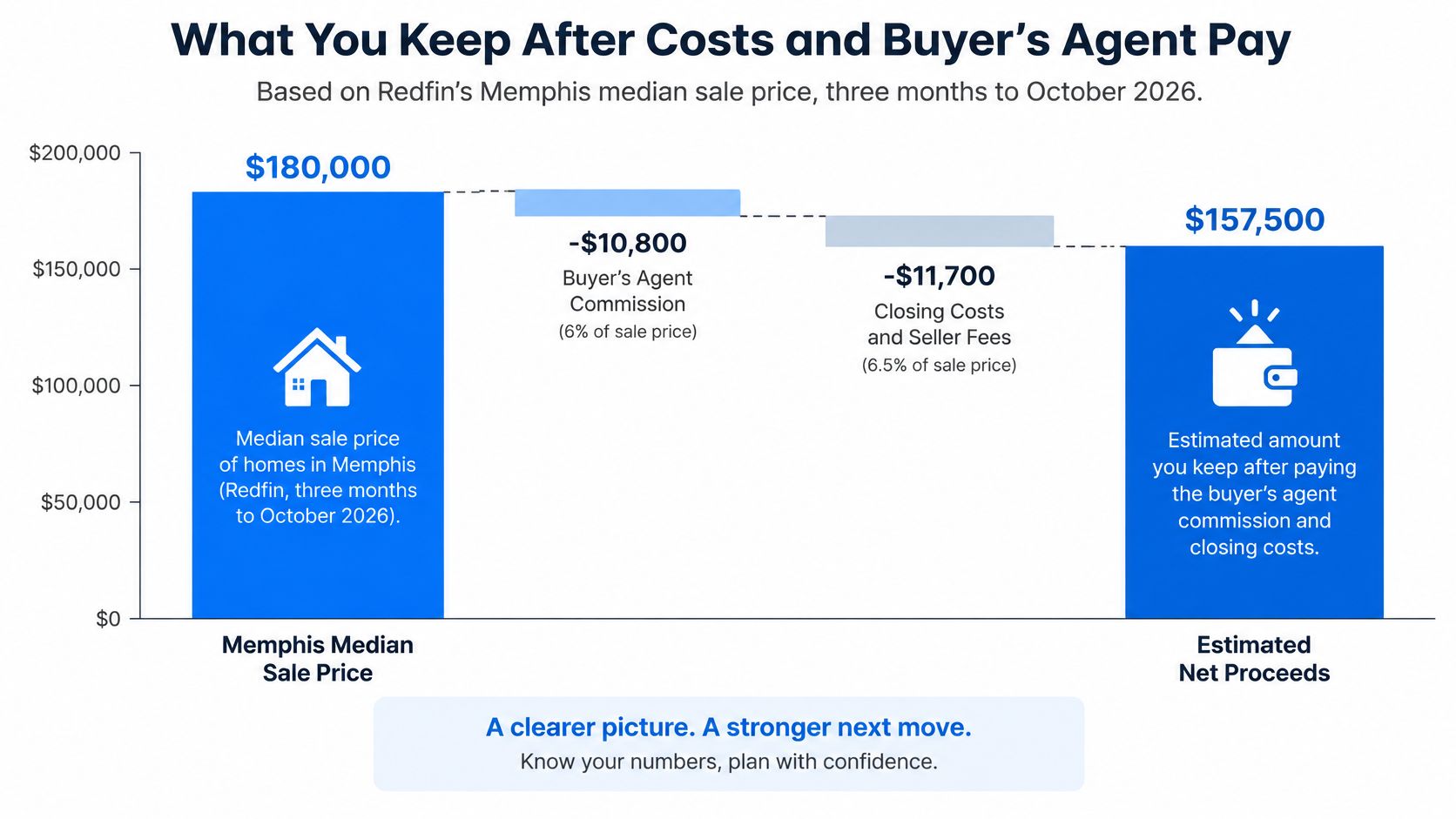
Redfin's Memphis housing-market report reported a median sale price of approximately $180,000 and $113 per square foot over the three months ending October 2026, with prices down 2.8% year over year and homes taking an average of 52 days to sell. Those figures describe the broader market. They won't value your particular house.
Everything downstream in your sale runs off this one number.
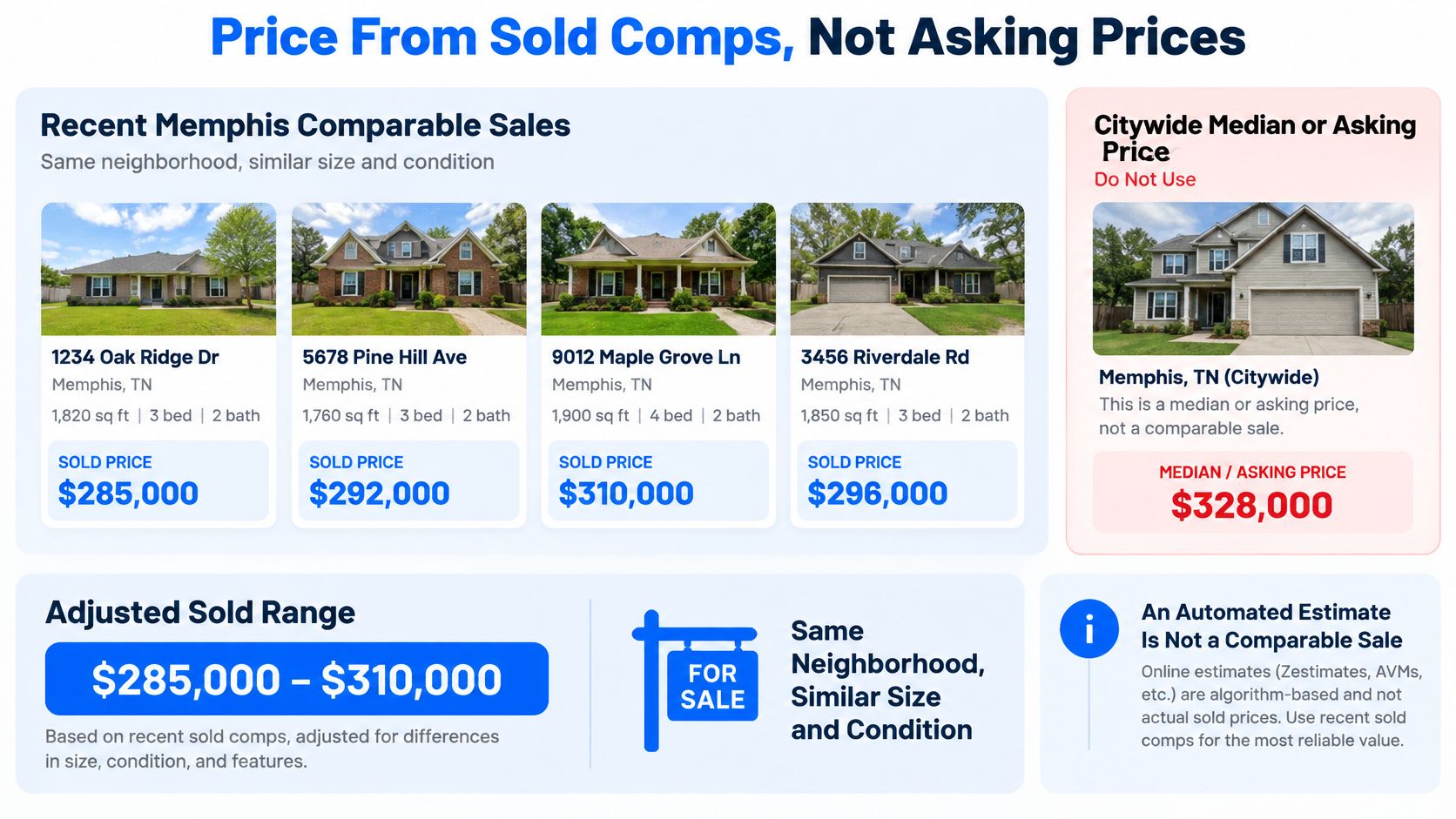
Build a defensible comparable-sale sheet
Start with nearby closed sales that share your property type, approximate living area, age, lot characteristics and renovation level. An updated home and an unrepaired property with the same bedroom count are different products, so keep them out of the same comparison.
For each candidate, record:
- Sale evidence: Closing date, final sale price and source of the information.
- Physical differences: Finished living area, bathrooms, garage, lot and layout.
- Condition differences: Roof, heating and cooling equipment, renovations and deferred maintenance.
- Location differences: Street setting, access and nearby land uses that affect comparability.
Use price per square foot as a reasonableness check. It misleads when you mix property types, finishes or homes of substantially different sizes. If your adjustments turn into guesswork, pay a local appraiser for a more defensible starting point before you commit to a list price.
Test demand without chasing every comment
Realtor.com's October 2026 Memphis market report reported 73 median days on market, compared with 63 nationally. That's a different measure and reporting window from Redfin's average, and both point the same direction: plan for patient marketing and buyers with room to negotiate.
Set a review date before launch. Track qualified inquiries, booked showings, feedback and written offers in Google Sheets rather than reacting to every online view.
Views without appointments point to weak photos, difficult access or a price mismatch. Showings without offers call for closer attention to condition, disclosures and competing inventory. Change one variable at a time so you can judge the response.
Price and certainty trade against each other. A financed buyer's lender orders an appraisal that can cap the loan below your contract price, a gap that exists in every market; REISR's explanation of bank-aligned appraisals for overseas buyers illustrates how appraisals anchor financing to evidence rather than the figure on a listing. For a deadline-driven sale, use this guide to selling quickly while evaluating market value to separate an achievable price from a hopeful one.
What You Keep After Costs and Buyer's Agent Pay
Your net equals the sale price minus selling expenses, concessions, agreed buyer-agent pay and debt payoffs. A commission you avoid isn't extra money added to the sale price, and you shouldn't subtract that avoided commission as an expense.
Use the Memphis median established above only as a worksheet starting point. The commission percentages below are hypothetical comparison assumptions, not standard Memphis rates or a promised saving.
Worked net example at the Memphis median price
| Line item | Amount or note |
|---|---|
| Sale price, using the Memphis median starting figure | $180,000, not a guaranteed price |
| Listing commission avoided at an illustrative 5–6% | $9,000–$10,800 comparison allowance, not an expense or a standard listing-side rate |
| Photos, marketing and flat-fee MLS | Enter written quotes for the services you choose |
| Attorney or title fees and recording | Enter the settlement quote; confirm recording charges with the Shelby County Register of Deeds |
| Realty transfer tax | Approximately $666 if the taxable basis is the example sale price; charge it to your side only if agreed |
| Buyer-agent pay, if offered | Enter the negotiated dollar amount or percentage |
| Concessions and repairs agreed | Enter signed credits and actual repair commitments |
| Net to you | $180,000 minus actual seller expenses, concessions, agreed compensation and mortgage or lien payoffs |
The Tennessee Department of Revenue's recordation-tax manual sets realty transfer tax at $0.37 per $100, generally on the greater of consideration or property value, producing approximately $666 on a $180,000 taxable transfer. State guidance places responsibility on the grantee, meaning the buyer, although the contract can allocate the expense differently.
Don't mistake the illustrative commission allowance for a typical listing-agent fee. If an agent quotes a listing-side fee separately from potential buyer-side compensation, compare those components separately against your FSBO costs.
This visual shows the distinction between a gross selling price and spendable proceeds.
What changed with buyer-agent compensation
Since August 17, 2024, under the NAR settlement practice changes, offers of buyer-agent compensation can't appear on the MLS, compensation remains negotiable, and participating agents generally need written buyer agreements before touring homes with buyers.
You can decline seller-funded compensation, offer a fixed amount, or negotiate a cap through the purchase agreement. Ask your flat-fee broker how to communicate any offer outside the MLS and have the closing professional document the obligation clearly.
Refusing payment can preserve your net, but a buyer who needs assistance may offer less or choose another property. Evaluate the complete offer instead of treating compensation as a stand-alone argument.
NAR's 2025 Profile of Home Buyers and Sellers highlights reported median prices of $360,000 for FSBO sales and $425,000 for agent-assisted sales. That national comparison doesn't establish what the same Memphis house would fetch through each route; property mix, seller circumstances and existing buyer relationships affect the results.
Net-proceeds test: A higher price isn't automatically a better offer if you pay more in repairs, concessions and carrying costs to reach closing.
Include taxes, insurance, utilities and financing costs through your realistic closing date. Then compare FSBO, an agent's proposal and a cash offer using the same expense categories.
Tennessee Paperwork and Who Handles Closing
Paperwork mistakes are the cheapest way to lose a Memphis buyer late in the deal, so complete the Tennessee property disclosure before negotiations and pull federal lead-paint forms for applicable older homes. An as-is price still carries the same disclosure duty.
The Residential Property Disclosure Act, Tenn. Code Ann. §§ 66-5-201–210, requires most residential sellers to disclose known structural and mechanical defects, environmental hazards, drainage problems, encroachments and unpermitted work. Skipping a known defect can support contract cancellation or legal action. Filling out the form early also lets you answer buyer questions about the roof, foundation or additions on paper rather than under pressure after an offer arrives.
Documents and closing steps by requirement
| Document or step | Applies to | Who handles it |
|---|---|---|
| Tennessee residential property disclosure statement | Most residential sales, subject to applicable exceptions | Seller completes before contract negotiations |
| Federal lead-based paint disclosure and pamphlet | Applicable older homes under the federal rule | Seller supplies information; buyer receives an inspection opportunity |
| Purchase contract with contingencies | Every sale should have a written agreement | Attorney reviews legal terms; title company coordinates settlement requirements |
| Title search, payoff letters and deed recording | Every closing needs ownership and payoff review | Title company or attorney coordinates |
| Point-of-sale inspection or certificate | Confirm property-specific requirements with the City of Memphis | Seller checks before listing |
For homes built before 1978, the state's guidance on the federal lead rule calls for disclosure of known lead information and available records, lead-specific contract language and the required pamphlet, plus an inspection window of up to 10 days unless otherwise agreed. A private or as-is sale doesn't remove that obligation.
Build a property file containing the deed, ownership information, available survey, permits, repair invoices, insurance-claim records, leases and lead records. For an inherited home, have counsel confirm who has authority to sign before you promise a closing date.
Put someone in charge of closing
A Tennessee title company or real-estate attorney can coordinate settlement. Hire an attorney when you need advice about legal exposure, estate authority, divorce orders, seller financing or unusual contract language, and don't assume routine title services provide that representation.
Use these controls:
- Disclose facts in writing. Don't mark an unknown condition as sound.
- Set contract responsibilities. Specify inspections, appraisal conditions, repairs, possession and deadlines.
- Order title and payoff work early. Ownership disputes or unreleased liens can prevent timely closing.
- Review the settlement statement. Check credits, prorations and every allocated charge.
- Release possession after authorization. Wait for the closing agent to confirm funding and completion requirements.
Memphis custom splits closing costs differently from deal to deal, so don't rely on what a buyer says is normal. Have the contract state who pays the owner's policy, lender's policy and recording costs.
Confirm recording questions with the Shelby County Register of Deeds, property-specific inspection or certificate requirements with the City of Memphis, and real-estate licensing questions with the Tennessee Real Estate Commission.
Vetting Buyers and Protecting Your Earnest Money
Accepting the highest headline offer without checking the buyer is a common FSBO mistake. Rank offers by their likelihood of closing and their likely net, not price alone.
Start with the documents behind the offer, not the buyer's assurances.
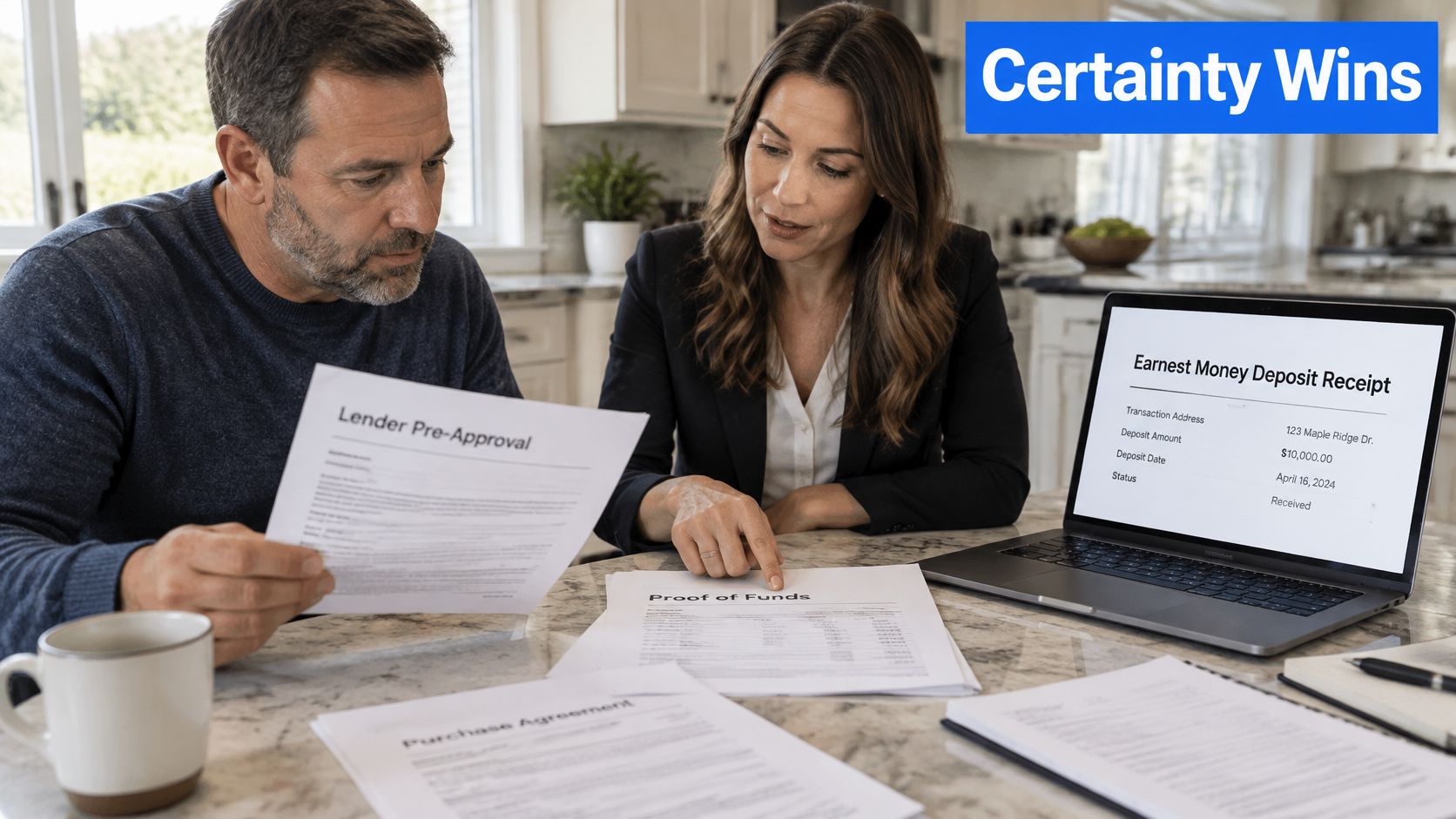
Check financing before negotiating details
A lender's preapproval is more useful than a casual affordability estimate, but it isn't a guaranteed loan. Ask whether the lender reviewed supporting income, asset and credit documents, whether underwriting has occurred, and what conditions remain.
For a cash offer, request proof of funds that reasonably matches the purchase obligation. A recent financial statement or financial-institution letter should identify the buyer or purchasing entity; buyers can redact unrelated account details.
Verify questionable documents through independently obtained contact information. A financing screenshot with no account holder or a letter from an unverifiable source isn't enough.
FHA and VA buyers can be dependable purchasers, so don't dismiss them because of the loan program. Their appraisals can identify property conditions requiring correction, and any financed transaction can encounter a low valuation. Ask who pays for required work and what happens if the buyer can't cover an appraisal gap.
Protect the deposit and the people involved
Have earnest money delivered to the title company or designated escrow holder, not your personal account. Write the deposit deadline, refund conditions, default provisions and dispute process into the agreement.
For showings, take practical precautions:
- Control access: Schedule appointments and verify who is attending.
- Avoid isolation: Arrange for another adult to be present when appropriate.
- Secure private information: Remove bank statements, prescriptions, valuables and spare keys.
- Keep records: Save communications, showing details and signed changes.
Pressure to bypass independent advice, close outside agreed procedures or proceed without financial evidence deserves scrutiny. Review these cash-buyer scam warning signs before signing an unfamiliar purchase agreement.
The following video provides additional context for evaluating the selling process.
Wire fraud requires a separate safeguard. Never accept changed wiring instructions by email alone, call the title company using a number you independently verified, and ask the closing agent to confirm funding in writing.
A buyer's willingness to skip an inspection isn't proof of reliability. Read the cancellation, assignment and price-adjustment provisions before treating the offer as firm.
Compare each offer's financing conditions, repair exposure, appraisal provisions, possession terms and closing date. A modestly lower offer can be the stronger choice when the buyer has documented funds and fewer unresolved conditions.
Your Step-by-Step Path From Pricing to Closing
A successful FSBO sale needs a sequence and a complete file, not a collection of verbal promises. Give every task an owner and a deadline so the buyer, lender and closing agent know what happens next.
Use this process as a working checklist.
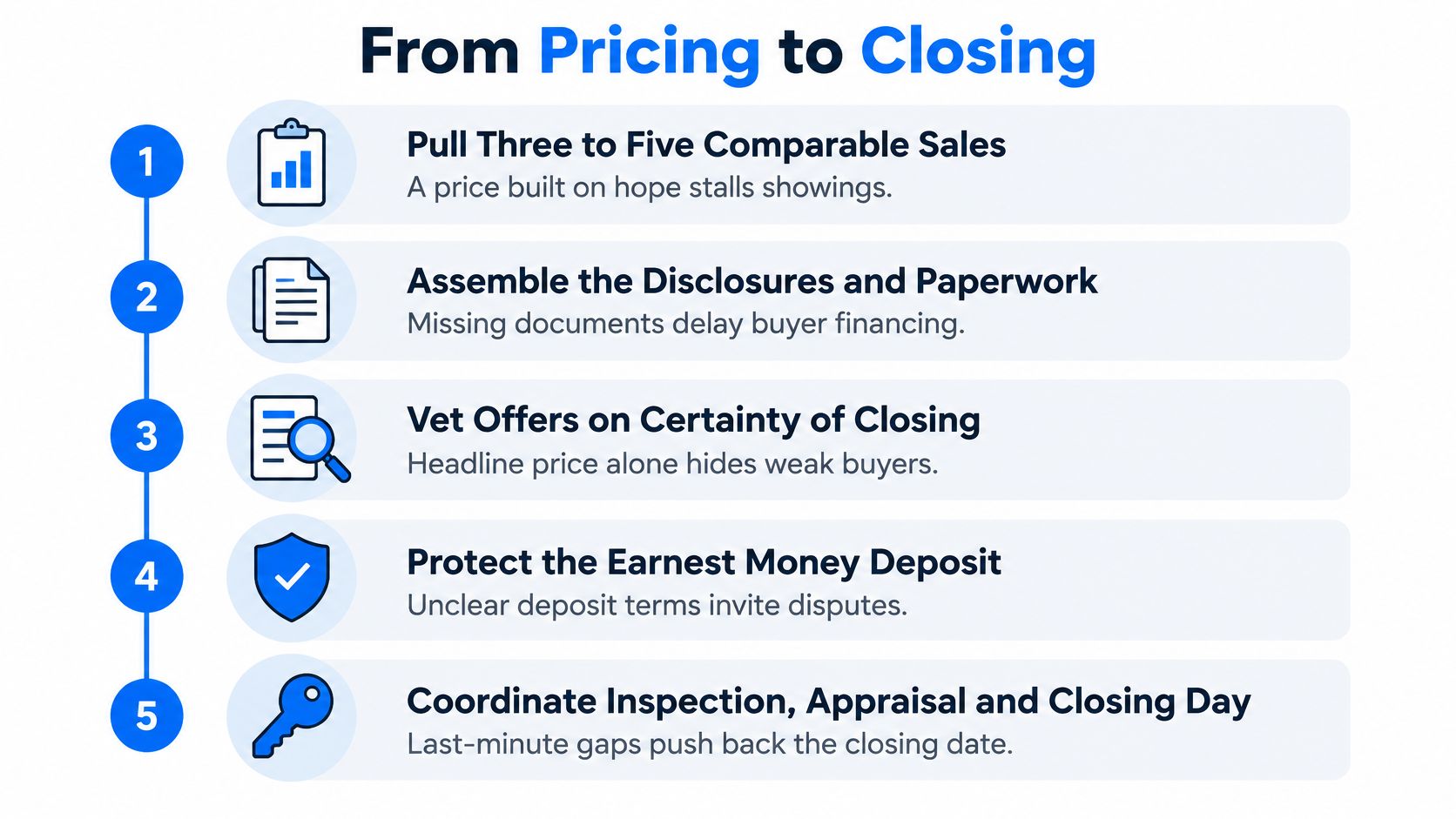
Build the sale file in order
Pull comparable sales and set a range. Record why each property is relevant. Don't substitute unsold competition for evidence of completed transactions.
Assemble ownership and condition documents. Complete disclosures while you have time to locate records. Don't discover missing signatures after accepting an offer.
Choose repairs or an as-is price. Obtain contractor estimates before committing to work. Avoid renovations that consume your available cash without a clear selling benefit.
Prepare complete listing materials. Include professional-quality photographs, a floor plan when practical, room dimensions and verified tax information. Label utility history as your household's usage, not a promise of the buyer's future bills.
Launch through your chosen channels. Keep the price, description and contact details consistent. Log every inquiry and showing in a single spreadsheet.
Review activity on a scheduled date. Separate unqualified messages from real buyer interest. Don't change photos, price and terms simultaneously.
Screen written offers. Verify financing evidence and the named escrow holder. A friendly conversation isn't a substitute for documented purchasing ability.
Negotiate the complete package. Put concessions, repairs, compensation and possession terms in writing. Avoid agreeing to a credit without checking its effect on your net.
Obtain professional contract review. Calendar inspection, appraisal and financing deadlines immediately. Don't assume the closing agent will negotiate an unfavorable clause for you.
Complete settlement and transfer possession. Confirm title clearance, payoff amounts, prorations and funding. Don't hand over keys because the buyer says their wire has been sent.
Know what completion looks like
Your finished file should contain signed disclosures, the purchase agreement, every amendment, the settlement statement and the closing agent's confirmation of completion. Keep copies somewhere accessible after you move.
A fixed closing date helps everyone plan, but it isn't proof that the transaction has funded. Coordinate moving arrangements around the contract's possession terms and the closing agent's instructions.
Frequently Asked Questions About Selling Without an Agent in Memphis
You can sell without a listing agent, but you still need a documented transaction and a reliable closing process. These are the practical questions to resolve before advertising.
Is selling by owner legal in Tennessee?
Yes, homeowners can sell their own property without hiring a listing agent. That doesn't authorize you to act as an unlicensed broker for someone else, and complex ownership issues deserve legal review.
Does selling as-is remove my disclosure duty?
No. As-is describes the repair arrangement, not permission to hide known problems; have an attorney confirm any applicable statutory exception or permitted alternative documentation.
Who pays transfer tax on a Memphis sale?
State guidance assigns responsibility to the buyer as grantee, but your contract can allocate the cost differently. Make sure the closing statement follows the signed agreement.
Does my home need lead-paint paperwork?
Check its construction date against the federal rule and gather any available lead reports. Don't assume a renovation or an as-is contract removes the requirement.
Should I hold earnest money myself?
No, use the designated title company or escrow holder. Keeping the funds separate gives both parties a documented deposit and a defined process if a dispute arises.
How long will my Memphis house take to sell?
Your neighborhood, condition, access and financing determine your actual schedule. Allow separately for finding a buyer and completing inspections, title work and any loan process.
When should I change my asking price?
Set a written review trigger before launch and inspect the quality of buyer activity. If qualified buyers repeatedly reject the same condition or price issue, address that evidence rather than waiting indefinitely.
Decision rule: Choose the route that meets your deadline with an acceptable net, not the route with the most attractive headline price.
If your by-owner net looks thin or your deadline leaves little room for repairs and showings, visit Cyber Homes to request a no-obligation cash offer for your Memphis property. Compare the written offer with your FSBO net and choose the closing timeline that fits your move; submitting information doesn't obligate you to sell or us to purchase.

Edited by
James Vasquez
Real Estate Investor & Land Specialist with 10+ years experience in residential flipping, vacant land investing, land wholesaling, and subdivision deals.
Disclaimer: The information provided is for educational purposes and does not constitute financial or legal advice. Always consult with licensed professionals before making investment decisions.