
Top 10 Companies That Buy Houses for Cash in Indianapolis, IN

If you’re looking up Top 10 Companies that buy houses for cash in Indianapolis, IN, you’re probably not doing it for fun. You’re dealing with a deadline. Maybe the house needs work you don’t want to fund. Maybe you inherited a property and live out of state. Maybe you’re behind on payments, handling a divorce, or trying to unload a rental that has become a headache.
That kind of pressure makes people vulnerable to bad deals.
A lot of sellers start with a “top 10” list and stop there. That’s a mistake. A list can help you find names to call, but it won’t protect you from a buyer who ties up your property, changes the price late, or never had the money to close in the first place. You need a short list and a vetting process. That’s what keeps you safe.
In Indianapolis, the cash-buyer space includes both marketplace platforms and direct buyers. iBuyer.com’s overview of Indianapolis cash buyers notes that marketplace-style options like iBuyer.com may generate multiple offers, while direct buyers such as Simple Quarters and Ben Buys Indy Houses advertise direct purchases and no seller-paid closing costs. That matters because the company type affects speed, certainty, and how much back-and-forth you’ll deal with.
How to Navigate the Indianapolis Cash Home Buyer Market
A seller in Indianapolis usually lands here after something has already gone sideways. The roof is bad. The tenant trashed the place. Probate is dragging on. A job transfer is forcing a move before the house is ready for photos, showings, and buyer inspections. In that situation, a fast cash offer can make sense. But speed without due diligence is how people get burned.
The first thing to understand is simple. Not every cash buyer is the same business wearing a different logo. Some are direct buyers using their own money or committed capital. Some are marketplaces collecting your lead and circulating it to buyers. Some are wholesalers trying to put a property under contract and assign that contract to someone else.
The list is only the starting point
Many individuals seeking the Top 10 Companies that buy houses for cash in Indianapolis, IN, usually want one answer. They want someone to say, “Call these three, avoid the rest.” I get it. But the smarter move is to use any top-10 list as a filtering tool, not a final decision.
Here’s the practical approach:
- Start with names, not trust: A company appearing on a list doesn’t mean it’s right for your situation.
- Match the buyer model to your problem: If your house is distressed and your timeline is tight, certainty matters more than theoretical price competition.
- Assume you’ll need to verify everything: Reviews, business registration, proof of funds, title-company process, and contract language.
Practical rule: Don’t choose a cash buyer because their website looks polished. Choose them because they can prove they’ll close on the terms they offered.
Know what you’re trying to solve
Before you call anyone, decide what matters most to you:
| Priority | What to look for |
|---|---|
| Need to close fast | Direct buyers with a simple process and clear closing steps |
| Want less hassle | True as-is purchase, no repairs, no showings, no cleaning |
| Want price competition | Marketplace platforms that can generate more than one offer |
| Need certainty | Proof of funds, clean contract terms, title-company closing |
If you know your priority, the rest gets easier. If you don’t, you’ll get talked into someone else’s preferred process.
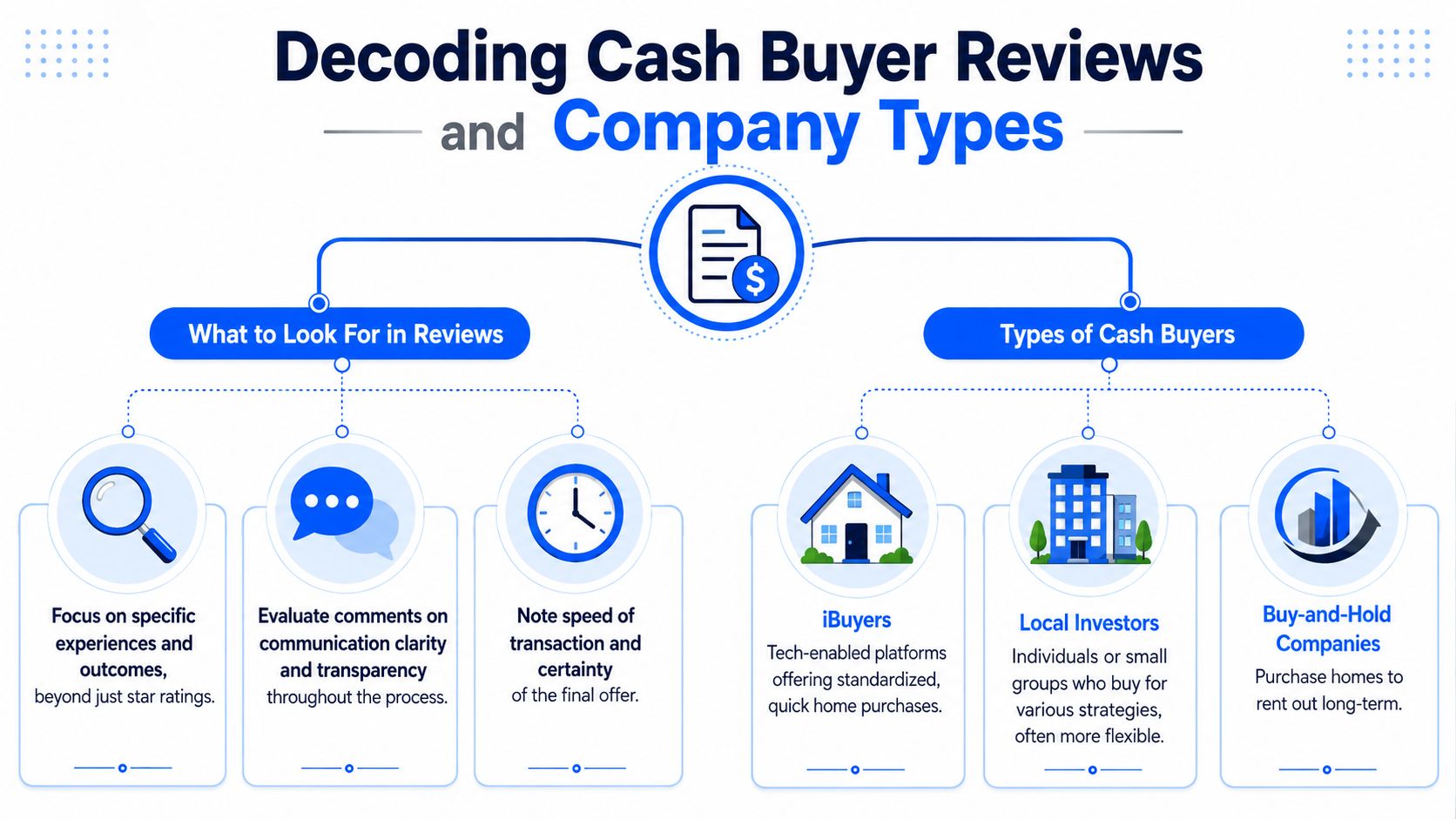
Decoding Cash Buyer Reviews and Company Types
Reviews are useful, but most sellers read them the wrong way. They skim the star rating, glance at two comments, and assume they’re done. That’s lazy research. What you need is pattern recognition.
Where to check a buyer’s trail
Use third-party platforms first. Start with Google Business Profile, Better Business Bureau, and Trustpilot. Then check the Indiana Secretary of State business search to confirm the company is registered, active, and operating under the name it’s using with you.
What you want in reviews isn’t generic praise. You want clues:
- Communication quality: Did the company explain the process clearly?
- Consistency: Did the final price match the original discussion?
- Closing reliability: Did the seller get to the closing table?
- Problem handling: When title issues or occupancy issues came up, did the company stay engaged or disappear?
A review that says “great company” tells you almost nothing. A review that says “they explained every step, used a local title company, and didn’t cut the price at the last minute” tells you a lot.
Direct buyer vs marketplace
This is the most important distinction in the whole cash-buying business.
According to Clever’s Indianapolis cash buyer guide, the most significant differentiator among cash buyers in Indianapolis is whether they’re a direct principal or a marketplace. Direct buyers offer more certainty. Marketplaces may create more price competition, but final terms can vary more. Sellers with time-sensitive needs often prioritize the certainty of a direct buyer.
That lines up with what I see in the field.
How that difference shows up in real life
| Buyer type | What it usually means for you |
|---|---|
| Direct buyer | One company evaluates, offers, and closes |
| Marketplace | Your property is circulated to multiple buyers |
| Wholesaler-style operator | May contract first, then look for an end buyer |
A direct buyer is usually cleaner if your house has problems or your life is messy right now. A marketplace can be smart if the property is in decent shape and you want to test whether competing offers produce better economics.
If the person making the offer isn’t the person buying the house, you need to know that before you sign anything.
What a good review profile looks like
A strong review profile has detail, recency, and consistency. A weak one looks padded, vague, or uneven across platforms. If Google looks strong but BBB complaints tell a different story, pay attention. If the company has no business registration trail, no real local presence, and no record outside its own website, keep moving.
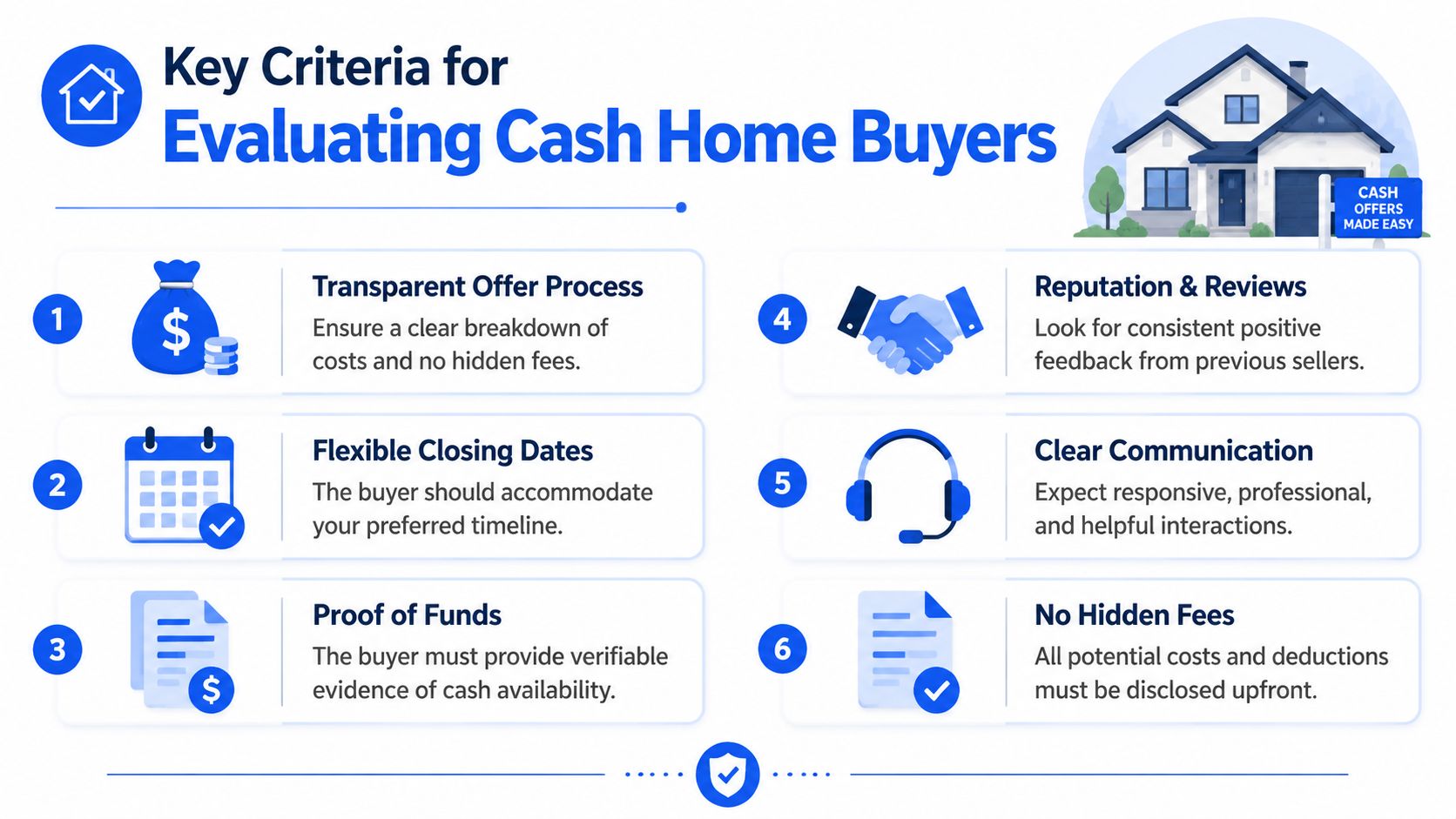
Key Criteria for Evaluating Cash Home Buyers
Most sellers compare only one thing: price. That’s how they get trapped. The better offer is the one that closes, on time, without surprise deductions.
A real evaluation needs more than a number.
One reason sellers use cash buyers at all is speed. HomeLight’s Indiana cash-buyer analysis says companies like Simple Quarters and HomeLight’s Simple Sale can close in as few as 7 days, compared with an average traditional selling timeline of 58 days, made up of 15 days to attract an offer and 43 days to close the loan. That’s a real gap, and it matters when you’re under pressure.
Here’s a useful video overview before you start comparing offers:
The six things that matter most
1. Offer transparency
Ask one direct question: “Is this the amount I walk away with?”
Some buyers present a clean net offer. Others throw out a number that sounds good, then chip away at it with repair deductions, closing adjustments, or vague fees. If they won’t explain the math in plain English, don’t sign.
2. Proof of funds
No proof of funds, no deal. This isn’t optional.
A serious buyer should be able to show they have the money or committed funding to close. If they dodge, stall, or say “our attorney handles that later,” that’s a warning sign.
3. True as-is terms
A company can say “as-is” on its website and still try to renegotiate after a walkthrough. That’s common.
Good as-is buying means:
- No repair requests
- No cleaning demands
- No punch list before closing
If they’re already softening that language on the first call, expect trouble later.
Judge the process, not just the pitch
A solid buyer should be able to explain the deal from start to finish in a few minutes. They should tell you how they evaluate the property, when they can send paperwork, which title company will handle closing, and whether the closing date is flexible.
Investor’s filter: Ask yourself which company sounds like they’ve closed a lot of transactions, and which company sounds like they’re improvising.
4. Closing flexibility
You want control here. Some sellers need to close fast. Others need extra time to move, clear the house, or coordinate family decisions. A good cash buyer adapts to your timeline instead of forcing theirs.
5. Communication style
Pay attention to how they answer basic questions. If they interrupt, deflect, or pressure you before you’ve even seen a contract, it won’t get better later.
6. Reputation under stress
Anyone can sound professional when the property is easy. The true test is how they behave when there are title issues, inherited-owner complications, tenants, or deferred maintenance.
A simple scorecard
Use this on every company you call:
| Criteria | What good looks like | What bad looks like |
|---|---|---|
| Offer clarity | Clear net number, plain terms | Vague deductions, fuzzy language |
| Funds | Proof provided quickly | Excuses or delay |
| As-is promise | No repair talk | Re-trading after inspection |
| Closing | Flexible and specific | “We’ll see” answers |
| Reviews | Detailed seller experiences | Thin or suspicious review trail |
| Communication | Direct and respectful | Pushy, evasive, inconsistent |
If you score buyers this way, weak operators become obvious fast.
Spotting Red Flags and Asking the Right Questions
A lot of sellers assume that if someone says “cash,” the deal is safer. That’s backwards. Cash removes lender risk. It doesn’t remove human risk.
The most expensive mistake isn’t taking a lower price. It’s signing with someone who can’t or won’t perform.
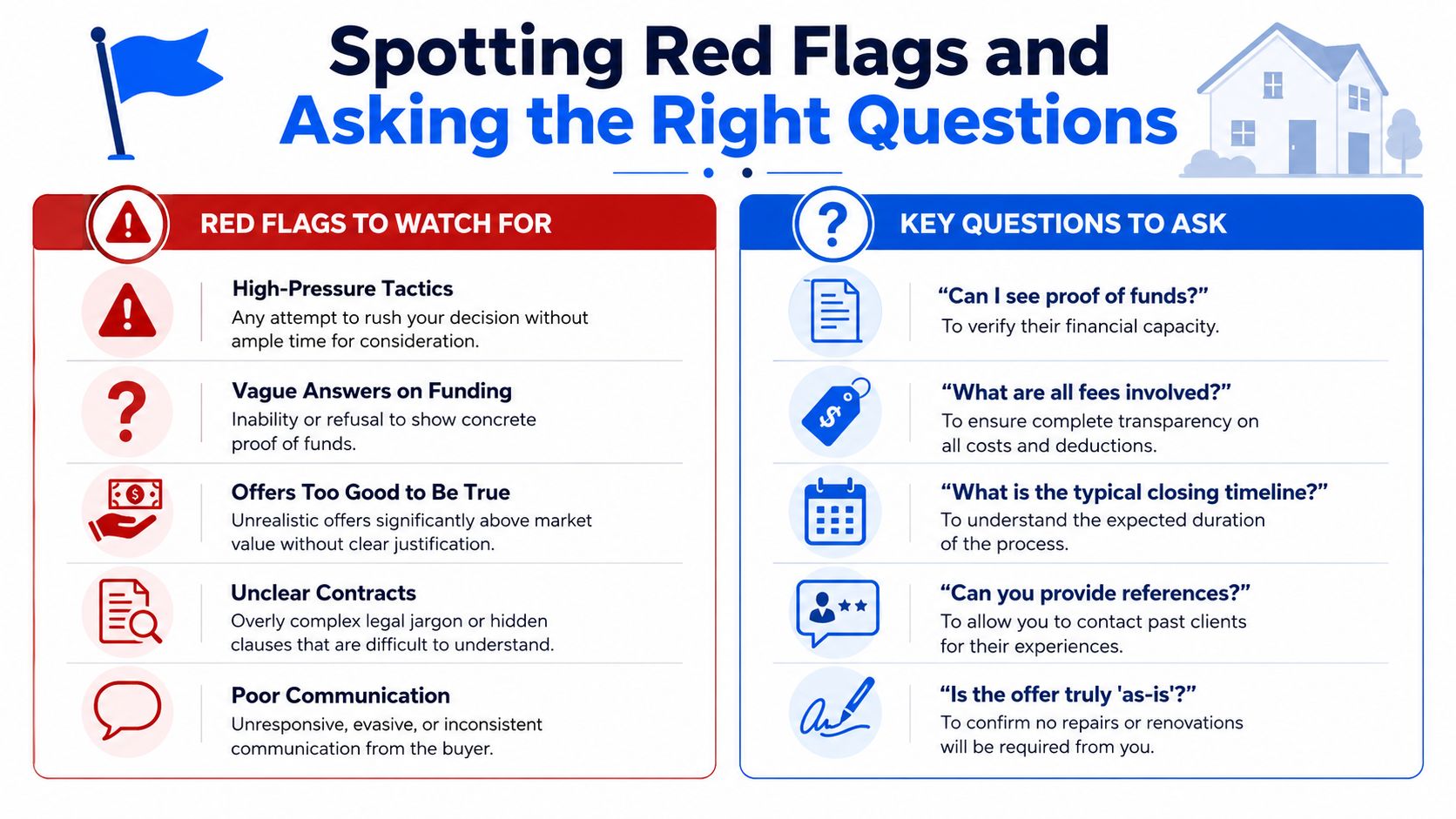
Red flags that should slow you down
Some warning signs are obvious. Others are subtle.
- High-pressure behavior: “You need to sign today” usually means the deal benefits them more than you.
- No straight answer on who the buyer is: If they can’t explain whether they’re buying directly or assigning the contract, that’s a problem.
- Offer without real diligence: A fast offer is fine. A careless offer often turns into a later price cut.
- Unclear contract language: If the agreement gives them broad exit rights but locks you in tightly, walk away.
- Poor responsiveness: If they’re hard to reach before signing, they’ll be worse after signing.
The questions that expose weak buyers
Ask these exactly as written. Then stay quiet and listen.
- Are you the direct buyer, or will you assign the contract?
- Can you show proof of funds before I sign?
- Is your offer firm, or can it change after a walkthrough or inspection?
- What fees, deductions, or closing costs could reduce my proceeds?
- Which title company or closing attorney will handle the sale?
- What happens if title issues come up?
- Can I choose the closing date, or are you setting it?
- What does as-is mean in your contract?
A strong buyer answers quickly and plainly. A weak one starts talking in circles.
“If a buyer gets irritated by reasonable questions, they aren’t the right buyer.”
Watch for re-trading
This is one of the oldest tricks in the business. A buyer gets your house under contract, ties up your options, then lowers the price right before closing because they think you’re too tired or cornered to start over.
That doesn’t always mean the buyer is dishonest. Sometimes a real issue shows up. But if the company has a pattern of vague offers followed by late renegotiation, that’s not a process problem. That’s their business model.
A Reliable Cash Buying Experience with Cyber Homes
You call a cash buyer because you need certainty, not another problem. The right company gives you a clear offer, explains the steps in plain English, and gets the deal to a real closing table without drama.

Cyber Homes is one example of that model. It is a family-owned real estate investment company that buys houses for cash, purchases properties as-is, does not charge commissions, and may offer moving assistance before closing. The seller contacts the company, schedules a quick walkthrough or evaluation, receives an offer, and closes through a title company on a timeline that fits the situation.
That matters because a predictable process protects you. Sellers in Indianapolis do not need polished marketing. They need to know who is buying, how the price was reached, and whether the company can perform.
What a dependable process looks like
A solid cash buyer keeps the process simple.
You reach out. They ask direct questions about the property’s condition, occupancy, and your timing. They look at the house in person or remotely. Then they make an offer and explain the next steps without slipping into vague language or pressure tactics.
Cyber Homes appears to follow that straightforward approach. That does not mean you should turn your brain off. It means the company belongs in the category of buyers worth screening carefully instead of dismissing outright.
Use that same standard here that you would use with any Indianapolis buyer:
- Clear explanation of the offer
- True as-is purchase terms
- No agent commissions
- Closing handled by an independent title company
- A timeline that matches your needs, not theirs
Who this type of buyer usually fits
This kind of company tends to make sense for sellers who want execution and simplicity more than a long listing process. That includes inherited houses, rentals, homes with heavy repair needs, and situations where timing matters more than squeezing out every last dollar.
Here is the part many sellers miss. A good experience is not about the company name by itself. It is about whether the company holds up under review checks, public record checks, and direct questions. If Cyber Homes makes your shortlist, evaluate it the same way you would evaluate any other buyer. Check the paper trail, confirm the closing process, and make sure the offer terms match what was said out loud.
How to Choose the Right Indianapolis Cash Buyer for You
By this point, the right move should be getting clearer. The best buyer for you isn’t the one with the loudest marketing. It’s the one that fits your property, your deadline, and your tolerance for uncertainty.
A practical three-step decision process
Build a shortlist
Pick three or four companies. Mix the list on purpose. Include at least one direct buyer and one marketplace-style option if your house is in decent shape. Check reviews, business registration, and whether the company has a real local operating footprint.
Interview them like you’re hiring them
Because you are.
Use the question set from the red-flags section. Take notes. Don’t trust your memory after four conversations that all start to sound the same. Score each company on offer clarity, proof of funds, as-is terms, communication, and contract confidence.
Compare certainty, not just price
A slightly higher offer can be worse if it comes with soft terms, vague contingencies, or a buyer who won’t verify funding. If one company feels clean, specific, and calm while another feels slippery, listen to that instinct. In this business, confusion usually costs money.
The right cash buyer makes the transaction simpler. If the process gets murkier the deeper you go, back out.
If you handle your decision that way, you won’t need to rely on any “top 10” list to think for you.
Frequently Asked Questions About Selling a House for Cash
Will I get full market value from a cash buyer
Usually, no. You’re trading some upside for speed, convenience, and a cleaner sale. If top dollar is your only goal and you have time, listing on the open market is often the better path.
Are all We Buy Houses companies in Indianapolis legitimate
No. Some are real operators. Some are inexperienced. Some are just middlemen trying to lock up a contract and figure out the rest later. That’s why review checks, business-record checks, proof of funds, and contract review matter.
Can I sell if I’m behind on payments or dealing with foreclosure
Yes. That’s one of the most common reasons people contact cash buyers. The key is moving quickly and dealing with a buyer that can perform, not someone who wastes your remaining time.
What happens after I accept a cash offer
Usually, the contract goes to a title company or closing professional. They verify title, prepare the closing paperwork, and coordinate payoff amounts if there’s an existing mortgage or lien. Then you sign, the funds are transferred, and ownership changes hands.
Do I need to clean or repair the house first
Not if the buyer is buying as-is. But don’t assume. Ask for that language to be reflected in the contract and confirm there won’t be repair credits or cleanup deductions later.
Should I get more than one offer
Yes. Even if you already like the first company. Multiple offers give you an advantage, help you spot outliers, and reveal whether one buyer is stretching the truth. You don’t need a dozen. You need enough to compare quality and terms.
What’s the biggest mistake sellers make
They confuse speed with certainty. A company can answer the phone fast and still fail to close. The safest sellers verify the buyer, read the contract, ask hard questions, and choose the offer they trust, not just the one that sounds highest.
If you want a straightforward cash-sale option, Cyber Homes is worth considering alongside the other buyers you shortlist. Reach out, ask the hard questions, compare the offer against your other options, and choose the company that gives you the clearest path to closing without surprises.