Selling an Inherited Property in San Antonio, TX: Guide
A family member has died, the house in San Antonio still contains personal belongings, and everyone wants to know what happens next. One heir may live out of state, another may want to keep the property, and the person named in the will may assume they can immediately hire an agent and sign a deed.
Selling an inherited property in San Antonio, TX is possible, but the first step isn't choosing a listing price. It's confirming who has legal authority to sell, how ownership passed, and whether probate, an affidavit, trust documents, or additional title work is required. This guide covers the practical choices, Bexar County issues, tax questions, and sale options heirs and estate representatives commonly face.

Get a cash offer for your home
Understanding Your Authority to Sell an Inherited Property
The right person to sell an inherited house depends on the ownership documents, not just on who is grieving, managing the property, or named as a beneficiary. A person identified in a will may still need court appointment documents before signing a listing agreement or deed.
Consider a San Antonio homeowner who leaves a house to three children. If the probate court appoints one child as an independent executor and the required authority is established, that executor may be able to sell estate property without separate court approval, subject to the governing documents and title-company review. The executor's authority to sell is different from the heirs' right to receive the proceeds.
If there is no will, the court may appoint an administrator. The administrator's authority depends on the probate administration and court orders. If the home passed into a living trust, the trustee generally acts under the trust documents, but the title company still needs to verify the trustee's authority and the chain of title.
Other homes pass outside ordinary probate:
- Joint ownership with survivorship rights may allow the surviving owner to take the required recording steps and sell as the owner.
- A transfer-on-death deed can direct the property to a named beneficiary, although the beneficiary must still establish the transfer properly in the county records.
- Multiple heirs may own the home together. Their interests and the executor's authority must be distinguished before anyone signs a contract.
Practical rule: Don't assume that possession, a will, or family agreement alone gives someone power to convey good title.
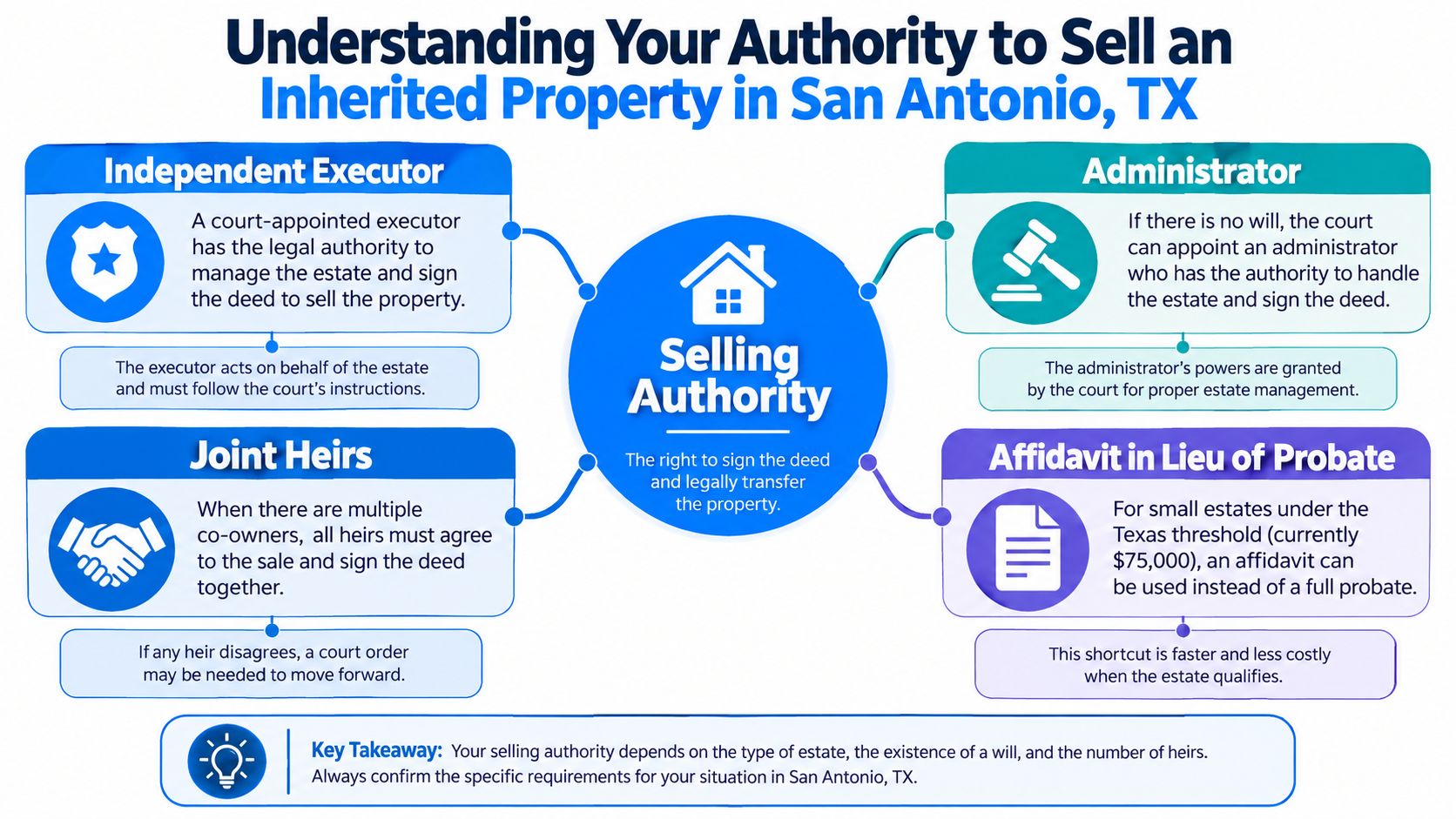
Bexar County also recognizes an important alternative in some estates. When someone dies without a will, has no outstanding debts, and owns only Texas real estate, heirs may generally use an Affidavit of Heirship. Once properly signed and recorded, it can connect the decedent's title to the heirs, after which a title company may allow a sale. That outcome is fact-specific, so the closing company should review the affidavit before the property is marketed as ready to close.
For general background, readers can review Bexar County's Probate Division information, then have a Texas probate attorney or title professional confirm the path for the particular estate.
Step-by-Step Process to Sell an Inherited House
A smooth sale begins with administration and title work, not photography. Use this sequence to keep avoidable problems from appearing after an offer is accepted.
-
Secure the property first. Change locks when appropriate, collect mail, check for leaks, maintain utilities needed to protect the home, and confirm that insurance remains in force. Tell the insurer that ownership has changed or that the home is vacant if applicable.
-
Gather the estate file. Locate the death certificate, will, trust, deed, property-tax records, mortgage information, insurance records, repair invoices, and any prior closing documents. Keep personal belongings separate until the heirs agree on what happens to them.
-
Confirm ownership and authority. Determine whether the home passed through a probate estate, trust, survivorship arrangement, transfer-on-death deed, or heirship process. The title company can identify gaps, but it needs accurate names and documents to begin.
-
Open or continue probate when required. If the property is solely in the decedent's name and no nonprobate transfer applies, obtain the appointment and authority documents appropriate to the estate. An executor or administrator shouldn't sign a deed outside the authority established in the probate record.
-
Order title work early. Ask the title company to check the deed history, mortgages, unpaid property taxes, judgments, liens, HOA or condominium balances, and any recorded probate documents. Early review gives the estate time to cure defects before a buyer's closing deadline.
-
Choose the sale method. A traditional listing may suit a clean, market-ready house. An as-is MLS listing can expose a property needing work, while a direct cash offer may reduce repairs, showings, and contingencies. Compare the likely sale price with the work, carrying costs, risk, and net proceeds.
-
Prepare a net sheet. Request estimated figures for the offer or list price, payoff amounts, taxes, title charges, commissions if applicable, repairs, and other estate expenses. The gross price doesn't tell heirs what they'll divide.
-
Close and distribute correctly. The authorized seller signs the closing documents. Sale proceeds should remain handled through the estate, trust, or ownership arrangement until debts, expenses, and beneficiary rights are addressed.
This is general information, not legal or tax advice. A local probate attorney, CPA, and title company may reach different conclusions based on the documents and facts of the estate.
Common Probate and Title Issues in Bexar County
Probate is the court-supervised process used to validate estate documents, appoint a representative when needed, address debts, and transfer property. It doesn't automatically mean that a San Antonio house must wait until every estate matter is finished before it can be sold. The decisive questions are how the property passed, what authority the representative has, whether heirs can be identified, and what the title company can insure.
Texas law gives an independent executor or administrator meaningful selling authority when the appointment and authority are properly established, unless the will or court order limits that authority. A buyer and title company may review the appointment, the will or probate order, and recorded evidence of authority in Bexar County deed records. If that authority is missing, the transaction may need further court action or heir consent. Texas law also protects certain good-faith purchasers who deal with an independent representative when statutory conditions are satisfied. The relevant statute is Texas Estates Code Chapter 402.
Problems that commonly stop a closing
- A missing will or unknown heir can prevent the representative from proving who owns the property.
- Disagreement among heirs may stop signatures, repairs, access, or approval of the proposed price.
- Old mortgages and unpaid taxes must be identified and paid or resolved at closing.
- Judgments, mechanic's liens, and HOA balances can reduce proceeds or prevent title insurance.
- Trust ownership or co-ownership may require a different set of signatures and certifications.
- Belongings left inside can create disputes over what is included, removed, donated, or discarded.
A useful plain-language overview of understanding probate in Texas can help families learn the terminology, but it doesn't replace review of the Bexar County file. For a broader explanation of how a probate sale is handled in practice, see selling a home in probate.
The most effective approach is to send the complete estate and title file to the closing company before accepting an offer. That lets the representative learn whether an affidavit, court order, recorded instrument, or additional heirship evidence is needed while the family still has time to act.
Get a cash offer for your home
Choosing Between Repairing, As-Is Listing, or a Cash Offer
The right sale method depends on the home's condition, the family's tolerance for work, and the importance of maximizing the final price. No option removes the need to establish ownership, clear liens, and provide information required for the transaction.
| Sale path | Usually fits | Main trade-off |
|---|---|---|
| Traditional agent listing | A home in good condition where market exposure and price matter | More preparation, showings, negotiation, and buyer contingencies |
| As-is MLS listing | A property needing work when the family still wants broad buyer exposure | Buyers may discount for repairs, and inspections can still affect negotiations |
| Direct cash buyer | Major repairs, inherited clutter, vacancy, or a need for a simpler transaction | Convenience can come with a lower price than a fully marketed sale |
A traditional listing makes sense when the house is clean, functional, and easy for buyers to finance. It may attract more competing interest, but the estate must coordinate repairs, staging, access, inspections, and buyer deadlines. Before approving a major upgrade, compare its expected contribution to saleability with its cost and the time it will take. For renovation planning, a resource on window upgrade return estimates can help frame the question, but local buyer expectations and the home's broader condition matter more than one improvement.
An as-is MLS listing doesn't mean “ignore everything.” The estate still needs a truthful understanding of known conditions, title status, liens, and material facts that must be disclosed under the circumstances. Buyers may accept the property in its present condition, but they can still inspect it, request information, or cancel under the contract.
A direct cash buyer may be practical when the home has severe deferred maintenance, personal property remains inside, or family members can't manage repeated showings. Cyber Homes is one example of a cash buyer that evaluates homes as-is, provides a firm offer within hours, can close on the seller's preferred timeline, and may advance up to $2,000 for moving expenses, as described by the company. Sellers should compare the written offer, verify proof of funds, understand title and closing charges, and weigh the convenience against the price. A broader comparison of providers is available through cash-home-buying companies in San Antonio.
An as-is sale changes the condition terms, not the ownership rules. The authorized representative still has to sign, and the title company still has to determine whether it can insure the buyer's deed.
Taxes and Costs When Selling an Inherited Property
Selling an inherited house can involve property taxes, unpaid balances, insurance, utilities, maintenance, title charges, and other closing expenses. The estate may also face tax questions involving the decedent, the estate, or the heir. The answer depends on the ownership structure, valuation, sale price, improvements, deductions, and each seller's tax position.
The federal step-up in basis is often central. The IRS generally uses the property's fair market value on the date of death as the initial basis, or an alternate valuation date if the estate properly elects that method on Form 706. The decedent's original purchase price usually isn't the starting point for the heir's gain calculation. The IRS guidance on gifts and inheritances explains the general rule, while IRS Publication 523 addresses inherited-home basis and related ownership situations.
For example, suppose a San Antonio house was purchased decades ago for $90,000, had a documented date-of-death value of $300,000, and later sold for $320,000. Before eligible selling costs and capital improvements, the calculation generally begins with approximately $300,000 of basis, leaving roughly $20,000 of appreciation rather than $230,000. Inherited property dispositions are generally treated as long-term gains regardless of the heir's holding period.
Keep the evidence that supports the calculation:
- Date-of-death valuation: Preserve a qualified appraisal or another defensible valuation.
- Improvement records: Save invoices for capital improvements and significant work.
- Sale documents: Keep the settlement statement and records of selling expenses.
- Estate records: Retain estate-tax valuation information and distributions.
San Antonio's property-tax rules also affect carrying costs while the home is held. The City of San Antonio states that a residence homestead receives a 20% exemption from market valuation, and qualifying owners aged 65 or older may receive an exemption of up to $85,000 of taxable value. A qualifying disabled person may also receive an $85,000 disabled-residence-homestead exemption, as described on the city's property-tax resource. These benefits concern an owner's principal residence. An inherited house left vacant, rented, or used as a second home won't automatically receive the same treatment.
Ask a CPA or tax professional to review the sale when the value, estate structure, or potential tax exposure is significant.
Get a cash offer for your home
Handling Disagreements Among Multiple Heirs
Multiple heirs often disagree about the listing price, repairs, personal belongings, timing, or whether to sell at all. Those disagreements can turn a straightforward transaction into a title and communication problem, particularly when each person expects an equal voice but the executor has separate authority under the estate documents.
Start with a shared written plan:
- Review the will, trust, deed, and probate appointment.
- Identify who can make the sale decision.
- Obtain a neutral valuation or competing opinions.
- Record proposed repairs and estimated costs.
- Set a deadline for removing or dividing personal property.
- Communicate decisions by email or shared written notes.
- Ask an estate attorney or mediator to help before conflict hardens.
An executor should distinguish personal preference from fiduciary responsibility. The executor's job may be to protect the estate and follow the governing documents, while the heirs' interests concern their eventual distributions. If the family can't agree, selling inherited property with multiple owners may provide useful context, but a Texas attorney should address any actual dispute.
Mediation can preserve relationships better than letting an argument become a court proceeding. It also gives heirs a structured way to discuss a buyout, a repair budget, a listing strategy, or an agreed sale date without treating every disagreement as a personal betrayal.
Local Considerations for San Antonio and Bexar County
San Antonio inherited-property sales require coordination among several local systems. The Bexar County Probate Division provides county-specific filing information, while the Bexar Central Appraisal District handles property-tax records and exemption administration. The county's records and the title company's search may reveal different issues, so don't rely on a family copy of an old deed as the complete ownership history.
Bexar County's heir-property homestead rules are especially relevant when an heir moves into the inherited home. An occupying heir may be able to preserve or establish a residence homestead exemption when ownership came through a will, transfer-on-death deed, or intestacy. If the occupant isn't specifically identified as the homestead owner in a recorded deed or county record, BCAD may require an affidavit establishing the ownership interest, the prior owner's death certificate, the most recent utility bill, and relevant court records when available. Other occupying heir-owners may need affidavits authorizing the application. Confirm current requirements directly with Bexar Central Appraisal District's exemption information.
Local checks that deserve early attention
- Probate and recording: Verify appointments, heirship affidavits, court orders, and deeds in the applicable Bexar County records.
- Taxes and exemptions: Check balances and confirm whether a claimed homestead exemption applies to the heir's principal residence.
- Utilities and liens: Ask the title company to investigate municipal balances, code-related issues, permits, judgments, and other recorded claims.
- HOA or condominium rules: Request resale documents, account statements, transfer requirements, and any architectural or maintenance records.
- Physical condition: San Antonio homes may require careful review of foundation movement, drainage, roof damage, storm exposure, plumbing, HVAC systems, and deferred maintenance.
- Outdoor and site conditions: Yard condition, irrigation, trees, drainage, and heat stress can affect preparation decisions. A local overview of the San Antonio landscape environment offers useful context for evaluating outdoor work.
A recorded Affidavit of Heirship may allow a sale before a full probate case is completed when the statutory facts and title requirements fit, but it isn't a universal shortcut. Confirm every authority, title, lien, and tax question with qualified local professionals. Updated for 2026, this article is general information and not legal or tax advice.
If you want to compare a traditional listing with an as-is sale, Cyber Homes can review an inherited San Antonio property, make a cash offer, and work with the title company on the seller's preferred closing schedule. Visit Cyber Homes with the property details, then discuss the offer and estate documents with your attorney, CPA, and closing professional before deciding.

Edited by
James Vasquez
Real Estate Investor & Land Specialist with 10+ years experience in residential flipping, vacant land investing, land wholesaling, and subdivision deals.
Disclaimer: The information provided is for educational purposes and does not constitute financial or legal advice. Always consult with licensed professionals before making investment decisions.