Selling an Inherited Property in Indiana

You're standing in a house that still contains someone's furniture, paperwork, and memories, while utility bills, property taxes, and maintenance decisions keep arriving. Perhaps a buyer has already made a cash offer, but the title company is asking for probate documents you've never seen. Or several heirs agree that selling is sensible, yet nobody knows who has the legal authority to sign.
Selling an inherited property in Indiana is rarely difficult because of one issue. Delays usually come from legal authority, creditor procedures, title defects, property condition, and incomplete tax records colliding at the same time. The practical approach is to verify the transfer path first, establish the property's tax basis, and choose a sale method that fits the estate's actual constraints.

Get a cash offer for your home
Understanding Indiana Inheritance Tax and Financial Relief
The first concern for many heirs is a large tax bill solely because they received the house. For Indiana property owners who died after December 31, 2012, that particular concern has largely been removed. The Indiana Department of Revenue's inheritance tax information states that no Indiana inheritance tax is owed, and it says inheritance-tax returns shouldn't be prepared or filed after October 5, 2023.
That's meaningful relief, but it doesn't mean every financial obligation disappears. Indiana inheritance tax is separate from probate costs, creditor claims, title work, unpaid property taxes, liens, recording charges, settlement expenses, and potential federal tax consequences when the property is sold. The absence of a state inheritance-tax bill improves the starting calculation, but it doesn't guarantee that the sale itself is tax-free or immediately ready to close.
Separate inheritance from sale costs
Before evaluating an offer, identify which expenses belong to the estate and which arise from selling the house:
- Estate administration: Probate filings, representative responsibilities, creditor issues, and legal work may still need attention.
- Property obligations: Unpaid taxes, mortgages, liens, utilities, insurance, and necessary maintenance can reduce the amount distributed to heirs.
- Closing expenses: Recording charges, settlement costs, payoff figures, and title-clearance work may be deducted at closing.
- Federal tax questions: A later sale can create capital-gains reporting obligations based on the property's adjusted basis.
This distinction matters when an offer looks lower than an expected retail price. A retail listing may produce a higher gross price, but repairs, holding costs, showings, financing contingencies, and a longer closing process can also reduce the final distribution. A cash offer should be compared using net proceeds, certainty, timing, and administrative workload, not headline price alone.
Practical rule: Treat Indiana's repealed inheritance tax as financial relief, not as a substitute for a complete estate and sale-cost review.
If the estate has limited liquidity, heirs may also need to think about how they'll cover property expenses while the sale is pending. A general resource such as Indiana financial help for poor credit may help someone review broader financial options, but it doesn't replace advice from an Indiana probate attorney or tax professional.
Verifying Legal Authority and Title Transfer Rules
A buyer can agree on price, inspections can be waived, and the house can be empty, yet the sale still stalls for one reason. The wrong person signed. In Indiana inherited-property sales, that is one of the most common closing failures, and it usually traces back to title, not the offer.
The first document to review is the recorded deed in the county where the property sits. That deed shows who held title, how they held it, and whether the property may pass automatically at death. If a transfer-on-death deed was properly executed and recorded before death, the named beneficiary may take the property outside probate under Indiana's transfer-on-death deed statute. If that deed was never recorded, was defective, or does not cover the property in question, title companies will not treat it as a shortcut.
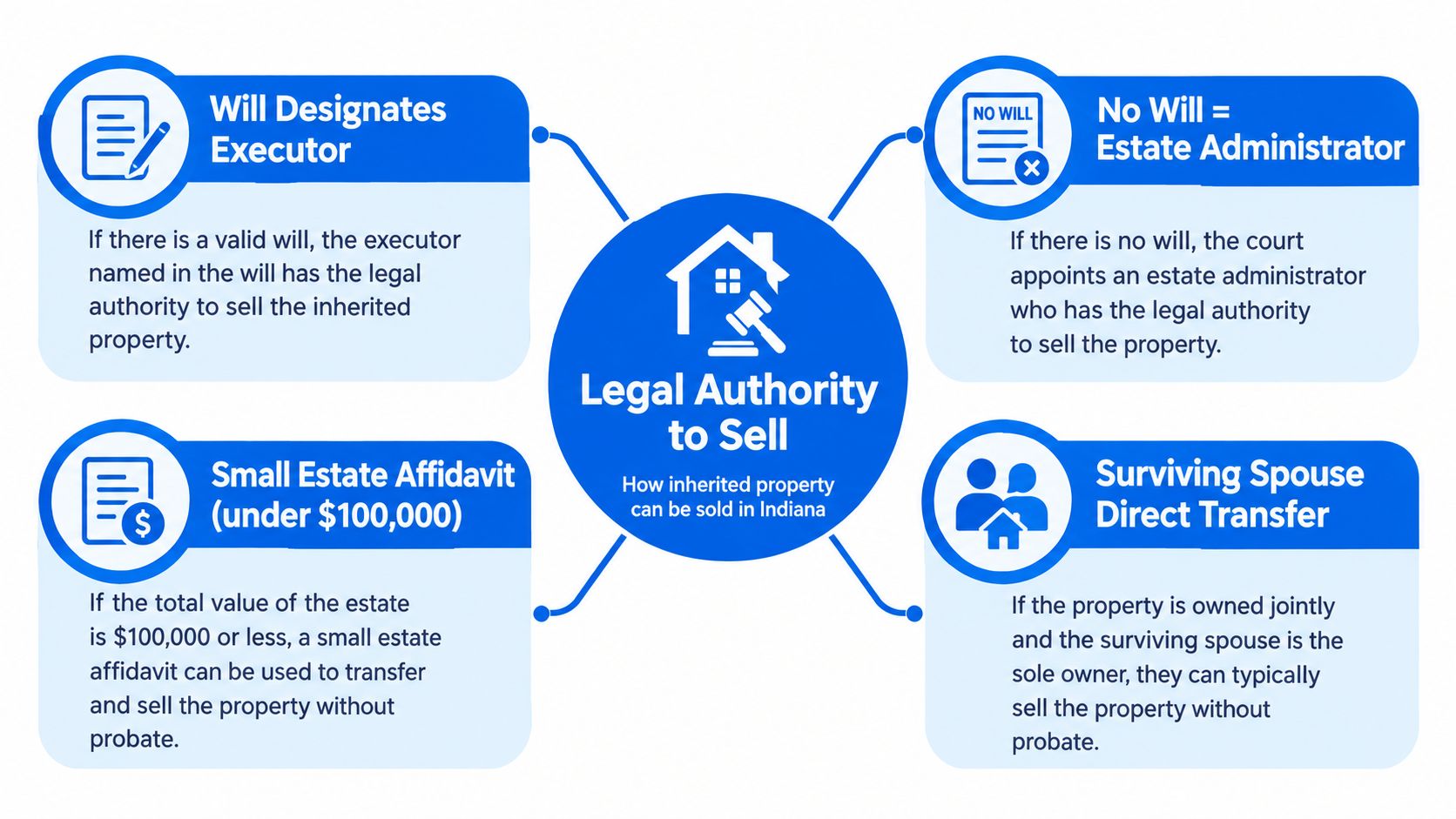
From there, the file usually splits into one of two paths. Either a personal representative has authority through the estate, or the property has already passed to heirs or beneficiaries who now need to sign in the correct capacity. A will helps explain intent, but it does not by itself give a beneficiary power to convey marketable title.
What the title company and closing attorney usually want is straightforward:
- Death certificate to confirm the owner's death for estate and title records
- Will or intestacy paperwork to show who may have an interest
- Letters testamentary or letters of administration to prove a personal representative's authority
- Probate orders if the court has imposed sale conditions or approval requirements
- Heir and beneficiary details to identify everyone whose interest may affect title
- Lien, mortgage, and judgment records to confirm what must be paid or cleared at closing
Delays pile up here. A middle initial is missing on an old deed. One heir signed a listing agreement but not the sale documents. A mortgage was paid off years ago but never released. The family assumes the oldest child can act for everyone, then the title company refuses to insure the deed. None of those problems are dramatic, but each can stop a closing.
Use this order instead: confirm the deed, confirm probate status, confirm signing authority, then clear title issues. Until those four pieces line up, a projected closing date is only a target, not a commitment.
Navigating Indiana Probate Timelines and Creditor Rules
You can have a buyer ready, a signed contract, and a title company lined up, then lose weeks because probate deadlines and creditor procedures were never built into the deal. In Indiana, inherited property sales often stall for procedural reasons, not because the house will not sell.
The first bottleneck is timing under Indiana's probate administration statute. If real estate may need to be sold to cover debts or administration costs, the estate generally must have an administration petition filed within 5 months after death, and letters testamentary or letters of administration issued within 7 months. Those dates matter in practice because they affect who can sign, who can give sale instructions, and whether title will treat the transaction as ready to close.
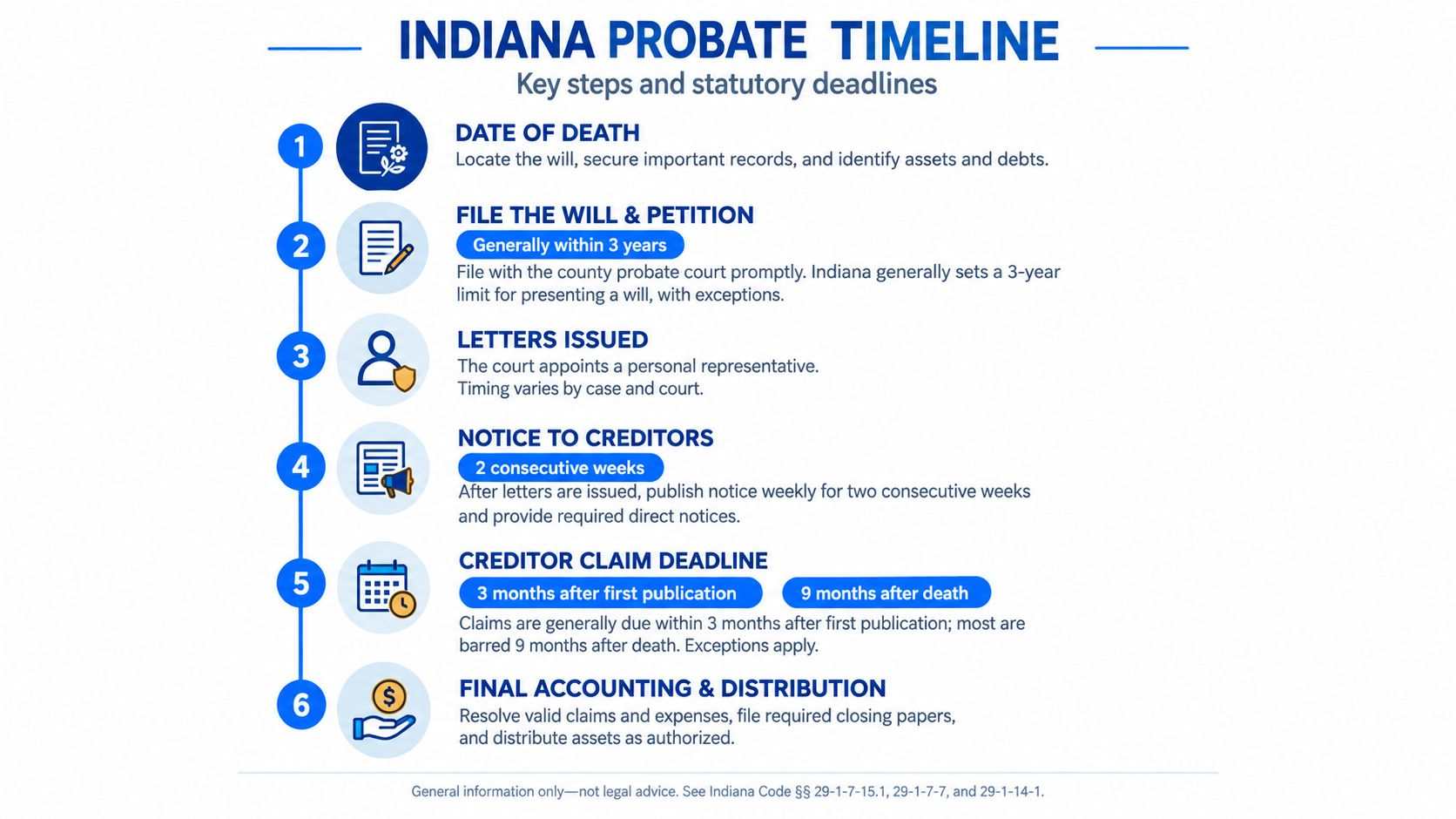
Creditor rules create the next delay point. In an unsupervised estate, closing generally cannot happen until at least 3 months after the first published notice to creditors, and many creditor claims are barred 9 months after death. That does not mean the property cannot be marketed or put under contract earlier. It means the file has to be structured around those dates, with enough room for title review, payoff demands, and any claim that could attach to sale proceeds.
Weak contracts create expensive problems here. A retail buyer expecting a normal closing date may walk once the probate attorney asks for more time. A better approach is to set expectations early and use a purchase agreement that allows extensions if probate filings, creditor notice, or title clearance are still pending.
I tell heirs to pressure-test the calendar before they accept any offer. Who is responsible for opening the estate. Have letters been issued yet. Was notice to creditors published correctly. Are there known medical bills, tax debts, liens, or reimbursement claims that could change net proceeds. Does the buyer understand that title clearance, not buyer enthusiasm, controls the closing date.
Some buyers can work with that reality. Some cannot. If you need a plain-English overview of selling a home in probate, review the process, then match that general guidance against the estate's actual court filings and title requirements in Indiana.
For a concise visual explanation of the process, use the following video as background, but rely on the estate's own filings and professional advice for decisions.
A signed contract does not clear probate. Closing still waits for valid authority, insurable title, and creditor procedures to be satisfied.
Get a cash offer for your home
Comparing Supervised and Unsupervised Estate Sales
The estate's administration type changes how much control the personal representative has over the sale. Supervised probate places more decisions under court oversight. Unsupervised probate can provide greater flexibility, but it doesn't eliminate fiduciary duties, title review, creditor concerns, or the need to act in the estate's interests.
In a supervised estate, Indiana court rules require a written professional appraisal when real estate is presented for sale unless an appraisal was already filed with the inventory, as explained in Hamilton County's official probate rules. The appraisal must support the property's identity, valuation date, fair-market-value analysis, and reasoning. That requirement affects the entire transaction sequence. The representative may need to coordinate the appraisal, petition, proposed terms, notice, and title review before presenting a reliable closing plan.
An unsupervised personal representative may generally sell estate property without prior court approval, subject to the governing probate authority and fiduciary obligations. That can reduce procedural friction, but it doesn't make the representative a private owner free to ignore beneficiaries, creditors, liens, or the title company.
| Feature | Supervised Estate | Unsupervised Estate |
|---|---|---|
| Court involvement | Sale-related approval and filings may be required | Prior court approval may not be required for the sale |
| Valuation | Written professional appraisal is required when applicable | Valuation still matters for fiduciary decision-making and pricing |
| Representative's role | Coordinates with the court, appraiser, beneficiaries, buyer, and title company | Coordinates directly with the buyer and title company within probate authority |
| Closing certainty | Depends on appraisal, petition, notice, and court timing | Can be more flexible, but title and creditor issues remain |
| Cash buyer advantage | Simplifies condition and marketing, not court requirements | Simplifies condition and marketing, not authority or title requirements |
What works in practice
Find out the estate type before listing the property or accepting an offer. Give the appraiser and title company the same ownership and probate records, and disclose unresolved heir objections early. A cash buyer can reduce inspection, repair, and financing complications, but no buyer can lawfully purchase around a missing appointment, an unresolved lien, or a required court order.
Calculating Federal Capital Gains and the Step-Up in Basis
A lot of heirs expect the tax issue to turn on what the parent or relative originally paid for the house. In most inherited sales, that is not the number that controls the federal gain calculation.
The starting point is usually the property's fair market value on the decedent's date of death. If the executor files an estate-tax return and makes the alternate valuation election, the basis may instead be the value six months later, as explained in the IRS guidance on gifts and inheritances. That step-up in basis often narrows the taxable gain, especially where the property was held for many years before death.
Here is the working formula:
Sale proceeds minus adjusted basis minus eligible selling costs and improvements equals potential taxable gain.
The paperwork matters as much as the math. If the probate file, appraisal, and title records do not line up, the closing may still happen, but the tax reporting gets harder and the heir is left reconstructing figures later from incomplete records. I have seen that happen when families focus on getting the house sold and do not keep the appraisal, closing statement, and estate accounting together.
Use a simple example. If the date-of-death appraisal is $250,000, the property sells for $275,000, and allowable selling expenses are $15,000, the approximate gain is $10,000 before other adjustments. That is calculated by subtracting the stepped-up basis and selling expenses from the sale price.
Real files are rarely that clean.
Improvements made after inheritance may increase basis, but ordinary repairs and maintenance usually do not. Partial interests, valuation disputes, and inconsistent estate records can also change the result. Inherited property is generally treated as acquired for long-term capital-gain purposes, even if the heir sells soon after receiving it.
Before proceeds are fully distributed, keep the documents that support the position taken on the tax return: the date-of-death appraisal, the final settlement statement, invoices for capital improvements, and the estate records showing how the personal representative reported value. If the house had been rented, this discussion of rental property sale capital gains can help frame the issues, but a tax professional should apply the rules to the estate's actual facts.
Get a cash offer for your home
The Strategic Advantage of As-Is Cash Offers for Heirs
You inherit a house, then the delays start. The court file is still open, the title company wants probate papers, and the property itself may be sitting vacant with old furniture, deferred maintenance, and no one nearby to manage contractors. In that situation, an as-is cash sale can solve a practical problem. It reduces the work tied to the house while the estate handles the legal work that still has to happen.
An inherited property in Indiana does not become easier to sell just because a buyer is paying cash. The personal representative still needs authority to sign. Title still has to be cleared. If probate is pending, unresolved liens, name mismatches, unreleased mortgages, or heirship questions can still delay closing. What cash changes is the part of the process that usually drains time and money before the title company is even ready.

For many heirs, comparison is not list price versus offer price. It is net proceeds versus delay, risk, and additional cash out of pocket.
A retail listing can work well if the house is clean, updated, and easy for the family to manage. It is a harder fit when the estate is waiting on paperwork, beneficiaries disagree about repairs, or the property is too cluttered or worn for ordinary showings. In those cases, every extra month can mean utilities, insurance, lawn care, cleanup, and more chances for the property to deteriorate or attract problems.
Cash buyers usually evaluate the house in its current condition. That means no renovation plan has to be approved by multiple heirs before the property can be marketed. It also cuts down on inspections, repeated showings, and financing uncertainty. Those advantages matter most when the sale is already exposed to Indiana probate bottlenecks and title clearance issues that no buyer can skip.
Cyber Homes is one option heirs can consider. The company buys inherited homes as-is for cash, does not require repairs or commissions, and coordinates closing through title partners. It is still worth asking direct questions. Who is buying the property? What proof of funds will they provide? Will they wait for the estate's court and title requirements to be completed? Heirs who want a wider frame of reference can compare cash home-buying companies in Indiana.
The best offer is the one that holds together when probate moves slowly and title review gets difficult. A lower-stress sale with fewer property demands can preserve more value than an ambitious retail plan the estate cannot realistically carry through.
Your Step-by-Step Action Plan for a Smooth Closing
A smooth inherited-property sale starts with documents, not advertising. The sequence below keeps the authority question ahead of pricing and puts tax documentation ahead of final distribution.
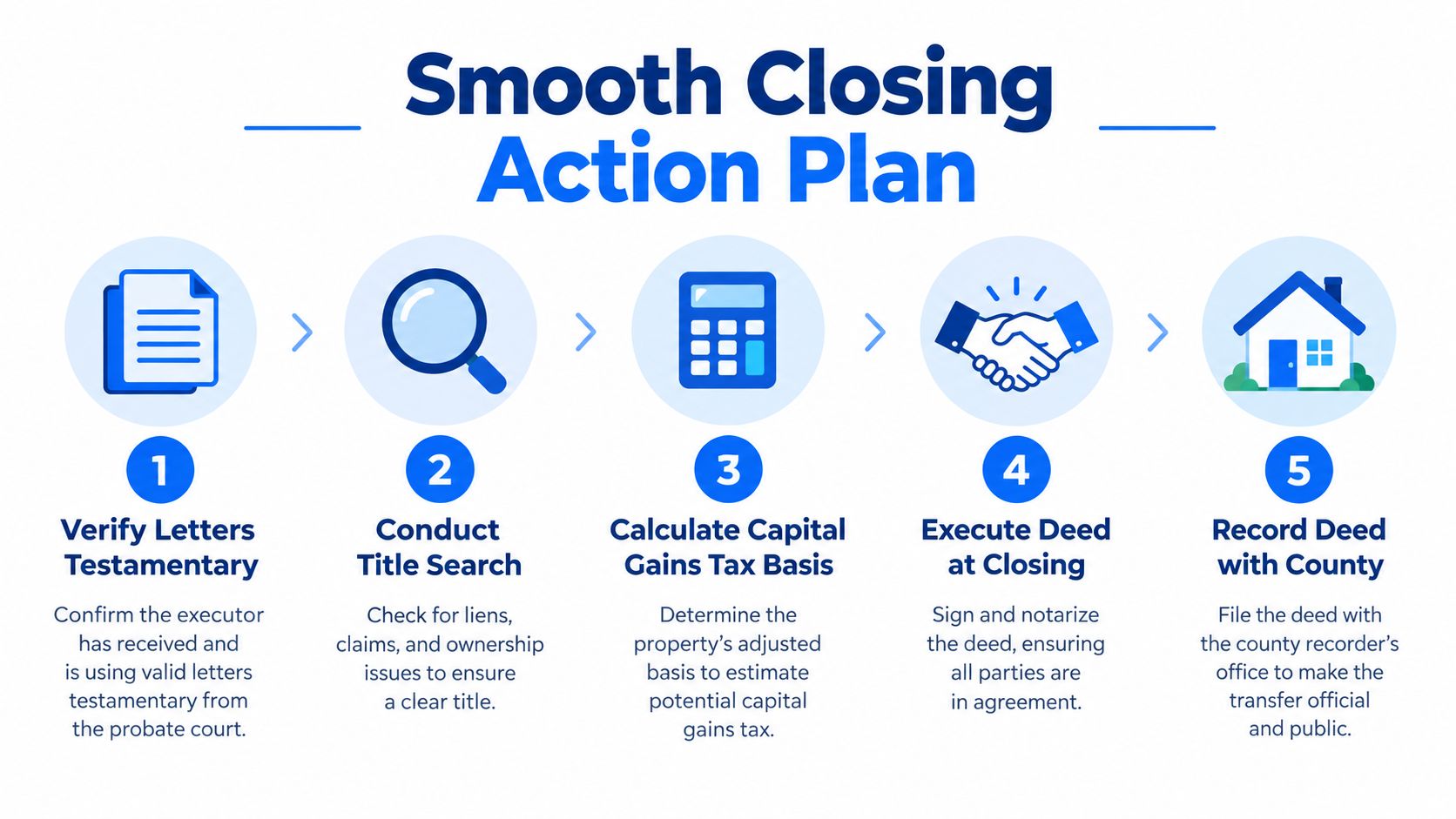
1. Establish ownership and probate status
Pull the recorded deed and check whether a valid transfer-on-death deed, joint ownership arrangement, trust, or probate administration controls the property. If the deed names only the deceased owner, identify the personal representative and obtain the relevant appointment records.
2. Give the title company a complete file
Provide the death certificate, will or intestacy documents, letters testamentary or letters of administration, probate orders, recorded deeds, and information about every beneficiary or heir. Ask for a title search early. Waiting until a buyer is committed can expose liens, unreleased mortgages, name discrepancies, or missing interests at the worst possible time.
3. Document the property's tax basis
Order a defensible date-of-death appraisal and preserve the estate inventory, improvement invoices, settlement statements, and payoff records. Don't estimate gain from the deceased owner's original purchase price. Give the complete file to the tax professional handling the estate or the heir's return.
4. Choose a sale method that fits the estate
Use a retail listing when the home's condition, family coordination, and schedule support repairs, marketing, inspections, and buyer financing. Consider an as-is cash offer when the estate values reduced preparation and greater execution certainty. In either case, compare expected net proceeds, not only the proposed sale price.
5. Match the contract to the legal process
Make the purchase agreement contingent on satisfactory title review and any required probate authority. Coordinate the closing date with the personal representative, probate counsel, title company, creditor procedures, and all required signers. At closing, verify that liens and approved expenses are paid, the deed is executed by the correct party, and the final proceeds are accounted for before distribution.
The most common mistake is treating a signed purchase agreement as proof that the estate is ready to close. A contract is only one part of the transaction. Authority, insurable title, creditor compliance, accurate basis records, and a buyer prepared for the estate's timeline are what carry the sale across the closing table.
Cyber Homes buys inherited Indiana houses as-is for cash, so heirs can evaluate a sale without repairs, showings, or commissions while the title company addresses the estate's legal requirements. Visit Cyber Homes to request an evaluation and discuss a closing schedule that fits the probate and title situation.

Edited by
James Vasquez
Real Estate Investor & Land Specialist with 10+ years experience in residential flipping, vacant land investing, land wholesaling, and subdivision deals.
Disclaimer: The information provided is for educational purposes and does not constitute financial or legal advice. Always consult with licensed professionals before making investment decisions.