Selling an Inherited Property in North Carolina: Key Steps
You've just inherited a house in North Carolina, and the practical questions arrive before the grief has settled. Who can sign the listing agreement? Is the mortgage still being paid? What happens to the furniture? Will selling the house create a tax bill?
Treating the property like an ordinary listing is the fastest way to create delays. Two issues control the sale: legal authority to convey the property and defensible tax-basis records. Price, repairs, marketing, and buyer selection come after those two questions. The North Carolina Judicial Branch estate guidance explains when real estate generally enters probate, while the IRS guidance on inherited property provides the federal basis rule that usually drives the tax calculation.

Get a cash offer for your home
Where North Carolina Heirs Usually Start
A typical inherited-property sale starts with a folder, a key, and several people who remember the deceased differently. One heir may live nearby and want to clean out the house. Another may live out of state and want a quick sale. A third may assume that being named in the will means they can sign everything immediately.
That assumption causes trouble. Before anyone hires an agent, accepts an offer, or signs a deed, the family needs answers to two separate questions:
- Who has authority to sell? The answer may be a personal representative, surviving owner, trustee, or multiple heirs, depending on how title passed and how the estate was handled.
- What is the property's tax basis? That figure affects whether a later sale creates a reportable gain, and it must be supported with valuation and expense records.
North Carolina no longer imposes a state inheritance tax on people who receive property from a deceased owner. The former inheritance-tax provisions were repealed effective January 1, 1999, and the state later repealed its separate estate-tax provisions effective January 1, 2013, as summarized by the North Carolina Department of Revenue's historical tax materials. That doesn't eliminate federal income-tax questions, estate costs, liens, recording charges, or closing adjustments.
Practical rule: Don't market the house until a North Carolina closing attorney confirms who can convey it and a tax professional tells you what valuation records to preserve.
The work usually follows a sensible order. Secure the house and insurance, locate the will and estate file, confirm the signer, order a title search, obtain a date-of-death valuation, gather improvement and rental records, and then choose a selling route. If you reverse that order, you may spend money preparing a listing that can't close or accept an offer without knowing how proceeds must be handled.
The sections ahead focus on those pressure points. Probate authority determines whether a buyer can receive clear title. Basis documentation determines how the sale is reported. Once both are under control, you can compare an MLS listing, a private sale, an auction, or an as-is buyer without guessing what each route really demands.
Probate, Titles, and the Right to Sell in NC
A house can sit vacant for weeks while the family argues about paint colors, repairs, and price, then the closing attorney opens the file and stops the sale because the wrong person signed. That is how inherited deals fall apart in North Carolina. The bottleneck is usually authority, not a marketing plan.
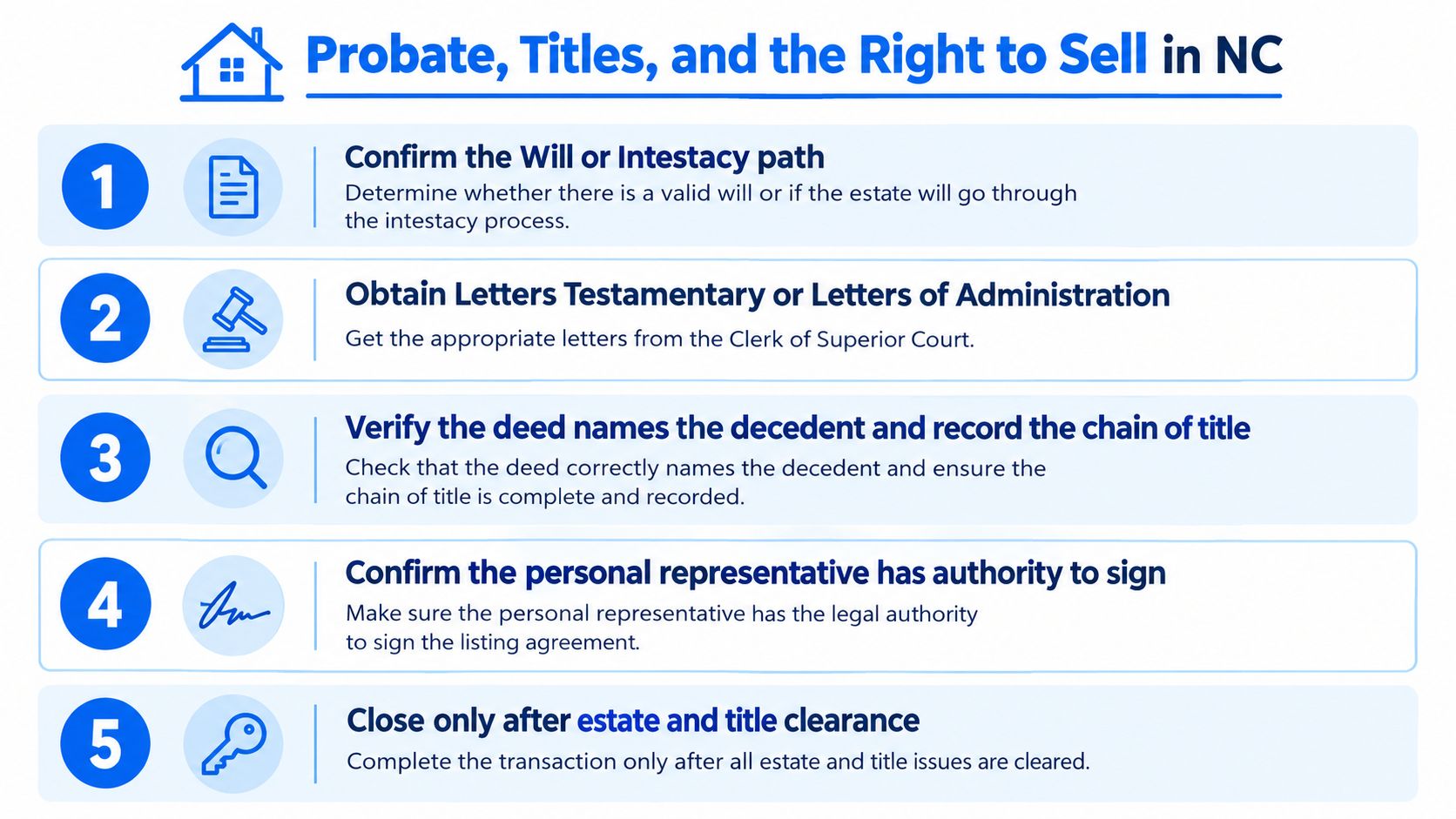
Start with the estate file and the deed. Do that before you clean out the house, hire an agent, or accept an offer. In North Carolina, inherited property does not always move through probate in the same way people expect, and land is often treated differently from bank accounts and other estate assets. If you guess wrong about who has signing authority, you waste time and risk a contract that never reaches the table.
Confirm the estate path
Pull the original will, death certificate, and county probate file first. Then answer the only question that matters at the start, who has legal authority to sign the deed.
If there is a will, read it closely. You need to know whether it gives the personal representative authority to sell or administer the property, or whether title passed directly to devisees subject to the estate process. If there is no will, the estate follows intestacy rules, and the clerk's file becomes even more important because family assumptions do not control title.
Next, confirm the appointment documents. Letters Testamentary or Letters of Administration are what matter in practice. A person named as executor in the will should not sign listing papers or a contract until the appointment is official. The personal representative may also need to deal with creditor notice, estate debts, and approval issues before sale proceeds can be distributed.
Check title before you take the market seriously
Order a title search through a North Carolina closing attorney or title company early. Do not wait until you have a buyer. The search should show the current deed, prior transfers, deeds of trust, judgments, liens, unpaid charges, and any break in the chain of title.
This step answers the closing-table questions that families often miss. Did the property pass outside probate. Is the estate still open. Do multiple heirs need to sign. Is a court filing, consent, or corrective document still missing. A verbal family agreement does not cure a title problem.
Use this checklist while the file is being reviewed:
- Obtain the death certificate and will.
- Identify the county probate file.
- Confirm the appointed personal representative.
- Verify signing authority and any co-signature requirements.
- Order the title search.
- Identify mortgages, liens, judgments, and estate debts.
- Preserve the valuation and closing records.
- Keep proceeds in the proper estate or trust account until obligations are resolved.
If the property is still held by the estate, the personal representative usually signs the listing agreement, purchase contract, and deed. Heirs can coordinate access, cleanout, repairs, and buyer communication, but that does not give them conveyancing authority. Money also needs to be handled in the right order. Paying heirs before liens, debts, taxes, and closing adjustments are resolved is a reliable way to create disputes that should have been avoided.
If you want a practical walkthrough of how this process plays out in an inherited sale, Cyber Homes' guide to selling a home in probate is a useful overview. Still, the closing attorney on your file is the person who should confirm exactly what must be signed, filed, and paid before transfer.
The video below provides additional background on estate-sale mechanics and the legal questions families often encounter.
By the time you reach closing, the file should prove four things clearly: the signer has authority, the estate can convey title, secured debts will be paid off, and the settlement statement shows where proceeds go. If one of those pieces is missing, the buyer's attorney or title insurer will pause the transaction, and they should.
Tax Basis, Date-of-Death Value, and What You Actually Owe
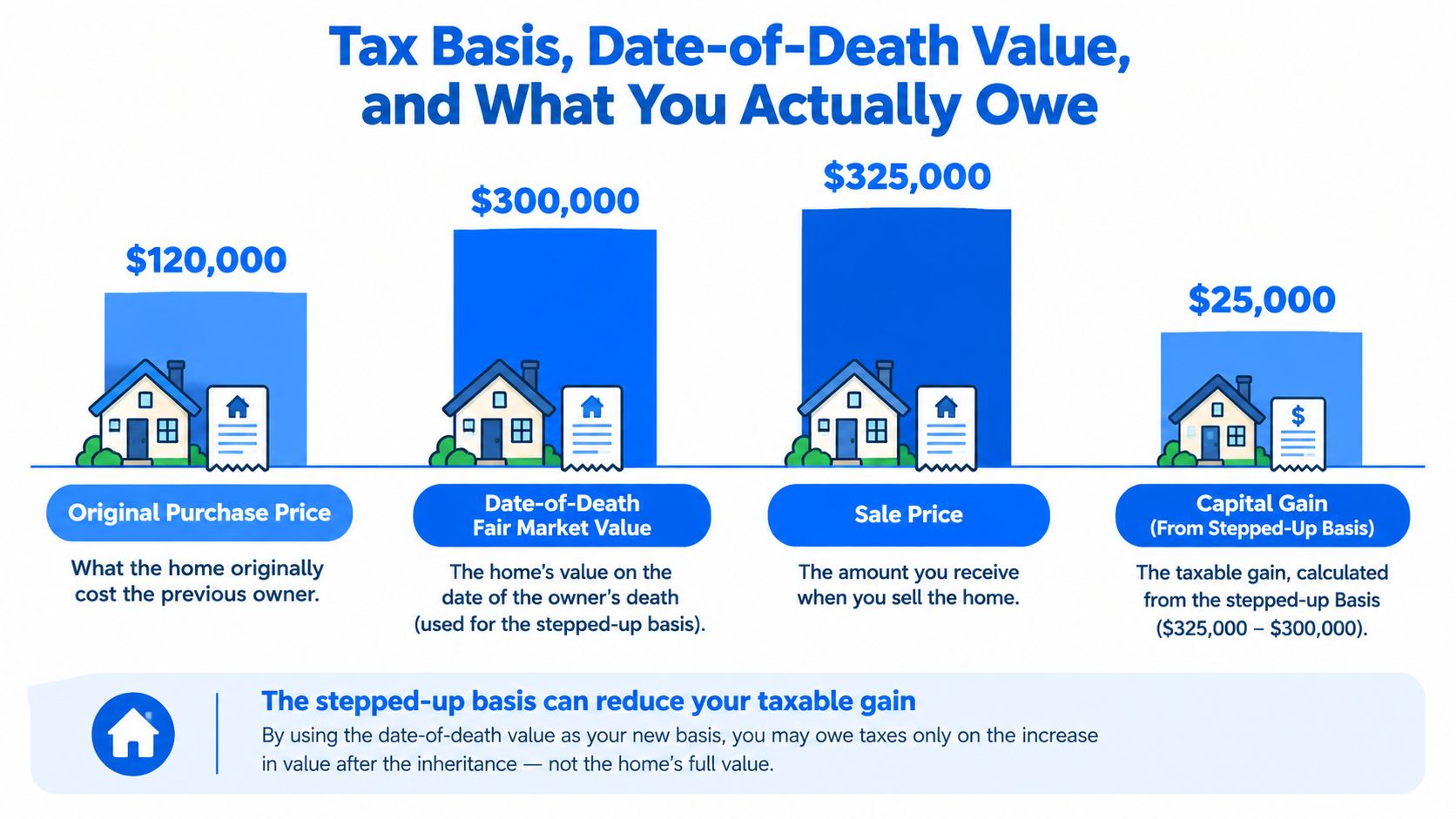
Heirs get tripped up here all the time. They focus on the sale price and miss the number that drives the tax result, the property's basis. In an inherited sale, that usually starts with the home's fair market value on the decedent's date of death, then changes based on records, including documented improvements, selling costs, depreciation, and other adjustments.
The IRS explanation of gifts and inheritances is the rule most families need. Inherited property generally gets a basis equal to fair market value on the date of death. An alternate valuation date applies only if the executor filed an estate-tax return and made that election. For federal capital gains treatment, the inherited holding period is generally treated as long-term, even if you sell soon after receiving the property.
Build the calculation from records
At the closing table, the fight is usually not over the rule. It is over proof.
If the date-of-death value was $300,000 and the property later sells for $315,000, the tax result may be far smaller than heirs expect once $20,000 in eligible selling costs and other documented adjustments are applied. That is why basis paperwork matters as much as probate authority. If you cannot support the number, you invite a problem you did not need.
Start with valuation evidence and keep it organized. A formal appraisal is the cleanest record, but a defensible market analysis can still matter. The Homes By Carmen valuation guide gives a plain-English overview of how property value is established. Then gather repair and capital-improvement invoices, the settlement statement, mortgage payoff information, and any rental records. If the house was rented, prior depreciation can change adjusted basis, and that needs to be reconciled before the return is prepared.
Do not fall back on the decedent's original purchase price unless a tax professional tells you that is the right rule for your file. A different basis assumption can change the outcome dramatically. If the decedent bought the house for $120,000 and it later sells for $300,000, a carryover-basis approach would start from that lower figure before improvements, selling expenses, and other adjustments. The North Carolina General Assembly historical overview helps explain the state's historical estate-tax background. The practical point for heirs is simpler. Do not assume today's market value is automatically the correct tax basis without checking how title passed and what tax treatment applies.
North Carolina heirs also mix up inheritance tax with income tax. Receiving the house generally does not mean you owe a state inheritance-tax bill just because you inherited it. Selling it can still trigger federal and state income-tax reporting if adjusted sale proceeds exceed the applicable basis.
Get your tax file lined up before you accept an offer, not after inspection credits and closing costs start shifting the numbers. Have the attorney or tax adviser handling the return review the date-of-death valuation, Form 706 status if applicable, improvements, depreciation, liens, and final net proceeds. If you are weighing convenience against possible net proceeds, this overview of Cyber Homes' inherited-property sale process shows how an as-is sale is typically handled.
Get a cash offer for your home
Comparing Your Realistic Selling Routes in NC
Once authority and basis records are in place, the selling route becomes a business decision. Don't choose based on the headline offer alone. Compare the expected net proceeds, work required, timing, buyer contingencies, and probability that the transaction will reach closing.
The table below is a practical comparison. “Typical days to close” varies by title status, probate requirements, buyer financing, property condition, and the parties' agreement. No route guarantees a specific timeline.
| Route | Typical Days to Close | Repairs Needed | Net Proceeds | Certainty |
|---|---|---|---|---|
| MLS listing with an agent | Varies with preparation, buyer financing, and title clearance | Often some cleaning, repairs, or staging | Often strongest gross-price potential, reduced by selling costs and commissions | Depends on buyer financing, inspections, appraisal, and contingencies |
| For-sale-by-owner | Varies with seller marketing and buyer financing | Seller decides, but retail buyers may request work | Avoids an agent commission, but marketing and negotiation fall on the seller | Depends heavily on buyer qualification and contract terms |
| Direct cash sale | Often faster when title and authority are ready | Usually no required repairs for an as-is buyer | Usually reflects a discount for convenience, repairs, and certainty | Stronger when the buyer has verified funds and a reputable closing partner |
| Auction | Set by auction schedule and title readiness | Presentation and disclosures still matter | Competitive bidding may help, but marketing and auction costs reduce proceeds | No-sale risk remains if bidding doesn't meet expectations |
| Short sale | Controlled by the mortgage lender's approval process | Usually limited by financial pressure | Proceeds may be below the debt and require lender approval | Lower, because a lender must approve the transaction |
When an MLS listing fits
An agent-led listing makes sense when the house is marketable, the family can manage preparation, and maximizing price matters more than reducing workload. Retail buyers may pay more for a clean, well-presented home, but they also bring inspections, financing, appraisal, and negotiation variables.
The personal representative must still have authority before signing. Marketing a property doesn't cure a defective estate file, and a buyer's lender or title insurer will eventually demand the same ownership evidence.
When FSBO or auction makes sense
FSBO can work for an organized seller who understands disclosure, pricing, contract deadlines, and buyer screening. It shifts the burden to the heir or representative, including arranging access, collecting documents, negotiating repairs, and coordinating the closing attorney.
An auction offers a defined sales event and visible competition, but it isn't automatically faster or more profitable. Marketing expenses, auction terms, buyer deposits, and the possibility of an insufficient bid need to be understood in writing.
When a direct sale or short sale is more practical
A direct cash sale suits a property that needs substantial work, sits vacant, or is difficult for distant heirs to manage. It can also reduce the exposure to buyer financing and repeated showings. The trade is usually a lower price than a successful retail sale.
A short sale is different. If the mortgage payoff exceeds the likely sale proceeds, the lender must approve the proposed settlement, and the estate should obtain legal and tax advice before signing. Don't describe a short sale as an ordinary cash transaction. The lender controls a critical part of the outcome.
When a Cash Investor Like Cyber Homes Is the Right Call
A cash investor is the right call when the estate's real problem is not marketing. It is getting to a closing without repair work, financing fallout, and weeks of back-and-forth while the family is still sorting out authority papers and tax-basis records.
That matters in inherited sales. Heirs often assume the house should hit the market first and the paperwork can catch up later. In practice, the two bottlenecks are the same ones that stall closings across North Carolina. The estate needs clear authority to sell, and the family needs enough documentation to understand the numbers. If those pieces are underway, a direct cash-buyer in North Carolina can make sense for the right property.
The fit is usually pretty obvious. One heir is out of state. The house is vacant. There is water damage, deferred maintenance, old systems, or a full cleanout ahead. Nobody wants to hire contractors, coordinate showings, or keep the property presentable for weeks. In that situation, paying for prep work just to chase a higher list price is often the wrong move.
Cyber Homes is one example of a buyer that purchases inherited and estate property as-is and does not require the seller to complete repairs before closing.
What the tradeoff looks like
You are buying certainty with price. An as-is investor will account for repairs, carrying costs, resale risk, and the convenience of a simpler deal. If the property could show well after cleanup and updates, a retail listing may bring more. If the house is a burden and the estate needs a controlled exit, the lower offer can still be the better outcome.
A direct offer usually fits when:
- The house needs major work: You do not want to spend money upfront without knowing whether the market will reward it.
- The heirs live far away: Managing access, vendors, and recurring property issues from another state is hard to do well.
- The estate wants fewer moving parts: Reducing financing and inspection risk can matter more than squeezing out every dollar.
- The property is vacant: Ongoing security, utilities, yard care, and maintenance create drag every month.
- The family needs one clear path: A private sale is often easier to coordinate than juggling multiple buyers and repair requests.
Do not sign the first short contract put in front of you. Ask for the exact price, earnest money, inspection or cancellation rights, who chooses the closing company, whether the contract can be assigned, what title documents the buyer expects, and every deduction from proceeds. Then confirm the agreement names the correct personal representative or owners.
If you want a simple outline of the steps, review the Cyber Homes cash home-buying process. Fast only helps when the buyer can perform and the title attorney can insure the conveyance.
Get a cash offer for your home
Negotiating, Closing, and NC-Specific Paperwork
North Carolina closings are attorney-centered, and inherited transactions require more than a standard purchase contract. The closing attorney or title company coordinates title examination, payoff information, deed preparation, probate documents, settlement figures, and recording.
The transaction usually begins with an offer using the North Carolina Offer to Purchase and Contract or another attorney-approved agreement. Read the due-diligence terms carefully. The contract should make clear the due-diligence fee, earnest money, inspection rights, closing date, personal-property treatment, and remedies if a party fails to perform.
What happens before the closing date
The buyer may inspect the property during due diligence and negotiate repairs or credits. The estate should avoid promising work before the representative, heirs, and attorney agree on the authority to make that commitment.
Meanwhile, the closing attorney reviews:
- Authority documents: Probate appointment, will, trust documents, or evidence of ownership outside probate.
- Title evidence: Deed history, liens, judgments, deeds of trust, and ownership discrepancies.
- Debt information: Mortgage payoff, estate obligations, taxes, utilities, association charges, and other closing adjustments.
- Seller signatures: The personal representative, owners, spouses, trustees, or other parties required by the title examination.
- Tax records: Date-of-death valuation, improvement documentation, depreciation history, and the final settlement statement.
Earnest-money release questions should go directly to the attorney. Don't authorize a release casually when heirs disagree or the estate still has unresolved claims.
Protect the wire and the file
Review the settlement statement against the accepted contract and the basis records. Confirm the sales price, payoff amounts, attorney charges, recording charges, prorations, commissions if any, credits, and net proceeds. The representative should know whether funds will be wired to the estate, trust, or another account and what authorization supports later distributions.
Re-verify wiring instructions by calling a known phone number for the attorney or title company. Never rely solely on an email change request. After closing, preserve the deed, settlement statement, payoff letters, authority documents, valuation, and beneficiary instructions in the estate file.
Your Inherited-Property Action Checklist
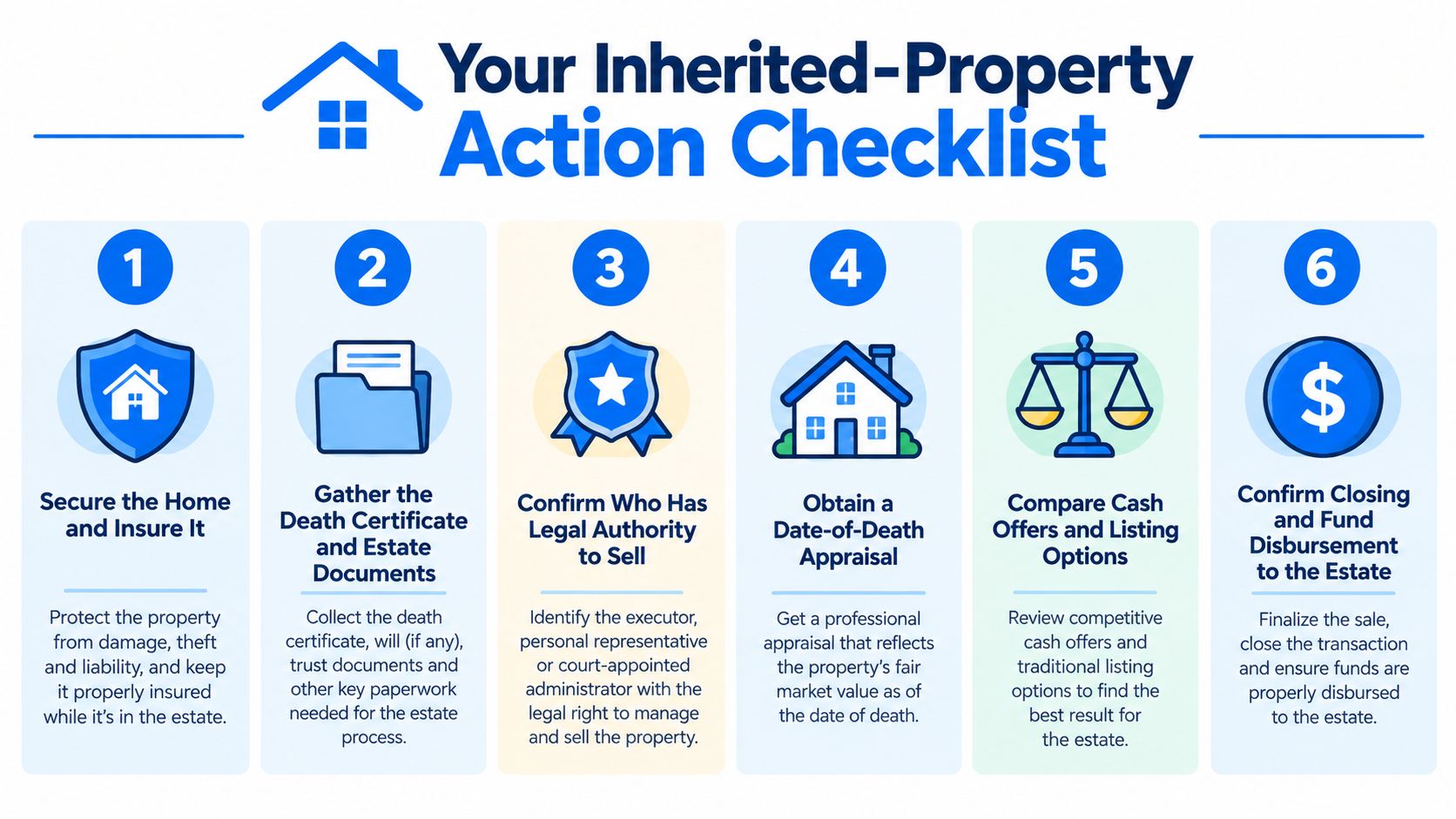
Inherited sales stall in two places. Sellers lack clear authority to sign, or they cannot prove tax basis cleanly when the deal is done. Run your file around those two bottlenecks first, then handle everything else.
Assign one person to own each step and set deadlines. Shared responsibility is how estate sales drift.
- Secure the house: Change access, keep utilities on, and make sure the insurance matches the property's current status.
- Open the file: Pull the death certificate, will, probate papers, mortgage information, prior deed, and old closing statements.
- Confirm authority: Get the letters, trust documents, or other ownership records that show who can sign a contract and deed.
- Document basis: Order the date-of-death value and keep receipts for improvements, selling expenses, and any depreciation tied to prior rental use.
- Choose the route: Compare a listing, FSBO, auction, short sale, and direct buyer against the estate's real priorities, speed, price, repairs, privacy, and certainty.
- Close and distribute properly: Have the attorney match the settlement statement to the contract, pay valid estate obligations, and release proceeds the right way under the estate plan.
A few trouble spots deserve a direct answer. How long will it take? As long as authority, title issues, creditor claims, heir disputes, financing, and condition make it take. Must every heir agree? Only the parties with legal authority need to sign, but do not guess. Let the closing attorney answer that before anyone signs. What if tenants are in place? Check the lease, deposit, notice requirements, and possession terms before you market. What if probate already closed? If multiple heirs now hold title, the current owners and any required spouses may need to sign, subject to title review.
If you want an as-is option, compare it the same way you would any other route. Review authority and basis documents first, then get the offer and measure it against a traditional listing on speed, repairs, closing risk, and net proceeds.

Edited by
James Vasquez
Real Estate Investor & Land Specialist with 10+ years experience in residential flipping, vacant land investing, land wholesaling, and subdivision deals.
Disclaimer: The information provided is for educational purposes and does not constitute financial or legal advice. Always consult with licensed professionals before making investment decisions.