Selling an Inherited Property in Dallas, TX: Key Steps
If you've inherited a house in Dallas, the pressure usually shows up fast. A sibling wants it listed, the mail is still coming, the keys are somewhere in a drawer, and nobody's fully sure who can sign what yet.
Selling an inherited property in Dallas, TX is possible, but the first real question is legal authority. Until you know who can act for the estate, whether the title is clear, and what the title company will require, a quick sale can stall at the closing table.
This is general information, not legal or tax advice. Dallas estates move more smoothly when heirs confirm authority early, keep paperwork organized, and treat tax basis as a real issue, not an afterthought.

Get a cash offer for your home
Understanding Who Can Sell an Inherited House in Dallas
A family gets a call from a Realtor, a buyer, or even a cousin who says, “Let's just list it.” That sounds simple until someone asks for a deed, a death certificate, or proof that the signer can bind the estate. The person named in a will may be the right person to move things forward, but that doesn't always mean they can sign a listing agreement or deed on day one.

Authority depends on how the home passed
If there's a will, the court-appointed executor is usually the person who can move the estate forward once the right probate documents are in place. If there's no will, an administrator may need appointment before anyone can sign for the estate. If the home is in a living trust, the trustee may already have selling authority under the trust terms.
Joint ownership and survivorship rights can simplify things, but only when the title documents support that result. A transfer-on-death deed can also change how title passes, but the paperwork has to be reviewed carefully before anyone assumes the property can be sold immediately.
Practical rule: the person who inherits emotionally is not always the person who can sell legally.
Multiple heirs inherited property creates another layer. The family may agree in principle, but if title is still in the decedent's name or the heirs have not cleared the estate records, the title company may not be ready to close. That's why a quick conversation about “selling the house” has to turn into a title question very early.
For a broader plain-English overview of inherited-home sales, this Dallas-focused guide on inherited property is useful background, but the definitive answer always comes from the deed, the probate file, and the title company's requirements.
The Step-by-Step Process to Sell Inherited Real Estate
The sale usually starts with paperwork, not pricing. A family can agree that the house should be sold, but the title company still needs to see who has authority, what debts attach to the property, and whether the estate file is clean enough to close.
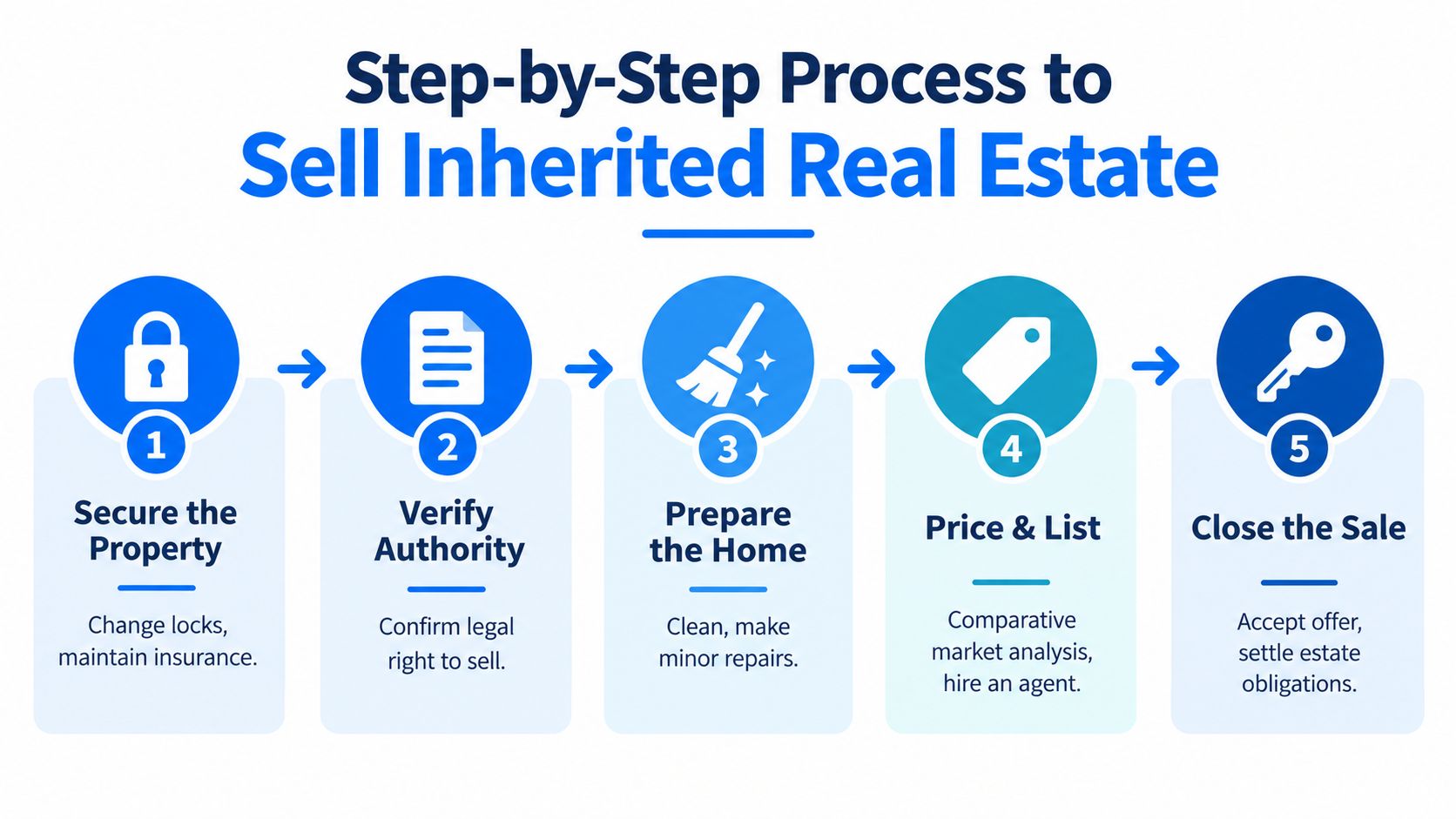
Secure the property first
Lock the house down right away. Change locks if needed, keep utilities and insurance active, and deal with any safety hazards before anyone starts showing the home. If the property has been vacant, check it regularly so a leak, break-in, or storm problem does not turn into a larger claim.
Confirm who can sign
The next question is who can legally move the deal. Review the will, probate file, trust records, death certificate, and any recorded instruments tied to the property. If heirs are involved, determine whether one person has signing authority or whether every owner must join the sale. A family agreement helps, but it does not replace title authority.
Clear title issues before you list
Old mortgages, unpaid property taxes, liens, judgments, and HOA balances can stop a closing until they are addressed. Title defects and unresolved heirship questions can do the same. If the house is cluttered or neglected, a non-toxic deep cleaning in Dallas can make the property easier to show. Budget roughly a few hundred dollars for a deep clean versus several thousand for pre-listing repairs, and only do it if showings are planned.
Choose the right exit path
At that point, compare the actual options. Some inherited homes sell best after repairs, some should be sold as-is, some should go on the MLS, and some make more sense as a direct offer. The right choice depends on net proceeds, timing, and the risk of delays, not just the headline price. A higher offer can still produce less money if the buyer wants credits, repairs, or a long closing timeline.
Close and distribute the proceeds
Once the offer is accepted, the closing documents have to match the estate structure. The proceeds then go to the estate or the heirs under the will, trust, or probate instructions. If any earlier step was skipped, the problem usually shows up at the closing table.
Probate and Title Issues That Can Delay a Sale
Probate gets described as if it's one single hurdle, but in real life it's really a set of authority and title questions. The estate structure, court orders, and the role of the executor, administrator, or trustee all affect whether the sale can move now or has to wait for more paperwork.
The Law Office of Bryan Fagan, PLLC offers a helpful heirship real property records guide for families trying to sort out ownership records in Dallas County.
The usual delay points
The most common problems are straightforward, but they're easy to underestimate.
- Missing wills: If the family can't find the will, the title company may need extra proof before it will accept the seller's authority.
- Unknown heirs: Unclear family lines can slow title clearance because the company has to determine who has an interest.
- Multiple heirs who disagree: A sale can stall when one person wants to hold, another wants to rent, and a third wants out.
- Old mortgages or unpaid property taxes: These are often resolved at closing, but they still have to be identified early.
- Liens, judgments, or HOA balances: Any of these can affect the net proceeds and the ability to insure title.
- Title defects: A bad legal description, an old deed problem, or a missing conveyance can create a closing delay.
- Trust or co-ownership issues: Property held in trust or with another owner may require different paperwork than the family expected.
- Personal belongings still inside: A house full of furniture, records, and heirlooms can slow clean-out, showings, and possession dates.
Probate doesn't always mean the house must sit untouched until everything is final. It means the family has to know who has authority, what the title company will accept, and what the court or estate documents allow.
The Dallas version of this process is often document-heavy. If the title company can't connect the death certificate, probate file, deed chain, and seller authority, the deal slows down no matter how ready the buyer is. That's why a property can be emotionally “ready” long before it is legally ready.
For families who want a second reference point, this probate sale overview is helpful, but the actual path still depends on the estate file and the title review.
Get a cash offer for your home
Comparing Selling Options for Inherited Houses
Families usually narrow the choice to three paths. Each one works in different situations, and the right answer depends on condition, timing, and how much uncertainty the heirs can tolerate.
Traditional listing, as-is listing, and direct offer
A traditional agent listing can make sense when the house is in good shape and the family wants the broadest market exposure. An as-is MLS listing keeps buyer exposure high while acknowledging that the house needs work. A direct cash offer inherited house route can be useful when the home needs major repairs, still has belongings inside, or the family values speed and simplicity more than top-dollar positioning.
| Option | Best For | Speed | Potential Price | Complexity |
|---|---|---|---|---|
| Traditional agent listing | Homes in good condition where price matters most | Moderate | Usually highest market exposure | Higher prep and showings |
| As-is MLS listing | Homes needing work but still suitable for retail buyers | Moderate | Often lower than fully repaired sales | Moderate |
| Direct cash buyer | Major repairs, urgent timelines, clutter, distance, or simplicity | Fastest | Usually lower, convenience priced in | Lower day-to-day effort, but title still matters |
A lot of families ask whether they can just sell inherited house as-is and skip the rest. As-is helps with condition, not with title. It does not remove the need to resolve ownership, liens, mortgages, disclosures, or estate authority before closing.
Bottom line: price and certainty often trade places. The more convenience the seller wants, the more carefully the family should compare the net proceeds.
If an heir is out of state, a direct offer can reduce travel and coordination, but it still needs careful document review. This Dallas cash-buyer resource is one example of the direct-offer route, though families should always compare multiple options before deciding.
Documents, Taxes, and the Step-Up in Basis Explained
The fastest sales still slow down when the paperwork is thin. A title company can tell you exactly what it needs, but families move better when they gather the core records early.

Keep these records together
- Death certificate: Usually one of the first documents a title company will ask to see.
- Will, trust, or estate papers: These show how the property passed and who can act.
- Court appointment documents: Useful if an executor or administrator has been appointed.
- Deed and property tax records: These help confirm ownership and tax status.
- Mortgage payoff statement: Needed if there's a loan still secured by the home.
- HOA documents: Important if the property is in a neighborhood, condo, or planned community.
- Insurance, repair, and improvement records: These can support the sale file and help explain the home's condition.
- Title documents and lien information: These help identify what must be cleared before closing.
- Government ID for the seller or estate representative: The closing company will need to verify identity.
A date-of-death valuation matters because inherited property generally gets a stepped-up basis at fair market value on the decedent's date of death under federal rules. The IRS says that basis must be determined before deciding whether the sale is taxable, and it also notes that gross sale proceeds can affect reporting and filing obligations. An executor may also provide estate-value documentation through Form 8971 when applicable, so heirs should coordinate with the executor and a qualified tax professional.
For Dallas families, the practical point is simple. If a home is valued at $400,000 on the date of death and later sells for $425,000, the preliminary gain is about $25,000 before adjustments, rather than the much larger spread from the original purchase price, according to the IRS inheritance guidance at IRS basis rules for gifts and inheritances.
Keep the records that support the final number
That means preserving the appraisal, closing statement, improvement receipts, and estate documents. If the home sells later for more than the date-of-death value, those records help determine what is taxable and what is not. When the value or tax exposure is significant, a CPA or tax professional should review the file before anyone signs off on distribution.
Get a cash offer for your home
Handling Multiple Heirs and Local Dallas Considerations
When siblings or other heirs disagree, the sale becomes more than a real estate problem. One person wants speed, another wants repairs, and a third wants the family to keep the house. Those disagreements can freeze the process unless the group documents decisions and keeps communication in writing.
Keep disagreement from becoming a title problem
If heirs can't agree on price, cleanup, personal property, or timing, the closing doesn't move cleanly. Written notes help, especially when one heir is out of state and another is handling the property day to day. If the conflict starts to affect authority or possession, an estate attorney or mediator should get involved before the dispute hardens.
Dallas adds its own documentation layer. Dallas Central Appraisal District defines heir property as property acquired by will, transfer-on-death deed, or intestacy where at least one owner claims it as a residence homestead. If an owner isn't identified as the homestead owner on a recorded deed or other county instrument, the county may require an ownership affidavit, the decedent's death certificate, the latest utility bill, and any available court record concerning ownership. Other occupying heirs may also need authorizing affidavits.
Local issues that show up often in Dallas
- Probate records: Dallas County probate and clerk records often need to line up with the deed chain before a title company will issue clean closing instructions.
- Homestead treatment: Heir property homestead status doesn't transfer automatically to every heir. Eligibility depends on occupancy, ownership, and the county's documentation rules.
- Property taxes: Texas property tax is locally assessed, so unpaid taxes may need to be handled in settlement.
- HOA and condo rules: Neighborhood dues, special assessments, and resale documents can add another layer of review.
- Regional property concerns: In Dallas, foundation movement, storm damage, and long-deferred maintenance often affect pricing and buyer expectations.
The market also matters. Redfin reported a median Dallas sale price of about $449,000 over the three months ending August 2026, with 2,681 homes sold in August and a year-over-year price change of roughly negative 0.066%, according to its Dallas housing market page at Dallas housing market data. That's a city benchmark, not an appraisal of any specific inherited property, but it does show why condition, neighborhood, and title readiness all matter before heirs accept an offer.
Next Steps and When to Seek Professional Help
The cleanest path is usually the one that confirms authority first, then title, then tax treatment. Gather the documents, ask the title company what it needs, and get an estate attorney and CPA involved when the ownership structure or tax exposure isn't simple.
This guide is general information, not legal or tax advice. If you're handling selling inherited property in Dallas, TX, the safest next move is to verify who can sign, what title issues exist, and how the sale should be reported before anyone commits to an offer.
Cyber Homes works with Dallas families who need a direct sale option for inherited homes, including properties that need repairs or a fast closing. If you want a simple way to compare a cash offer against an agent sale, visit Cyber Homes and review the next steps for your property.

Edited by
James Vasquez
Real Estate Investor & Land Specialist with 10+ years experience in residential flipping, vacant land investing, land wholesaling, and subdivision deals.
Disclaimer: The information provided is for educational purposes and does not constitute financial or legal advice. Always consult with licensed professionals before making investment decisions.