Selling an Inherited Property in Nashville, TN: 2026
Updated for 2026
You've inherited a Nashville house while managing grief, paperwork, family expectations, and bills that didn't stop when the owner died. The fastest way to create an expensive problem is to list the property before confirming who has authority to sell it.
Selling an inherited property in Nashville, TN is possible, but the first step isn't hiring an agent or ordering repairs. It's determining whether the home passed through probate, a trust, joint ownership, or another transfer method, then confirming that the person signing the contract can legally convey marketable title. This guide is general information, not legal or tax advice. Tennessee probate counsel, a title company, and a tax professional should review the facts of your estate.

Get a cash offer for your home
Confirming Your Legal Authority to Sell
Start by securing the property. Change the locks if appropriate, confirm that insurance remains active, notify the insurer that the home may be vacant, and arrange basic upkeep. Keep utilities, climate control, and alarms operating when needed to prevent damage. Photograph the property and its contents before relatives remove personal belongings.
Then gather the foundational records:
- Death certificate: Obtain a certified copy for the title company, probate attorney, and financial institutions.
- Estate papers: Locate the original will, trust documents, beneficiary designations, and any prior deeds.
- Property records: Collect tax statements, mortgage information, insurance policies, repair invoices, and HOA correspondence.
- Family information: Prepare contact details for every potential heir, including relatives who live outside Tennessee.
Ownership and selling authority are related, but they aren't identical. A person named in a will may be the intended executor, yet still need formal court appointment before signing for the estate. A beneficiary may inherit an interest but lack authority to sell the entire property alone. A trustee may have authority if the home was properly titled in a living trust. A surviving joint owner may be able to transfer the property independently, depending on the deed language and recorded ownership.
Practical rule: Don't spend estate money on major repairs until a title search and authority review show who can approve that expense and sign the sale documents.
Nashville estates are generally handled through the appropriate Tennessee chancery court unless a county has a special probate court. Tennessee's probate materials begin with determining whether a will exists and locating the original document. That makes the initial order clear: secure the home, gather records, and establish authority before marketing it.

A premature listing can waste money and weaken negotiations. If the title company later discovers that another heir, a prior estate, or a lienholder must participate, the buyer may walk away or demand a new closing schedule. Authority problems, not outdated carpet or an overgrown yard, often cause the delay.
Navigating Probate and Title Requirements
The correct selling pathway depends on how the Nashville property was owned when the decedent died.
Identify the person who can sign
An executor is named in a will, but the will alone may not prove present authority. The executor usually needs court appointment documents, often called letters testamentary, before acting for the estate.
An administrator performs a similar role when there is no will or when the named executor can't serve. The court appoints the administrator, who then handles estate assets, debts, and any real-estate sale according to Tennessee requirements.
A trustee handles property held in a living trust. If the deed transferred the house to the trust and the trust names a successor trustee, the trustee may sell without the same probate process used for individually owned property. The title company will still require the trust and evidence that the trustee has authority.
A surviving joint owner may receive the property through survivorship rights. That result depends on the recorded deed, not on family assumptions. A deed that lacks survivorship language can produce a different outcome, particularly when another estate was never administered.
A transfer-on-death arrangement must also be verified through the recorded instrument and applicable Tennessee law. Don't assume a beneficiary designation overrides the deed or eliminates every title requirement.
Multiple heirs create a separate issue. If the property passes directly to several heirs, each person may hold an ownership interest and the title company may require every necessary signature. If an executor or administrator has authority to sell for the estate, the signing process can differ, but the representative still must follow the governing estate documents and court requirements.
Tennessee probate jurisdiction generally lies with chancery court, while Nashville estates commonly involve Davidson County Probate Court. Begin with a title search and probate-status review, not a purchase agreement. The title company must identify liens, unpaid taxes, mortgages, judgments, prior deeds, and claims connected to the estate before it can insure the buyer's title.
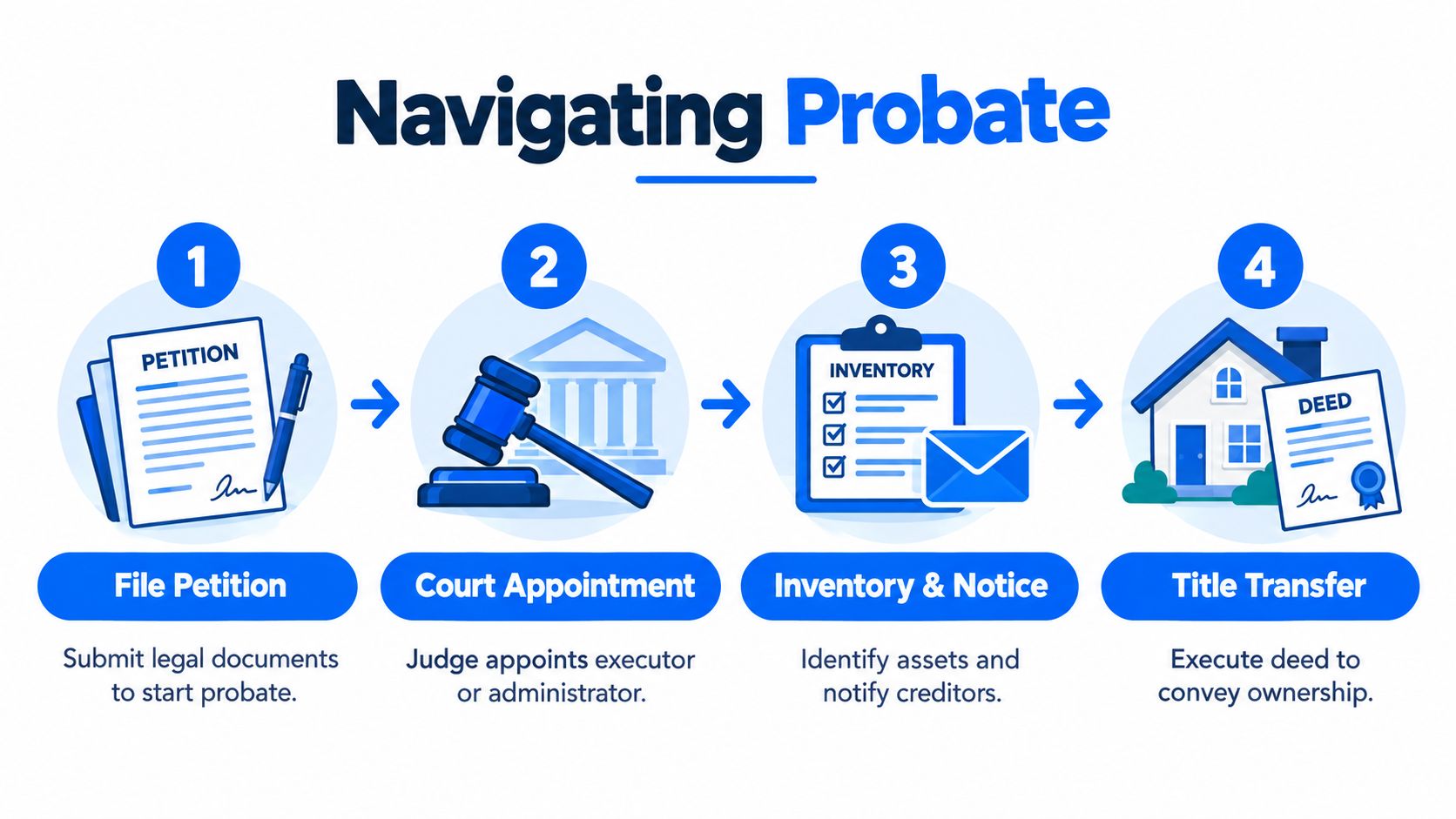
A helpful general explanation of how courts, representatives, assets, and title transfers interact is available in these Texas probate insights from Bryan Fagan. Texas law isn't a substitute for Tennessee advice, but the distinction between court authority and beneficiary status is useful.
For a practical overview of transaction issues, review this guide to a probate house sale. Nashville heirs should treat it as background only and have a Tennessee attorney confirm the actual procedure.
Expect title issues to control the schedule
Common bottlenecks include:
- A missing original will or uncertain beneficiary.
- An heir who died before the property could transfer.
- A relative whose address is unknown.
- Multiple heirs who disagree about price or timing.
- An old mortgage, judgment, lien, or unpaid tax balance.
- A home still titled in a decedent's name from an earlier generation.
- A trust whose deed and beneficiary records don't match.
- Personal belongings that heirs haven't allocated or removed.
You may be able to market or negotiate a sale before probate is complete, but closing and distribution depend on authority, court orders, local law, and title requirements. Never promise a buyer that the transaction can close until the probate attorney and title company confirm the path.
Essential Documents for a Smooth Closing
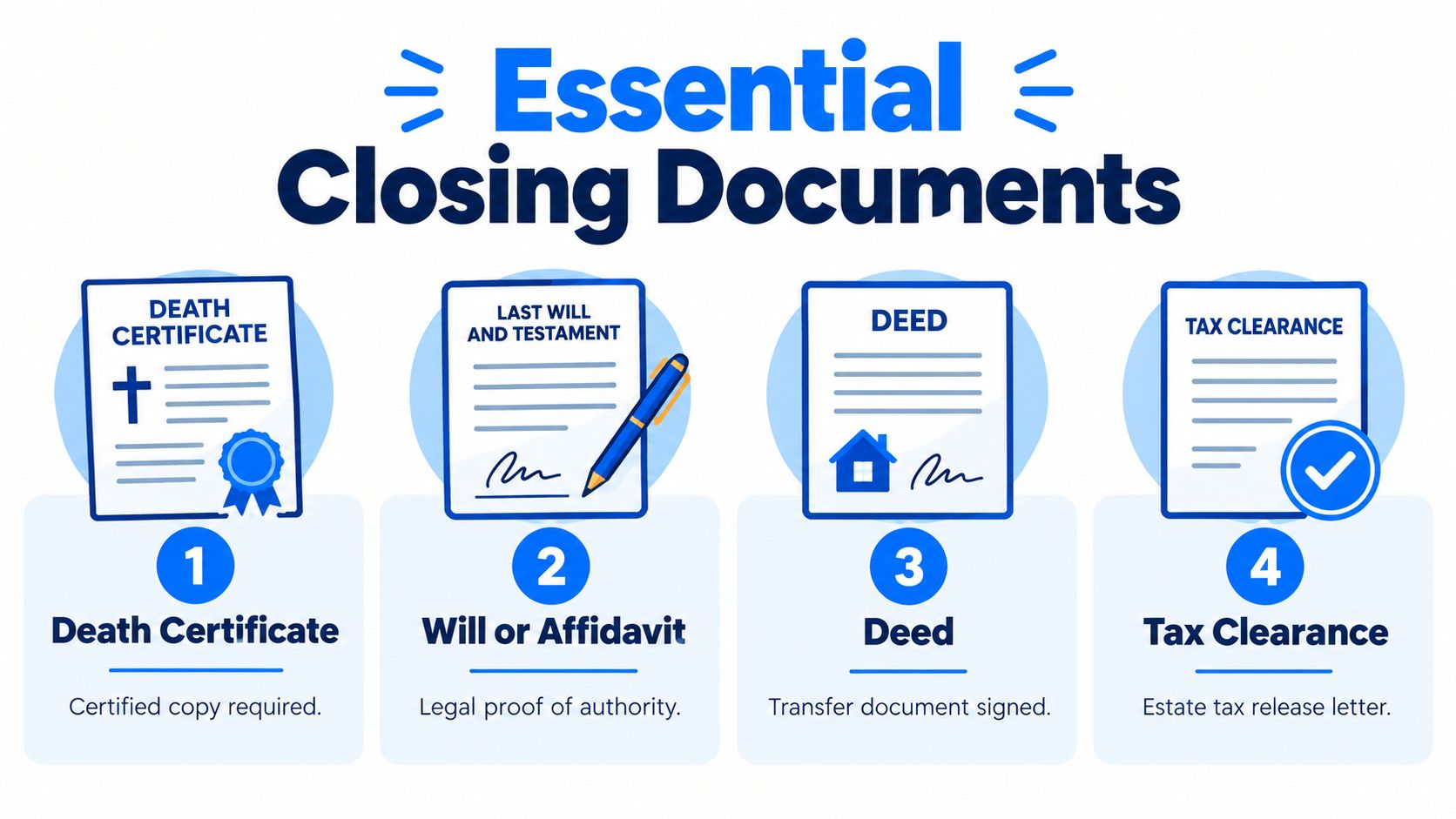
A title company can identify the exact closing package after reviewing the deed and estate structure. You can make that review faster by creating one organized digital and paper file.
Build the estate file first
Use this checklist:
- Certified death certificate: The title company may need proof of death before it can determine how the property transferred.
- Original will: Include probate filings, court orders, and letters testamentary if an executor was appointed.
- Trust documents: Provide the relevant trust, amendments, certification of trust, and trustee appointment records when the property was held in trust.
- Administrator records: Include letters of administration and any orders authorizing the sale.
- Recorded deed: Confirm the exact owner, vesting language, survivorship rights, and legal description.
- Tax records: Gather Davidson County property-tax statements and evidence of payments or balances.
- Mortgage payoff information: Request a current payoff statement from every lender, including a reverse-mortgage servicer if applicable.
- HOA or condominium records: Provide account information, unpaid assessments, transfer requirements, contact details, and resale documents when relevant.
- Insurance records: Include the policy, vacancy communications, claims, and notices about occupancy.
- Repair and improvement records: Preserve invoices, permits, contractor agreements, and evidence of capital improvements.
- Title and lien information: Give the closing company prior title policies, judgments, payoff letters, and recorded releases.
- Government identification: The executor, administrator, trustee, surviving owner, or other seller will need valid identification for signing.
Protect the valuation evidence
Arrange a professional date-of-death appraisal or another defensible valuation record before the property changes condition or sells. Tennessee requires inherited property to be valued at its full and true value on the decedent's date of death for inheritance-tax purposes, with an alternate valuation date potentially available when the applicable rules permit it. The Tennessee Revenue guidance on valuing inherited property explains why that valuation should be documented.
For Davidson County property taxes, Nashville's Metropolitan Trustee states that taxes become due on the first Monday of October and must be paid by the last day of February of the following year to avoid interest. At closing, the settlement statement should prorate unpaid or prepaid taxes according to the contract and closing date.
The title company will also check for estate-related claims and liens. Tennessee's Department of Revenue states that the state has a statutory lien on property owned by the decedent, and an administrator may need an Inheritance Tax Consent to Transfer before transferring real property under the applicable process. Confirm whether that clearance applies to your estate before accepting a closing date.
Get a cash offer for your home
Choosing the Right Selling Strategy in Nashville
Once authority and title are under control, decide whether the property should be sold conventionally, listed as-is, or offered directly to a cash buyer. Don't choose based on the highest apparent price. Compare the expected net proceeds after repairs, carrying costs, commissions, taxes, insurance, utilities, maintenance, contractor risk, and the time required to close.
The Nashville-Davidson housing index from the Federal Reserve Bank of St. Louis rose from 481.09 in the fourth quarter of 2025 to 484.71 in the first quarter of 2026, an increase of approximately 0.75% between those quarters. That index provides broad market context, not a value for a particular inherited house. Neighborhood, condition, lot, title status, occupancy, and deferred maintenance matter more to the actual offer. The Federal Reserve's Nashville-Davidson house-price index should support market context, not replace an appraisal or comparative-market analysis.
Nashville conditions also favor deliberate pricing. Inventory reached 12,315 homes in February 2026, up 12% year over year, while the median single-family price was $499,900, compared with $489,900 a year earlier, according to reporting on Nashville's balanced housing market. By mid-2026, active listings were up 8% year over year, homes averaged 51 days on market, and supply was roughly six months, according to the same source. More choice for buyers means an inherited home must be priced and presented accurately.
| Strategy | Best For | Timeline | Net Proceeds |
|---|---|---|---|
| Traditional agent listing | A home in good condition when maximizing exposure matters | Depends on preparation, buyer demand, title, and financing | Potentially higher gross price, less repairs, commissions, and carrying costs deducted |
| As-is MLS listing | A property needing work when the family still wants broad buyer exposure | Depends on condition, pricing, inspections, and buyer financing | Can preserve market exposure while shifting repair negotiation to the buyer |
| Direct cash buyer | Major repairs, inherited clutter, vacancy, out-of-state heirs, or a firm estate schedule | Depends on authority, title, due diligence, and the agreed closing date | Usually prioritizes certainty and convenience, so compare the offer against realistic net proceeds |
For a traditional listing, repair only what improves safety, function, and buyer confidence. A full renovation is justified only when the expected increase in sale proceeds exceeds contractor costs, delay, financing or carrying costs, and the risk of overruns.
An as-is listing still requires truthful disclosures and title clearance. “As-is” describes the property's condition and repair negotiation, not the seller's authority. A cash offer can simplify showings and repairs, but request written terms, verify proof of funds, identify all fees, and compare the net amount rather than the headline price. For additional comparison, review this resource on companies that buy houses for cash in Nashville.
Understanding Taxes and the Step-Up in Basis
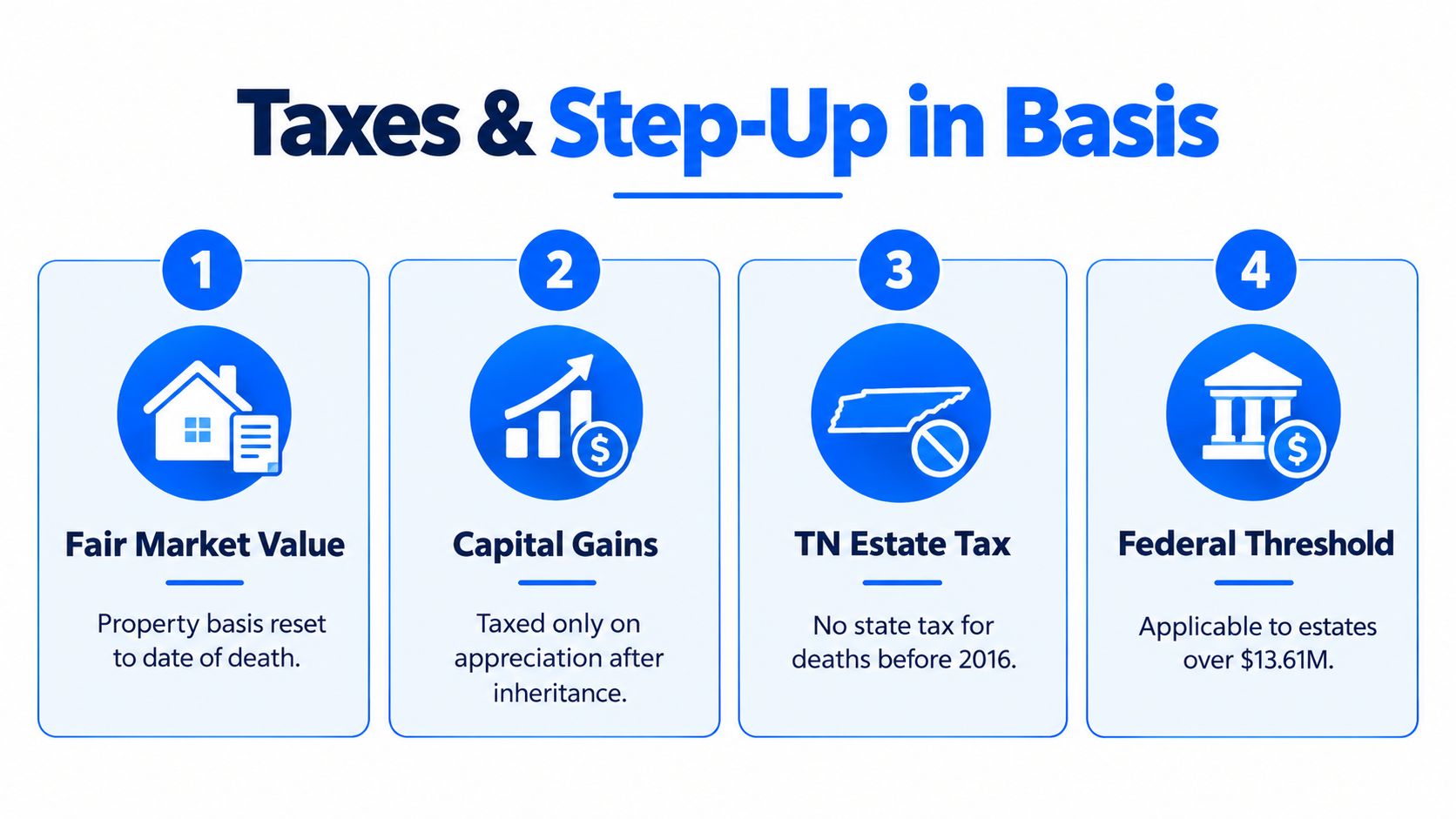
The decedent's original purchase price usually isn't the starting point for an heir's federal capital-gains calculation. Under Internal Revenue Code Section 1014, the initial basis is generally the property's fair market value on the decedent's date of death. An alternate valuation date applies only when the executor files an estate-tax return and elects that method. The IRS explanation of inherited-property basis provides the governing framework.
Consider a simple example. Suppose a professional appraisal supports a $400,000 date-of-death value, and the inherited house later sells for $415,000 after eligible selling costs and documented improvements are considered. The starting gain calculation uses the $400,000 inherited basis, not the decedent's much older purchase price. The potential appreciation before those adjustments is $15,000, rather than the entire increase from the original purchase price.
That example doesn't determine the final tax bill. Selling costs, improvements, estate records, the seller's circumstances, and any federal reporting requirements can change the result. Keep the appraisal, settlement statement, invoices, and estate records together. If the estate filed Form 706, certain beneficiaries may receive Form 8971 and Schedule A, and some recipients must use the estate-tax value as a consistent initial basis.
Separate inheritance tax from sale costs
Tennessee eliminated its inheritance tax for deaths occurring after December 31, 2015. Therefore, an heir handling a Nashville property inherited from someone who died on or after January 1, 2016 generally doesn't face Tennessee inheritance tax merely because the property was received. The relevant date is the decedent's date of death, not the later sale date. See the Tennessee Department of Revenue inheritance-tax guidance.
Earlier deaths require a different review. Tennessee's historical schedule applied 5.5% to the first $40,000 of net taxable estate, 6.5% to the next portion through $240,000, 7.5% through $440,000, and 9.5% above $440,000. The return and tax were generally due nine months after death for estates still subject to those rules. The Tennessee schedule and due-date guidance also states that real property owned by the decedent must be included in the estate.
Inheritance tax, when applicable, was paid from estate assets by the executor, administrator, or trustee. It isn't the same as recording charges, transfer costs, property taxes, mortgage payoff, maintenance, or possible federal income-tax obligations. A CPA or Tennessee tax professional should review any sale with meaningful value, uncertain basis, an earlier date of death, or complicated estate reporting.
Get a cash offer for your home
Managing Multiple Heirs and Family Disagreements
The assumption that the family can “just agree later” causes avoidable delays. Heirs often disagree about the listing price, repairs, personal belongings, occupancy, or whether to accept a cash offer. One sibling may want to keep the house, another may need liquidity, and an out-of-state heir may not be available for every decision.
Set a written decision process early:
- Name the decision-maker: Identify whether the executor, administrator, trustee, surviving owner, or all co-owners control the sale.
- Set a valuation reference: Use an appraisal or documented market analysis instead of competing opinions about what the house is worth.
- Record approvals: Put repair budgets, listing instructions, offer responses, and belongings decisions in writing.
- Track estate expenses: Maintain receipts for insurance, utilities, maintenance, taxes, repairs, and professional services.
- Protect remote heirs: Use secure document sharing, scheduled calls, electronic signatures where permitted, and remote notarization when the closing company approves it.
A personal representative shouldn't use estate authority as a shortcut for ignoring beneficiaries. Follow the will, trust, court orders, and Tennessee law, and give interested parties appropriate notice. Conversely, an heir shouldn't block an otherwise authorized sale because the price doesn't match a personal expectation.
Family strategy: Agree on the process before debating the price. A neutral appraisal, written deadlines, and complete expense records often reduce the emotional temperature.
Mediation is usually preferable to an escalating family fight. If someone refuses to cooperate, a Tennessee estate or real-estate attorney can explain the available remedies, including whether a court proceeding is appropriate. Don't let a buyer become the referee. Resolve authority and consent issues before signing a contract.
For situations involving shared ownership, use this guide to selling inherited property with multiple owners as general background, then obtain advice specific to the deed and estate.
Frequently Asked Questions About Estate Sales
What if a sibling contests the sale after a contract is signed?
Stop before accepting earnest money or moving toward closing. A sibling's objection may involve ownership, notice, the will, or the personal representative's authority. Give the title company the objection in writing, preserve all communications, and have a Tennessee estate attorney determine whether the contract can proceed. Do not ask the buyer to resolve a family dispute.
What can cause a Nashville title search to fail?
Unreleased mortgages, judgment liens, unpaid taxes, probate-record inconsistencies, missing heir information, and an old deed can create title exceptions. A clean tax record does not prove marketable title. Order the title search early, then assign someone to obtain releases, corrected records, or court documents before listing the property.
Which estate-sale costs are commonly deducted at closing?
The settlement statement may include title-search and title-insurance charges, recording fees, mortgage payoff, property-tax adjustments, attorney charges, repairs authorized by the estate, and approved executor or administrator compensation. Exact amounts depend on the property and transaction. Request an estimated settlement statement before accepting an offer so heirs can compare net proceeds.
Can the estate sell if a lien appears after the listing?
The sale may continue, but the lien must be addressed before or at closing. The closing agent can sometimes pay a valid lien from sale proceeds. If the lien is disputed, obtain legal advice before promising a closing date or distributing money to heirs.
What if the buyer's title company rejects the estate documents?
Ask for the specific defect, not a general rejection. The cure may require certified probate records, a court order, an affidavit, a corrected deed, or additional signatures. Sending more documents without identifying the underwriting issue wastes time.
Does a buyer receive the deceased owner's insurance claim history?
Not automatically. Ask the insurer and closing team what records can be released, and keep documentation for repairs and prior claims. A buyer may request property-condition information, while the estate must avoid making unsupported statements about the home.
Who receives the earnest money if the sale collapses?
The contract controls. The escrow holder generally cannot release disputed funds without written instructions from the parties or a legally sufficient order. Keep the estate's records separate and do not treat earnest money as distributable proceeds until the dispute is resolved.
Can heirs distribute sale proceeds immediately?
No. First account for closing expenses, debts, taxes, liens, and any required reserve. The personal representative should keep a written distribution record and confirm that creditor and court requirements have been satisfied before paying beneficiaries.
Cyber Homes buys inherited houses as-is for cash, subject to authority and title review. Visit Cyber Homes to discuss the property and compare a direct sale with a conventional Nashville listing.

Edited by
James Vasquez
Real Estate Investor & Land Specialist with 10+ years experience in residential flipping, vacant land investing, land wholesaling, and subdivision deals.
Disclaimer: The information provided is for educational purposes and does not constitute financial or legal advice. Always consult with licensed professionals before making investment decisions.