Selling an Inherited Property in Buffalo, NY Fast

You can sell an inherited house in Buffalo, but you can't skip the legal and tax work just because the family wants it handled quickly. The first question is always the same: who has the authority to sign, and is the title ready to transfer? In Erie County, that answer usually decides whether the sale moves smoothly or gets stuck in probate, title review, or a fight among heirs.

Get a cash offer for your home
Updated for 2026
Confirming Legal Authority to Sell the Home
A family member dies, the house sits empty, and someone wants to list it right away. That is where inherited sales in Buffalo start going wrong. Being named in a will does not automatically give someone the right to sell the property, and the title company will ask for proof before it lets the deal close.
Who has the legal right to sign
If there is a will, the executor named by the court handles the estate. If there is no will, the court appoints an administrator. If the property is held in a trust, the trustee may be able to sell without full probate. If title passed through joint ownership with survivorship rights, the surviving owner may already have the authority to act.
A beneficiary can inherit an interest in the house and still have no power to sign a deed, a listing agreement, or closing documents. That mistake slows the sale and can force everyone to start over.
Practical rule: Confirm the signer's authority before accepting an offer. If the wrong person signs, the closing can fall apart late in the process.
Why Buffalo families get stuck
Erie County Surrogate's Court handles probate matters, including validating wills, appointing executors, and overseeing debts and distributions. An uncontested estate commonly takes about six to twelve months (Erie County Surrogate's Court). That delay is a problem when the house needs repairs, insurance, taxes, or an urgent sale.
A will admitted in another county can also need to be filed locally if it affects real property in Erie County. The local filing charge is $45 plus $5 per page for those certified documents. Families miss that step all the time, then wonder why the title work stalls.
If the estate is not clear on who can sign, pause the sale until the court papers match the person at the table. That one check prevents a broken closing later.
Navigating Erie County Probate and Title Requirements
Erie County probate controls more than inheritance. It controls whether the title company will insure the sale at all. If the estate is not documented correctly, a buyer can be ready to close and still get blocked by a title exception.
What the court process does
The Surrogate's Court validates the will if there is one, appoints the executor or administrator, and supervises the distribution of estate assets. For Buffalo families, the primary bottleneck is often not the sale itself, but the paperwork needed to prove who has authority to act for the estate.
A title company in Erie County usually wants court-issued authority before it will issue a clean commitment. That may mean Letters Testamentary or Letters of Administration, along with the death certificate, the will, and the estate filing documents. If the title file is thin, underwriting will stop the deal until the missing papers are supplied.
Sometimes a sale can move forward on an affidavit of heirship or a similar title-company-approved document, but only when the chain of ownership is simple and the company accepts that approach. If the estate is more complicated, full probate control is the safer path.
For a practical overview of probate sales, see the Cyber Homes guide for homes in probate.
A house can be inherited and still be unmarketable. The closing depends on what the title company can insure, not what the family assumes.
Buffalo-specific problems that delay closings
The files that cause trouble in Erie County are usually the same ones: missing wills, unknown heirs, old mortgages, unpaid property taxes, judgments, HOA balances, and recorded title defects. If the decedent owned property in more than one place, the local title review gets tighter, because every recorded interest has to line up cleanly.
Heirs also run into delays when the estate papers were filed elsewhere and no local title package was ever assembled. A title company will not guess its way through that. It wants the authority to be clear on paper before it signs off.
Handle the court and title file first, then list the house. That order avoids failed closings, last-minute corrections, and families signing documents they should have had checked weeks earlier.
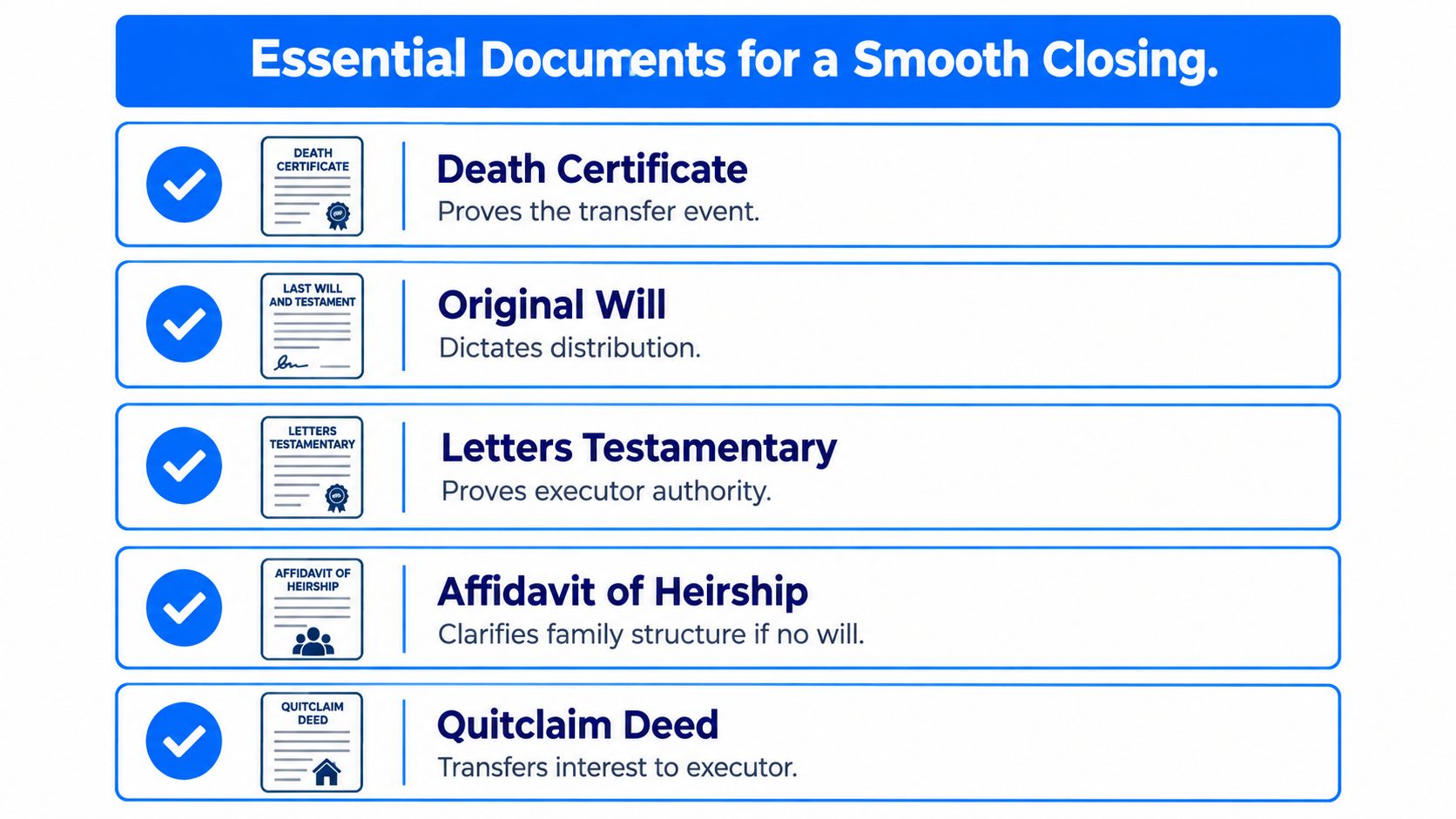
Essential Documents for a Smooth Closing

A Buffalo title company wants a clean file, not a family story. In an inherited sale, the paperwork has to prove who can sign, who owns what, and whether anything still clouds title. Get that file together before you list the house, and you avoid delays, renegotiations, and closing-day surprises.
Gather these documents first
- Death certificate: This confirms the transfer event and is one of the first items a title company will request.
- Will, trust, or estate documents: These show how the property passed and who has authority over it.
- Letters Testamentary or Letters of Administration: These prove the court has appointed someone to act for the estate.
- Deed and property tax records: These confirm how title is held and whether taxes are current.
- Mortgage payoff statement: If a loan remains, the payoff amount must be known before closing.
- HOA documents, if applicable: Associations can have balances, rules, or transfer requirements that affect the sale.
- Insurance, repair, and improvement records: These help document condition and may matter later for basis or disclosure questions.
- Title documents and lien information: Old judgments, unpaid taxes, or recorded liens need to be identified early.
- Government-issued identification: The seller or estate representative will need it for closing and notarization.
A title company can tell you what is missing before the sale gets too far along. That is the time to fix problems, not the week before closing.
Missing paperwork is not rare
If records are incomplete, do not guess. Pull the file together, request payoff letters, ask the county for recorded documents, and verify whether any old mortgage or lien still attaches to the property. Vacant homes and long-held inherited properties often surface exactly those problems.
A local closing attorney or title officer will also want to know whether the house is in a trust, part of a probate estate, or owned with another person. That legal structure controls which documents matter most.
Once closing documents are scanned, the PDFWix guide for legal teams shows how to flatten the files so nothing shifts before title review.
Get a cash offer for your home
Choosing Between an Agent, As-Is Listing, or Cash Offer
Once authority is clear and the documents are in hand, the key decision begins. You need to choose how to sell, and in inherited-property cases, speed and certainty often matter more than chasing the last dollar on paper.
Traditional agent listing
A full-service agent listing fits homes in good condition where the family wants broad market exposure. That path usually makes sense when the house is clean, repairs are manageable, and someone can handle showings, appraisals, and buyer inspections. It can also be the right move if you need maximum market visibility and have time to wait.
As-is MLS listing
An as-is listing works when the home needs work but you still want multiple buyers to see it. It's a solid middle ground for heirs who can't or won't complete repairs before listing. Just remember that “as-is” does not erase title, lien, disclosure, or authority issues. The seller still has to solve those.
Cash buyer or investor
A direct cash buyer is useful when the house needs major repairs, contains inherited clutter, or has to sell on a tighter timeline. It can also be the cleanest option for out-of-state heirs who can't manage cleanup, staging, or repeated showings. If you compare that route, verify proof of funds and compare the offer against the likely net after repairs, carrying costs, and commission on an open-market listing.
Convenience has a price. A cash sale can be the right move, but only if the family understands what they're giving up in exchange for speed and simplicity.
If you want a local overview of the cash-sale market, Cyber Homes publishes a Buffalo-specific list of companies that buy houses for cash on its Buffalo cash-buyer guide.
For families who want a direct sale without repairs, one option is Cyber Homes, which buys inherited houses as-is and closes through title companies on the seller's timeline. That doesn't mean it's the right fit for every estate, but it is a real choice when the home is too burdensome for a traditional listing.
Understanding New York Taxes and the Stepped-Up Basis
An inherited Buffalo home can look simple on paper and still get stuck on tax details. The starting point is not the decedent's purchase price. For inherited property, the basis is generally reset to fair market value on the date of death, often called a stepped-up basis (New York tax guidance on inherited property basis).
A simple example
If a Buffalo home is valued at $250,000 on the date of death and later sells for $260,000, the taxable gain is usually much smaller than heirs expect, because the tax basis begins with the inherited value. Selling expenses and capital improvements can also affect the final calculation. The common mistake is using an old purchase price or a basis with no records behind it.
Keep the date-of-death appraisal or valuation, repair invoices, the closing statement, and records of selling costs. Without those documents, the family has a weak position if the sale is questioned later.
Buffalo transfer tax still matters
Erie County says a Buffalo real-estate conveyance generally incurs combined New York State and Erie County transfer taxes of $4.50 per $500 of consideration, which is 0.9% of the stated consideration (Erie County Clerk FAQ). On a $250,000 sale, that works out to roughly $2,250 before any exemption or contract term shifts the cost.
Inheritance itself is treated separately from the later sale. New York's transfer-tax rules apply to the conveyance, while New York estate tax is handled at the estate level, not as a tax on each heir's share (New York transfer tax guidance; New York estate tax guidance). That distinction matters because many families focus only on the house price and miss the estate filing side until closing is already delayed.
If the estate is large or the paperwork is unclear, involve a CPA before you sign. Families working from another state can start with where to find remote tax support.
Get a cash offer for your home
Resolving Disagreements Among Multiple Heirs
When three siblings inherit the same house, the sale rarely stays purely financial. One wants to hold out for a higher price, another wants the fastest closing, and someone else is still sorting through the furniture. If you don't handle that tension early, the estate stalls.
Put decisions in writing
Write down who is responsible for cleanup, whether repairs will be made, what offer range is acceptable, and who can speak to the agent, title company, or buyer. That record matters because family conversations blur quickly when money is on the line.
If there are multiple heirs, every dollar spent and every decision made should be traceable. Keep sale proceeds in a dedicated estate account until debts, taxes, and distributions are resolved. Don't start dividing money informally just because everyone seems to agree in the moment.
Don't let one heir freeze the estate
A single dissenting heir can delay a sale, especially if no one has established a clear process for decisions. That's when an estate attorney or mediator becomes worth the cost. You need someone neutral when the fight is about price, repairs, or sentimental belongings, not just legal title.
For families dealing with co-ownership issues, the Cyber Homes overview of inherited property with multiple owners is a straightforward primer on why shared ownership can complicate timing and consent.
Best practice: Handle the house like an estate asset, not a family trophy. That mindset keeps emotion from turning into unnecessary delay.
If the home still contains valuables or personal items, separate those conversations from the sale discussion. Mixing them together usually makes both problems worse.
Final Steps to Close and Distribute Proceeds
At the closing table, Erie County details still control the deal. The executor or administrator signs the closing papers, the title company records the deed transfer, and the net proceeds go where the will, trust, or Surrogate's Court order requires.
What has to happen at closing
Before closing, lock down the final property tax prorations, payoff figures, lien releases, and any estate documents the title company still wants. If the estate has an active court file, the closing attorney needs to know whether the transaction requires extra paperwork or a specific form of authority.
Do not distribute sale proceeds casually. Keep them in the estate account until debts, taxes, and distribution obligations are resolved. That protects the fiduciary and prevents confusion if a later bill arrives.
Use local professionals who know Erie County
Local Erie County details decide these sales, so work with a closing attorney, title officer, and CPA who handle this courthouse and these county forms regularly. They can tell you whether the estate authority is enough, whether title is clean, and how New York's stepped-up basis rules affect the tax picture on this file. That matters most when the home is already in probate, the heirs live out of state, or the basis is still unclear.
The right next move is straightforward. Confirm estate authority, confirm title requirements, and confirm the tax questions before you accept an offer. That protects the net amount the heirs receive.
If you need a direct sale without repairs, showings, or commissions, Cyber Homes can review the property and make a cash or private-money offer on your timeline. Start there if a fast exit makes sense, then have your local professionals verify the estate, title, and tax details before you sign anything.

Edited by
James Vasquez
Real Estate Investor & Land Specialist with 10+ years experience in residential flipping, vacant land investing, land wholesaling, and subdivision deals.
Disclaimer: The information provided is for educational purposes and does not constitute financial or legal advice. Always consult with licensed professionals before making investment decisions.