Selling an Inherited Property in Houston, TX: 2026 Guide

Yes, inherited Houston homes can be sold while probate is open if the executor has authority, but the fastest reliable close still depends on title, tax records, and lien clearance at the Harris Central Appraisal District before proceeds can move. Houston has 1,040,576 housing units, including 110,172 vacant units, so an inherited home can begin creating insurance, utility, maintenance, security, and property-tax costs almost immediately. The City of Houston's 2024 housing profile places the citywide vacancy share at 10.6% and owner occupancy at 42.1% of occupied housing.
The funeral is over, the house is sitting empty, and family members are asking whether to clean it out, list it, rent it, or accept an offer. The wrong first move is choosing a price. The right first move is confirming who can sell, what the title file shows, what Houston buyers are likely to accept, and how the tax basis will be documented.
Selling an inherited property in Houston, TX is an estate decision before it becomes a real estate decision. Use the checkpoints below to turn a stressful week into a controlled closing plan.

Get a cash offer for your home
What You Are Actually Deciding When a Houston Home Is Inherited
An inherited house creates four separate decisions, and they don't always point in the same direction.
First, identify the person with legal authority. A beneficiary may have an economic interest in the property without having authority to sign a listing agreement or deed. An executor, administrator, trustee, surviving joint owner, or group of heirs may control the sale, depending on how ownership transferred.
Second, inspect the title file rather than relying on family memory. The deed, probate documents, recorded liens, unpaid taxes, mortgage balance, and ownership records must tell the same story. If they don't, a buyer can agree to the price and still be unable to close.
Third, match the sale method to the property's condition and the family's capacity. A livable home may justify a traditional listing. A storm-damaged or cluttered property may make an as-is listing or direct offer more practical. An out-of-state heir may value certainty and fewer property visits more than maximum exposure.
Fourth, preserve the tax records. The date-of-death valuation can establish the inherited property's federal tax basis, while appraisal and exemption records can affect Harris County tax treatment and closing adjustments.
Your week-one checklist
- Secure the property: Change locks if needed, maintain insurance, keep essential utilities active, redirect mail, and photograph the interior and exterior.
- Find the authority documents: Locate the will, trust, death certificate, deed, and any probate appointment papers.
- Call the title company early: Ask for a title commitment and a written list of documents required for this estate.
- Contact the records offices: Confirm ownership, appraisal records, exemptions, unpaid taxes, and account information.
- Preserve valuation evidence: Arrange a defensible date-of-death appraisal and save repair, improvement, and closing records.
- Set a family process: Put decisions about price, repairs, belongings, and timing in writing.
Practical rule: Don't spend money on renovations until the person authorized to sell has confirmed the title path and the heirs understand the expected net proceeds.
Who Has the Legal Authority to Sell the House
The person named in a will isn't automatically ready to sell the house. A Texas probate court generally must appoint the executor, and the will or appointment order must provide, or support, authority to sell real estate.
Here are the common ownership paths:
- A probated will: The court-appointed executor signs for the estate, subject to the will, appointment order, and type of administration.
- No will: The court appoints an administrator and determines the heirs and authority required to transfer the property.
- A living trust: The trustee signs under the trust's terms. The title company will review the trust certification and related documents.
- Joint ownership: A surviving owner may receive the deceased owner's interest through survivorship rights, but the deed and title records must confirm that structure.
- A transfer-on-death deed: The beneficiary may receive the property outside ordinary probate, subject to the deed's validity and any required filings.
- Multiple heirs: The heirs may own the property together, or the estate representative may sell it for the estate. The required signatures depend on the legal structure and title company's requirements.
Texas law makes the administration type especially important. Under Texas Estates Code §402.052, an independent executor or independent administrator generally may sell estate property without separate court approval. A supervised estate generally requires court permission under Estates Code §356.251 before the contract becomes binding.
A buyer may rely on a recorded affidavit from an independent representative stating that the sale is necessary or advisable for an authorized estate purpose. That doesn't mean every executor has unlimited power. The will and appointment order can restrict authority, so review them before signing.
For a broader explanation of the transaction issues, see this guide to selling a home in probate. If the will doesn't grant authority to sell estate real property, the probate attorney may need to seek a court order. Don't let an agent or buyer pressure you into signing first and checking authority later.
Houston Market Reality Before You Pick a Path
Older inherited-home advice often assumes that listing publicly will automatically produce the highest net result. Houston's August 2026 market calls for a more disciplined comparison. Active single-family listings reached roughly 41,000, supply was about 5.3 months, and the 12-month median sales price was near $331,000, according to the Houston housing sales update. The same source reported that 21.3% of listings had price reductions.
Realtor.com reported an August median list price of $359,000, down 1.6% year over year, while median time to sell increased to 52 days. Those figures describe a market where buyers have more room to negotiate and where an estate can spend meaningful time carrying the property before closing.
Price the decision by net proceeds, not the offer headline. Estimate insurance, property taxes, utilities, lawn care, security, repairs, cleanup, commissions, concessions, and the cost of delaying distribution to heirs. Then compare the results under realistic timelines.
Net-Proceeds Worksheet for a Heir-Owned Houston Home
| Cost or risk line | Traditional MLS list | As-is MLS list | Direct cash buyer |
|---|---|---|---|
| Expected sale price | Based on condition and comparable homes | Adjusted for deferred maintenance | Usually reflects as-is condition and convenience |
| Repairs and cleanup | May be substantial | Limited to safety or presentation work | Often minimal before closing |
| Buyer financing risk | Present | Present, especially for major defects | May be reduced, but verify proof of funds |
| Showings and access | Frequent coordination | Frequent coordination | Usually fewer property visits |
| Carrying costs | Continue through marketing and buyer closing | Continue through marketing and buyer closing | May end sooner if the buyer closes as agreed |
| Negotiation exposure | Inspections, appraisal, and repair requests | Inspections and condition-based negotiations | Contract terms, inspection rights, and title clearance still matter |
| Best fit | Livable home, patient heirs, retail exposure | Repair-heavy home, broad buyer exposure | Urgent timeline, major repairs, vacancy, or remote management |
A public listing isn't automatically the highest-net strategy. If the roof, foundation, plumbing, flood history, or tenant situation makes the property compete poorly against move-in-ready inventory, a certain as-is sale can outperform a higher theoretical list price after carrying costs and concessions.
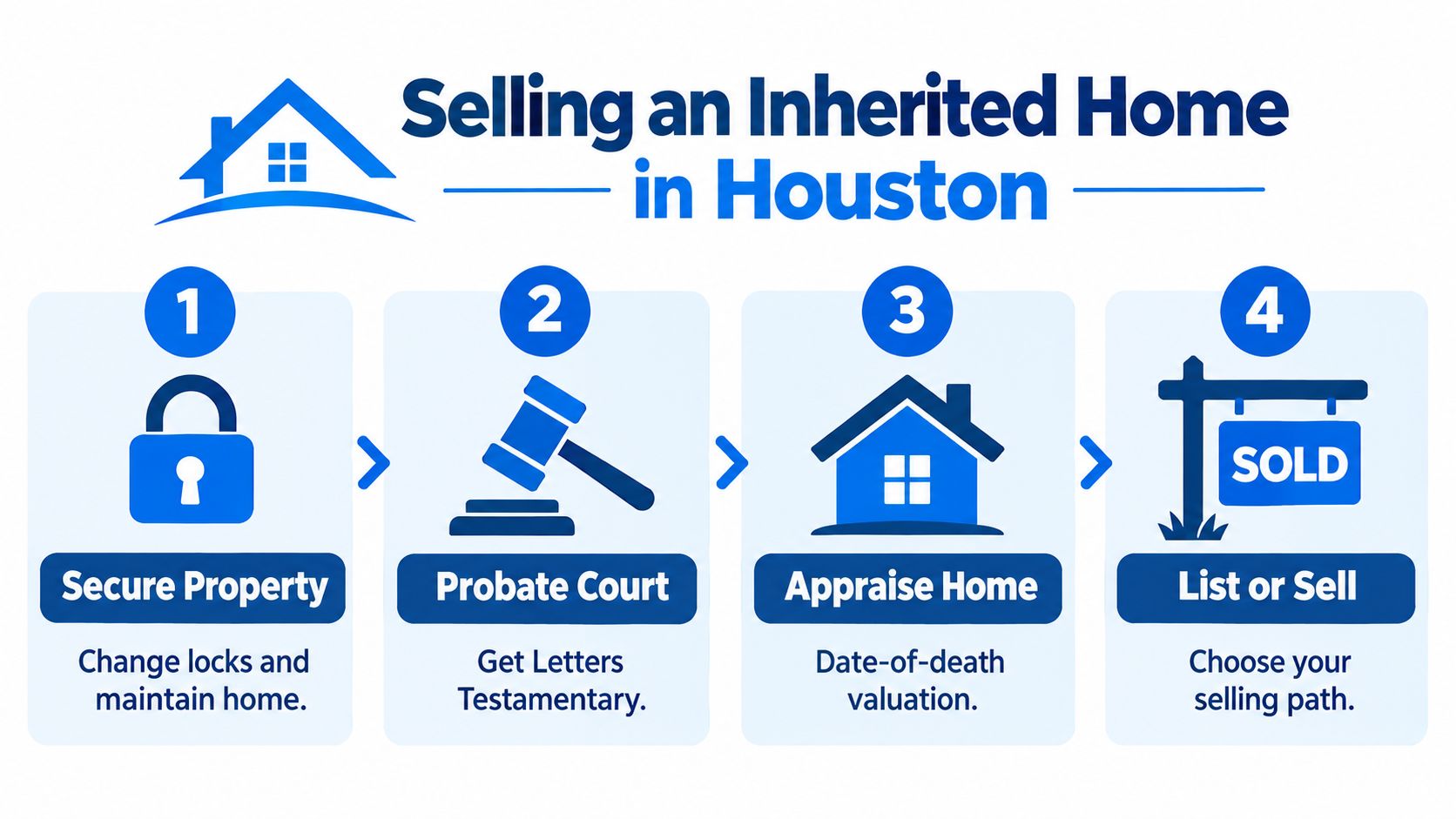
Step-by-Step Process to Sell an Inherited Houston Home
Treat the sale as a closing-readiness project. Each step removes a different reason a title company, lender, buyer, or family member might stop the transaction.
Start with the property and the paper trail
-
Secure and document the house. Change locks, maintain insurance, keep utilities on where needed, remove obvious hazards, and record the condition with dated photographs and video. Create one shared folder for estate, property, title, tax, and repair records.
-
Confirm ownership and authority. Order a title commitment early. Ask whether the record owner is the decedent, a trust, surviving joint owners, or multiple heirs. Confirm whether probate, independent administration, a muniment of title, or another Texas process applies.
-
Open or continue probate when required. Gather the death certificate, will, heirship documentation, and court appointment papers. Don't assume that a pending probate case prevents every sale, and don't assume that a will alone gives an executor signing power.
-
Build the title package. Include the deed, court documents, mortgage payoff statement, property-tax records, HOA information, insurance records, repair invoices, improvement records, lien information, and government-issued identification.
-
Choose the sale route. Get a written listing strategy or written offers. Compare traditional MLS exposure, an as-is listing, and a direct cash proposal on net proceeds and certainty.
-
Resolve the closing obstacles. Confirm mortgages, delinquent taxes, judgments, contractor liens, code matters, HOA balances, occupancy, and required disclosures. The title company should identify what must be paid, released, corrected, or signed.
-
Close and distribute funds. Sign through the title company, verify the settlement statement, pay authorized estate obligations, and distribute remaining proceeds according to the will, trust, probate order, or ownership agreement.
For an executor handling the broader estate, this overview of Atascocita probate and executor duties can help clarify which responsibilities sit with the representative rather than with the property agent.
HCAD says owners can submit its real-property account correction form with evidence such as a recorded deed, signed closing settlement statement, or probated will. HCAD's frequently asked questions make clear why ownership records should be corrected before the final title review, not after a buyer is waiting to close.
Get a cash offer for your home
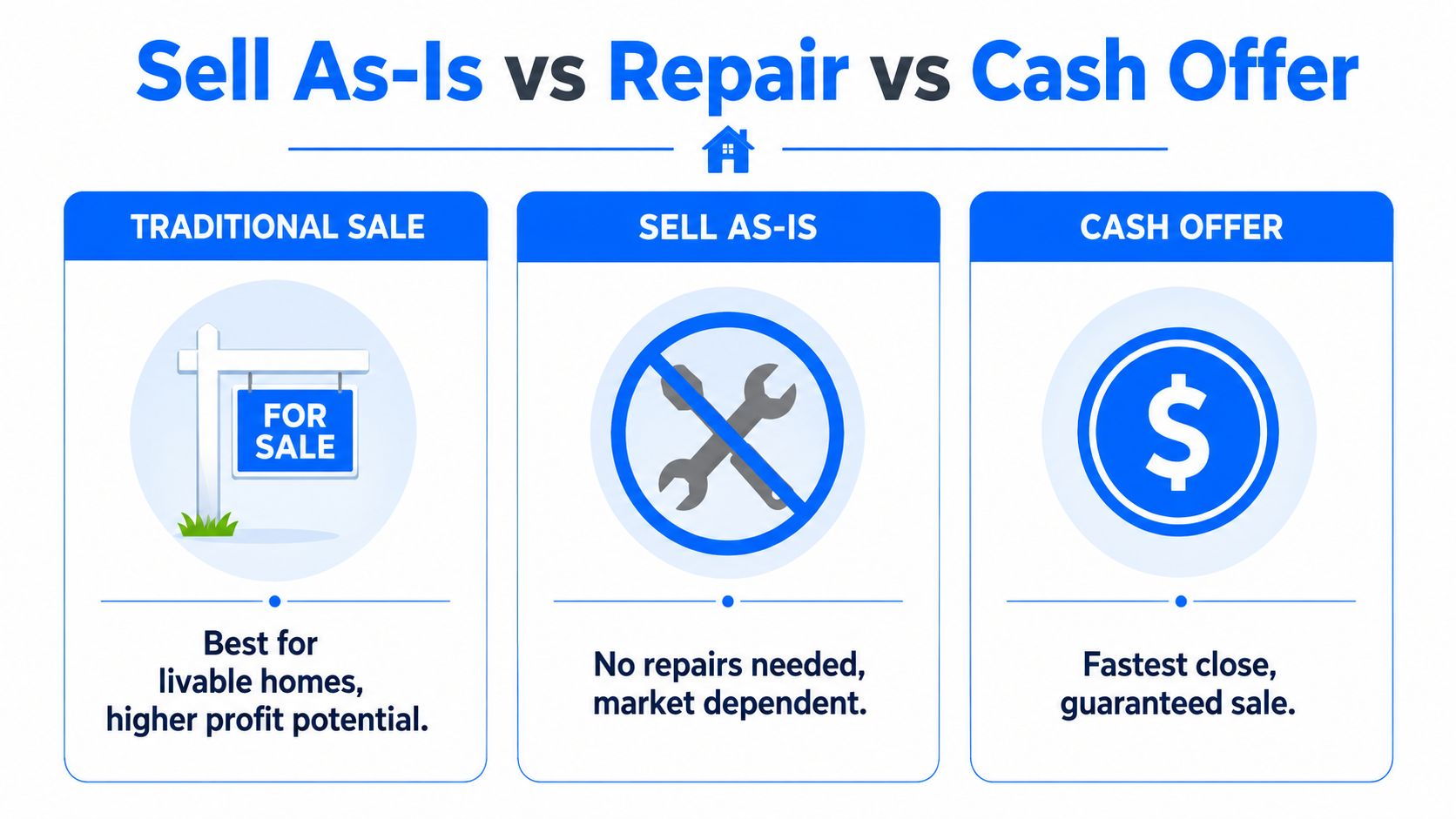
Should You Repair, List As-Is, or Take a Cash Offer
Choose the path that fits the house and the estate, not the path that sounds most profitable in a family conversation.
A traditional agent listing makes sense when the home is habitable, reasonably presentable, and the heirs can tolerate showings, inspection requests, financing conditions, and negotiation. Repairs may improve buyer confidence, but the executor should approve the spending only after comparing the expected added proceeds with the cost and delay.
An as-is MLS listing preserves broad buyer exposure without promising a renovated home. It can work for dated interiors, accumulated belongings, or moderate deferred maintenance. It won't make serious roof, foundation, HVAC, plumbing, flood, or insurance problems disappear, and some financed buyers may not qualify for a property in poor condition.
A direct cash buyer can fit major repairs, inherited clutter, vacancy, foreclosure pressure, or an out-of-state family that wants fewer moving parts. The trade-off is usually a lower headline price in exchange for convenience and a more straightforward transaction. Compare the offer against the estimated retail net, including cleanup, carrying expenses, commissions, concessions, and the risk of a buyer's financing failing.
If you're evaluating a cash buyer, use this Houston cash-home-buying company comparison as a starting point, then verify the individual buyer's contract and funding.
Compare the closing statement: A cash offer isn't better because it arrives quickly. It's better only if the amount you actually receive, after liens, taxes, costs, and estate obligations, fits the family's objective.
Selling “as-is” also doesn't eliminate ownership, title, lien, or disclosure work. Estate sellers should answer required property questions carefully and disclose known material conditions as applicable. The title company and attorney can explain which disclosures and exceptions apply to the specific estate.
Taxes and Costs Heirs Should Expect in Houston
Inherited property taxes involve several separate issues. Keep property taxes, unpaid liens, closing charges, federal income-tax basis, and any estate-level tax questions in different categories.
For federal income-tax purposes, inherited property generally receives a basis equal to its fair market value on the decedent's date of death, rather than the decedent's original purchase price. An executor may elect an alternate valuation date on a federal estate-tax return when the law permits and the election is properly made. The IRS frequently asked questions explains that selling above basis generally creates taxable gain.
A simple basis example
Suppose the date-of-death appraisal values the home at $300,000 and net sale proceeds are $325,000. The preliminary gain is approximately $25,000, before applicable adjustments for eligible selling costs and capital improvements. That is materially different from calculating gain from the decedent's historic purchase price.
Keep these records:
- Date-of-death valuation: Preserve the appraisal and the method supporting the value.
- Improvement records: Save invoices and evidence for qualifying capital improvements.
- Selling costs: Retain the final settlement statement and records of eligible expenses.
- Tax and lien records: Confirm unpaid property taxes, releases, and closing adjustments.
- Appraisal history: Keep HCAD valuation and exemption information with the estate file.
Harris County provides an optional 20% homestead exemption to eligible homeowners. On a property valued at $100,000, that exemption reduces the county-taxable value by $20,000, to $80,000. A 2019 Texas law also made it easier for certain heir-property owners, including multiple co-owner heirs, to qualify for homestead treatment, but ownership and primary-residence use still matter. HCAD's homeowner exemption guidance explains that homeowners apply through HCAD, not the county tax office.
An heir living elsewhere doesn't qualify merely because the home was inherited. An heir occupying the property may qualify after meeting the applicable requirements. Ask a CPA or tax professional to review the transaction when the estate's value, improvements, basis, or tax exposure is significant.
Get a cash offer for your home
When Heirs Disagree or the Property Comes With Baggage
The house isn't always the obstacle. A missing signature, unclear authority, unpaid lien, or disagreement over belongings can stop a sale that otherwise has a willing buyer.
Multiple heirs may disagree about repairs, list price, timing, personal property, or whether to keep the home as a rental. Don't treat a verbal agreement as a closing plan. Hold one family call, record the decisions in writing, and agree on a minimum net amount rather than an attractive headline price.
Resolve people problems before property problems
- Check the will and appointment order: Confirm who may act for the estate and whether all heirs must participate.
- Identify every interested person: Unknown, missing, or unreachable heirs can create title and probate complications.
- Separate belongings from the property: Make a written plan for furniture, vehicles, documents, jewelry, and items with sentimental value.
- Use written communication: Email or text can preserve decisions about access, repairs, offers, and deadlines.
- Bring in help early: An estate attorney or mediator is cheaper and calmer than letting a dispute harden into litigation.
An unsigned contract from a partial signer may not bind everyone who owns an interest. The title company will require the signatures, releases, court documents, or affidavits needed to convey clean title.
The property may also carry a mortgage, unpaid property taxes, HOA balances, contractor liens, judgment liens, code issues, or foreclosure activity. The title commitment typically identifies recorded claims and exceptions. A mortgage payoff statement shows what must be paid at closing, while tax and HOA records may reveal additional amounts.
This guide to selling inherited property with multiple owners is useful for families deciding whether to sell together, buy out one heir, or ask an authorized representative to handle the transaction.
Local Considerations for Houston and Harris County
In Houston, the first local question is whether the house is ready to close, not whether the asking price is high. Gulf Coast storms can leave unresolved roof, siding, electrical, tree, drainage, and insurance issues. Flood-zone status may affect lender requirements and flood insurance. Foundation movement, termite history, permits, and prior repairs can change the buyer pool and the price a buyer can defend.
Vacancy creates a separate risk. As noted in the introduction, the city's 2024 housing profile provides context for how quickly an unoccupied property can become a preservation problem. Secure the house, confirm vacancy coverage with the insurer, keep necessary utilities running, arrange lawn care, and schedule regular inspections. Before listing, ask HCAD to verify the account owner, appraisal record, and homestead exemption. Check the Harris County Tax Office for balances and payment status, then give the title company those records for closing adjustments.
The Harris County file to assemble
- Probate authority: Confirm the assigned Harris County Probate Court and the representative's power to accept an offer and sign closing documents.
- HCAD records: Check ownership, appraisal information, homestead status, and whether the account needs correction.
- Harris County Tax Office: Obtain current balances, payment history, and tax information needed for prorations or payoff.
- Title commitment: Order it early. Ask the title company to identify every required deed, affidavit, court document, release, and signature.
- HOA or condominium records: Request resale documents, account balances, transfer requirements, and violation information.
- Property-risk records: Collect flood information, insurance claims, foundation reports, termite records, permits, and storm-repair invoices.
A probate attorney can distinguish beneficiary rights from executor duties and tell you whether court action is required. For a regional starting point, review this resource on Kingwood, Texas probate, then confirm the estate's facts with the attorney handling the matter.
A direct buyer gives heirs a useful comparison when certainty matters more than maximum retail exposure. Cyber Homes says it buys inherited Houston properties as-is, can close through reputable title companies on the seller's preferred timeline, does not charge commissions, and may advance moving expenses up to $2,000. Evaluate that offer alongside an MLS estimate, title review, and tax advice. It does not replace any of them.
This article provides general information, not legal or tax advice. Confirm estate authority with a Texas probate attorney, closing requirements with the title company, and basis, gain, and tax questions with a qualified tax professional.
This week, secure the property, gather the death certificate and estate documents, order the title commitment, verify HCAD and Harris County tax records, preserve the date-of-death appraisal, and compare a realistic MLS net with an as-is offer. For a no-obligation direct-sale comparison, visit Cyber Homes and submit the inherited property's details.

Edited by
James Vasquez
Real Estate Investor & Land Specialist with 10+ years experience in residential flipping, vacant land investing, land wholesaling, and subdivision deals.
Disclaimer: The information provided is for educational purposes and does not constitute financial or legal advice. Always consult with licensed professionals before making investment decisions.