How to Sell a House As-Is for Cash in Phoenix, AZ (2026)

Selling a house as-is for cash in Phoenix typically means a 7 to 21 day closing target, an offer below the roughly $411,000 retail-sale benchmark, and no seller-funded repairs, public showings, or agent commission in a direct purchase. The actual price and schedule depend on condition, title, and the signed contract.
If you've inherited an Arcadia house with a failing AC and an outdated electrical panel, the appeal is obvious: you don't want another project. But convenience isn't a reason to accept an unexplained discount. Treat the cash offer as a financial decision, not a rescue package.
Updated October 2026.

Get a cash offer for your home
What Selling a Phoenix House As-Is for Cash Actually Looks Like
Selling as-is for cash means a buyer purchases the property in its existing condition without requiring you to prepare it for the retail market, subject to the actual contract terms.
You can skip staging, open houses, and the contractor cycle. You can't skip ownership verification, truthful condition information, or a professional closing. A buyer may still inspect the property, and an inspection clause may still let that buyer cancel.
Key Takeaways
Your decision rule: Compare risk-adjusted net proceeds over time, not the largest number on the offer sheet.
- Timeline: Treat the opening's closing window as a target, not a guarantee. Title problems and seller authority can change the schedule.
- Offer range: There's no defensible universal Phoenix cash-offer percentage. Condition and the buyer's resale assumptions determine the discount.
- Disclosure: As-is describes the repair arrangement. It isn't permission to conceal known problems.
- Location: Phoenix is in Maricopa County, and pricing needs neighborhood-level comparisons.
- Trade-off: Buy certainty only when its value exceeds the proceeds you're giving up.
The summary below illustrates the appeal for an inherited property, but your contract controls what the buyer promises.

Match the route to your property
Don't treat Arcadia, Ahwatukee, Maryvale, North Phoenix, and Downtown Phoenix as interchangeable markets. An updated house and a neglected rental can require very different selling strategies, even when they're nearby.
For current context, Realtor.com's September 2026 Phoenix market report reported 62 days on market, compared with 61 nationally. That describes a slower, more buyer-friendly selling environment than a fast seller's market, not proof that every Phoenix home must sell at a steep discount.
My recommendation: get an as-is listing opinion before committing to cash when the property needs only cosmetic work. If the home needs substantial work, you lack renovation funds, or a deadline matters more than maximum price, a direct purchase deserves serious consideration.
The cash-home-buying process provides a useful sequence for organizing an inquiry, evaluation, and closing. For broader preparation ideas, Purified Air Duct Cleaning's resource on how to close deals faster this year can help you think through avoidable delays. Neither replaces a written offer and net sheet.
How Cash Offers Are Actually Calculated in Phoenix
A cash buyer calculates an offer from expected resale value, then accounts for repairs, holding expenses, transaction costs, execution risk, and the buyer's required profit.
Start with after-repair value, or ARV. That's the estimated value after the buyer completes the planned improvements, not today's asking price and not an automatic citywide median.
Zillow's January 2026 Phoenix data reported a median sale price of approximately $411,000, a 0.985 sale-to-list ratio, and about 39 median days to pending. The reported median list price was approximately $449,667, which shows why comparing a cash offer with asking prices can exaggerate the apparent loss.
Understand the rule without accepting it as your valuation
The 70% rule is an investor screening shortcut, not a Phoenix appraisal standard. Its simplified structure is ARV multiplied by the rule's factor, minus estimated repairs; the remaining allowance is intended to accommodate other costs and profit.
Don't let a buyer apply that haircut and then subtract the same holding costs and margin again without explanation. Ask for an itemized calculation instead:
Estimated resale value − repairs − holding and resale expenses − risk allowance − required profit = proposed purchase price.
The image illustrates investor underwriting, not a mandatory seller discount.

For a Phoenix house benchmarked against the earlier median, replace the benchmark with physically similar recent sales before doing this calculation. Obtain at least three comparable sales, adjusting for size, lot, age, pool, location, and condition, as recommended in the Zillow-linked valuation workflow.
Use condition bands, not invented percentages
| Condition band | What the buyer should evaluate | Your negotiating position |
|---|---|---|
| Light repairs | Paint, finishes, cleanup, limited deferred maintenance | Demand a close comparison with an as-is listing |
| Moderate repairs | Aging AC, roof work, plumbing or electrical updates | Challenge repair allowances with invoices or estimates |
| Heavy repairs | Structural concerns, extensive damage, major systems, difficult occupancy | Prioritize credible scope, funding, and execution |
Phoenix heat makes HVAC condition important. Sun exposure, monsoon storms, wind, and hail can affect roofs; older homes may need plumbing, sewer, insulation, window, or panel work.
Dry weather doesn't eliminate expansive-soil movement, slab problems, drainage issues, or localized flooding near washes. Unusual cold snaps can damage exposed pipes, while vacant homes may develop pests, water damage, vandalism, or unauthorized occupancy.
These are inspection questions, not reasons to assume every property has every problem. Separate documented defects from suspected ones, and reject blanket repair allowances that the buyer can't explain.
Cash Buyer vs Agent Listing vs Fix-and-List
The best route is the one that delivers acceptable net proceeds within your deadline, with risks you can afford to carry.
Cash can win on execution without winning on gross price. An agent listing as-is can win when the house is livable and the owner has time; fix-and-list deserves consideration only when the expected improvement in proceeds justifies the renovation risk.
Selling a Phoenix Home As-Is Through Three Paths
| Path | Net Proceeds (Phoenix median) | Fees | Repairs | Time to Close | Certainty |
|---|---|---|---|---|---|
| Direct cash buyer | Actual offer minus seller obligations, not the retail benchmark | No agent commission in an unrepresented direct sale; verify other charges | Usually no seller-funded work if agreed | Contract-specific, after title clearance | Stronger when funds and limited contingencies are verified |
| Agent listing as-is | Comparable-supported price minus negotiated selling and carrying costs | Commission, escrow charges, concessions as agreed | No planned renovation, but negotiations may arise | Marketing period plus escrow | Depends on buyer financing, inspection, and title |
| Fix-and-list | Post-renovation price minus project and sale costs | Selling costs plus renovation-related expenses | Seller manages and funds work | Renovation, marketing, then escrow | Exposed to contractor, budget, appraisal, and buyer risks |
October 2026 Phoenix market reporting from RJH Homes Team cited 49 median days on market for sold homes. Don't confuse days on market, days to pending, and days to receive sale proceeds. Those clocks measure different stages.
A worked net-sheet example without fictional expenses
Use the earlier Phoenix median as a benchmark input, not a promised price for your home. A completed numerical net sheet requires actual offers, fee agreements, payoff statements, and repair estimates.
| Net-sheet line | Agent listing benchmark example | Cash comparison |
|---|---|---|
| Starting price | Earlier Zillow median benchmark | Buyer's written purchase price |
| Commission | Subtract negotiated commission | None if no agent commission is owed |
| Concessions and fees | Subtract agreed concessions and seller closing charges | Subtract only charges assigned to seller |
| Property work | Subtract preparation and agreed repair spending | None if buyer accepts current condition without seller work |
| Waiting costs | Subtract mortgage cash outflow, taxes, insurance, utilities, and vacancy costs | Subtract costs through the contractual closing |
| Debt and other obligations | Subtract payoff, liens, and applicable charges | Subtract verified payoff and applicable obligations |
| Spendable proceeds | Starting price minus actual deductions | Written offer minus actual deductions |
A mortgage payment is a cash-flow burden, but its principal component also changes your payoff balance. Have the title company or advisor reconcile the worksheet so you don't double-count debt.
Break-even test: Choose cash when the listing's expected extra net proceeds don't compensate you for waiting, additional spending, and the chance of a failed closing.
The Phoenix housing-market comparison from Homes.com supports evaluating commissions, concessions, repairs, carrying costs, and the financial cost of waiting together. Make your own downside scenario for a delayed sale or repair overrun. Don't assign made-up probabilities just to make the worksheet look precise.
Get a cash offer for your home
Step-by-Step Cash Sale Timeline and How to Vet the Buyer
A cash sale moves from inquiry to evaluation, contract, title clearance, and closing, but a fast offer is useful only if the buyer can fund and perform.
Ask the buyer to state its response deadline and closing date in writing. An advertised quick close isn't evidence that probate authority, liens, or occupancy arrangements are already resolved.
This flowchart shows the transaction sequence; use the contract and escrow confirmation for your actual deadlines.
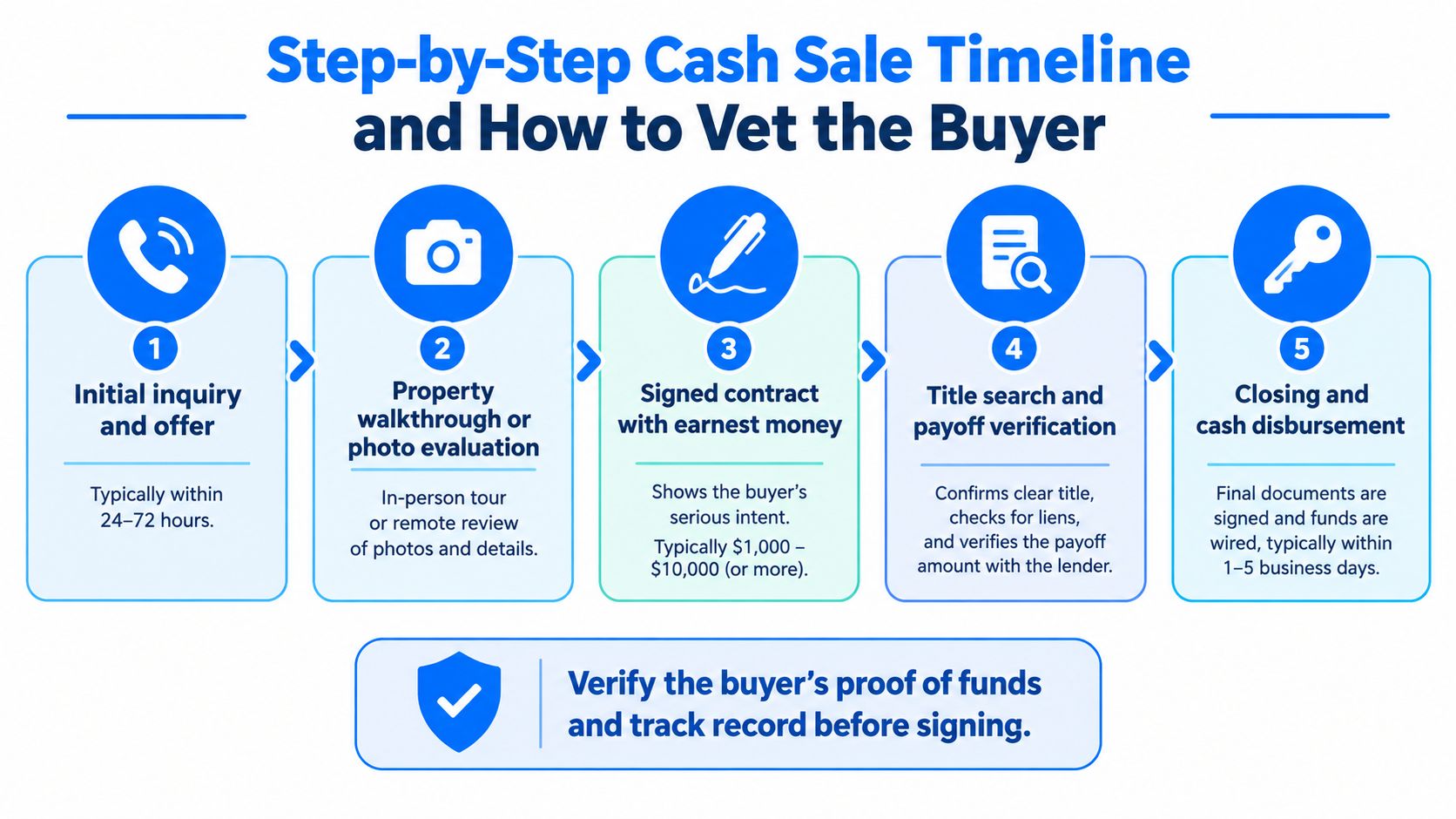
Move through the transaction in order
- Request the offer: Supply the address, ownership situation, condition photos, occupancy details, and desired closing date.
- Complete the evaluation: Give safe access or detailed photographs. Ask which findings could change the preliminary offer.
- Review the contract: Confirm price, earnest money, escrow holder, inspection rights, cancellation deadlines, assignment terms, and possession.
- Clear title: Have escrow obtain payoff information and identify ownership or lien issues.
- Approve the closing statement: Reconcile deductions, independently confirm wiring instructions, and establish when funds will be disbursed.
Vet the buyer before giving away control
Ask for proof of funds tied to the purchasing entity. Independently contact the named local title company, verify the earnest-money deposit, and review recent complaints and local references.
A list of companies that buy houses for cash in Phoenix can help build a comparison shortlist. Rankings and reviews don't replace verification of the specific buyer signing your agreement.
Don't sign a contract whose closing depends on the buyer finding somebody else, unless you knowingly accept that arrangement.
Wholesaling requires special attention. Ask whether the signer will buy the property or assign the contract to another investor, whether assignment requires your approval, and who remains responsible if the replacement buyer fails.
There isn't a universal “normal earnest-money reassignment” arrangement. Require escrow to explain how the deposit, replacement purchaser, seller consent, and original buyer's obligations are documented.
Watch for unexplained price cuts after a second visit, broad cancellation rights, pressure to sign immediately, and requests for upfront processing fees. A genuine newly discovered defect deserves documentation; a vague late discount deserves a challenge.
For a visual supplement to the written checklist, review the following video alongside your own proposed contract.
Realistic Phoenix Scenarios That Call for a Cash Sale
A cash sale is most useful when it solves a documented repair, ownership, occupancy, or deadline problem at an acceptable net price.
The following are illustrative seller situations, not claimed client outcomes. Each requires a different first action, even if the eventual buyer is the same.
Inheritance, payments, and divorce
An inherited Arcadia property may have willing heirs but unresolved authority to sell. Get probate or trust documents reviewed before promising a closing date, and use the inherited-property selling checklist for Phoenix to organize the ownership questions.
For a Maryvale owner behind on payments, first verify the trustee-sale date, request a written payoff, and contact the mortgage servicer about loss-mitigation alternatives. A cash offer doesn't resolve foreclosure risk unless the transaction can close and satisfy the required obligations before the deadline.
Phoenix foreclosure guidance from Living in Phoenix AZ emphasizes reviewing deadlines, equity, liens, and possible servicer-approved alternatives. Don't let a buyer's promise discourage you from investigating repayment or modification options.
A North Phoenix divorce creates a different problem: agreement between owners. Set a shared minimum net, clarify who can sign, and have counsel address proceeds allocation before accepting an offer.
Rentals, damage, and municipal problems
| Seller situation | First action | What to require from the buyer |
|---|---|---|
| Tenant-occupied Ahwatukee rental | Gather lease, deposits, payment history, and access restrictions | Written acceptance of occupancy and possession terms |
| Hoarder property | Document accessible areas and disclose inaccessible spaces | Clear responsibility for belongings, cleanup, and remaining contents |
| Fire or water damage | Gather reports, claim history, and repair records | A condition-based offer that identifies unresolved work |
| Liens or back taxes | Request title review and current account balances | A net sheet showing how obligations affect proceeds |
| Code-enforcement letters | Obtain current status and municipal account information | Written allocation of unresolved items and charges |
For water-related structural concerns, the Restore Heroes foundation damage guide is a useful starting point for framing questions. It isn't a property-specific engineering assessment.
If bankruptcy, disputed ownership, HOA obligations, or unresolved title is involved, bring the relevant attorney or escrow professional into the conversation early. Cash removes a buyer's mortgage approval process; it doesn't erase seller-side obstacles.
Urgency doesn't mean accepting the first number. Ask for competing written terms when the deadline allows, and prioritize a verifiable closing over a higher offer with an easy exit clause.
Get a cash offer for your home
Phoenix Disclosure, Vacant Property Rules, Liens, and Tax Basics
An as-is sale changes who handles repairs, not whether you should provide truthful information and resolve closing obligations.
Use the Residential Seller's Property Disclosure Statement, commonly called the SPDS, as a document to discuss with your Arizona real-estate attorney or title company. Have them confirm the applicable form, contract requirements, exemptions, and disclosure rules for your transaction rather than assuming a universal form requirement.
The checklist below highlights topics to address, but its shorthand isn't a substitute for transaction-specific legal advice.
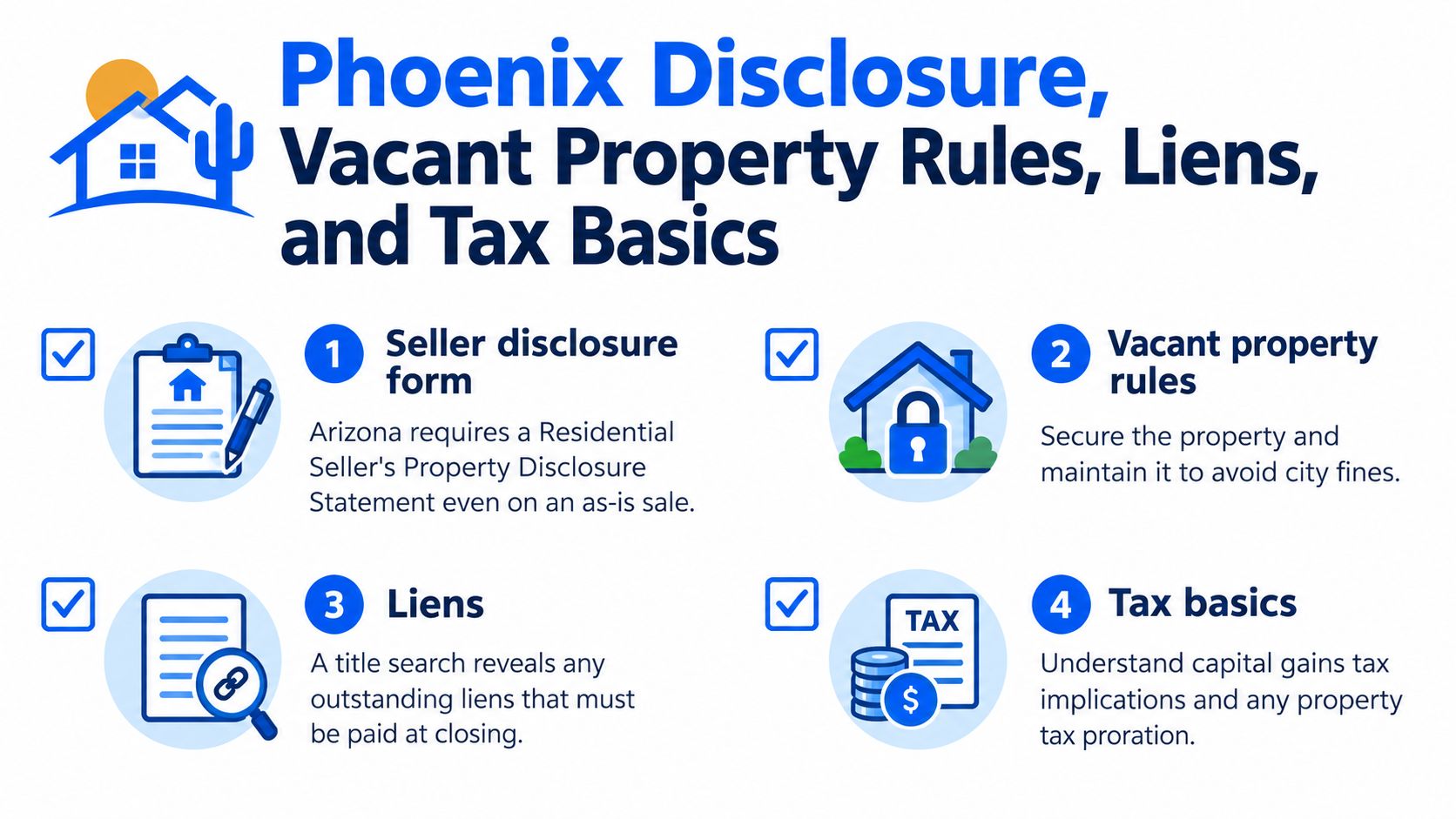
Disclose accurately and confirm closing requirements
Document known leaks, system failures, prior damage, permits, insurance claims, and code correspondence. Distinguish what you know from what you suspect; don't guess at causes or describe an uninspected system as sound.
Concealment or inaccurate representations can create disputes, derail negotiations, and expose you to legal claims. Ask counsel about the specific consequences rather than assuming the as-is clause protects you.
Also obtain confirmation of whether Arizona requires attorney participation at closing and whether any state transfer tax applies. Don't confuse recording, escrow, title, or tax-proration charges with a transfer tax.
Know which vacant properties must register
The City of Phoenix Vacant Property Registry, effective January 1, 2024, covers vacant nonresidential properties, unimproved land larger than 10,000 square feet, and residential properties with 50 or more units when vacant for more than 30 days. Its published penalties include a $500 minimum first violation, $750 second violation, and up to $2,500 for third or subsequent violations.
That isn't a blanket registration rule for every vacant single-family house. Smaller properties still need review for separate nuisance, building, zoning, and maintenance issues.
Request current municipal status, not just an old letter. Unresolved charges or conditions can affect negotiations and the seller's final proceeds.
Separate payoff mechanics from tax planning
Have escrow obtain written mortgage and lien payoff instructions and show the required disbursements on the closing statement. If sale proceeds won't cover the obligations, get professional advice before signing a contract that assumes they'll disappear.
For a financed listing, ask your agent whether condition could affect FHA or VA financing, appraisal, or required repairs. Commissions, concessions, insurance, utilities, and waiting costs also belong in the comparison.
Ask a tax professional whether the familiar federal home-sale exclusion thresholds of $250,000 for a qualifying single filer or $500,000 for qualifying married joint filers apply to you, and have them verify current rules. Don't assume eligibility, particularly for inherited homes, rentals, or changed ownership and occupancy circumstances.
Documents to Gather, FAQs, and Next Steps
Gather ownership, debt, condition, and occupancy records before requesting a firm offer so the buyer and escrow company can evaluate the same information.
Your closing document checklist
- Identity and ownership: ID, deed, trust documents, probate paperwork, and signing authority.
- Financial records: Mortgage statement, payoff request, tax bill, HOA status, and lien correspondence.
- Condition evidence: Room-by-room photos, system ages, invoices, permits, and insurance claims.
- Occupancy and city records: Leases, deposit information, code notices, and municipal account status.
How long does a Phoenix cash closing really take?
Use the agreed closing date, not the advertisement. Ask escrow whether title, payoffs, authority, and possession can support that date.
Will I still pay closing costs?
Possibly, depending on the contract. Ask for a seller net sheet that distinguishes buyer-paid closing charges from your debt, taxes, liens, and other obligations.
Can the buyer skip an appraisal?
A buyer using its own funds may not need a mortgage lender's appraisal. The buyer can still obtain a valuation or retain other contingencies, so check the agreement.
Can I stay after closing?
Only with a written post-closing occupancy arrangement. Specify the move-out date, charges, insurance responsibilities, deposit terms, and consequences of delayed possession.
How much do you lose selling as-is?
There's no universal percentage. Compare actual spendable proceeds with a realistic listing alternative, including the costs and risks you'd retain.
Should I repair the AC before requesting offers?
Get offers and a repair estimate first. Don't replace a major system merely because an investor says it will increase the offer.
Can I negotiate a cash offer?
Yes, you can counter the price and terms. Competing written offers and documented condition give you a stronger basis than comparing with neighborhood asking prices.
Cyber Homes offers as-is cash or private-money purchases without agent commissions, with closing handled through reputable title companies on an agreed timeline. Visit Cyber Homes to request a Phoenix offer and discuss a flexible closing date, then compare the written net proceeds and contract terms with your listing alternative.

Edited by
James Vasquez
Real Estate Investor & Land Specialist with 10+ years experience in residential flipping, vacant land investing, land wholesaling, and subdivision deals.
Disclaimer: The information provided is for educational purposes and does not constitute financial or legal advice. Always consult with licensed professionals before making investment decisions.