How to Sell a House As-Is for Cash in Charlotte, NC (2026)
A typical 2026 cash offer on a Charlotte home in average condition lands around 80% to 90% of estimated market value, lower if the property needs heavy work, and closings usually finish in 7 to 30 days. In Charlotte, that trade-off makes sense when you want certainty, no repairs, and a fast exit more than you want to squeeze every last dollar out of the open market.
Key Takeaways
- Cash offers are priced off risk, not optimism. Buyers start with resale value, then subtract repairs, holding costs, and profit.
- North Carolina still requires disclosure. Selling as-is doesn't erase what you know about the property.
- Title has to clear. Mortgages, liens, taxes, and estate issues still get reviewed before money moves.
- Listing can cost more than sellers expect. Commissions, credits, repairs, and months of carrying costs eat into the headline price.
- Bad buyers leave clues. No proof of funds, upfront fees, contract assignment games, or last-minute price cuts are all red flags.

Get a cash offer for your home
What Selling As-Is for Cash in Charlotte Actually Means
Selling as-is for cash in Charlotte, NC means you're offering the home in its current condition, with the buyer agreeing to take on the repairs, the risk, and the closing speed. It does not mean you can ignore disclosures, skip title work, or assume every cash buyer is equally serious. In practical terms, most Charlotte sellers who choose this route are trading a full-price retail process for a simpler closing and fewer moving parts.
A realistic 2026 cash offer usually lands below what a polished MLS listing might fetch, often around 80% to 90% of value for homes in decent shape, and less if repairs are major. The upside is speed and certainty, because a serious buyer can often close in 7 to 30 days once the title is clean and the documents are ready.
If you're trying to sell my house as-is in Charlotte, this route fits best when the property needs work, you're inheriting a headache, or you'd rather not host showings in places like NoDa, Dilworth, South End, Plaza Midwood, or University City. A local buyer who means business should be able to explain the offer, the timeline, and the closing process without drama.
Practical rule: if the buyer won't tell you how they got to the number, you don't have a real offer yet.
A serious starting point is to compare the offer to your likely net, not the sticker price. If you want a baseline for what as-is buyers say they do, this overview from Cyber Homes shows the kind of direct-sale model many sellers are evaluating.
How Cash Buyers Actually Calculate Their Offer
Cash buyers usually start with after-repair value, or ARV, then subtract repairs, carrying costs, and their profit margin. That's why the number you hear on the phone is rarely the same as a retail listing price. The most common shortcut is the 70% rule, which means an investor may target about 70% of ARV minus repairs.
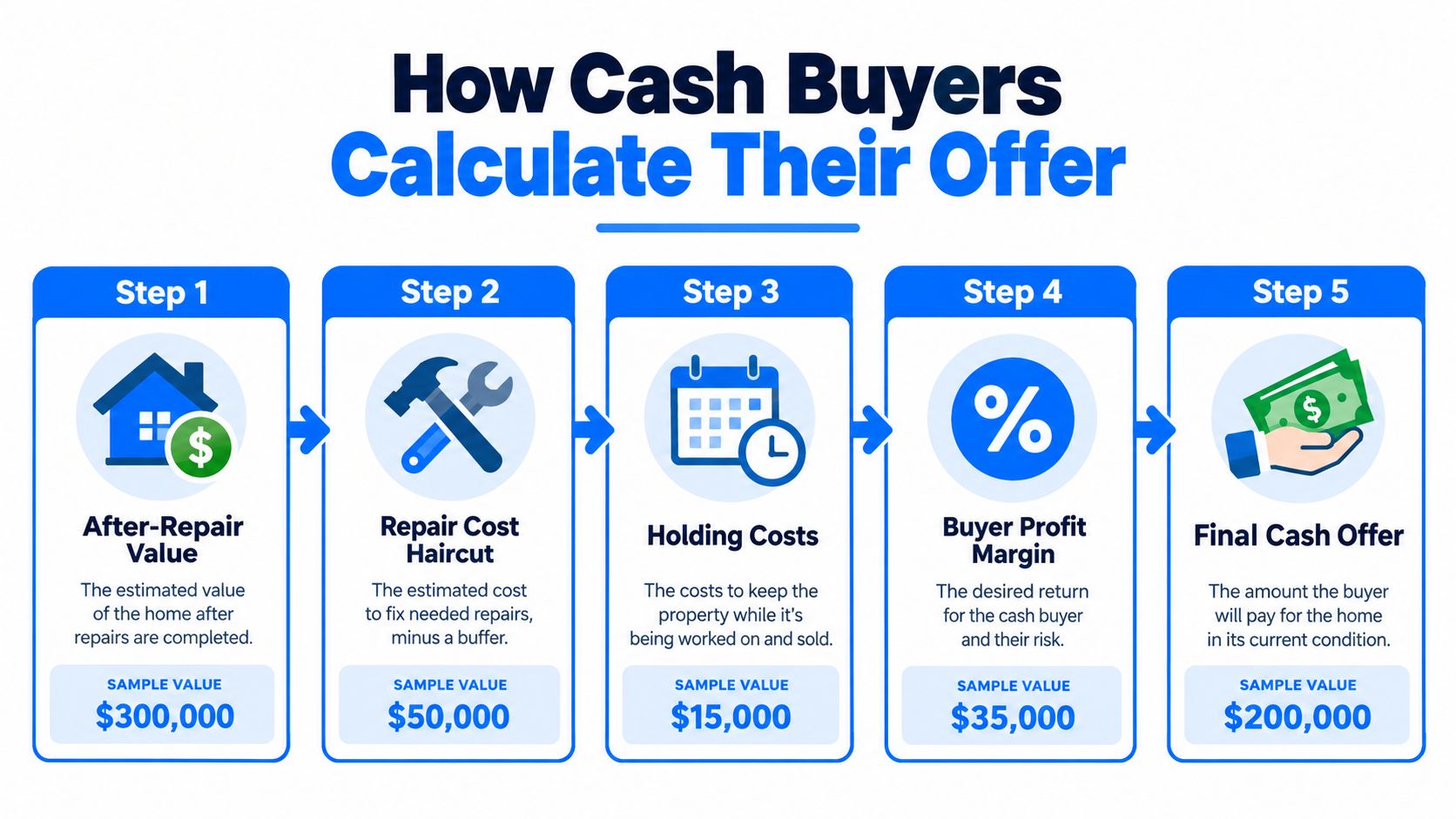
A Charlotte house with a repaired value around $350,000 can make the math easier to see. If a buyer thinks repairs and holding costs will consume part of the margin, the offer can fall into the low-to-mid $200,000s even when the home would sell much higher after updates.
How the math works
The buyer's logic is usually simple. They estimate resale value, then make room for work that has to happen before resale.
| Calculation Step | Formula | Example Amount |
|---|---|---|
| After-repair value | Estimated resale price | $350,000 |
| 70% rule baseline | $350,000 × 70% | $245,000 |
| Repair haircut | Subtract needed repairs | -$25,000 |
| Holding and resale costs | Subtract carrying and transaction costs | -$10,000 |
| Buyer profit margin | Subtract investor margin | -$15,000 |
| Final cash offer | What remains | $195,000 |
That same house might get a very different offer from a landlord than from a flipper. A buy-and-hold buyer may pay more if rents look strong, while a wholesaler may offer less because they're trying to assign the contract instead of close with their own money.
A lower offer isn't automatically a bad offer. It's only a bad offer if the buyer can't show you where the discount is coming from.
If you want to see how a direct purchase process is usually presented, this cash home buying process overview is a useful comparison point before you sign anything.
Realistic Offer Ranges by Property Condition
The offer range starts with condition, not ZIP code. A home with fresh paint and a tired kitchen sits in a different bucket from a property with roof leaks, failed systems, or hidden water damage.
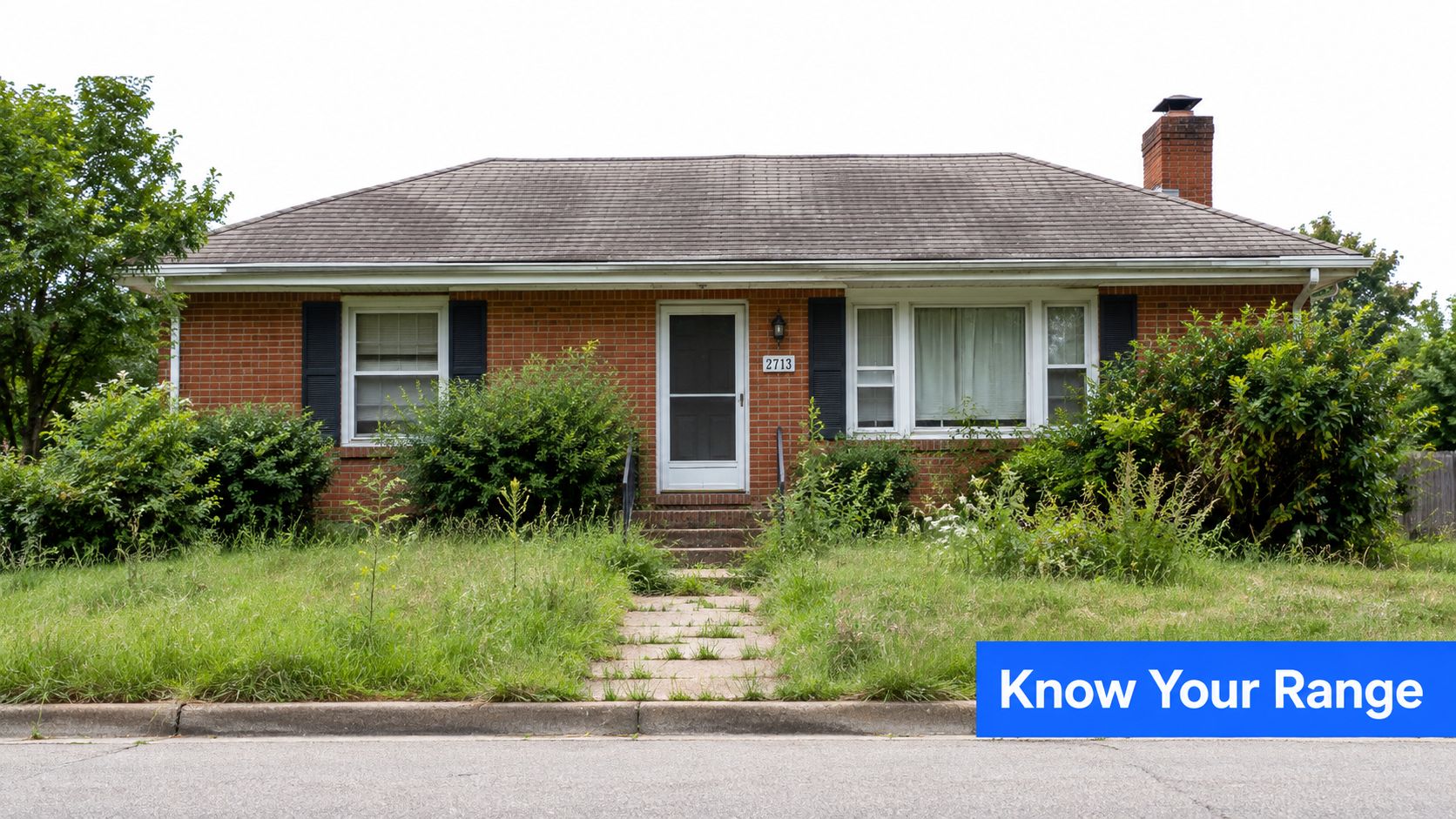
Light repairs
Light repairs usually mean cosmetic issues, paint, flooring, dated fixtures, and general cleanup. In Charlotte, those homes usually draw the strongest cash offers because the buyer sees limited uncertainty, not a major rehab.
For a home worth roughly $415,000, a light-repair cash offer can sit near the higher end of the typical range because the buyer's rehab risk is low. Sellers who want to sell house fast in Charlotte can still get a fair result here without putting the home on the market.
Moderate repairs
Moderate repairs usually involve a roof nearing the end of its life, an HVAC replacement, or several interior systems that need attention. At this stage, sellers start asking how much they lose by selling as-is, because the discount becomes visible fast.
The buyer has to budget for the work and the time it takes. In Charlotte, that pushes the offer well below what a polished listing might show on paper, even when the house is still livable.
Heavy repairs
Heavy repairs include foundation concerns, fire or water damage, major system failure, or a property that has been neglected for years. These homes attract the most conservative offers because buyers are pricing hidden damage, not just obvious repairs.
Charlotte sellers need to watch clay-soil foundation movement, hail and roof damage, older plumbing, electrical issues, and AC strain in summer. Those problems turn a normal as-is sale into a deep-discount deal fast.
The rule is simple. A house that only needs cosmetic work should not be priced like a home with structural or moisture damage. Do not let anyone lump those together just because both are called sell house without repairs in Charlotte.
Cash Buyer vs. Agent Listing vs. Fix-and-List
Cash is the fastest path, but it is not automatically the highest-net path. In Charlotte, Mecklenburg County, the market in September 2026 had a median of 64 days to sell, active listings up 10.3% year over year, a median list price of $424,950, and 26.2% of active listings with a price reduction, so the old assumption that every listing flies off the shelf just isn't true source.
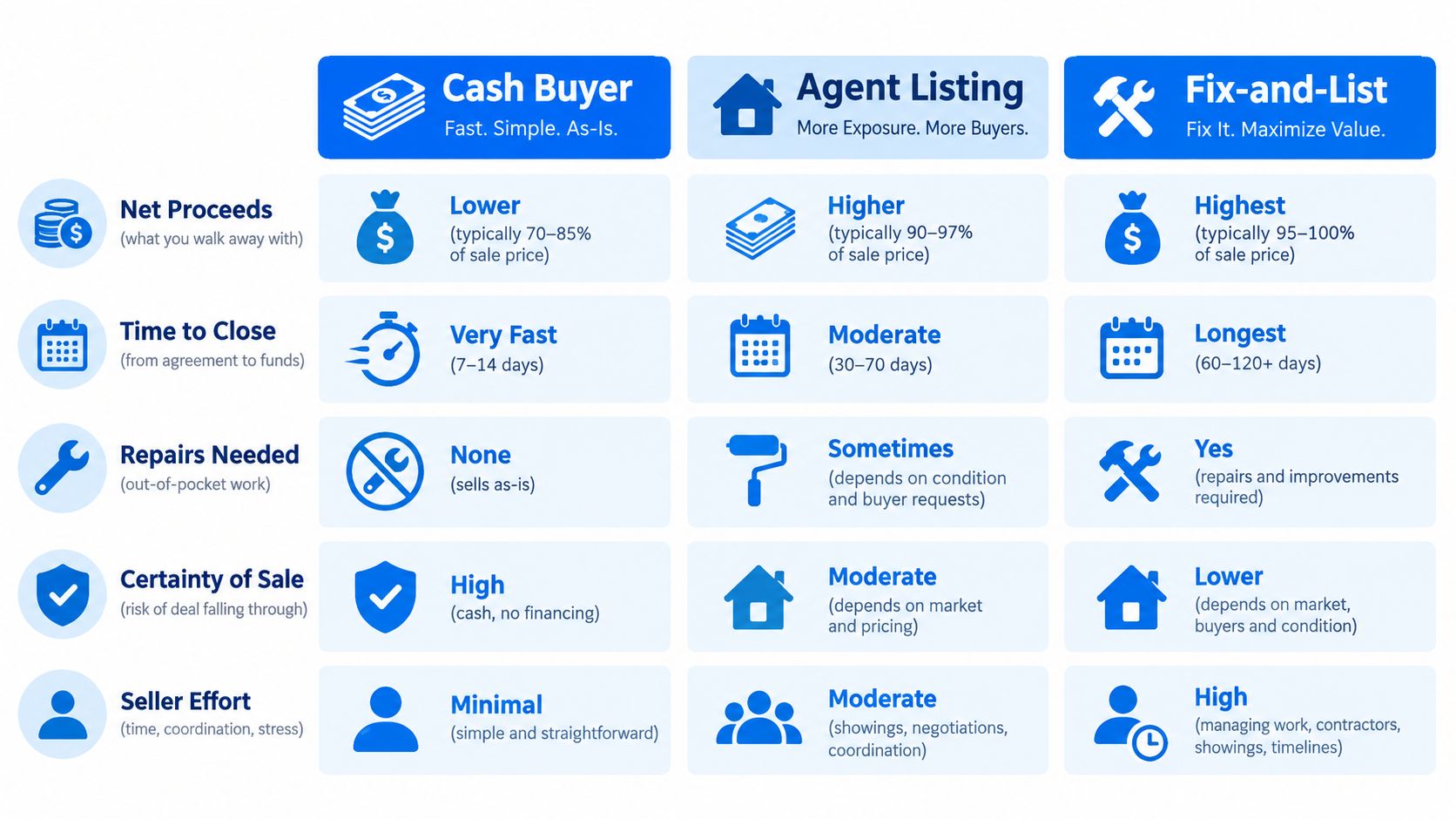
Here's the blunt comparison for a $410,000 Charlotte home.
| Factor | Cash Buyer (As-Is) | Agent Listing As-Is | Fix-and-List |
|---|---|---|---|
| Net proceeds | Lower headline price, fewer deductions | Higher gross, but deductions can stack up | Potentially highest gross, but only after spending on repairs |
| Fees | Usually minimal, sometimes none | Commission, closing costs, possible concessions | Repairs plus commissions and closing costs |
| Time to close | Often 7 to 30 days | Often weeks or months | Usually longest because repair work comes first |
| Repairs needed | None from seller | None upfront, but credits may come later | Seller funds repairs before listing |
| Certainty of closing | High if buyer has funds and title is clear | Lower because financing and appraisal can fail | Medium, because the home still has to appraise and inspect cleanly |
The hard truth is that top dollar on paper is not the same as top net at closing. Once you factor in carrying costs, possible price cuts, and the risk of re-trading after inspection, an as-is listing can lose some of its appeal fast.
If you need certainty more than exposure, compare net proceeds, not just asking price.
If you're sorting through cash home buyers in Charlotte, the main question is who can close, not who talks the fastest. A local list of buyers, including firms that market themselves as we buy houses in Charlotte, is only useful if they can show funds and use a real closing attorney. One example is this Charlotte cash-buyer comparison resource, which is helpful when you're screening options.
Get a cash offer for your home
A Realistic Cash Sale Timeline From Offer to Close
A serious cash sale starts quickly, but it still has steps. A credible buyer can often give you an offer within a couple of days, then move through walkthrough, contract, title search, and closing without dragging the process out.
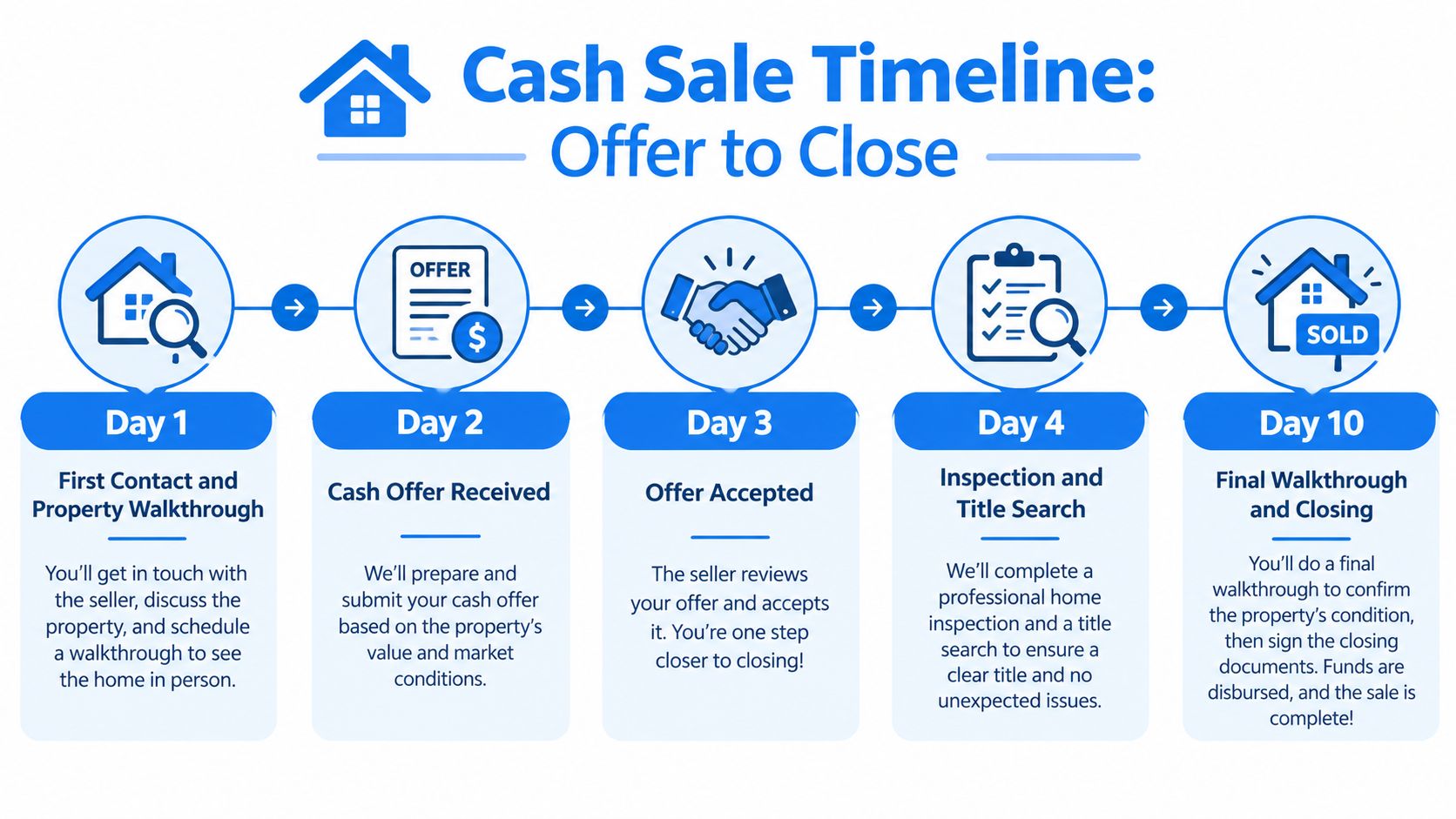
At the walkthrough, the buyer confirms the condition, spots the repair risk, and checks whether the numbers still work. After that, the contract and earnest money should lock in the terms, not leave them floating.
- First contact and walkthrough. The buyer reviews the property in person or by video and confirms what they're buying.
- Written offer. You get the price, the closing window, and the terms in writing.
- Contract and earnest money. A real deal should include signed paperwork and earnest money held by the closing attorney or title company.
- Title search and payoff work. The attorney checks mortgages, liens, taxes, and other issues that can stop a clean transfer.
- Closing and recording. The deed is signed, funds are disbursed, and the transfer is recorded.
A 7-day close is possible when the title is clean, the buyer already has funds, and there's no mortgage payoff or estate issue slowing things down. A 14- to 30-day close is more common when there's a mortgage, inherited property, tenants, or a lien to clear.
If you're moving inventory or tools between properties, a short-term storage solution can keep the timeline from getting messy, especially if you need a place for furniture, contractor gear, or documents during the transition. For sellers comparing practical move-out support, weatherproof storage for your work van is a useful example of the kind of temporary storage planning that can reduce stress during a sale.
Vetting the Buyer, the Contract, and Your Disclosures
A fast offer is useless if the buyer can't close. Before you sign anything, ask for proof of funds, confirm who's handling the closing, and read the assignment language carefully.
What to verify before you sign
A legitimate cash buyer should show a bank statement or letter that supports the offer amount. The earnest money should sit with the closing attorney or title company, not just be promised verbally.
Practical rule: if the buyer wants you to sign first and explain later, stop there.
The contract should also say who chooses the closing attorney, whether the buyer can assign the deal, and whether they can reduce the price after walkthrough. In Charlotte, that last one matters because some operators use the walkthrough to reopen the negotiation after you've already committed.
What North Carolina still requires
North Carolina sellers generally still use the Residential Property and Owners' Association Disclosure Statement under N.C. Gen. Stat. Chapter 47E, even in an as-is home sale in North Carolina. The as-is label shifts repair responsibility, but it doesn't erase the duty to disclose known material issues.
The state also requires a licensed attorney to handle the closing, and the transfer tax is $1 per $500 of consideration, which equals 0.2% of the sale price source. On a $400,000 sale, that tax works out to $800.
Pre-signing checklist for a Charlotte cash sale
| Item to Verify | What Good Looks Like | Red Flag |
|---|---|---|
| Proof of funds | Bank statement or letter matching the offer | Verbal claim only |
| Earnest money | Held by a local title company or closing attorney | Buyer won't deposit it |
| Closing attorney | Named in writing | Buyer refuses to identify one |
| Assignment rights | Clearly disclosed if allowed | Hidden wholesaling language |
| Inspection rights | Limited and specific | Buyer can reopen price endlessly |
| Payoff statements | Lien and mortgage payoffs requested early | No plan for debts or title issues |
| Disclosure form | Known defects listed honestly | Seller told to “skip the paperwork” |
If you're behind on payments, timing becomes even more important. A power-of-sale foreclosure in North Carolina can't proceed without court authorization, and the clerk's decision can be appealed within 10 days, so the sale date and the payoff deadline have to line up. That's why people looking to sell house fast in Charlotte should get the payoff figure before they assume a buyer can save the deal.
Get a cash offer for your home
Hidden Costs of Holding a Charlotte Home Through a Listing
The biggest mistake sellers make is comparing a cash offer to the list price, not the net. Every extra month on market adds mortgage interest, taxes, insurance, utilities, and upkeep, and those costs don't show up in the headline number.
Charlotte's market data shows why that matters. In May 2026, the region had 12,619 homes for sale, 3.4 months of inventory, and a median sales price of $410,000 source. By June, inventory had climbed to 13,082 homes and supply reached 3.6 months, which means sellers had more competition and more time exposure.
A listed home can also trigger commissions, buyer credits, repair concessions, and appraisal drama. Financed buyers can still fall apart if the inspection turns up issues or an FHA or VA appraisal gets picky about condition.
Here's the practical decision rule. If your carrying cost plus the risk of a failed listing is bigger than the cash discount, the cash path usually wins on net.
Selling in Tough Situations and What Happens to Your Mortgage
If you are under pressure, this is the section that decides whether a cash sale is the right move. Inherited houses, divorces, tenant-occupied rentals, liens, back taxes, code violations, fire damage, water damage, and hoarder homes all push sellers toward cash because the standard listing route gets complicated fast.
Inherited, probate, and divorce sales
Inherited homes usually need a title review before anything else. If the estate paperwork, lien releases, or mortgage payoff details are not ready, a buyer may still want the property, but the closing attorney cannot finish the file until the title issues are cleared.
Probate sales often slow down for the same reason. The attorney needs a clean paper trail showing who can sign and who has authority to sell.
Divorce sales turn on consent and signatures. Both owners have to sign the right documents unless a court order already settles that issue.
Tenants, liens, and property damage
A tenant-occupied rental can still sell as-is, but the buyer needs to know what comes with the deal. Lease terms, deposit handling, and possession timing all matter before anyone signs.
A house with liens, back taxes, or code violations may still close. The closing attorney has to confirm what must be paid from the proceeds, and the seller needs that answer in writing before accepting the offer.
Fire damage, water damage, and hoarder conditions usually push a property further into the discount range because the buyer is pricing uncertainty as much as cleanup. The same is true for older Charlotte housing stock where pipes, HVAC, or electrical systems are near the end of their useful life. A buyer who has to guess at hidden repairs will price that risk into the offer.
How your mortgage gets paid off
Your mortgage does not disappear just because you sell as-is. At closing, the attorney orders a payoff statement and pays the lender from the sale proceeds before you receive your net.
The settlement statement should also list taxes, liens, fees, and any other deductions. That document is the paper trail you need to see exactly where the money went. If the sale price will not cover the full debt, you need that number before you accept the offer.
Tax basics to keep in mind
The federal home-sale exclusion is generally $250,000 for a single filer and $500,000 for a married couple filing jointly, but it is not automatic and it does not wipe out every tax issue. Depreciation recapture, ownership tests, and use tests can change the result, so consult a tax pro before you sign.
For Charlotte sellers comparing options, the right sequence is simple. Gather the title paperwork, payoff information, and disclosure details first, then ask for a written offer that shows payoffs, costs, and net proceeds. If you want to compare that against a direct cash purchase model, Cyber Homes is one Charlotte-facing option that buys as-is and closes through a title company.
FAQs
Can I sell a house as-is in Charlotte if I still have a mortgage?
Yes. The mortgage gets paid off at closing from the sale proceeds, and the closing attorney should show that line on the settlement statement.
What if the buyer wants to assign the contract?
That is a wholesaling red flag unless it is fully disclosed and you are comfortable with it. If the buyer can assign without telling you who is closing, ask more questions or walk away.
Do I have to make disclosures if I sell as-is?
Yes. You still have to disclose known material defects under North Carolina's residential disclosure rules. As-is changes repair responsibility, not honesty.
How fast can foreclosure move in North Carolina?
It can move quickly enough that timing matters a lot, especially if you are already behind on payments. Get the payoff or reinstatement amount immediately and have the closing attorney confirm the closing date before the lender's next legal step.
What transfer tax will I owe on a $400,000 sale in North Carolina?
At $1 per $500, the tax works out to $800 on a $400,000 sale. Confirm whether your closing attorney is allocating that charge the way you expect.
What vacant-property or code rules should I check before selling a hoarder or inherited home?
Check with the City of Charlotte's Code Enforcement division, Mecklenburg County, and a local closing attorney or title company. The available sources do not establish one simple citywide threshold, so current rules need to be verified before marketing the home.
How do I know if a cash buyer is real?
Ask for proof of funds, a written offer, named closing attorney details, and earnest money in escrow. If they dodge those basics or push you to sign before you review the contract, that is not a serious buyer.
Is a cash offer always better than listing?
No. If the home is in strong shape and you can wait, a listing may produce more gross dollars. If you need speed, certainty, or a way out of repairs and showings, cash usually makes more sense.
If you want a straight answer on whether your Charlotte house is a true cash-sale candidate, gather your payoff info, disclosure details, and photos, then compare a written offer against your likely net on the open market. If you would rather skip the guesswork, visit Cyber Homes and ask for a direct as-is offer on your property.

Edited by
James Vasquez
Real Estate Investor & Land Specialist with 10+ years experience in residential flipping, vacant land investing, land wholesaling, and subdivision deals.
Disclaimer: The information provided is for educational purposes and does not constitute financial or legal advice. Always consult with licensed professionals before making investment decisions.