Selling an Inherited Property in Indianapolis, IN

A family member has passed away, and you're standing inside their Indianapolis home with a practical question that feels harder than it should: can you even put the property on the market yet? The answer is usually yes, but not necessarily in the way a typical homeowner would sell. First, you need to confirm who has legal authority to sell and whether the home requires probate, a recorded title transfer, or another legal step.
This guide walks through authority, probate, documents, title problems, selling options, taxes, disagreements between heirs, and Marion County considerations. It's updated for 2026. The information is general education, not legal or tax advice, so confirm your situation with qualified Indiana professionals before signing a listing agreement or accepting an offer.

Get a cash offer for your home
Selling an Inherited Property in Indianapolis Starts With Authority
The first mistake many families make is treating inheritance and ownership as the same thing. A will may name a beneficiary, but that beneficiary might not yet have the authority to sign a deed. A court-appointed personal representative, trustee, surviving owner, or properly documented heir may hold that authority instead.
Indiana real estate can pass to heirs or devisees at death, but the property can still remain subject to estate administration, creditor claims, and title requirements. If the decedent owned the Indianapolis home alone and didn't use a trust, survivorship ownership, or a valid transfer-on-death deed, the estate commonly needs probate or another recorded process before a buyer can receive clear title. Indiana estate-transfer guidance explains why the transfer route matters before a family spends money on repairs or commits to a closing date.
Think of selling authority as a key. Being related to the deceased person may give you an interest in the property, but the right legal document gives you the key to list, negotiate, and sign.
Practical rule: Don't sign a listing agreement as the seller until a title company or estate attorney confirms who has authority to sign.
For some Indianapolis families, that key comes from probate court. For others, it comes from a trust, survivorship deed, transfer-on-death deed, or small-estate affidavit. The right answer depends on how the home was owned and what documents existed before death.
The rest of the process becomes easier once that question is settled. You can then gather records, check liens and taxes, choose between an agent listing, an as-is sale, or a cash offer, and estimate what the estate will receive after obligations are paid.
Who Can Legally Sell an Inherited House
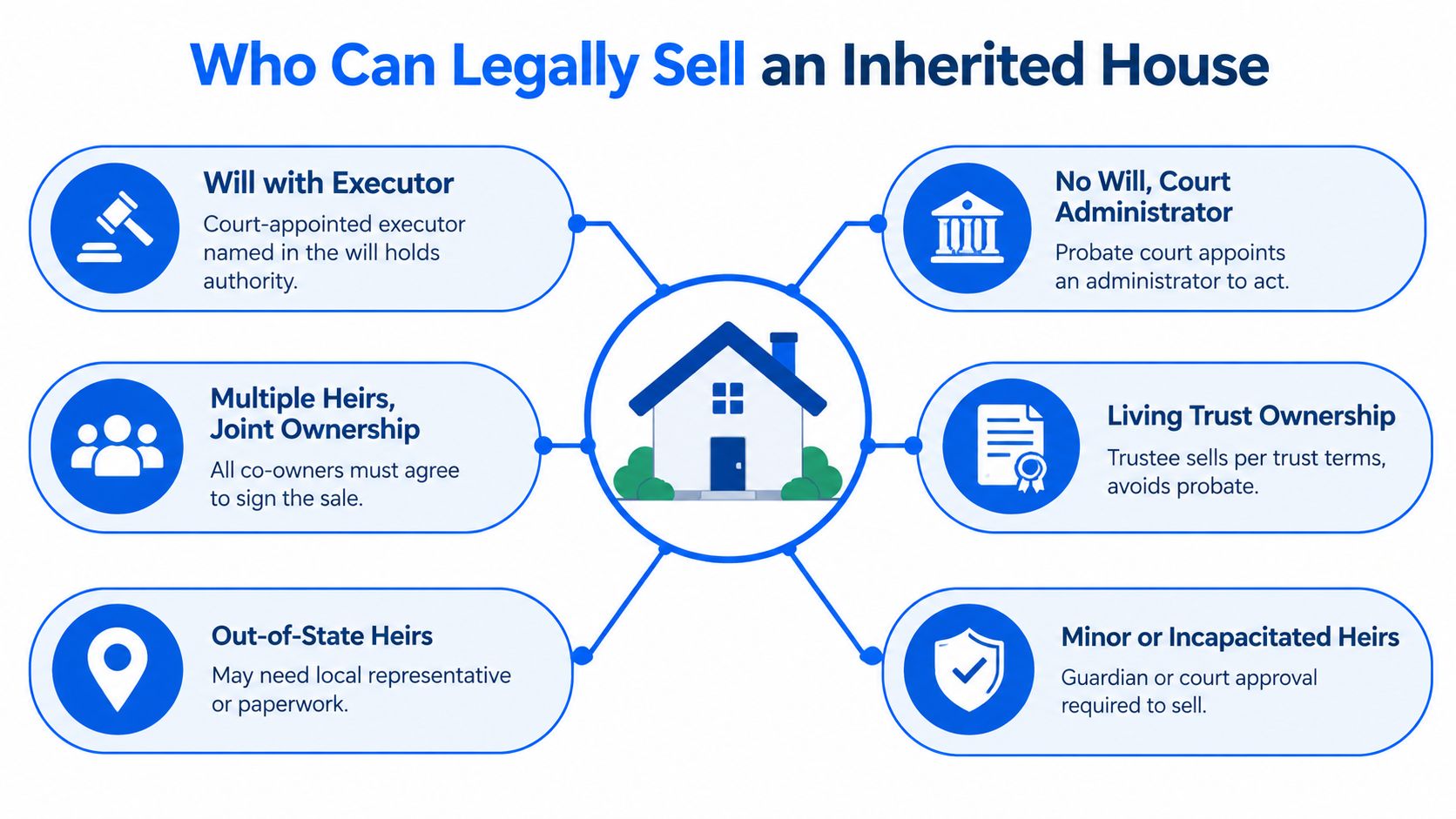
Several ownership paths can lead to an inherited-house sale. Each gives signing authority to a different person.
A will with a court-appointed executor
A will can nominate an executor, but the nomination alone may not be enough. The probate court generally needs to recognize the will and appoint the personal representative. Once appointed, the executor can often act for the estate, subject to Indiana law, court orders, and the terms of the administration.
Indiana law gives a personal representative broad powers to sell, mortgage, or lease estate property. That power comes from the probate appointment and estate process, not merely from being named as a beneficiary. Indiana's personal-representative statute describes those powers.
No will and a court-appointed administrator
When someone dies without a will, the court may appoint an administrator. The administrator performs the practical estate duties, including identifying assets, addressing claims, and handling a sale when appropriate. An heir can't automatically sign for the estate just because Indiana intestacy rules may eventually give that person an interest.
A living trust and trustee
If the home was titled in a living trust, the trustee usually follows the trust terms and signs for the trust. This path can avoid traditional probate for that property, but the title company still needs the trust certificate, trustee documentation, death certificate, and other proof that the trustee has authority.
Joint ownership with survivorship rights
A surviving joint owner may receive the deceased owner's interest without a probate-style transfer. The surviving owner still needs to document the death and update the title record before selling. Joint ownership language matters, so don't assume every shared deed creates survivorship rights.
A transfer-on-death deed
Indiana recognizes transfer-on-death deeds, but the deed must be executed and recorded in the county where the property is located before the owner's death. Otherwise, it's void. When valid, the transfer occurs automatically at death without a request for execution of the transfer. Indiana's transfer-on-death deed law sets out this requirement.
Multiple heirs owning together
If several heirs become co-owners, all people with an ownership interest generally need to approve the sale and sign, unless a court order or valid power of attorney changes the arrangement. A family member living out of state may be able to sign remotely, but the title company must approve the signing method.
Step-by-Step Process and Documents You Need
Start with preservation, not renovation. Change locks if necessary, keep utilities running where needed, maintain appropriate insurance, and arrange lawn care or inspections. An empty Indianapolis property can develop maintenance problems quickly, and unpaid bills continue while the estate decides what to do.
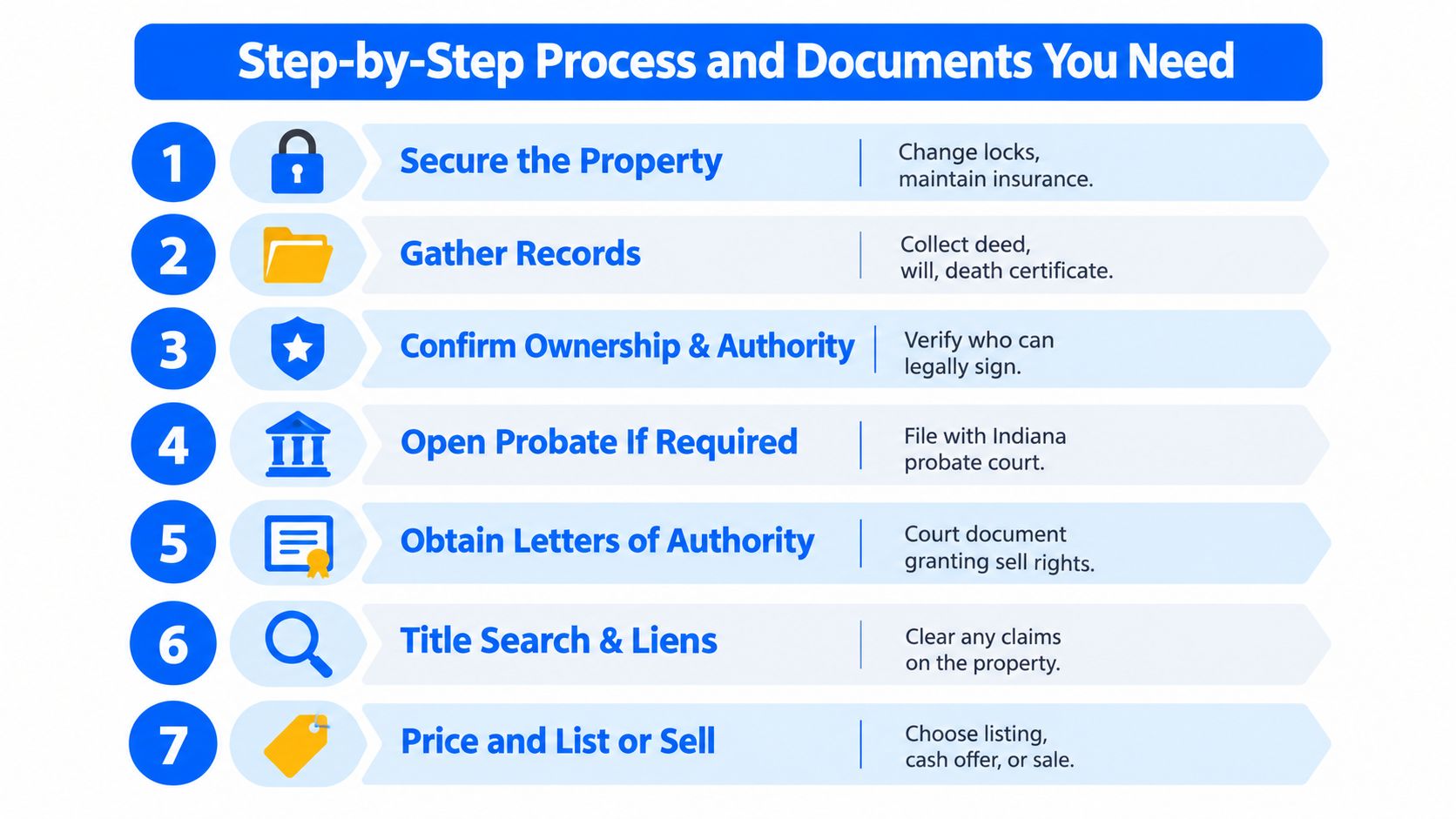
Follow the authority-first sequence
- Secure the house and gather records. Find the deed, tax statements, mortgage information, insurance policy, warranties, repair records, and personal papers.
- Confirm ownership and signing authority. Determine whether the home belongs to an estate, trust, surviving owner, or multiple heirs.
- Open probate if required. If the property needs court administration, the personal representative must obtain the appointment and follow the applicable process.
- Give the title company the estate documents. The title company can identify missing affidavits, deeds, court orders, death certificates, trust documents, or personal-representative paperwork.
- Check financial obligations. Request mortgage payoff information and search for property taxes, liens, judgments, HOA balances, and other title claims.
- Choose the sale route. Compare a traditional listing, an as-is MLS listing, and a direct cash offer based on condition, timing, and expected net proceeds.
- Price from the net backward. Consider the expected sale price, repairs, carrying costs, payoff amounts, closing charges, and estate obligations.
- Close and distribute proceeds properly. The personal representative or trustee must follow the estate plan, court requirements, creditor process, and ownership shares.
Keep this document checklist
- Death certificate: Have certified copies available if the title company, lender, or court requires them.
- Will, trust, or estate documents: These show how the decedent intended the property to transfer.
- Court appointment documents: Letters or other probate records can establish the executor's or administrator's authority.
- Deed and property tax records: These help verify ownership and identify tax status.
- Mortgage payoff statement: The lender must be paid or otherwise addressed at closing.
- HOA or condominium records: Request balances, rules, resale documents, and contact information if applicable.
- Insurance and repair records: These help with risk management, disclosures, and tax documentation.
- Title and lien information: Old mortgages, judgments, and recorded claims can affect the sale.
- Government-issued identification: The seller, trustee, executor, administrator, or authorized agent will need identity verification.
A title company should review the file before the property is marketed aggressively. If family members need help organizing documents or coordinating routine administrative work, virtual legal assistant services can support attorney-directed tasks, but they don't replace an Indiana attorney or the title company.
Probate and Title Issues That Affect Timing
Probate is the court-supervised process used to administer an estate. It can validate a will, appoint a personal representative, address claims, and help transfer property. It isn't automatically a waiting period during which nobody can discuss, prepare, or even market the home.
The key question is whether the person signing has authority to convey clear title at closing. An executor or administrator may be able to move a sale forward during probate, but some situations require court involvement or a specific order. Indiana law allows a personal representative to petition the probate court to sell estate real estate, with the petition identifying the property and reasons for the sale. Indiana's real-estate-sale statute explains that court approval may be relevant.
Common sources of delay
- A will can't be located or has competing versions.
- Potential heirs are unknown, unreachable, or disputing the distribution.
- Co-heirs disagree about repairs, price, belongings, or timing.
- An old mortgage remains on the title, even if the family believes it was paid.
- Property taxes, liens, judgments, or HOA balances are unpaid.
- The deed contains an error, an unclear legal description, or a prior owner's unresolved interest.
- The home was placed in a trust, shared with another owner, or transferred through a deed that wasn't properly recorded.
- Personal belongings remain inside, making access, cleanup, and possession unclear.
Don't assume formal probate is the only route. Indiana's small-estate affidavit cap is $100,000, and some inherited homes may qualify for that route depending on the estate and the property-transfer facts. Indiana probate guidance on asset transfer recommends checking the available path before committing to repairs or carrying costs.
A title company and Indiana estate attorney can determine whether the property needs full probate, an affidavit, a recorded deed, a trust transfer, or a court order. For additional general background on the subject, this probate home-sale guide can help families understand the terminology, but it isn't a substitute for a local title review.
Get a cash offer for your home
Repair, Sell As-Is, or Accept a Cash Offer
The right selling method depends on what the estate needs, not on a universal promise about price or speed. A well-maintained home may benefit from broad buyer exposure, while a vacant property with significant deferred maintenance may create more risk through every week of delay.
Three common paths
A traditional agent listing usually fits a home in saleable condition when the family is willing to prepare it, allow showings, and pursue the strongest available market response. An agent can help with pricing, buyer negotiations, disclosures, and transaction coordination.
An as-is MLS listing keeps the property visible to ordinary buyers while making clear that the estate isn't promising to complete repairs. This can work when the house needs updating but still has appeal to buyers who can handle the work.
A direct cash buyer may suit a house with major repairs, inherited clutter, vacancy concerns, or an urgent estate decision. Convenience can come with a lower price than a fully marketed sale, so compare the offer against the likely repair budget, holding costs, financing risk, and net proceeds. Ask for proof of funds and understand every proposed deduction.
| Selling Path | Price Potential | Speed and Convenience | Best Fit |
|---|---|---|---|
| Traditional agent listing | Often the strongest opportunity for broad market pricing, depending on condition and presentation | Requires preparation, showings, negotiations, and buyer due diligence | A home in good condition where maximizing price matters |
| As-is MLS listing | Can reach many buyers, but condition may influence offers | Avoids major pre-listing repairs while retaining market exposure | A house needing work where the family still wants an open-market sale |
| Direct cash buyer | Convenience may be reflected in a lower offer | Fewer showings and less repair work, subject to title and authority review | Major repairs, clutter, vacancy, or a need for a simpler transaction |

“As-is” describes the condition and repair position. It doesn't erase ownership requirements, liens, title defects, or applicable disclosure duties. Estate sellers may have limited knowledge of the home, but they should still discuss what they know and what Indiana law requires with a qualified real estate professional or attorney. For another framework for comparing local cash-sale options, review cash-buying companies in Indianapolis, then independently verify each buyer's funds, contract, and closing process.
Inherited Property Taxes and Costs in Indiana
Taxes depend on the estate, the seller, the property, and the transaction. Before accepting a price, identify unpaid property taxes, liens, mortgage balances, insurance, utilities, cleanup, repairs, and closing charges. Those obligations reduce what the estate receives even when the sale price looks attractive.
Indiana doesn't levy an inheritance tax for people who died after December 31, 2012. That means the transfer-and-sale economics for inherited Indianapolis property are usually driven more by probate and title mechanics and by capital-gains treatment than by a state inheritance levy. The Indiana Department of Revenue's inheritance-tax information provides the state's relevant guidance.

How the step-up in basis works
Inherited property typically receives a new federal tax basis tied to its fair market value at death. Gain is generally measured against that adjusted basis, rather than against what the decedent originally paid. That can reduce or eliminate taxable gain on a quick sale when the market value at death is close to the contract price, but later appreciation can still create gain.
For a simple illustration, suppose a documented date-of-death value is $230,020 and the home later sells for $260,000. The difference is $29,980 before considering allowable selling expenses or other adjustments. The example uses an Indianapolis market figure reported for August 2026, but it isn't a tax calculation for any particular property. A CPA must determine the actual basis, adjustments, gain, and tax treatment. Indianapolis inherited-property guidance discusses the importance of documenting local value, taxes, deductions, and carrying costs.
Keep these records together:
- Date-of-death valuation: Preserve an appraisal or another supportable valuation.
- Repair and improvement receipts: Separate ordinary maintenance from improvements where possible.
- Outstanding liens and payoffs: Record what the sale proceeds must satisfy.
- Selling expenses: Keep invoices and settlement details.
- Final closing statement: Give the settlement statement to the tax professional.
- Property tax records: Track paid, unpaid, prorated, or delinquent amounts.
Marion County property taxes can continue while the home sits empty. A missed tax bill may become a lien or create a larger problem if the property enters the county's tax-sale process. Ask a CPA about capital gains, and ask an estate attorney about estate administration, creditor claims, and beneficiary distributions. This is especially important when the property value or potential tax exposure is significant.
Get a cash offer for your home
Multiple Heirs, Disagreements, and Indianapolis Considerations
A family sale can stall over a price, a repair, the contents of a bedroom, or the question of whether someone should keep living in the home. Put decisions in writing, establish who communicates with the agent or buyer, and create a shared record of offers, expenses, belongings, and deadlines. If negotiations deteriorate, an estate attorney or mediator can help before the disagreement becomes a court dispute. This guide to selling inherited property with multiple owners offers additional context for co-owner situations.
Indianapolis sellers should check the Marion County probate court and clerk resources, then confirm the deed and recorded documents through the county recorder. The county auditor and treasurer records can help identify assessed information, tax balances, and whether the homestead deduction may have fallen off after the owner's death. Ask about the county tax-sale calendar early instead of waiting for a closing problem.
Local title review should also cover old mortgages, judgment liens, unpaid taxes, contractor claims, and HOA or condominium balances. For a condominium, the association may require resale documents, account verification, or approval-related paperwork before closing.
Indianapolis homes also vary significantly by neighborhood and condition. An older property may need a closer look at the foundation, roof, electrical system, plumbing, drainage, or basement moisture. A buyer's inspection may uncover issues that affect an as-is offer or an agent's recommended repair plan.
Market timing matters, too. Reported Indianapolis figures for August 2026 placed median prices at about $260K, average home value at about $230,020, and the typical pending pace at roughly 21 days. Local Indianapolis market guidance supports a deliberate timing decision, rather than automatically waiting to list later while taxes, insurance, utilities, and maintenance continue.
Inherited House FAQs and Next Steps
Can I sell an inherited house before probate is complete?
Sometimes. A personal representative may have authority to market or sell estate property during probate, while a trust, survivorship interest, transfer-on-death deed, or qualifying small-estate route may avoid traditional probate. The title company and estate attorney must confirm whether the proposed closing can transfer clear title.
Do all heirs have to agree to sell?
Co-owners generally need to agree and sign. If the property remains under estate administration, the personal representative may have authority to act for the estate, but that doesn't mean family disputes can be ignored.
Can an executor sell an inherited house?
An executor can often sell for the estate after appointment and within the authority granted by Indiana law, the will, and any court orders. Being named in the will isn't always enough before the court recognizes the appointment.
Can I sell an inherited house as-is?
Yes, an as-is sale can be listed through the MLS or negotiated directly with a buyer. It still requires proper authority, title clearance, lien resolution, and careful attention to applicable disclosure duties.
What happens if the inherited home has a mortgage?
The lender's payoff or other approved arrangement must be addressed at closing. Request the payoff early, because the balance, liens, and estate obligations affect the net proceeds.
Do I have to pay taxes when I sell inherited property?
You may have property-tax obligations, closing costs, lien payoffs, and possible federal capital-gains consequences. Indiana's inheritance tax doesn't apply to decedents who died after December 31, 2012, but a CPA should review the basis and sale records.
What documents are needed to sell an inherited house?
Common documents include the death certificate, will or trust, court appointment records, deed, tax records, mortgage information, HOA documents, insurance and repair records, lien details, and identification. A title company will confirm the exact package.
Can an out-of-state heir sell a property remotely?
Often, yes. The title company must approve remote notarization, powers of attorney, electronic signatures, or another signing process, and every owner or authorized representative must be properly documented.
How long does it take to sell a probate property?
There isn't one reliable timeline. Missing heirs, title defects, creditor issues, court requirements, and disagreements can extend the process, while a trust, survivorship transfer, TOD deed, or qualifying affidavit may change the path.
Should I use an agent or accept a cash offer?
Use an agent when broad exposure and maximum market opportunity matter and the home can support preparation. Consider a cash offer when repairs, clutter, vacancy, or certainty matter more, but compare the complete net proceeds and verify proof of funds.
Your immediate next step is to identify the current owner of record, gather the death and estate documents, and ask an Indiana title company what must be recorded before a sale. Confirm estate authority, title requirements, and tax questions with qualified local professionals. This article is general information, not legal or tax advice.
If you want to compare an as-is solution for an inherited Indianapolis home, Cyber Homes can review the property, provide a cash offer, and coordinate a closing through a title company on an agreed timeline. Share the property details and condition so you can evaluate that option alongside an agent listing and other qualified offers.

Edited by
James Vasquez
Real Estate Investor & Land Specialist with 10+ years experience in residential flipping, vacant land investing, land wholesaling, and subdivision deals.
Disclaimer: The information provided is for educational purposes and does not constitute financial or legal advice. Always consult with licensed professionals before making investment decisions.