
Selling Inherited Property with Multiple Owners
You may be dealing with a house that belonged to a parent, grandparent, or sibling. One heir wants the money now. Another wants to wait for a better price. Someone else is still sorting through the furniture and family photos. Meanwhile, taxes, insurance, utilities, and upkeep keep coming.
That's the main problem with selling inherited property with multiple owners. The house is only part of it. The harder part is getting clear legal authority, fair pricing, and family alignment at the same time.
When families handle those three pieces in the right order, the sale usually moves. When they don't, the process drags, tempers rise, and even a willing buyer can't close.
First Steps Confirming Ownership and Authority
When a property passes to several heirs, the first mistake I see is treating it like an ordinary home sale. It isn't. Before anyone talks about repairs, showings, or offer prices, you need to know exactly who owns the property and who has the authority to sign.
A reliable starting workflow is to verify title and legal authority before marketing the home, including getting the deed, determining whether the property passed by joint tenancy, tenancy in common, or probate, and confirming who has signing authority, as noted in this guide on inherited-property title and authority. That's not just legal housekeeping. Inherited-property sales often fall apart late in escrow when ownership is unclear or one co-owner disputes the sale.

Start with the paper trail
Pull together the documents that answer four questions:
- Who died owning the home
- How was title held
- Did the property pass outside probate or through the estate
- Who can legally sign sale documents
That usually means locating the deed, any will or trust, probate filings if they exist, and letters showing who the executor or personal representative is. If the family is in Texas and trying to sort out whether formal probate is required, this guide for Texas families on estates can help clarify how heirship documentation fits into the process.
Why joint tenancy and tenancy in common matter
These ownership labels affect the path forward.
- Joint tenancy often means the surviving owner may receive the deceased owner's interest automatically, depending on how title was structured and state law.
- Tenancy in common usually means each owner has a separate share, and that share can pass through the estate to heirs.
- Probate ownership means the estate may still control the property until the court recognizes the heirs or the personal representative has authority to act.
If you don't know which category applies, don't guess. The title company, probate attorney, or closing attorney will need the answer anyway, so solve it upfront.
Practical rule: If you can't identify every owner and every required signer on day one, you're not ready to list the property.
Decide who speaks for the group
Even where several people must approve the sale, one person should handle communication with the attorney, title company, agent, or buyer. That person isn't the dictator. They're the coordinator.
Use a single shared email thread or group text for updates, and keep major decisions documented. Families get into trouble when one heir talks to the agent, another promises a buyer something different, and a third hasn't even seen the paperwork.
The cleanest inherited-property sales start with authority, not optimism. If the ownership picture is blurry, every other step becomes harder.
Aligning Heirs and Resolving Disagreements
The legal side matters. The people side decides whether the sale happens.
In multi-owner inherited homes, communication and decision alignment drive timeline risk more than marketing does, and these transactions often take longer than ordinary sales because heirs must coordinate on pricing, repairs, and sale method, according to this discussion of inherited-property delays and disputes. That matches what happens in practice. Most stalled sales don't stall because there isn't a buyer. They stall because the heirs never got on the same page.
The disagreement usually isn't about the house
Families often say they're fighting over value. Usually they're fighting over something underneath the value.
One heir may need cash quickly. Another may feel guilty selling the family home. Another may think fixing it up honors the parent who died. If you don't name those motives early, every pricing discussion turns into a proxy war.
A better approach is to ask each owner to answer three direct questions in writing:
- Do you want to sell or keep the property
- If sell, do you want speed or maximum exposure
- Are you willing to invest money or labor before sale
That simple exercise exposes the true conflict fast.
Use ground rules before emotions take over
Families do better when they agree on process before they argue about outcome.
Try these rules:
- One decision channel: Use one group email, one shared folder, and one point of contact with vendors.
- Set response deadlines: If signatures or decisions are needed, everyone should know the deadline.
- Separate facts from preferences: Appraisal, title issues, lien payoff, and required repairs are facts. Asking for top dollar or wanting a fast close is a preference.
- Record decisions in writing: Verbal family agreements tend to mutate.
The fastest way to create a legal fight is to market the property before the co-owners agree on the exit strategy.
Common conflict patterns and how to handle them
Here's where many families get stuck:
| Disagreement | What usually helps |
|---|---|
| One heir wants top dollar, another wants speed | Agree on a clear sale method first, then measure offers against that method |
| One heir wants to keep the home | Use an appraisal and discuss a buyout instead of arguing from emotion |
| One heir is doing all the work | Track tasks and expenses in writing so resentment doesn't build |
| One heir won't respond | Set formal deadlines and involve the estate attorney or title professional early |
A family doesn't need perfect harmony to sell. It needs a workable process and a shared understanding of what happens if no consensus emerges.
Know when to stop negotiating inside the family
If one person refuses every proposal but offers no alternative, that's not negotiation. That's obstruction. At that stage, the heirs may need outside help from probate counsel, a mediator, or court guidance, depending on the facts and the jurisdiction.
The smoother path is almost always the voluntary one. It preserves more control, usually creates less bitterness, and avoids turning a family problem into a court problem.
Valuing the Home and Choosing a Sale Path
Once the owners are aligned enough to move forward, the next issue is value. At this stage, many family disputes either calm down or get worse.
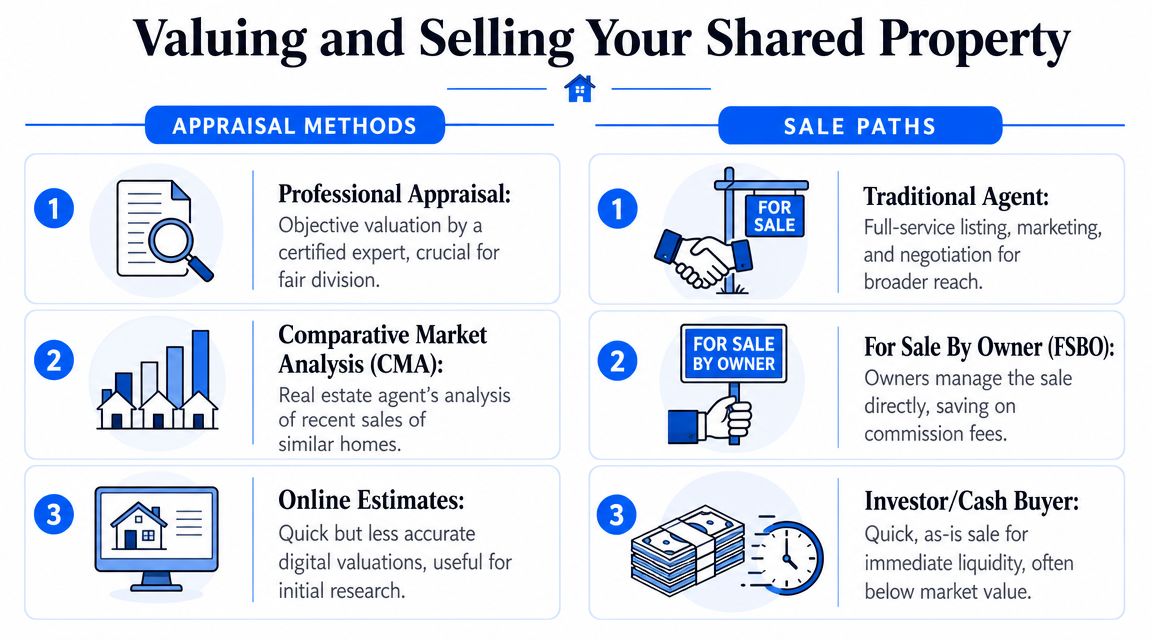
The cleanest way to anchor the conversation is with a professional appraisal. Industry guidance on inherited-property sales consistently treats the appraisal as critical because it establishes fair market value for pricing and for dividing proceeds fairly among owners, especially when several heirs inherit together, as explained in this resource on inherited sales with multiple owners. Without that neutral reference point, every conversation turns into opinion.
Why value needs to be objective
When several heirs own one house, even a small disagreement over value can change each person's expected payout and trigger conflict. The appraisal gives the family a common starting point.
That doesn't mean every buyer will pay the appraised number. It means the heirs can stop arguing about what the house is “worth” in theory and start discussing which sale path fits their priorities.
A broad sell preference also shapes this decision. Nearly 70% of Americans who expect to inherit property say they plan to sell it, according to Charles Schwab research cited in this overview of inheriting a house and deciding whether to sell. For most heirs, the issue isn't whether to exit. It's how to do it fairly and with the least friction.
Here's a quick explainer before comparing paths:
Comparing your sale options
| Factor | Listing on MLS | Heir Buyout | Cash Buyer (like Cyber Homes) |
|---|---|---|---|
| Best for | Families aiming for broad market exposure | Families where one heir wants to keep the home | Families prioritizing speed, simplicity, and as-is sale |
| Property condition | Usually works best when the home shows well | Depends on financing and agreement among heirs | Often workable even if the property needs repairs or cleanout |
| Decision burden | Higher, because heirs may need to agree on prep, pricing, and negotiations | High at the start, but simpler once terms are set | Lower if heirs want a straightforward exit |
| Time and effort | More showings, prep, and buyer interaction | More internal coordination on valuation and documents | Less operational work for the heirs |
| Price outcome | May attract stronger offers if the home is market-ready | Based on appraised value and ownership shares | Often chosen for certainty and convenience rather than highest price |
| Risk points | Inspection issues, financing delays, buyer renegotiation | Financing and family agreement | Need to compare terms carefully and confirm title readiness |
Matching the path to the family, not just the house
A listing makes sense when the heirs agree on preparation, can tolerate a longer market process, and want to test broad demand.
A buyout works when one sibling wants the property and the others mainly want a fair exit. The amount is typically based on the appraised fair market value multiplied by each person's ownership percentage, and the buying heir may need financing.
A direct cash sale makes the most sense when conflict is rising, the property needs work, the heirs live in different places, or nobody wants months of coordination. In those cases, comparing your options with a cash home sale path can help frame the trade-off clearly: less hassle and more certainty, usually in exchange for not chasing every last dollar.
An inherited home doesn't need the "best" sale path in theory. It needs the sale path the co-owners can actually complete.
Executing the Sale From Contract to Closing
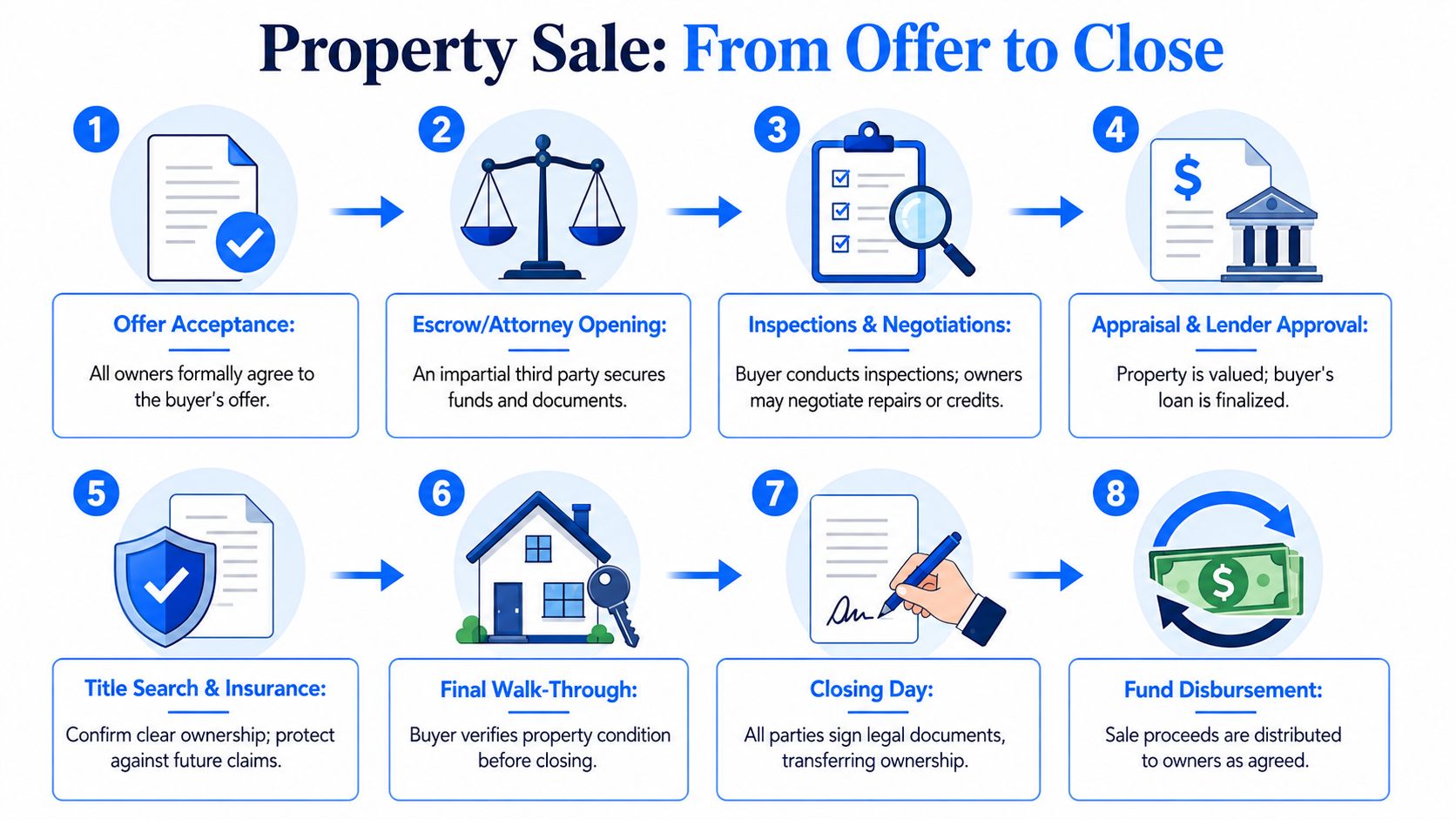
Once the owners accept an offer, the transaction becomes much more technical. This stage feels procedural, but details matter. A missing probate document, unsigned affidavit, lien payoff issue, or disputed ownership share can still stop the closing.
What happens after the offer is accepted
The first move is opening escrow or opening the file with the closing attorney, depending on the state. That neutral party coordinates the contract, funds, title work, payoff requests, and final closing package.
A core legal milestone in inherited-property sales is that title usually can't be cleanly transferred until the estate is administered and heirs' ownership is established, and once ownership is clear, co-owners generally must agree on the sale terms, with court approval sometimes required in contested situations, as outlined in this overview of probate milestones in inherited-property sales. If probate is still unresolved, that issue has to be handled before the transfer can finish.
Documents you'll likely need
Multi-owner inherited sales usually require a thicker file than a normal owner-occupied sale.
Expect requests for:
- Proof of inheritance: probate orders, letters testamentary, letters of administration, trust documents, or heirship records
- Title records: current deed and any documents showing how ownership passed
- Payoff information: mortgage statements, lien details, judgment payoff letters, or estate-related obligations
- Identity and signature items: IDs, wiring instructions, and notary-ready signature packages for each signer
If the home has been sitting vacant, confirm the property is still properly insured until closing. A vacant inherited house can create coverage issues, and families who are unsure what their current policy does or doesn't cover may benefit from reviewing a complete guide to home insurance policies.
How to keep closing from getting messy
The title company's job is to make sure the buyer receives clean title and the proceeds are distributed correctly. Your job is to answer questions quickly and keep the signer group organized.
A few practical habits help:
- Collect signatures early: If heirs live in different states, line up remote notary or local signing options before the last week.
- Disclose occupancy issues: If a relative still lives there, say so immediately.
- Resolve personal property disputes before closing: Don't leave the title company sorting out who gets the dining room set.
- Sell as-is only if everyone understands what that means: Condition disclosures still matter, even in a simplified sale. If the family wants a low-prep route, reviewing an as-is home sale approach can help set expectations.
Closing gets easier when the hard conversations happen before escrow, not during it.
Managing Taxes and Distributing Proceeds Fairly
The sale price is not the amount the heirs split. Families often know that in the abstract, but the stress starts when the settlement statement arrives and the gross number becomes a smaller net number.
Before heirs receive funds, the closing process usually has to account for mortgage payoff, liens, and estate obligations. After that, the remaining proceeds are distributed according to ownership shares and any court-approved or estate-approved instructions. That's why families should agree early on how expenses, reimbursements, and credits will be handled.
What comes out before the heirs are paid
Net proceeds are commonly shaped by several deductions:
- Mortgage payoff or home equity debt
- Tax liens, judgment liens, or other recorded claims
- Closing costs and title charges
- Agent compensation, if the property was listed
- Estate obligations that must be paid from sale proceeds
- Any agreed reimbursements among heirs
If one heir paid for lawn care, winterization, lock changes, or urgent repairs, decide before closing whether that person gets reimbursed from the top or whether those costs are treated as voluntary. Don't leave that issue floating.
The stepped-up basis issue
Tax treatment is where inherited-property sales can be more favorable than many heirs expect. In the U.S., inherited property generally gets a stepped-up basis to its fair market value at the time of the owner's death, and that rule is a major planning factor because it can sharply reduce or eliminate capital gains taxes when heirs sell shortly after inheriting, as summarized in this discussion of inherited real estate and stepped-up basis.
That doesn't mean every sale is tax-free. The outcome can change if the property is held for a while, rented out, improved, or partially transferred among siblings before the final sale. A sibling buyout can also create basis questions that deserve careful documentation.
Keep documentation like you'll need it later
You probably will.
Save these records:
| Document | Why it matters |
|---|---|
| Appraisal or date-of-death valuation | Supports inherited basis |
| Closing statement from the sale | Shows actual proceeds and transaction costs |
| Probate or trust records | Confirms ownership and authority |
| Buyout documents between heirs | Clarifies basis changes and transfer terms |
| Receipts for major improvements | May matter if the property was held before sale |
If the home had major damage before sale, some families compare repair-heavy options against a direct disposition of the property in its current state. In those situations, looking at a fire-damaged house sale route can help heirs think through whether fixing the property first really serves the group.
A clean closing isn't the finish line. A clean paper trail is.
Your Actionable Checklist and Timeline
Families do better when the sale is treated like a project with tasks, owners, and deadlines. That keeps emotion from filling the gap left by missing process.
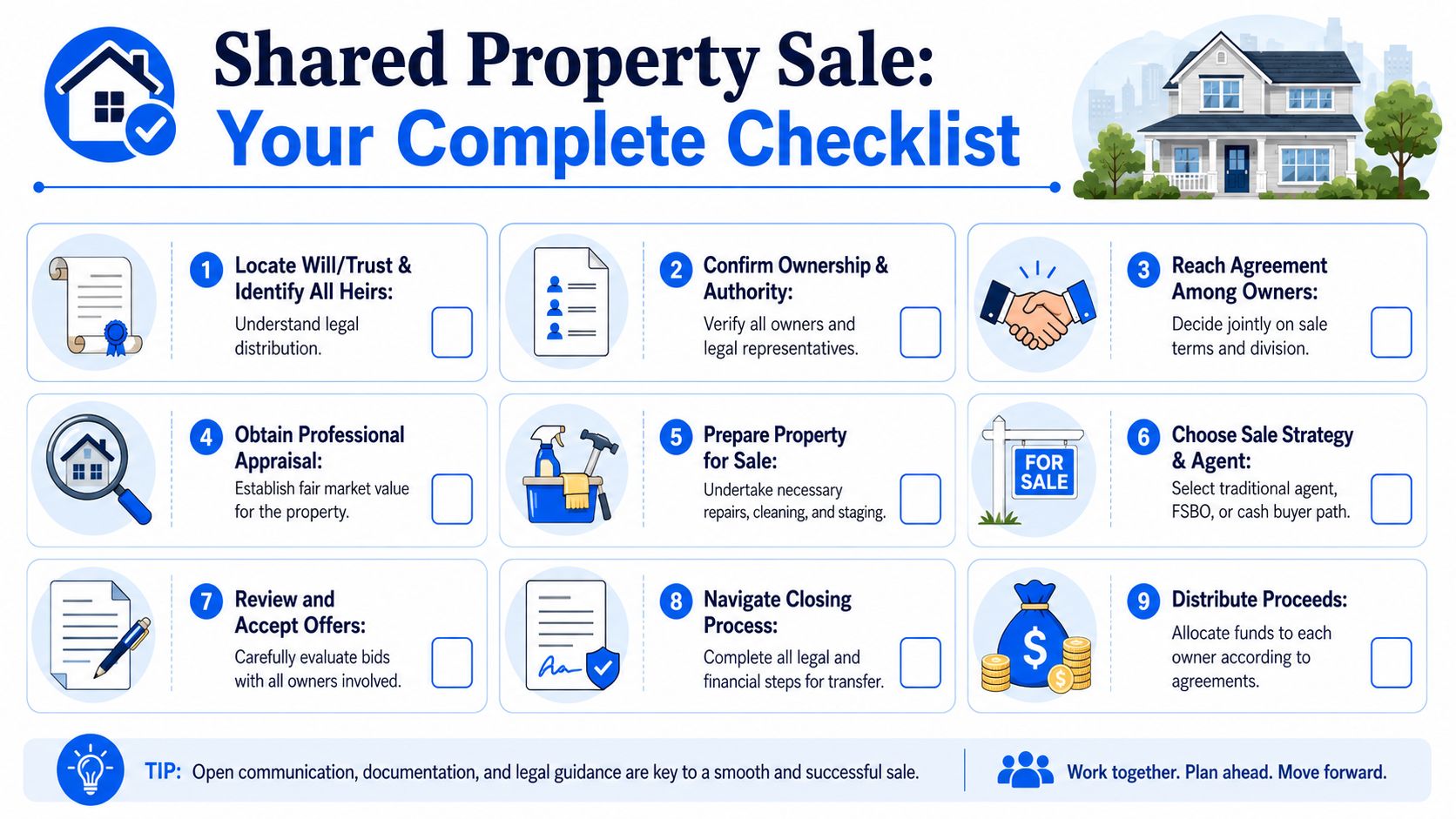
Use this checklist as a working document, not just a reading exercise.
Core checklist
- Locate estate documents: Gather the will, trust, death certificate, deed, and any probate paperwork.
- Confirm legal authority: Determine who owns the property now and who has power to sign.
- Choose a coordinator: One person should handle scheduling, document flow, and communication.
- Get everyone's position in writing: Sell, keep, buy out, list, or sell as-is.
- Order an appraisal: Use it as the baseline for pricing or buyout math.
- Decide on a sale path: MLS listing, heir buyout, or direct cash sale.
- Prepare the property only as much as the chosen path requires: Don't over-improve a house the family plans to sell as-is.
- Open title or escrow quickly after accepting an offer: Front-load document delivery.
- Review the settlement statement carefully: Confirm payoffs, credits, and ownership percentages.
- Confirm final distribution and save records: Keep every closing and tax document.
A realistic timeline
Some parts of selling inherited property with multiple owners move quickly. Others don't. The variable isn't usually buyer demand. It's whether the estate and heirs are ready.
A practical sequence looks like this:
| Phase | What drives the timing |
|---|---|
| Ownership review | Finding documents, confirming title, identifying all heirs |
| Family alignment | Agreement on whether to sell, who manages the process, and what path to use |
| Valuation | Scheduling the appraisal and reviewing the result |
| Property prep | Cleanout, repairs, or deciding to skip both |
| Sale process | Listing, negotiations, or direct-offer review |
| Closing | Title clearance, payoff statements, signatures, and fund disbursement |
Where families lose time
The two biggest slowdowns are usually personal-property cleanout and indecision. If the house is packed with years of belongings, bring in help early. A service like On The Move estate cleanout help can be useful when the family can't physically clear the house themselves or lives out of town.
The families who close smoothly are rarely the families with zero tension. They're the ones who assign tasks, document decisions, and keep moving.
FAQs for Selling a Multi-Owner Inherited Home
What if one heir refuses to sell
If all required owners must consent to a voluntary sale and one person refuses, the sale can stall completely. In some jurisdictions, a co-owner may pursue a partition action through the court to force a resolution. That route is usually slower, more expensive, and harder on family relationships than a negotiated agreement.
The better first move is to isolate the reason for the refusal. If the heir wants more money, an appraisal may help. If the heir wants to keep the property, discuss a buyout. If the heir won't engage, bring in the estate attorney or mediator before the file sits for months.
What if one heir is living in the property
Deal with occupancy upfront. A buyer, title company, and closing professional need to know whether the property will be delivered vacant.
If the occupant is an heir, the family needs a written agreement about move-out timing, responsibility for utilities, access for showings or inspections, and whether that heir is paying any carrying costs. Unwritten family understandings tend to collapse when closing gets close.
Can one sibling buy out the others
Yes, if the ownership and authority issues are clear and everyone agrees. In practice, the buyout amount is commonly based on the appraised fair market value and each person's ownership share.
The buying sibling may need financing, and the transfer should be documented carefully. If the family tries to do a casual off-the-record deal to save time, it often creates title or tax problems later.
What if the home has a mortgage or liens
The property can still be sold, but those claims usually have to be addressed through closing. The title company or closing attorney will request payoff statements and make sure valid liens are handled before the remaining proceeds are disbursed.
This is one reason inherited-property sales should not be priced casually. The family needs to understand the net outcome, not just the contract price.
Should we fix the house up first
Only if the heirs agree on budget, scope, and who manages the work. Otherwise, repairs become another source of conflict.
If the home has deferred maintenance, outdated finishes, or damage, a lower-prep path may be the smarter operational choice. Chasing a cleaner listing can backfire if the family spends months arguing over contractors and reimbursements.
What paperwork do we usually need
That depends on the state and the way the property passed, but common requirements include probate or inheritance records, the deed, payoff information, IDs for the signers, and any documents showing who has authority to act for the estate.
The biggest mistake is waiting for the buyer or title company to ask. Gather those records before the property goes live.
Is selling inherited property with multiple owners always harder than a normal sale
Usually, yes. More signatures, more opinions, more records, and more chances for delay. But it becomes manageable when the family does things in the right order: authority first, alignment second, valuation third, and sale execution after that.
Most inherited-property problems aren't really real estate problems. They're decision problems attached to real estate.
If your family wants a simpler way to resolve an inherited house sale without repairs, showings, or long negotiations, Cyber Homes offers a practical cash-sale option. For heirs who care more about certainty, speed, and reducing conflict than squeezing out every possible dollar, that kind of sale can remove a lot of friction from a difficult process.