5 Best Ways of Selling Your Home by Owner in South Carolina

Only 5% of recent U.S. home sales were completed as for-sale-by-owner (FSBO) transactions, the lowest share in survey history, and 60% of those owner-sellers already knew their buyer, according to the National Association of REALTORS® 2025 Profile of Home Buyers and Sellers, while 91% of sellers worked with an agent. If you're weighing the 5 best ways of selling your home by owner in South Carolina, your realistic options are a full DIY sale, a flat-fee MLS listing, an owner-led sale closed by a South Carolina real estate attorney or title company, a direct transfer to someone you already know, or an as-is sale to a local cash buyer. Picking the right path comes down to your actual net proceeds after every closing, carrying, and repair cost, plus how cleanly you handle South Carolina's legal disclosures and title rules.

Five Ways to Sell by Owner Compared Side by Side
Selling without a listing agent keeps the listing-side commission in your pocket only if you price accurately, handle negotiations cleanly, and avoid letting the house sit on the market for months. Most homeowners underestimate how fast price reductions, repair credits, and monthly holding costs can overtake those commission savings. Before you commit to marketing the house yourself, compare all five by-owner routes against the same five criteria.
| Route | Upfront cost | Time to close | Effort | Best for |
|---|---|---|---|---|
| Full DIY FSBO | Photos, yard signage, and disclosure prep; no listing commission | Buyer-driven; often two to four months | High: pricing, showings, vetting, and contracts | Sellers with a warm lead or flexible schedule |
| Flat-fee MLS listing | Written flat fee from a participating broker; no listing commission | Tracks local MLS pace once priced well | Medium: showings, negotiations, and paperwork stay on you | Owners wanting broad MLS exposure at lower upfront cost |
| By-owner with attorney or title closing | Marketing costs plus written attorney or title closing quotes | Same marketing window, plus legal contract review | High marketing workload, lower closing and title risk | Sellers comfortable showing the home who want legal protection |
| Sell to someone you know | Minimal marketing; price negotiated directly | Fastest traditional close once terms are signed | Low marketing, high focus on written contracts and disclosures | Tenants, neighbors, or relatives already interested in the house |
| Sell as-is to a local cash buyer | Lower purchase price in exchange for speed and certainty; no commission | Often days to a couple of weeks | Low: no repairs, staging, or public showings | Urgent, inherited, vacant, or repair-heavy properties |
Weighing the Real Trade-Offs of Each Route
A full DIY FSBO gives you total control over showings and messaging, yet it exposes you to the steepest drop in buyer visibility if you skip the local Multiple Listing Service. Posting on free classifieds and Zillow's by-owner tab draws bargain hunters, and you carry every phone call, scheduling conflict, and contract deadline alone. Before choosing a fully self-managed listing, reviewing practical do's and don'ts like Miles Hansford Law Firm's selling tips helps you spot where unrepresented sellers routinely create avoidable contract disputes.
Paying a participating brokerage for a flat-fee MLS listing solves the exposure problem by pushing your property onto the same feeds buyers' agents monitor every day. Because broker packages differ widely in photo limits, contract add-ons, and listing duration, request itemized written quotes before paying. You still coordinate lockboxes, answer buyer-agent calls, and review financing letters yourself.
Pairing a by-owner sale with a South Carolina real estate attorney or title company is the practical middle ground for most DIY sellers. You handle photography and open houses, while legal counsel drafts the purchase agreement, checks liens, clears payoffs, and manages closing funds. Ask at least two local closing offices for written fee schedules so closing charges don't surprise you at the table.
Selling directly to a tenant, neighbor, or family member cuts out public marketing altogether, though familiarity creates its own blind spots. Informal verbal deals frequently unravel over repairs, appraisal gaps, or missed financing deadlines. Put every term in a formal contract and deliver every statutory disclosure just as you would with a stranger.
An as-is sale to a local cash buyer trades maximum retail price for speed, zero prep work, and closing certainty. For example, Cyber Homes buys houses directly for cash with no listings, showings, or seller-funded repairs, and our South Carolina as-is cash sale guide walks through how cash buyers price repair-heavy properties.
When Going By Owner Costs More Than It Saves
Skip the DIY route if you can't answer buyer inquiries the same day, leave the house spotless for weekday showings, or absorb a sudden relocation deadline. You should also bring in professional representation or consider a direct cash exit if you're dealing with an inherited house whose probate authority isn't settled, or if your home's condition will trigger strict lender repair demands.
Practical rule: If your timeline is tight or your house needs major mechanical work, a slower DIY sale rarely nets more than a faster, cleaner exit once holding costs and price cuts pile up.
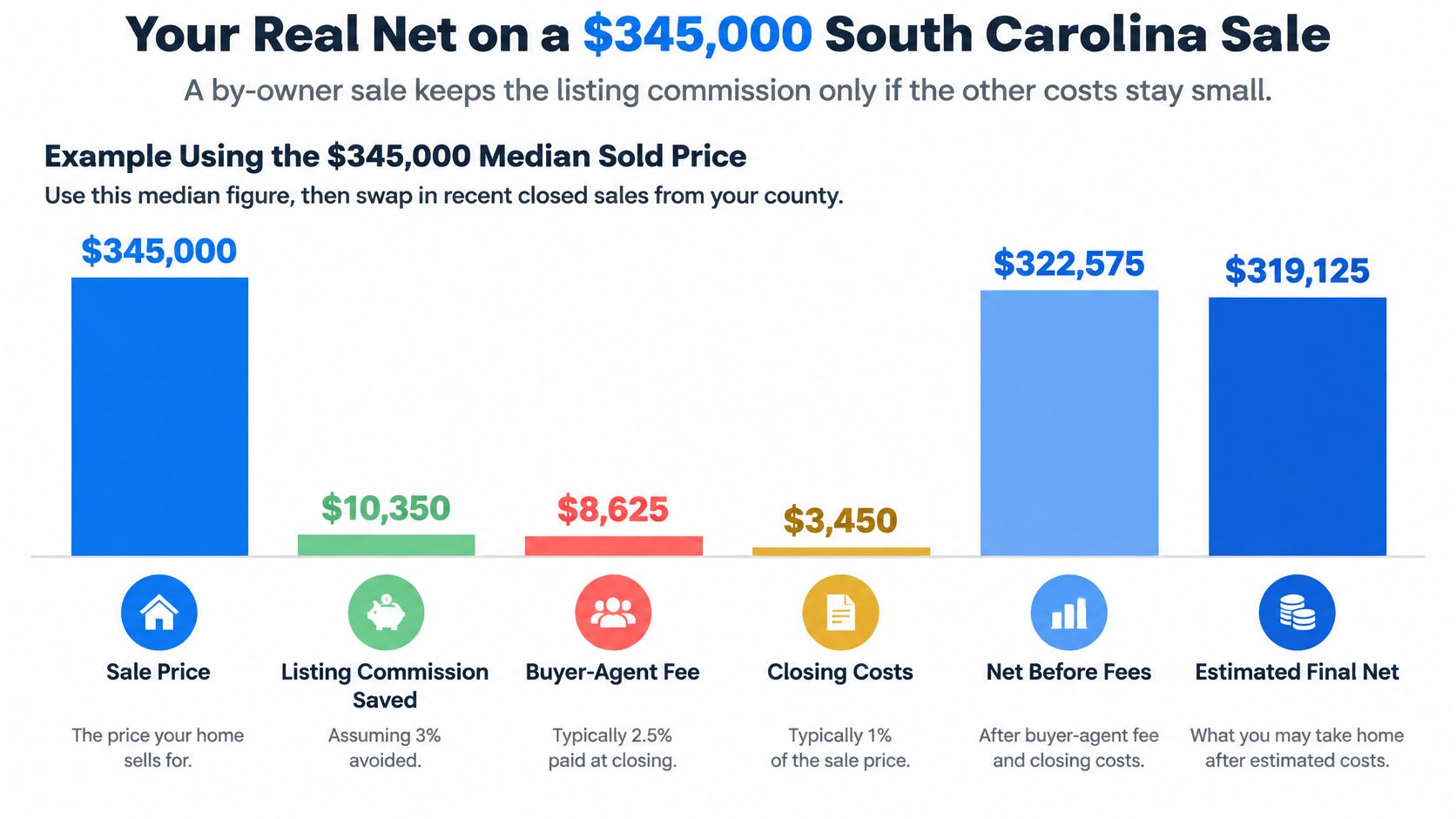
Your Real Net on a $345,000 South Carolina Sale
A $345,000 sale price tells you almost nothing about what lands in your bank account. Your true net proceeds equal the final closed price minus every marketing bill, closing charge, recording fee, concession, repair credit, carrying cost, and mortgage payoff, so an owner sale beats an agent-led sale only when those line items stay smaller than the commission you avoided.
According to Realtor.com's South Carolina market overview, statewide indicators show a median listing price near $359,945, a median sold price around $345,000, roughly 58,149 active listings, and a median 68 days on market. Two implications follow from those numbers. Buyers negotiate: the statewide sold median sits below the listing median, so expect offers to open under your ask. And time costs money, since more than two months of typical marketing means two extra rounds of mortgage payments, taxes, and insurance before you reach the table.
Use the chart below to visualize how fees compress cash in hand on a $345,000 sale, then swap in written quotes from Charleston, Greenville, or Columbia providers.
Replacing Sample Numbers With Your Own Quotes
Every county and property carries different holding and closing expenses, so treat the worksheet below as a working template. Replace each row with written quotes from local providers and confirmed figures from your county register of deeds.
| Line item | Notes |
|---|---|
| Sale price (median sold, example) | Start at $345,000 for modeling, then swap in recent closed sales in your county |
| Listing commission avoided at 5-6% | Hypothetical combined-commission benchmark; actual brokerage rates are negotiable |
| Photos and staging | Request written local quotes for photography, cleaning, and prep |
| Flat-fee MLS listing | Quoted directly by the participating South Carolina brokerage |
| Attorney or title closing fee | Quoted per engagement by your South Carolina closing attorney |
| Deed recording fee | Charged on the property's value at transfer; confirm the exact amount with your county register of deeds |
| Buyer-agent pay if offered | Negotiated outside the MLS and approved in writing |
| Concessions and repair credits | Set a hard dollar cap before reviewing any offer |
| Mortgage payoff, prorations and carrying costs | Lender payoff letter plus property taxes, HOA dues, insurance, and utilities while the home sits |
| Estimated cash in hand | Final sale price minus every cost above and your mortgage payoff |
Walking Through the Costs Sellers Forget
Most owner-sale worksheets stop after subtracting photography and a flat-fee MLS package, leaving out four expenses that regularly cut deep into proceeds:
- Pre-listing prep and curb appeal: Deep cleaning, yard work, touch-up paint, and exterior glass care all come out of pocket before the photographer arrives. Benchmarking small prep items with resources like the Aloha Window Bros cost guide helps you budget realistically alongside local photography quotes.
- Deed recording and prorations: South Carolina charges a deed recording fee tied to the value of the property changing hands, and the bill grows with your sale price before county recording charges, tax prorations, and HOA transfer fees get added. Get exact figures from your local register of deeds before finalizing your worksheet.
- Buyer-agent compensation and inspection credits: Even when you skip a listing agent, represented buyers frequently request closing-cost concessions or broker compensation inside their offer, followed by repair credits after inspection. Treat the inspection period as a second round of price negotiation and budget for it.
- Holding costs during a slow sale: At the statewide median of 68 days on market, a seller who has already moved out covers two-plus months of mortgage interest, utilities, lawn maintenance, HOA assessments, and higher vacant-home insurance premiums on top of the costs above.
For a closer walkthrough of how South Carolina sellers weigh commissions, holding costs, and closing expenses in practice, watch this short overview.
Comparing By-Owner Net Against a Direct Cash Offer
Once you calculate your estimated cash in hand, compare that figure against a firm cash offer rather than your dream list price. Cyber Homes buys houses for cash, with no listings, no showings, and no repairs needed from the seller. The company covers closing costs, presents a no-obligation offer usually within 24 hours, and averages 7 to 14 days from sale to closing. A retail owner sale can net more on a move-in-ready home in a popular subdivision, yet for an inherited, vacant, or repair-heavy house, avoiding months of carrying costs and buyer renegotiations often makes a fast cash offer the stronger financial floor.
Pricing From Recent Sales, Not Asking Prices
Set your list price from recent closed sales in your exact neighborhood, never from active listings or automated home-value websites. Asking prices only show what hopeful neighbors wish someone would pay; closed deeds show what buyers and mortgage appraisers approved.
The financial stakes of mispricing an owner-listed home are steep. According to the NAR 2025 Profile of Home Buyers and Sellers highlights, the median FSBO sale price was $360,000 compared with $425,000 for agent-assisted sales, an approximately 15.3% gap relative to the agent-assisted median. That gap doesn't prove hiring an agent automatically creates a higher price, since FSBO properties differ in condition, location, seller urgency, and buyer relationships, but it proves that guessing from online estimates can leave tens of thousands of dollars on the table.
A Three-Step Pricing Workflow That Holds Up Under Appraisal
- Pull three or more recent closed comparables from your immediate submarket. Use county deed and tax records to select physically similar homes that closed recently in the same school zone and neighborhood. Never mix submarkets across counties or even across major roads: Charleston County flood zones and historic districts, Greenville County suburban corridors, and Richland County (Columbia) neighborhoods shift sharply in value block by block.
- Build a written adjustment grid. List each comparable side by side and assign a concrete dollar adjustment for every measurable difference: heated square footage, lot size, bathroom count, construction age, roof and HVAC age, cosmetic condition, and documented upgrades. Writing the adjustments down keeps emotion out of the math.
- Price inside your adjusted range and set a 10-to-14-day review trigger. Publish a price supported by the middle of your adjusted range rather than stretching above the top comparable. Put a firm review date on your calendar at 10 to 14 days; if showing requests and written offers are weak after two weeks, adjust your price or upgrade your listing presentation before the listing loses momentum.
Overpricing creates the classic stale-listing trap. When a house sits untouched for weeks, buyers assume something is wrong with the roof, foundation, or title, and start submitting lowball offers below what the home would have fetched on day ten. Worse, even if an eager buyer agrees to an inflated number, their lender's appraiser still values the property strictly against recent closed sales.
Separating Ask Price From Expected Net Proceeds
Before you publish your price, keep three distinct figures on separate lines of your working sheet: your asking price, your minimum acceptable net proceeds, and your maximum concession budget. Building a modest buffer for an appraisal shortfall or inspection credit upfront lets you negotiate calmly instead of scrambling under contract deadlines. If your priority is speed without giving up fair market alignment, our guide on selling a house fast for market value explains how to balance pricing discipline against timeline pressure.
Price for the appraiser and the active buyer pool, not for what you paid during renovations or what you hope to clear after closing.
Can You Sell an Inherited Home Before Probate Ends?
Usually no, you can't legally close on an inherited South Carolina home as the seller on record until someone holds formal legal authority over the estate. Typically, the probate court in the county where the decedent lived must appoint a personal representative or executor and issue certified letters of authority before a title company will insure the transfer.
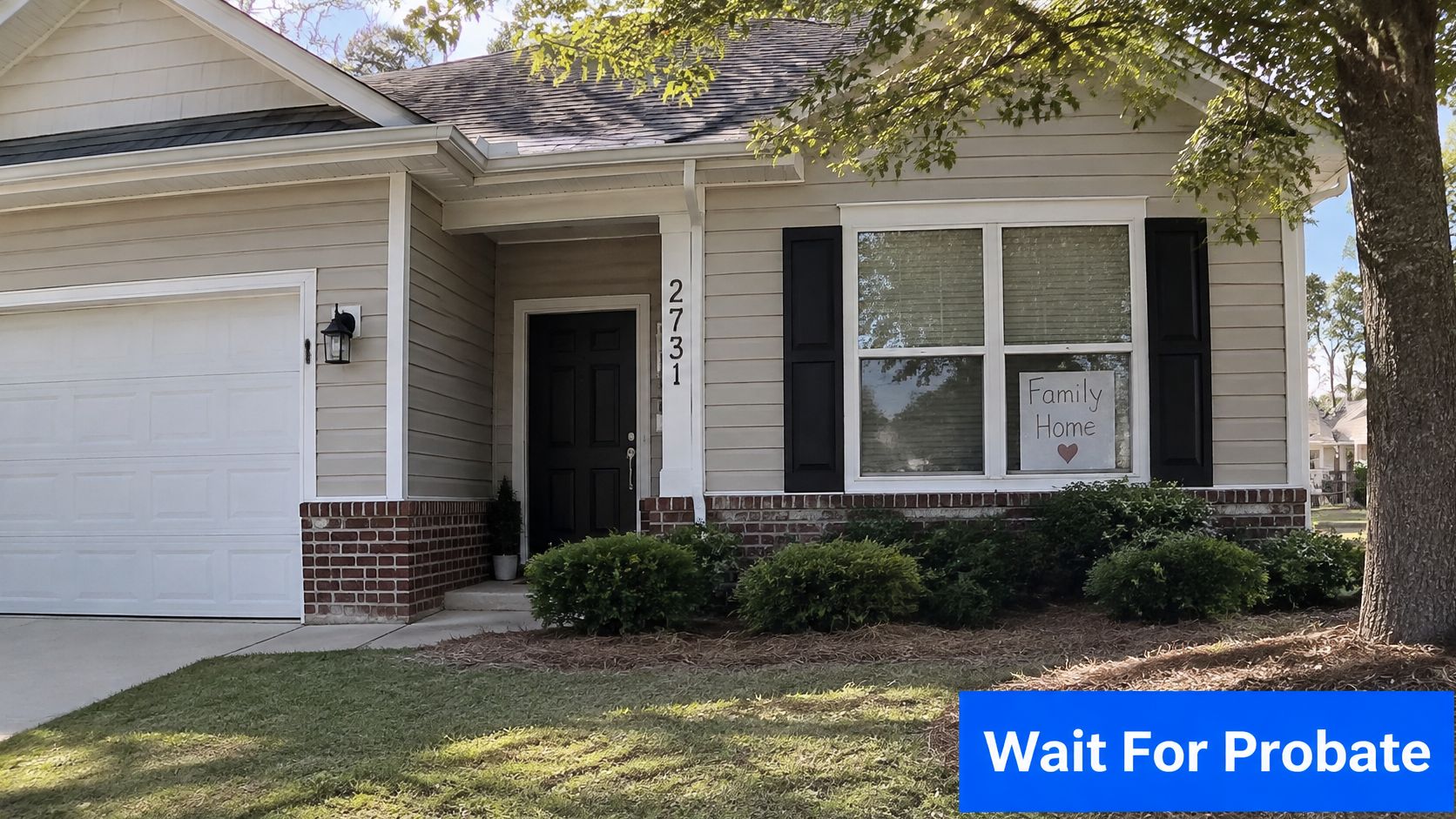
Many heirs list an inherited house early, accept a buyer's offer, and then watch the deal collapse two weeks before closing because no one on the contract had legal standing to convey clear title. Confirming authority first saves months of wasted showings and potential breach-of-contract claims.
Five Steps to Establish Legal Authority to Sell
- Verify the will and open the estate in the proper county. Contact the probate court clerk in the county where the decedent resided to confirm whether an estate is open, who has been appointed personal representative, and whether the representative needs separate court approval to sell real property.
- Secure certified letters of appointment. Request certified copies of the court's letters testamentary or letters of administration. The buyer's closing attorney and title insurer will demand these documents before issuing a title commitment.
- Gather the core estate property file. Pull the recorded deed in the decedent's name, a certified death certificate, the latest mortgage payoff statement, county property tax status, and active utility billing records so you can spot unpaid liens or delinquent taxes early.
- Confirm written agreement among all heirs. If multiple siblings or beneficiaries hold an interest, get everyone aligned in writing before listing. Treat any family disagreement, unclear deed vesting, or unpaid creditor claim as an immediate reason to retain a South Carolina probate attorney.
- Ask counsel before signing a conditional contract. If financial pressure pushes you to market the house before court letters arrive, ask a South Carolina probate attorney whether a purchase agreement can be made expressly contingent on court appointment and sale approval. Never copy unverified contract language from the internet.
Disclosure Duties and Carrying Costs During Probate
Even when an estate transfers property, heirs shouldn't assume they're exempt from state disclosure laws. Statutory exemptions under the South Carolina Residential Property Condition Disclosure Act apply only to specific qualifying transfers, so verify your estate's exact obligations with a licensed South Carolina attorney before executing any agreement.
Timing also carries a real monthly price tag. Probate administration can stretch over several months, and throughout that wait, the estate still pays vacant-home insurance, property taxes, electricity, water, lawn maintenance, and HOA dues. Comparing those ongoing holding costs against a traditional retail sale versus a direct as-is sale is covered step by step in our South Carolina probate home selling guide.
Paperwork and Disclosures Before You Sign
South Carolina requires most owners selling residential property with one to four dwelling units to complete and deliver the official South Carolina Residential Property Condition Disclosure Statement issued by the South Carolina Department of Labor, Licensing and Regulation before forming a real estate contract. Treating this form as closing-day paperwork instead of a pre-offer requirement exposes you to contract cancellation and post-closing disputes.
| Requirement | Applies when | Usually paid by | Confirm with |
|---|---|---|---|
| SC Residential Property Condition Disclosure Statement | One-to-four unit residential property, before contract | Seller prepares at no filing cost | SC Department of Labor, Licensing and Regulation and a closing attorney |
| Lead-based paint disclosure | Home built before 1978 | Seller supplies federal pamphlet and records | Federal lead rules and a closing attorney |
| Deed recording | Every real estate transfer | Negotiated in contract; statutory fee applies per $500 of value | County register of deeds |
| Title insurance | Most financed and cash closings | Negotiated in contract by local custom (lender policy typically buyer) | Title company or closing attorney |
| Transfer tax | State and local transfer rules apply | Negotiated in contract; verify any local exemptions | County or city office |
| Point-of-sale inspection or certificate | Required only where local municipal ordinances mandate it | Negotiated in contract when locally required | City or county building office |
Working Through Your Pre-Contract File in Order
- Complete the official disclosure before accepting any offer. The state form covers structural components, plumbing, electrical systems, roofing, flooding or drainage, termites, environmental contamination, lead-based paint, asbestos, radon, methane, storage tanks, toxic materials, and other hazards. Answer strictly from known facts, mark items you haven't investigated as unknown rather than guessing, and keep signed copies for your records.
- Add the federal lead-based paint package for older homes. If your house was built before 1978, federal law requires delivering the lead-based paint disclosure and any inspection reports you hold before contract execution. As noted in this South Carolina FSBO legal and disclosure guide, assembling core title, tax, HOA, and hazard records upfront prevents closing delays, though you should always verify state-specific legal details directly with a licensed South Carolina closing attorney.
- Assemble a practical evidence file. Generic FSBO checklists rarely prepare sellers for how hard South Carolina buyers and insurance underwriters scrutinize coastal and low-lying properties. As Beycome's overview of South Carolina FSBO contracts highlights, flood history, septic systems, wood-destroying insects, and unpermitted work frequently reopen negotiations mid-contract. Pull your deed, survey, mortgage payoff, municipal permits, repair invoices, termite letters, septic records, insurance claim history, and HOA documents, and consider ordering a pre-listing inspection so you control the narrative.
- Retain a South Carolina real estate attorney early. Don't wait until the week before closing to call a lawyer. Engaging a closing attorney before you market lets them prepare or review your contract, verify title, clear payoffs or liens, and confirm how attorney-led residential closings operate in your county.
- Put closing cost allocations and municipal checks in writing. Specify clearly in the contract who pays for title insurance, deed recording, and any local transfer fees. Because no single statewide point-of-sale certificate applies everywhere, call your city or county building office before listing to check for local sewer, septic, or occupancy requirements.
Don't rely on "as-is" as a legal shield. Marketing a South Carolina house "as-is" changes your negotiated duty to make repairs, not your legal duty to disclose known problems accurately, and a disclosure form never replaces a buyer's independent inspection or acts as a warranty.
Evaluating Offers, Buyers and Buyer-Agent Pay
A serious offer shows three things immediately: verified money, realistic written deadlines, and transparent buyer-agent compensation terms. Everything else on the first page, including a high headline price, means little if the buyer can't close or hides an unexpected commission request inside the fine print.

Vetting Funds, Financing, and Staying Safe
Before you take your house off the market, verify the buyer's ability to perform using four concrete safeguards:
- Verify pre-approval or proof of funds directly: Cash buyers should provide a current bank statement or verifiable proof-of-funds letter matching the buyer's legal name. Financed buyers need a recent lender pre-approval letter (not a loose online pre-qualification). Look up the lender's main number independently and call to confirm the letter is genuine.
- Hold earnest money in neutral escrow: Never deposit a buyer's earnest money into your personal checking account. Require the deposit to go directly to a South Carolina closing attorney's trust account, title company, or licensed escrow agent, with written rules governing disbursement if either side defaults.
- Account for FHA and VA loan requirements: Government-backed mortgages enforce stricter property-condition standards and independent appraisals. Peeling paint on older homes, worn shingles, missing handrails, or termite issues can become mandatory lender repairs, and a low appraisal can reopen the contract price. Lock short, explicit inspection and appraisal deadlines into the agreement.
- Protect yourself during showings and closing wires: Never host a showing alone; meet prospective buyers at the home with another adult, request photo ID before open houses, and lock away medications, checkbooks, and jewelry. Guard aggressively against real estate wire fraud by ignoring any emailed changes to closing instructions and confirming wire details by calling your closing attorney on a phone number you verified independently.
Handling Buyer-Agent Pay After the 2024 NAR Settlement
Rules governing buyer-agent compensation changed materially for every South Carolina FSBO seller. Beginning August 17, 2024, under the National Association of REALTORS® Settlement FAQ, MLS participants can't communicate offers of buyer-agent compensation through the MLS. Compensation remains fully negotiable, and any buyer's agent touring your home must already have a written buyer agreement specifying their fee or how it's calculated.
When a represented buyer submits an offer, you have three clean choices:
- Offer no buyer-agent payment, leaving the buyer to pay their agent directly under their buyer agreement.
- Offer a specified dollar amount or percentage through a separate written agreement outside the MLS, remembering that you must approve any payment in writing when an agent or broker arranges it.
- Offer a buyer concession, such as closing-cost assistance, provided the buyer's purchase contract and mortgage lender permit it.
Before comparing competing offers, ask every represented buyer three direct questions: who is paying their agent, what exact dollar amount is requested, and whether it's structured as a closing-cost concession or a separate broker payment. Only after deducting that number can you compare true net proceeds.
Essential Items Every Written Offer Must Include
Never negotiate off text messages or verbal promises. Require every written offer to state:
- Buyer's exact legal name (or LLC name, backed by signatory authority)
- Financing type and verification (loan program or verified cash proof of funds)
- Earnest-money amount, due date, and escrow holder
- Inspection, repair-request, and appraisal deadlines
- Exact closing date and possession terms (never release keys before closing funds are irrevocably disbursed)
- All contingencies and written default remedies
Confirm the Order Before You List Your Home
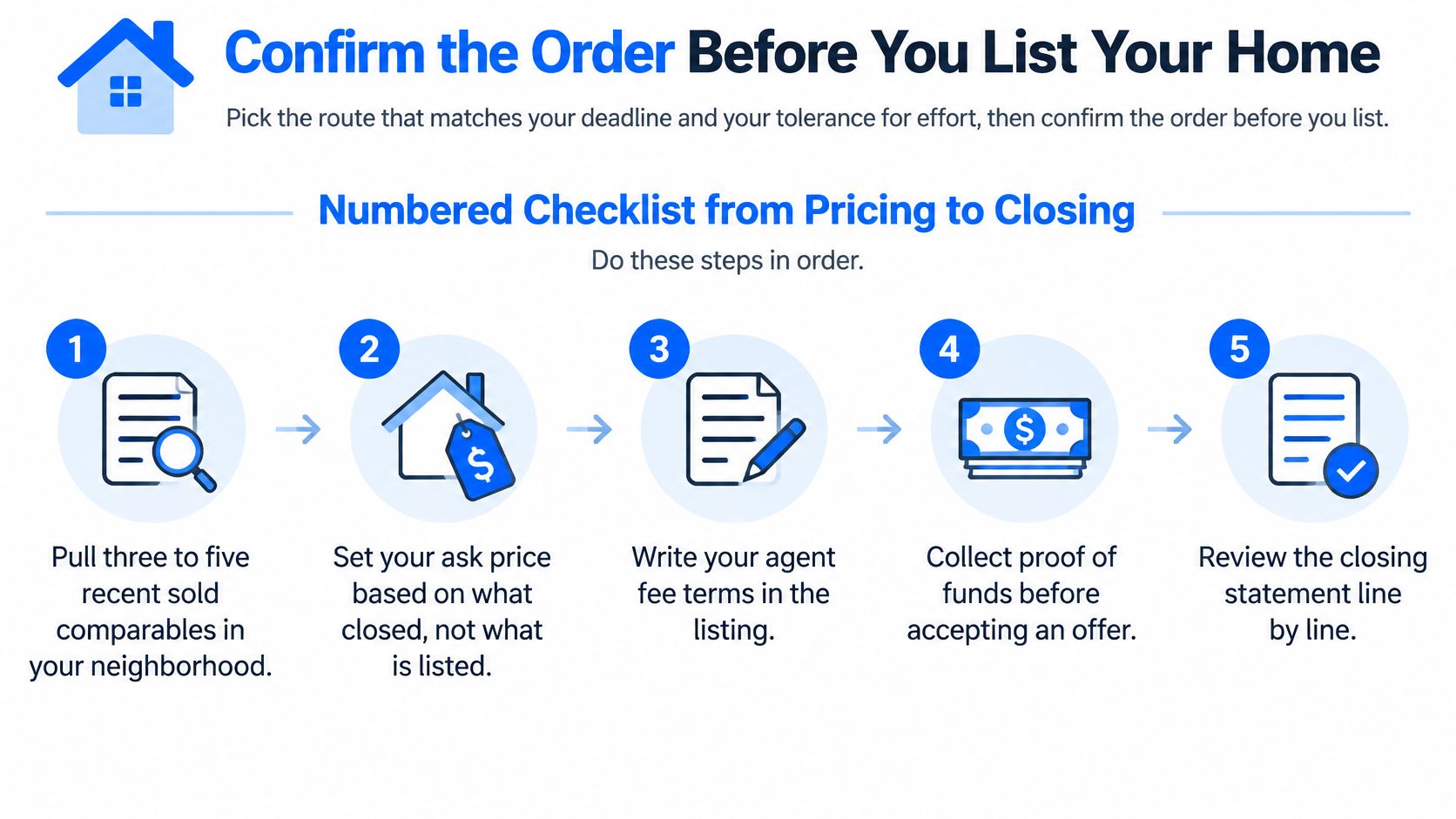
Pick the selling route that matches your timeline and tolerance for showings, then execute the sequence in order before putting a sign in the yard. Doing steps out of order, such as marketing before pulling comps or accepting an offer before finishing disclosures, is what turns a promising DIY sale into a stalled contract.
Eight-Step By-Owner Closing Checklist
- Pull three to five recent closed sales from your county records and complete your written adjustment grid.
- Fill out your net-proceeds worksheet with written quotes from a flat-fee brokerage (if using one), closing attorney, title office, and photographer.
- Choose your selling route based on your hard deadline, repair budget, and tolerance for showings and renegotiation.
- Assemble your disclosure and property file, including the state disclosure form, federal lead-paint package for pre-1978 homes, deed, permits, and mortgage payoff details.
- Publish your price and launch marketing directly or through a flat-fee MLS broker, marking a 10-to-14-day review date on your calendar.
- Screen every offer rigorously for verified funds, escrow-held earnest money, and explicit written buyer-agent compensation terms.
- Manage inspection, appraisal, and repair negotiations strictly inside your contract deadlines, documenting every credit or change in writing.
- Verify closing disbursement before handing over keys, reviewing your final settlement statement line by line and confirming mortgage payoff, deed recording, and irrevocable transfer of funds.
Before you sign any listing agreement or purchase contract, confirm recording fees with your county register of deeds, local occupancy or inspection rules with your city or county office, and any brokerage or agent licensing questions with the South Carolina Real Estate Commission.
Common Questions South Carolina Owner-Sellers Ask
Can I sell my house myself in South Carolina? Yes. South Carolina permits homeowners to sell without a listing agent, provided you comply with state property disclosure laws, federal lead-paint rules for older homes, and binding contract requirements.
Do I need a lawyer to close a FSBO sale in South Carolina? Confirm local closing requirements directly with a licensed South Carolina real estate attorney. Attorneys routinely oversee residential closings, title examinations, lien payoffs, and deed preparation across South Carolina, and hiring one early protects you from costly contract mistakes.
Who pays for title insurance in South Carolina? Title insurance is negotiable in the purchase contract and follows county custom, with buyers typically covering the lender's policy when financing. Confirm owner and lender policy rates with your closing attorney or title company before accepting an offer.
Does selling a home "as-is" remove South Carolina disclosure duties? No. An "as-is" clause limits your agreement to perform repairs, not your legal obligation to accurately disclose known material defects on the state disclosure form.
Can I sell an inherited South Carolina home before probate finishes? Usually not as the seller on record. A title company generally requires certified letters of appointment from the county probate court showing legal estate authority, unless a South Carolina probate attorney structures a valid court-contingent contract.
How do FHA or VA loans affect a by-owner transaction? Both programs enforce strict appraisal valuations and property-condition standards. Build extra cushion into your timeline and concession budget for lender-mandated repairs or a potential appraisal gap.
How can I benchmark my by-owner net against a fast cash exit? Get a written cash offer upfront so you have a concrete number to beat after subtracting carrying costs, concessions, and repairs. Cyber Homes reviews your property and local sales, then presents a no-obligation cash offer, usually within 24 hours, and submitting your property details doesn't obligate you to sell or obligate Cyber Homes to buy the home.
Last updated: April 2026
Before you spend weeks prepping for showings or paying upfront marketing fees, get a hard baseline to measure your South Carolina by-owner net against. Cyber Homes purchases houses as-is for cash with no listings, no showings, no repairs, and a closing timeline built around your schedule, so you can compare certainty side by side with a DIY sale. Visit Cyber Homes today to request your free, no-obligation cash offer and see what your home could net in days instead of months.

Edited by
James Vasquez
Real Estate Investor & Land Specialist with 10+ years experience in residential flipping, vacant land investing, land wholesaling, and subdivision deals.
Disclaimer: The information provided is for educational purposes and does not constitute financial or legal advice. Always consult with licensed professionals before making investment decisions.