5 Best Ways of Selling Your Home by Owner in Oklahoma City, OK (2026)

By-owner sales are less common than they were decades ago. Selling without an agent still works in Oklahoma City when owners treat it like a job: they price from closed sales, market beyond their own contact list, verify every buyer, and count what they keep after every cost.
This guide compares five by-owner routes by upfront cost, timeline, effort and risk. Then it works the net-after-cost math, including who pays closing costs, so you can judge each method by the money you keep rather than the advertised price.

Five Ways to Sell Your Home by Owner Side by Side
None of the 5 best ways of selling your home by owner in Oklahoma City, OK is right for every house. They split on one question: who carries the work and the risk once the sign goes up.
| Method | Typical upfront cost | Time to close | Seller effort | Best for |
|---|---|---|---|---|
| Full DIY FSBO | Low to moderate: photos, syndication, signs | Depends on buyer financing; often 30 to 60 days after contract | High: marketing, showings, paperwork, disclosures | Owners with time, local sales data and their own buyer leads |
| Flat-fee MLS listing | Flat fee quoted by the company, plus photos | Often similar to a listed sale, 30 to 60 days after contract | Medium: you run showings, offers and paperwork | Owners who want MLS exposure without a full commission |
| By-owner sale with attorney or title company | Attorney or title fees, plus marketing | Set by the closer and the buyer's financing | Medium to high: you still market and negotiate | Owners who want a professional handling the contract and closing |
| Sale to someone you know | Usually minimal; price is negotiated | Often the fastest; set by both parties | Low to medium: agree terms and paperwork | Tenants, neighbors or relatives buying at a negotiated price |
| Sale to a local cash buyer | Usually no commission; check the offer for any fees | Set by agreement; often faster than a financed sale | Low: one walkthrough and a closing date | Sellers who need speed or certainty, or who want repairs skipped |
Marketing is where by-owner sales stall. The NAR 2025 Profile of Home Buyers and Sellers reports that 40% of FSBO sellers did not actively market their homes and that 60% already knew the buyer before the sale, while 91% of U.S. sellers used an agent. A yard sign plus a text to a cousin isn't a marketing plan, and it reaches only a sliver of the buyers who are shopping.
- Full DIY FSBO. You handle photos, syndication, signs, showings, disclosures and every contract step. Risk: without deliberate marketing, no buyer ever sees the house. Best for: owners with time, local sales data and their own leads. If the property needs work you'd rather not do, the as-is cash sale guide for Oklahoma City walks through that version of the transaction.
- Flat-fee MLS listing. You pay a set fee for MLS exposure, then run showings and offers yourself. Risk: buyer agents still expect to be paid, and that payment now gets negotiated outside the MLS. Best for: owners who want MLS reach without a full commission.
- By-owner sale with an attorney or title company. A professional drafts the contract and runs payoff, lien search, recording and disbursement. Risk: legal and title fees land before you see a dollar of proceeds. Best for: owners who want the paperwork handled by someone who does it every week.
- Sale to someone you know. A tenant, neighbor or relative buys at a negotiated price with almost no marketing spend. Risk: the price usually lands below what open competition produces, and family friction can outlast the closing. Best for: sellers who value speed and privacy more than the last few percent.
- Local cash buyer. No commission, no showings, no repairs. Cyber Homes reviews the property and local sales, then presents a no-obligation cash offer, usually within 24 hours, after one quick walkthrough instead of a run of open houses, and covers the closing costs. Risk: the offer comes in below what a retail buyer might pay. Best for: sellers who need a date certain.
An agent is the better fit when the house sits at the top of its neighborhood's price range, when the title is tangled by probate or an old lien, or when your schedule can't absorb a month of showings. Rank the five by expected net proceeds, probability of closing and your own workload, in that order. Advertised price ranks last.
Closing Costs and Your Real Net
The number that decides between two selling methods isn't the list price. It's the net advantage: the commission you avoid minus every by-owner cost you take on. Write it as a formula and the debate gets short.
Who Pays What in an Oklahoma City Closing
Oklahoma splits closing costs by custom more than by statute, and the purchase contract can move almost any line. Two items usually stay with the seller: the owner's title insurance policy and the documentary stamp tax on the deed. Recording fees, the attorney or closing fee, repair credits and buyer concessions get negotiated in the contract. Confirm every split with your closer before you accept an offer, because a customary payer is a starting position, not a rule.
| Line | Customary payer | How to calculate |
|---|---|---|
| Sale price | Agreed in the contract | The purchase price the buyer offers |
| Commission avoided | Not applicable | Listing commission rate in your agreement times the sale price |
| Owner's title insurance | Seller, customary in Oklahoma | Quote from the title company or attorney |
| Documentary stamp tax on the deed | Seller, customary; rate set by state law | Confirm the amount with the Oklahoma County Clerk |
| Deed recording fee | Set in the contract | Fee schedule from the Oklahoma County Clerk |
| Attorney or closing fee | Negotiated in the contract | Quote from your closer |
| Photos, signs and syndication | Seller | Provider quotes |
| Flat-fee MLS | Seller | Fee quoted by the company |
| Buyer-agent pay, if offered | Negotiated in the contract | The amount written in the purchase contract |
| Repair and concession credits | Negotiated in the contract | The amount agreed in the contract |
| Payoff, liens and prorations | Seller, deducted at closing | Lender payoff statement plus the closing statement |
| Net advantage over an agent listing | Not applicable | Commission avoided minus by-owner costs |
Buyer-Agent Pay After the 2024 Settlement
Since August 17, 2024, a buyer's agent affiliated with an MLS participant must have a written buyer agreement with the buyer before conducting a home tour, in person or live virtual. The NAR summary of the MLS policy changes states that the agreement must spell out the agent's compensation in an objectively ascertainable form, such as a flat dollar amount, a percentage or an hourly rate, and must disclose that commissions are negotiable and not set by law.
Offers of compensation can no longer be advertised through the MLS, so the payment now lives in the purchase contract or another written agreement, as the NAR guide to the practice changes explains. The buyer's own agreement caps what the agent can collect from any source, which means the fee is settled before the tour, not at the closing table. You have three options: offer a defined amount, offer nothing, or substitute another concession such as a repair credit. Ask the buyer how the fee will be handled in your first conversation, before you compare offers.
A Worked Example on a $250,000 Sale
Suppose a listing agreement would have charged 3%, which is $7,500 on a $250,000 sale. Every figure below is a teaching number. Replace each one with real quotes for your house.
- Photos and floor plans: $300
- Flat-fee MLS: $400
- Attorney or closer to draft the contract and review the disclosure: $900
- Buyer-agent pay at 2.5%: $6,250
Total by-owner cost: $7,850 against $7,500 avoided. The net advantage is negative $350, and the commission you thought you saved has evaporated.
Remove the buyer-agent payment and the same sale runs on $1,600 of costs, a net advantage of $5,900. Add a $2,000 repair credit and it falls to $3,900. A $5,000 concession turns a comfortable margin into a rounding error.
Owner's title insurance, documentary stamps, recording and your loan payoff appear on the net sheet under either method, so they cancel in a side-by-side comparison. They still shape the check you receive. They just don't decide which method wins.
Practical rule: compare two offers on their estimated net sheets, never on headline price. A $255,000 offer carrying a $6,000 concession and an open-ended financing contingency is not better than $250,000 that closes in 14 days.
Pricing From Recent Sold Homes, Not Asking Prices
A closed sale is a fact with a date on it. An asking price is a wish attached to a listing. Buyers and their lenders work from the first, which is why the sold column in your neighborhood's record carries more weight than any active listing or automated estimate.
Start with three to six recent closings and adjust from there.
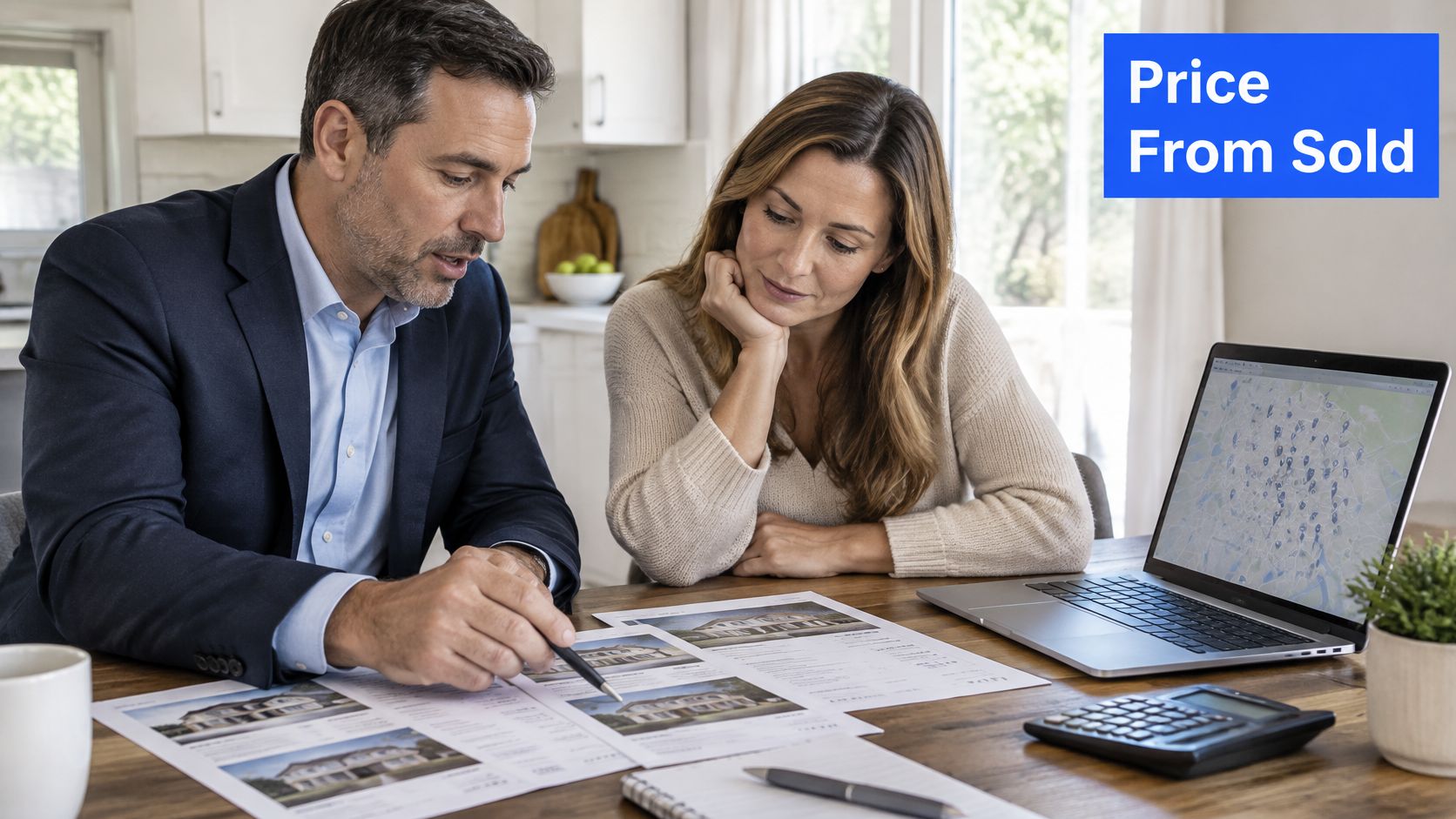
- Pull three to six closed sales in the same neighborhood from roughly the last six months, which gives a comparable-sales set that reflects current pricing.
- Match the basics: gross living area, lot size, age, condition, bedroom and bath count, and major systems.
- Adjust for differences you can measure: garage capacity, renovations, roof age and location within the neighborhood.
- Check active competition at your price point, because that's what your buyer is also touring this weekend.
- Order a licensed appraisal or broker price opinion when the comparables disagree with each other.
- Write a price-reduction schedule before you list, with the trigger for each cut spelled out in advance.
Market conditions decide how much room you have for error. Realtor.com's Oklahoma City market report shows a median of 60 days on market for October 2026, up 8.6% year over year, and a Homes.com Oklahoma City housing market report counts 59 days on market, inventory up 4.4% to 7,091 homes, and a sale-to-list ratio near 96.1%.
That ratio is the quiet number in the pair. A typical sale closes a few percent below the last asking price, so the gap between your list price and your net widens before anyone mentions a repair credit. Buyers have time to compare, and an overpriced listing loses strength instead of gaining it.
Common traps: anchoring to the neighbor's asking price, pricing renovation costs dollar for dollar, ignoring the concession a buyer will request, and skipping the net-proceeds comparison. Cut the price only when weekly showings, saves, inquiries and offer quality show the market is rejecting your position. Before you sell, read how to sell my house fast for market value without pricing below the sold comparables.
Disclosures and Local Paperwork to Confirm Before You List
Before you accept an offer, Oklahoma expects a written condition statement in the buyer's hands. The Oklahoma Residential Property Condition Disclosure Act requires a seller to disclose known conditions that negatively affect monetary value or impair occupants' health or safety when the statutory process applies. The text of the act published by the Oklahoma Real Estate Commission says the disclosure or disclaimer must be delivered before acceptance of a purchase offer, and that a defect you discover later requires an amended statement. The completed form generally cannot be dated more than 180 days before the buyer receives it.
Attach the paper trail rather than describing it: invoices, permits, warranties, insurance claims, surveys, and any environmental or foundation reports.
The items sellers most often leave out:
- Water intrusion, including a repaired leak or a basement that seeps after heavy rain
- Roof and HVAC history, with replacement dates and the name of the contractor
- Structural movement, foundation repairs, and any engineer's report
- Unpermitted work, from a converted garage to a bathroom added without a permit
- Boundary disputes and known hazards, including easements, shared driveways and flood history
Homes built before 1978 also trigger the federal lead-based paint disclosure: disclose known lead paint and give the buyer the required pamphlet. It's a short form, and skipping it is an easy claim to defend against.
| Requirement | When it applies | What to do |
|---|---|---|
| Oklahoma residential property condition disclosure | Residential sales covered by the Oklahoma Residential Property Condition Disclosure Act | Deliver before accepting an offer; amend it if you find a new defect |
| Federal lead-based paint disclosure | Homes built before 1978 | Disclose known lead paint and give the buyer the required federal pamphlet |
| Title insurance and deed recording | Every closing | Confirm the customary payer with your closer |
| Point-of-sale inspection or certificate | Only if the city or county requires it | Confirm with the City of Oklahoma City or Oklahoma County before listing |
Three questions remain local and worth a phone call: whether an attorney or a title company will run your closing, who pays title insurance and the documentary stamp tax in your specific contract, and whether Oklahoma City or Oklahoma County requires a point-of-sale inspection or certificate for your property. Ask the city, the county or your closer directly. The Oklahoma Real Estate Commission licenses agents and brokers, not private sellers, so it isn't the office to call about your own sale. Because the statute allows actual-damage claims for undisclosed defects, keep every conversation in writing.
Vetting Buyers and Protecting Your Earnest Money
The most expensive mistake in a by-owner sale is accepting an offer you never verified. A preapproval letter says a lender glanced at a file. Proof of funds says the money exists. They aren't the same document, and neither one is a commitment to close.
- Cash buyers: ask for a current bank or brokerage statement with the account holder's name and a recent date, plus a short signed letter of intent. Blur nothing that proves ownership, and expect the same from a company.
- Financed buyers: read the preapproval for loan type, down payment, and whether income and assets were verified. A letter issued in twenty minutes has verified very little.
- Earnest money: the deposit goes to the title company or an escrow agent, never to you. Ask for the receipt and know which contingency sends it back to the buyer.
- Appraisal gap: if the appraisal lands below the contract price, a financed buyer either brings cash or renegotiates. Ask at offer stage whether they can cover a gap.
Showings, Wires and Appraisals
Set showings on a schedule and log who came through. Meet an unrepresented buyer at the door with ID in hand, don't let a stranger walk the house alone, and put away prescription medication and small valuables before an open house. The we buy houses scams guide covers the other direction, the buyers worth walking away from.
Wire fraud check: confirm the closing account by calling a number you already have on file, never one that arrives in an email. A "updated" routing number on a Friday afternoon is the entire scam.
FHA and VA loans come with property conditions attached. Their appraisals can flag peeling paint, a missing handrail or a failing roof, and the lender can require repairs before the loan is approved. That doesn't kill a deal, but it changes your timeline and your budget.
Before you sign, the contract should carry contingencies for inspection, financing, appraisal and title review, each with a specific deadline. An indefinite deadline hands the buyer an option to walk for free.
Common Questions About Selling Your Oklahoma City Home by Owner
Can I sell by owner if I still owe on the mortgage?
Yes. Your lender provides a payoff figure, and the closer verifies it before any funds move. Request the payoff statement in writing as soon as you accept an offer, since a stale figure or an escrow adjustment can change the number at the table.
What if the house is inherited or still in probate?
Confirm who holds legal authority to sign before you list. A personal representative's letters, a trust document or an affidavit of heirship may be required, and selling before authority is granted creates a title problem nobody can fix at closing. The Oklahoma City inherited-property guide lays out the sequence.
Does selling as-is remove my duty to disclose?
No. An as-is sale still requires the Oklahoma disclosure before a buyer accepts, and as-is does not cancel the duty to disclose known defects. As-is describes what you'll repair, not what you'll admit.
How long does a by-owner sale take?
Often 30 to 60 days after contract with a financed buyer, because the appraisal, underwriting and title work run on the lender's calendar. A cash buyer can close faster. Ask every buyer two questions: how is this financed, and what date do you want.
Who do I call first with a question?
The City of Oklahoma City or Oklahoma County for local requirements such as inspections and recording. Your closer for the cost split and the settlement statement. The Oklahoma Real Estate Commission only for questions about licensees, since it doesn't regulate private sales.
Is a home warranty required?
No. It's optional and negotiable, sometimes offered as a concession instead of a price cut. Ask your closer what it would cost and what it excludes before you dangle it in a counteroffer.
Confirm Your Net and Choose Your Method Before You List
Work the numbers in order and the decision makes itself. Start with the method, end with the offer, and keep every figure written down where you can compare it.
- Choose the method from the comparison table. Expected net, closing certainty and your workload rank above the advertised price.
- Pull three to six closed comparables and set a price. Attach a written reduction schedule, so a slow month doesn't turn into a panic cut.
- Assemble the disclosure, its attachments and the lead paint form. Pre-1978 homes need the federal disclosure before a buyer signs.
- Confirm the cost splits and complete the net worksheet with your closer. Customary payers move once they're in a contract.
- Screen every buyer for proof of funds or a verified preapproval. An unverified buyer costs more than a lower offer from a verified one.
- Route earnest money to the title company or escrow. Then verify the wire instructions by phone before anything moves.
- Compare offers on estimated net sheets. Repair credits, concessions and buyer-agent pay all live in that number.
- Put the contract, contingencies and deadlines in writing. Close through your closer and keep the settlement statement with your tax records.
If your by-owner net looks thin after photos, buyer-agent pay and repair credits, price the alternative before you list. Cyber Homes reviews the property and local sales, then presents a no-obligation cash offer, usually within 24 hours, and requesting it creates no obligation to sell, so you can hold a real number beside your worksheet and decide with both in front of you.
This guide was last updated in October 2026.
If your worksheet shows a net advantage that disappears the moment you offer buyer-agent pay, a cash offer gives you a second number to compare against. Cyber Homes buys as-is with no showings and no repairs, covers the closing costs, and lets you pick the closing date, so the comparison happens on your timeline rather than a lender's. Visit Cyber Homes to request a no-obligation offer and see what your Oklahoma City house is worth to a cash buyer.

Edited by
James Vasquez
Real Estate Investor & Land Specialist with 10+ years experience in residential flipping, vacant land investing, land wholesaling, and subdivision deals.
Disclaimer: The information provided is for educational purposes and does not constitute financial or legal advice. Always consult with licensed professionals before making investment decisions.