
5 Best Ways of Selling Your Home by Owner in Chicago, IL

No single one of the 5 best ways of selling your home by owner in Chicago, IL wins for every seller. The right route depends on three things: how fast you need the money, how much work the property needs, and how much paperwork you're willing to run yourself. Most Chicago owners who skip the listing agent do best with a flat-fee MLS listing plus an attorney reviewing the contract, while owners facing a deadline or a repair-heavy house usually do better with a direct cash sale.
Price is the anchor for every comparison. The median Chicago metropolitan-area home price reached $366,000 in 2025, up 4.6% from $350,000 in 2024, according to Illinois REALTORS®. Keep that number in view. The listing commission you avoid is one line on the closing statement, not the whole story.

Which Way to Sell Without an Agent Fits Your Situation?
Start with your deadline and your repair list, not with the commission. Each of the five routes below carries a different mix of cost, time, effort and legal exposure, and the right one is the row where the trade-offs match your situation. Treat every cost figure as a reference point until a title company or attorney puts a quote in writing.
| Route | Typical cost to you | Time to close | Effort | Best for |
|---|---|---|---|---|
| Full DIY FSBO | Photos, signs, attorney and title fees; no listing fee | Set by contract; confirm key dates with your closing attorney | Highest: pricing, showings, offers, contract deadlines | Confident sellers who will track every deadline |
| Flat-fee MLS listing | Flat listing fee plus photography and attorney or title fees | Set by contract; confirm with the title company | High: you still run showings and negotiation | Sellers who want MLS exposure without a full commission |
| By-owner with an attorney or title company handling closing | Flat attorney or title fees plus marketing; get a written quote | Set by contract; confirm with your attorney | Medium: you market, a professional handles the contract and closing | Sellers who want legal protection on every document |
| Sell to someone you know | Attorney and title charges; the price is negotiated, not tested by the market | Often shorter when the buyer pays cash; confirm the financing timeline | Low to medium | Tenants, neighbors or family buying at an agreed price |
| Sell as-is to a local cash buyer | Possible discount to retail price; the buyer may cover some closing costs | 7 to 14 days on average from agreement to closing with Cyber Homes | Low: no repairs, few showings | Urgent sales, repairs, probate or relocation |
The risks follow the same order as the table.
- Full DIY FSBO: the danger isn't marketing, it's a missed date. An inspection response due in five business days, an appraisal contingency that expires, a disclosure you never delivered. One slipped deadline can cost more than the commission you saved.
- Flat-fee MLS listing: you're buying exposure, not labor. You still negotiate, schedule showings, answer buyer-agent questions and manage the offer window yourself.
- Attorney or title company handling closing: the added fee buys review of each document, which is exactly what you want if you've never read a Multi-Board contract. The trade-off is coordination, since you're the project manager between the attorney, the title company and the buyer.
- Selling to someone you know: the risk is a price a family later disputes. Order an independent valuation and have an attorney draft or review the contract before anyone shakes hands.
- Selling as-is to a local cash buyer: fewer showings and no repairs, usually below retail. Compare the offer against your own net rather than against your asking price.
The honest framing matters here. By-owner sales were 5% of US home sales in NAR's 2025 Profile of Home Buyers and Sellers, and the median by-owner price ran $360,000 against $425,000 for agent-assisted sales, an approximately 15.3% gap relative to the assisted benchmark, as Florida Realtors' summary of the NAR data reports.
What that gap means: a large share of by-owner sellers already knew their buyer, so the median reflects who the buyer was, not only what the seller skipped. Don't read the difference as pure savings.
A cash sale is priced off local resale data, not off your list price, and that arithmetic is worth understanding before you compare routes. Here's how a fast market-value cash sale is priced. An agent is the better fit for a complex property, a seller who wants the highest possible price with full marketing behind it, or anyone who can't realistically run showings and deadlines for two months.
What Will You Actually Keep on a $366,000 Chicago Sale?
On a $366,000 sale with no listing commission, the worked example lands at roughly $347,700 to $351,360 after a 2% buyer credit and a 2% to 3% seller-side closing-cost band, with the avoided commission treated as savings rather than cash in the settlement check.
Use two formulas. Savings equals the commission avoided minus your by-owner costs. Your check equals the sale price minus every seller-side cost and every concession. They answer different questions, and sellers who confuse them think they are keeping money they never see.
| Line item | Amount or basis |
|---|---|
| Sale price, Chicago metro median for 2025 | $366,000, source: Illinois REALTORS |
| Listing commission avoided at an assumed 5% | $18,300, assumption |
| Chicago transfer tax, seller share at $1.50 per $500 | $1,098, counted once inside the closing-cost band |
| Chicago transfer tax, buyer share at $3.75 per $500 | $2,745, paid by the buyer |
| Illinois state and Cook County transfer tax | Quote-needed; assumption: $0 as a separate add-on because it is inside the $7,320 to $10,980 band |
| Recording fees | Quote-needed; assumption: $0 as a separate add-on because it is inside the band |
| Owner's title policy and settlement charges | Quote-needed; assumption: $0 as a separate add-on because it is inside the band |
| Attorney fees | Quote-needed; assumption: $0 as a separate add-on because it is inside the band |
| Photos, marketing and flat-fee MLS | Quote-needed; assumption: $0 as a separate add-on because it is inside the band |
| Seller closing-cost cross-check at 2% to 3% of price | $7,320 to $10,980 |
| Concession or repair credit at 2% | $7,320 |
| Optional buyer-agent compensation | $0 in this example; add only a written amount you choose |
The city transfer tax is arithmetic you can do now. The City of Chicago levies $5.25 per $500 of transfer price, with the buyer generally responsible for $3.75 and the seller for $1.50, per the Chicago Department of Finance transfer tax page. At $366,000 that is 732 units, so your share is $1,098 and the buyer's $2,745 never touches your side of the settlement statement.
State and county transfer taxes, recording fees, the owner's title policy, attorney time, photography and a flat-fee MLS are quote-needed items, so the example does not pretend to know their invoices. It budgets them inside the existing 2% to 3% cross-check, $7,320 to $10,980 at this price, and the $1,098 city tax is part of that same envelope rather than a second subtraction. If written quotes push the total above $10,980, reduce the check by the excess dollar for dollar.
The concession line is where savings disappear. A 2% credit is $7,320, which can absorb much of the $18,300 you saved. Run the full subtraction: $366,000 minus a $7,320 credit leaves $358,680. Subtract the full closing-cost band of $7,320 to $10,980 and the range lands between about $347,700 and $351,360.
The contrarian point: a lower headline cost does not raise your net if you underprice the house, accept an oversized credit, or double count a mandatory closing expense. Net proceeds reward discipline, not optimism.
Plug in your own price, your written quotes and the commission you would otherwise have paid.
How Has Buyer-Agent Pay Changed Since the 2024 NAR Settlement?
Since August 17, 2024, MLS participants may not communicate an offer of buyer-agent compensation through the MLS, but compensation can still be negotiated separately outside it, according to the NAR settlement FAQ. That leaves the choice with you.
Your first option is to pay nothing toward the buyer's agent. Your second is to offer a specific dollar amount or rate, negotiated outside the MLS and written into the deal. Your third is a buyer concession, such as help with closing costs, which puts money in the transaction without labeling it as agent pay.
The rules on the buyer's side are firm. A REALTOR or other MLS participant working with a buyer must have a written buyer agreement before touring the property, including in-person and live virtual tours. That agreement must state compensation in an objectively ascertainable way, cannot leave payment open-ended, must disclose that commissions are not set by law and are fully negotiable, and prevents the agent from collecting more than the agreed amount from all sources.
Scenario: a buyer walks in with an agent who has no signed agreement. Ask to see it before the showing. If it doesn't exist, the agent isn't supposed to be touring your home with that buyer yet.
Any amount you agree to pay should be documented in the purchase contract or a separate written agreement and reviewed for compliance by the closing attorney. Offer a concession when a qualified buyer needs help with cash at closing. Offer nothing when the buyer has no agent and your price already reflects that.
What Paperwork and Closing Rules Apply to Your Chicago Home?
Illinois law requires a seller of covered residential property to complete the statutory Residential Real Property Disclosure Report and deliver it to the prospective buyer, per the Illinois Residential Real Property Disclosure Act. Complete it before you accept an offer, and keep a copy showing the delivery date.
The report covers conditions you know about. It is not a home inspection and it doesn't promise a defect-free house. It's your account of what you know, written down before the buyer signs.
| Case | Required document | Who handles it | When |
|---|---|---|---|
| Standard Chicago home, any age | Illinois Residential Real Property Disclosure Report | Seller completes; buyer receives | Before accepting an offer |
| Home built before 1978 | Federal lead-based paint disclosure, available records and warning information | Seller provides; buyer may inspect | Before the contract is signed |
| Foreclosure, probate or trust transfer | Possible statutory disclosure exemption | Illinois real estate attorney decides | Before marketing the home |
| Vacant or tenant-occupied rental | Disclosure plus lease and occupancy documents | Seller, with attorney review | Before showings begin |
| Condo or association unit | Association documents and assessment statements | Seller requests from the association | Confirm the delivery deadline with the association |
Where the duty stops and liability starts
The statute contains exemptions, including certain foreclosure-related transfers. Rather than assume one applies, have an Illinois real estate attorney confirm it, because a knowingly false or omitted disclosure can expose a seller to actual damages, court costs and attorney fees, as an Illinois consumer law practice explains.
That exposure is heaviest on inherited homes, tenant-occupied rentals, vacant properties and houses with prior water, foundation, roof or code problems.
Lead paint, association papers and city requirements
For a home built before 1978, the federal lead-based paint package rides on top of the state form: available records and reports, disclosure of known hazards, the federal warning information, and a real chance for the buyer to test. The Illinois disclosure does not replace it.
Attorneys commonly attend or review Chicago closings, which is normal here rather than a sign something is wrong. The city may also require inspections or certificates for some properties, so confirm with the Department of Buildings before you list. Who pays transfer taxes, title charges and recording fees belongs in the contract, and the closing attorney should read that clause.
How to Price, Vet Buyers and Close Step by Step
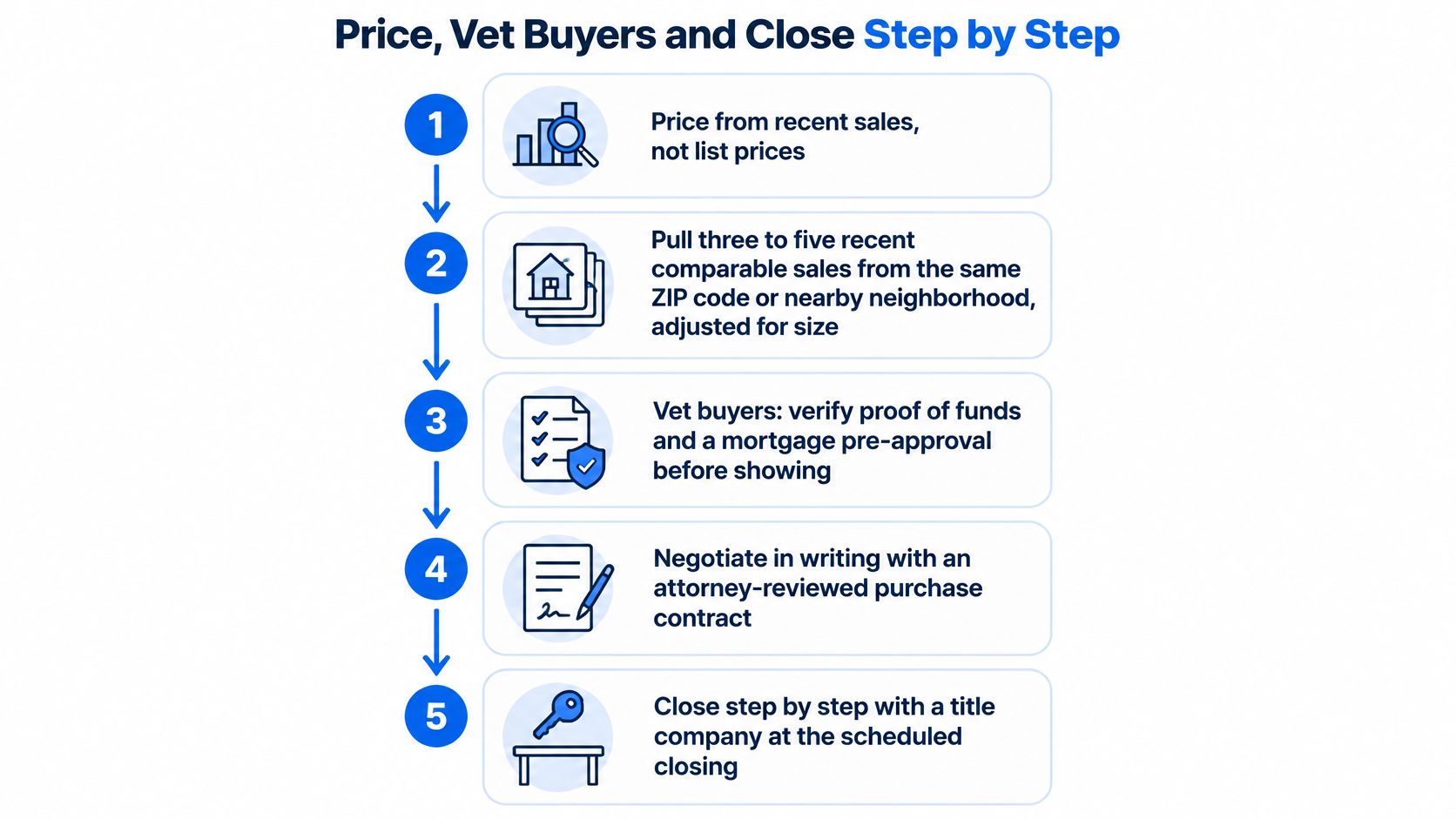
Price from recent sold homes in your ZIP code, then protect the contract with written deadlines and third-party escrow. The nine steps below run in this order for a reason: each one makes the next one cheaper.
Price From Sold Comparables, Not Asking Prices
Pull at least three to five recent comparable sales from the same ZIP code or a closely similar neighborhood, then adjust for square footage, condition, parking, lot characteristics and renovations. Neighborhood-level evidence beats a citywide estimate. In September 2025, Redfin's Chicago housing market data showed a median sale price of $400,000 in ZIP code 60634, with homes typically selling after 48 days.
Medians and marketing times shift sharply from one part of the city to another, so a price that looks reasonable on a citywide average can sit well above or below what buyers are paying on your block. Read that spread as a market signal: your asking price is a local decision, and pricing a few percent too high costs you the early exposure that drives competition and, ultimately, your net proceeds.
- Pull your comps and set a defensible price. Write down the adjustment logic for each comparable so you can explain the number to a buyer's agent and to yourself in week three.
- Order a title commitment and a mortgage payoff estimate. Unreleased mortgages and liens surface late when nobody ordered them first.
- Prepare presentation pieces. Professional photography, a measured floor plan, a feature sheet, a showing protocol and a lead log. Buyers compare you against listings with agents behind them.
- Prequalify buyers before showing the home. Ask for a lender preapproval or proof of funds, verify the loan officer exists, and screen cash offers against the warning signs in this guide to spotting cash-buyer scams before anyone signs a contract.
- Verify every wire instruction by phone. Use a number you found yourself, not one emailed to you, because escrow deposits are a common target for payment redirection fraud.
- Ask how FHA and VA appraisals could bite. Both can require repairs the seller pays for, so price the risk into the offer you accept rather than discovering it after inspection.
- Compare offers on net proceeds, not headline price. Weigh financing strength, inspection terms, appraisal risk, earnest money and closing date. A slightly lower cash offer that closes in two weeks can beat a higher one with a financing contingency once you subtract carrying costs and the risk of a collapsed deal.
- Put every deadline in the contract. Inspection, attorney review, financing and appraisal contingencies, fixtures, possession, prorations, default remedies, and who pays transfer tax and title charges.
- Run the closing checklist in parallel. Liens, payoff figures, tax and assessment prorations, the settlement statement, the deed recording.
Set a review trigger: if 10 to 14 days pass without a qualified showing, reprice rather than wait. Every extra week on market adds mortgage, tax and utility costs that come straight out of your final check.
The Closing Week, in Order
A smooth closing week looks boring. Title clears, the payoff letter matches the settlement statement, the buyer's loan funds, the deed gets recorded, and keys change hands on the date written in the contract. Keep your attorney's number close during the review window, and never promise repairs outside the written agreement, because anything you concede verbally after signing is money out of your net with no obligation on the buyer's side.
What Do Chicago Sellers Ask Most About Selling by Owner?
Here are the questions that come up in nearly every by-owner conversation in this city, answered plainly.
Lawyers, fees and money
Do I need a lawyer to sell by owner in Chicago? Attorneys commonly attend or review Chicago closings, and a real estate attorney should read your contract on the day it's signed because the review period can let terms change afterward.
Who pays the transfer tax? You pay the seller's share of the Chicago tax, calculated per $500 of price, and the worksheet in this guide shows where it fits in your total. The buyer covers the larger share.
Is the commission I avoid all savings? No. The gap between by-owner and agent-assisted median prices is bigger than the commission, largely because so many by-owner sellers sell to someone they already knew.
Buyers, mortgages and timing
- Can I sell by owner with a mortgage on the property? Yes. Order a payoff estimate and a title commitment before you list, so you know the number that clears the loan at closing.
- Who holds the earnest money? A title company or escrow agent, never you. Holding a buyer's deposit yourself invites disputes you don't need.
- What if the buyer's agent has no signed agreement? Ask for the written buyer agreement before any in-person or live virtual tour, and hold the showing until you see it.
- Do I need to disclose lead paint? Yes for homes built before 1978, alongside the Illinois disclosure report and any records you have.
- How long will it take to sell? Your route and your price decide it. Confirm realistic dates with your title company or attorney before you promise a closing day to anyone.
Should You Sell by Owner or Take the Cash Offer?
One rule settles it. Take your expected sale price, subtract every by-owner cost, every concession and the carrying costs for each month you hold the house, then compare that net against a firm cash offer. Sell by owner if your net is higher and you can run the checklist. Take the cash route if you need speed, want to skip repairs, or face a legal or financial deadline. Choose an agent if the property is complex or you want maximum price with full marketing behind it.
Work the comparison on paper before you commit. A Chicago owner expecting a sale near the metro median might offer a buyer credit to get the contract signed, pay the seller's transfer tax and attorney fees at quoted amounts, and carry the home for three months at their own monthly figure. Each line comes off the headline price, so the avoided commission is only one input. A cash offer that covers closing costs and asks for no repairs can beat that net even when its number looks lower. Net versus net, on the same closing date, is the only comparison that counts.
Cyber Homes reviews the property and local sales, then presents a no-obligation cash offer, usually within 24 hours. The sale runs on one quick walkthrough instead of open houses, the average time from the property being sold to closing is 7 to 14 days, and submitting your information doesn't obligate you to sell or Cyber Homes to buy.
For a property that needs work, an estate sale or a rental with tenants in place, selling a house as-is for cash in Chicago removes the repair and showing lines from your worksheet entirely. This week, request your cash offer and your written quotes, put both numbers side by side, and pick the higher net.
Last updated: November 2026.
Cyber Homes buys houses for cash across the United States, with no listings, no showings and no repairs needed from you, and covers the closing costs so your net is easier to predict. If you want a second number to compare against your by-owner net, ask for a no-obligation cash offer and see how it stacks up against your written quotes. Visit Cyber Homes to get started.

Edited by
James Vasquez
Real Estate Investor & Land Specialist with 10+ years experience in residential flipping, vacant land investing, land wholesaling, and subdivision deals.
Disclaimer: The information provided is for educational purposes and does not constitute financial or legal advice. Always consult with licensed professionals before making investment decisions.