
5 Best Ways of Selling Your Home by Owner in Hartford, CT

The five ways to sell your Hartford home without a listing agent are full DIY FSBO, a flat-fee MLS listing, an attorney-handled by-owner closing, a sale to someone you know, and an as-is cash sale. With FSBO accounting for just 5% of U.S. home sales, choose by timeline and net proceeds, not the smallest upfront fee.

Five Ways to Sell by Owner in Hartford
The best route is the one that matches your workload, property condition, and buyer access. Hartford is in Hartford County, but selling here still means handling a distinctly Connecticut transaction, including disclosures, legal documents, and municipal recording.
Last updated November 2026. Latest local market period discussed September 2026.
The NAR 2025 Profile of Home Buyers and Sellers reports that FSBO represented 5% of U.S. home sales, while 91% of sellers used an agent; it also found that 40% of FSBO sellers didn't actively market their homes. Those are national findings, not Hartford transaction rates. They explain why avoiding an agent isn't the same as avoiding the agent's work.
Five by-owner paths in Hartford
| Way | Typical seller cost | Time to close | Effort | Best for |
|---|---|---|---|---|
| Full DIY FSBO | Photos, signs, attorney or title, transfer taxes | Marketing period plus the buyer's financing and contract schedule | High | Clean homes and owners who can show and negotiate |
| Flat-fee MLS listing | Flat fee, photos, closing costs; confirm the current fee | Buyer search followed by contractual closing deadlines | Medium | Owners seeking MLS reach without full listing service |
| Attorney-handled by-owner sale | Attorney, title, transfer taxes; no listing commission | Buyer's financing and title-clearance schedule | Medium | An owner who already found a buyer |
| Sale to someone you know | Minimal marketing; closing costs remain | Can move quickly with verified cash or prepared financing | Low to medium | Tenant, neighbor, or family with written terms |
| As-is local cash buyer | No listing commission; weigh the discount against avoided work | Closing date established in the purchase contract | Low | Repairs, a deadline, or certainty over top dollar |
What each route does and doesn't buy
Full DIY gives you control over pricing, photographs, inquiries, showings, and negotiation. Thin exposure is the main danger. A sign and an unanswered voicemail won't produce the same buyer access as a well-distributed listing.
A flat-fee MLS service buys a defined listing package, not necessarily advice. Confirm syndication, listing duration, changes, cancellation terms, and whether anyone helps negotiate. Don't assume the advertised fee includes contract support.
An attorney-handled sale works when you've already found a buyer. Connecticut residential closings are commonly attorney-led, but legal help doesn't replace buyer screening or marketing.
Selling to a tenant, neighbor, or relative can eliminate the search. It doesn't eliminate financing risk. A friendly buyer who can't obtain a loan is still an unqualified buyer, so use written terms and independent escrow.
An as-is cash sale trades some potential price for less preparation and fewer contingencies. Cyber Homes offers a no-obligation cash comparison; the risk to watch is accepting a discount larger than the repairs, delay, and uncertainty you avoid.
This visual compares selling-service models, including some alternatives that use an agent.
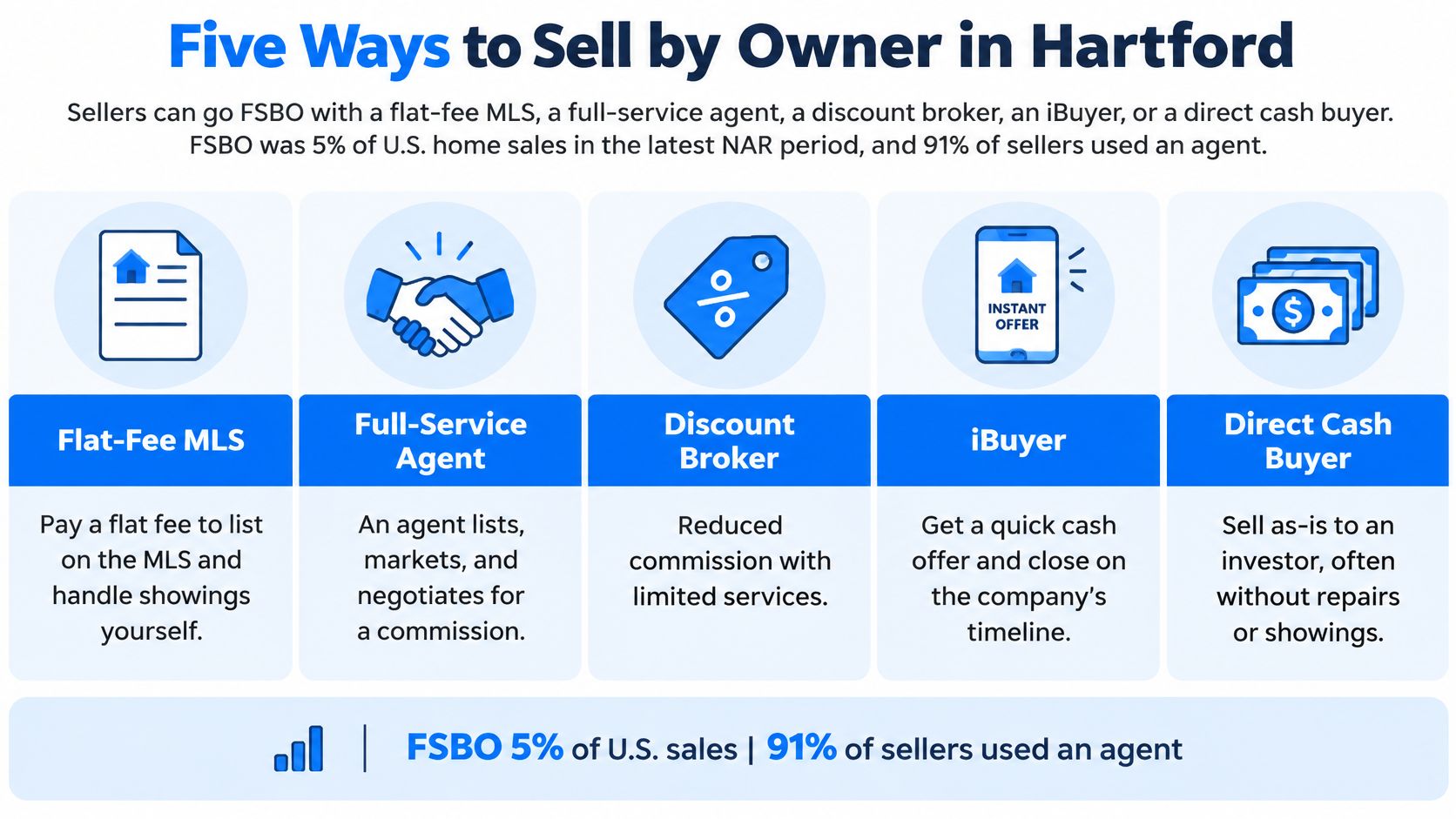
Use the private home-selling guide to organize the owner-managed work. Before choosing a row, build a net sheet.
What You Actually Net on a Hartford Sale
A $228,600 sale price is only a starting point. The U.S. Census Bureau's Hartford QuickFacts reports that figure as the median value of owner-occupied homes for 2020–2024. It is a historical citywide benchmark, not a current sale-price estimate for your home.
Sample Hartford net at the Census median
Use the table to identify costs and collect actual figures. State and municipal conveyance taxes depend on the applicable rules and transaction details. Ask your closing attorney to confirm both before estimating your proceeds.
| Line | Example amount | Who usually pays | What to confirm |
|---|---|---|---|
| Price benchmark | $228,600 | Not a cost | Historical Census owner-occupied value |
| Listing commission if no agent | $0 | Seller only if an agent is hired | No listing agreement or other fee obligation |
| Buyer-agent pay if offered | Written negotiated amount | Seller when agreed | Compensation and lender-approved credits |
| State conveyance tax | Confirm with closing attorney | Seller or grantor | Current rate and transaction treatment |
| Municipal conveyance tax | Confirm with closing attorney | Seller | Hartford's applicable municipal rate |
| Missed condition-report credit | $500 if applicable | Credit to buyer | Attorney confirms disclosure compliance |
| Photos, flat-fee MLS, attorney, title, recording | Obtain itemized quotes | Seller or contract allocation | Scope, exclusions, and recording responsibility |
| Mortgage and other lien payoffs | Current written payoff statements | Seller | Interest through closing and release charges |
| Repairs and inspection concessions | Negotiated amount | Seller when agreed | Scope, deadlines, and lender approval |
| Carrying costs | Your actual monthly bills | Seller until transfer | Interest, taxes, insurance, utilities, maintenance |
The price of skipping a listing commission is not automatically your savings. At this benchmark, a hypothetical 2% listing fee equals $4,572, and 3% equals $6,858. Those are arithmetic examples, not standard Connecticut commissions. Subtract your actual costs before comparing sale methods.
Buyer-agent compensation is negotiable and cannot be displayed on the MLS under practice changes effective August 17, 2024. Buyers working with participating agents sign a written agreement before touring. You can offer no payment, negotiate a fixed amount or percentage outside the MLS, or consider a contractual credit. Have a Connecticut attorney review any arrangement alongside the Connecticut sale-agreement document.
A month of carrying costs can erase part of the commission avoided. Add your actual mortgage interest, property taxes, insurance, utilities, and maintenance for the time you expect to hold the home. Use written payoff statements and itemized quotes, and count each inspection credit only once.
Net-sheet rule: Compare the amount you expect to receive after closing, not the fee removed from an advertisement.
Connecticut Disclosures and Closing Rules
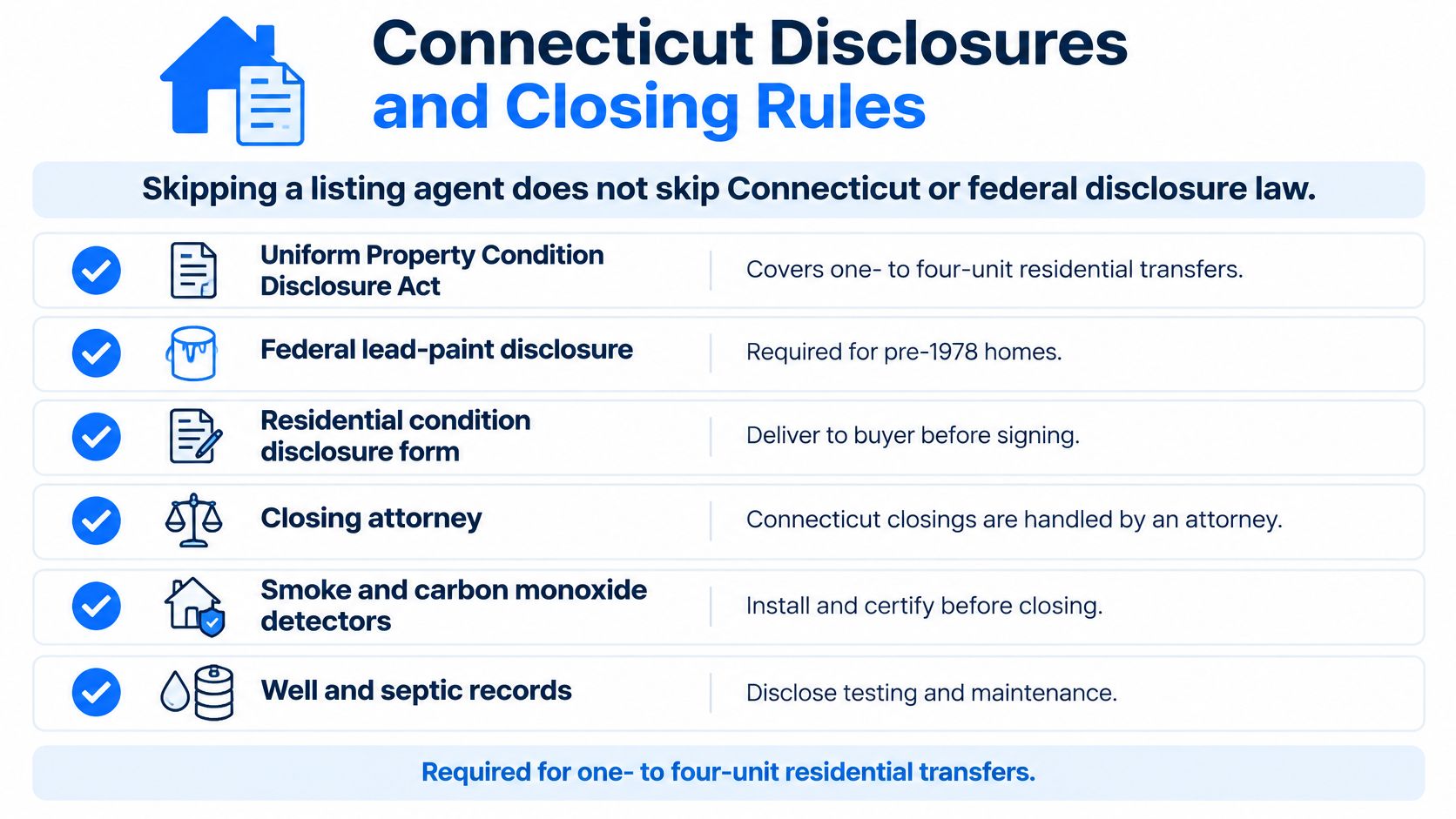
Skipping a listing agent doesn't skip disclosure law. Connecticut's disclosure requirements can include a $500 buyer credit when the required condition report isn't provided, as described in the Connecticut purchase-agreement document.
The Uniform Property Condition Disclosure Act covers residential transfers involving one to four dwelling units, including condominiums and cooperatives, whether or not a broker participates. Deliver the Residential Property Condition Report before the buyer signs a binder, purchase contract, option, or lease with a purchase option. Answer to the best of your knowledge and disclose known property problems; a closing credit isn't permission to hide a defect.
Keep state and federal paperwork separate
For most homes built before 1978, federal lead-based-paint disclosure is a separate obligation. Provide known lead information, available reports and records, the approved lead-warning pamphlet, and the contractual opportunity for a lead inspection or risk assessment before the buyer becomes bound.
Verify the construction year through reliable city records. Completing the Connecticut condition report doesn't substitute for the federal packet, and an as-is clause doesn't make either disclosure disappear.
The checklist below is a preparation aid. Ask your attorney which detector certifications, well or septic records, and transaction-specific documents apply rather than treating every illustrated item as a universal Hartford requirement.
Who handles the contract and closing details?
Hire a Connecticut real-estate attorney before signing. An online purchase form can miss financing deadlines, possession terms, inspection procedures, or the authority needed to sell an inherited property.
The Connecticut Real Estate Commission, within the Department of Consumer Protection, handles real-estate licensing oversight. It doesn't prepare your seller contract or replace legal counsel.
Confirm these allocations in writing:
- Title insurance: Specify who buys the owner's policy and lender's policy. Don't assume both are automatically your expense.
- Recording and conveyance tax: Have counsel identify the filing party, current charges, and payment responsibility.
- Local requirements: Ask the City of Hartford and the town clerk whether your property needs inspections, certificates, permit resolution, or other transfer documents.
- Condominium and estate records: Obtain the association or ownership documents early enough for legal review.
Your pre-signing stack should contain the condition report, any applicable lead packet, payoff information, and attorney-reviewed agreement. For inherited property, add evidence that the person signing has authority to transfer title.
How to Price a Hartford Home From Sold Comps
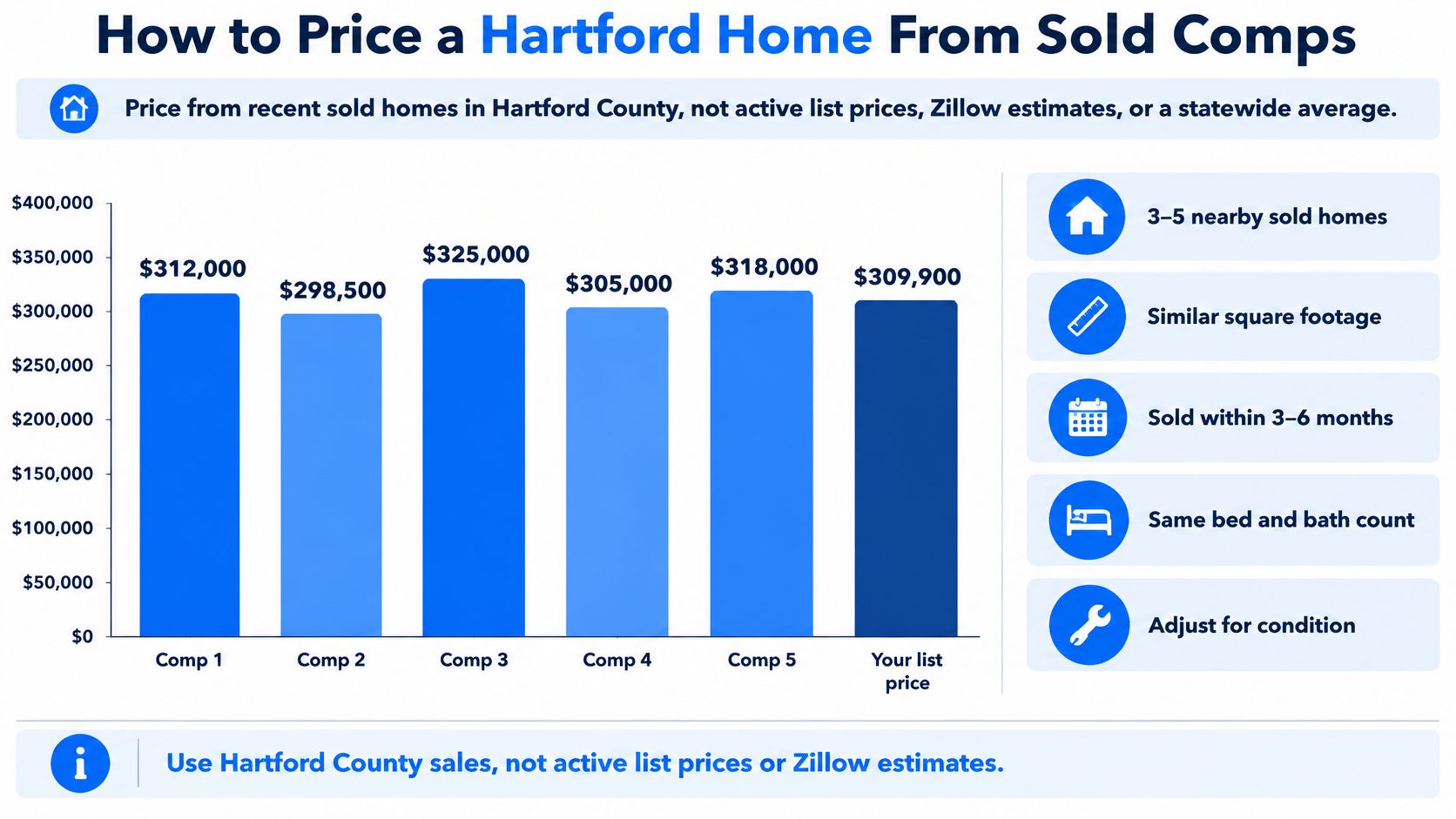
A defensible asking price starts with nearby closed sales, not active asking prices or a statewide average. Search first in the property's Hartford neighborhood and category, then widen the area if you need more comparable sales.
A Hartford multifamily property and a West Hartford single-family home are poor matches, even if they are close together. Compare property use, location, finished living area, parking, and condition.
The visual below illustrates how recent nearby sales can be compared to set an asking price.
Adjust the house, not just the square footage
Build a spreadsheet of comparable sales with the sale date, closing price, finished area, lot, bedrooms, bathrooms, parking, condition, and major systems. Review listing descriptions and photos. A price-per-square-foot average can conceal differences that matter to buyers.
- Finished area: Separate above-grade space from finished basement space.
- Condition: Distinguish cosmetic updates from needed roof, heating, electrical, or structural work.
- Parking and lot: Compare usable parking and outdoor space, not just acreage.
- Occupancy: For a rental property, consider leases, access limits, and the buyer's intended use.
Renovation cost is not the same as added market value. Buyers may value the work differently, and a lender's appraiser will look for support in comparable transactions.
What does the local selling pace tell you?
The FRED Hartford-West Hartford-East Hartford series reports median market time of 35.25 days in September 2026, compared with 25 days in May and 28.5 days in June. These figures provide regional context, not a forecast for a Hartford city listing or its closing date.
A longer marketing period is a reason to avoid assuming buyers will compete immediately for every available property. It does not establish whether each Hartford neighborhood favors buyers or sellers.
A defensible asking price is one you can explain to a buyer and support when the lender orders an appraisal.
Judge the price by the quality of inquiries, showing feedback, and written offers. Before rejecting a reasonable adjustment, count another month of ownership costs. A price reduction has a cost, and so does waiting.
This video offers another way to think through the selling process.
Record your asking price and the date you'll review it on the net sheet. If you cannot support the number with comparable sales, get pricing help before testing it with buyers.
How to Move From Price to Closing Safely
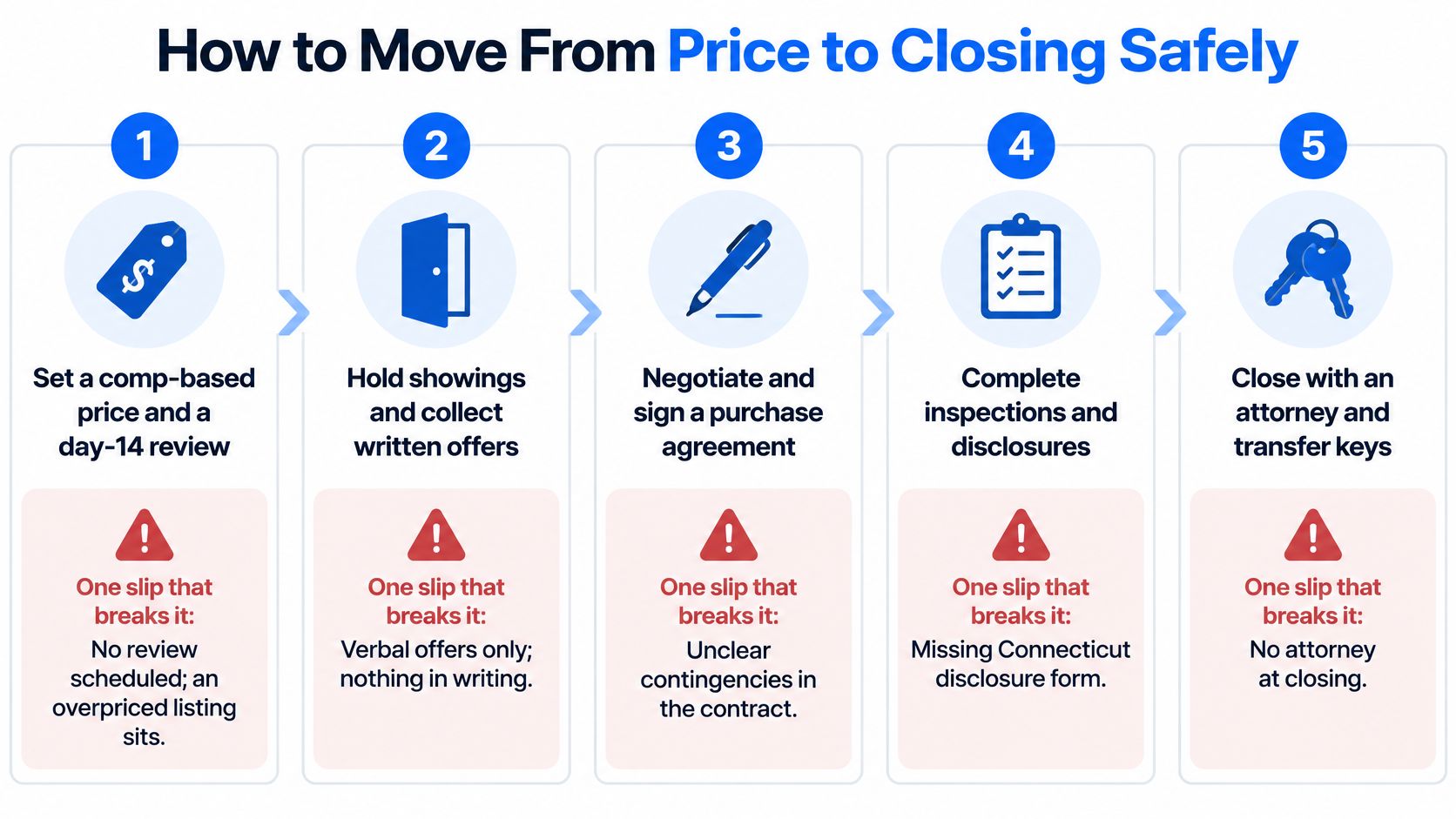
A signed offer is only one part of a safe sale. Keep deadlines, documents, and payment instructions organized, and have your attorney review the agreement before you commit.
Follow the transaction in order
Set a supported price and a review trigger. Keep the sold-property records behind your asking price and decide what evidence would prompt a change. If inquiries are weak and credible written offers are not coming in, reassess rather than leaving the price untouched indefinitely.
Prepare disclosures before signing. Assemble the Connecticut disclosure report and any applicable lead materials while preparing the sale. Ask your attorney when buyers must receive them. A complete file after signing cannot fix a disclosure delivered too late.
Decide whether to consider buyer-agent compensation. Put your position and required proceeds in writing. If a buyer requests compensation, check how the offer handles it before agreeing verbally or signing.
Give buyers accurate information. Use clear photographs, a measured floor plan, accurate property details, and practical showing instructions. Distribute the listing through channels you can use, and check measurements before publishing them.
Check the buyer's ability to pay. A mortgage pre-approval is not final loan approval. For a cash offer, ask for proof of funds and verify it using contact information you obtain independently, not just a screenshot or a phone number on an unfamiliar letter.
Have your attorney review the whole offer. Review the deposit, financing, appraisal, inspection, possession, and cancellation terms together. The deposit should go to the attorney, title company, or escrow holder named in the agreement, never to your personal account.
Keep showings and payment instructions safe. Schedule appointments when you feel comfortable, tell someone who is coming, and secure valuables and medications. Confirm changed wiring instructions by calling a number you already trust. An email thread alone is not verification.
Track inspection and appraisal deadlines. Financing terms may require repairs, and buyers may request inspection concessions. Put any agreed repairs in writing, meet contract deadlines, and don't assume an “as-is” listing overrides the signed agreement.
Check the closing statement before signing. Get current payoff statements and compare the final figures with agreed credits, taxes, compensation, and prorations. Have your attorney coordinate the closing documents, funds, and key handoff. Don't release possession based on an informal promise.
Know when to stop forcing a retail sale
Scrutinize a buyer who won't document financing, repeatedly changes the purchasing entity, or asks for unexplained advance payments. The cash home-buyer scam checklist can help you assess the offer and the person making it.
For an inherited or badly damaged house, confirm who has authority to sell and whether retail preparation makes financial sense. If repair costs and time outweigh the likely benefit, compare other sale options before spending money on work.
Questions Hartford Sellers Ask Before Signing
Resolve uncertain terms before you commit, especially when the answer changes your proceeds or ability to cancel. A buyer's confidence isn't a substitute for your attorney's reading of the agreement.
How much is a delayed or failed sale worth to me?
Add mortgage interest, taxes, insurance, utilities, maintenance, and vacancy exposure for the likely delay. Compare that total with the reduction you'd accept for a more reliable closing, without treating the mortgage principal payoff as a new monthly expense.
What if a buyer's agent asks for more than I agreed to pay?
Ask for the request in writing and calculate the revised net before answering. You can decline, counter, or negotiate another term, but have counsel determine whether you've already made an enforceable commitment.
What if the appraisal comes in below my price?
Possible outcomes include a price adjustment, buyer cash covering a gap, a negotiated split, or termination under an applicable contingency. Your contract and the lender's requirements control, so don't promise a solution before reviewing both.
Can I take a backup offer after going under contract?
Have your attorney confirm whether and how you can accept a properly drafted backup agreement. Don't sign competing primary contracts or promise possession while the first buyer still has enforceable rights.
Are sales to relatives exempt from Connecticut conveyance tax?
Don't assume a family relationship automatically creates an exemption. Your attorney should evaluate the transfer, consideration, and applicable statutory treatment before anyone prepares the deed or calculates proceeds.
Who confirms fees and local certificates?
Confirm municipal conveyance-tax treatment with the City of Hartford and recording charges with the town clerk. Ask your attorney to identify any property-specific inspection or certificate requirement rather than assuming a standard online checklist covers your house.
Before accepting: Get unresolved fee allocations, repair obligations, and possession arrangements into the written agreement. Good intentions don't settle a closing-statement dispute.
Compare Your Net With a Cash Offer
Stay by owner only if the economics and workload still make sense after you price the entire transaction. Saving a listing fee isn't a good reason to accept weak financing, skip legal review, or carry a vacant house indefinitely.
Choose the route that fits the property
- Stay FSBO when you can execute. If your net remains acceptable after taxes, legal costs, potential buyer-agent payment, concessions, and carrying costs, and you can handle access and negotiation, keep going. Retain a Connecticut attorney before signing.
- Hire an agent when exposure matters most. If you want broad retail competition, need pricing guidance, or can't answer inquiries and arrange showings, a full-service listing may be the better fit. Paying for work you can't perform well can be more economical than managing a poorly marketed sale.
- Compare cash when certainty matters more. Repairs, inherited ownership, tenant occupancy, relocation, or a fixed deadline can make a dependable closing more valuable than an ambitious asking price. Measure the discount against costs avoided, not against an unsupported retail estimate.
For property-condition trade-offs, use the Hartford guide to selling a house as-is for cash. Pay particular attention to the difference between selling without repairs and selling without disclosure obligations.
Make the comparison concrete this week
Cyber Homes buys houses for cash with no listings, no showings, and no repairs needed from the seller. Our average time from the property being sold to closing is 7–14 days, and requesting an offer creates no obligation to sell.
Put the written cash offer beside a realistic by-owner outcome. Compare the possession date, seller-paid expenses, contingencies, repair obligations, and money left after your payoff. Keep ordinary seller obligations on the worksheet unless the written purchase agreement expressly allocates them elsewhere.
Choose the offer you can live with financially and execute safely, not the one with the highest number at the top.
We buy Hartford houses as-is for cash, so you can compare a direct sale with the costs and work of selling by owner. Visit Cyber Homes to request a no-obligation cash offer, then compare it with your Hartford net before choosing.

Edited by
James Vasquez
Real Estate Investor & Land Specialist with 10+ years experience in residential flipping, vacant land investing, land wholesaling, and subdivision deals.
Disclaimer: The information provided is for educational purposes and does not constitute financial or legal advice. Always consult with licensed professionals before making investment decisions.