HUD in Real Estate: What It Means and Why It Matters

HUD in real estate can mean the U.S. Department of Housing and Urban Development, a HUD-owned foreclosed home, or a HUD settlement statement at closing. Each affects your transaction differently.
Have you ever searched for “HUD in real estate” and found answers that seem to describe three entirely different subjects? That confusion is understandable. The acronym can refer to a federal agency, a type of government-owned property, or a closing document, and treating those meanings as interchangeable can lead to poor pricing decisions, missed paperwork, or the wrong expectations about a sale.

Get a cash offer for your home
What Does HUD Actually Mean in Real Estate
The first question is simple: which HUD are you dealing with?
In most real estate conversations, HUD means the U.S. Department of Housing and Urban Development, the federal agency responsible for housing policy, affordability programs, fair-housing administration, and related market data. A buyer, seller, lender, or agent may mention HUD when discussing financing rules, housing assistance, discrimination standards, or neighborhood affordability.
The second meaning is a HUD-owned home. This is a property that became real-estate-owned by HUD after a qualifying FHA-insured loan went through foreclosure and the property was transferred to the agency. These homes are sold through a government disposition process, rather than through the same process used for an ordinary homeowner listing.
The third meaning is a HUD settlement statement, usually referring to the HUD-1 form associated with closing paperwork. In that context, HUD isn't a government-owned property or a policy discussion. It's a document that organizes the money moving between the buyer, seller, lender, and other parties.
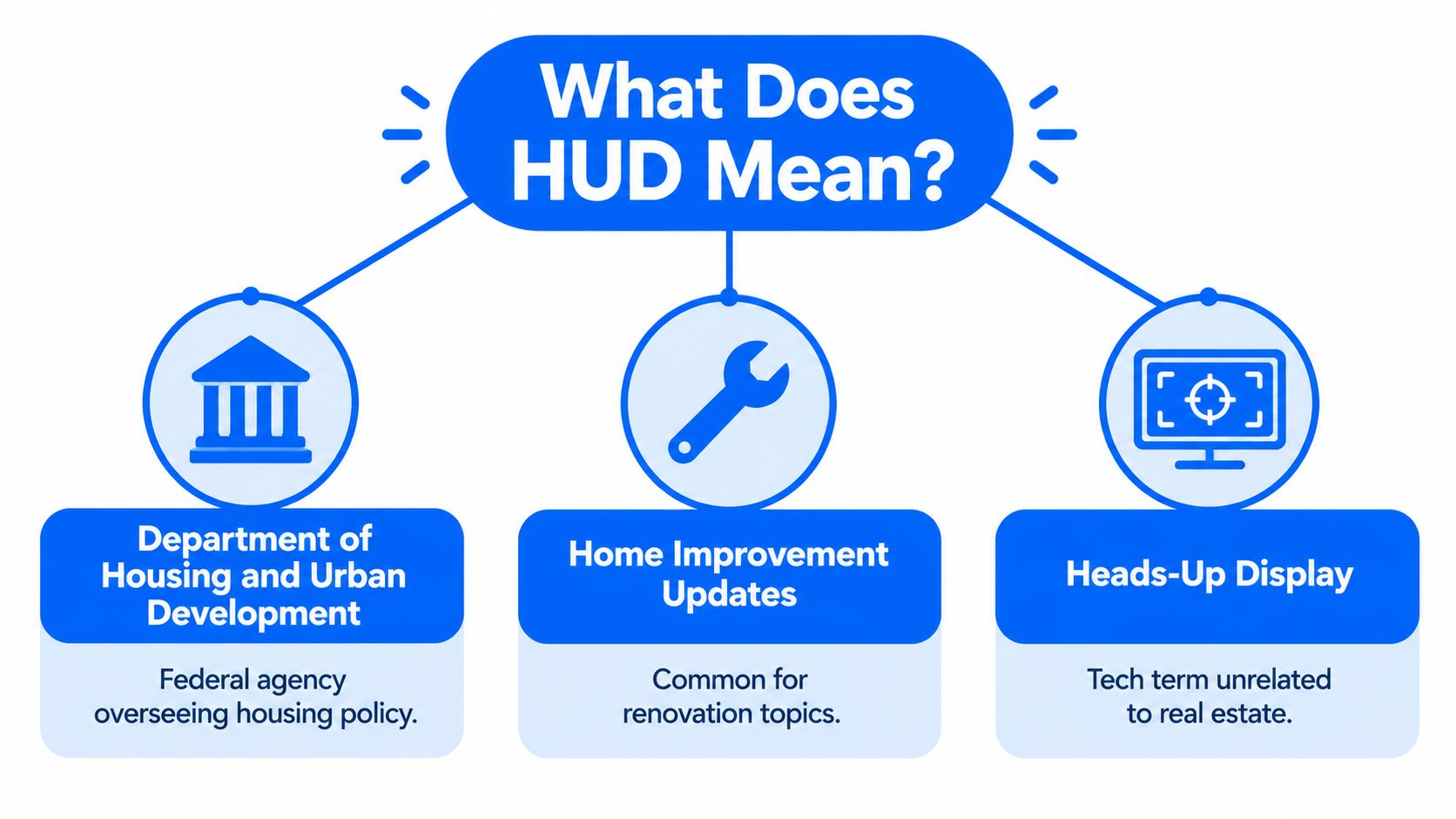
A practical way to separate the meanings
Think of HUD as a company name with several divisions. One division creates and administers housing policy. Another handles certain properties that come into government ownership. A third term, used in transaction conversations, identifies a financial statement.
Use the surrounding words as your clue:
- HUD policy or HUD data usually means the federal agency.
- HUD home or HUD foreclosure usually means a government-owned property.
- HUD statement or HUD-1 usually means closing paperwork.
Practical rule: Before you ask what HUD requires, identify whether the conversation concerns a government agency, a property, or a document.
This distinction matters most for sellers. A homeowner competing with a government-owned property needs market and condition analysis. A homeowner reviewing settlement paperwork needs a line-by-line financial check. A homeowner reacting to a policy change needs reliable information about affordability, financing, or fair housing. The acronym is the same, but the decision is not.
How the U.S. Department of Housing and Urban Development Shapes the Market
HUD matters to homeowners who never buy a government-owned property. The agency helps shape the policy environment, administers housing programs, and publishes information that can help people understand supply, demand, financing, ownership, and vacancy.
HUD was created on September 9, 1965, when the Department of Housing and Urban Development Act made it a Cabinet-level agency. It consolidated five earlier federal housing bodies, reflecting the need for a more coordinated response to substandard housing, housing finance, and community development concerns. In 1968, the Fair Housing Act gave HUD responsibility for enforcing most federal housing-discrimination rules, while the Housing Act of 1968 established Ginnie Mae to broaden mortgage funding for moderate-income households. HUD's official history provides the agency's historical context.
That history explains why HUD appears in so many seller conversations. The agency isn't only associated with subsidies or first-time buyers. Its work touches the rules, programs, and information that influence who can buy, what homes are available, and how communities respond to housing needs.
Read market conditions as a seller
HUD's U.S. Housing Market Conditions database consolidates annual, quarterly, and monthly indicators covering supply, demand, finance and investment, ownership, and vacancy. The database has historical coverage extending back several decades and supports analysis at national, regional, state, metropolitan, and local levels. Sellers can use that breadth to compare their neighborhood with a broader market before setting a price or choosing a sales strategy. HUD's housing market conditions database is a useful starting point for that research.
HUD noted that in Q3 2025, new single-family construction declined while multifamily construction increased. It also reported that home purchases rose while listed inventory fell. Taken together, those signals can indicate tighter resale supply and stronger absorption relative to available stock, although the effect on an individual home depends on location, condition, and buyer demand.
A seller can use this information to ask better questions:
- Inventory: Are comparable homes becoming harder to find?
- Construction: Is new supply entering the same buyer segment?
- Demand: Are purchases increasing, holding steady, or weakening?
- Liquidity: Are homes moving easily, or are buyers becoming more selective?
Understanding this context supports fiscally sound community planning, especially when a seller wants to interpret affordability and supply changes without relying on a single listing or anecdotal opinion.
Understanding HUD Homes and Foreclosure Properties
A HUD home doesn't become government-owned because the borrower used an FHA-insured mortgage. The ownership transfer follows a specific sequence.
First, the lender forecloses on the FHA-insured property. The lender then files a claim against FHA insurance and transfers title to HUD. After receiving the property, HUD sells the asset to recover the insurance loss. This process creates a distinct real estate segment with its own disposition channel and pricing considerations. HUD's public REO property data identifies these assets as structured data rather than merely ordinary listings.
HUD-owned properties are one-to-four-unit homes. They're often evaluated differently from a conventional resale because the government acquired them after a foreclosure process, and their condition can vary substantially. A buyer may need to investigate repairs, occupancy, title matters, financing suitability, and the rules of the applicable sale process.
Why the data matters to nearby sellers
HUD's revitalization-area variables can expose local measures such as the average REO sales price over the last twelve months, active FHA-insured loans, 90-day defaults, and a two-year REO closing history. A seller shouldn't treat any one field as a guaranteed valuation. Instead, these indicators can reveal whether distressed inventory is isolated or part of a broader neighborhood pattern.
For example, a cluster of distressed properties may create competition for buyers who prioritize a lower acquisition price. On the other hand, a limited REO presence may mean that a well-maintained owner-occupied home competes primarily with conventional listings. The right conclusion depends on condition, location, financing access, and the buyer pool.
Investors researching how to buy houses to flip for profit should separate the purchase process from the renovation and resale plan. A low asking price doesn't automatically produce a viable project after repairs, carrying costs, title work, and resale risk.
A homeowner selling a property in its current condition can also review guidance on how to sell a house as-is. The central lesson is practical: identify the property's actual condition, understand the nearby distressed inventory, and price for the buyers most likely to complete the transaction.
Get a cash offer for your home
HUD Settlement Statements and Closing Documents Explained
A HUD settlement statement is a closing document that organizes the financial details of a real estate transaction. Sellers may see it described as a HUD-1 settlement statement, particularly in conversations about older closing procedures or transactions that don't use the newer disclosure format. The exact documents used can depend on the transaction type and applicable closing rules, so the title company, settlement agent, or real estate attorney should confirm what applies.
Read the statement as a reconciliation, not as a form to sign quickly. The document should show the agreed purchase price, credits, commissions, taxes, recording or transfer charges, loan-related items, and the amount the seller is expected to receive after deductions.
Start with the number that affects you most
Find the seller's proceeds first. Then work backward through the charges. Compare the purchase price and credits with the contract, verify the commission arrangement, and check whether taxes, association charges, rent, or utilities have been prorated correctly.
| Charge Category | What It Covers | Who Typically Pays |
|---|---|---|
| Purchase price and credits | The agreed price and negotiated adjustments | Buyer and seller according to the contract |
| Brokerage charges | Compensation connected to the sale | Usually allocated under the listing and purchase agreements |
| Taxes and assessments | Property taxes or local assessments allocated through the closing date | Buyer, seller, or prorated between both |
| Transfer and recording charges | Fees for transferring or recording ownership documents | Varies by location and contract |
| Loan payoff | The amount required to satisfy the seller's mortgage or other recorded debt | Seller |
| Seller credits | Agreed contributions toward buyer costs or repairs | Seller, if included in the contract |
Check before signing
Ask for the statement early enough to review it. A seller should compare every major entry against the purchase contract, prior payoff information, invoices, and written agreements. If a charge looks unfamiliar, ask who authorized it and whether it changes the expected proceeds.
Common problems include an outdated loan payoff, a missing credit, an incorrect tax allocation, or a fee assigned to the wrong party. These issues can delay signing or reduce the seller's net amount if nobody catches them.
For a broader explanation of what to expect at closing, sellers can review the process with a qualified legal professional and then ask the settlement agent to explain any unfamiliar line.
Before signing: Confirm the property price, credits, payoff, prorations, fees, and final proceeds. A short review can prevent a long correction process.
Comparing HUD Home Sales Conventional Listings and Cash Offers
A seller choosing a sales route should focus on the trade-off between price, preparation, speed, and certainty. A HUD-owned property sold through a government channel is not the same transaction as a homeowner listing on the MLS, and neither is identical to accepting a direct cash offer.
A conventional listing usually gives the seller access to a broad buyer pool through agent representation and public marketing. That route may support stronger market exposure, but it can also involve showings, negotiations, inspection requests, financing conditions, and repairs or preparation before launch.
A cash offer changes the priority. The seller may avoid extensive preparation and reduce the number of contingencies, but the offer may reflect the buyer's repair costs, holding risk, and desired margin. The right choice depends on the seller's priorities rather than on a universal claim that one route is best.
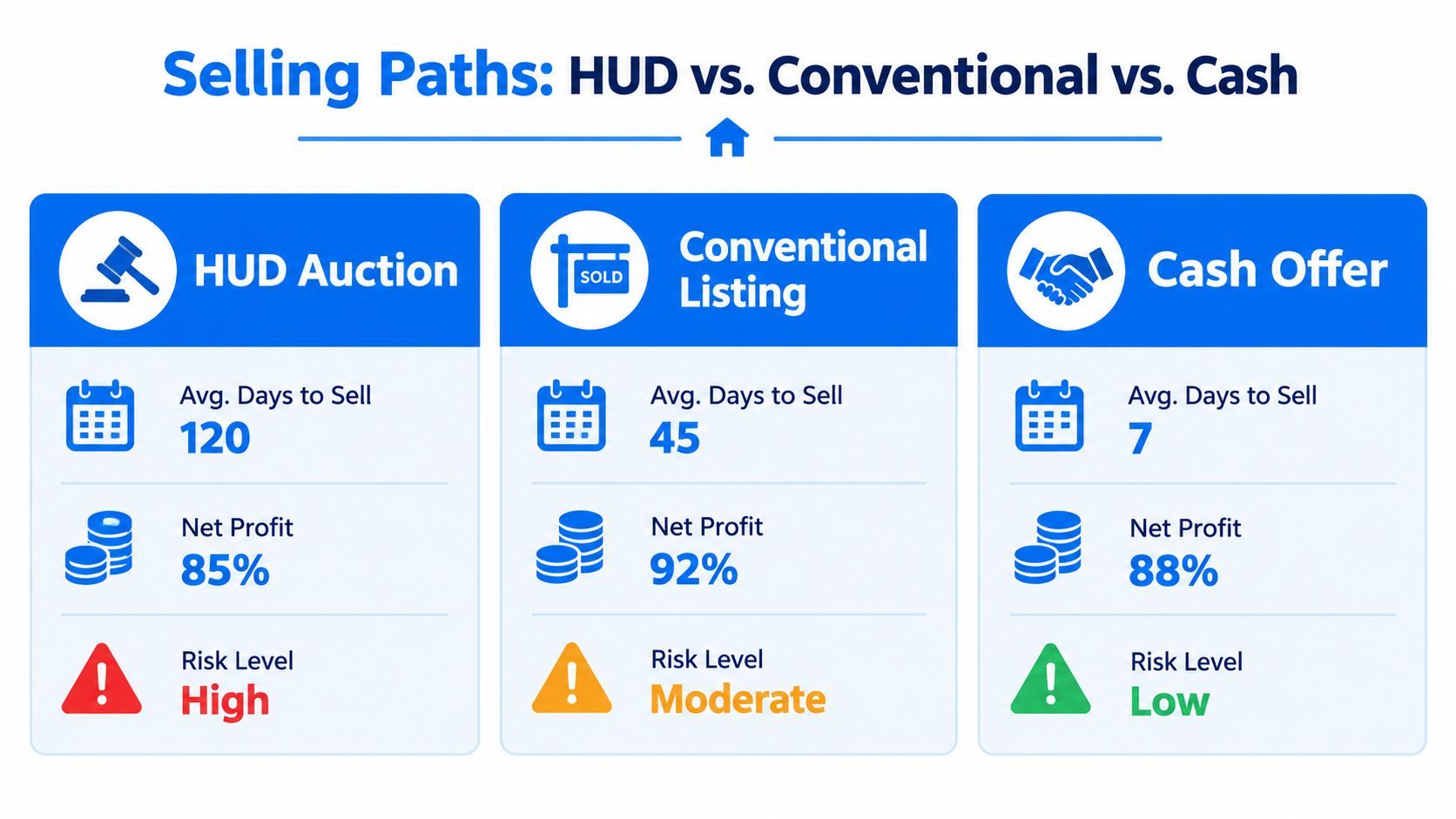
Match the route to the situation
| Selling Route | Typical Timeline | Repair Required | Commission Cost | Best For |
|---|---|---|---|---|
| HUD auction or government disposition | Controlled by the applicable government sale process | Often evaluated according to the property's condition and sale terms | Depends on the transaction rules | Buyers and sellers who can follow a structured government process |
| Conventional listing | Depends on preparation, buyer demand, negotiations, and financing | Often includes preparation recommended for marketability | Usually based on the listing agreement | Owners prioritizing broad exposure and market competition |
| Cash offer | Set by the buyer and seller's agreement and closing process | May allow an as-is sale | May avoid traditional listing commissions, depending on the offer | Sellers prioritizing simplicity, flexibility, or a defined closing plan |
The matrix is a decision aid, not a promise. A property needing extensive work may be difficult to present conventionally, while a clean, well-positioned home may benefit from open-market exposure. A seller facing relocation, probate, foreclosure pressure, or a strict move-out date may value certainty more than the possibility of a higher gross offer.
Before accepting a direct offer, ask whether it is firm, how the buyer handles inspections, which costs the buyer will pay, and whether the closing date fits your needs. Sellers considering that route can review the cash home buying process and compare the written offer with the likely net proceeds from a traditional sale.
The important comparison isn't the headline price alone. It's the amount you keep after repairs, concessions, commissions, carrying costs, delays, and transaction risk.
Get a cash offer for your home
Why HUD Policy Changes Matter to Every Seller
HUD isn't relevant only to first-time buyers or households receiving assistance. The agency's policy, enforcement, and data work can influence the conditions surrounding every sale, including the size of the buyer pool, the affordability of competing homes, and the supply options available in a community.
HUD's data tools track affordability problems at 30%, 50%, and 80% of area median income. Those thresholds help policymakers and housing professionals examine how affordability pressures affect different income groups. HUD's data portal brings together public housing information that can help sellers understand the broader environment around their property.
That doesn't tell you exactly what your home is worth. It does help answer a more useful question: which buyers can realistically afford homes like yours, and how much competition do they face?
Watch the signals behind buyer behavior
HUD's Q1 and Q2 2025 market summaries show homeownership moving from 65.7% to 65.1%, then 65.0%, while annual house price growth slowed to 2.3% to 2.9% in Q2 2025. These figures point to a cooling market environment, but they don't determine the result for every city or property. Sellers should use them as context alongside local inventory, comparable sales, financing conditions, and buyer feedback. HUD's Q1 2025 national summary provides the cited market context.
HUD's role also reaches the supply side. The agency has promoted factory-built housing and lowered barriers in public-housing repositioning. Coverage in late September 2026 described a federal push around manufactured homes amid a persistent construction labor shortage. That direction matters because additional housing formats can affect future competition, neighborhood revitalization, and the availability of lower-cost options.
For sellers, the practical response is disciplined rather than dramatic:
- Price for the actual buyer pool: Don't assume every buyer can absorb a higher payment.
- Track competing supply: Include renovated homes, new construction, multifamily options, and distressed properties.
- Use objective information: Separate national policy signals from your local market evidence.
- Review timing: A changing affordability environment may affect how long buyers need to make a decision.
HUD may be a policy institution, but sellers experience its effects through buyer qualification, supply, competition, and transaction confidence.
Real-World Scenarios for Sellers Dealing with HUD Issues
A homeowner receives a closing statement and notices that the expected proceeds are lower than anticipated. The purchase price is correct, but the statement includes a loan payoff that may be outdated and a credit the seller remembers agreeing to. The right response isn't to sign first and investigate later. The seller should request the payoff details, compare the credit with the contract, and ask the settlement agent to explain each unfamiliar charge.
A different seller lives near a property that appears to be a HUD foreclosure. The homeowner assumes the government-owned property sets the price for every nearby home. That conclusion is too broad. The seller should compare condition, unit type, location, buyer financing, and the property's sale channel before deciding whether the REO asset is a direct competitor.
The presence of a HUD-owned property is a market clue, not an automatic valuation.
Another homeowner needs to sell a rental property that requires work. A traditional listing might provide broader exposure, but it could also require cleaning, repairs, showings, negotiations, and inspection responses. A direct offer may provide a simpler path, though the seller should compare the written net amount and closing terms rather than focusing only on speed.
A seller facing an urgent move can review options for as-is home buyers, then ask each potential buyer how inspections, title work, closing costs, and the move-out date will be handled. The decision should reflect the seller's priorities, property condition, and tolerance for uncertainty.
The most useful habit is to name the HUD issue before trying to solve it. Is it agency policy, a government-owned home, or a settlement document? Once that answer is clear, the next step becomes far easier to identify.
If you need to sell a home quickly, especially one requiring repairs or facing relocation, probate, foreclosure, or tenant-related complications, Cyber Homes can evaluate the property and provide a direct cash offer. Contact the team to discuss an as-is sale, compare your options, and choose a closing timeline that fits your situation.

Edited by
James Vasquez
Real Estate Investor & Land Specialist with 10+ years experience in residential flipping, vacant land investing, land wholesaling, and subdivision deals.
Disclaimer: The information provided is for educational purposes and does not constitute financial or legal advice. Always consult with licensed professionals before making investment decisions.