Squatters Rights in West Virginia: Practical Guide 2026

Adverse possession in West Virginia generally requires 10 years of qualifying possession, but recent state law allows faster removal of unauthorized occupants who aren't tenants or immediate family members. A person who has just moved into a vacant home doesn't automatically gain ownership rights, and may not be entitled to ordinary eviction protections.
You return to an inherited house in West Virginia and find strangers living inside. The locks have changed, personal belongings fill the rooms, and a neighbor says the occupants have been there for an unknown period. Your first instinct may be to demand that they leave, but the safest response depends on whether you're facing unlawful occupation, a tenancy dispute, a family disagreement, or a potential ownership claim.
The phrase “squatters rights in West Virginia” often blends two separate legal questions. The first asks how an owner can recover possession now. The second asks whether a person who has occupied land for a long period could eventually claim title through adverse possession. Those questions can overlap, but they aren't interchangeable.
The distinction matters because West Virginia's newer fast-removal rules focus on possession, while the older adverse-possession rules concern ownership. A homeowner who understands both can gather the right evidence, contact the right officials, and avoid turning a stressful discovery into a larger legal problem.

Get a cash offer for your home
Why Squatters Rights in West Virginia Matter for Homeowners
A vacant property can look like an invitation, especially when it has broken windows, overgrown vegetation, or an estate owner who lives far away. Suppose Maria inherits a rural house but delays repairs while settling the estate. During a routine visit, she finds someone sleeping in an upstairs room. The person says they believed the home was abandoned and refuses to show identification or leave.
Maria doesn't know whether the occupant entered recently, received permission from a relative, once rented the house, or has already started making an ownership claim. Each possibility changes the proper response. Calling the police, changing the locks, or removing belongings without understanding the facts could create additional complications.

Why the first facts matter
Start by establishing what happened, not by arguing about what the occupant deserves. Write down when you discovered the person, how you learned about the property condition, and whether you have any record of prior permission, rental arrangements, or family access.
Useful evidence may include:
- Ownership records: Keep the deed, probate documents, tax records, insurance policy, and property photographs together.
- Entry evidence: Photograph damaged doors, windows, fences, utility connections, discarded locks, and other visible conditions from a safe location.
- Occupancy details: Record names, statements, vehicles, mail, and items that appear to show when the person arrived. Don't enter occupied areas without legal advice or permission.
- Communication history: Save texts, emails, letters, and messages involving the occupant, relatives, tenants, contractors, or neighbors.
Practical rule: Treat the first visit as evidence collection and a safety assessment, not as an opportunity to force someone out.
The situation can become harder if the owner waits without documenting it. A person may claim that a relative authorized the stay, that a prior landlord accepted them as a tenant, or that the owner knew about the occupation and did nothing. Those statements won't automatically succeed, but they can make the dispute less straightforward.
Owners also need to separate urgency from panic. An unauthorized occupant does not become the legal owner just because they entered a vacant property, and a short occupation does not satisfy the long-standing adverse-possession standard. At the same time, a homeowner shouldn't assume every occupant can be handled through a routine tenant process. West Virginia's current law creates a specific route for some unlawful occupants, while excluding several common dispute types.
Understanding Adverse Possession and the 10-Year Rule
Adverse possession is the older title-based doctrine people usually mean when they talk about “squatters rights.” It can allow a claimant to seek legal title after occupying land in a way that meets strict requirements for the statutory period. In West Virginia, that period is 10 years, tied historically to the state's limitation rule for recovering land. The West Virginia Supreme Court materials on adverse possession describe the required possession as actual, open, notorious, exclusive, and continuous, with proof required by clear and convincing evidence.
That standard is much more demanding than moving into an empty house. The claimant must show conduct that looks like ownership and must connect that conduct to the entire required period. A person who occupies a property briefly, hides the occupation, shares control with the owner, or entered with permission generally has a serious problem proving the claim.
The elements in plain language
The legal terms describe practical questions a judge would ask:
- Actual possession: Did the claimant physically use or occupy the land rather than merely claim it on paper?
- Open and notorious possession: Would the owner, neighbors, or visitors reasonably see that someone was using the property? Secret occupancy weakens this element.
- Exclusive possession: Did the claimant control the property as an owner would, rather than sharing possession with the true owner or the public?
- Continuous possession: Did the claimant maintain the required occupation without a legally meaningful interruption?
- Hostile possession: Was the use without the owner's permission and under a claim inconsistent with the owner's right to control the property?
“Hostile” doesn't necessarily mean violent or threatening. In this context, it generally concerns possession without the owner's authorization. If an owner allows a cousin to stay, lets a neighbor use a field, or gives a caretaker access, that permission can affect whether the use is adverse.
What clear and convincing evidence means
A claimant needs more than a story about having lived at the property. They may point to dated photographs, correspondence, repairs, utility records, boundary maintenance, witness testimony, or other material showing visible and exclusive control. The owner should preserve contrary evidence, including inspection records, notices, rent documents, permission messages, and proof of attempts to reclaim possession.
The West Virginia statutory text addressing the land-recovery period reinforces the importance of the 10-year benchmark, but meeting the period alone isn't enough. The claimant must still establish the full set of possession elements with the required level of proof.
A recent unauthorized occupant is a possession problem. A long-running, documented, owner-like occupation may become a title dispute. Don't treat those situations as the same case.
For owners, documentation should begin as soon as an issue is discovered. The purpose isn't to create a dramatic file. It's to show who held title, what permission existed, when the owner learned of the occupation, and what steps the owner took to assert control.
How West Virginia's New Squatter Removal Law Works
West Virginia's recent anti-squatting framework changes the starting assumption for some cases. A qualifying squatter isn't treated as a tenant because that person occupies a dwelling. The statute says courts shouldn't require an eviction-style procedure to remove a squatter, and it gives law enforcement a role when the statutory conditions and probable cause are present. The current West Virginia code provisions on squatter removal provide the operative framework.
The law defines a squatter as someone occupying a dwelling unit without entitlement under a rental agreement and without authorization from the tenant. That definition helps explain why a person who broke into a vacant house may be treated differently from someone whose lease ended, whose landlord accepted rent, or whose family member gave permission.
The practical response
If you discover an unauthorized occupant, take these steps:
- Confirm your ownership and authority. Have identification and documents available that connect you to the property. An heir, trustee, landlord, or authorized representative may need different supporting records.
- Avoid confrontation. Don't threaten, touch, remove, or lock out occupants before understanding the circumstances. Safety comes before property recovery.
- Report the facts accurately. Explain that the person is unauthorized, identify the property, describe how entry appears to have occurred, and provide available ownership evidence.
- Ask about the statutory process. If officers find probable cause and the case meets the law's conditions, law enforcement may serve a notice to immediately vacate and restore possession to the owner.
- Preserve the scene. Photograph damage and keep copies of notices, reports, messages, and officer information.
The law also addresses property damage. Unlawful occupation that causes more than $1,000 in damage to the property, fixtures, or the owner's personal property can constitute a felony, with penalties of 1 to 10 years in prison, or up to 1 year in jail and a fine of up to $2,500, as stated in the statutory provisions linked above. Owners should document damage and avoid exaggerating estimates, because the legal consequences depend on the facts and proof.
Why speed matters
The fast-removal process is designed to restore possession, not to decide every complicated ownership question. If the occupant disputes the owner's title, claims a rental agreement, identifies a family relationship, or points to pending litigation, officers may not be able to resolve the matter at the property. The owner may then need a civil proceeding or legal advice.
The new framework gives owners a potentially faster tool, but it doesn't turn every occupancy dispute into an immediate police removal. Accurate classification is the first step.
Get a cash offer for your home
When Fast Removal Applies and When It Does Not
The most important limitation is that the fast path has boundaries. It generally fits a straightforward situation where an unauthorized person occupies a dwelling, the property wasn't open to the public, the owner didn't authorize the occupation, and no excluded relationship or court dispute exists.
It becomes less suitable when the occupant has a plausible legal connection to the property. West Virginia's statutory exceptions include current or former owners, current or former lawful tenants, immediate family members, and cases involving pending litigation, according to the legislative text governing unlawful occupation and removal.
Two different routes
| Situation | Likely legal focus | Owner's practical priority |
|---|---|---|
| A stranger enters a vacant home without permission | Unlawful occupation and possible criminal trespass | Secure evidence, contact law enforcement, and ask whether the statutory removal process applies |
| A former tenant remains after a rental relationship | Landlord-tenant possession dispute | Gather the lease, payment history, notices, and advice about the proper civil process |
| A relative occupies inherited property | Family, probate, authorization, or ownership dispute | Review estate documents and avoid assuming the fast process applies |
| A former owner or co-owner remains | Title and possession dispute | Obtain legal advice before changing access or removing belongings |
| A claimant raises a long-term title theory | Adverse possession and ownership | Preserve historical records and prepare for a civil title dispute |
The table shows why “call the police and they will always remove the person” is unreliable advice. Officers may find that a person is present but still lack a clean basis for immediate removal because the facts point to a tenancy, family permission, co-ownership, or litigation.
The distinction also protects owners from choosing the wrong remedy. A former tenant isn't automatically a squatter just because the lease ended. A sibling living in an inherited home may be unauthorized from one heir's perspective but still connected to the estate. A person claiming ownership may be wrong, yet the disagreement may require a judge to examine deeds, probate records, and possession history.
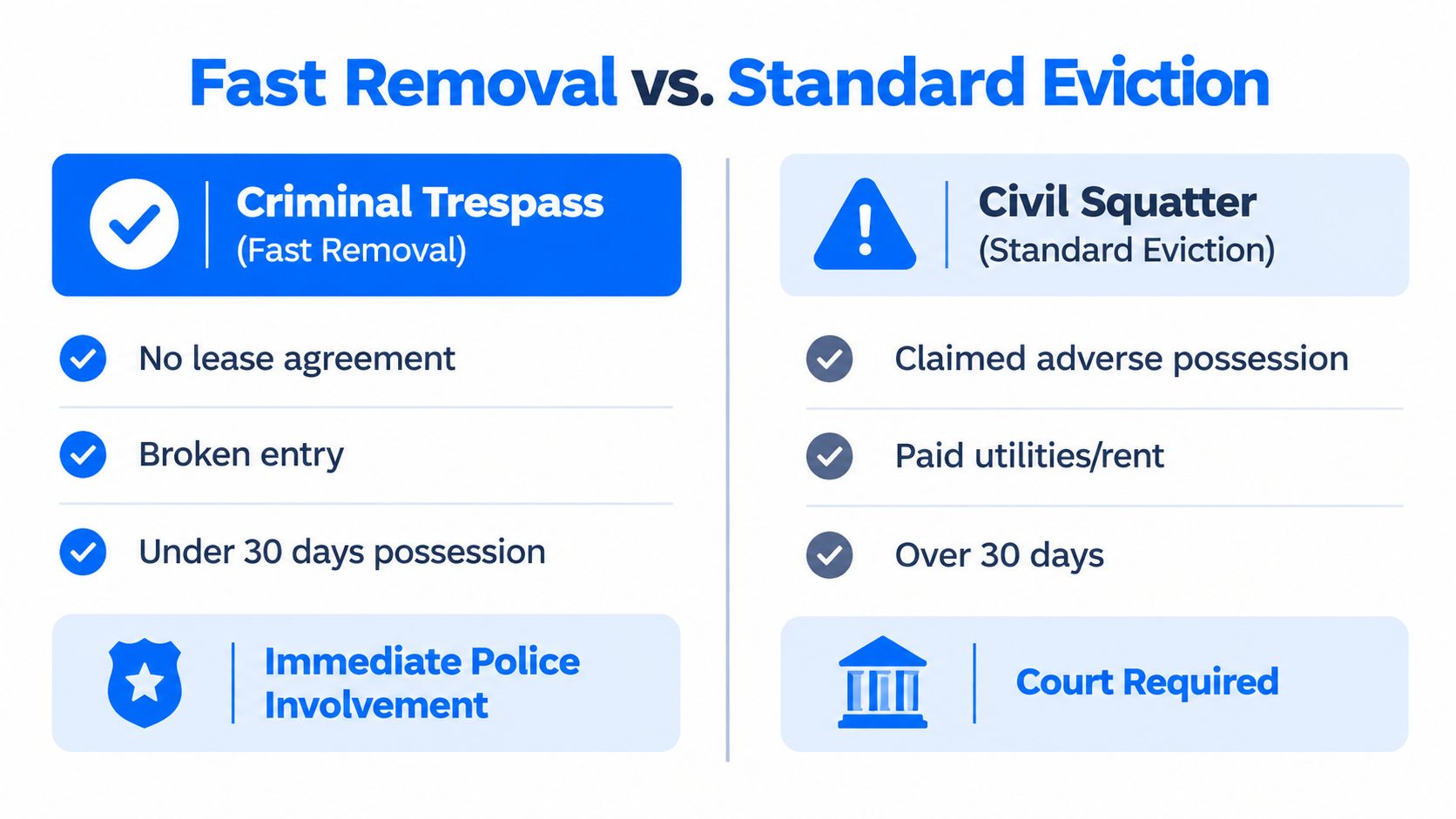
The fast-removal statute addresses immediate possession. It doesn't erase every possible title claim or decide every family and tenancy dispute at the scene.
If the quick route doesn't fit, don't improvise. A civil lawyer can identify whether the case calls for a possession action, a title proceeding, probate involvement, or another remedy. The owner should continue documenting the property and communicating carefully while that decision is made.
Prevention Steps and Immediate Actions for Property Owners
Prevention starts with making a vacant property difficult to enter and easy to monitor. A locked door alone may not be enough if no one checks the house for an extended period. Regular attention also creates a record showing that the owner has continued to exercise control.

Build a simple vacancy routine
- Secure entrances: Use sturdy locks, reinforce vulnerable doors, close accessible windows, and repair openings promptly.
- Create visibility: Motion lights, maintained landscaping, and clear “No Trespassing” signs make unauthorized access more noticeable.
- Inspect consistently: Ask a trusted person, property manager, or neighbor to check the exterior and report broken locks, vehicles, fresh trash, or signs of occupancy.
- Monitor remotely: A camera system can help identify entry and preserve time-stamped information. Position devices lawfully and respect privacy boundaries.
- Keep records together: Store ownership documents, insurance details, inspection notes, contractor invoices, and photographs in one accessible file.
Don't advertise a property's vacancy through neglected maintenance or an unsecured mailbox. If utilities need to remain active for winter protection or monitoring, keep account records that show the owner's continuing involvement. These steps don't guarantee that nobody will enter, but they reduce the chance that an entry goes unnoticed.
Respond without damaging your position
When you find signs of occupancy, leave if you feel unsafe and contact local authorities. Don't confront occupants, shut off essential services to force them out, discard their belongings, or make threats. Those actions can escalate the encounter and complicate later proceedings.
Use a dated incident log. Note when you arrived, what you saw from outside, who was present, what was damaged, and which officials or professionals you contacted. Save original photographs rather than editing them, and ask witnesses to write down what they observed while their memory is fresh.
The following video can help owners think through practical warning signs and property-protection habits:
If the property is vacant, damaged, inherited, or difficult to manage from a distance, an owner may also consider an as-is sale rather than carrying the risk while repairs and legal questions continue. A resource on selling a property to as-is home buyers can help you evaluate that route without treating it as a substitute for legal advice.
Get a cash offer for your home
When to Call an Attorney or Sell the Property Instead
An attorney becomes especially important when the occupant claims a lease, ownership interest, family permission, or a long history at the property. The same applies when the home is part of an estate, multiple people appear on the deed, a title defect exists, or a lawsuit is already pending. Those facts can place the dispute outside the clean fast-removal lane.
Legal advice is also sensible before sending a threatening message, signing an agreement with the occupant, accepting money, or changing locks. A lawyer can help preserve the owner's position while identifying the correct possession or title remedy.
Selling may be a reasonable alternative when the property is distressed, remote, severely damaged, tied up in an estate, or too burdensome to supervise. The owner may give up the possibility of a higher retail price, but an as-is transaction can avoid repairs, repeated showings, prolonged vacancy, and the uncertainty of managing a difficult property.
Before choosing that option, confirm that the seller has authority to convey the property and disclose the occupancy issue. A buyer and title company will need accurate information about liens, heirs, occupants, and pending disputes. The guide to understanding a distressed property may help owners compare a sale with continued management.
The right choice depends on the objective. If preserving title and possession is the priority, consult counsel early. If certainty and a clean transition matter more than maximizing the eventual sale price, a properly structured sale may be worth considering.
Frequently Asked Questions About Squatting in West Virginia
How long before occupancy creates an ownership concern?
West Virginia's adverse-possession period is 10 years, but the claimant must also prove actual, open, notorious, exclusive, continuous, and hostile possession by clear and convincing evidence. A short occupation doesn't create title.
Will police always remove a squatter immediately?
No. The fast process applies only when the statutory conditions are met. Former owners, former lawful tenants, immediate family members, and cases with pending litigation may require a civil route.
What should owners document?
Keep deeds, probate papers, inspection records, photographs, messages, damage estimates, and evidence showing when you asserted control. Don't enter an occupied property to collect evidence if doing so creates a safety or legal risk.
What if the occupant damaged the home?
Photograph the damage, preserve receipts and estimates, and report the facts accurately. Damage exceeding the statutory threshold can carry serious criminal consequences, while compensation and possession issues may still require separate action.
Heirs handling an occupied inherited property should also review the practical issues discussed in selling a home in probate before making commitments.
Cyber Homes buys houses as-is for cash, including vacant, damaged, inherited, and occupied properties, so you can avoid repairs, showings, and commissions when a fast resolution fits your plans. Visit Cyber Homes to request an evaluation and discuss a closing timeline that works for your situation.

Edited by
James Vasquez
Real Estate Investor & Land Specialist with 10+ years experience in residential flipping, vacant land investing, land wholesaling, and subdivision deals.
Disclaimer: The information provided is for educational purposes and does not constitute financial or legal advice. Always consult with licensed professionals before making investment decisions.