Sell My House Fast Richmond Va

You may be leaving Richmond for a new job, managing an inherited house from another state, dealing with a property that needs more work than you can afford, or trying to protect a closing date that can't move. In those situations, searching for “sell my house fast Richmond VA” isn't really about chasing a headline price. It's about deciding how much time, uncertainty, repair work, and negotiation risk you're willing to accept.
Richmond can reward sellers who prepare well, but a quick market isn't the same as a frictionless transaction. The right choice depends on your net proceeds after time costs, your property's condition, and how certain you need the closing date to be.

Get a cash offer for your home
Why Richmond Sellers Often Choose Speed Over Perfection
A Richmond homeowner receives a job offer outside Virginia and needs to move before the next housing payment, utility bill, and maintenance problem arrive. The house is livable, but the roof is older, the basement needs attention, and the owner doesn't have the time to coordinate contractors. A conventional listing might produce a stronger offer, but it also introduces showings, inspections, appraisal questions, buyer financing, and the possibility of renegotiation.
Another seller may be handling an inherited property with several heirs involved. Someone wants to list immediately, another wants repairs completed first, and nobody lives close enough to manage the house. In that situation, a clean, documented cash transaction can be more valuable than spending months pursuing a theoretical maximum.
Richmond's market can move quickly. Homes in the city were selling in about 14 days on average in the latest Redfin Richmond housing market snapshot, while Zillow reported a median of 8 days to pending and a 50.2% share of sales closing above list price in July 2026 through the same market reference. Those figures show strong buyer response, but they don't eliminate inspection problems, appraisal gaps, financing fallout, or title delays.
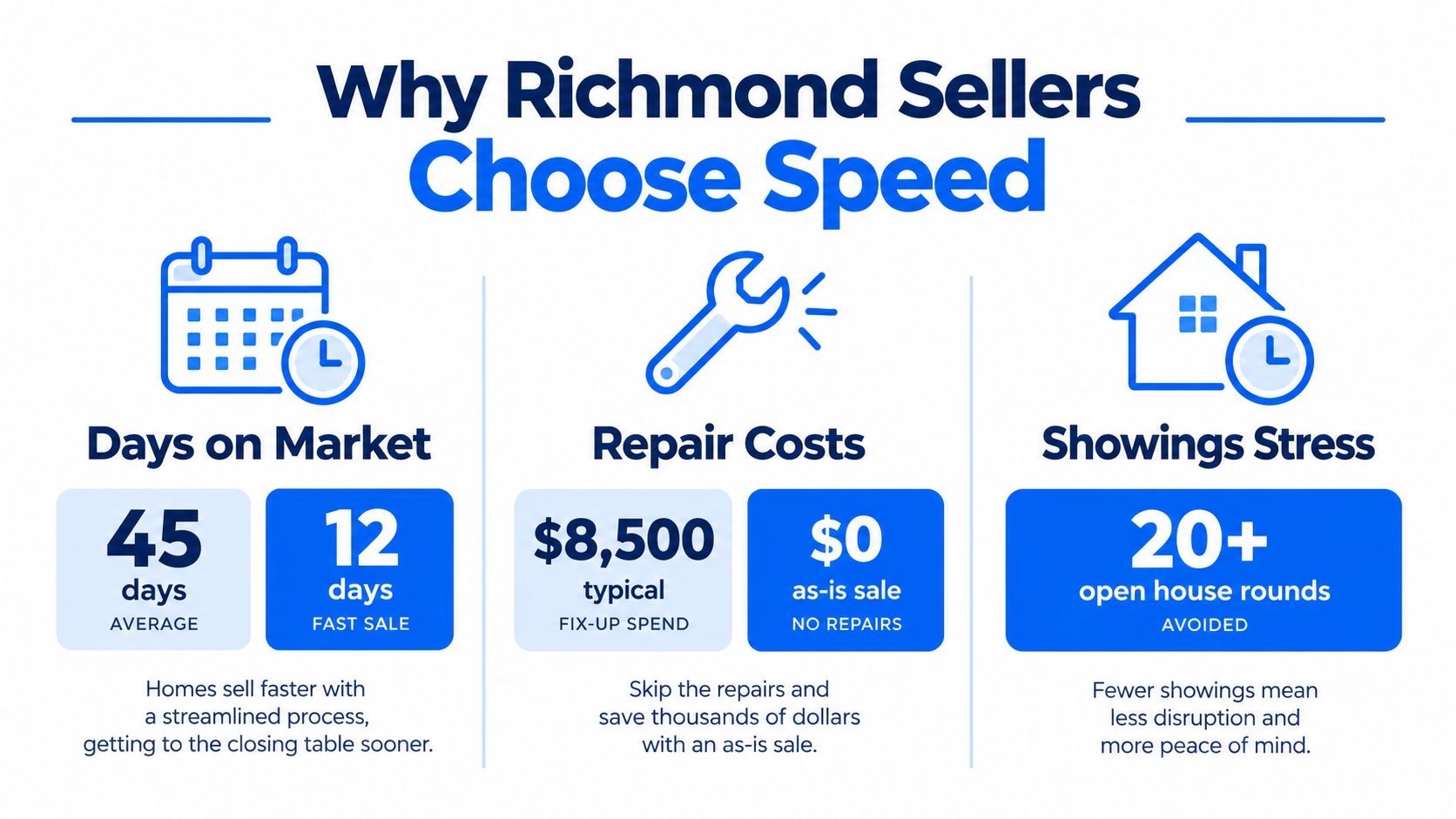
The decision is about certainty
Zillow also reported 708 active listings and 318 new listings at the end of August 2026, which means sellers still compete on price, presentation, condition, and timing according to the Richmond market data. A buyer may respond quickly to a well-presented home, then ask for credits after an inspection. A listing may attract attention immediately, then lose its edge if the initial price misses the neighborhood's buyer expectations.
Richmond's long-term context adds another layer. The city's population grew by 17% from 2000 to 2019, adding 32,646 residents, according to the city's Inclusive Housing report. Zillow's Richmond data also showed a median sale price of $402,900 and an average home value of $364,726, while the FRED index referenced in that market overview reached 399.26 in Q2 2026, up from 394.46 in Q1 2026 and 388.33 in Q3 2025.
Practical rule: Don't ask only, “Which offer is highest?” Ask, “Which offer gives me the most reliable net result on the date I actually need?”
A fast sale is rational when the cost of waiting includes relocation pressure, vacancy, repairs, legal administration, tenant problems, foreclosure risk, or the chance that a buyer won't obtain financing. It isn't automatically rational for every Richmond homeowner. If the house is turnkey, the seller has time, and maximizing proceeds matters most, a carefully priced MLS listing may still be the better route.
Comparing Cash Buyers, iBuyers, and Traditional Listing Paths
The fastest route isn't always the most profitable, and the highest initial offer isn't always the best offer. Compare the entire transaction, including repairs, concessions, commissions, carrying costs, inspection risk, and the likelihood that the buyer reaches closing.
| Option | Typical Speed | Repair Expectation | Commission and Fees | Closing Certainty |
|---|---|---|---|---|
| Direct cash buyer | Fast and scheduled around the contract | Usually as-is, with condition reflected in the offer | May avoid agent commission, but review all contract charges | High when funds, title work, and closing terms are verified |
| iBuyer | Fast for qualifying homes | Usually expects a property that fits its buying criteria | Service charges and other transaction costs may apply | Depends on valuation, inspection, and program approval |
| Traditional MLS listing | Can be quick with accurate pricing and strong presentation | Seller usually handles preparation, repairs, or buyer credits | Agent compensation and seller-paid costs depend on the agreement | Exposed to inspection, appraisal, and financing contingencies |
| FSBO | Variable, based on pricing and seller execution | Seller decides what to address | No listing-agent commission, but marketing and transaction costs remain | Depends heavily on buyer quality and contract management |
A direct cash buyer can make sense for a property with deferred maintenance, an uncertain tenant situation, or a seller who needs control over the closing date. The trade-off is usually a lower price than a successful retail sale because the buyer is taking on repair, resale, financing, and market risk.
An iBuyer may suit a standardized home in acceptable condition where the seller wants a largely online process. It can offer convenience, but the seller still needs to understand the valuation process, service charges, inspection adjustments, and circumstances that could change the final terms.
What the traditional route still does well
An experienced Richmond agent can create competition among retail buyers and may produce a higher gross price when the property photographs well, needs limited work, and can tolerate showings. The seller, however, absorbs more preparation and transaction management. A financed buyer may also introduce an appraisal or loan approval problem after the seller has already spent time preparing the home.
FSBO eliminates the listing-agent relationship, but it transfers pricing, marketing, showing coordination, disclosure organization, negotiation, and contract oversight to the homeowner. That can work for an organized seller with time and a strong understanding of local demand. It can work poorly when the seller's primary need is certainty.
Before accepting any cash proposal, review a clear explanation of the cash home buying process. The useful comparison is not “cash versus listing” in the abstract. It is the expected net from each path after repair spending, price reductions, commissions, concessions, carrying costs, and the value of your time.
Immediate Actions That Actually Speed Up a Richmond Sale
Speed starts before an offer arrives. Sellers lose time when buyers discover basic problems late, documents are missing, or the property enters the market at a price that attracts attention but not qualified offers.
Start with facts, not improvements
Walk through the property and write down its actual condition. Include roof age if known, HVAC history, plumbing leaks, electrical concerns, water intrusion, unfinished work, code questions, and anything a buyer could discover during a visit. Don't spend money on cosmetic upgrades until you know whether the chosen sale path rewards them.
Then gather the documents that commonly slow decisions:
- Locate ownership records: Find the deed, mortgage information, tax records, survey if available, and any documents connected to a trust, estate, divorce, or prior transfer.
- Clarify occupancy: Write down whether the home is vacant, owner-occupied, or tenant-occupied, and gather the lease and payment history if a tenant is involved.
- Separate must-fix items from nice-to-have work: Address active leaks, unsafe conditions, and access problems first. Fresh paint or upgraded fixtures may not justify their cost in an as-is sale.
- Set your required date: Identify when you need proceeds, when you must move, and whether you need time after closing to remove belongings.
- Compare realistic paths: Get a cash evaluation and a retail pricing opinion if you're uncertain. Compare the net result, not just the headline offer.
Price for the outcome you need
An asking price that is too ambitious can waste the property's strongest launch period. A cash buyer's offer may look lower because it includes the buyer's estimate of repairs and risk, while a retail offer may look higher but carry inspection, appraisal, and financing conditions.
Remove clutter, improve access, secure loose items, and make the home easy to inspect. For an MLS sale, clean photographs and a clear description matter. For a direct evaluation, accurate condition details matter more than staging. Don't conceal defects. Surprises create renegotiation, and renegotiation is one of the fastest ways to lose a closing date.
Seller's checkpoint: Every task should answer one question, will this action improve the buyer's confidence, reduce a known delay, or increase the net proceeds enough to justify its cost?
Get a cash offer for your home
Virginia Paperwork, Title Issues, and Closing Timelines
Marketing creates attention. Title clarity creates the ability to close. A buyer can agree to your price quickly, but the title company still has to confirm who owns the property, identify liens or payoff requirements, and resolve issues that affect transfer.
Start the title conversation as soon as you decide to sell. Give the closing company the names of every owner exactly as they appear on the deed, along with mortgage details, tax information, judgments, estate documents, divorce orders, and any paperwork involving an heir or trust. If the home came through an inheritance, don't assume a family agreement is enough. The closing professionals need the documents that establish authority to sell.
Common sources of administrative delay
A prior mortgage may have been paid off without a recorded release. A contractor or creditor lien may appear unexpectedly. A deceased owner may still be listed on title. A divorce may have divided economic interests without completing the deed transfer. Each issue can require additional documents, signatures, court filings, or professional review.
Virginia sellers also need to provide accurate property information and respond truthfully to questions from the buyer and closing professionals. Your agent, attorney, and title company can explain which disclosures and forms apply to your circumstances. A cash sale may reduce financing-related uncertainty, but it doesn't remove the need for a valid transfer and a clean settlement process.
A conventional transaction often has several moving parts at once. The buyer may need an inspection, an appraisal, lender underwriting, insurance, and final loan approval. A cash transaction can remove the lender's approval process, but the title review and seller's ability to deliver possession still matter.
The Virginia probate home sale guidance is particularly relevant when an estate owns the property or multiple heirs must participate. Get professional advice early if probate, guardianship, a trust, divorce, bankruptcy, or disputed ownership is involved.
Here is a short video that illustrates the closing process and the coordination required before funds can be released:
Build the timeline backward
Start with the date you need funds or possession, then work backward. Allow time for the offer, property review, contract signatures, title search, payoff statements, document collection, final walkthrough, and settlement. Don't promise a closing date before the title company confirms that the file can support it.
Get a cash offer for your home
How to Vet Cash Buyers and Avoid Closing Risks
A cash offer is only useful if the buyer can close under the terms presented. Sellers should treat proof of funds, contract language, and title-company coordination as part of the offer, not as administrative details to handle later.
Verify the buyer before signing
Ask who will appear as the buyer on the contract. Some companies purchase directly, while others assign or transfer their contract to another party. Assignment isn't automatically a problem, but you should know whether the named buyer has the funds and authority to perform.
Request current proof of funds that reasonably supports the proposed purchase. Ask whether the buyer plans to use private money, a partner, or another funding source, and ask when that documentation will be available. A vague promise that “the money is ready” isn't the same as verifiable evidence.
Check the company's identity, physical contact information, reviews, transaction history, and complaints. Speak with the title company directly rather than relying only on a buyer's description. The title company should confirm the contract parties, anticipated closing date, deposit handling, payoff process, and the documents you need to provide.
Read the contract for exit points
Don't evaluate an offer from the price alone. Look for:
- Inspection language: Determine whether the buyer can cancel or renegotiate after the property visit.
- Assignment rights: Confirm whether another party can step into the contract and whether that changes your protections.
- Deposit terms: Ask where the earnest money is held, when it becomes nonrefundable, and what happens if the buyer defaults.
- Closing date: Make sure the date is specific, and identify whether either party can extend it.
- Fees and deductions: Request a written settlement estimate showing every charge that affects your proceeds.
- Possession requirements: Clarify whether you must remove everything before closing or whether an agreed post-closing occupancy period is possible.
Pressure is a risk signal. A reliable buyer should allow you to review the contract, ask questions, and consult an attorney or real estate professional. Be cautious if the offer changes repeatedly, the buyer avoids proof of funds, the closing location remains unclear, or the person making the offer refuses to identify the actual purchasing entity.
For sellers comparing programs, review the cash home buying options alongside at least one alternative. A slightly slower transaction with documented funds and a reputable settlement provider is safer than a rushed agreement that collapses after you have already moved, stopped maintaining the property, or committed to another purchase.
Closing safeguard: Ask the title company, not just the buyer, what must happen before the file can close. That answer usually reveals the real timeline.
Choosing the Right Path and Moving Forward Confidently
The right decision comes down to four questions. How soon must you close? What condition is the property in? How much work can you personally manage? How much do you value certainty over the possibility of a higher gross price?
A traditional listing may fit a prepared home and a seller with flexibility. A direct cash path may fit an inherited, vacant, tenant-occupied, or repair-heavy property, especially when a fixed date matters more than a prolonged marketing process. An honest comparison should include expected net proceeds, repair costs, concessions, carrying costs, and the risk of the transaction failing.
Before you commit, collect your property documents, identify your required closing date, describe the condition accurately, and request written terms. If a cash buyer offers an as-is sale with a seller-selected timeline, verify the funds and settlement process before treating the offer as certain.
Cyber Homes buys Richmond houses as-is with cash or private-money offers, so sellers can avoid repairs, showings, commissions, and financing contingencies while choosing a practical closing date. Visit Cyber Homes to request an offer and discuss your property, timeline, and next step.

Edited by
James Vasquez
Real Estate Investor & Land Specialist with 10+ years experience in residential flipping, vacant land investing, land wholesaling, and subdivision deals.
Disclaimer: The information provided is for educational purposes and does not constitute financial or legal advice. Always consult with licensed professionals before making investment decisions.