
Sell House with Water Damage: Options, Costs and Steps

You've got a damp patch on the basement wall, a plumber's invoice from the week the supply line let go, and a start date at a new job that isn't moving. The floor near the dishwasher still feels soft. Now you're trying to work out whether to spend money fixing the house first or tell a buyer what happened and accept a lower number.
Both routes work. What decides the outcome is the paperwork you can hand over on the day someone prices the place. A documented repair and an honest as-is sale both close cleanly. A patched wall with no records behind it is the version that costs owners money at the closing table, usually in the form of a credit demand they didn't budget for.

Why Water Damage Changes Your Sale
A buyer walks into your basement with a flashlight, sweeps it along the base of the wall, and stops at the tide line on the drywall. She isn't pricing paint. She's asking whether the water came from inside the house or from the yard, whether anyone dried the framing, and whether it's happened before.
You're not an oddity. The Insurance Information Institute reports that approximately 1 in 60 insured homes experiences a property-damage claim caused by water damage or freezing in a typical year, so agents, inspectors, lenders and contractors handle these files routinely and know exactly which questions to ask.
The stain understates the loss. Moisture moves into drywall, flooring, insulation, subfloor, cabinetry, electrical components and the air the household breathes, and none of that shows in a photograph of a ceiling.
Three sources account for most of the files I'd expect an owner to be holding:
- A burst pipe during a cold snap: water travels along framing and drops several rooms away from the break, so the visible damage and the wet area rarely match.
- A dishwasher or water heater leak: slow, repeated, and usually found by the subfloor rather than by eye, often after the finish floor has already cupped.
- Roof penetration after a storm: the ceiling stain is the endpoint, and the wet insulation above it stays wet long after the shingle is fixed.
Separate an internal leak from a flood loss early. A single supply-line failure is a repair story. River flooding, storm surge or repeated drainage failure is a risk story, and it changes what an insurer will write, what a lender will require, and how the next buyer judges the address. That difference often pushes a house into the distressed property category, where the buyer pool narrows and the terms matter more than the asking price.
First task: write one line per affected area and mark each as visible or suspected. That list becomes the scope, the disclosure draft and the pricing conversation, all from one page.
Which Path Fits
Four routes are open to you, and they differ less in headline price than in who pays, who waits and who carries the risk of a surprise.
| Route | Upfront cash needed | Typical timeline | Buyer pool | Disclosure workload | Best when |
|---|---|---|---|---|---|
| Full repair, then list | High, paid before listing | Several weeks to months | Widest, including conventional financing | Full, with invoices and permits | Damage is contained, insurance pays and you can wait |
| Stabilize, document, then list | Moderate, for drying and testing | Several weeks | Medium, buyers may still negotiate | Full, with drying logs and test results | Source is fixed but reconstruction cost is unclear |
| Sell as-is to a cash buyer | None before sale | Days to weeks, depending on the buyer | Cash buyers and investors, fewer conventional buyers | Still required for known defects | You need speed, cannot fund repairs or face a deadline |
| Sell as-is on the open market | Low | Usually longer, with inspection periods | Buyers who accept a discount | Full, and buyers inspect independently | You want market exposure and accept a lower price |
Two questions that sort most owners
Start with containment. Is the source stopped, and do you have moisture readings that show the affected assemblies came back down to dry levels? If you can't answer yes with a document, you're not in the full-repair row yet, whatever the contractor's verbal reassurance was.
Then ask whether insurance will pay. That answer lives in the claim file, not in the adjuster's phone call. A paid claim with a clear scope funds the first row. A denial, a deductible that swallows most of the loss, or a slow-coverage dispute pushes you toward the third or fourth row, and selling the house as-is becomes a legitimate strategy rather than a surrender.
Why the cheapest start isn't the cheapest finish
Repair bills have been getting heavier, not lighter. The 2026 LexisNexis U.S. Home Insurance Trends Report reports that the severity of non-weather-related water losses increased 63% from 2019 to 2025, which means the quote you got last spring is a poor guide to the invoice you'll get after demolition.
Mold narrows the buyer pool on its own. Informed buyers who learn about contamination either walk or ask for a discount large enough to cover their own uncertainty, and a lender may refuse the property until remediation is documented. So the useful question isn't only what repairs cost. It's whether those repairs restore insurability, financing eligibility and buyer confidence, because a repair that doesn't do all three buys you very little at closing.
A repaired house with no paper trail can be harder to sell than a documented as-is house. Buyers discount what they can't verify.
Test the row that matches your tightest constraint first. No cash, test the cash-buyer row. No time, same row. Insurance paying and three months of runway, test full repair.
How to Document the Damage Before Anyone Prices It
Documentation is the cheapest value you'll add to this sale. It costs a folder, a moisture meter and an hour of writing, and it's the difference between a buyer accepting your account and a buyer assuming the worst.
The sequence below is the order I'd work in, before anyone gives you a price.
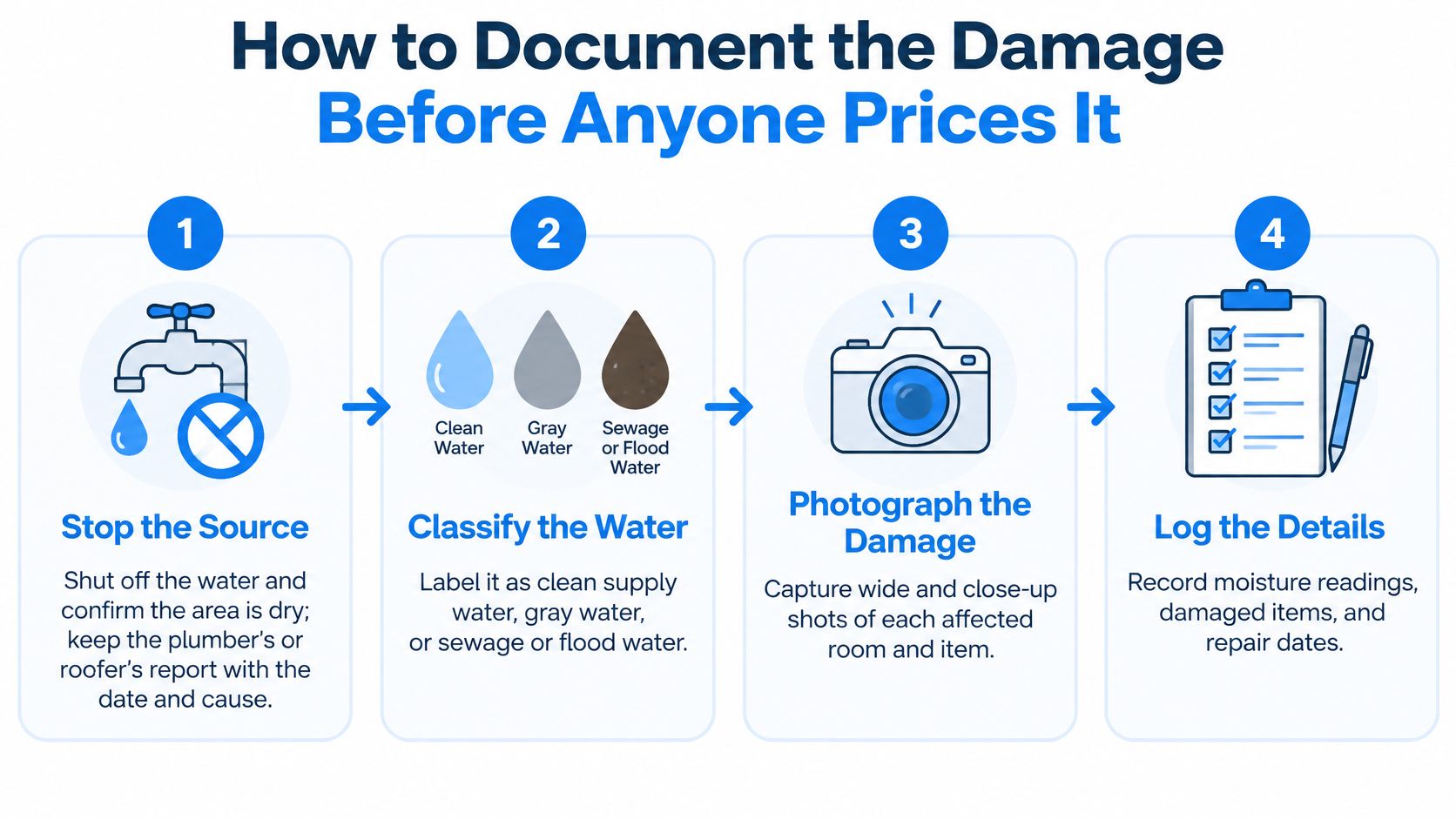
- Stop the source and prove it. Shut the supply, get the plumber or roofer to write the cause and the date on their report, and keep that page. A buyer's inspector wants to know the water stopped for a reason, not by luck.
- Classify the water. Clean supply water, gray water from an appliance, and sewage or flood water are three different jobs. The class decides what can be dried in place and what has to come out, so write it down before anyone starts pulling material.
- Photograph everything before demolition. Wide shot of each room, close-up of each affected assembly, then more photos of any wall cavity or subfloor opened during the work. Those cavity photos are the only proof you'll ever have of what was wet behind the finish.
- Log moisture readings until they're dry. Use a pin or penetrating meter on drywall, flooring, framing and subfloor, record the location and the reading each day, and keep the log. The EPA's brief guide to mold and moisture recommends drying wet materials within 24 to 48 hours, since mold generally won't grow in most materials dried in that window, while cautioning that mold may still develop even when drying happens inside 48 hours.
- Keep one folder. Invoices, drying logs, laboratory or clearance reports where they apply, permits and the full insurance claim file. Scattered receipts read as a scattered repair.
- Write a one-page timeline. Cause, discovery, response, repairs, in date order. An inspector who can follow the story stops inventing one.
Here's a walkthrough of what that documentation looks like in practice.
The patch that costs you at closing
The failure I'd warn you about is cosmetic repair over an uncorrected source. Someone skins new drywall over a damp cavity, paints it, and the room smells musty by the second showing. The buyer's meter finds the moisture, the inspector writes it up, and now you're negotiating a credit against a repair you already paid for once.
When drying stops being enough
If materials stayed wet beyond about 48 hours, or you can see mold, ordinary drying is no longer the right procedure. Porous materials such as saturated carpet, padding and some drywall may need removal rather than surface cleaning, and that's a remediation specialist's call, not a handyman's. Get it assessed before you list, because the assessment is a document you can show and a surprise is not.
Price the Repair Scope Without Underestimating It
Three numbers decide this sale, and most owners only have one of them. You need the as-is value, the repaired market value, and the total repair cost. The gap between the first two is what a repair can buy you. The third is what it costs, and it's almost always larger than the quote sitting on your counter.
A contractor's visible-repair quote prices what he can see. It rarely prices containment, the wet insulation behind the drywall, the subfloor under the cupped boards, or the six weeks of taxes and utilities you'll pay while the work runs.
| Cost item | Often missed? | Why it matters |
|---|---|---|
| Containment and negative-air controls | Yes, on mold or sewage jobs | Adds cost before any repair starts |
| Demolition beyond the visible area | Yes, insulation and subfloor | Wet framing often hides under finished surfaces |
| Drying equipment and monitoring | Sometimes | Equipment days add up when drying runs long |
| Mold testing and clearance | Yes | Buyers and lenders may require documentation |
| Permits and code upgrades | Yes | Older wiring or plumbing may need upgrading during repair |
| Temporary relocation | Yes | Household or tenant costs during the work |
| Carrying costs | Yes | Taxes, insurance and utilities while the house sits |
| Contingency reserve | Often skipped | Hidden damage often appears only after demolition |
Get scopes, not prices
Ask each bidder for a written scope, not a number. The EPA's remediation guidance for schools and commercial buildings identifies extraction vacuums, dehumidifiers and fans as appropriate measures for drying carpet and backing within 24 to 48 hours, and treats areas with mold growth or materials wet beyond that period as needing more extensive remediation. A scope that names containment, material removal, drying targets, antimicrobial use, reconstruction and permits is one you can compare against another. A line reading "water damage repair, turnkey" is not.
Get at least two independent bids on that same written scope. When the two come back apart, the difference usually sits in demolition extent or drying days, and asking each contractor to explain the gap teaches you more about your house than either quote alone.
Pricing rule: build your number from comparable sales of repaired homes, then subtract the full scope. Don't take an undamaged value and knock off a percentage. Percentage discounts hide the carrying costs entirely.
Compare offers on what lands in your account
Say a repaired house would sell for a strong retail number and the full scope, including permits, relocation, three months of carrying costs and a contingency, eats most of the difference from as-is value. In that case the repair isn't an investment, it's a purchase of a slightly better headline price with your own cash and your own risk.
Run every offer through the same filter: price, minus remaining repair obligations, minus closing costs and commissions, minus the carrying costs you'll pay until the actual closing date, minus any credit the buyer has already signaled. Then read the inspection rights and cancellation terms, because an offer that lets the buyer re-trade after a walkthrough isn't the same product as one that doesn't.
Disclosure Duties and Flood Records by Situation
Sellers routinely collapse three separate questions into one. Water-damage disclosure is what you tell a buyer about the condition and history of the house. Insurance history is what your carrier paid, denied or recorded. Flood-risk disclosure is about the property's exposure and location, and it follows different rules again. Answer them separately and your paperwork gets much easier to defend.
| Situation | Usually disclosed? | Records to keep |
|---|---|---|
| Active leak or moisture now | Yes, as a known defect | Current moisture readings and repair plan |
| Past water loss, repaired | Usually yes, as known history | Invoices, permits and post-repair test results |
| Mold found or suspected | Usually yes | Lab results and remediation or clearance reports |
| Flood or storm surge damage | Usually yes, and check flood-zone status | Flood claim file and flood-zone or elevation records |
| Insurance claim paid or denied | Disclose the loss; confirm details with an attorney | Claim letters and adjuster report |
| Damage before you owned the home | Depends on what you knew | Prior seller disclosures and inspection reports |
Flood history is its own question
Buyers ask about flooding more than they used to, and for good reason. NOAA's billion-dollar disaster records show the United States experienced 26 billion-dollar flood events from 2010 through 2024, compared with 19 combined across the 1980s, 1990s and 2000s. A buyer who has watched that pattern will ask whether your event was internal or external, and whether the address sits in a mapped hazard area.
State rules don't line up. Research cited in iBuyer's guide to disclosing water damage when selling a house indicates only 29 U.S. states have some form of flood-disclosure requirement, while 21 states have none. That's a reason to check your own state's rule rather than assume the advice you read online applies to you.
Fixed doesn't mean irrelevant
A professionally remediated event with permits, invoices and post-repair verification is usually easier to sell than a repair nobody documented. The history isn't the problem. The absence of evidence is.
There's also a difference between what the law requires you to volunteer and what a buyer, insurer, lender or title professional can find on their own. Claim histories, permit records and prior listings surface without your help. When your disclosure says less than the file shows, you've handed the buyer a reason to renegotiate or walk, and possibly a claim after closing.
Take the folder to a real-estate attorney or licensed agent and have them review the disclosure wording before you sign a contract, not after.
Choose Your Route and Request a Cash Offer
You don't need more research. You need a route, a packet and two real offers you can put side by side.

- Pick the route that matches your constraint. Cash on hand, time available and the insurance answer sort you into one row. Write the row down and commit to it, because half-repaired houses with vague disclosures are the ones that stall.
- Assemble the packet. One-page timeline, photos including cavities, moisture log, invoices, permits, draft disclosure and the claim file. Scan it into a single PDF so you can send it in one attachment the moment someone asks.
- Vet the buyer before you accept anything. Confirm licensing where your state requires it, ask for proof of funds, check references and complaint history, and treat any request for upfront fees as a warning sign. A cash offer is only as good as the buyer's ability to fund it on the date promised.
- Request written offers from at least one cash buyer and one retail agent. Then compare net proceeds, inspection rights, closing date and cancellation terms rather than the number at the top of the page.
We're one of the cash buyers you can put in that comparison. Selling to us has three steps: tell us about the property, get a fair cash offer, and pick your closing date. We review the property and local sales, then present a no-obligation cash offer, and our cash home buying process runs through a title company rather than around one. The average time from the property being sold to closing with us is 7 to 14 days, which matters when a job start date or a probate deadline is driving the decision.
Submitting your information doesn't obligate you to sell, and it doesn't obligate us to buy. That's the point of getting the offer in writing early: it gives you a firm floor to measure the repair-and-list route against, with no commitment attached. If the retail number beats it after carrying costs and credits, list the house. If it doesn't, you already know.
I'd spend this week on the folder, not on the paint. Get the moisture log current, chase the plumber's written cause-and-date report, pull the claim letters, and write the timeline while the dates are still fresh. Then send the same packet to a cash buyer and an agent and ask both for terms in writing.
We buy houses as-is, so a wet subfloor, a stained ceiling or an open insurance claim doesn't disqualify your property from an offer. Send us the address and whatever documentation you've gathered, and we'll review the house and local sales and give you a no-obligation cash offer you can hold next to a repair estimate. Visit Cyber Homes to start, and pick your own closing date if the numbers work for you.

Edited by
James Vasquez
Real Estate Investor & Land Specialist with 10+ years experience in residential flipping, vacant land investing, land wholesaling, and subdivision deals.
Disclaimer: The information provided is for educational purposes and does not constitute financial or legal advice. Always consult with licensed professionals before making investment decisions.