Selling an Inherited Property in Oklahoma City, OK (2026)

A family member has died, the Oklahoma City house is vacant, and everyone wants to know the same thing: can we sell it now, and who is allowed to sign? Selling an inherited property in Oklahoma City, OK, is possible, but the first step isn't choosing an agent or accepting a cash offer. You must confirm who has legal authority to sell, how title passed, and whether probate or additional title work is required.
The right sale strategy also depends on the home's condition, the number of heirs, carrying costs, and the evidence supporting its tax basis. A fast as-is sale may reduce uncertainty, while an MLS listing may produce stronger gross proceeds if the property is marketable and the family can manage repairs, showings, and delays.
Updated for 2026. This article is general information, not legal or tax advice. Estate authority, title requirements, disclosure duties, and tax treatment should be confirmed with qualified Oklahoma professionals.

Get a cash offer for your home
Confirming Legal Authority to Sell the Home
Suppose a parent dies owning a house in Oklahoma City solely in their name. A child may be the only person named in the will, but that doesn't automatically give the child authority to sign a listing agreement or deed. The property generally becomes a probate asset, and the district court process determines who receives it, resolves creditor and tax claims, and authorizes distribution to heirs or beneficiaries. The Oklahoma Bar Association explains that a straightforward estate normally takes six to 12 months to administer, although disputes, creditor issues, missing heirs, property condition, and court requirements can change the schedule. Oklahoma Bar Association probate guidance
Identify the person who can sign
The correct signer depends on the ownership structure and the documents already in place:
- Executor: If there's a valid will, the court may appoint the named person as personal representative. The executor's authority comes from the court appointment and applicable estate documents, not merely from the name printed in the will.
- Administrator: If there's no will, or the nominated executor can't serve, the court may appoint an administrator. That administrator handles estate property and follows the court's requirements for a sale.
- Trustee: A home owned by a revocable living trust is generally handled by the trustee under the trust terms, outside ordinary probate administration.
- Surviving owner: Joint ownership with survivorship rights may transfer the property to the surviving owner without probate for that parcel. The deed must be reviewed carefully before anyone assumes survivorship exists.
- Transfer-on-death beneficiary: A properly recorded transfer-on-death deed may pass the property outside probate, but the beneficiary still has to complete the required post-death recording steps.
- Multiple heirs: If the property has been distributed to several heirs, those owners may need to act together unless an agreement, power of attorney, court order, or other valid arrangement permits a different process.
A listing agent can market a property, but marketing isn't the same as conveying title. A buyer, lender, title company, or closing attorney may require letters of appointment, a court order, a decree of distribution, recorded beneficiary documents, or proof of survivorship before insuring the transfer.
Practical rule: Don't sign a binding purchase contract until a title company or Oklahoma estate attorney confirms who has authority to sell and what conditions must be satisfied before closing.
Secure the house, maintain appropriate insurance, preserve records, and avoid distributing personal belongings until the representative or all affected owners agree. Those basic steps protect the estate while the title question is being resolved.
Navigating Oklahoma Probate and Title Requirements
Probate is the court-supervised process used to validate a will when necessary, identify heirs, protect assets, address valid debts and taxes, and distribute property. A house titled only in the deceased owner's name generally needs probate or another legally effective title-clearing route before a buyer can receive marketable title. That doesn't mean every sale must wait until the entire estate is closed. A personal representative may be able to sell during an open administration if the appointment, authority, court requirements, and title-insurance conditions are satisfied.
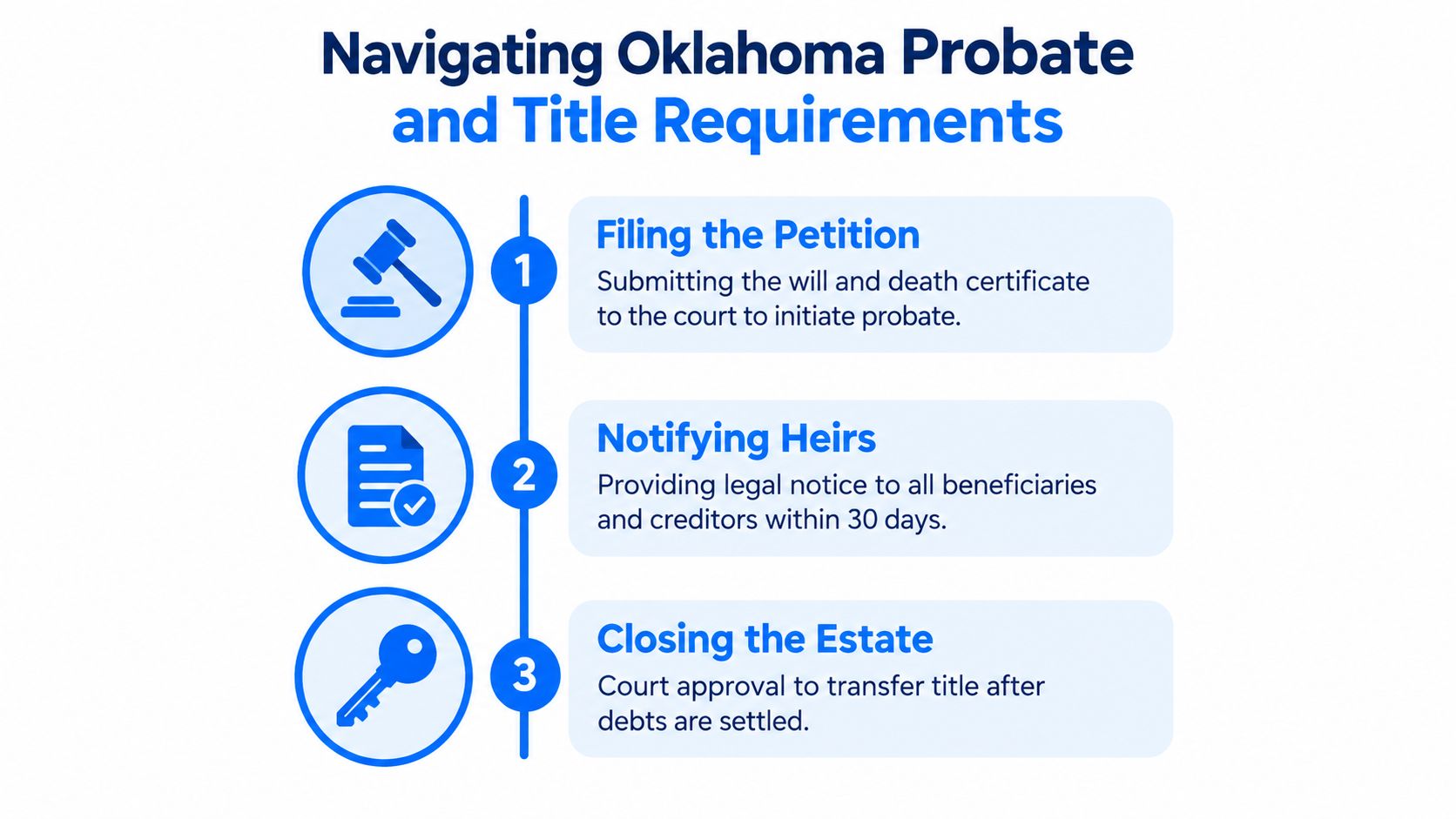
Match the property to the correct transfer path
Start with the deed and the estate documents, not assumptions about the family relationship.
- A will-based or intestate transfer generally requires a personal representative and court documentation when the property was solely owned by the decedent.
- A living trust may allow the trustee to handle the property under the trust terms.
- Joint ownership with survivorship can transfer the parcel to the surviving owner outside probate.
- A transfer-on-death deed can pass the real estate to the named beneficiary outside conventional probate.
- A tenancy-in-common interest generally remains part of the deceased owner's estate because the interest doesn't automatically pass to the other owner.
Oklahoma's transfer-on-death rules require particular attention. For an owner who died after November 1, 2011, a named beneficiary generally must record an affidavit claiming the interest and proof of death with the county clerk in the county where the property is located within nine months of the owner's death. If the filing isn't completed within that period, the property can revert to the estate and require probate. Oklahoma Bar Association explanation of when probate may be needed
The statute also requires review of the recorded deed, the beneficiary affidavit, the death certificate, marital information, and the property's legal description. A beneficiary who believes the transfer happened automatically may still lack the recorded evidence a title company needs.
Plan around the actual timing
The Oklahoma Bar Association identifies approximately six to 12 months as a normal administration period for a straightforward estate. That isn't a promise, and a pending sale can take longer when heirs disagree, creditors file claims, ownership is unclear, or the court requires additional proceedings.
The practical question is whether the personal representative can establish authority early enough for the chosen buyer and title company. A probate property sale may proceed during administration, but the contract should account for court approval, title objections, required notices, and the possibility that the estate cannot deliver clear title by the originally proposed closing date. For a broader overview of the sale process, see this guide to selling a home in probate.
This video provides another general visual explanation of probate-sale mechanics:
Essential Documents for Closing an Estate Sale
A title company doesn't rely on a family's understanding of who inherited the house. It follows the recorded chain of title and asks for documents proving death, authority, ownership, lien status, and the identity of the person signing. Gathering the file before marketing the property reduces the risk of accepting an offer that can't close.
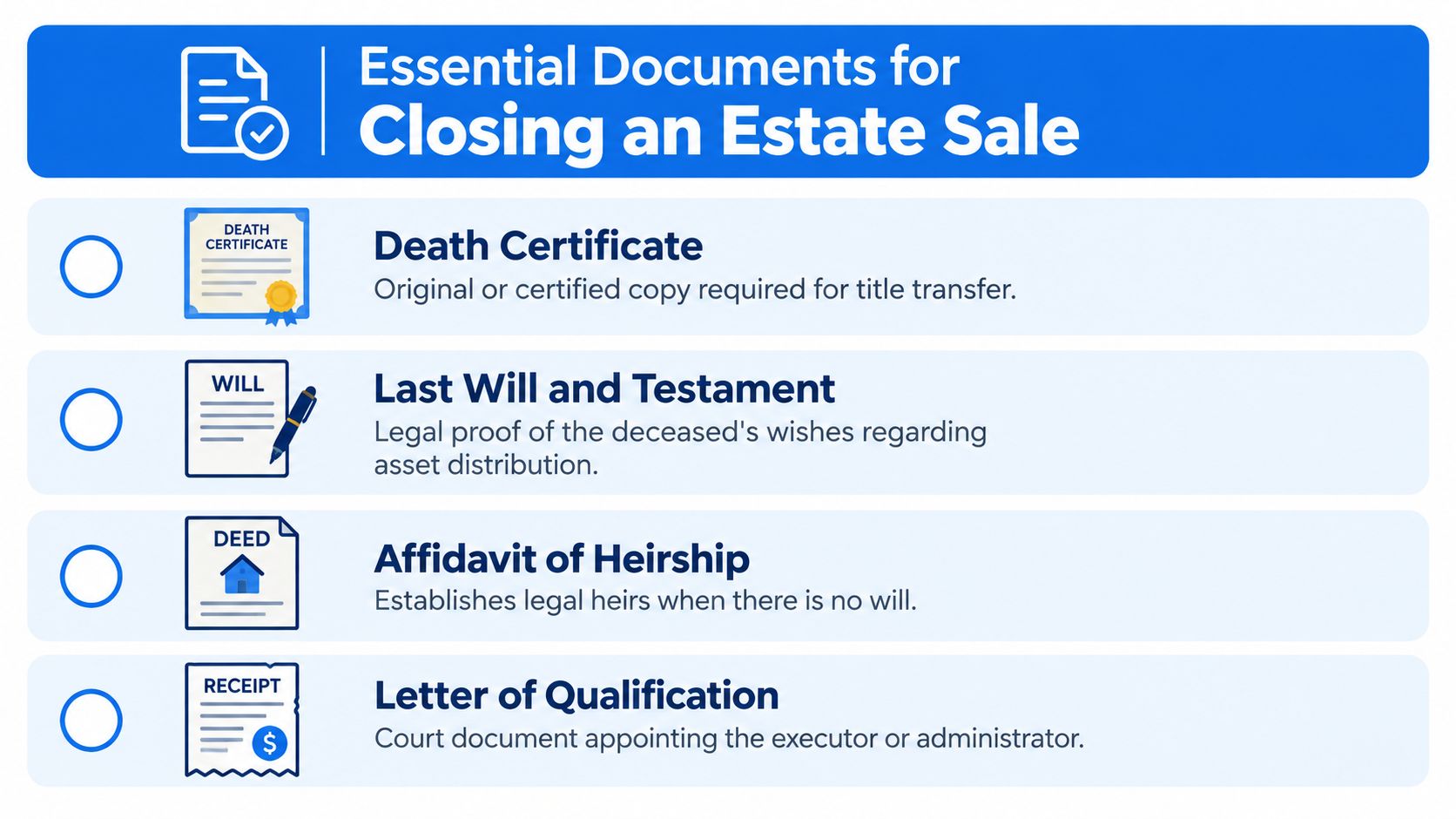
Build the estate-sale file
Use this checklist as a starting point:
- Death certificate: Obtain the original or a certified copy in the form the title company requires.
- Will or trust: Gather the complete will, trust, amendments, and any document identifying beneficiaries or successor trustees.
- Court appointment documents: Collect Letters Testamentary, Letters of Administration, or other documents appointing the executor or administrator.
- Deed and title records: Locate the most recent deed, legal description, prior conveyances, and any survivorship or transfer-on-death language.
- Property-tax records: Check current tax status, delinquency, exemptions, and any notices from the county assessor or treasurer.
- Mortgage payoff statement: Request a current payoff, including instructions for obtaining an updated figure close to closing.
- HOA or condominium records: Obtain account status, dues, restrictions, resale requirements, and any balance or lien information if applicable.
- Insurance records: Preserve the policy, claim history, vacancy notifications, and correspondence with the insurer.
- Repair and improvement records: Keep invoices, permits, contractor agreements, and receipts that may support pricing, title review, or tax reporting.
- Lien information: Identify judgments, utility balances, unpaid contractor claims, federal or state claims, and other recorded encumbrances.
- Identification: The personal representative, trustee, surviving owner, or heirs signing closing documents will need government-issued identification.
Verify how the property was titled
The Oklahoma County deed-transaction search can be searched by tax year, deed type, account type, building description, and whether the property is vacant or improved land. It can help an heir or out-of-state administrator locate a recorded deed and understand how the property appears in county records.
That search isn't a substitute for a title examination. Ask the title company to order a title commitment and identify requirements before you spend money on repairs or commit to a closing date. The title commitment may reveal an old mortgage, an unreleased lien, a missing conveyance, an incorrect legal description, or a probate document that still needs to be recorded.
Get a cash offer for your home
Comparing Listing, As-Is, and Cash Offer Strategies
The best way to compare selling methods is to compare net proceeds and execution risk, not just the highest stated price. Oklahoma City indicators describe a more selective 2026 market. One market report lists a $280,000 median sale price, 7,773 homes in inventory, 57 days on market, 4.5 months of supply, and a 96.5% sale-to-list ratio. Oklahoma City housing-market report Realtor.com data cited in the same context reports roughly 3,595 active listings, a $265,000 median listing price, 53 median days on market, and listings up 10.4% year over year. Realtor.com Oklahoma City market data
Those figures don't predict what your inherited house will sell for. They do show why a family should calculate vacancy, insurance, utilities, lawn care, cleanup, repairs, commissions, concessions, mortgage payments, tax arrears, and possible price reductions before comparing an MLS price with a cash offer.
Three practical paths
Traditional agent listing usually fits a clean, financeable home where maximizing market exposure matters and the family can tolerate preparation, showings, inspections, appraisal issues, and a buyer's financing timeline. It may produce a stronger gross price, but the relevant figure is the written estimated net sheet.
As-is MLS listing can work when the home needs repairs but still has features that attract owner-occupants or investors through broad buyer exposure. “As-is” doesn't eliminate ownership, title, lien, or disclosure issues. It generally means the seller isn't promising to complete repairs, not that the buyer or title company accepts unresolved legal problems.
Direct cash sale can be useful for severe deferred maintenance, inherited clutter, vacancy concerns, urgent administration, or a family that values a defined closing process. The trade-off is often a lower price in exchange for convenience and fewer repair-related contingencies. Compare the offer with proof of funds, identify every deduction, and confirm who pays title, closing, recording, or other charges.
| Selling Method | Estimated Timeline | Repair Requirements | Best For |
|---|---|---|---|
| Traditional agent listing | Depends on preparation, buyer demand, contract terms, and closing conditions | Usually selective preparation or repairs | A marketable home where broad exposure and price are priorities |
| As-is MLS listing | Depends on market response and buyer financing | Limited seller repairs, but condition must be described accurately | A home needing work where the family still wants MLS exposure |
| Direct cash buyer | Depends on title readiness, due diligence, and agreed closing date | Often no repairs before closing | A property with major repairs, clutter, vacancy, or a need for simpler execution |
A useful comparison extends beyond the house. If the estate also contains valuable personal property, document its condition and ownership separately. Families handling inherited contents may benefit from learning how to obtain a fair appraisal for inherited jewelry before distributing or selling those items.
For additional due diligence, review this resource on companies that buy houses for cash in Oklahoma. Any buyer should provide written terms, explain the inspection period, identify title and closing responsibilities, and let the seller consult independent professionals.
Create a break-even worksheet with two columns. Under “MLS,” include preparation, cleaning, repairs, utilities, insurance, lawn care, commissions, concessions, holding time, and possible price reductions. Under “cash,” include the offered price, stated deductions, payoff amounts, and any estate or title costs. The correct choice is the one that produces the clearest acceptable net result for the people authorized to decide.
Understanding the Step-Up in Basis and Tax Implications
An inherited home can appear to have a large gain on paper when the family compares its sale price with the decedent's original purchase price. Federal tax law generally resets the property's basis to its fair market value on the date of death under Internal Revenue Code § 1014. Capital gain or loss is generally measured from that date-of-death value, the sale price, allowable selling expenses, and later adjustments such as qualifying improvements. See the IRS guidance on basis in inherited property.
A simple example
Assume a qualified appraisal places the home's date-of-death value at $300,000. The estate later sells it for $315,000, with $15,000 in allowable selling costs. The approximate gain may be zero before later improvements or other adjustments, because the net sale amount is about $300,000.
That calculation is only an example, not a guaranteed tax result. The appraisal should be defensible, and every expense should be documented. A quick sale below the appraised value may reflect deferred repairs, limited market exposure, carrying costs during probate, or the buyer's assessment of as-is risk. Keep records explaining why the accepted offer differs from the valuation.
Keep the evidence
Retain:
- The appraisal or other qualified valuation dated as close as possible to death.
- The closing statement from the sale.
- Invoices for improvements and significant repairs.
- Cleanup, legal, appraisal, and transaction-cost records.
- Mortgage, tax, insurance, and lien payoff information.
- Estate documents showing how the property passed to the seller.
Tax exposure may also involve property-tax balances, liens, closing costs, and federal reporting questions. Inheriting a house does not automatically create an immediate tax bill, while selling quickly does not remove every obligation. Oklahoma and federal treatment depends on the estate, the seller, the property, and the transaction.
A CPA or other tax professional should review the sale when the value, possible gain, estate complexity, or family tax exposure is significant. Obtain that review before accepting an offer if the appraisal is weak, improvements are extensive, the transfer involves a related party, or unusual selling expenses may affect the reported result. Carrying costs during a delayed sale can reduce the estate's net proceeds even when the eventual tax calculation is favorable.
Get a cash offer for your home
Managing Disagreements Among Multiple Heirs
Multiple heirs rarely disagree only about price. One person may want the house sold immediately, another may want repairs, and another may be using the property or sorting sentimental belongings. Those differences become expensive when nobody records decisions and the house remains vacant while taxes, insurance, utilities, maintenance, and security continue.
Start with a written decision process. Identify who has legal authority, list the issues requiring consent, set deadlines for responses, and keep the discussion in email or a shared estate file. A neutral valuation can separate the question “what is the house worth?” from “what should we do with it?”
Resolve the practical disputes first
Use a short written agreement covering:
- Whether the house will be listed, sold as-is, or offered directly to cash buyers.
- Which repairs, cleanup, inspections, and appraisals the estate will fund.
- Who may enter the property and remove personal belongings.
- How storage, utilities, insurance, lawn care, and emergency repairs will be paid.
- How offers will be reviewed and how each decision will be documented.
- How sale proceeds will be held and distributed after liens, expenses, and estate obligations are addressed.
If one heir is living in the home, address possession and expenses directly. Don't change locks, remove belongings, or shut off essential services as a pressure tactic. A surviving spouse may have occupancy rights that affect the property, and the title or probate structure may impose obligations that aren't obvious from the will alone.
Use local resources before conflict hardens
The Oklahoma County court clerk and district court resources can help the personal representative identify filing requirements and court procedures. Oklahoma County's 2025 summary of court costs lists a proceeding for the sale or lease of real or personal property in probate at $92.89, but that is only one identified court charge. An estate may also incur filing, publication, appraisal, title, attorney, recording, and other administration costs. Oklahoma County court-cost summary
Oklahoma City homes can also raise practical property questions involving foundation movement, storm damage, roof condition, drainage, insurance availability, and neighborhood or condominium rules. Ask the listing agent, inspector, title company, and HOA for the documents relevant to the particular property rather than assuming one answer applies throughout the city.
If direct negotiation fails, consider an Oklahoma estate attorney or mediator before filing a contested action. A partition dispute may ultimately lead to a court-ordered sale, but litigation adds time, expense, and uncertainty. Guidance on selling inherited property with multiple owners may help families identify the questions to address before choosing that route.
Answers to Common Inherited Property Questions
Can I sell an inherited house before probate is complete? Often, yes, if the personal representative has authority, the court requirements are satisfied, and the title company will insure the transaction. A will alone isn't enough.
Do all heirs have to agree to sell? It depends on who owns the property and whether it remains an estate asset. If several heirs hold title together, all required owners generally must participate or an authorized legal process must be used.
Can an executor sell an inherited house? An executor may be able to sell during estate administration, subject to the will, court authority, creditor issues, and title requirements.
Can I sell an inherited house as-is? Yes, but as-is doesn't remove title, lien, disclosure, or authority obligations.
What happens if the inherited home has a mortgage? The loan and property taxes must be addressed at or before closing. Request a payoff statement and notify the lender or servicer about the death and estate process.
Do I have to pay taxes when I sell inherited property? Potentially. The date-of-death basis may limit capital gain, but the result depends on valuation, selling costs, improvements, and your tax circumstances.
What documents are needed to sell an inherited house? Expect to provide a death certificate, will or trust, court appointment documents when applicable, deed, tax records, mortgage payoff, lien information, insurance and repair records, and identification.
Can an out-of-state heir sell remotely? Often, yes. The title company and closing attorney can explain acceptable signing, notarization, and identification procedures, but Oklahoma title requirements still apply.
How long does it take to sell a probate property? A straightforward Oklahoma estate normally takes six to 12 months to administer according to the Oklahoma Bar Association, while a sale may occur before final closure if authority and title requirements are met.
Should I use an agent or accept a cash offer? Compare written net proceeds after repairs, carrying costs, commissions, concessions, title charges, and expected delay. Convenience is valuable, but it shouldn't prevent you from checking proof of funds and every deduction.
Before signing a listing agreement or purchase contract, confirm estate authority, title requirements, mortgage and lien status, and tax questions with qualified Oklahoma professionals.
Cyber Homes offers a direct cash option for inherited Oklahoma City houses, including properties sold as-is without repairs, showings, or commissions, with a closing date selected with the seller. If that approach fits the estate's needs, visit Cyber Homes to request an evaluation and compare the terms with an agent's written net sheet.

Edited by
James Vasquez
Real Estate Investor & Land Specialist with 10+ years experience in residential flipping, vacant land investing, land wholesaling, and subdivision deals.
Disclaimer: The information provided is for educational purposes and does not constitute financial or legal advice. Always consult with licensed professionals before making investment decisions.