Selling an Inherited Property in Boise, ID: 2026 Guide

You can sell an inherited Boise property, but you must first confirm who has legal authority to sign and whether probate paperwork is ready. Boise's real median owner-occupied housing value was $278,300 for 2017–2021, and that value rose 89.8% from 1980 to 2017–2021, so an inherited home may represent a substantial asset that deserves careful valuation before a sale. (Indicators Idaho)
A call about a parent's house rarely arrives at a convenient time. You may be grieving, coordinating with siblings in different states, sorting personal belongings, and wondering whether you can just hire an agent and put the property on the market.
You can sell an inherited property in Boise, ID, but the first question isn't marketing. It's who has authority to sign the listing agreement, purchase contract, and deed. Depending on how the property was owned, that person may be an executor, administrator, trustee, surviving owner, or the heirs themselves. A buyer's speed and an attractive offer won't cure missing authority or a defective title.

Get a cash offer for your home
Navigating the Early Steps of an Inherited Sale
A family may be ready to sell a Boise house while the title still prevents anyone from signing. Start with the recorded deed, not an old will or a relative's recollection. The deed can show whether the deceased owned the property alone, with a spouse or joint tenant, through a trust, or under survivorship rights.
That distinction determines the sale process. An individually owned home generally requires probate to transfer title, address creditor claims, and establish the signer's authority. Ada County recognizes informal probate as one possible route when the decedent owned real property. Formal probate may be required if the title is unclear, heirs disagree, or the estate presents procedural complications. Review the Ada County probate information before choosing a filing path.

Identify the person who can convey title
The signer depends on how ownership transferred:
- A will and executor: The person named in the will usually must be appointed by the probate court before acting for the estate. Letters testamentary provide evidence of that authority.
- No will and administrator: In an intestate estate, the court appoints an administrator. Letters of administration show that the administrator can act.
- Living trust and trustee: A successor trustee may sell trust-owned property under the trust terms, subject to the title company's review.
- Joint ownership or survivorship rights: A surviving owner may receive the deceased owner's interest outside ordinary probate if the deed created valid survivorship rights. Idaho recognizes joint tenancy and community property with a right of survivorship, as explained by the Idaho State Bar on real-estate joint tenancy.
- Transfer-on-death deed: A properly recorded deed may transfer the property to its named beneficiary outside probate. Confirm the recording history before relying on it.
- Multiple heirs: Several beneficiaries may own the property together, or a personal representative may retain control. One heir generally cannot sell the entire house alone.
Do not sign a listing agreement or accept an offer until an Idaho probate attorney or title officer confirms who can sign the contract and deed. A strong offer cannot cure missing authority, unreleased liens, or a defective title.
Establish value early as well. The deceased owner's purchase price does not determine today's sale decision. Obtain a current market analysis or appraisal, and preserve evidence of the date-of-death value for estate and tax records. Ada County assessment records show assessment years, valuations, and tax-district information, but an assessment is not a substitute for an independent appraisal or current market analysis.
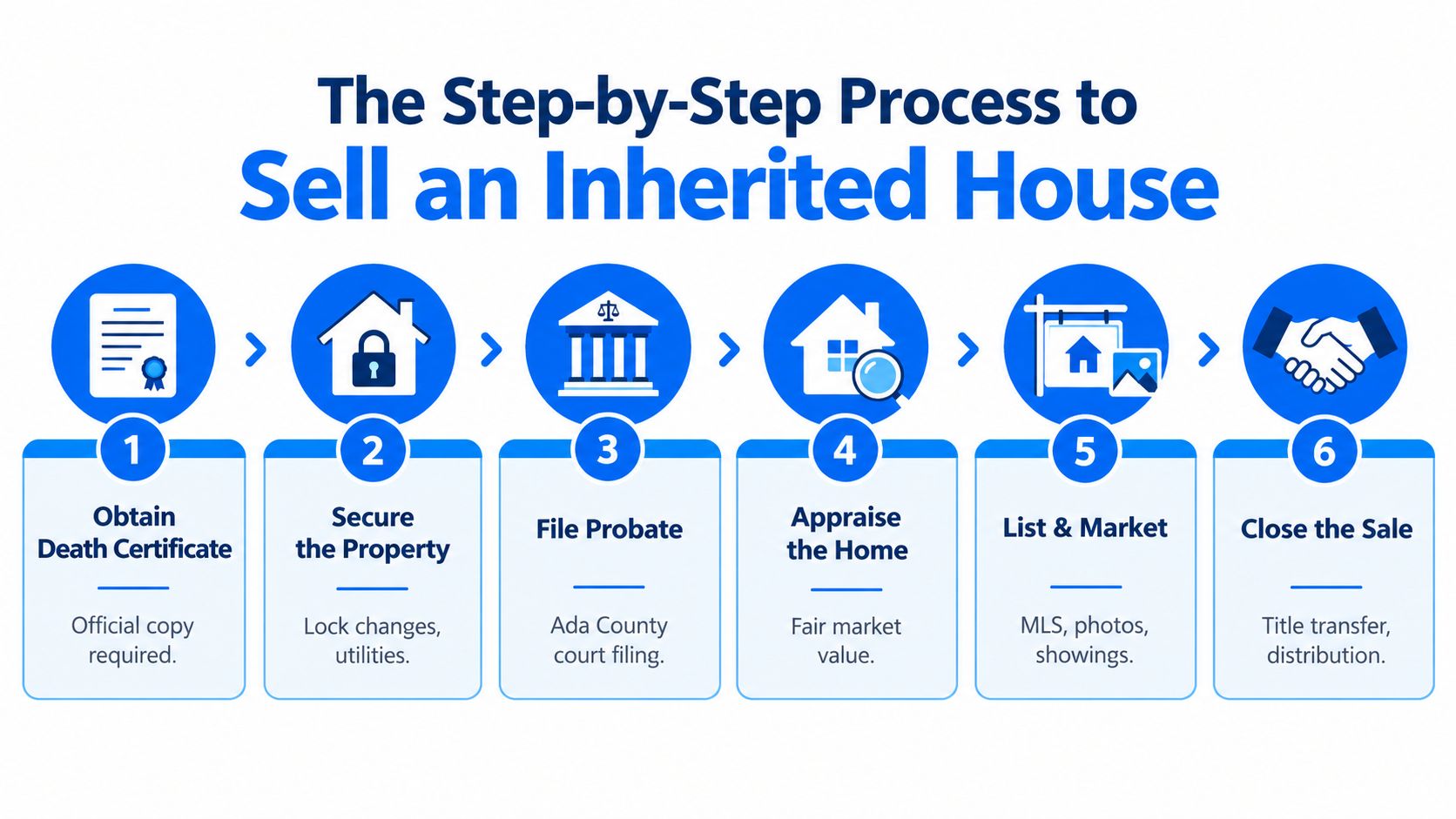
The Step-by-Step Process to Sell an Inherited House
A probate house sale moves more smoothly when the family handles the legal and physical work in the right order.
-
Secure the property. Change locks when appropriate, check for leaks or winter damage, arrange lawn and snow care, and keep utilities operating when needed. Tell the insurer that the home is vacant or inherited. Vacant-property coverage may require specific conditions, so ask before assuming the existing policy is sufficient.
-
Gather records. Find the deed, death certificate, will or trust, mortgage information, property-tax notices, insurance records, utility bills, repair invoices, and HOA correspondence. Photograph the home and its contents before removing personal property.
-
Confirm ownership and authority. Determine whether the home is individually owned, jointly owned, community property, trust-owned, or subject to a transfer-on-death deed. If probate is required, confirm the appointed personal representative and obtain the court documents that establish authority.
-
Open or verify probate. Ada County's public-administration guidance explains that real property may be appraised and listed through a private realtor sale or auction when the estate is handled by a public administrator. Idaho probate guidance also states that the personal representative must prepare an inventory within three months of appointment and include each asset's fair market value as of the date of death. (Ada County public-administration guidance)
-
Order title work. Ask a title company to search for mortgages, unpaid property taxes, liens, judgments, HOA balances, probate filings, and ownership defects before you set a firm closing date.
-
Choose the sale method. Compare a traditional listing, an as-is MLS listing, and direct offers. Estimate repairs, carrying costs, commissions or other selling expenses, and the likely net proceeds rather than focusing only on the headline price.
-
Close and distribute funds correctly. The title company prepares closing documents and pays approved obligations from the transaction as required. Sale proceeds should generally remain in the estate or trust account until creditor, tax, and beneficiary obligations are addressed.
Families also need a plan for belongings. If the home must be emptied, separate sentimental items, documents, hazardous materials, and ordinary household goods before hiring a removal company. A practical Get n Go Removals Melbourne guide can help with general relocation and removal planning, even though your Idaho title and probate requirements remain local.
Required Documents and Title Clearing in Ada County
An inherited house can look ready for market while its title remains unsellable. A title company needs proof of who may sign, how ownership passed, and whether debts or defects must be resolved first. Build the file early and request a property-specific checklist from the title officer.
Working document checklist
Prepare copies of:
- Death certificate: Obtain the official version requested by the court or title company.
- Will or trust: Include amendments, schedules, and successor-trustee provisions.
- Court appointment documents: Keep letters testamentary, letters of administration, and relevant probate orders together.
- Recorded deed: Confirm how the decedent held title and whether survivorship language applies.
- Property-tax records: Include current statements and any unpaid balances.
- Mortgage payoff statement: Get the lender's payoff amount and release requirements.
- HOA documents: Gather dues statements, resale requirements, transfer charges, and violation notices.
- Insurance records: Include the policy, claims history, and vacancy-related communications.
- Repair and improvement records: Preserve invoices, permits, contractor details, and receipts.
- Lien and title information: Identify judgments, claims, easements, and prior releases.
- Government-issued identification: The personal representative, trustee, surviving owner, or other authorized seller will need valid identification.
Ada County recognizes informal probate as one route and formal probate as an option for more complicated estates. The governing framework includes Idaho Code sections 15-1-101 through 15-3-1205, available through the Idaho Code probate provisions.
The title company may require the probate case number, appointment documents, death certificate, recorded orders, and a deed signed in the correct fiduciary capacity. A personal representative cannot sign just because the family agrees. Authority must appear in the court record or governing estate documents.
Multiple heirs create another common title problem. The company may request evidence of heirship, written consents, or releases, particularly when the deed, will, and family relationships do not align. Resolve those questions before accepting a closing date.
For a plain-language explanation of the broader process, read this guide to selling a home in probate. Use it for general education, then follow the Ada County court record and your Idaho title officer's requirements for the actual sale.
Choosing the Right Selling Strategy, Repair, As-Is, or Cash
Inherited homes often need a decision before they need a contractor. The right path depends on condition, family capacity, urgency, and whether maximizing the sale price matters more than reducing work.
Selling Strategy Comparison
| Strategy | Best For | Effort Level | Potential Proceeds |
|---|---|---|---|
| Traditional agent listing | A home in good condition where broad buyer exposure and price are priorities | Higher | Potentially strongest retail proceeds, before selling expenses |
| As-is MLS listing | A home needing work where the family still wants open-market exposure | Moderate | May attract a wider range of buyers than a direct sale |
| Direct cash buyer | Major repairs, inherited clutter, difficult access, or a need for a simpler closing | Lower | Convenience may come with a lower offer |
A traditional listing usually makes sense when the property is clean, functional, insurable, and easy for conventional buyers to finance. An agent can coordinate photography, showings, offer comparisons, inspection negotiations, and disclosure paperwork. The tradeoff is preparation, ongoing access, and the possibility of repair requests or financing delays.
An as-is MLS listing can be a sensible middle ground. The family markets the property broadly but avoids promising repairs. “As-is” doesn't mean “hide defects.” Sellers still need to handle known property-condition and title issues accurately, while the estate representative should distinguish known facts from matters they never observed personally. For practical guidance on the mechanics, see this resource on selling a house as-is.
A direct cash offer can fit a house with severe deferred maintenance, abandoned belongings, or an out-of-state family that can't manage repeated showings. Compare more than the price. Check proof of funds, inspection or cancellation rights, closing conditions, title-company arrangements, and the buyer's willingness to work with probate authority.
A cash offer solves a marketing problem. It doesn't solve an authority problem.
If the exterior needs attention before photography, keep the work modest and functional. Basic cleanup, safe access, and removal of obvious hazards usually matter more than an expensive redesign. For visual planning before spending money on improvements, an AI front yard design tool may help you evaluate possibilities, but don't invest estate funds until the authorized representative and beneficiaries agree.
Get a cash offer for your home
Understanding Taxes, Costs, and Market Value
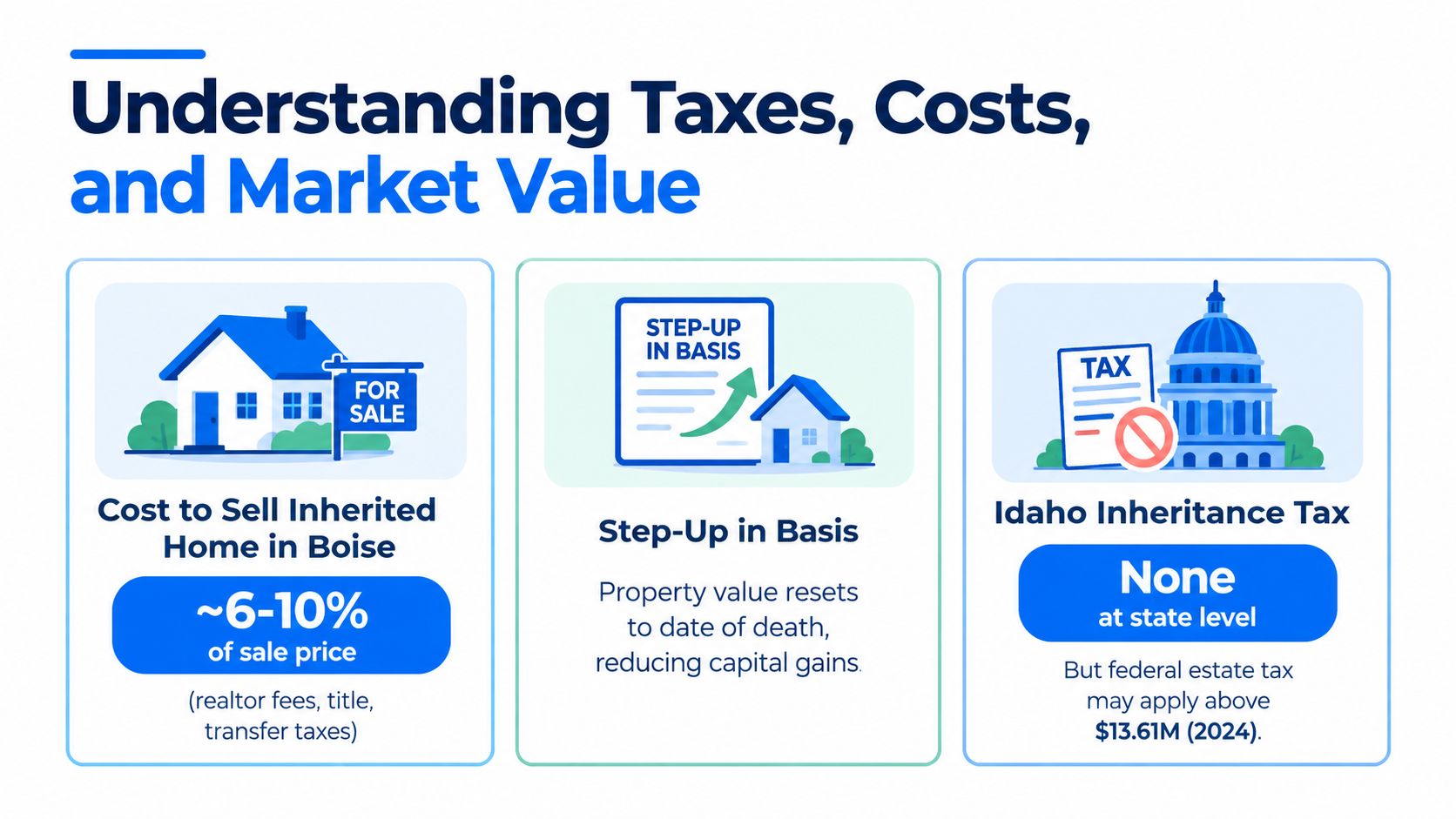
For an inherited Boise home, the tax analysis starts with its value on the owner's date of death, not the original purchase price. Federal law generally sets the property's basis at its fair market value on that date under Internal Revenue Code Section 1014(a)(1), subject to applicable alternate-valuation rules. That documented basis can determine whether a later sale produces a taxable gain.
The step-up in basis
Suppose an appraisal places the home's date-of-death value at $400,000. If the estate later sells it for $425,000, the gain calculation generally begins with the $400,000 inherited basis, then accounts for eligible improvements, selling costs, and other allowable adjustments. The relevant comparison is the supported inherited value, not what the deceased owner paid decades earlier.
This example is only a starting point. The result can change based on ownership structure, valuation method, estate records, improvements, selling expenses, tax elections, and whether the property is held by a trust or estate. Preserve the appraisal or broker valuation, repair invoices, improvement records, and final closing statement. Those records support both the tax filing and the estate's accounting.
Idaho has no inheritance tax, and its estate tax expired in 2004, according to the Idaho State Tax Commission (Idaho estate and inheritance tax information). A sale can still create federal or Idaho capital-gain reporting, while the estate may have separate fiduciary filing duties. Idaho's capital-gains instructions state that the deduction is calculated from qualifying capital-gain net income included in federal taxable income, with basis governed by applicable federal Internal Revenue Code rules (Idaho Form CG instructions).
Costs that affect the net
Calculate the expected net proceeds before accepting an offer. Include:
- Mortgage payoff and property taxes: Bring these accounts current or pay them through closing.
- Liens and judgments: Unresolved title claims can reduce proceeds or stop the sale.
- Repairs and cleanup: Spend estate funds only with approval from the authorized representative.
- Sale-related charges: Review title, escrow, recording, brokerage, and other settlement fees.
- Ongoing ownership costs: Insurance, utilities, maintenance, and HOA obligations continue while the property remains unsold.
Market conditions help set an asking price, but they do not establish the home's tax basis or prove that an offer is fair. Use a property-specific appraisal or broker market analysis that reflects condition, location, comparable sales, and needed work. A listing price is marketing evidence, not tax documentation.
Handling Multiple Heirs and Property Disagreements
Families rarely disagree only about price. One sibling may want to repair the kitchen, another may want to sell immediately, and a third may still be sorting personal belongings. Those differences become expensive when nobody records the decision-making process.
Set a written protocol before listing:
- Name the decision-maker: Identify the personal representative, trustee, or co-owners with legal authority.
- Agree on valuation: Use an appraisal or market analysis rather than an emotional estimate.
- Set repair limits: Approve a specific scope and spending authority before work begins.
- Create a response process: Decide how quickly beneficiaries must review offers and who communicates with buyers.
- Record distributions: Keep proceeds in the estate or trust account until obligations are resolved.
If one heir wants to keep the home, a buyout may be cleaner than forcing a sale. Establish the value independently, calculate each ownership interest under the estate documents or applicable law, and document financing and transfer terms.
Family rule: Put important decisions in writing before the first serious offer arrives.
A personal representative owes duties to the estate and its interested parties. That doesn't mean every beneficiary gets an absolute veto over every administrative act, but it does mean the representative should not favor one heir, conceal information, or distribute funds before obligations are handled. If family members cannot agree, consult an Idaho estate attorney or mediator before threats, self-help actions, or unilateral contracts escalate the dispute.
The Idaho State Bar's probate materials recognize heirship and community-property questions as issues that may require formal documentation. If the recorded title, family relationships, or estate documents don't align, resolve that gap before marketing the property.
Get a cash offer for your home
Local Considerations for Boise and Ada County
A Boise inherited-property sale can stall for administrative reasons long before a buyer sees the home. Start with the Ada County Clerk for probate filings and county guidance on estate procedures. Review the deed and assessment history through Ada County records, but do not treat an assessed value as a sale-specific valuation.
Ada County assessment records show prior assessment years, valuation information, and tax-district details. Compare those records with an independent appraisal or current market analysis when the estate needs a defensible value for negotiation, inventory, or tax reporting. Boise's Census-based real median owner-occupied housing value was $278,300 for 2017–2021, compared with $266,500 statewide, according to Indicators Idaho.
Boise-specific checks before listing
- Probate authority: Confirm whether informal probate, formal probate, trust administration, or a survivorship transfer governs the property. The person signing the listing and deed must have authority.
- Title clearance: Hire an Idaho-licensed title company familiar with probate deeds, heirship, liens, and community-property questions. Resolve gaps between the recorded owner, estate documents, and family relationships before accepting an offer.
- Property taxes: Verify the current assessment, tax district, delinquent amounts, and payment status.
- HOA or condominium rules: Request resale documents, balances, transfer requirements, and violation notices.
- Property condition: Check the roof, foundation, plumbing, electrical system, heating, and vacant-home risks before approving repairs.
- Local exposure concerns: Ask qualified inspectors about site-specific flood, wildfire, drainage, soil, and other environmental issues.
Out-of-state heirs can usually complete much of the transaction remotely. The title company should explain remote signing, identity checks, wire procedures, and powers of attorney. Do not sign a power of attorney casually. Have an Idaho attorney review it if the estate has multiple beneficiaries, unusual title, or disputed authority.
If you compare direct buyers, use an independent checklist for cash-buying companies in Boise. Verify the offer, funding, contract terms, and title process before signing.
Frequently Asked Questions About Inherited Property Sales
Can I sell an inherited house before probate is complete?
Sometimes. A personal representative may be able to market or contract the property after appointment, but closing depends on authority, title requirements, court procedures, and the estate's circumstances.
Do all heirs have to agree to sell?
If the heirs own the property together, they generally must coordinate the conveyance. A personal representative may have statutory authority, but should act for the estate and follow required approvals.
Can an executor sell an inherited house?
Yes, if the executor has been appointed and has authority under the will, probate order, and applicable Idaho law.
Can I sell an inherited house as-is?
Yes. “As-is” changes the repair negotiation, not the requirements for authority, title clearance, liens, or truthful disclosures.
What happens if the home has a mortgage?
The loan usually must be paid, assumed, or otherwise resolved through the estate and closing process. Request a payoff statement early.
Do I have to pay taxes?
Possible capital-gain, fiduciary, property-tax, or other obligations depend on the facts. Idaho has no inheritance tax, but ask a tax professional to review the sale.
What documents are needed?
Expect the death certificate, deed, will or trust, court appointment papers when applicable, tax and mortgage records, title information, identification, and closing documents.
Can an out-of-state heir sell remotely?
Often, yes. Coordinate remote signing and identity requirements with the title company before the closing date.
How long does a probate property sale take?
There is no reliable universal timeline. Missing heirs, disputes, title defects, creditor issues, and court requirements can all extend the process.
Should I use an agent or accept cash?
Use an agent when the home is market-ready and maximizing exposure is the priority. Consider an as-is listing or cash offer when repairs, access, clutter, or certainty matter more, and compare the full net proceeds.
This article is general information, not legal or tax advice. Confirm estate authority, title requirements, disclosure duties, valuation, and tax reporting with qualified Idaho professionals before signing a contract or distributing sale proceeds.
Cyber Homes offers a direct cash-sale option for inherited houses, purchasing properties as-is without requiring repairs, showings, or commissions and coordinating closing through a title company on the seller's preferred timeline. If that approach fits your estate, compare the terms carefully and contact Cyber Homes for a property evaluation.

Edited by
James Vasquez
Real Estate Investor & Land Specialist with 10+ years experience in residential flipping, vacant land investing, land wholesaling, and subdivision deals.
Disclaimer: The information provided is for educational purposes and does not constitute financial or legal advice. Always consult with licensed professionals before making investment decisions.