Selling an Inherited Property in Columbus, OH

Updated for 2026
You can sell an inherited property in Columbus, OH, but the first job is not pricing it or choosing a buyer. It's confirming who has the legal right to sign, whether probate or title work is still needed, and what paperwork a title company will require before closing. In Franklin County, that can be the difference between a smooth sale and weeks of avoidable delay.
That matters because inherited homes are often harder to move than a normal resale. The property may be vacant, full of belongings, behind on maintenance, or owned by more than one heir. In Columbus, where homes took about 42 days to sell and received an average of 2 offers in the three months ending August 2026, timing and condition still shape the final outcome, not just list price. The local market is active enough that heirs can realize value, but not so loose that a careless approach won't cost money or time. Redfin's Columbus housing market data shows why a clear title path and realistic plan matter.

Get a cash offer for your home
Selling an Inherited Property in Columbus, OH
A family usually feels the pressure all at once. The house still needs insurance, the utilities are still running, and someone has to decide whether to keep paying the mortgage, clean out the rooms, or prepare the place for sale. In that moment, the most important question is simple, who can legally sell the home?
Start with legal authority, not the listing strategy
If the home passed through a will, the executor may be able to act once the court appoints them. If there's no will, Franklin County Probate Court may appoint an administrator. If the property was held in a trust, the trustee may already have authority. If title passed by survivorship or by a transfer-on-death arrangement, the ownership path may be different, but the deed still has to be updated correctly before a buyer can close. Ohio title mechanics matter here because a property can't be marketed, deeded, or recorded cleanly until the right person is in place to sign.
That's why inherited-property sales in Columbus usually split into two tracks at the same time, title authority and sale strategy. You need both. A house can be worth good money and still be impossible to close if the wrong person is trying to sign.
Practical rule: if you don't know who has authority to sign, don't start with repairs or price cuts, start with the probate file, the deed, and the title company's requirements.
Who Actually Has the Authority to Sell the Home
Different ownership paths create different selling rights. That's where a lot of heirs get tripped up, especially when siblings are involved or when the home passed outside a standard estate administration.
The person who can sign depends on how title passed
If a will names an executor, that person may handle the sale after the court gives authority. If the person died without a will, an administrator may be appointed instead. For trust-held property, the successor trustee usually handles the sale. When title was held in joint survivorship form, the surviving owner generally takes title automatically at death. Ohio law also allows transfer-on-death deeds and affidavits, which can move title without opening probate for that asset if the recorded paperwork is in place under Ohio Revised Code chapter 5302.22 and the related recording rules in chapter 5302.
That doesn't mean everyone can act alone. If several heirs now own the property together, one heir usually can't unilaterally list the home, accept an offer, or sign a deed. The group has to agree on the terms, or a court process may be needed to break the deadlock. The deed path determines who signs, but it doesn't automatically solve how the proceeds are divided. That's a separate issue.
For readers dealing with multiple owners, this guide to selling inherited property with multiple owners is useful because the authority question and the family coordination question often collide.
Authority to sell is not the same as authority to keep the money
A person may be authorized to complete the transaction without having the final say on distribution. Executors, administrators, trustees, and heirs all have different roles. If siblings disagree about price or timing, the sale can stall even when the title path is otherwise clear. In some estates, mediation is faster than letting the conflict drag the property into a court fight.
The Practical Path From Inheritance to Closing
The easiest Columbus sale starts with stability. Before anyone talks about showings or offers, the house should be protected, the paperwork should be assembled, and the title path should be confirmed.
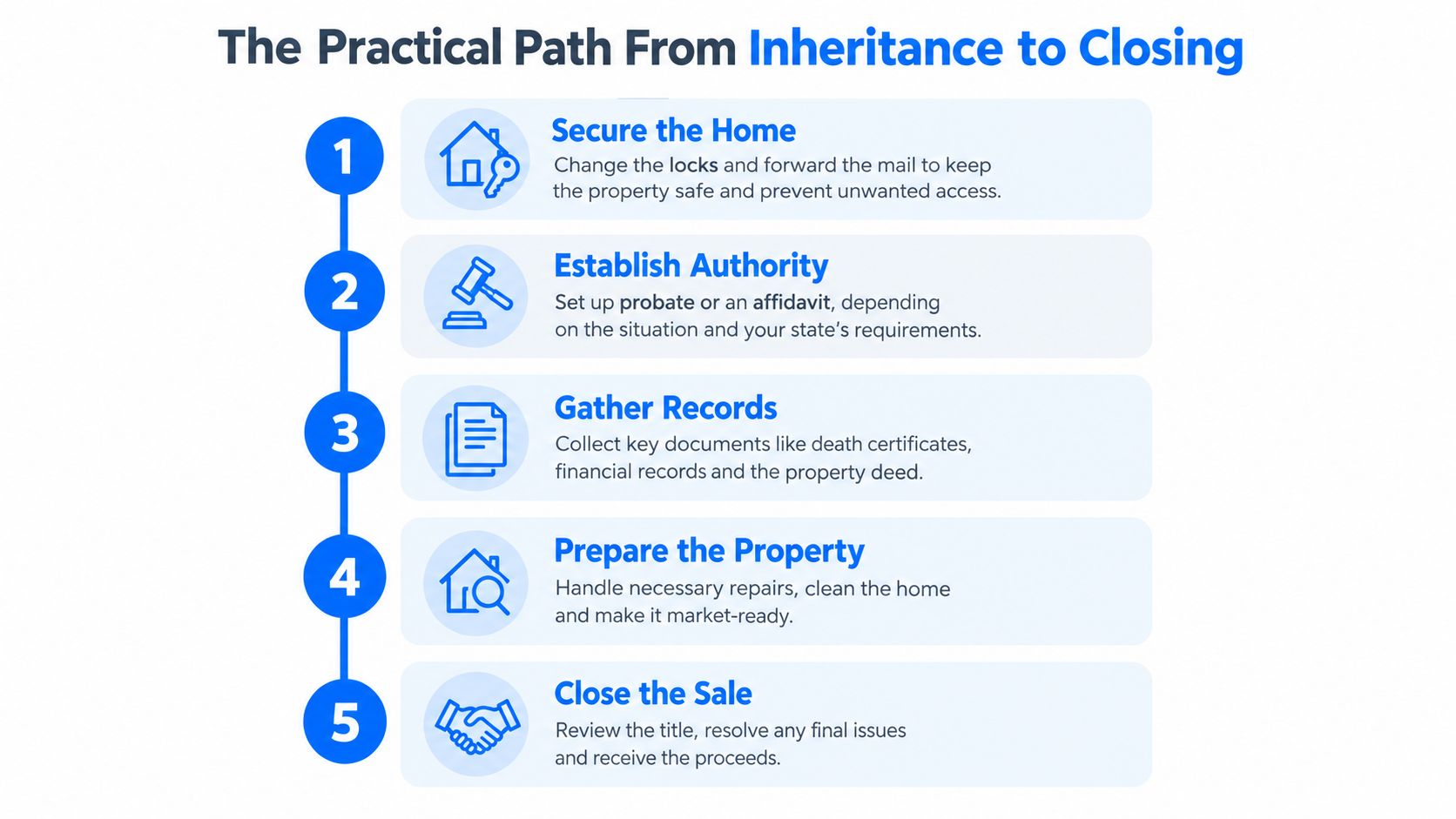
If the home is vacant, lock it up, forward the mail, maintain insurance, and keep the heat on if freezing temperatures are a concern. That sounds basic, but a frozen pipe or break-in can create a bigger problem than the inheritance itself. If there's a mortgage, payments still matter while the estate is being sorted out.
Then move through the title sequence
After the home is secured, gather certified death certificates and find the will, trust, or other estate documents. If probate is required, the Franklin County Probate Court becomes part of the path. If the property qualifies for a shorter real-estate-transfer-only process, that still depends on title chain, filing documents, and a recent deed from the county recorder before closing can happen.
A Columbus title company then checks for the issues that often hide in inherited homes, liens, old judgments, unpaid taxes, and recording gaps. A title search also helps surface whether a transfer-on-death filing was ever completed, or whether the deed history needs cleanup before a buyer can take clear title. That review matters because lenders won't fund around a clouded title, and cash buyers usually price that risk into their offer.
Choose the sale route after the paperwork is clear
Once authority and title are lined up, heirs can compare a traditional listing, an as-is listing, or a direct buyer. The right answer depends on how much work the house needs, how fast the estate needs money, and how much family coordination is still unresolved. A buyer can't solve title problems for you, but the sale route should match the condition of the property and the speed the family needs.
If the title company hasn't reviewed the file yet, any “closing date” is just a wish, not a plan.
There's also a video walkthrough available for readers who want a visual overview of the process.
Documents You Will Need Ready for the Title Company
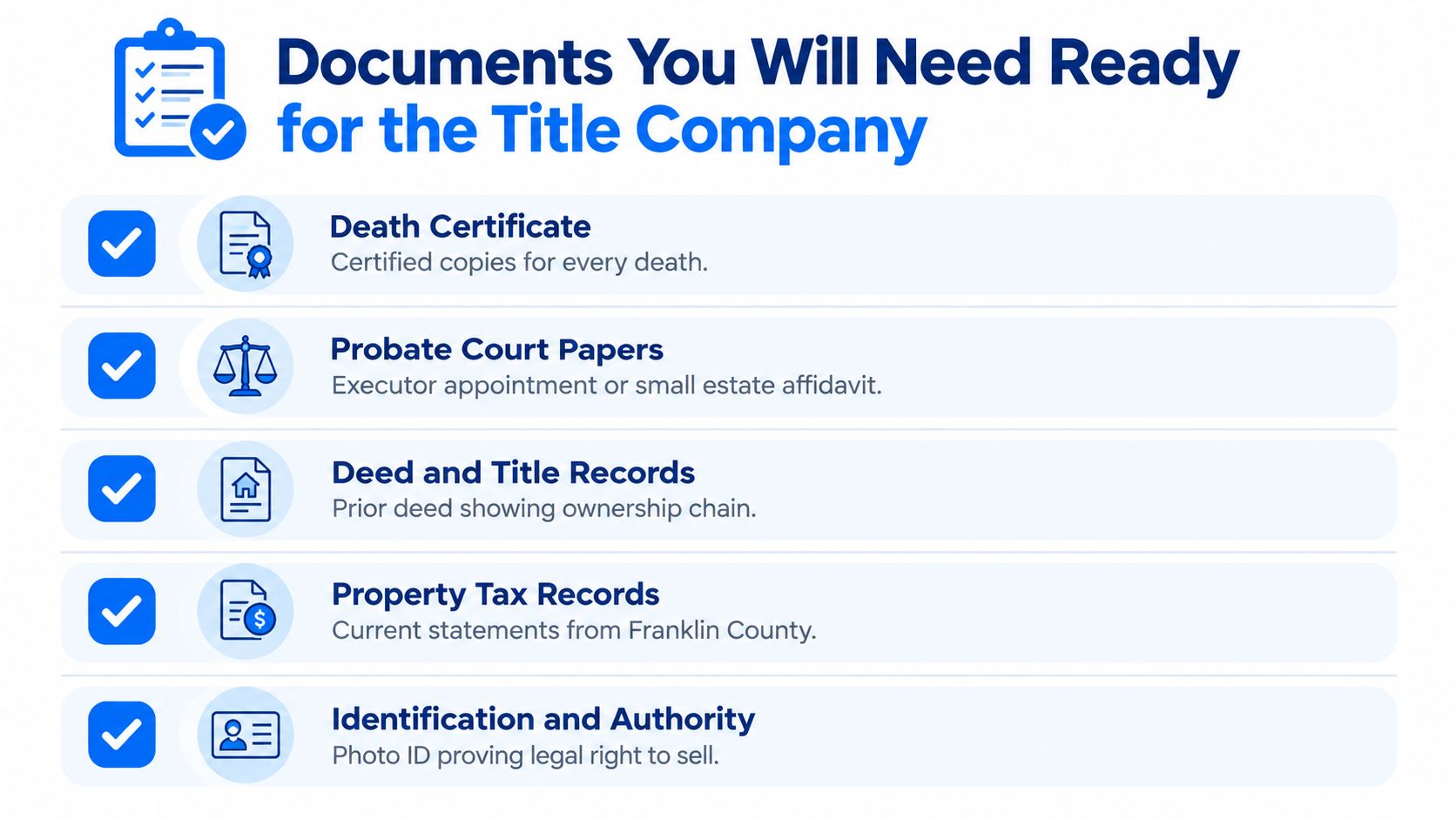
A title company can tell you exactly what's missing, but it helps to arrive with the basics already in hand. That saves a lot of back-and-forth, especially if heirs live in different states or the house has been untouched for a while.
The practical checklist
- Certified death certificate copies. The title company needs proof of death, and certified copies are often required rather than plain photocopies.
- Will, trust, or estate papers. These show who has authority and how the property is supposed to pass.
- Court appointment documents. If probate is open, the executor or administrator paperwork matters because it shows who may sign.
- Existing deed and title records. The deed confirms the legal description and how the property was last vested.
- Property tax bills and parcel information. Franklin County records help identify the parcel number and current tax status.
- Mortgage payoff statement. This prevents the closing from being derailed by a balance no one had confirmed.
- HOA or condominium paperwork. If the home is in an association, rules and balances can affect closing.
- Insurance, repair, and improvement records. These help explain the property's condition and any work done after inheritance.
- Photo ID for every signer. Title companies verify identity before closing.
- Prior title policy or survey, if available. These aren't always required, but they can make a title search cleaner.
Why each item matters
The biggest surprises usually come from documents no one thought to look for. A missing payoff letter can delay closing. A deed with the wrong legal description can delay recording. A deed search can also show whether the property was ever transferred by survivorship or TOD affidavit, which changes the rest of the process.
The title company will identify additional requirements during its search, so the checklist is a starting point, not a guarantee. But in a probate house sale, good paperwork often saves more time than a fresh coat of paint.
Get a cash offer for your home
Probate, Title, and the Friction That Slows Columbus Sales
Columbus inherited-property sales usually slow down for the same few reasons. It's rarely one big problem. It's a stack of small ones that keep the title from being clean enough to transfer.
The delays usually show up in the records, not the market
Franklin County probate can take time just to get the right person appointed. After that, the appointment still has to line up with the recorded title documents. If the deed history is messy, if a survivorship deed conflicts with the will, or if an old mortgage release was never recorded, the closing file can sit until those gaps are cleared. Probate court materials from Franklin County note that a real-estate-transfer-only path can exist in some estates, but the title chain and court documentation still have to support it.
Unpaid property taxes and old liens are another common block. Buyers and lenders want clear title, and they won't close around a cloud unless it's resolved before signing. Even a cash buyer usually adjusts price for that friction. That's one reason heirs sometimes think the market is the problem when the actual issue is the paperwork.
The hidden time cost is often worse than the legal one
If one heir is out of state, if belongings are still inside the house, or if nobody can find a prior deed, the property can sit longer than anyone expected. While it sits, taxes, insurance, utilities, and maintenance keep running. A slow sale also gives more time for weather damage or vacancy problems to show up.
The practical takeaway is simple. Before you choose a sales path, make sure the title company and probate records are aligned. If they aren't, you're not comparing offers yet, you're fixing the gate that controls the sale.
For a plain-language overview of how probate title issues affect sales, the guide on selling a home in probate is a useful reference point.
Listing, Aiding as-is, or Taking a Cash Offer
Most inherited homes in Columbus fall into one of three sale paths. The right one depends on the home's condition, the family's timeline, and how much work the heirs want to take on.
| Factor | MLS with Agent | As-Is MLS Listing | Direct Cash Offer |
|---|---|---|---|
| Best fit | Homes in stronger condition | Homes needing work but still broad-market ready | Homes with repairs, clutter, or urgent timing |
| Condition needed | Usually the highest | Lower than a full retail listing | Minimal prep |
| Timeline | Usually longest | Often shorter than full retail listing | Usually fastest |
| Buyer pool | Traditional buyers | Investors and some owner-occupants | Investors or companies buying as-is |
| Net proceeds | Potentially higher, but with commissions and prep costs | Mid-range, depends on buyer demand | Convenience can come with a lower price |
| Family effort | More showings, more coordination | Less prep, but still market-facing | Least coordination once title is ready |
How each path feels in real life
A traditional agent listing works best when the house is in good shape and the family wants to maximize exposure. It usually means cleaning, repairs, staging, showings, and some back-and-forth after inspection. That can be the right answer if the home is already close to market-ready.
An as-is MLS listing is different. The property still hits the broader market, but the family doesn't promise repairs. That can work when the home needs updates but still has enough appeal to attract buyers who are willing to take on the work. It's not repair-free in the legal sense, though, because ownership, title, and disclosure issues still need attention.
A direct cash offer can be useful when the property is full of belongings, needs major repairs, or the heirs want simplicity over a longer process. Cyber Homes is one example of a company that buys homes as-is and can make a direct offer without showings, but the tradeoff is usually a lower price than a well-prepared retail listing. If you compare it with other cash buyers in Columbus, make sure you get more than one written offer, and verify proof of funds before you decide.
For a market-specific comparison, this list of companies that buy houses for cash in Columbus can help you frame the choice without turning the home into a months-long project.
Get a cash offer for your home
Taxes, Step-Up Basis, and What Actually Costs Money
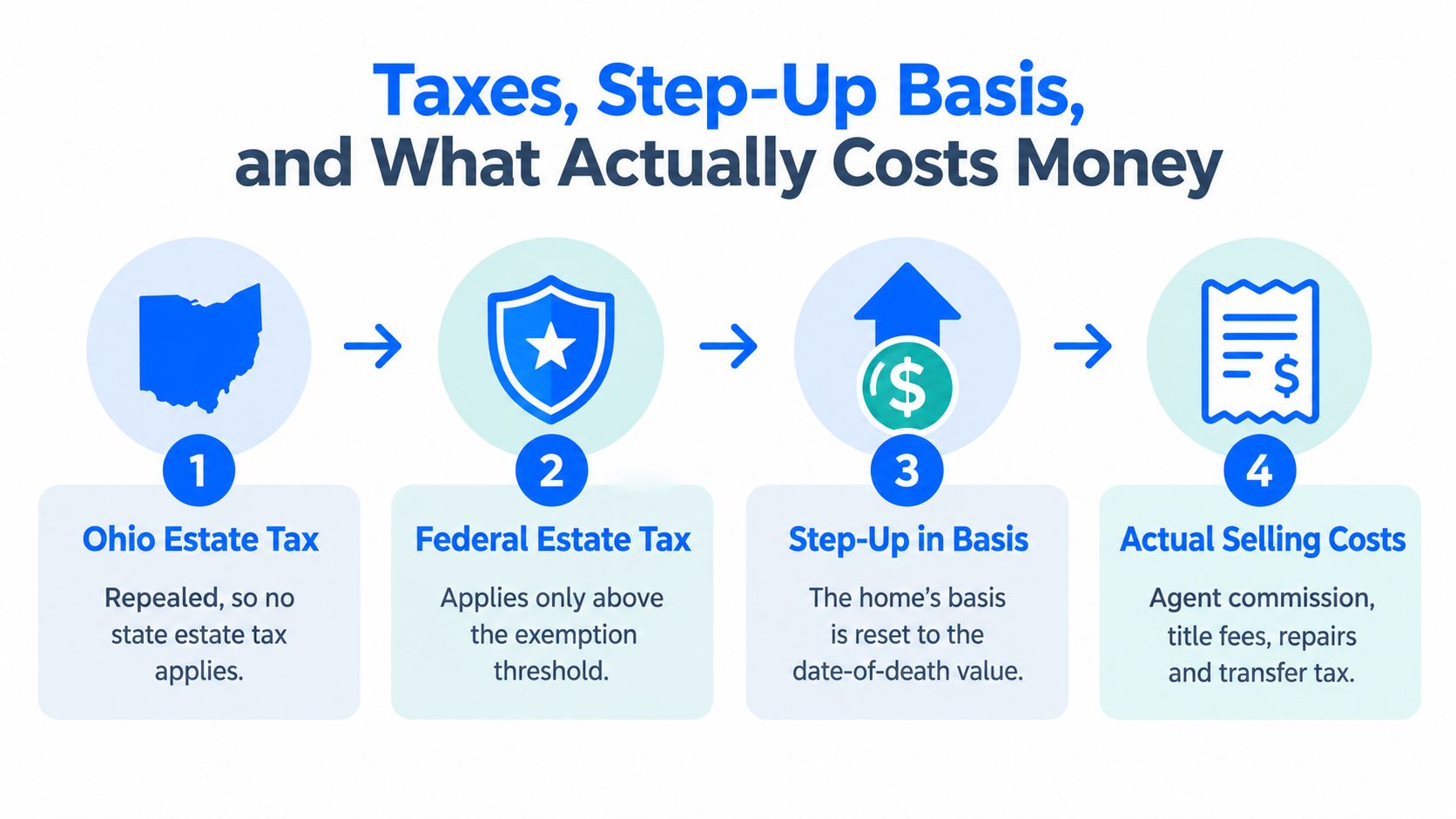
Inherited property taxes are often less scary than people expect, but the details matter. Ohio has no state estate tax for modern decedents, and inherited real estate generally receives a step-up in basis to the home's fair market value at the date of death under federal tax rules. That means the tax picture usually starts with the value at inheritance, not with what the original owner paid decades ago.
A simple Columbus example
If a Columbus home is worth $250,000 at death and later sells for $280,000, the gain is usually measured from the stepped-up basis, not from the decedent's original purchase price. If the sale also includes $15,000 in selling costs, the taxable gain is roughly $15,000, not the full spread from the old purchase price. That's the key reason heirs should keep the date-of-death valuation, repair records, and final closing statement.
That example is only a rough illustration, not tax advice. A rising market, delayed sale, or major repairs can change the result, and the rules can shift depending on the estate structure. For a deeper plain-English breakdown of inherited-property tax questions, Allied Tax Advisors' inheritance tax tips can be a useful starting point.
The quiet costs are often the real burden
While the home sits, the bills keep arriving. Property taxes, insurance, utilities, HOA dues, lawn care, winterization, and security all chip away at proceeds. Those carrying costs can matter more than the tax bill if the house takes months to sell.
The right move is usually to track the date-of-death value early, then compare a likely sale price against the carrying costs and closing expenses. If the property is significant enough, a CPA or tax professional should review the file before you sign anything.
Your Next Steps After Inheriting a Home in Columbus
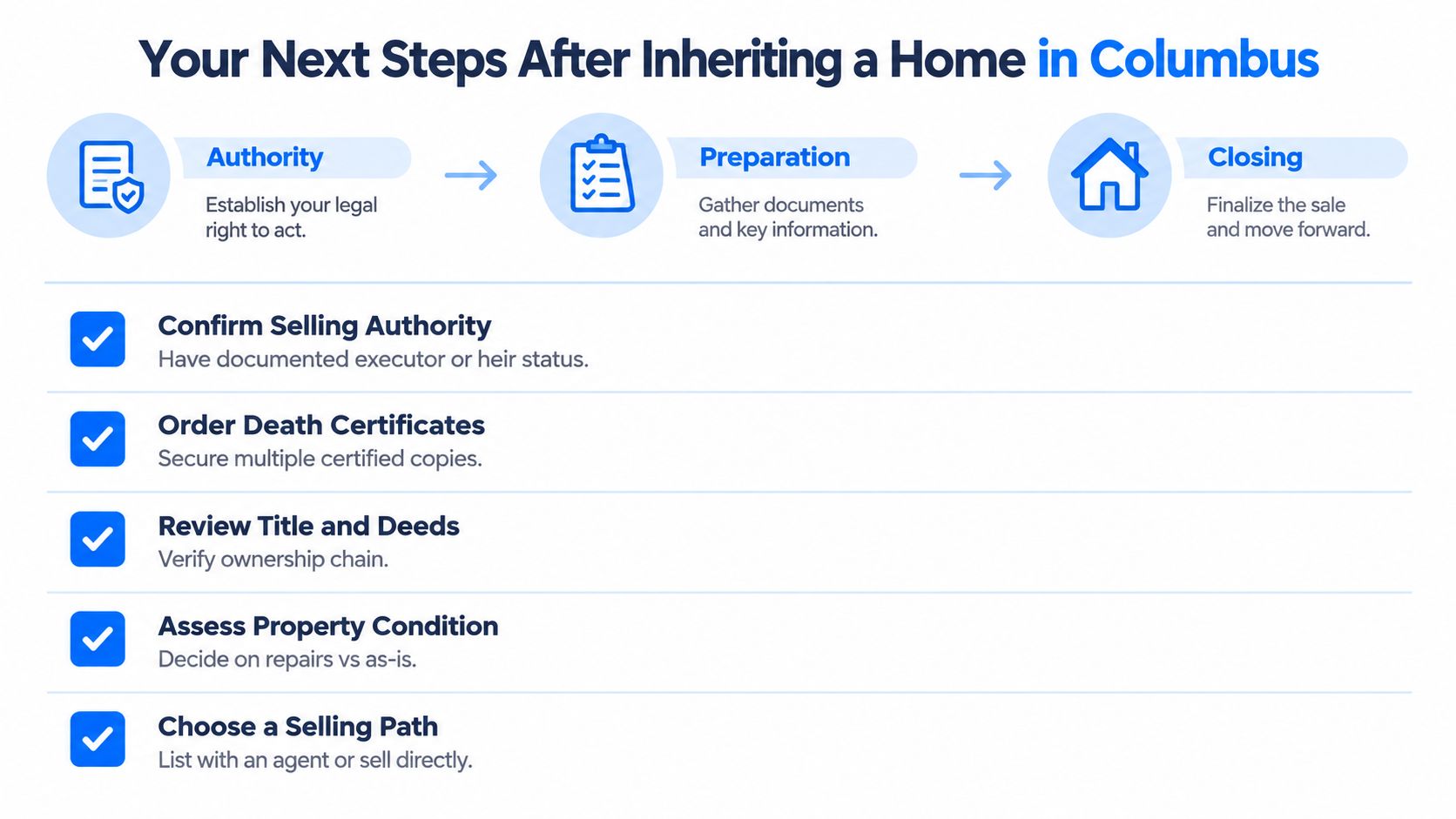
The cleanest path is the one where the paperwork matches the ownership and the sale route matches the home's condition. By this point, you should know who has authority to sell, whether probate or affidavit work is needed, what the title company wants, and whether the property is better suited to a listing or a direct offer.
A short checklist for this week
- Confirm selling authority. Make sure the executor, administrator, trustee, surviving owner, or heirs have the right to act.
- Order certified death certificates. You'll almost always need more than one copy.
- Review the deed and title history. Check for survivorship language, TOD filings, missing releases, or other title issues.
- Identify mortgage and lien status. Don't guess, verify.
- Decide how the home should be sold. Compare an agent listing, an as-is listing, and a direct buyer based on the property's condition and the family's timeline.
If the house is still vacant, secure it now. Change the locks if needed, forward the mail, keep the insurance active, and winterize if the weather calls for it. Those small steps protect the estate while everyone else is figuring out the legal path.
A Franklin County probate attorney can confirm authority, a Columbus title company can confirm the recording path, a CPA can review the inheritance tax side, and a real estate advisor can help you compare sale options without turning the process into guesswork. If you're trying to sell inherited property in Columbus, the next move is to line up those professionals before you accept an offer or sign a listing.
Cyber Homes helps Columbus owners sell inherited homes as-is when they want a direct offer and a simpler closing path. If you're sorting out probate, title questions, or a house that needs work, visit Cyber Homes to compare that option with listing and decide what fits the estate best.

Edited by
James Vasquez
Real Estate Investor & Land Specialist with 10+ years experience in residential flipping, vacant land investing, land wholesaling, and subdivision deals.
Disclaimer: The information provided is for educational purposes and does not constitute financial or legal advice. Always consult with licensed professionals before making investment decisions.