
How to Sell a House As-Is for Cash in North Carolina (2026)

The usual advice is to chase the highest offer and assume the rest will sort itself out. I would not. A bigger headline price that falls apart over financing, repairs, or title often leaves you with less than a lower cash number you can close.
Selling a house as-is for cash in Charlotte means a firm offer on the home in its current condition, with no repairs, showings, or listing commission, and a title-company closing in about 7 to 30 days. Offers commonly land between 45% and 80% of value, depending on condition.

Reading an Annotated Seller Settlement Statement
Updated October 2026.
The email offer is not your check. Selling as-is for cash in Charlotte, Mecklenburg County, still runs through a settlement statement that subtracts every payoff, tax, and fee before you are paid. This worked example uses a $300,000 cash offer because a round number makes each deduction easy to trace.
| Settlement line | What it covers |
|---|---|
| Sale price, cash offer | $300,000 agreed offer before seller costs |
| Payoff of first mortgage | Lender payoff letter good through the closing date, plus per diem interest |
| Second lien or HELOC | Junior lien paid from proceeds with its own payoff letter |
| Back taxes or city charges | Unpaid taxes and municipal charges found in the title search |
| NC excise tax (confirm applicability) | $600 if the title company applies $1 per $500 of the $300,000 price |
| Title search and closing fees | Set by the title company |
| Recording fees | Recording the deed and lien releases |
| Prorated property taxes and HOA dues | Days of ownership in the closing year |
| Starting cash to seller | $300,000 before payoff, tax, fee, and proration lines are subtracted |
How each line changes the check
Sale price is the gross amount due to you. Nothing has been disbursed yet.
The first-mortgage payoff comes from the lender's letter, good only through a stated date. Per diem interest keeps running until the wire lands, so a delayed closing raises what you owe.
A second lien or HELOC needs its own payoff letter. It is paid from proceeds, and skipping it does not make it disappear.
Back taxes and city or county charges surface in the title search. They are paid at the table, which is why a clean quote before title work is only a guess. Old code liens, unpaid utility balances, or a missed association assessment can move straight from the title report into the debit column.
Ask the title company whether North Carolina excise tax applies and how they compute it. If they use $1 per $500 on a $300,000 price, the line is $600; treat it as an estimate until their ledger shows it.
Title search and closing fees are whatever that company charges. Recording fees cover the deed and the lien releases. Prorated taxes and HOA dues split the closing year by the days you still owned the house. Every extra week before funding can keep per diem interest and those prorations moving against you.
Practical rule: Trust the cash-to-seller line after every debit, then compare that figure across offers.
A cash deal still produces that itemized statement. For how the older HUD-1 layout lines up with today's papers, see how a HUD statement works in a real estate closing. The North Carolina Real Estate Commission closing brochure says buyers and sellers receive documentation of the funds transferred, while federally insured loan transactions use the federal Closing Disclosure.
What the proceeds may mean at tax time
A home-sale gain may be excluded for a single filer or a married couple filing jointly when the ownership and use tests are met. That exclusion is not automatic. Paying off a mortgage at closing does not, by itself, create or erase taxable gain, because the payoff changes cash in hand rather than the gain calculation. Confirm your position with a tax professional before you spend the money.
How Cash Offers Are Calculated and Priced by Condition
Cash buyers do not start from your mortgage balance. They start from after-repair value (ARV), then subtract repair costs, holding costs, and the buyer's margin. Many use a 70% rule as the first cut: about 70% of ARV, minus estimated repairs.
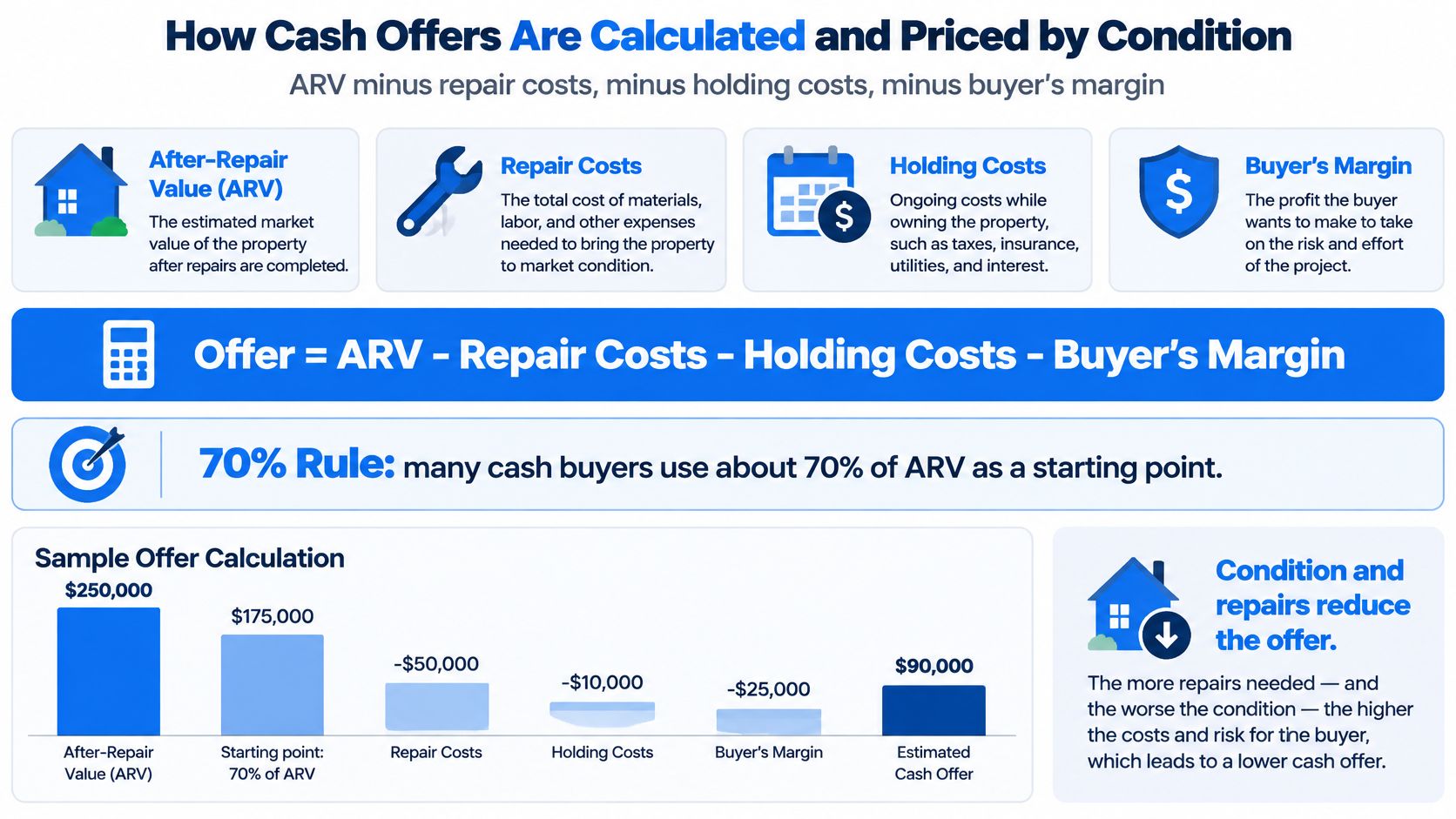
Say a Charlotte house has an ARV of $370,000. Seventy percent is $259,000. Subtract $30,000 in repairs and the starting offer is $229,000, before holding costs and margin are priced in. That is a worksheet, not a promise. Verify it against recent comparable sales.
| Condition | Typical repair scope | Offer as share of after-repair value |
|---|---|---|
| Light | Paint, flooring, and minor fixes | 70% to 80% |
| Moderate | Roof section, HVAC or water heater, plumbing or electrical repairs | 60% to 70% |
| Heavy | Foundation or drainage work, major roof replacement, fire or water damage | 45% to 60% |
On a $370,000 ARV, light work points to roughly $259,000 to $296,000, moderate work to $222,000 to $259,000, and heavy work to $166,500 to $222,000. These are typical investor ranges. A buy-and-hold buyer who plans to rent may pay more than a flipper who needs a full resale margin.
Why Mecklenburg houses land in each tier
Red clay soils across Mecklenburg County push water against foundations and turn a "small crack" into drainage and structural work, which is a heavy-tier item. Hail and age beat up roofs. Older stock in Plaza Midwood and NoDa often carries tired wiring, galvanized plumbing, and HVAC that has already outlived a few hot summers, so those houses tend to price in the moderate band. Low-lying streets add flood risk that buyers discount even when the interior looks fine. Newer houses in Steele Creek, Matthews, and Huntersville more often sit in the light tier, where paint and flooring are the job.
Get two contractor estimates before the walkthrough. If you don't know the tier, you can't tell a fair offer from a padded one.
Cash Buyer, Agent Listing or Fix-and-List Compared
Pick the route that matches your constraint. Cash wins when time or condition is the limit. A listing wins when the house can sell and price is the priority.
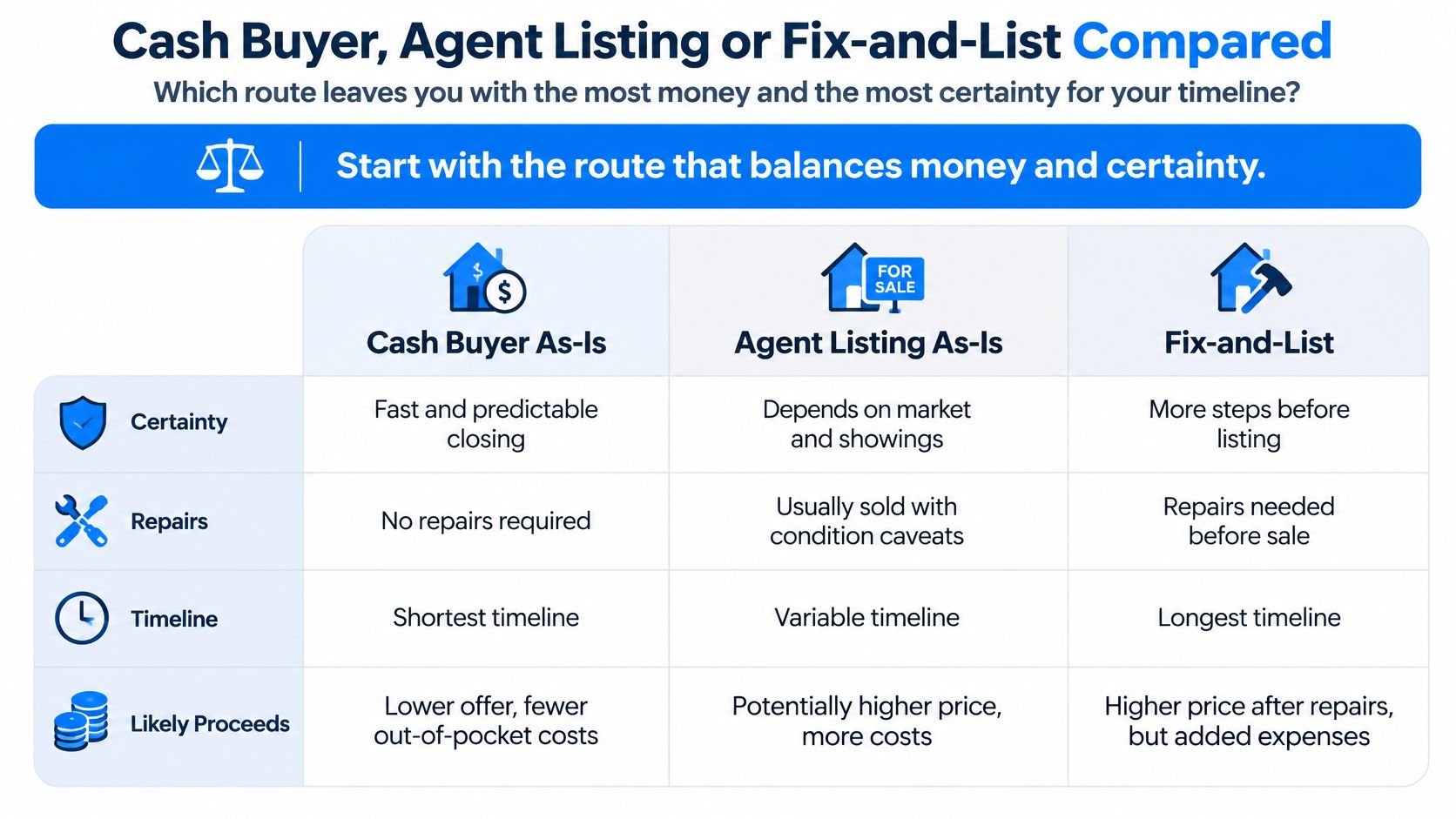
| Route | Net proceeds | Fees and costs | Time to close | Repairs | Certainty |
|---|---|---|---|---|---|
| Cash buyer, as-is | Lowest gross price, fewest deductions after the offer | No commission; closing and title fees; holding costs until closing | About 7 to 30 days | None | High once the contract is signed and title clears |
| Agent listing, as-is | Closer to full market value if a buyer appears; price cuts are common | Commission about 5% to 6%; seller concessions; holding costs for about 65 days in the Charlotte metro | Listing period plus 30 to 45 days to close | None required, but buyers may ask for credits | Lower; financing and inspection can end the deal |
| Fix-and-list | Highest potential price if repairs pay back | Repair costs; commission; holding costs during repairs and listing | Repair period plus the listing period, often several months | Full repairs before listing | Moderate; repair overruns and market shifts add risk |
North Carolina was not a runaway seller's market in fall 2026. North Carolina REALTORS reported October inventory near balance at 5.98 months, sales volume down 19% year over year, and a median sales price of $368,990. Realtor.com put median days on market for the Charlotte-Concord-Gastonia metro at 65 days in October 2026. That is a metro figure, not a neighborhood one.
What a listing quietly costs
A 5% to 6% commission on a mid-range sale is five figures before concessions. Say carrying costs for mortgage, taxes, insurance, and utilities run $2,000 a month. Over those 65 metro days, that is about $4,300 before you close, and it keeps running if the first contract dies.
FHA and VA buyers can lose financing when an as-is house fails appraisal or minimum property standards. A higher listed price that cannot be financed is not a higher net. Cash removes that contingency. It also removes the upside if the house would have appraised clean.
Cyber Homes buys houses for cash, with no listings, no showings, and no repairs needed from the seller. If you want to see how other North Carolina cash buyers are set up, compare companies that buy houses for cash in North Carolina on proof of funds and who closes, not on the slogan.
The walk-through below shows how a cash closing is sequenced once you have a written price.
Disclosure, Documents and Buyer Checks Before You Sign
As-is changes who pays for repairs. It does not cancel what you must disclose.
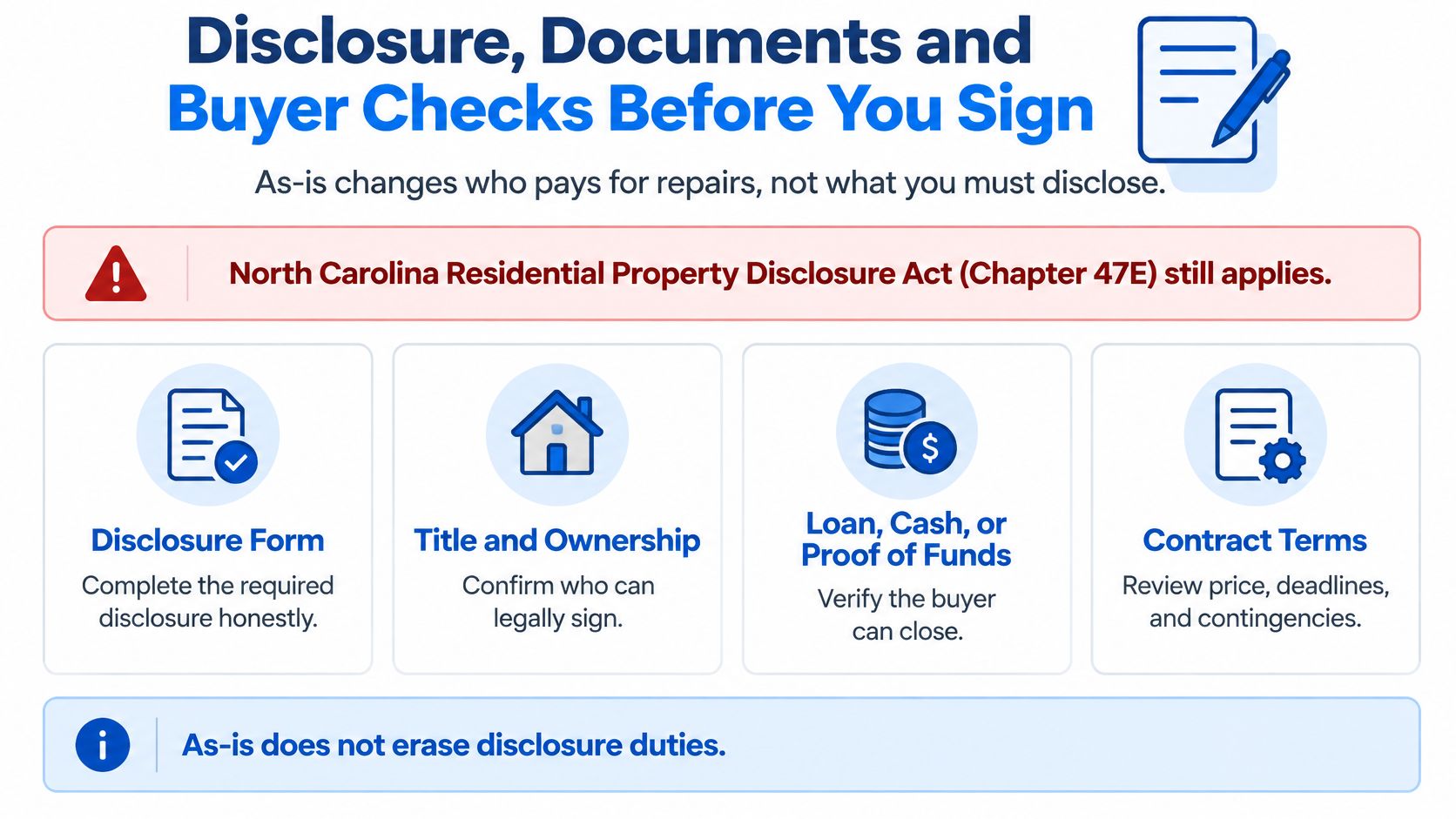
Under the Residential Property Disclosure Act, Chapter 47E covers residential transfers of one to four dwelling units, and the owner generally must give the disclosure statement no later than the buyer's offer. You may disclose known conditions or state that no representations are made, subject to statutory and contractual exceptions. Known material facts still have to be handled. An undisclosed defect you knew about can support a misrepresentation claim after closing, which usually costs more than the repair. Estate, trustee, court-ordered, and foreclosure transfers can fall under exceptions, so ask a North Carolina attorney before you skip the form.
Papers to pull before anyone walks the house
- Deed and payoff letters. You need the recorded deed, each mortgage payoff, and tax status.
- Occupancy papers. Leases, HOA documents, permits, and insurance claim files belong in the same folder.
- Code history. Under G.S. 160D-1201, a city or county may adopt an ordinance to repair, close, or demolish an abandoned structure that is a health or safety hazard. Ask the local government for notices, violations, and municipal charges, then give that file to the title company.
- What stays behind. A written list of excluded personal property keeps a "junk left in the garage" fight out of closing.
How to vet the buyer
Start with proof of funds, such as a current bank letter the title company can verify. Confirm a local title company or attorney holds earnest money, that nobody asks for an upfront fee, and that recent North Carolina sellers describe a completed closing rather than a vanished buyer. Cyber Homes buys houses in Charlotte, Raleigh, and Greensboro. Requesting a cash offer creates no obligation for you to sell, and submitting information does not obligate you to sell or obligate a purchase.
Watch these tells:
- A price cut after inspection. Put the new number on your net sheet before you answer.
- Assignment without disclosure. That is wholesaling. Ask for the assignment clause in writing.
- Pressure to sign tonight. Insist on attorney review first.
- No closing company named. Ask for the company before you initial anything.
For patterns that show up in bad contracts, read how we-buy-houses scams typically work. Then ask your title company or attorney whether an attorney must conduct your closing and which transfer tax, if any, applies. Do not treat a blog as that answer.
Cash Sale Timeline From Offer to Closing
A clean cash sale is five stages. Most finish in 7 to 30 days from contract. Title problems are what stretch it.
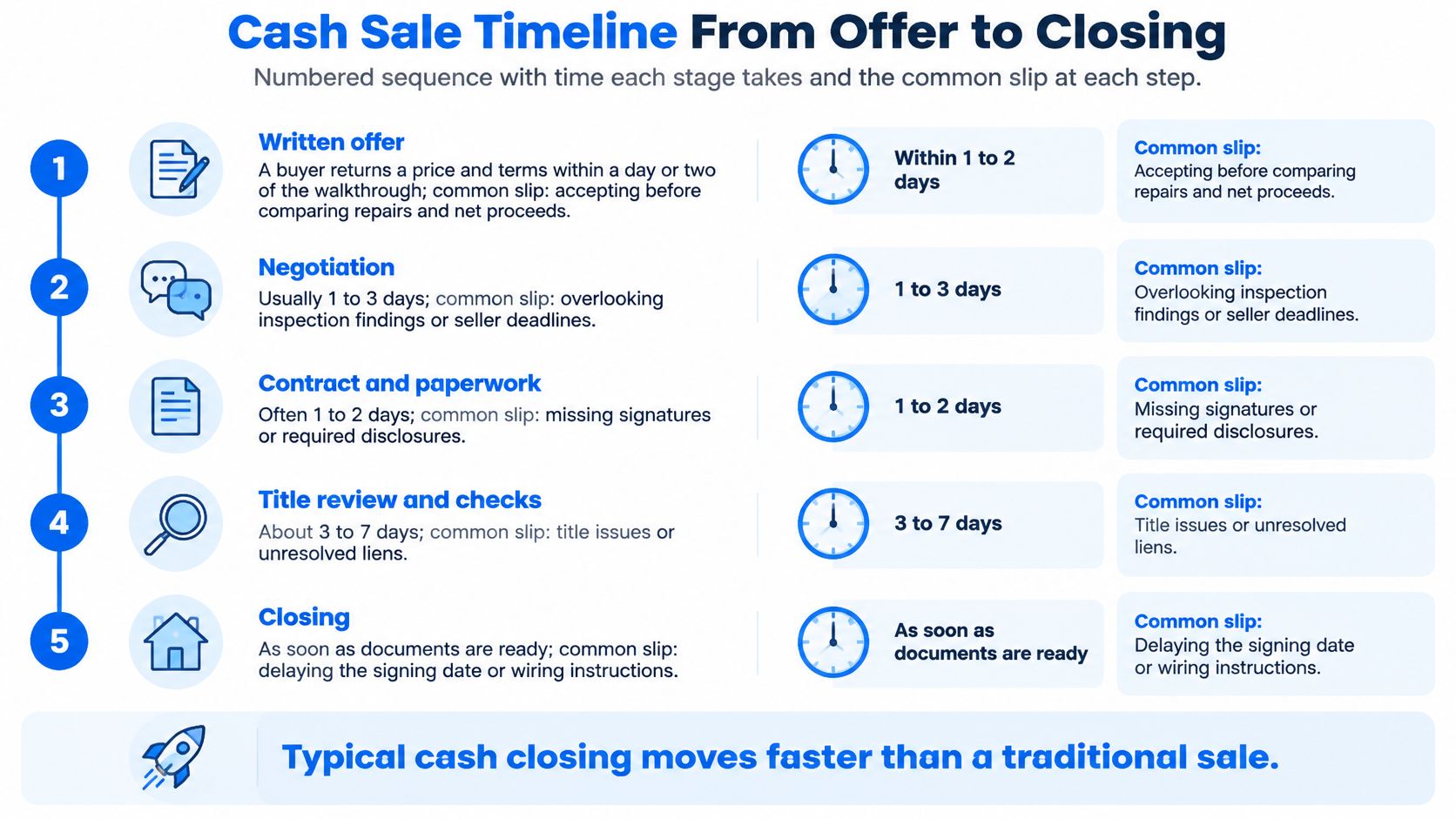
- Written offer. Expect a price and terms within a day or two of the walkthrough. The slip is accepting a verbal number with no repairs list, no closing date, and no statement of who pays title charges.
- Walkthrough. Plan on 30 to 60 minutes. The buyer checks condition and you answer what you know. Hiding a defect feels faster. It usually reopens the price once the buyer finds it.
- Contract. You sign the purchase agreement, earnest money goes to the title company, and the disclosure goes with the contract. A missing signature or an open "price to be confirmed" blank is not a deal.
- Title search. Allow about 7 to 14 days for liens, judgments, back taxes, and code charges, and for payoff letters to come back. Skipping those letters is the usual reason a "next Friday" closing slides.
- Closing. Deed, funds, and the settlement statement should match the figures you already agreed. Read each line before you sign. Keys move at the time the contract states, not whenever someone remembers.
A finished sale looks boring, which is what you want. The deed is recorded, lenders issue releases, the statement matches the contract, and you leave with the net you calculated. If a judgment or an unreleased lien appears, the window moves until that item is paid or insured over. Speed is a result of a clean file, not a slogan on the offer.
Situations That Change How Your Sale Works
A cash contract does not erase debt, ownership gaps, or a court date. Each situation changes who may sign, what must be paid, and how little time you have.
Foreclosure is the tight case. The North Carolina Judicial Branch states that after a foreclosure sale, a 10-day upset-bid period begins, any higher bid starts a new 10-day period, and the sale is not final until a period passes with no new bid. Before the sale, notice must be served, posted at the courthouse for at least 20 days, and advertised. Confirm the trustee or attorney's sale date and the full payoff immediately. A buyer cannot wipe out valid liens. A sale that closes before the foreclosure sale can pay the mortgage and other liens only with lender cooperation and enough equity. Call a North Carolina closing attorney or housing counselor when the notice arrives.
| Situation | What changes | Confirm first |
|---|---|---|
| Pre-foreclosure or behind on payments | The sale date follows the statute and the trustee or court, and the offer must cover all liens | Trustee sale date, total payoff, and whether the offer covers every lien |
| Inherited or probate property | Authority to sign, the creditor-notice window, and possible joinder of the personal representative | Letters of authority, will status, and signatures of all heirs |
| Divorce | Both spouses may be on title, and a court order may control the sale | Divorce decree and signatures of both owners |
| Tenant-occupied rental | The lease, notice rules, and who has possession at closing | Lease terms, notice given, and the move-out date |
| Liens, judgments, or back taxes | They are paid from proceeds and can erase most of the cash | Title search results and a payoff letter for each lien |
| Code violations or vacant-property orders | Local notices, repair demands, or demolition proceedings can survive the sale | Code-enforcement history from the city or county |
| Fire or water damage | Claims, permits, and disclosure duties travel with the file | Insurance settlement, permits, and repair records |
| Hoarder or heavily cluttered home | Clean-out cost, access, and price all move together | A clean-out estimate and an access plan |
On an inheritance, do not assume any heir can sign. When the first creditor notice falls within two years after death, a transfer made before that notice can be void as to creditors and the personal representative, and a sale after notice but before final-account approval may require the personal representative to join, as Pierce Law Group's North Carolina probate guidance explains. Talk with a probate attorney before you advertise a closing date.
Speed should never outrun a title the title company will insure.
Frequently Asked Questions About Selling As-Is for Cash in North Carolina
Do I need an attorney at closing in North Carolina?
Don't assume yes or no from a general article. Ask the title company or a North Carolina attorney what your transaction requires, who prepares the deed, and which recording charges apply.
What happens to earnest money if the buyer backs out?
The title company holds it in escrow. The contract, not a phone call, decides whether it returns to the buyer or is paid to you.
How do I get a current payoff figure?
Ask each lender for a written payoff letter good through the closing date, including per diem interest. A monthly statement is not a payoff.
Can an as-is sale stop a foreclosure sale?
It isn't guaranteed. A sale that closes before the sale date may pay the liens if equity and the lender's cooperation are both there. Miss the date and the trustee's process continues.
What if the buyer's offer falls below my net sheet?
Ask them to itemize repairs, holding costs, and margin. Check that list against your contractor estimates, and get at least one other written offer before you decide.
Should I get a pre-listing inspection before selling as-is?
It can put known defects on the table early so the price isn't reopened later. It can also create facts you must disclose. Discuss that trade with a local agent or attorney first.
Cyber Homes buys houses in Charlotte, Raleigh, and Greensboro, and a no-obligation offer can be set next to your net sheet before you commit to any route.
If you want a cash price on a North Carolina house without repairs, showings, or a listing commission, Cyber Homes reviews the property and local sales, then you choose whether the number beats your net sheet. You pick the closing date, and a title company handles the paperwork. Visit Cyber Homes to start with your address and compare that offer with the settlement lines above.

Edited by
James Vasquez
Real Estate Investor & Land Specialist with 10+ years experience in residential flipping, vacant land investing, land wholesaling, and subdivision deals.
Disclaimer: The information provided is for educational purposes and does not constitute financial or legal advice. Always consult with licensed professionals before making investment decisions.