
How to Sell a House As-Is for Cash in Dallas, TX (2026)

Selling a house as-is for cash in Dallas trades potential retail value for speed and certainty, with a 7–30 day planning window, not a guaranteed closing date. There's no reliable universal offer range: if repairs, an inherited property, or a deadline have become overwhelming, start with a property-specific valuation.
Updated October 2026.

What an As-Is Cash Sale Means in Dallas
An as-is cash sale means transferring your property in its documented condition without agreeing to renovations or depending on a conventional buyer's mortgage approval. It doesn't remove the need for a sound contract, accurate disclosures, or clear ownership.
Dallas is in Dallas County, but a citywide price isn't a valuation of your house. Oak Cliff, Lake Highlands, East Dallas, Preston Hollow, and Bishop Arts aren't interchangeable markets. Exact location, lot, condition, ownership issues, and nearby comparable sales should determine the offer.
What the current market means for your decision
For the three months ending September 2026, Redfin reported a Dallas median sale price of approximately $450,000, about 53 days to sell, and roughly two offers per home. Its description of Dallas as “somewhat competitive” supports a balanced-to-buyer-leaning interpretation, not an assumption that sellers can dictate terms, according to Redfin's Dallas housing-market report.
That matters because you still have alternatives to accepting a discounted cash offer. A habitable house with realistic pricing may attract an owner-occupant, while a property with substantial damage may require a different buyer pool.
Practical rule: Pay for speed only when you can explain what that speed saves you.
What you're actually buying with a lower price
A direct buyer may let you avoid repairs, repeated showings, and a financed buyer's approval process. In exchange, the buyer accounts for renovation expenses, ownership costs, resale expenses, uncertainty, and profit.
Use these questions before requesting offers:
- Condition: Can someone reasonably occupy the house now, or does it need substantial remediation?
- Deadline: Is your closing date a preference or a documented obligation?
- Cash available: Can you afford repairs and continued ownership without creating another financial problem?
- Access: Can you accommodate inspections and showings, especially with tenants?
The right answer to how to sell a house as-is for cash in Dallas, TX, in 2026 starts with those constraints, not with an advertisement promising the highest price.
Which Sale Path Fits Your Situation
Choose the sale path that produces the best credible net proceeds within your deadline, rather than automatically choosing cash or the highest advertised price.
An agent can market a property as-is, too. The meaningful distinction is between a direct purchase, wider market exposure without renovations, and investing in improvements before listing.
Cash Buyer Versus MLS Listing Versus Fix and List
| Sale path | Net proceeds | Repairs and holding costs | Time to close | Financing risk | Best fit |
|---|---|---|---|---|---|
| Direct cash buyer | Negotiated price minus agreed charges and obligations; confirm every deduction | Usually avoids renovation spending; ownership costs continue until closing | Negotiated deadline, subject to title and contract requirements | Verify actual funds and any funding conditions | Significant repairs, limited access, or a firm deadline |
| Agent listing as-is | Sale price minus negotiated commission, credits, closing charges, and obligations | No planned renovation, but continued carrying expenses and possible concessions | Marketing period plus the buyer's closing process | Depends on the buyer and loan terms | Habitable property with time for market exposure |
| Fix and list | Sale price minus renovation, marketing, transaction, and ownership costs | Seller funds and manages improvements before closing | Renovation period plus marketing and closing | Depends on the eventual buyer | Seller with capital, reliable contractors, and flexibility |
Fees aren't interchangeable across these paths. Ask an agent for proposed compensation and a seller net sheet. Ask a direct buyer which title charges, cleanup expenses, or other deductions the seller will pay.
Match the strategy to the property
For a vacant inherited house, evaluate continuing insurance, utilities, taxes, maintenance, and deterioration against the likely benefit of waiting. A lower cash offer can be reasonable when those obligations outweigh the expected additional proceeds.
For a habitable rental, don't treat occupancy as an automatic reason to discount heavily. First determine whether the lease, tenant cooperation, and showing access support a marketed sale or favor a buyer willing to purchase subject to the tenancy.
For a sound home with flexible timing, I'd usually obtain an as-is MLS opinion before committing to an off-market purchase. You may not need a renovation project to reach a broader audience.
When comparing companies that buy houses for cash in Dallas, evaluate the written contract rather than the “we buy houses Dallas” headline.
A lower offer can be the better decision. It isn't the better decision merely because someone calls it convenient.
Include commissions, concessions, mortgage carrying expenses, taxes, insurance, utilities, and possible financing failure in your listing comparison. For FHA or VA offers, ask the lender and agent whether the property's condition could create approval or repair requirements rather than assuming every financed buyer can close as-is.
How Cash Buyers Calculate an Offer
Cash buyers generally work backward from the property's expected repaired value and subtract repairs, holding expenses, resale costs, risk allowances, and profit.
Estimated repaired value − repairs − holding costs − resale costs − risk allowance − buyer profit = proposed purchase price.
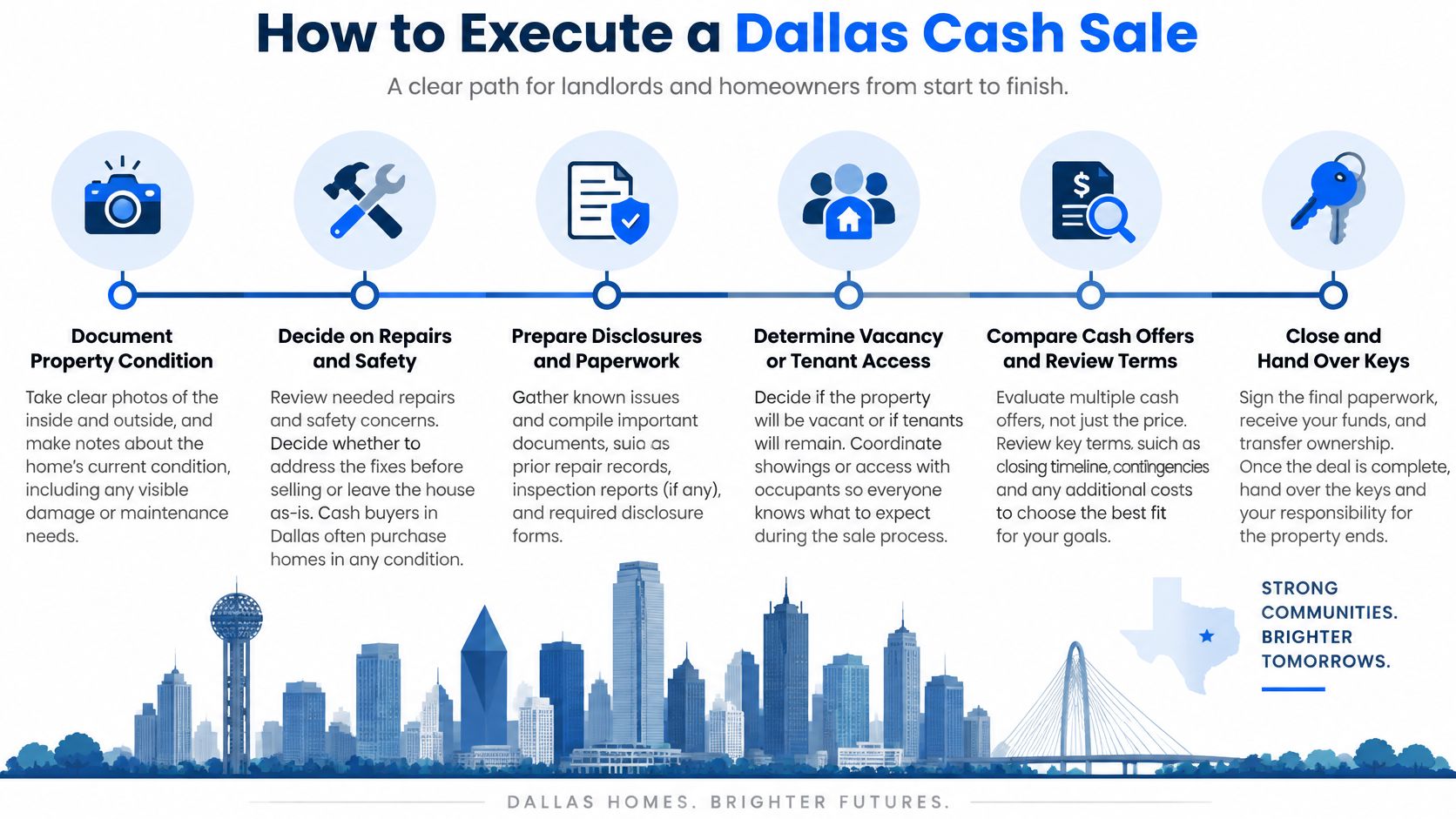
The process graphic below helps organize the information a buyer needs before those deductions can be evaluated.
Why the “70% rule” isn't your valuation
The “70% rule” is investor shorthand for a screening approach that reserves a share of repaired value for costs and profit before subtracting repairs. Don't accept it as a Dallas market standard, an appraisal, or proof that a proposed discount is justified.
A neighborhood's demand, renovation scope, resale strategy, and the buyer's financing can change the calculation. Ask for comparable sales and a breakdown of deductions instead of debating a slogan.
A Dallas condition-based example without invented discounts
Dallas-area median pricing was approximately $399,000 in the first quarter of 2026, according to D Magazine's market discussion. For a fictional house, use that amount only as a calculation starting point after local comparable sales support it, not as an automatic repaired value.
| Fictional condition scenario | Repair assumption to document | Offer calculation |
|---|---|---|
| Light repairs | Written scope for cosmetic work and limited maintenance | Supported repaired value minus light-repair bids and itemized buyer costs |
| Moderate repairs | Bids for roof, HVAC, plumbing, or other substantial systems work | Supported repaired value minus system-replacement bids and itemized buyer costs |
| Heavy repairs | Specialist scope for structural damage, extensive water damage, or major remediation | Supported repaired value minus remediation bids and itemized buyer costs |
These are condition categories, not established offer ranges. There isn't enough reliable evidence to promise a universal Dallas discount for any category.
Ask the buyer to distinguish foundation movement and clay-soil concerns from documented structural findings. Separately identify flood history, hail or roof damage, freeze-damaged pipes, aging electrical systems, air-conditioning or heating problems, and unpermitted work.
Negotiation rule: Every material deduction should connect to a documented expense, a stated assumption, or an identifiable risk.
For landlords, calculate your own minimum acceptable proceeds using rent received, vacancy, leases, utilities, insurance, taxes, and required remediation. Don't confuse the buyer's desired profit with your required discount.
Use the video as a process overview, not as a substitute for property-specific bids and contract review.
How to Execute a Dallas Cash Sale
Execute the sale by documenting the property, verifying the buyer, negotiating complete terms, and letting an independently verified title company coordinate ownership and money.
The practical sequence is offer → walkthrough → contract → title search → closing. Preparation should begin before you accept an offer, not after someone promises an immediate closing.
Prepare the house and the transaction file
Photograph the property and describe known damage, unfinished work, and safety concerns. Decide what you'll leave as-is, what requires immediate safety attention, and which belongings remain at possession.
Gather:
- Ownership records: Deed, identification, and documents establishing authority to sell.
- Financial records: Mortgage information, tax account, lien notices, and available payoff statements.
- Condition records: Repair invoices, inspection reports, warranties, and insurance claims.
- Occupancy records: Leases, deposit records, access arrangements, and proposed possession terms.
Obtain independent valuation opinions: one grounded in comparable sales and another showing repaired value less documented buyer costs. The Texas Real Estate Commission's Seller's Disclosure Notice resources provide the official starting point for the property-condition file.
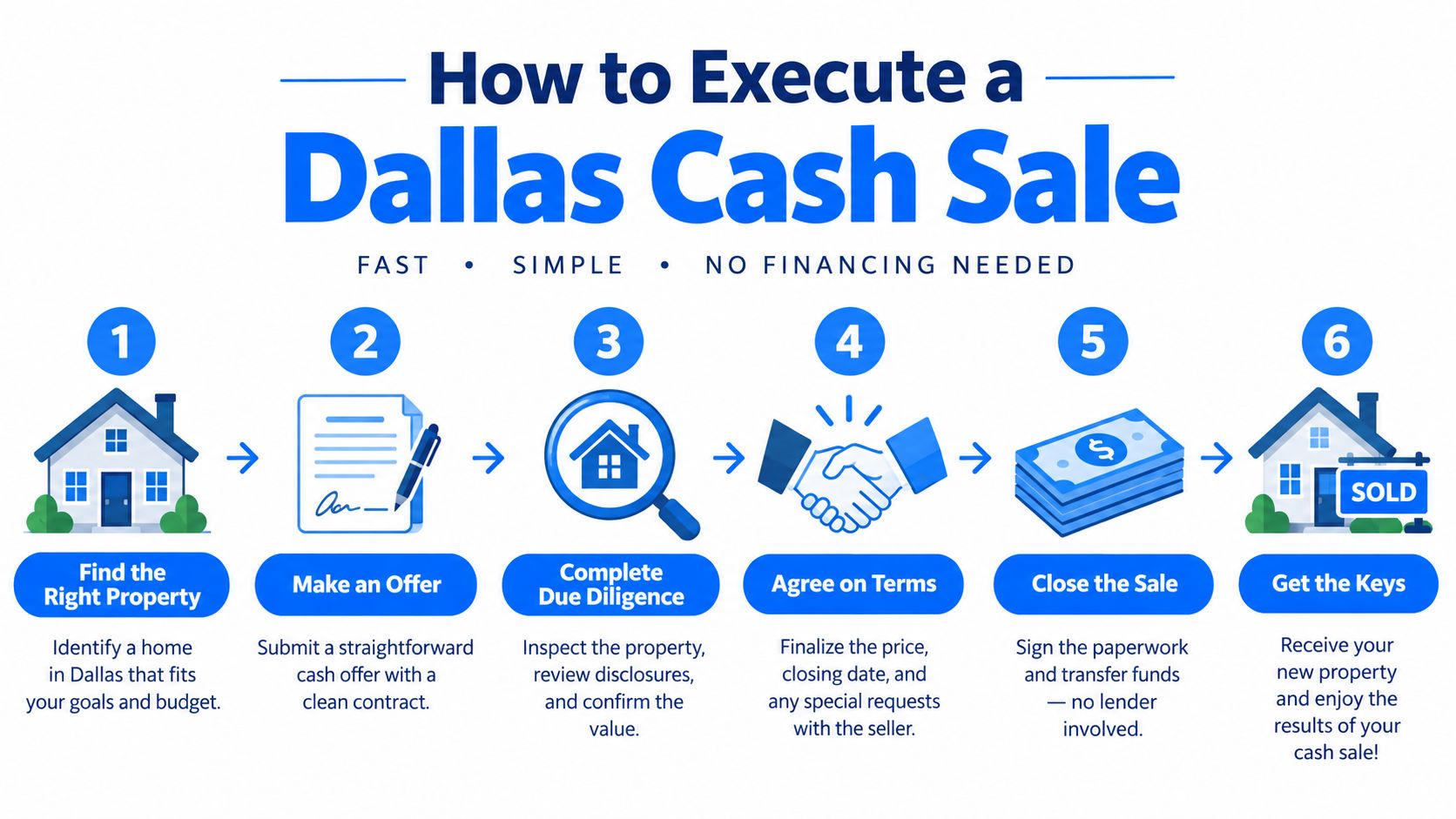
The timeline below keeps the operational milestones visible.
Verify the buyer before valuing the promise
Request current proof of funds, the purchasing entity's legal name, direct contact details, and the proposed title company. Independently contact the title company and review the buyer's public feedback for patterns involving cancellations, communication, or changed prices.
Pause if the buyer demands upfront fees or won't explain whether it intends to purchase or assign the contract. Wholesaling or assignment should be disclosed and addressed in the agreement, not discovered immediately before closing.
A detailed cash home-buying process overview can help you prepare questions, but the signed agreement controls your transaction.
Put the entire bargain in writing
The offer should identify the price, earnest money, inspection or feasibility period, termination rights, escrow provider, closing deadline, possession, assignment rights, and every seller deduction.
Ask when inspection rights expire and whether the buyer can cancel without a meaningful consequence. A high headline price with broad unilateral cancellation rights offers less certainty than it appears to.
After signing, confirm earnest-money delivery, title review, final payoff requests, and any required curative documents. Don't accept a late repair deduction without requesting the report, supporting estimate, and contractual basis.
Treat the opening timeline as an illustrative planning window, not evidence that a particular buyer can perform. Missing heirs, title defects, tenant complications, payoff errors, and incomplete buyer documentation can extend closing.
How to Handle Legal, Tenant, and Tax Complications
Route each complication to the person who can resolve it before agreeing to a closing date: title handles ownership and payoff coordination, attorneys handle legal authority and disputes, and tax professionals handle tax treatment.
The Texas Real Estate Commission Seller's Disclosure Notice, under Texas Property Code §5.008, addresses known material facts and physical condition for previously occupied single-family residences. Selling as-is doesn't erase those obligations, and not having lived in the property doesn't automatically excuse disclosure, as explained in the Texas REALTORS seller-disclosure guidance.
Identify who owns the property and who can sign
For an inherited property, distinguish the estate's executor from heirs who already hold ownership. An executor may qualify for an exemption that doesn't apply to heirs selling personally; foreclosure, court-ordered, and deed-in-lieu transfers also require separate analysis under the Texas REALTORS disclosure-requirements guidance.
Use an inherited-property sale preparation guide for Dallas to organize documents, then have counsel verify authority. Don't assume a family agreement, pending divorce, or possession of keys establishes the right to convey title.
Give each difficult condition a resolution path
- Pre-foreclosure: Give the title company and attorney the actual notices and deadlines. An unsigned offer isn't a completed solution.
- Liens, judgments, or back taxes: Request written payoff or release requirements and determine whether the available proceeds can satisfy them.
- Tenant occupancy: Provide the lease and establish written access, deposit accounting, notices, and possession terms with qualified guidance.
- Code violations or vacancy: Ask Dallas code enforcement and your title professional which open cases, security obligations, permits, or vacant-property requirements apply to the address.
- Fire, water, or hoarder conditions: Preserve photographs, insurance records, remediation information, and safe inspection access; specify responsibility for remaining contents.
For tenants and landlords asking does a sale end my lease, The Law Office of Bryan Fagan, PLLC offers a focused resource to review alongside the actual lease and legal advice.
Known defects shouldn't be hidden behind incomplete answers or blocked inspections. Concealment and misleading statements can undermine as-is protections and create misrepresentation disputes.
Keep tax and closing assumptions separate
Ask a tax professional whether you qualify for the home-sale capital-gains exclusion, commonly described as $250,000 for eligible single filers and $500,000 for eligible married couples filing jointly. These aren't automatic exemptions for every property or seller, particularly with rentals or inherited homes.
Have the local title company or attorney confirm whether any Texas transfer tax applies and identify the actual government recording charges. For applicable properties, also confirm federal lead-based-paint disclosures and MUD/PID notices before signing.
What to Verify Before Closing
Before closing, verify that the contract, title commitment, settlement statement, possession terms, and funding instructions all describe the same transaction.
Texas closings are typically handled through title companies rather than mandatory attorney closings, and deeds require proper acknowledgment for recording. The Texas closing-process guide also emphasizes independently verifying wire instructions, especially after an emailed change.
Check documents, money, and possession
- Documents: Match the deed, seller identity, signing authority, completed disclosure, leases, repair records, and insurance claims to the transaction.
- Title: Review the preliminary commitment, Schedule C requirements, ownership exceptions, and required releases.
- Money: Confirm final payoff figures, tax prorations, escrow charges, recording fees, seller credits, and policy coverage.
- Property: Complete the agreed final walkthrough and document keys, occupants, belongings, and possession timing.
- Records: Retain signed closing documents, the final settlement statement, payment confirmation, and recording confirmation.
A mortgage or lien doesn't automatically prevent a sale. The title company must coordinate an acceptable payoff and release, and the verified obligation reduces your proceeds.
Illustrative Dallas Seller Net Sheet
The earlier Dallas-area median is a market reference, not a claim that your property will sell for that amount. Use the worksheet below with actual written terms rather than invented standard fees.
| Line item | Illustrative amount or formula | Seller verification |
|---|---|---|
| Market reference only | Approximately $399,000 | Replace with property-specific valuation |
| Actual contract price | P = $_____ | Signed purchase agreement |
| Seller-paid repairs | R = $_____ | Agreed scope, if any |
| Title, escrow, and recording charges | T = $_____ | Title company estimate |
| Taxes and other prorations | X = $_____ | Settlement calculation |
| Commission, if applicable | C = $_____ | Listing or other signed agreement |
| Seller credits | S = $_____ | Contract and amendments |
| Mortgage and lien payoffs | M = $_____ | Current written payoff figures |
| Estimated closing proceeds | P − R − T − X − C − S − M | Reconcile with final settlement statement |
| Preclosing ownership expenses | H = $_____ | Your actual carrying-cost records |
| Net after carrying expenses | Closing proceeds − H | Compare alternatives consistently |
Call the title company using a previously verified phone number before sending money or accepting changed instructions. Don't rely on the number contained in the suspicious email.
Frequently Asked Questions
Can I sell my house as-is in Dallas without cleaning everything out?
Negotiate that explicitly. Identify which contents remain and whether removal costs are included in the price or deducted separately.
How much do you lose selling as-is?
There's no defensible universal discount. Compare your documented cash proceeds against a realistic listing net, not against an imagined fully renovated asking price.
Should I repair the foundation before selling?
Get a qualified assessment and written bids before deciding. Compare the likely improvement in net proceeds with the expense, delay, and execution risk of managing repairs yourself.
Can a cash buyer lower the price after inspection?
A buyer may propose a change, but your response depends on the contract and termination rights. Require documentation and don't treat a revised offer as something you must automatically accept.
Can I sell with back taxes or an outstanding mortgage?
Potentially, provided the obligations can be resolved through the closing arrangement. Ask title to confirm the required payments and whether a shortfall requires additional approvals or seller funds.
Do I need to remove tenants before selling?
Don't assume you do. Have the lease, applicable notice requirements, deposits, and buyer's occupancy plans reviewed before promising vacant possession.
What if the cash offer is higher than the agent's estimate?
Examine the deductions and cancellation rights before celebrating. A credible offer requires verified funding and executable terms, not just an attractive price.
Cyber Homes offers direct as-is purchases without agent commissions, providing another option to compare with an MLS listing or a different buyer. Visit Cyber Homes to request a property review, then use this checklist to compare the written offer, expected net proceeds, and closing conditions before deciding.
Edited by
James Vasquez
Real Estate Investor & Land Specialist with 10+ years experience in residential flipping, vacant land investing, land wholesaling, and subdivision deals.
Disclaimer: The information provided is for educational purposes and does not constitute financial or legal advice. Always consult with licensed professionals before making investment decisions.