
5 Best Ways of Selling Your Home by Owner in Tucson, AZ

Only 5% of recent U.S. home sales were by owner, according to the National Association of REALTORS®’ 2025 Profile of Home Buyers and Sellers. The best ways of selling your home by owner in Tucson, AZ, are full DIY FSBO, a flat-fee MLS listing, a privately marketed sale with professional closing help, a sale to someone you know, or an as-is cash sale. The right choice is the one that produces the best realistic net proceeds, not the smallest commission bill.

Five Ways to Sell Without an Agent, Compared
For a clean, competitively priced Tucson home, DIY FSBO or flat-fee MLS exposure can preserve more equity if you handle the work well. A known buyer or cash buyer can be a better fit when repairs, access, or a firm deadline matter more than achieving a retail price.
Last updated March 2026.
Five ways to sell without an agent in Tucson
| Option | Typical cost | Time to close | Effort | Best for |
|---|---|---|---|---|
| Full DIY FSBO | Photos, signs, advertising, title and escrow charges | Market exposure plus the buyer's closing period | Highest, you handle pricing through closing | Owners comfortable with marketing and negotiation |
| Flat-fee MLS listing | Broker's flat fee, selected add-ons, closing costs | Market exposure plus financing and escrow | High, showings and negotiations remain yours | Owners who want MLS distribution without full service |
| By-owner sale with attorney or title company handling closing | Marketing plus quoted legal, title and escrow fees | Marketing period plus document review and closing | Medium-high | Owners needing help with contracts or unusual ownership |
| Sale to someone you know | Minimal marketing, professional paperwork and closing costs | Set by financing, title clearance and agreed possession | Low marketing effort, substantial paperwork responsibility | Tenant, neighbor or family transactions |
| Cash buyer for an as-is sale | Usually a below-retail price in exchange for fewer selling tasks; compare all deductions | Written buyer-specific schedule | Lowest preparation and showing burden | Repair-heavy, inherited or time-sensitive properties |
None of these methods removes the need for a sound contract. A title company coordinates title and settlement work; it doesn't become your pricing adviser or your advocate in every negotiation. Likewise, an attorney can review legal terms without taking over photography, advertising or buyer follow-up.
The national price comparison deserves care. NAR's Profile reported a median FSBO price of $360,000, versus $425,000 for agent-assisted sales, and found that 60% of FSBO sellers already knew their buyer. Those figures describe different groups of properties and transactions, not a guaranteed gain from hiring an agent.
When the cash option makes sense
Cyber Homes buys houses in Tucson as well as Phoenix, Mesa, Glendale, Chandler and Scottsdale. We review the property and local sales before presenting a no-obligation cash offer, usually within 24 hours; our average time from the property being sold to closing is 7–14 days. We charge no commission and cover closing costs.
Get the offer amount, closing schedule and any conditions in writing. Use this comparison of Tucson cash-home-buying companies to evaluate alternatives, rather than assuming every cash contract works the same way.
For local verification, Pima County Recorder handles recording jurisdiction, and the Arizona Department of Real Estate is the state regulator. Shortlist the methods that fit your deadline, then compare their likely proceeds.
How to Price From Sold Comps, Not Asking Prices
A comparable sale shows what a buyer paid, while an active listing shows only what a seller hopes to receive. For a Tucson by-owner sale, start with recently closed homes in the same neighborhood and match property type, approximate living area, lot size, age, condition and amenities. Bedroom count alone is not enough: a central Tucson bungalow, a foothills property and an outlying Pima County house may attract different buyers and prices.
Build a defensible starting price
Use a 90-day comparable-sales window and adjust for material differences such as roof age, HVAC, pool condition, solar equipment and needed repairs. Realtor.com's Tucson market analysis describes this sold-comps approach. The asking price is a starting position, not a promise of what the home will sell for.
Make an adjustment worksheet. For each comp, record the sale price, relevant differences and your reasoning. If competing sales or a qualified valuation cannot support an adjustment, avoid presenting a precise premium as fact.
Check solar ownership and obligations before pricing. Owned equipment is different from leased or financed equipment, which may affect a buyer's decision. For renovations, keep permits and invoices available, but don't assume each dollar spent adds a dollar to the asking price.
Diagnose before reducing
Prepare professional photos, a measured floor plan and a disclosure package before launch. Set predictable showing availability, and keep the price and property details consistent across advertising channels.
- Views without appointments: Recheck the price, photos, listing accuracy and access restrictions.
- Showings without offers: Review buyer feedback about condition, layout and disclosures, then compare competing properties.
- Offers that repeatedly fail: Examine financing, appraisal, title and contract terms before blaming the advertising.
Choose an early review date before listing. Track inquiries, completed showings, written feedback and offers. These records help distinguish a pricing problem from limited access or a concern about the property.
Practical rule: Compare the likely benefit of waiting with the added ownership costs and transaction risk before holding out for a higher offer.
A tenant-access problem, unresolved probate authority or serious repair issue may make a traditional listing harder to manage. For sellers weighing speed against price, selling quickly while protecting market value is another approach to consider. A cash sale may suit a seller who values a simpler process, while a capable listing agent may be a better fit if you need help setting the price and managing buyer follow-up.
What You Actually Keep After Selling by Owner
Sale price minus loan payoff, selling costs and concessions equals the cash you keep. Set a supportable asking price first, then work out the likely net. A moving budget is not evidence of market value.
The 2025 MLS of Southern Arizona Residential Market Overview reported a $355,000 Southern Arizona median sale price, 35 days of typical market exposure, and buyers paying an average of 2% below asking. Use these as regional planning benchmarks, not as a Tucson neighborhood valuation or a promise about how long your home will take to sell.
Illustrative net proceeds for a by-owner sale
This worked example uses the regional median as a hypothetical asking price, then applies the reported discount. Because the median is itself a closed-sale measure, the arithmetic is for comparison, not a forecast.
| Line item | Illustrative amount | Source or note |
|---|---|---|
| Sale price | $347,900 | Hypothetical $355,000 asking price less 2% |
| Commission you would have paid at 5% | $17,395 | Comparison only, not an FSBO deduction |
| Photos and measured floor plan | $500 | Illustrative assumption |
| Flat-fee MLS listing | $500 | Illustrative assumption; actual services and add-ons vary |
| Title and escrow fees | $2,000 | Illustrative allowance; request a seller-specific estimate |
| Recording and transfer fees | $100 | Illustrative allowance; applicability and charges depend on the transaction |
| Optional buyer-agent compensation at 2.5% | $8,697.50 | Assumption, payable only if agreed |
| Repair credit or concession | $3,000 | Hypothetical negotiated credit |
| Carrying costs for 35 days | $2,333.33 | Illustrative monthly ownership outflow of $2,000 × 35/30 |
| Net cash after payoff and all costs above | $330,769.17 minus loan payoff | Subtract actual seller expenses, not the comparison commission |
Apart from the regional median and the calculation based on the reported discount, the dollar amounts are illustrative assumptions, not local fee quotes. Replace them with estimates for your property and transaction before relying on the net.
What the savings really mean
In this example, photos, the buyer-agent payment and the repair credit total $12,197.50. That is $5,197.50 less than the assumed commission comparison, before MLS charges, title and escrow costs, recording charges and carrying costs.
The comparison does not prove that selling by owner will cost less. An agent-assisted sale may also include concessions and closing costs, while its final sale price may differ. Compare both options using the same property condition and realistic terms.
For a vacant home, each additional ownership period brings bills without rental income. Include mortgage payments in your cash plan. When assessing economic cost, remember that principal payments also reduce the eventual loan payoff.
Write down your expected net as one number, using actual estimates for fees and carrying costs. Then compare a cash offer against that figure, not against your asking price.
Buyer's Agent Pay After the 2024 NAR Settlement
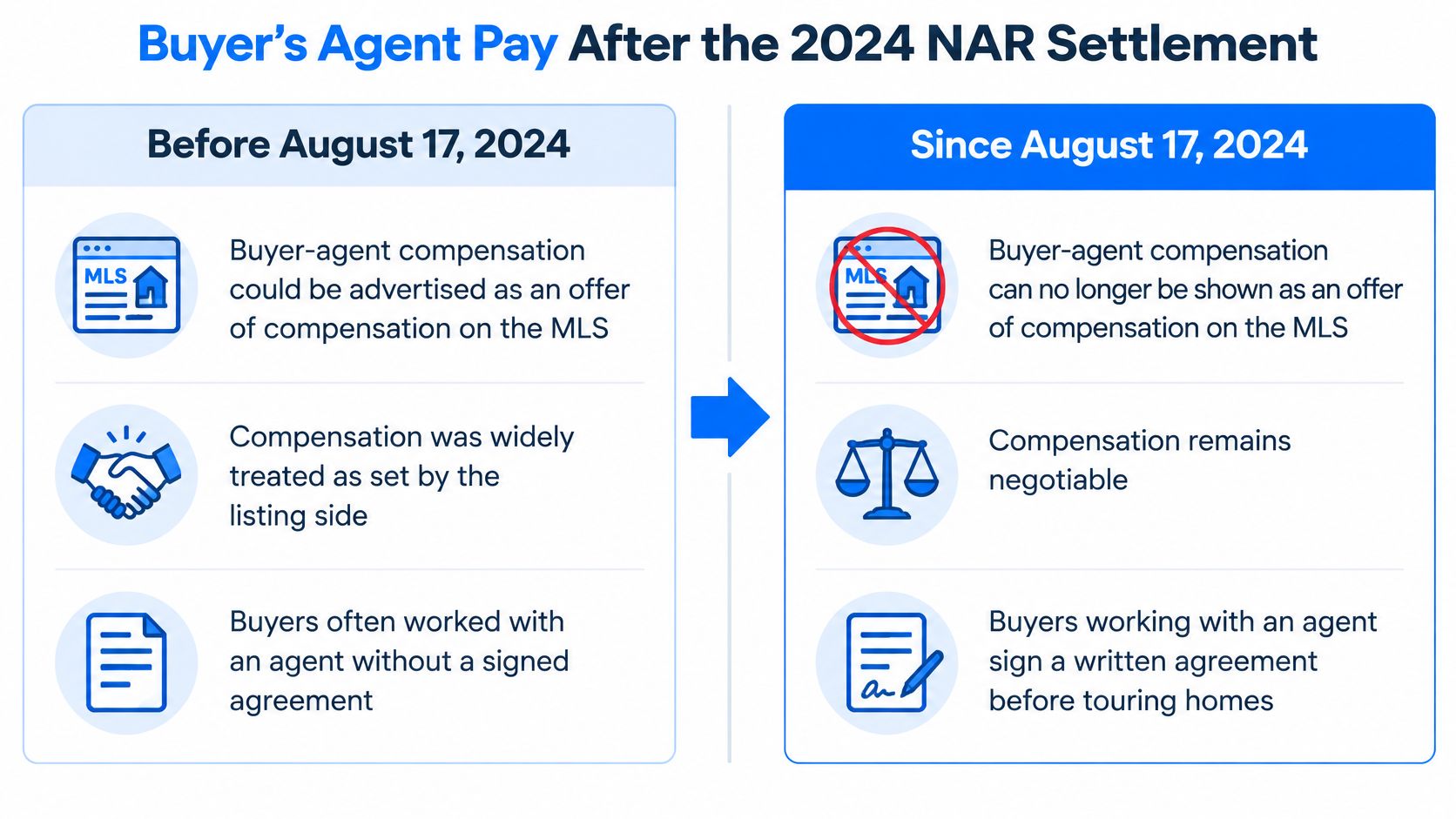
A seller does not automatically owe the buyer's agent a fee. Under NAR's 2024 settlement changes, buyer-agent compensation generally can no longer be displayed as an offer of compensation in the MLS. The amount remains negotiable, and buyers working with an MLS-participating agent generally sign a written buyer agreement before touring.
The comparison below shows how the process changed. Compensation was negotiable before the settlement, too.
Your choices as a Tucson seller
- Offer no contribution: The buyer handles compensation under their agreement. Your stated proceeds are protected, but a buyer with limited cash may lower the offer or be unable to proceed.
- Agree to a specific payment: Negotiate an amount outside the MLS compensation display. Assess the full offer before accepting a fee request, and specify who receives payment and what conditions apply.
- Offer a seller concession: A credit may help the buyer complete the purchase, but the contract and lender limits determine how it can be used. A general credit does not automatically cover an agent's fee.
A buyer's agreement alone does not obligate you to pay. Your obligation depends on what you agree to in the transaction documents.
Negotiate the offer as a package. A higher price paired with a larger contribution may leave you with less than a lower offer without one.
Put the agreement in precise language
Specify the payer, recipient, amount, payment timing and conditions in the contract. Avoid vague wording such as “I'll take care of the agent” or “I'll pay what's customary.”
Ask the title or escrow company how the payment will appear on the settlement statement. If the wording is unusual or agreements conflict, have an Arizona real-estate attorney review the terms before acceptance.
A flat-fee MLS service provides exposure under its service agreement, not automatic full representation. You remain responsible for pricing, disclosures, appointments, negotiations and deciding whether to contribute toward the buyer's representation. Read the broker's package carefully so you know who drafts changes and responds to calls from a buyer's agent.
Arizona Disclosures, Paperwork and Closing Costs
An as-is clause can limit agreed repair obligations, but it doesn't erase the duty to disclose known material facts. It also doesn't override a separate repair promise you sign later.
The Arizona Department of Real Estate's Residential Seller's Property Disclosure Statement guidance explains that the disclosure duty remains even when the parties agree not to provide an SPDS; the common delivery timing is within five days after contract acceptance. Confirm the actual deadline in your contract rather than relying on a general timetable.
Match the documents to the property
Arizona doesn't mandate a single universal residential disclosure form, although the SPDS is commonly used. Arizona FSBO legal guidance from KEYTLaw also explains that an as-is provision doesn't excuse concealment and that homes built before 1978 trigger federal lead-paint disclosure requirements.
The SPDS covers property history and conditions, including asbestos, radon, lead-based paint, pesticides, underground tanks, and fuel or chemical storage. Disclose known roof leaks, water intrusion, soil movement, foundation concerns and unpermitted work accurately. Don't replace facts with reassurance such as everything is fine now.
For rural property, the Arizona Department of Real Estate's Buyer Advisory identifies an Affidavit of Disclosure requirement when a buyer purchases five or fewer parcels, other than subdivided land, in an unincorporated county area.
Arizona disclosure requirements by case
| Situation | Document or rule | Verify with |
|---|---|---|
| Any as-is sale in Arizona | Known-material-fact disclosure; common SPDS delivery timing described above | Title or escrow company |
| Older home covered by the federal age threshold | Federal lead-based paint disclosure package | Title or escrow company |
| Qualifying parcels in unincorporated Pima County | Affidavit of Disclosure, distinct from the SPDS | Title company or Arizona attorney |
| Parcel inside Tucson or another municipality | Confirm applicable city-specific requirements | City of Tucson or relevant municipality |
| Property in an HOA | Required resale documents and applicable charges | HOA management company |
| Possible point-of-sale inspection or certificate | Confirm whether any applies; none is assumed | City of Tucson or Pima County |
A Tucson mailing address doesn't establish municipal jurisdiction. Confirm the parcel's actual location and subdivision status before deciding which documents apply.
Closing and cost verification
Arizona title and escrow companies commonly coordinate residential closings. Consider separate legal advice for probate authority, tenant disputes, trust ownership or competing ownership claims; escrow isn't a substitute for legal representation.
Don't assume the seller pays every title charge or that the buyer pays every recording charge. Ask for a written estimate separating owner's title insurance, lender's title insurance, escrow, recording, prorations and other charges, then negotiate allocation in the contract. Confirm whether any transfer-related charge applies instead of importing another state's tax rules.
Before advertising, create a disclosure file with repair invoices, permits, warranties, inspection reports and insurance claims. Call the relevant offices and your closing professional to confirm requirements for the specific parcel. Complete records make it easier to answer questions consistently and avoid late surprises.
Screening Buyers and Protecting Your Earnest Money
Verify the buyer, define the contract and keep transaction money with neutral escrow. An enthusiastic buyer isn't necessarily a qualified buyer, and a high offer isn't useful if the financing can't close.
The 2025 Profile of Home Buyers and Sellers provides national context for buyer relationships and FSBO transactions. For your sale, the practical protection is transaction-specific documentation, not confidence based on how the buyer found you.
Verify before accepting
For a financed offer, request a lender preapproval and permission to confirm its status with the loan officer. Ask whether income, assets and credit have been reviewed, and which conditions remain.
For cash, request proof of funds sufficient for the purchase. A redacted statement or institution letter should identify the account holder and be recent enough to verify. A financed buyer may also need to demonstrate funds for the down payment, closing expenses and any appraisal shortfall.
- Compare complete terms: Evaluate net proceeds, financing type, contingencies, closing date and possession.
- Ask about FHA or VA financing early: Appraisal or property-condition requirements may require repairs before funding. A low appraisal can also trigger renegotiation or cancellation under the contract.
- Resolve document problems: Gather the deed, prior title policy, payoff information, permits, utility records, warranties, HOA documents, leases and disclosures before marketing.
Control the contract and the money
Use a written purchase contract defining earnest money, inspection and appraisal deadlines, included personal property, repairs and possession. Require the deposit to go to the title or escrow company, never your personal account.
Earnest money isn't automatically yours if the buyer cancels. Release and forfeiture depend on the agreement, contingencies and applicable procedures.
Hypothetical wire-fraud scenario: An email appears to come from escrow shortly before closing, announcing a replacement bank account. The logo looks correct, and the message contains your property address.
Don't use the email's phone number to verify it. Call the closing professional using a number you already independently confirmed, and treat last-minute instruction changes as a warning sign. Review these cash-home-buyer scam warning signs before sharing sensitive documents or signing unfamiliar terms.
For showings, prescreen visitors, verify identities, avoid meeting strangers alone and secure valuables, medications and financial records. Keep a showing log, and don't leave unrestricted access instructions in public posts.
Frequently Asked Questions About Selling by Owner in Tucson
You can sell without a listing agent, but you still need professional-grade paperwork and closing controls. These are the questions to settle before accepting an offer.
Do I need a real-estate license to sell my own home?
An owner selling their own property generally doesn't need a license. Confirm with the Arizona Department of Real Estate before paying an unlicensed person to market the property or negotiate on your behalf.
Who pays the buyer's agent now?
The buyer's agreement governs their obligation to their agent. You pay a contribution only if you agree to it, so evaluate the requested payment alongside price and other concessions.
Does selling as-is protect me from disclosure claims?
No. Refusing repairs doesn't authorize withholding known material facts. Describe what you know accurately and preserve the supporting documents.
Do I need a lead-paint disclosure?
Yes, if the home falls within the federal preconstruction-date threshold described in the disclosure requirements. Have escrow confirm the construction date and provide the complete applicable package before you sign.
How long does a by-owner sale take?
Allow time for both finding a buyer and completing closing. Repairs, restricted tenant access, an unsupported asking price or unresolved title can extend either stage; don't schedule your move around an assumed immediate sale.
Do I need an attorney?
Not every straightforward transaction requires separate counsel. Legal review is particularly useful for probate, disputed repairs, tenant rights, trust authority or unusual title issues.
Where does earnest money go?
To the named title or escrow company under the signed contract's deposit instructions. Don't accept it personally or assume a screenshot proves that the deposit cleared.
Your Pricing-to-Closing Checklist Before You List
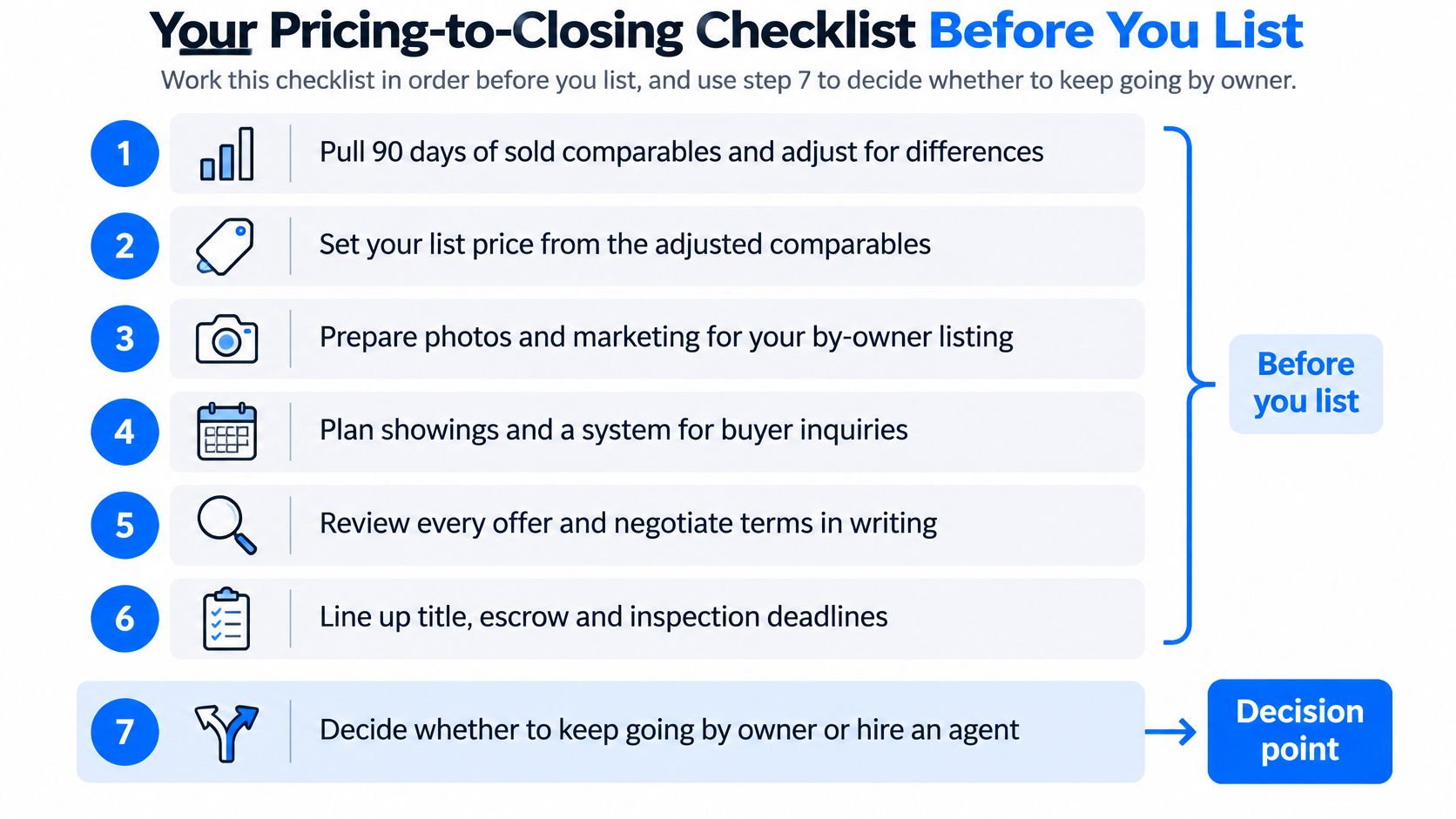
Work in order, and use your net calculation as the decision point before spending more on marketing. If the numbers don't support your deadline or repair budget, change the selling method before committing to an open-ended listing effort.
This visual provides a compact overview of the selling tasks.
Prepare the property and the decision
- Build the comparable-sales worksheet. Use closed properties and document meaningful differences rather than selecting only the highest prices.
- Set the asking price. Choose a defensible starting position and put a review date on your calendar.
- Assemble the property file. Collect ownership, payoff, lease, permit, repair and warranty records.
- Verify parcel requirements. Confirm jurisdiction, subdivision status and any affidavit, resale package or certificate.
- Complete disclosures. Answer from actual knowledge and attach explanations where a checkbox would be misleading.
- Choose your compensation policy. Prepare clear language for any contribution you're willing to negotiate.
- Approve the projected net. Use written quotes and your actual payoff to decide whether DIY selling remains worthwhile.
If your budget assumes a perfect offer, no inspection credit and no delays, revise it before launching. A listing agent may be the better choice when you need broad exposure but can't reliably manage appointments and negotiations.
Manage the sale through settlement
- Launch consistent marketing. Use professional images, a measured floor plan and a reliable appointment system.
- Track buyer response. Review inquiries, showings and specific objections at your scheduled checkpoint.
- Verify each serious offer. Confirm financing or funds before comparing proceeds and contingencies.
- Open escrow under the signed agreement. Calendar the deposit, inspection, appraisal and closing obligations.
- Authenticate settlement instructions. Verify wires by phone and review the final statement before authorizing closing.
For another explanation of the selling process, watch the video below.
Keep your decision grounded in the property you own. An inherited house with uncertain authority needs a different preparation plan from a move-in-ready home, and a repair-heavy property needs a financing strategy as well as advertising.
Cyber Homes offers an as-is cash purchase without commissions or seller-paid closing costs, giving you a concrete alternative to compare against your by-owner net. Visit Cyber Homes to request a no-obligation cash offer before committing to repairs or listing expenses. Submitting your information doesn't obligate you to sell or obligate us to purchase the property.

Edited by
James Vasquez
Real Estate Investor & Land Specialist with 10+ years experience in residential flipping, vacant land investing, land wholesaling, and subdivision deals.
Disclaimer: The information provided is for educational purposes and does not constitute financial or legal advice. Always consult with licensed professionals before making investment decisions.