
5 Best Ways of Selling Your Home by Owner in Houston, TX

Houston recorded 88,634 single-family home sales in 2025, according to the Houston Association of Realtors, but a busy market doesn't guarantee a profitable by-owner sale. The five best ways of selling your home by owner in Houston, TX, are full DIY marketing, flat-fee MLS exposure, a professionally managed closing, a sale to someone you know, or an as-is cash sale. Choose by net proceeds, workload, and closing certainty, not commission savings alone.

Five Ways to Sell Without an Agent Compared
A Houston owner can sell without a listing agent through any of these approaches, but each trades savings for work, risk, or a lower price. They aren't mutually exclusive: you can buy flat-fee MLS exposure and still hire an attorney to review your contract.
Five ways to sell without an agent, side by side
| Option | Typical cost to you | Effort | Best for |
|---|---|---|---|
| Full DIY sale, you list and market | Photos, signage, marketing, plus title and closing fees | High | Owners with time, local sales data, and a buyer network |
| Flat-fee MLS listing | Flat listing fee plus closing costs | Medium | Owners who want MLS exposure and will run showings |
| By-owner sale with title company or attorney | Attorney or title fees plus closing costs | Medium to high | Owners who want control and professional closing support |
| Sale to someone you know | Closing costs, usually little or no marketing | Low to medium | Tenants, neighbors, or relatives with an acceptable price |
| As-is sale to a local cash buyer | Usually no commission; price generally below retail | Low | Urgent sales, repair-heavy homes, inherited property, or tenant issues |
Time to close follows the buyer and contract, not the marketing label. A financed DIY, MLS, or known-buyer transaction must accommodate underwriting, appraisal, and title clearance. Attorney involvement doesn't eliminate those steps; a cash transaction removes lender underwriting but still needs clear title.
Watch the weak point in each approach:
- DIY: You carry pricing, advertising, negotiation, and screening risk.
- Flat-fee MLS: Check who handles inquiries, listing changes, cancellations, and contract questions. Exposure isn't representation.
- Professional closing: A title company handles settlement, not your negotiating strategy. Engage an attorney before signing if you need legal advice, rather than adding that expense after a dispute.
- Known buyer: Convenience can hide an unsupported price or financing problem.
- Cash buyer: Compare the discount against repairs, carrying costs, and uncertainty avoided.
For the cash option, Cyber Homes reviews the property and local sales, usually presents a no-obligation offer within 24 hours, and has an average sale-to-closing time of 7–14 days. Our Houston as-is cash-sale guide explains the practical trade-offs.
Nationally, the NAR 2025 Profile of Home Buyers and Sellers put FSBO at 5% of sales, with a $360,000 median versus $425,000 for agent-assisted sales, and reported that 60% of FSBO sellers already knew the buyer. Those different buyer relationships and property mixes help explain the gap; it doesn't prove that an agent caused the higher price or that avoiding one automatically improves your net.
Settlement Statement Lines and Required Paperwork in Houston
A by-owner seller still pays the seller-side obligations assigned by the contract. Mortgage payoffs, title charges, tax prorations, and negotiated concessions can matter more than your photography budget.
Ask for a preliminary seller net sheet before accepting an offer. For a financed transaction, ask which Closing Disclosure and seller settlement documents you'll receive; for cash, request an itemized settlement statement, commonly an ALTA-style statement. Don't rely on someone calling everything a HUD-1.
This visual groups the costs and documents you should reconcile.
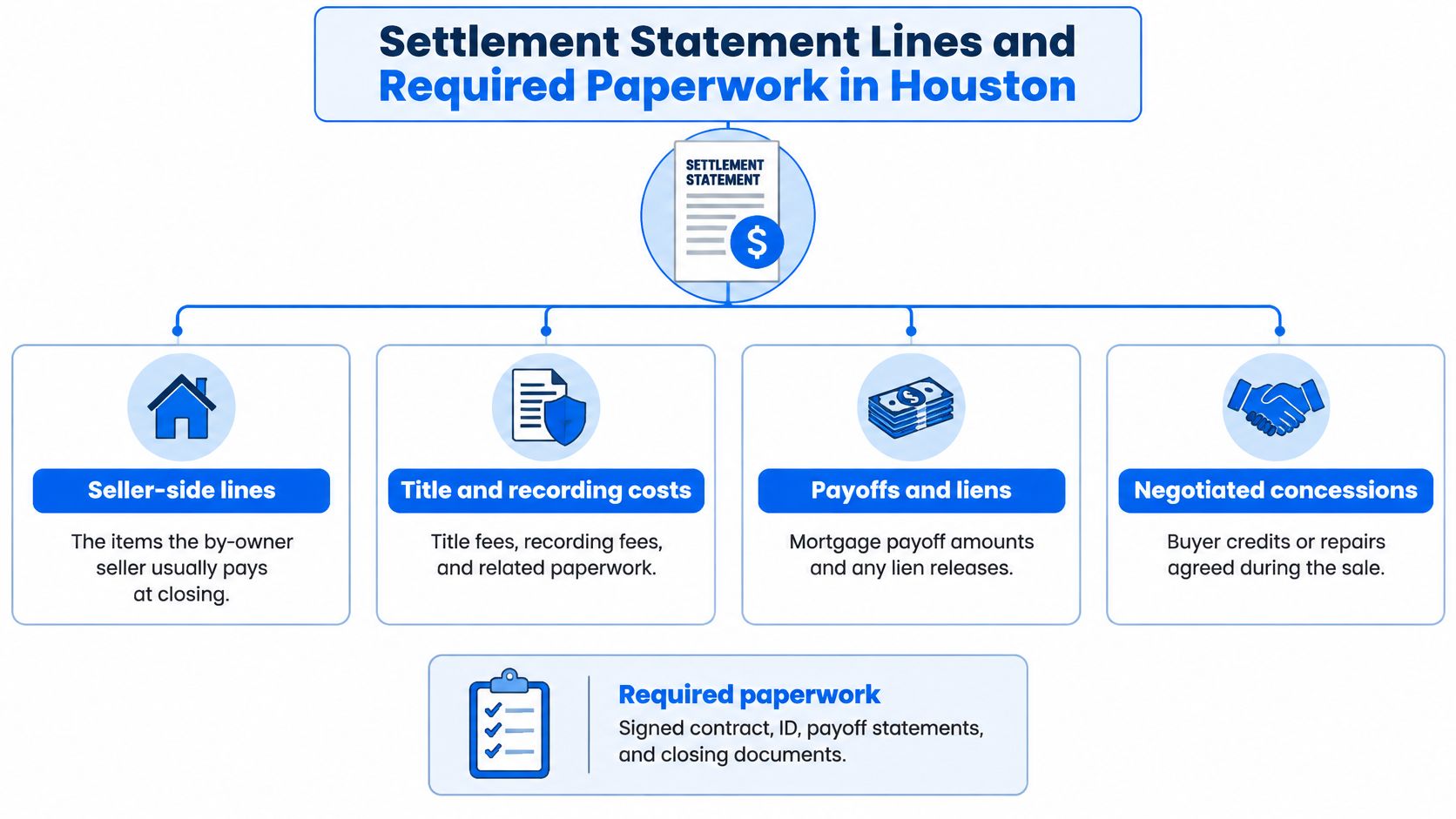
Read the charges before negotiating the price
The sales price starts the calculation, but it isn't your check. Title insurance addresses covered ownership risks, while the escrow fee pays for settlement services.
Recording charges cover documents filed in public records. Mortgage payoffs include the lender's actual payoff demand, not the balance on your last statement.
Taxes are allocated through closing adjustments. HOA documents and surveys are separate items, and buyer-agent payments or repair credits arise only from agreed terms.
Seller-side settlement lines in Houston
| Settlement line | Who usually pays in Houston | Typical cost |
|---|---|---|
| Sales price | Seller receives the agreed price | Contract price |
| Owner's title insurance policy | Commonly seller, subject to contract | Applicable Texas Department of Insurance premium |
| Escrow or closing fee | Negotiated, often split | Written title-company quote |
| Deed and lien release recording | Party assigned in the contract | Applicable county clerk fee schedule |
| Mortgage payoff and liens | Seller | Current lender and lienholder payoff demands |
| Prorated property taxes | Allocated by closing date | Calculation using the applicable tax bill and contract |
| Transfer tax | No Texas state transfer tax | No state transfer-tax charge; verify other filing charges |
| HOA resale certificate | Often seller, subject to contract | Association or management-company quote |
| Survey | Party assigned in the contract | Accepted existing survey or surveyor's replacement quote |
| Buyer-agent compensation, if offered | Seller, by negotiation | Agreed amount |
| Seller repair credit or concession | Seller, by negotiation | Agreed amount |
Confirm these allocations and charges in writing with your title company. In Houston, check the property's actual county before requesting recording information: Harris County is the starting point for many addresses, but Houston also extends into Fort Bend and Montgomery counties.
Assemble the document file early
Texas title companies usually coordinate closings; hiring your own real-estate attorney is optional but useful when you need advice about obligations or ownership.
- Seller disclosure: Obtain the Texas Real Estate Commission Seller's Disclosure Notice and confirm applicability, exemptions, and delivery requirements under Texas Property Code Section 5.008.
- Lead-based paint: For a home built before 1978, arrange the applicable federal lead-paint disclosure package before contracting.
- Association and district documents: Ask title to identify HOA resale documents and any municipal utility district notices that apply. Don't assume they're interchangeable.
- Local certificates: Confirm with the City of Houston and the property's county whether a point-of-sale inspection or certificate applies. Don't order a generic inspection package on an unsupported assumption.
- Ownership records: Supply identification, payoff authorizations, existing surveys, repair records, leases, and estate or divorce documents where relevant.
Practical rule: Resolve document questions before a buyer's deadline turns them into a negotiating problem.
Pricing From Recent Sales, Not Asking Prices
Price from recent closed sales in your neighborhood, not an online estimate or another owner's ambitious asking price. County-wide comparisons are a starting filter, not proof that homes in different school zones or subdivisions are interchangeable.
Redfin's Houston housing-market report reported an approximately $330,000 median sale price for the three months ending October 2026, with homes averaging 54 days on market and prices down 5.5% year over year. That median is a benchmark, not an appraisal of your house.
Build a defensible price range
- Collect comparable closings. Start with the same subdivision or school zone, matching property type, size, age, bedroom count, and condition. If you widen the search, record why each additional property belongs.
- Adjust for buyer-visible differences. A replacement roof, enclosed garage, pool, updated kitchen, or larger lot can change the comparison. So can foundation movement, drainage concerns, prior flooding, or deferred maintenance. Don't assume your renovation spending returns dollar for dollar.
- Read active listings as competition. Compare your photos, condition, and price against the houses buyers can tour today. An unsold asking price doesn't establish what anyone will pay.
- Set a review date before launch. Evaluate qualified inquiries, completed showings, feedback, and offers together. Few inquiries can indicate weak exposure or price; repeated showings without offers call for a closer look at condition and competing choices.
- Calculate the cost of waiting. Add mortgage cash outflow, property taxes, insurance, utilities, lawn care, pool service, and necessary upkeep. Avoid counting escrowed taxes and insurance twice.
For a hypothetical carrying-cost example, assume monthly ownership cash outflow of $3,000. Waiting two months uses $6,000 before a price reduction or additional repair, so a seemingly stronger offer can still leave less cash.
Make the listing support the price
Use professional-quality photographs after cleaning, decluttering, and addressing obvious defects. Publish accurate room details, included appliances, improvements, and showing instructions across the channels you choose.
Our guide to selling quickly without abandoning market value can help frame that balance.
An asking price is a proposal. A comparable closing is evidence.
Write down your supported price range, review date, and monthly carrying-cost figure. Those are the inputs for a decision, not just a listing advertisement.
Calculating Your Real Net on a Houston Sale
Your real net is sale proceeds minus the costs and obligations you pay. An avoided commission improves the comparison against an agent-assisted sale, but you don't subtract a fee you never paid from your FSBO proceeds.
Use the following visual as a checklist of inputs, then calculate from your actual settlement figures.
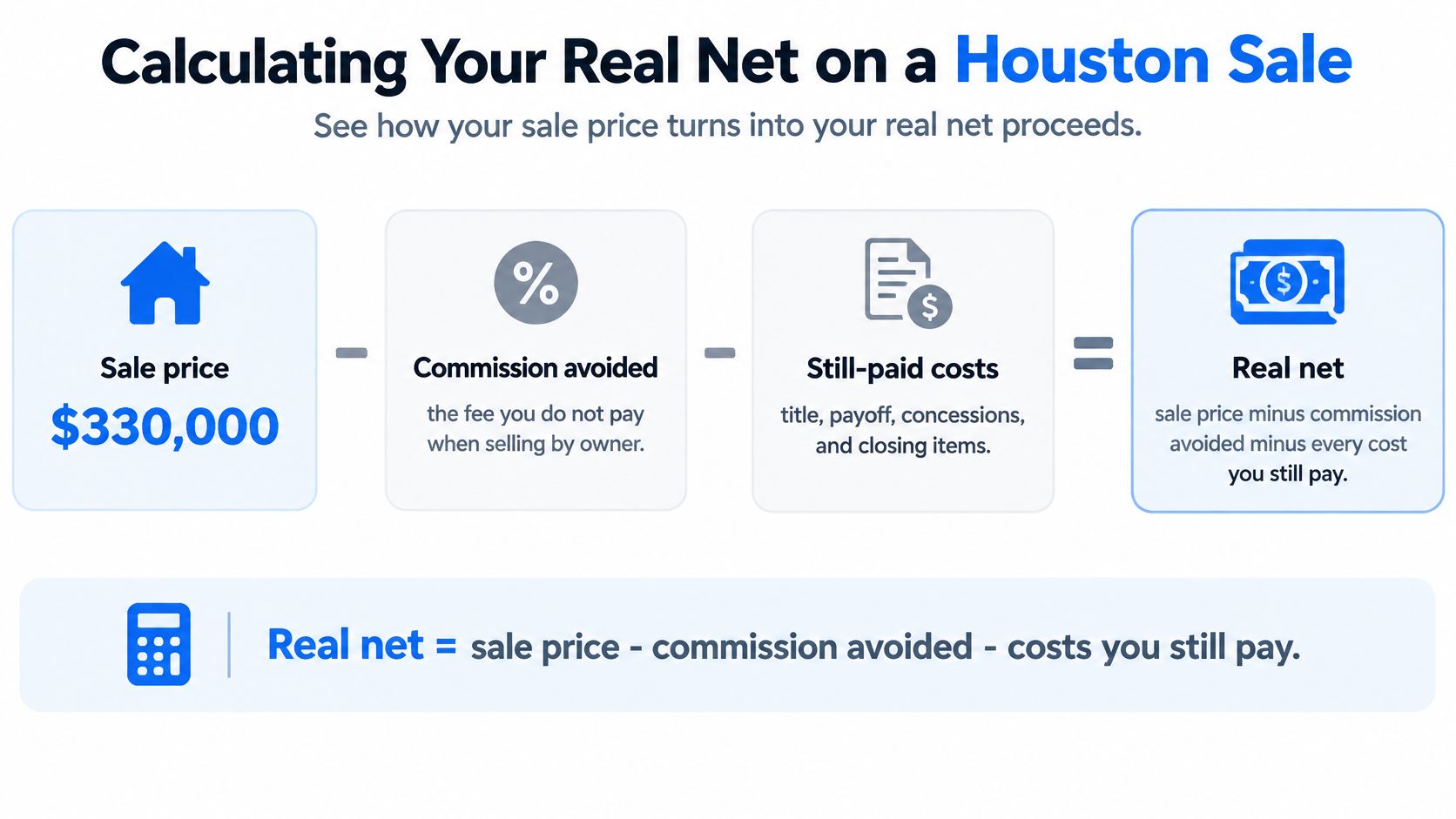
Separate the savings comparison from the proceeds calculation
Here's a hypothetical example, using the market benchmark discussed earlier solely as an assumed contract price. These are assumptions, not Houston fee quotes or standard commission rates.
- Assumed sale price: $330,000.
- Assumed commission comparison: If a written listing proposal charged 5.5%, that would equal $18,150. Check whether that proposal includes buyer-side compensation; don't treat a combined fee as listing-only savings.
- Assumed owner marketing: $400 for photos plus $500 for flat-fee MLS service equals $900.
- Assumed optional buyer-agent payment: 2% equals $6,600.
- Remaining apparent savings: $18,150 − $900 − $6,600 = $10,650, before any additional FSBO-only legal expense or difference in sale price, concessions, or time.
That last figure isn't your net proceeds. Under these assumptions, proceeds begin at $322,500, calculated as $330,000 − $900 − $6,600, before title charges, recording fees, payoff obligations, tax adjustments, concessions, and other applicable costs.
Get written title and escrow quotes, then add an attorney fee only if you hire one. Costs both routes would incur aren't automatically extra FSBO expenses.
Choose your buyer-agent payment strategy
According to HAR's explanation of the compensation changes, since August 17, 2024, buyer-agent compensation offers can't appear through the MLS; compensation remains negotiable, and buyers working with an MLS participant must sign a written agreement before touring that identifies services and compensation terms.
Your choices are:
- Contribute outside the MLS: Agree to pay some or all of the buyer agent's agreed compensation.
- Offer an eligible concession: Advertise buyer closing-cost assistance through the MLS without conditioning it on paying or using a buyer broker.
- Make no contribution: Leave compensation to the buyer's written agreement and evaluate how that affects the buyer's ability to complete the purchase.
Compare a cash offer using its own itemized net sheet. Remove only expenses that disappear, include any costs the buyer covers, and apply the same mortgage payoff to both alternatives.
Replace every assumed amount with a written quote or signed term before deciding.
Screening Buyers and Protecting Earnest Money
Verify the buyer's financing before committing to their offer, and have the contract name an established title or escrow company to hold earnest money. Never hold the deposit personally.
Realtor.com characterized Houston as a buyer's market in October 2026, reporting 53 median days on market. In a negotiable market, a high offer with weak financing can cost you valuable marketing time.
A funding discussion should establish who is buying and where the money will come from.

Run checks at each commitment point
- Before entry: Confirm identity and appointment details. Secure medications, documents, weapons, and valuables; don't conduct unrepresented-buyer tours alone. Use controlled access and change temporary lockbox codes after use.
- Before acceptance: Read the preapproval letter and, with permission, confirm financing status with the lender. Preapproval isn't a guarantee. Cash buyers should provide current, verifiable proof of accessible funds, with sensitive account information redacted.
- Before spending on repairs: Require written offer terms, deposit deadlines, inspection rights, financing conditions, and closing dates. Confirm earnest-money delivery with escrow.
- Before agreeing to lender-related repairs: Ask how the loan program affects property eligibility. FHA or VA appraisal requirements can trigger safety or condition repairs, including paint, roof, or other defects. Put the agreed scope and responsibility in writing.
A cash offer still requires identity checks, title review, lien resolution, and payoff coordination. Use this home-buyer scam checklist to evaluate pressure tactics and unexplained contract changes.
The video offers additional context for evaluating the transaction.
Protect the final handoff
Wire-fraud warning: Confirm wiring instructions by calling a trusted, independently obtained title-company number. Never rely on an emailed account change or the phone number included with that change.
Don't release keys until the closing team confirms completed documents, funding, and authorized possession. Tenant occupancy, probate, inherited ownership, divorce orders, or foreclosure deadlines warrant attorney review before you promise a closing or vacant possession.
Choose and Sequence Your Steps
Choose FSBO when its expected net, after waiting and execution risk, beats the alternatives and you can manage the work. A move-in-ready house with strong comparable sales is a better DIY candidate than a property with unresolved ownership or major condition problems.
The Houston Association of Realtors' March 2026 market report recorded 34,898 active single-family listings, 4.7 months of supply, and 67 average days on market. Those figures describe market exposure, not a guaranteed closing timeline for your address.
Apply the break-even test
Take your expected FSBO proceeds and subtract carrying costs through your realistic closing date. Compare that result with each cash offer's net proceeds, accounting for repairs avoided and closing costs covered.
A cash sale can fit repair-heavy, inherited, tenant-occupied, or deadline-driven situations. It doesn't automatically win. An agent may justify the expense when unusual features, a difficult price range, or your schedule make broad exposure and negotiation hard to manage.
Use this order:
- Establish value: Pull closed comparables and set a price-review date.
- Prepare documents: Assemble applicable disclosures, association records, and ownership paperwork.
- Price the closing: Obtain written title, escrow, and legal quotes.
- Launch carefully: Finish photos and descriptions, then establish screening and showing procedures.
- Control the contract: Confirm financing, earnest-money custody, deadlines, and wiring verification.
- Document concessions: Put repair responsibilities and credits in writing.
- Choose by proceeds: Compare the final expected net with a written cash alternative.
Decision threshold: Don't spend money preparing for retail buyers until you've priced both the retail route and the as-is alternative.
Keep the cash benchmark available through negotiation. A price reduction, new repair demand, or delayed closing can change which route leaves you better off.
Frequently Asked Questions About Selling Your Houston Home Without an Agent
Do I need a real-estate attorney to sell by owner in Houston?
Usually, you can use a title company without hiring your own attorney. Legal review is particularly useful for custom terms, disputed ownership, estates, and deadline-sensitive transactions; title services aren't a substitute for your own legal advice.
Who pays for the owner's title policy in Texas?
The seller commonly pays, but the contract controls. Request the applicable premium and any endorsements on your written title quote.
Is there a Texas state transfer tax?
Texas doesn't levy a state transfer tax. Recording and other closing charges are separate, so confirm the applicable fees with the Harris County Clerk or the clerk for your property's actual county.
Do I need a lead-paint disclosure?
For older housing subject to federal lead-disclosure requirements, arrange the disclosure package before signing. Give the closing professional the construction year rather than assuming a renovation removed the obligation.
Can I offer buyer-agent compensation?
Yes. Keep the offer outside the MLS, negotiate the amount, and document exactly what you've agreed to pay.
Is a preapproval letter enough?
It's a starting point, not assured funding. Confirm lender status for financed buyers and verify available funds for cash purchases and required buyer cash.
Does selling by owner mean accepting less?
Not necessarily. National median comparisons include different properties and private-network sales, so they don't predict your result. Your home's supported price, exposure, contract terms, and costs determine whether FSBO works financially.
Last updated: November 2026
Cyber Homes offers a no-obligation cash alternative for Houston owners who want to skip repairs, listing preparation, and commissions, and we cover closing costs. Visit Cyber Homes to tell us about your property and compare a written cash offer against your expected by-owner net before choosing your route.

Edited by
James Vasquez
Real Estate Investor & Land Specialist with 10+ years experience in residential flipping, vacant land investing, land wholesaling, and subdivision deals.
Disclaimer: The information provided is for educational purposes and does not constitute financial or legal advice. Always consult with licensed professionals before making investment decisions.