
5 Best Ways of Selling Your Home by Owner in Grand Rapids, MI: Real Net Costs

Only 5% of U.S. home sales were by owner between July 2024 and June 2025, according to the National Association of REALTORS®’ 2025 profile. Selling without a listing agent in Grand Rapids can work, but the best route is the one that leaves you the strongest net proceeds with a closing you can complete, not the smallest commission bill.
Last updated July 2026.

Five Ways to Sell Without an Agent Compared
Your choices range from doing everything yourself to accepting a direct cash offer. They differ mainly in who finds the buyer, who manages the paperwork, and how much uncertainty you retain.
Nationally, agent-assisted homes had a median selling price of $425,000, compared with $360,000 for FSBO homes, according to NAR's report on its 2025 findings. That isn't proof that hiring an agent produces the difference. Location, property condition, seller circumstances, and transactions between people who already know each other affect the comparison.
Five by-owner routes compared for Grand Rapids sellers
| Route | Typical cost | Time to close | Effort | Best for |
|---|---|---|---|---|
| Full DIY FSBO, no MLS | Low listing-service costs; marketing and negotiated buyer-agent pay remain | Buyer search, then contractual closing schedule | High | Owners who already know a buyer or can wait |
| Flat-fee MLS listing | Fixed listing fee plus photos and selected services | Marketing period plus buyer's financing and contingency deadlines | Medium to high | Owners wanting broad exposure who can run showings |
| By-owner with attorney or title company handling closing | Legal or title fees on top of marketing costs | Allows for document review and closing coordination | Medium | Owners wanting professional transaction support |
| Sell to someone you know | Little marketing expense; independent pricing and closing costs remain | Can skip buyer search; financing and title still control closing | Low to medium | Tenants, neighbors, and relatives |
| Selling as-is to a cash buyer | Potentially no commission; lower offer in exchange for convenience | Negotiated date after title and purchase conditions are satisfied | Lowest | Urgent sellers, repair-heavy homes, and inherited property |
These aren't local fee quotes or guaranteed timelines. Ask each provider for a written scope of work, cancellation terms, and an itemized charge sheet.
Flat-fee MLS service also isn't necessarily the same as having no agent involvement. A broker may place the listing while leaving you responsible for inquiries, negotiations, disclosures, and deadlines.
Selection rule: Match the route to your deadline and risk tolerance, then verify the actual charges before deciding.
How Each Route Works and Its Main Risk
The key difference between selling routes is who handles each step and what can disrupt the closing. A lower service cost leaves more work with you, so match the route to the tasks you can manage and the risk you can accept.
Routes that preserve open-market exposure
Full DIY FSBO. You control the price, advertising, showings, and negotiations, and pay for only the marketing and transaction services you choose. The main risk is mistaking buyer interest for financial readiness. This route suits owners with time to respond to inquiries and track contract deadlines.
Flat-fee MLS listing. You pay to distribute the listing, but that does not necessarily include representation. Confirm who edits the listing, answers agent inquiries, schedules tours, and supplies documents. Get the package terms in writing, including whether buyer-agent compensation is a separate expense.
Attorney-supported or title-supported sale. You retain marketing control and hire professionals for defined tasks. An attorney can advise you and review contract language; a title company handles its agreed title and settlement work. Those roles differ, so request written fees and confirm which services are included.
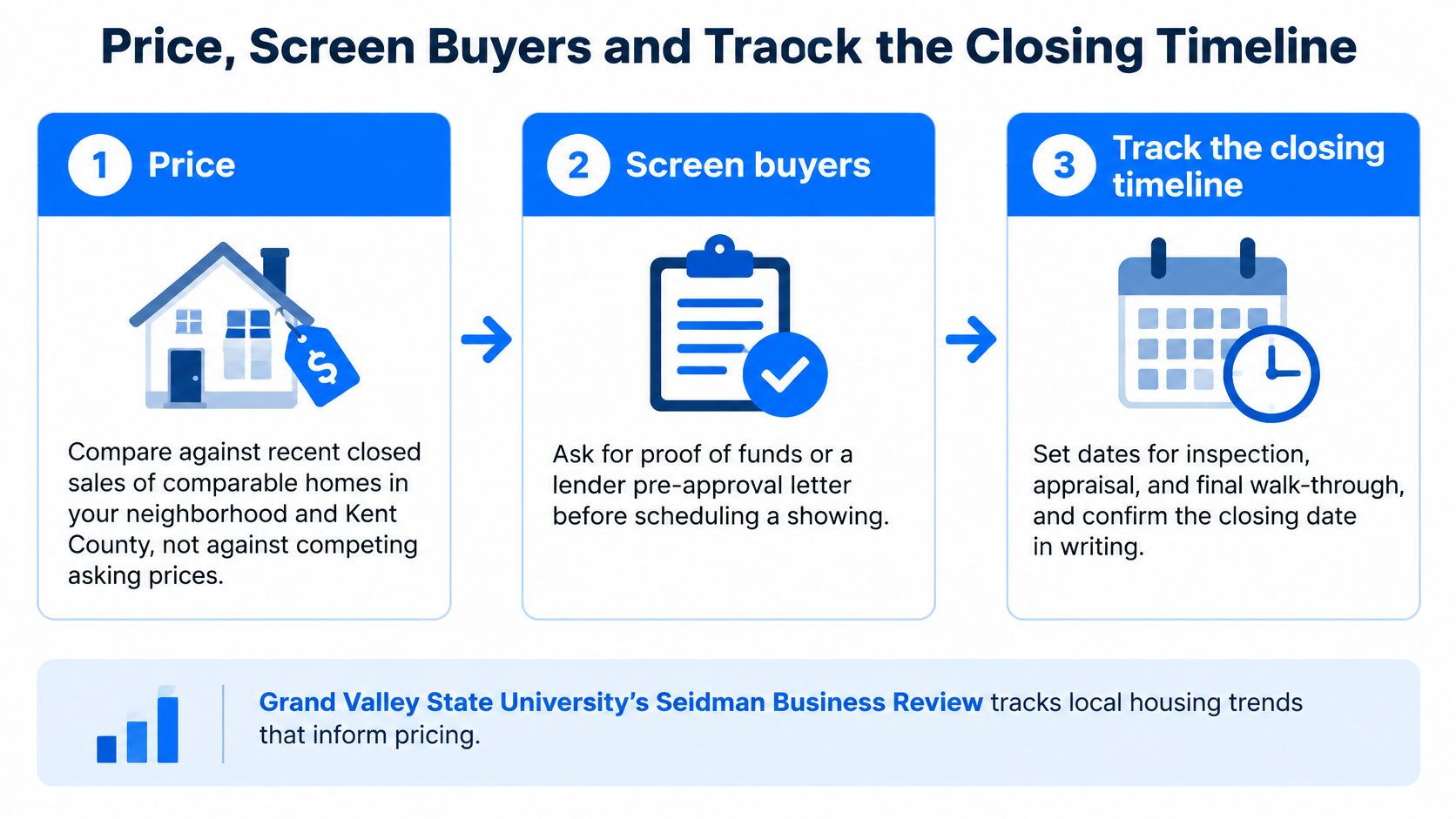
This process graphic highlights the work you retain even when you purchase limited assistance.
Routes that begin with an identified buyer
Selling to someone you know can reduce the need for advertising and buyer search. You still need defensible pricing, written terms, and clear arrangements for possession. A tenant's familiarity with the home does not replace documenting its condition.
Selling as-is to a cash buyer trades broad market exposure for less preparation and fewer financing-related complications. It may fit an inherited, vacant, or repair-heavy home when the seller values certainty and flexibility over pursuing the highest possible price.
Cyber Homes reviews the property and local sales, then usually presents a no-obligation cash offer within 24 hours. Sellers provide property details, receive an offer, and choose their closing date. The sale includes one quick walkthrough rather than open houses, and Cyber Homes covers closing costs. Compare the written terms, including inspection and termination provisions, before deciding.
For a private sale, review the steps involved in selling a home without an agent. For an inherited property, assemble records showing who has authority to sell, who owns the property, its probate status, and any outstanding liens before marketing it.
Your Real Net After By-Owner Costs
A by-owner sale's financial benefit is the commission avoided, minus added selling expenses and any difference in sale price or carrying time. The advertised commission amount alone does not show the seller's net.
For a hypothetical comparison, a $305,000 sale with an alternative agent proposal totaling 5% would mean $15,250 in commission. That figure is an illustration, not a local commission standard or a valuation.
The Redfin Grand Rapids housing-market page is useful for checking market conditions, so pull a dated snapshot before deciding whether buyers or sellers currently have the stronger negotiating position.
Net proceeds worksheet for a by-owner sale
| Line item | Who usually pays | What to confirm |
|---|---|---|
| Gross sale price | Buyer supplies purchase funds | Recent closed comparables for your home |
| Agent commission avoided | Seller retains the avoided expense | Actual alternative listing proposal |
| Professional photos and staging | Seller commissioning the work | Local provider's written quote |
| Flat-fee MLS listing | Seller purchasing the package | Included services and separate buyer-agent obligations |
| Attorney or title fees | Parties designated by engagement and contract | Itemized title and legal quotes |
| Transfer tax | Allocation must be confirmed | Applicable tax treatment and contractual allocation |
| Deed recording fee | Allocation must be confirmed | Kent County Register of Deeds charges |
| Buyer-agent compensation | Negotiated | Written amount and payment obligation |
| Seller concessions and repair credits | Seller when agreed | Purchase-agreement terms |
| Net proceeds before payoff | Seller receives remaining proceeds | Mortgage payoff, unpaid taxes, and moving expenses |
Commission avoided is a comparison item, not money added to the sale price. Use separate worksheets for an agent sale, FSBO, and cash offer, subtracting mortgage payoff and comparable expenses consistently. Include utilities, insurance, and other carrying costs through the expected closing date.
Before committing to major kitchen work, the Jennifer Gilmer Kitchen & Bath rebuild comparison can help frame the scope decision. It does not establish a Grand Rapids resale return. Compare local repair quotes and likely added proceeds with the full project cost.
A higher contract price can produce a lower net if repairs, credits, and extra time owning the property consume the difference.
Buyer's Agent Pay After the 2024 NAR Settlement
Buyer-agent compensation is negotiable, but it can't be displayed on the MLS. The practice changes took effect August 17, 2024, according to the NAR settlement FAQ.
For a Grand Rapids owner, the main options are:
- Agree to an off-MLS payment. You may negotiate compensation for the buyer's representative and document the terms. The buyer's agreement with their agent does not, by itself, require you to pay.
- Consider a buyer concession. MLS advertising may include closing-cost assistance, as long as it isn't conditioned on paying or using a buyer broker. Ask your listing-service provider how it records concessions.
- Check the touring agreement. An MLS participant working with a buyer must have a written agreement before touring with that buyer. Compensation must be stated as an amount or an objectively ascertainable method.
- Set an approval policy. Decide what you may pay, who can approve it, and where any final obligation must appear in the transaction documents.
Compare the whole offer
A represented buyer may request seller-paid compensation. An unrepresented buyer may ask for closing-cost assistance or a lower price. Compare each offer's net to you; neither arrangement automatically produces the better result.
Then assess financing, inspection rights, appraisal terms, and possession. Count each seller-paid amount once, not under both compensation and concessions.
A buyer's representative works on the buyer's side of the transaction. For example, Destin Buyer's Agent identifies a buyer-side professional in Florida, but does not establish Michigan compensation rules or Grand Rapids closing practices. Verify any local representative's credentials independently.
Before the first showing, give your flat-fee listing provider a written compensation policy that follows its procedures. When an offer arrives, ask your reviewer to reconcile the purchase agreement, compensation paperwork, and estimated settlement statement.
Michigan Paperwork and Closing Rules to Confirm
Michigan's residential disclosure duties and local property requirements can affect both a buyer's right to proceed and the closing timeline. Confirm which rules apply to the property before setting a firm closing date.
The Michigan Seller Disclosure Act covers certain residential transfers involving one to four dwelling units. Failure to provide a signed disclosure can give a purchaser termination rights, as described in the Michigan Seller Disclosure Act provision. Answer the form's questions accurately, and ask an attorney whether an exemption applies to your transfer.
Local governments may require additional disclosures or a different form under Michigan's statute on local disclosure requirements. A Grand Rapids mailing address does not establish whether the City of Grand Rapids or another municipality governs the property.
Michigan and local requirements to confirm before listing
| Requirement | When it applies | Confirm with |
|---|---|---|
| Michigan seller disclosure statement | Covered residential transfers under the state act | Michigan real-estate attorney or title company |
| Federal lead-based paint disclosure | Older housing subject to federal disclosure requirements | Title company or closing attorney |
| City or township disclosure form | When the property's municipality requires one | City of Grand Rapids or relevant township |
| Point-of-sale inspection or certificate | Applicability not established for this property | City or township building department |
| Title insurance payer | As allocated in the transaction documents | Title company |
| Transfer tax payer | Applicable law and agreed allocation must be checked | Title company and county treasurer |
| Deed recording fee | When the deed is submitted for recording | Kent County Register of Deeds |
For a home built before 1978, ask the closing professional to verify federal lead-paint disclosure requirements, required materials, and any applicable exception. A general condition disclosure does not replace federal paperwork.
The available local information does not establish whether attorneys usually conduct Grand Rapids closings, who customarily pays each title charge, or whether a particular property needs a point-of-sale certificate. Get written answers from the relevant professionals rather than assuming local customs.
Build the property file
- Identify jurisdiction. Confirm the municipality using property and tax records.
- Collect evidence. Gather permits, warranties, repair invoices, leases, and prior reports.
- Separate knowledge from assumption. Describe known issues accurately without guessing about concealed conditions.
- Preserve communications. Keep signed disclosures, delivery records, offers, and amendments together.
For estate vehicles, legal options for selling a car without title paperwork address a separate ownership issue. Vehicle-title guidance does not replace real-estate title advice.
Take the checklist to your title company before advertising a firm closing date.
Price, Screen Buyers and Track the Closing Timeline
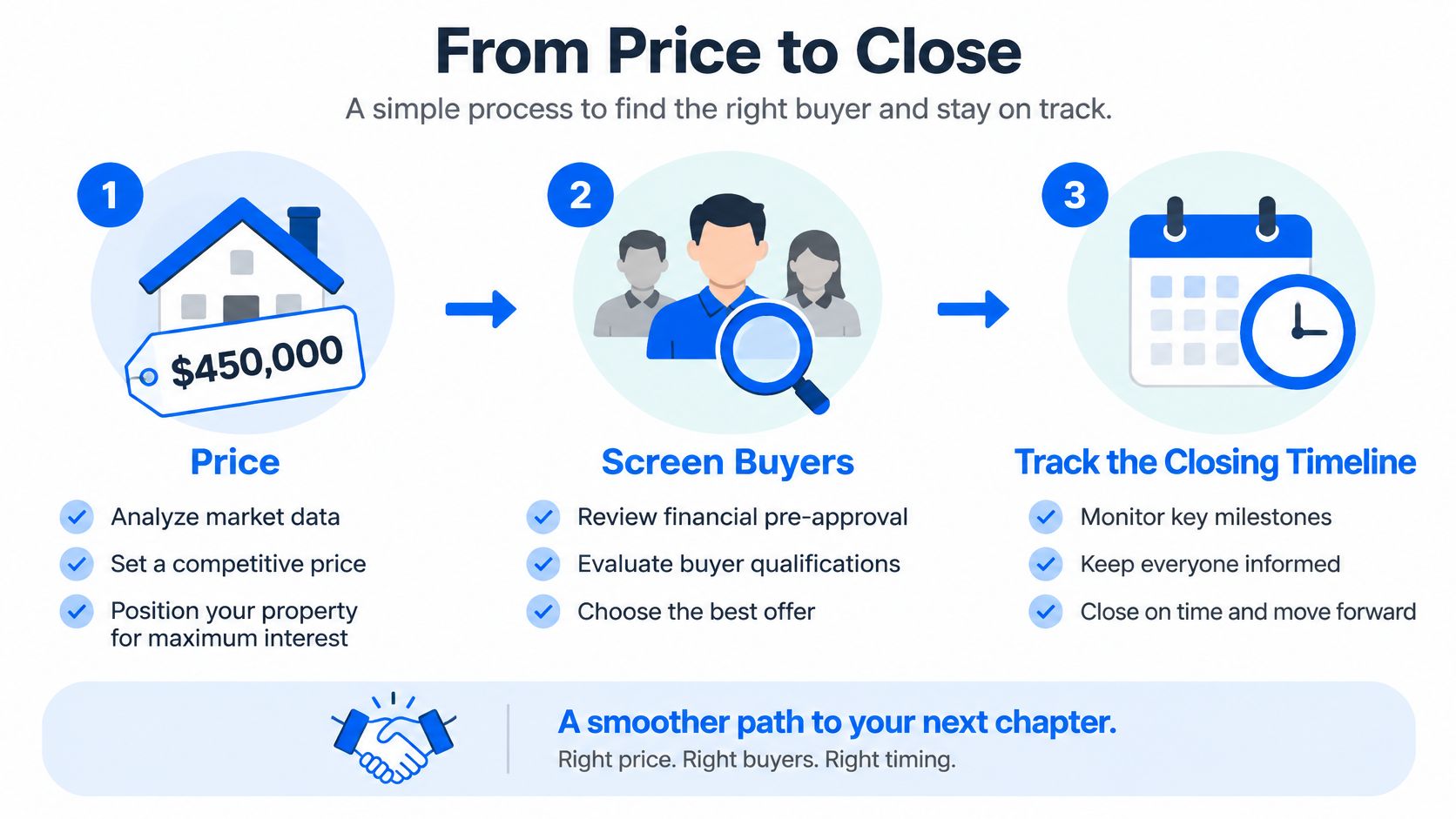
Recent closed sales provide a stronger pricing reference than competing listings. The Grand Valley State University Seidman Business Review's report on the 2025 Grand Rapids housing market found prices in Grand Rapids, East Grand Rapids, and Grand Rapids Charter Township rose 6% in 2025, following 7% in 2024. Those area-wide changes don't establish the value of a specific home. Compare properties with similar location, size, age, condition, and improvements.
Before accepting an offer
- Build a comparable-sales file. Record recent closed sales and why each is relevant to your home.
- Review differences. Account for deferred maintenance, renovations, lot size, and usable space. If qualified buyers aren't requesting tours, set a date to reassess the price.
- Check the buyer's ability to close. For a financed purchase, request lender pre-approval. For a cash purchase, request proof of funds that matches the purchasing party. Pre-approval is not final underwriting approval.
- Read the contingencies. Identify inspection, financing, appraisal, and home-sale conditions. Ask the lender how FHA or VA appraisal and property-condition requirements could affect repairs.
- Protect earnest money. Use the title or escrow holder named in the contract, not a personal account.
- Put the terms in writing. Document the price, included items, possession, repair promises, and deadlines in signed documents.
For showings, verify visitors, secure medications and valuables, and have another adult present. For direct offers, review this guide to recognizing house-buying scams, especially before responding to pressure or unusual payment requests.
From acceptance to possession
- Acceptance and deposit: Calendar earnest-money delivery and each contingency deadline.
- Title search and payoff: Start early so liens, ownership questions, or estate documents can be addressed before closing.
- Inspection and repairs: Record agreed work, completion evidence, credits, and amendments.
- Appraisal and financing: Track lender conditions; silence does not confirm approval.
- Walkthrough and closing: Confirm funds, signing arrangements, possession, and key delivery with the settlement professional.
Verify wire instructions by calling a trusted number you already have, not one provided in a last-minute email. Ask the title company for a transaction-specific schedule.
The accompanying video offers another format for reviewing the selling process.
Frequently Asked Questions About Selling Without an Agent
Do I need a license to sell my own home?
Generally, an owner selling their own property isn't acting as a broker for someone else. Confirm your circumstances with the Michigan Department of Licensing and Regulatory Affairs and the Michigan Board of Real Estate Brokers and Salespersons, particularly if an entity or another owner is involved.
Do I need a lawyer?
Don't confuse settlement administration with legal representation. A title company can handle its contracted closing functions, while an attorney can advise you about unusual contingencies, disclosure disputes, or estate authority.
How long does closing take?
Ask your settlement professional to build a schedule around the actual contract. Financing conditions, title defects, appraisal issues, and repair disputes can change the date.
What if I still have a mortgage?
Request a formal payoff statement from your lender. The settlement agent needs the payoff amount and instructions, not just the balance shown on your monthly statement.
How do I stay safe during showings?
Use appointments, verify visitors, and keep an attendance record. Don't allow an unidentified visitor to pressure you into an unscheduled tour or immediate signature.
What happens if the appraisal is low?
The contract determines the parties' rights. Possible outcomes include a price adjustment, additional buyer cash, a negotiated compromise, or termination under an applicable contingency.
What if I inherited the home?
Establish who has authority to sign before marketing it as ready to close. Ask the estate attorney and title company to identify probate documents, ownership interests, liens, and any unresolved estate requirements; don't assume every heir can independently authorize a sale.
Should You Sell by Owner or Take a Cash Offer?
FSBO is strongest when you can manage the work and afford the uncertainty. A financeable, presentable house with flexible timing may benefit from broad exposure. An agent can be the better fit when you want that exposure but can't reliably manage pricing, buyer contact, negotiations, and deadlines yourself.
A direct cash sale deserves closer consideration when repairs, vacancy, relocation, or estate administration make continued ownership expensive. It isn't automatically the better financial result, and cash alone doesn't remove title or contractual risk.
Make the decision with written inputs
- Your deadline. Identify the latest workable closing and possession dates, including what happens if the buyer misses them.
- The property's condition. Separate cosmetic preferences from repairs that could interfere with financing or occupancy.
- Your capacity. Be realistic about showing availability, buyer communication, and document management.
- Your financial comparison. Gather estimated net proceeds, monthly carrying expenses, and written repair estimates.
Our Grand Rapids as-is cash-sale guide explains how to evaluate that alternative without assuming you must renovate first.
Choose the strongest net you can realistically close on time, not the largest headline offer.
Leave yourself a decision margin. If the open-market advantage is small and depends on optimistic repairs, no concessions, and a flawless closing, it may not compensate you for the extra exposure. If the advantage remains substantial after conservative deductions, professional marketing support or a well-managed FSBO may be worth the effort.
Cyber Homes offers a no-obligation cash offer for your Grand Rapids home so you can compare it with your estimated by-owner net. Requesting an offer takes less than a minute, your information stays private, and you decide on your own timeline. Visit Cyber Homes with your property details, then compare the written offer, costs, and closing terms before choosing.

Edited by
James Vasquez
Real Estate Investor & Land Specialist with 10+ years experience in residential flipping, vacant land investing, land wholesaling, and subdivision deals.
Disclaimer: The information provided is for educational purposes and does not constitute financial or legal advice. Always consult with licensed professionals before making investment decisions.